
Key Takeaways
- AlliAI pushes approved on-page edits to live sites via a lightweight script, removing developer handoffs for high-volume local and mid-market accounts.
- Semrush with AI Copilot prioritizes issues and drafts briefs against a large SERP dataset, working as a diagnostic and prioritization layer rather than an execution tool.
- Ahrefs pairs entity-based content scoring with segmented rank tracking, giving agencies an auditable analytical backbone that traces every recommendation back to source data.
- Clearscope grades drafts against term frequency and entity distribution of ranking pages, standardizing on-topic definitions and reducing editor-writer cycles across clients.
- MarketMuse models topic authority and generates briefs with subtopics and internal link targets, giving strategists leverage at the content planning layer.
- Surfer SEO combines content scoring, AI drafting, and light on-page audits in one tool, appealing to agencies avoiding enterprise platforms.
- BrightEdge routes recommendations through enterprise CMS approval workflows and applies ML to a large proprietary SERP index, often pre-installed on the client side.
- seoClarity emphasizes data warehousing, custom reporting, and compliance-ready audit trails, making it suited for financial, insurance, and healthcare enterprise engagements.
- Vectoron routes each on-page, content, and internal linking change through per-decision approval, directly addressing position-bias drift risk 1for YMYL portfolios.
Why ranking software split into two categories
The category of search engine ranking software has quietly bifurcated. On one side sit passive monitors: rank trackers, SERP scrapers, and dashboards that report position changes after the fact. On the other side sit active systems that use learning-to-rank principles to decide what an SEO team should change next, and in some cases execute those changes under human approval.
The split matters because modern ranking is driven by learning-to-rank models that score candidate documents against a query using dozens of signals, then refine those models with click feedback corrected for position bias 1, 5. Software that only tracks positions measures the output of a system it does not model. Software that ingests SERP features, entity coverage, internal link graphs, and behavioral signals can at least approximate what the ranker rewards 10.
For an agency Head of SEO managing 20 to 150 client accounts, the practical question is not which tool has the prettiest keyword report. It is which tools reduce specialist hours per account without surrendering strategic control. The nine profiled below are graded on exactly that axis.
What 'AI-driven' actually means under the hood
The phrase "AI-driven" is often applied loosely. In serious ranking software, it refers to a specific machine learning task: learning-to-rank, where a model scores candidate documents against a query using a feature vector, then orders them by predicted relevance 5, 6. These features are concrete, including term frequency, BM25 on query terms, link-based scores, freshness, click-through history, and entity signals 5.
Modern search engines close the loop with click feedback. Users click, the ranker learns, and the model updates. However, clicks are biased toward higher positions regardless of relevance. Raw click logs can teach the model the wrong lesson unless the training procedure corrects for position bias. The WSDM 2023 model-based unbiased learning-to-rank framework addresses this by jointly learning a relevance model and a bias model from the same click data 1. Tools that consume SERP behavioral data without acknowledging this trade-off produce recommendations skewed toward positions that already rank highly.
Reverse-engineering work suggests that the shape of these rankers is tractable: linear learning models with recursive partitioning can predict Google and Bing rankings with meaningful accuracy 10. This is what serious AI ranking software does. Anything that only pulls positions from a scraper and wraps a large language model around the output is essentially a keyword tracker with a chatbot attached.
The two-axis model: automation depth vs. oversight granularity
Feature grids often flatten what agency leaders truly need to compare. A more useful framework plots each tool on two axes.
The x-axis represents automation depth: how much of the ranking workflow the software handles without specialist intervention. On the low end are passive rank trackers. In the middle are tools that generate briefs, on-page recommendations, and internal linking suggestions. On the high end are systems that execute approved changes to live sites and integrate feedback into the ranking model's feature set 5, 6.
The y-axis is oversight granularity: how inspectable and reversible the tool's actions are. This ranges from black-box scoring to approval-first workflows with per-change sign-off. This axis is crucial because unbiased learning-to-rank research shows that click-feedback loops can silently reinforce existing high rankings unless position bias is corrected 1. An agency using a tool that ships changes without review inherits this drift risk at the delivery layer.
The nine tools below are plotted against both axes before their profiles begin. Automation without oversight is a liability on YMYL accounts, while oversight without automation creates a headcount problem.
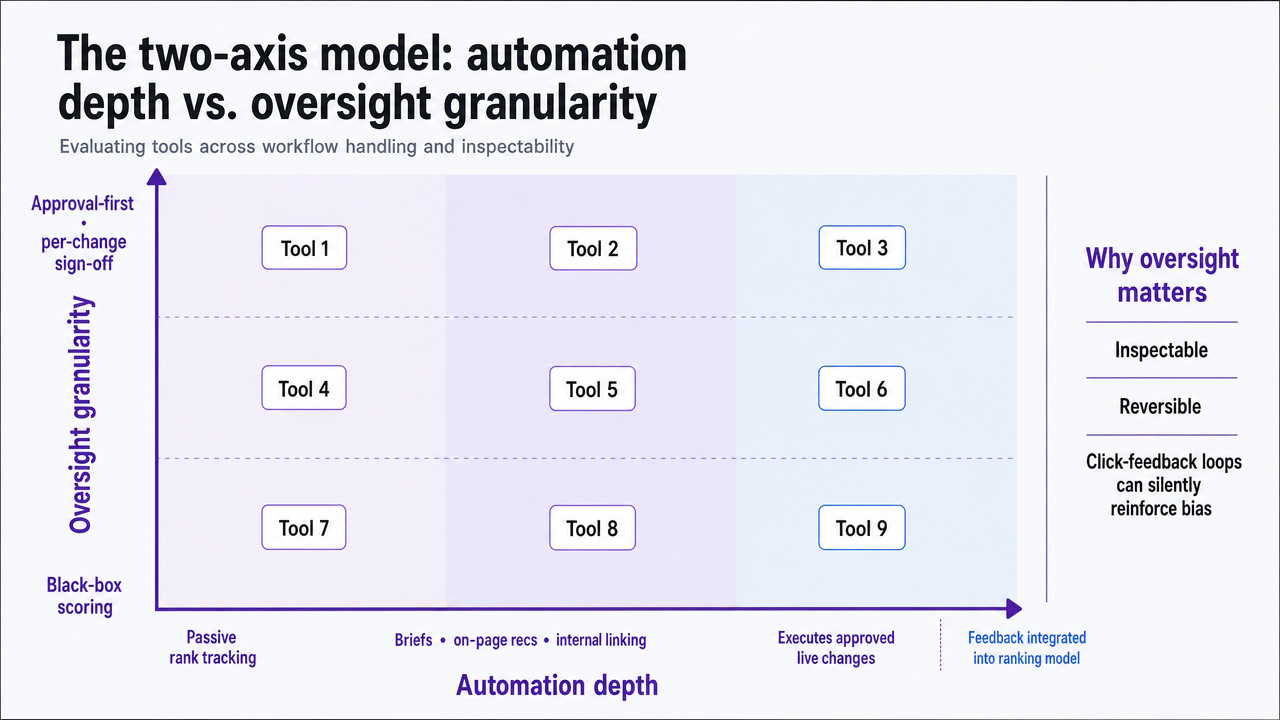 Visualize the two-axis framework the section explicitly describes for evaluating the nine tools, plotting automation depth against oversight granularity
The nine tools
AlliAI
AlliAI focuses on the execution side of automation. It reads a site's existing pages, generates on-page recommendations (title tags, meta descriptions, header structure, schema, internal link anchors), and can push approved changes to the live site via a lightweight script without CMS access. For agency delivery, this eliminates the developer handoff that often delays technical SEO work.
The ranking logic behind its recommendations is closer to rule-based pattern matching than a trained learning-to-rank model, which can limit its effectiveness on ambiguous queries where entity signals and link graph features are more critical 5. Oversight granularity is moderate: changes queue for approval, but the approval unit is often the rule rather than individual page edits. Agencies managing high volumes of straightforward local and mid-market accounts benefit most from AlliAI.
Semrush with AI Copilot
Semrush has integrated an AI Copilot with its established keyword, backlink, and position-tracking dataset. The Copilot surfaces prioritized suggestions (e.g., pages losing rankings, keyword cannibalization, technical issues, content gaps) and drafts briefs. Automation depth remains in the middle band; the platform recommends, but a specialist still executes.
Semrush's ranking predictions model SERP features against its own crawl data, an approach that reverse-engineering research has shown can be tractable with linear models and recursive partitioning 10. Oversight is high because human approval is required for all changes, which also limits the per-account hour savings compared to tools that push edits directly. Agencies use it as a diagnostic and prioritization layer, fitting well into content production workflows.
Ahrefs AI Content Helper and Rank Tracker
Ahrefs prioritizes data quality over execution automation. Its AI Content Helper scores drafts against the entity and subtopic coverage of top-ranking pages for a target query, while the Rank Tracker segments position data across locations, devices, and SERP features. Both are diagnostic tools with AI features built upon a strong crawler and link index.
Ahrefs' strength for agencies lies in auditability; every recommendation traces back to specific data, which is valuable for client strategy reviews. Automation depth is low, and oversight is high. Ahrefs complements execution platforms because it doesn't attempt to be one. For agencies with robust in-house content and technical teams, it serves as an analytical backbone rather than a workflow engine.
Clearscope
Clearscope is designed for a narrow purpose: scoring content drafts. It evaluates drafts against the term frequency and entity distribution of top-ranking pages for a target query, providing a grade and a list of missing terms. This aligns closely with what a learning-to-rank feature vector considers on the content side: term frequency, BM25-style relevance, and entity signals 5.
Automation depth is limited to content grading. Oversight is complete, as writers decide what to include and manage their own review cycles. For agencies where content quality is the bottleneck, Clearscope reduces editor-writer back-and-forth and standardizes "on-topic" definitions across clients. It does not track rankings or push changes.
MarketMuse
MarketMuse extends beyond content grading into planning. It models topic authority across a site's existing content, identifies coverage gaps within a target subject cluster, and generates content briefs specifying subtopics, questions, and internal linking targets. While it uses its own topic modeling, its outputs map to the same feature categories a ranker weighs 6.
For agencies, MarketMuse provides leverage at the strategy layer, allowing a single strategist to produce a defensible content plan quickly. Oversight is high because the platform produces artifacts (briefs, cluster maps) rather than shipping changes. The trade-off is that MarketMuse assumes the agency has a production pipeline downstream; it is not a replacement for one.
Surfer SEO
Surfer SEO bridges Clearscope and MarketMuse in scope, adding a light on-page audit layer. Its content editor scores drafts on term coverage, structure, and length against ranking pages, and its audit tool flags on-page issues on published URLs. Recent updates include AI-assisted drafting, moving it slightly further up the automation axis than pure grading tools.
Its ranking recommendations rely on SERP-derived feature comparisons, consistent with research on how tractable linear models can approximate ranker behavior 10. Oversight remains at the writer or strategist level. Agencies seeking a single tool for content briefs, in-editor scoring, and on-page audits without an enterprise platform often standardize on Surfer SEO.
BrightEdge
BrightEdge is an enterprise incumbent. Its DataMind and Copilot layers generate recommendations across content, technical, and competitive dimensions. The platform integrates with content management systems to route changes through internal approval workflows. Automation depth is high in principle, though most enterprise deployments operate in an advisory capacity rather than direct execution.
Its ranking intelligence draws on a large proprietary index of SERP data and applies machine learning to relevance and personalization signals, aligning with how modern search engines treat ranking as an ML problem 7. Oversight is configurable and typically routed through the client's governance stack. For agencies serving enterprise accounts, BrightEdge is often already installed on the client side, shifting the agency's role to strategy overlay rather than tool operator.
seoClarity
seoClarity competes in the same enterprise segment as BrightEdge, with a stronger emphasis on data warehousing and custom reporting. Its Sia AI assistant identifies prioritized opportunities across a large keyword universe, and the platform's content and technical modules produce recommendations that route through the client's approval flow.
Automation depth is moderate; the platform recommends more than it executes. Oversight is high, and the audit trail is designed for teams requiring compliance or legal review. Agencies primarily use seoClarity on accounts where the client owns the SEO reporting layer and needs specialists to work within the client's tool of record. It is well-suited for financial services, insurance, and healthcare enterprise work.
Vectoron
Vectoron is built around approval-first execution rather than rank tracking. Its SEO strategist analyzes live business signals (qualified calls, bookings, cost per lead, pipeline) alongside SERP and site data, prioritizes changes, and routes each recommendation through a Command Center for human sign-off before executing content, on-page, internal linking, and publishing work. Five other specialist strategists (Content, PPC, Backlinks, Social, Call Intelligence) operate within the same approval loop.
This design directly addresses the position-bias problem in click-feedback loops: if a system executes changes without per-decision review, drift can compound silently 1. Vectoron's automation depth is high on the workflow axis, while oversight granularity remains at the individual recommendation level. The platform is priced at $599 per month after a two-week trial, positioning it below enterprise incumbents and above single-purpose grading tools.
Experience full-scale AI ranking workflow risk-free
Test real-time, AI-driven search ranking improvements on your own domains before making a commitment.
Workflow coverage: what each tool actually automates
Ranking workflows consist of six stages: keyword research, content brief, on-page edits, internal linking, publishing, and monitoring. Each stage maps to a subset of the feature vector a learning-to-rank model scores against, such as term frequency, BM25, entity coverage, or link-based signals 5. For agency delivery, the key is identifying which stages a tool automates versus which it merely reports on.
Across the nine tools, coverage clusters into three bands. Clearscope and MarketMuse focus on content brief and scoring. Semrush, Ahrefs, and Surfer cover keyword research, brief generation, and monitoring, with Surfer adding light on-page auditing. BrightEdge and seoClarity extend to recommendation routing for technical and content layers but typically stop short of executing changes on the live site. AlliAI and Vectoron are the two that touch publishing: AlliAI pushes on-page edits via a site script, and Vectoron routes content, on-page, and internal linking changes through per-decision approval before execution.
Monitoring is nearly universal, as position tracking is a commodity. Internal linking and publishing are where coverage thins out, and this is where specialist hours accumulate in a traditional agency stack.
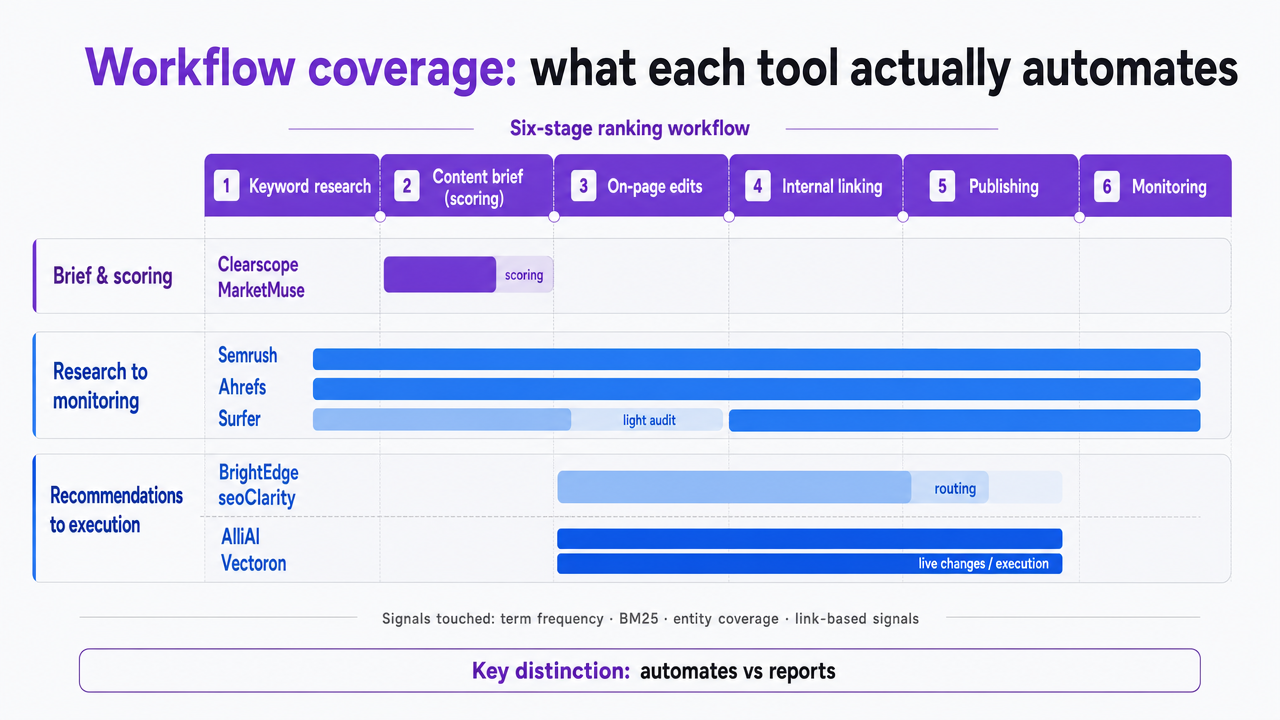 Visualize the six-stage ranking workflow described in the section and show which tool categories cover which stages, directly supporting the section's cited comparison
Personalization and position bias: why 'rank' is a moving target
The word "rank" implies a single number, but in production search, it's a distribution. Personalization research, based on anonymized log studies, precisely defines this effect: showing the same documents for a query in different orders based on what each user is most likely to consume 8. Machine learning models leveraging user profiles and behavior can significantly alter ranking order compared with non-personalized baselines 9. For queries like "family dentist near me," two users in the same ZIP code might see different orderings based on prior clicks, device, and session context.
Position bias exacerbates this problem for tools. Click data trains ranker updates, but users tend to click higher positions regardless of true relevance. Systems that ingest raw click logs without correction reinforce whatever already ranks well 1. AI ranking software that identifies "opportunities" based on uncorrected SERP behavior often recommends defending current winners rather than displacing them.
For agency reporting, a single tracked position per keyword is a point estimate of an unseen distribution. Tools that segment by location, device, and SERP feature (Ahrefs, Semrush, seoClarity) provide a broader view. Tools that report one number per keyword obscure this complexity. When a client questions organic traffic changes without a position shift, the answer often lies in the segments the default report collapsed.
High-stakes verticals: where approval-first matters most
Ranking recommendations have different consequences for a family dental site compared to a memory care intake page. Healthcare SEO research highlights both the visibility upside and the risk: ranking algorithms influence which sources patients see first, and non-authoritative pages can outrank evidence-based resources if optimization outpaces editorial review 3. A systematic review of healthcare SEO strategies emphasizes compliant content and accurate information exposure as preconditions for responsible search visibility 2.
AI in healthcare marketing expands this surface area. Personalization, predictive targeting, and automated content generation increase both patient acquisition potential and regulatory exposure 4. For agencies managing behavioral health, senior living, dental, or legal accounts, the oversight axis becomes critical. Tools that ship changes without per-decision review shift liability towards the agency and away from the client's compliance layer. Approval-first workflows ensure the specialist, the client's legal reviewer, and the audit trail are all in the loop, which is the minimum operating condition for YMYL work.
Evaluate AI-Driven Ranking Platforms for Scalable, Multi-Client SEO Execution
Connect with our team to benchmark the latest AI-powered search engine ranking tools and explore workflow solutions designed for agency-scale, multi-channel SEO management.
If you manage multi-location or franchise portfolios
For agencies managing multi-location dental groups, senior living portfolios, home services franchises, or regional legal networks, the ranking problem multiplies. Each location competes in its own personalized SERP, where machine learning models re-rank results by user profile, prior clicks, and session context 9. A 40-location dental group is not one SEO account; it is 40 overlapping local rankers whose results reshuffle per user 8.
This complexity impacts tool selection. Rank tracking must segment by location, device, and SERP feature for reliable data, favoring Ahrefs, Semrush, and seoClarity for reporting. Execution needs to scale per-location content without creating 40 near-duplicate pages. This is where AlliAI's script-based edits and Vectoron's approval-routed content and internal linking runs reduce specialist hours. The operational rule is clear: a specialist supervising a portfolio needs a tool that batches recommendations across locations while keeping each approval discrete. Batched execution without per-location review can lead to duplicate-content and NAP-inconsistency problems across a franchise footprint.
Delivery economics: specialist hours, accounts per SEO, and where automation pays back
The unit economics of an agency SEO practice depend on three variables: fully loaded specialist cost, active accounts per specialist, and billable hours per account per month. Automation is beneficial only when it reduces hours from the middle variable without increasing quality or compliance risk.
The table below provides a variable framework. Agencies should plug in their own numbers.
| Variable | Traditional model | AI-augmented model ||---|---|---|| Fully loaded specialist cost / mo | S | S || Active accounts per specialist | A | A × multiplier (1.5–3×) || Hours per account per mo | H | H − automated hours || Tool cost per account / mo | T | T + platform fee |
The source of automated hours determines which tool category is most valuable. Rank tracking and reporting are commodity tasks; automating them saves reporting time but not delivery time. Hour recovery that increases accounts-per-specialist occurs in three areas: content brief production (Clearscope, MarketMuse, Surfer), on-page and internal linking execution (AlliAI, Vectoron), and prioritization across large keyword universes (Semrush, seoClarity, BrightEdge). Learning-to-rank models within search engines reward these feature categories—term coverage, entity signals, link structure—so automation in these areas aligns with what the ranker scores 5, 7.
Vectoron publishes a $599 per month rate after a two-week trial, providing a concrete data point for the tool-cost row. The multiplier on accounts-per-specialist depends on the vertical mix. Straightforward local rosters allow for greater scaling than YMYL portfolios, where approval review reclaims hours saved by automation.
How to choose without buying twice
Tool consolidation fails when agencies prioritize feature parity over workflow position. The nine tools profiled here occupy different slots on the automation-oversight matrix, and most stacks require two, not one. A diagnostic layer (Ahrefs, Semrush, or seoClarity) handles the auditable data spine. An execution layer (AlliAI or Vectoron) manages on-page and internal linking work that would otherwise consume specialist hours. A content grading layer (Clearscope, MarketMuse, or Surfer) enforces term coverage and entity signals that align with what learning-to-rank models score 5, 6.
Before signing a second contract, agencies should identify the specific workflow stage the tool removes from a specialist's calendar and the audit artifact it produces for client review. If neither answer is concrete, the tool is likely decorative. Vectoron's approval-first workflow was designed with this test in mind, which is why a two-week trial is offered at $599 per month rather than requiring an annual commitment.
Frequently Asked Questions
References
- 1.Model-based Unbiased Learning to Rank.
- 2.Search Engine Optimization Strategies for Healthcare Websites: A Systematic Review.
- 3.The Impact of Search Engines on Health Information Seeking Behavior.
- 4.Artificial Intelligence in Healthcare Marketing: A Scoping Review.
- 5.Learning to Rank.
- 6.A Short Introduction to Learning to Rank.
- 7.Search engine performance optimization: methods and techniques.
- 8.Personalized Web Search Ranking: CS229 Project Report.
- 9.Search Personalization Using Machine Learning.
- 10.Search Engines: A Comparative Study of Ranking Algorithms.