
Key Takeaways
- Tier fit is a utilization question first: budget trackers, mid-market suites, and enterprise platforms each break down at predictable client counts, and mismatched selection erodes delivery margin faster than any feature gap 8.
- Sub-$500/month trackers like SE Ranking, Mangools, Serpstat, and ProRankTracker fit rosters under 25 clients, with SE Ranking distinguished by daily refresh across organic and AI search under one subscription 2, 4.
- Mid-market suites earn their ramp cost between 20 and 60 clients, with Semrush anchoring broad mixed-vertical rosters, Nightwatch pulling ahead on local-heavy books, and AccuRanker or AWR layering in for reporting depth 3, 4.
- Enterprise platforms span roughly $25K to $500K+ annually, and only pencil out when the client holds the license or agency retainer clears the threshold where six-figure suites replace three or four narrower tools 5.
- Execution matters more than measurement: ranking data delivers profit only when tied to strategic implementation, so the stack is compressing toward layers that convert observed movement into shipped briefs, fixes, and outreach 9.
- Three variables — managed client count, vertical concentration, and who holds the license — predict tier fit more reliably than feature audits, and should anchor any 2026 platform decision 4, 5, 8.
Why tool tier now decides agency delivery margin
The rank tracking category has fractured. Budget agency trackers, mid-market all-in-one suites, and enterprise platforms no longer compete on the same feature axis, and the tier an agency selects has more impact on delivery margin than any individual keyword strategy inside it. A peer-reviewed analysis of SEO's business impact confirms what agency P&Ls already show: structured optimization translates directly into higher traffic and profitability, but only when investment is matched to strategic execution rather than tool deployment alone 9.
That qualifier matters. Agencies scaling past 40 client accounts hit a workflow ceiling where reporting, rank tracking, and technical audits collide, and the tools that solved the first ten clients start eroding specialist utilization 8. A senior SEO spending three hours a week reconciling white-label reports across two platforms is a margin problem, not a tooling preference.
What follows segments the market into three tiers with sourced cost ranges and agency-scaling scenarios, then examines where the stack is compressing as AI-coordinated execution layers begin consuming ranking signals rather than just displaying them. The framing is deliberate: fewer specialists per client, more decisions per hour of specialist time.
The three-tier split reshaping the rank tracking category
How budget, mid-market, and enterprise tiers actually differ
The category now separates cleanly along cost and scope lines, and the segmentation predicts specialist utilization more reliably than any feature list. Budget agency trackers — SE Ranking, Mangools, Serpstat — deliver core ranking, keyword research, and white-label reporting at roughly half the cost of comprehensive suites, which is why they dominate rosters under twenty clients 8. Mid-market all-in-one platforms like Semrush and Ahrefs cover the widest surface area, from backlink analysis to content audits to rank tracking, but demand significant investment in both licensing and specialist training time 8. Enterprise platforms — BrightEdge, Botify, Conductor, seoClarity, Moz Enterprise — operate in a different economic universe entirely, built for organizations where technical SEO, executive reporting, and multi-location workflows justify six-figure annual commitments.
The forty-client mark is where the tier decision stops being a preference and starts being a P&L question. Agencies scaling past that threshold consistently standardize on reporting and rank-tracking platforms that reduce manual workload and support white-label delivery at volume, because the manual reconciliation cost of budget tools compounds faster than the license savings 8. The trap is picking a tier by feature envy rather than delivery model. A twelve-client boutique running Semrush Enterprise burns margin on unused capability. A forty-five-client agency running Mangools burns margin on specialist hours spent stitching reports together. Tier fit is a utilization question first, feature question second.
The evaluation criteria that separate tiers in 2026
Four criteria now do most of the work when a head of SEO shortlists platforms across tiers. Data refresh cadence sits at the top: daily SERP refresh has moved from premium feature to baseline expectation for agencies tracking volatile verticals, with SE Ranking cited as the reference point for daily rankings across both organic and AI search under a single subscription 2. White-label reporting quality separates agency-viable tools from generalist ones, and comes standard in the six trackers most commonly deployed by agencies — SE Ranking, ProRankTracker, AccuRanker, Nightwatch, Advanced Web Ranking, and Mangools 4. Local geo-grid capability determines fit for multi-location verticals like legal, dental, and home services, where city-level tracking is insufficient.
The fourth criterion is newer and reshaping shortlists faster than the others: AI search visibility tracking. Coverage of AI-generated answer surfaces is projected to become a standard buying criterion for rank-tracking tools used by agencies and mid-market teams 2. Tools that treat AI search as a bolt-on rather than a first-class data stream will lose evaluations in 2026 regardless of how strong their traditional SERP coverage is. Tier selection increasingly comes down to which vendor treated these four dimensions as core rather than as a pricing upsell.
 SEO software adoption among agencies using multi-client reporting and white-label workflows (CAGR: 0.0%)
Source: Discover the Top 6 Agency Rank Tracking Tools for 2026
Budget agency trackers: the sub-$500/month tier
SE Ranking for daily refresh and AI search visibility
SE Ranking has become the reference point in this tier because it collapses two shortlists into one subscription. Independent testing of eleven rank trackers identifies it as the best overall pick for agencies and mid-market teams that want daily rankings across both organic SERPs and AI search surfaces under a single license 2. That combination matters more in 2026 than it did even a year earlier, because agencies fielding client questions about ChatGPT citations and AI Overviews can no longer answer them with a bolt-on subscription.
The operational fit sits squarely with agencies running twenty to forty client accounts where daily refresh is a client expectation but six-figure enterprise licensing is not defensible. White-label reporting comes standard, and the platform slots into the agency-focused shortlist alongside ProRankTracker, AccuRanker, Nightwatch, Advanced Web Ranking, and Mangools 4. The known ceiling is GPS-level local geo-grid work and the most volatile enterprise verticals, where specialized local trackers or enterprise platforms outperform 2. For a growth-stage agency where a senior SEO manages fifteen to twenty-five clients, the tool covers roughly ninety percent of delivery without forcing a mid-cycle platform migration when the client roster expands.
Mangools and Serpstat for lean client rosters
Mangools earns its place on lean rosters by pricing well below the mid-market suites while still delivering the core agency shortlist: keyword research, rank tracking, backlink checks, and white-label reporting 4. It appears repeatedly in agency stack roundups grouped with SE Ranking and Serpstat as the budget-conscious alternative that delivers solid features at roughly half the cost of Semrush or Ahrefs 8. For an agency running twelve to twenty clients, that cost differential funds an additional specialist hire before it becomes a licensing conversation.
Serpstat sits in a similar bracket with broader keyword database coverage and competitive analysis features that lean toward research-heavy engagements. Both tools break down when the client count crosses roughly twenty-five and reporting reconciliation starts eating specialist hours. The signal to migrate is not a feature gap but a workflow one: when a lead SEO spends more than two hours a week stitching client reports together, the license savings have inverted into a margin problem. Stay in this tier while manual reconciliation stays under that threshold.
ProRankTracker for bulk keyword coverage
ProRankTracker occupies a narrower slot: bulk keyword tracking at volume, without the surrounding suite. It appears on the agency-focused six alongside SE Ranking, AccuRanker, Nightwatch, Advanced Web Ranking, and Mangools, and earns its position by supporting large keyword universes with white-label reporting at a lower cost than the all-in-one platforms 4. Agency stack analysis reinforces the same positioning, grouping it with specialized rank trackers preferred by teams that already have keyword research and backlink tools handled elsewhere 8.
The fit pattern is specific. A local-SEO shop tracking three hundred keywords per client across forty locations does not need the content and technical modules bundled into Semrush; it needs deep keyword capacity and clean client-facing reports. ProRankTracker delivers that without forcing the agency to pay for capability its specialists never open. The trade-off is a multi-tool workflow, which only pencils out when a dedicated ops person owns the report assembly.
Test Real-Time Ranking Insights on Live Campaigns
Evaluate search ranking improvements using actual client data in a live, production environment for one week.
Mid-market all-in-one suites: where most 20 to 60 client agencies land
Semrush for comprehensive coverage with a learning curve
Semrush sits at the default center of the mid-market shortlist because it covers the widest surface area of any single platform: rank tracking, keyword research, backlink analysis, site audits, and content optimization under one license 8. For an agency running twenty-five to sixty clients across mixed verticals, that consolidation eliminates the multi-tool reconciliation problem that erodes margin in the budget tier. One login, one billing line, one training curve per specialist.
The learning curve is real and shows up in ramp time. Independent agency-scenario mapping places Semrush alongside Nightwatch as a top pick for agencies, but flags the cost and onboarding investment as the primary trade-off against narrower specialist tools 3. A new senior SEO typically needs four to six weeks before Semrush utilization matches what a two-week Mangools onboarding delivers. That cost is worth paying when the specialist will use projects, position tracking, and content templates across ten or more accounts. It is not worth paying for a boutique running eight clients on a single vertical, where a leaner tracker plus a dedicated backlink tool covers the same ground at lower total cost.
AccuRanker and Advanced Web Ranking for data-heavy delivery
AccuRanker and Advanced Web Ranking share a positioning that matters for delivery-heavy agencies: fast update cadence and deep analytics built for teams that treat ranking data as a working input, not a monthly deliverable 4. Both platforms appear on the six-tool agency shortlist alongside SE Ranking, ProRankTracker, Nightwatch, and Mangools, and both differentiate on the same axis — refresh speed and analytical depth over suite breadth.
The capability split across that six-tool shortlist is where head-to-head evaluation gets useful. SE Ranking and AccuRanker anchor the daily refresh column 2, 4. White-label reporting is standard across all six agency-focused trackers, which is why they qualify for the shortlist in the first place 4. Local geo-grid capability separates Nightwatch and specialized local tools from the generalists. AI search visibility remains the newest column and the one where SE Ranking has taken an early lead by integrating organic and AI search under one subscription 2.
Advanced Web Ranking earns its slot with enterprise-oriented analytics — historical trend depth, forecasting, and segmentation that hold up when a client has fifteen thousand tracked keywords. AccuRanker leans into speed and clean API access for agencies feeding rank data into custom dashboards or client portals. The choice between them tends to follow reporting sophistication: AWR for agencies producing analyst-grade quarterly reviews, AccuRanker for agencies whose specialists check rankings daily and act on them the same afternoon.
Nightwatch for agencies weighting local geo-grid work
Nightwatch earns its place on the mid-market shortlist by leaning hard into geo-precision. Agency-scenario mapping pairs it with Semrush as the top two picks for agencies, with Nightwatch specifically called out when local SEO carries significant delivery weight 3. It also holds a spot on the six-tool agency shortlist alongside SE Ranking, ProRankTracker, AccuRanker, Advanced Web Ranking, and Mangools, differentiating on granular location tracking and white-label reporting rather than suite breadth 4.
The fit pattern maps cleanly to multi-location service verticals — legal firms with regional offices, dental groups, home services franchises — where city-level tracking hides the block-by-block variance that determines whether a client's phones ring. An agency running thirty clients where two-thirds carry meaningful local components will get more delivery leverage from Nightwatch than from a generalist suite priced at similar levels. For predominantly national or e-commerce rosters, that geo-precision goes underused and the cost per specialist hour tilts back toward Semrush or AccuRanker.
Enterprise SEO platforms: six-figure suites for large client accounts
Annual cost ranges across the five enterprise leaders
Enterprise SEO pricing is where the tier comparison stops being academic. Published 2026 annual ranges across the five leaders span nearly two orders of magnitude:
- BrightEdge runs $150,000 to $500,000+
- Botify $100,000 to $400,000
- seoClarity $100,000 to $300,000
- Conductor $75,000 to $250,000
- Moz Enterprise $25,000 to $100,000 5
The spread inside a single vendor — Botify alone varies by $300,000 depending on deployment scale — signals that these are negotiated contracts, not shelf pricing, and that seat count, crawl volume, and content module inclusion swing the final number more than the vendor label does.
For an agency, the math flips depending on who signs the contract. When the client licenses the platform directly and the agency operates inside it, six-figure suites become viable at any client-list size because the cost sits on the client's ledger. When the agency licenses the platform and allocates it across accounts, the entry point starts making sense somewhere north of $2 million in managed retainer, where a $100,000 Moz Enterprise or Conductor deployment carves out under 5% of revenue and replaces three or four narrower tools plus the specialist hours spent gluing them together.
Below that revenue floor, enterprise platforms overshoot the delivery model. Mid-market suites paired with a specialized rank tracker cover the same functional ground at a fraction of the cost, and the capability gap only becomes a margin problem when clients start demanding executive dashboards and technical audits at a scale that breaks the mid-market stack.
Differentiation: Botify technical, BrightEdge recommendations, Yext multi-location
The five enterprise leaders sit close on price and diverge sharply on emphasis, and the emphasis is what determines fit. Botify concentrates on technical audits, weblog data, website analysis, and reporting — the deepest crawl and log-file intelligence in the category, built for sites where JavaScript rendering, crawl budget, and indexation coverage are the primary levers on organic performance 6. BrightEdge takes the opposite tack, differentiating on detailed content recommendations and keyword translation, which pushes it toward marketing-led organizations where the content team consumes SEO output daily rather than quarterly 6.
Semrush Enterprise leans into customization and advanced automation, which is why it appears on enterprise shortlists alongside seoClarity, BrightEdge, Conductor, and Botify despite its mid-market roots 7. Yext occupies a distinct slot in the same shortlist as the platform built specifically for multi-location organizations, handling listings, structured data, and location-level visibility that the pure SEO suites treat as adjacent rather than core 7.
The practical read: technical-heavy e-commerce or publisher clients push toward Botify, content-heavy B2B toward BrightEdge or Conductor, and multi-location service brands toward Yext layered under whichever content platform the client's team already uses. Picking the wrong axis wastes the majority of a six-figure license.
If you manage multiple locations: how enterprise stacks handle branch-level tracking
For agencies whose rosters lean into multi-location service verticals — legal firms with regional offices, dental groups, home services franchises, senior living portfolios — the enterprise tier evaluation narrows to a specific question: does the platform treat locations as first-class entities or as filters on top of a national dataset. Enterprise rank trackers built for scaled organizations monitor keyword positions over time across locations and devices so teams can measure SEO progress and detect regressions at branch level, which is the baseline capability multi-location clients now expect 1.
Yext is the clearest example of location-native architecture, positioned specifically for multi-location organizations across the enterprise SEO shortlist 7. It handles the listings, structured data, and location-page visibility layer that generalist enterprise suites either bolt on or hand off. Pairing Yext with a content-focused enterprise platform like Conductor or BrightEdge covers both the local-visibility and organic-content axes without asking one tool to be great at both.
The operational takeaway for a portfolio of forty or more locations across three or more clients: budget for the location-native tool separately from the content and technical suite. Consolidating both into a single vendor almost always sacrifices depth on one side to save on the other.
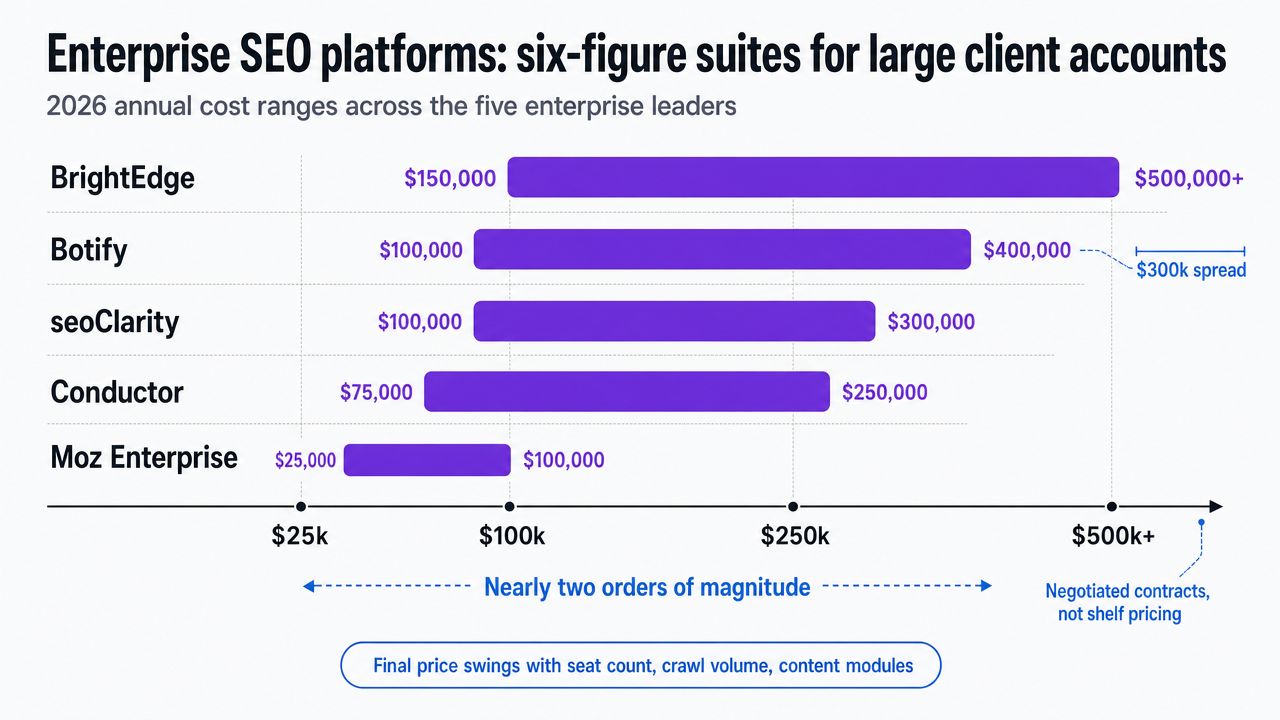 Chart the cited 2026 annual cost ranges across the five enterprise SEO leaders to make the price spread and vendor-by-vendor variance concrete, supporting the section's argument about when enterprise licensing pencils out
See How Advanced Ranking Tools Streamline Agency SEO at Scale
Request a walkthrough of unified search engine ranking platforms built for agencies managing multiple clients—compare workflow automation, reporting depth, and approval controls tailored for enterprise-scale delivery.
From measurement to execution: where the stack is compressing
Why ranking data has to feed decisions, not sit in a report
The category assumption worth challenging: rank tracking is a measurement problem. It is not, at least not anymore. Enterprise rank tracking exists to help teams measure SEO progress, detect regressions, and act on movement across locations and devices — the operative word being act 1. When a keyword drops six positions on Tuesday, the value of the tracker is the decision it triggers on Wednesday, not the chart it produces on Friday.
The peer-reviewed evidence backs this operationally. SEO investments translate into higher traffic and profitability specifically when tied to strategic implementation rather than tool deployment alone 9. A senior SEO watching a dashboard is not delivering the outcome the license was purchased to produce. The outcome comes from the content brief, the technical fix, or the internal link change that follows the observation.
The stack is compressing along that seam. Agencies scaling past forty clients cannot rely on manual translation between ranking data and execution decisions because specialist hours run out before the backlog does 8. What replaces manual translation is the interesting question for 2026.
Vectoron as an approval-first execution layer above the rank tracker
Vectoron sits in a different category than the tools above. It is not a rank tracker and does not compete with SE Ranking, Semrush, or BrightEdge on refresh cadence or SERP coverage. It consumes ranking signals from whatever platform an agency already licenses and coordinates the work those platforms only measure — content briefs, technical fixes, backlink outreach, and social distribution — through specialist AI strategists whose recommendations route to a human approver before anything ships.
The fit pattern is specific to agencies whose margin problem is not tracker selection but the specialist hours spent turning ranking movement into execution. For a forty-client roster where the senior SEO already has a working tracker, an approval-first execution layer converts observed data into shipped work without adding headcount. Rank tracking stays where it is. What changes is what happens after the report loads.
A decision framework by client count and vertical mix
Three variables predict tier fit better than any feature audit: managed client count, vertical concentration, and who holds the platform license. Under twenty clients on a single vertical with minimal local exposure, a budget tracker like SE Ranking or Mangools covers delivery without margin leakage, and the license savings fund the next specialist hire before they fund a Semrush seat 4, 8.
Twenty to sixty clients across mixed verticals is where mid-market all-in-one platforms earn their ramp cost. Semrush and Nightwatch anchor that decision, with Nightwatch pulling ahead when more than half the roster carries meaningful local weight and Semrush winning on broader mixes 3. AccuRanker or Advanced Web Ranking slot in as specialized layers when reporting sophistication outpaces what the generalist suite delivers 4.
Enterprise platforms only pencil out when the client licenses them directly or the agency's managed retainer clears the threshold where six-figure suites replace three or four narrower tools plus the specialist hours spent stitching them together 5. Beyond that, the compounding constraint is not tracker selection but the specialist time between observing rank movement and shipping the fix.
Frequently Asked Questions
References
- 1.Top 10 Best Enterprise Rank Tracking Software | 2026 Edition.
- 2.Best Rank Tracking Software 2026: 11 Tools Tested.
- 3.Best SEO Rank Tracking Software for 2026: Top Tools Compared.
- 4.Discover the Top 6 Agency Rank Tracking Tools for 2026.
- 5.Enterprise SEO Platforms: Compare the 5 Best Tools 2026.
- 6.7 top enterprise SEO tools compared.
- 7.6 Best Enterprise SEO Tools (In Depth Comparison).
- 8.15 Secret SEO Tools Top Agencies Use to Rank Fast.
- 9.SEO: Driving Business Growth and Digital Impact.
- 10.The Best Enterprise SEO Tools and Software 2026.