
Key Takeaways
- Search-to-revenue measurement operates as three layers: attribution assigns credit, incrementality tests whether that credit reflects caused revenue, and privacy-governed identity determines which joins are legally executable 1, 3, 4.
- Last-click persists because it is cheap, portable, and defensible in a QBR without a methodology appendix; keep it as the client-facing view and run a data-driven or incrementality-adjusted view alongside it internally 4, 10.
- Treat the measurement stack as an internal product shipped once to delivery teams, with attribution defaults and tagging architecture standardized across the portfolio and only identity joins configured per account 3, 10.
- Let regulated verticals set the default posture: server-side tagging, consent-gated joins, and aggregated conversion modeling protect HIPAA-covered accounts and also close CRM-to-analytics gaps everywhere else 8, 9.
Why last-click still wins the QBR (and what it costs the agency)
Walk into any agency quarterly business review and the revenue slide almost always leans on the same underlying model: whichever search touch closed the session gets the credit. Last-click is not defended in that room because anyone believes it. It is defended because it is cheap to produce, portable across accounts, and legible to a client CMO who does not want to hear about Shapley values before lunch.
The peer-reviewed literature has been direct about the limits. A survey of multi-touch attribution methods in online advertising catalogs how single-touch models systematically misassign credit across the search, display, and referral touches that actually contribute to a conversion, and treats last-click as a known-flawed baseline rather than an acceptable production model 4. A tutorial on marketing attribution models makes the companion point: no single attribution model is universally correct, and the choice among them is a governance decision constrained by data, goals, and organizational capacity 10.
The cost of ignoring both papers shows up in the agency's P&L, not the client's. When the QBR narrative depends on last-click, three things happen on repeat. Paid media argues that branded search stole organic's credit, and the retainer conversation turns into a channel-vs-channel fight the head of SEO cannot win with the current data. The CRM reports a revenue number that does not match the analytics number, and the client concludes the agency does not know which lever moved the pipeline. And every new account inherits the same fragile setup, because there is no standardized measurement stack to hand the next delivery team. Last-click wins the meeting and quietly erodes the book of business.
The three-layer measurement stack
Layer one: attribution as a credit-assignment decision
Attribution answers a narrow question: given a conversion, how should credit be divided among the search touches that preceded it? That is a credit-assignment rule, not a measurement of causal impact. The distinction matters because agencies routinely present attribution outputs as if they were evidence of what search did, when in fact they only describe how the model chose to split the pie.
The peer-reviewed survey of multi-touch attribution methods treats this explicitly. Its authors catalog probabilistic and game-theoretic approaches that assign credit across search, display, and other channels, and note that last-click has known limitations as a baseline rather than a defensible production model 4. The tutorial on attribution models makes the governance point plainly: no single model is universally best, and model choice depends on data availability, business goals, and organizational constraints 10. In agency terms, that means the head of SEO is choosing a credit policy for the portfolio, not solving a math problem for one account.
The tradeoff space compresses into four families that a head of SEO can actually operate against:
- Last-click: minimal data requirements, fully portable across accounts, systematically undercredits upper-funnel search touches 4.
- Rule-based multi-touch (linear, time-decay, position-based): still portable, transparent to clients, but the weights are asserted rather than learned.
- Data-driven/probabilistic MTA: more accurate credit assignment where sufficient path data exists, less portable across smaller accounts, and harder to defend in a QBR without the underlying model documentation 4.
- Incrementality as a check on the above: not an attribution model at all, but the causal reference point that tells the agency whether the credit its attribution model is assigning corresponds to revenue that would not have arrived anyway.
The operational move at layer one is to pick a default attribution family for the portfolio, document why, and treat exceptions as governance decisions rather than analyst preferences.
Layer two: incrementality as the causal check on attribution
Attribution says who gets credit. Incrementality asks a different question entirely: would the revenue have arrived without that search touch? A branded organic click that intercepts a customer already halfway to the phone gets full last-click credit and often meaningful credit under data-driven MTA, but its incremental value can be close to zero. A well-designed measurement stack does not force the agency to choose between the two lenses. It uses attribution to allocate credit for reporting and uses incrementality to check whether the credit corresponds to caused revenue.
The Stanford working paper on causally driven incremental multi-touch attribution is useful here because it does not treat causal measurement and MTA as separate universes. It describes a practical system for multi-touch attribution built for a publisher of digital ads, structured around estimating the incremental contribution of each touch rather than only distributing observed credit 1. For a head of SEO, the practical translation is not that every account needs a recurrent neural network. It is that every account needs a defensible answer to the QBR question,
"how much of this revenue would we have gotten anyway?"
Three tests scale reasonably well across a portfolio without a data scientist per account:
- Geo holdouts on paid search, which give a clean causal read on branded-versus-non-branded incremental lift and can be run on a rotating basis across the book of business.
- On/off tests for specific SEO investments (technical fixes, content clusters, digital PR pushes) measured against pre-registered forecasts rather than post-hoc trend narratives.
- Conversion-lift studies on ad platforms where the client's spend and volume support them, treated as periodic recalibrations of the attribution model rather than as reporting artifacts.
The operational discipline at layer two is separating what the agency reports from what the agency believes. Attribution feeds the client dashboard. Incrementality feeds the retention argument.
Layer three: privacy-governed identity as the base of the stack
Neither attribution nor incrementality functions without identity. A search touch on a mobile device, a return visit on desktop, and a phone call to the client's front desk are the same customer only if the measurement stack can say so. The identity layer sits underneath everything else because it determines what the upper two layers are legally allowed to know.
The FTC's staff report on cross-device tracking is the clearest anchor here. It describes how cross-device linkage actually works, recommends transparency, consumer choice, heightened protections for sensitive data, and reasonable security, and flags that consumers are often surprised when activity on one device informs advertising on another 2. That surprise is not a marketing problem. It is a disclosure and consent design problem that the agency owns whenever it is stitching identities on a client's behalf.
A concrete search-to-revenue journey shows where the identity work has to happen. A prospect searches on mobile for a non-branded service term and lands on a location page. Two days later, the same person returns on a desktop through a branded search and requests more information. The next morning, they call the client's front desk from a third number. For that revenue to attribute back to the original organic touch, identity resolution has to succeed at three specific joins: the mobile-to-desktop session bridge, the web-to-call bridge, and the CRM-to-analytics bridge. Each join is a place where the FTC's disclosure expectations apply and where the consent record has to exist before the join is executed 2.
The NIST Privacy Framework provides the governance vocabulary the agency can carry across every account. It is described as a voluntary tool for identifying and managing privacy risk while building products and services 3, which is the correct posture for a measurement stack that has to work across regulated and unregulated verticals without being rebuilt each time. At layer three, the agency's deliverable is not more data. It is a documented answer to what identity joins are executed, what consent supports each one, and what the fallback measurement is when consent is not present.
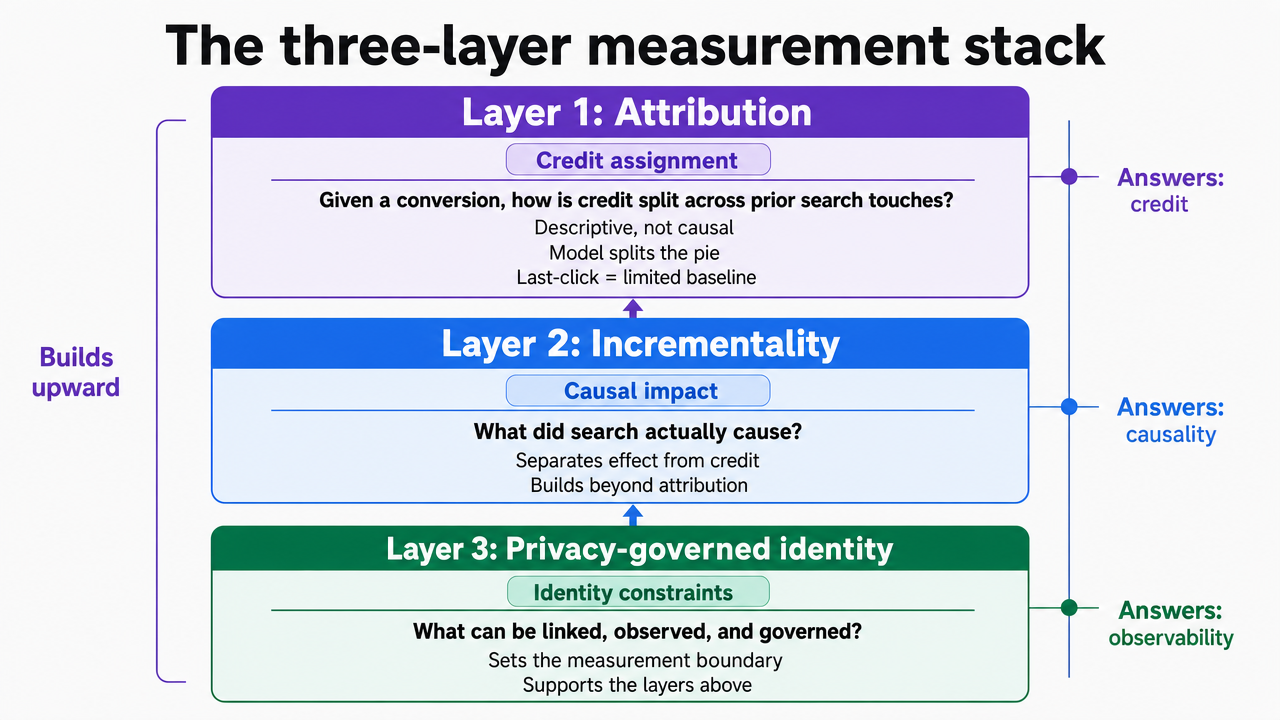 Visualize the three stacked measurement layers (attribution, incrementality, privacy-governed identity) that structure the entire section, showing what each layer answers and how they build on each other
Why last-click persists even when the stack exists
Agencies that have already built the three-layer stack still ship last-click dashboards to clients. The reason is not technical debt. It is that last-click has three properties the alternatives do not: it is cheap to reproduce every month, it is portable across accounts that have wildly different data maturity, and it survives a QBR without a methodology appendix.
Data-driven multi-touch attribution is the reverse on every axis. It requires enough path data per account to fit a model, documentation the client's marketing lead can defend to their CFO, and a shared vocabulary for what the model is actually doing. The peer-reviewed survey of MTA methods is direct that model choice involves methodological debates over probabilistic versus game-theoretic approaches and that data sparsity degrades accuracy, which is precisely the condition of the long tail of accounts in most agency portfolios 4. The attribution tutorial reinforces the governance angle: no single model is universally best, so the head of SEO is choosing a portfolio default and living with its known biases, not solving attribution once 10.
The practical move is to keep last-click as the client-facing credit view, publish the data-driven or incrementality-adjusted view alongside it as the agency's operating view, and reconcile the two in the QBR narrative rather than in the numbers.
Test Real Search Tracking Connected to Revenue
Publish live campaigns and directly measure search-driven revenue impact before committing long-term.
Portfolio economics: what the agency builds once vs. per account
The reason most agencies cannot standardize search-to-revenue measurement is not that the layers are hard. It is that the layers get budgeted as if each account were a greenfield project. Every new logo triggers a fresh conversation about attribution model choice, a fresh call-tracking integration, a fresh consent audit. The head of SEO ends up funding a private analytics engineering shop inside the delivery team, and the margin on smaller accounts disappears into setup hours that never get reused.
The portfolio economics question is narrower than it looks. For each of the three layers, what is the agency building once and shipping to every client, versus what genuinely has to be configured per account? The honest answer is that the reusable surface is larger than most delivery teams admit, and the client-specific surface is concentrated at the identity layer where consent posture and CRM topology actually differ.
The NIST Privacy Framework is useful here as the connective tissue rather than as a compliance artifact. It is described as a voluntary tool for identifying and managing privacy risk while organizations build products and services 3, which is the correct framing for a portfolio-wide measurement stack that has to hold up across verticals without being rewritten each time. The framework gives the agency a common vocabulary for what is standardized (data minimization defaults, consent categories, risk tiers) so the per-account work is scoped to the joins and disclosures that genuinely vary.
The table below breaks each layer into what is reusable across the book of business, what governance source anchors it, and what fails operationally when the agency treats the layer as one-off client work.
| Measurement layer | Standardized once across portfolio | Client-specific configuration required | Governance anchor | Failure mode when skipped |
|---|---|---|---|---|
| Attribution | Default model family, credit-policy documentation, dashboard templates, reconciliation logic between platform-reported and CRM-reported conversions | Conversion definitions tied to client's revenue model, model calibration where path volume supports it | Attribution tutorial's governance point that no single model is universally best 10 | Every QBR becomes a bespoke methodology defense; last-click wins by default |
| Incrementality | Geo-holdout test protocol, pre-registered forecast templates, rotating test calendar across the book | Market geography, spend thresholds that make lift detectable, business-cycle timing | Causal MTA methodology from the Stanford working paper 1 | Attribution outputs get reported as caused revenue; retention argument collapses when spend cuts do not reduce revenue |
| Identity & Consent | Consent taxonomy, disclosure language patterns, server-side tagging architecture, fallback measurement for consent-absent traffic | CRM-to-analytics join keys, call-tracking provider, cross-device linkage scope, vertical-specific restrictions | NIST Privacy Framework as portfolio governance backbone 3; FTC cross-device guidance at the identity layer 2 | Consent gaps surface in enforcement or client audit; regulated-vertical accounts become uninsurable to serve |
Two variables travel with every row: per-account setup hours and reusable-across-portfolio (Y/N). At the attribution layer, both should trend toward low setup hours and full reusability once the default model and dashboard template exist. At the incrementality layer, the test protocol is reusable but the calendar is per-account. At the identity layer, the architecture is reusable but the join configuration is not, and that is the layer where standardization discipline pays off the most because it is also where legal exposure concentrates.
The operational read for the head of SEO is that the measurement stack should be treated as a product the agency ships to its own delivery teams, not as a deliverable that each account manager reinvents. The margin math only works when the reusable surface is genuinely reused.
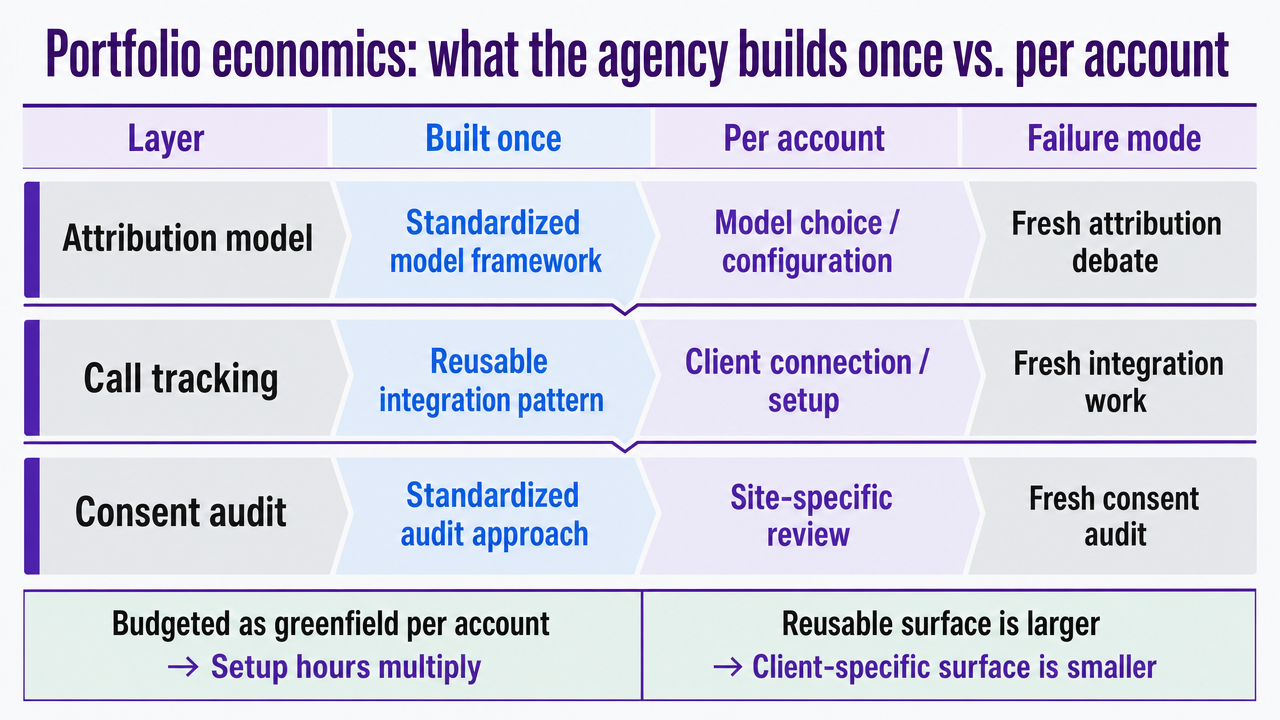 Restate the reusable-vs-per-account breakdown from the section's comparison table as a scannable framework, since the article explicitly maps each layer to standardized assets, per-client configuration, and failure modes
Regulated verticals as the stress test
Healthcare, legal, dental, and senior living accounts are where naive search-to-revenue tracking breaks first, which is exactly why they belong in the middle of the methodology conversation rather than at the end of it. The constraints these verticals impose are not edge cases. They are the general model with the guardrails visible.
HIPAA is the sharpest example. HHS guidance clarifies that marketing involving protected health information generally requires patient authorization, with narrow exceptions, which directly constrains how a healthcare client can link identifiable digital activity to revenue 9. In practice, that means the tracking payload cannot carry PHI into ad platforms or third-party analytics, and any join between search behavior and a specific patient record has to sit inside an environment covered by a business associate agreement. The FTC has reinforced the broader posture for sensitive data, warning that companies must be transparent about collection and use and take reasonable steps to secure data against unauthorized access, with enforcement activity concentrated where tracking and targeting outpace disclosed practice 6.
The measurement consequence is specific. In regulated accounts, the identity layer is not permitted to close the loop the same way it does in a home services account. The agency's job is to design a measurement architecture that reports revenue impact using aggregated, de-identified, or authorization-gated data, and to accept that some causal precision is traded for legal defensibility. The healthcare systematic review on digital marketing and consumer behavior makes this tradeoff concrete: linking online engagement to offline clinical and financial outcomes is difficult precisely because privacy rules and data fragmentation prevent the naive joins that unregulated verticals rely on 8.
What survives the stress test is the discipline the rest of the portfolio should have adopted anyway:
- Consent categories get written down.
- Server-side tagging replaces client-side pixels for anything approaching sensitive data.
- Call tracking is scoped so recordings and transcripts do not enter ad-platform audience pools.
- Aggregated conversion modeling replaces one-to-one stitching where authorization is absent.
Each of these moves also improves measurement quality in unregulated accounts, because the same disciplines close the CRM-to-analytics gap and reduce the fragility of cross-device joins the FTC flagged as a consumer expectation problem in the identity section.
The operational read for a head of SEO is that regulated verticals should set the default posture for the portfolio, not the exception policy. An agency that can deliver defensible search-to-revenue reporting for a multi-location dental group or a plaintiff law firm has already built the measurement stack that scales to every other account on the roster.
Three failure modes in agency search-to-revenue reporting
The last-click credit war with paid media
The credit war starts the same way every quarter. Paid media points at branded search conversions and claims the retainer. Organic points at the non-branded discovery touches that fed the branded query and claims the retainer. Both are working from the same last-click export, which is why neither can win the argument with data.
The peer-reviewed MTA survey is direct that last-click systematically misassigns credit across the touches that actually contribute to a conversion, which is exactly the condition producing the channel-vs-channel fight 4. The fix is not a better dashboard. It is a documented credit policy the head of SEO agrees to before the QBR, so the reporting layer stops being the negotiation surface between internal teams.
The CRM stitching gap between click and closed revenue
The second failure mode surfaces when the analytics number and the CRM number disagree in front of the client. Analytics reports 240 form conversions from organic. Salesforce shows 178 leads tagged to organic and 41 closed deals. The client asks which number is right, and the honest answer is that both are wrong in different directions because the join between the click and the closed record was never designed.
The healthcare-focused review of digital marketing and consumer behavior identifies this exact problem: measuring outcomes requires linking online engagement metrics with offline clinical and financial data, and that link is difficult because of privacy rules and data fragmentation 8. The operational read is that the CRM-to-analytics join is a build-once artifact for the agency, with defined keys, latency expectations, and a reconciliation report the client sees before the QBR rather than during it.
Consent and PHI exposure in tracking payloads
The third failure mode is the one that ends the account rather than the meeting. A pixel on an appointment confirmation page fires with URL parameters that identify the service line. A call-tracking integration pushes transcripts into an ad-platform audience. Neither was designed to carry protected health information, and both do.
HHS guidance is specific that marketing involving PHI generally requires patient authorization, with narrow exceptions 9. The fix is architectural, not procedural. Server-side tagging strips identifiers before the payload leaves the client's environment, consent state gates the join, and aggregated conversion modeling replaces one-to-one stitching where authorization is absent. Ship that architecture once, apply it to every account by default, and the exposure stops being a per-client audit exercise.
Bridge the Gap Between Search Metrics and Real Client Revenue Impact
See how agencies are connecting organic search data directly to revenue outcomes—enabling more accurate client reporting, streamlined workflow, and actionable recommendations at scale.
Where the SOW draws the measurement boundary
The measurement stack fails commercially, not technically, when the statement of work is vague about who owns which layer. The agency ends up accountable for revenue numbers it cannot see, and the client ends up blocking the integrations that would let the agency see them. Both outcomes show up in the renewal conversation.
A workable boundary follows the data. The agency owns the attribution layer end to end: model choice, dashboard templates, credit-policy documentation, and the reconciliation logic between platform-reported and CRM-reported conversions. That is defensible because the agency is choosing the credit policy the peer-reviewed literature already frames as a governance decision rather than a technical one 10. The client owns the CRM, the practice management system, and the source-of-truth revenue record. The join between them is shared, and the SOW should name it as a shared artifact with defined keys, latency expectations, and a named owner on each side.
The identity layer is where the SOW earns its keep. The agency owns the tagging architecture, consent taxonomy, and disclosure language patterns as reusable assets. The client owns the legal authorization to execute specific joins, the business associate agreements where applicable, and the final call on what identifiers leave their environment 3. Written that way, the boundary stops being renegotiated every quarter.
Standardizing the stack across the book of business
The head of SEO running a 40-account book cannot afford a bespoke measurement conversation per client, and the peer-reviewed literature does not require one. The attribution tutorial's core point is that model choice is a governance decision constrained by data and organizational capacity, which means a portfolio default is not a compromise but the correct unit of analysis 10. Pick the attribution family once, document the credit policy once, ship the dashboard template once.
Incrementality follows the same logic at a slower cadence. A rotating geo-holdout calendar across the book gives the agency a causal read on a subset of accounts each quarter without staffing a data scientist against every logo, which is the practical translation of the Stanford working paper's system-level framing of causal MTA 1. The identity layer standardizes at the architecture level and configures at the join level, with NIST's risk-management vocabulary carrying the consent taxonomy across verticals 3.
The operational read is that the measurement stack is an internal product with a release cycle, not a per-account deliverable. That is the shape of delivery that scales without adding specialists.
Frequently Asked Questions
References
- 1.Causally Driven Incremental Multi Touch Attribution Using a Recurrent Neural Network.
- 2.Cross-Device Tracking: An FTC Staff Report - January 2017.
- 3.NIST Privacy Framework.
- 4.Multi-Touch Attribution in Online Advertising: Methods and Applications.
- 5.Effectiveness of Online Marketing in Healthcare: A Systematic Review.
- 6.Federal Trade Commission: Privacy & Data Security Guidance.
- 7.Digital Marketing Strategies and Patient Engagement in Healthcare.
- 8.Digital marketing and consumer behavior in healthcare: systematic review.
- 9.HIPAA Privacy Rule Guidance.
- 10.A Tutorial on Marketing Attribution Models.