
Key Takeaways
- Ahrefs anchors the research layer with deep backlink and keyword data that collapses discovery work, though findings still need transcription into briefs or tickets.
- Semrush consolidates paid, organic, and local research in one login, cutting the tab-switching tax during competitive audits for integrated SEO and PPC retainers.
- Screaming Frog delivers rendered-DOM crawl precision that all-in-one platforms abstract away, making it essential for migrations, replatforms, and large multi-location diagnostics.
- Google Search Console is the free authoritative source for impressions, clicks, and index coverage, and every downstream reporting layer should reconcile to it rather than argue with it 3.
- Clearscope aligns briefs and drafts against SERP-derived term sets, shifting editorial hours from remediation to judgment on argument, angle, and client voice.
- Surfer SEO functions as an on-page scoring checkpoint that only earns its license when it measurably raises pieces-shipped-per-editor or on-target-first-pass rates.
- Frase compresses outline research by extracting headings and question patterns from top-ranking pages, collapsing a strategist's forty-five-minute brief prep to roughly ten.
- Looker Studio reconciles Search Console and GA4 in a free, cloneable reporting canvas, turning monthly report builds into fifteen-minute anomaly reviews 3.
- AgencyAnalytics packages white-label client dashboards and connector breadth that most agencies could not build in-house, provided integrations stay clean and narrative reconciliation still happens.
- Vectoron adds approval-first workflow orchestration across specialist strategists, closing the gap between weekly AI use and end-to-end value that fewer than 10% of marketers currently capture 6.
Why agency margin math has changed in 2026
The economics of running a search practice inside an agency have quietly inverted. Retainers are flat or compressing, client scrutiny of organic performance is sharper, and the labor cost of coordinating five to seven point tools per account has become the single biggest drag on gross margin. The question is no longer whether search optimization software pays back on the client side. It is whether the agency's own production stack pays back on the delivery side.
The client-side case remains strong. Forrester's Total Economic Impact model for a composite organization calculated a 611% ROI on SEO investment, though that figure describes one modeled composite built from interviewed customers, not an industry average 9. Forrester packages the methodology as a workbook so agencies can model benefits, costs, risks, and flexibility against a specific client's revenue base rather than borrow the headline number wholesale 8. Used that way, the framework is a sales asset and a scoping tool at the same time.
The broader picture is narrower and more honest. McKinsey reports that organizations investing in AI across marketing and sales have seen revenue uplift in the 3% to 15% range and sales ROI uplift of 10% to 20%, contingent on how deeply the technology is wired into workflow and measurement 14. Those ranges are the yardstick this list uses. A tool earns its slot in an agency stack when it either compresses a production step, tightens attribution, or removes a handoff that a human currently owns. Everything else is overhead dressed up as software.
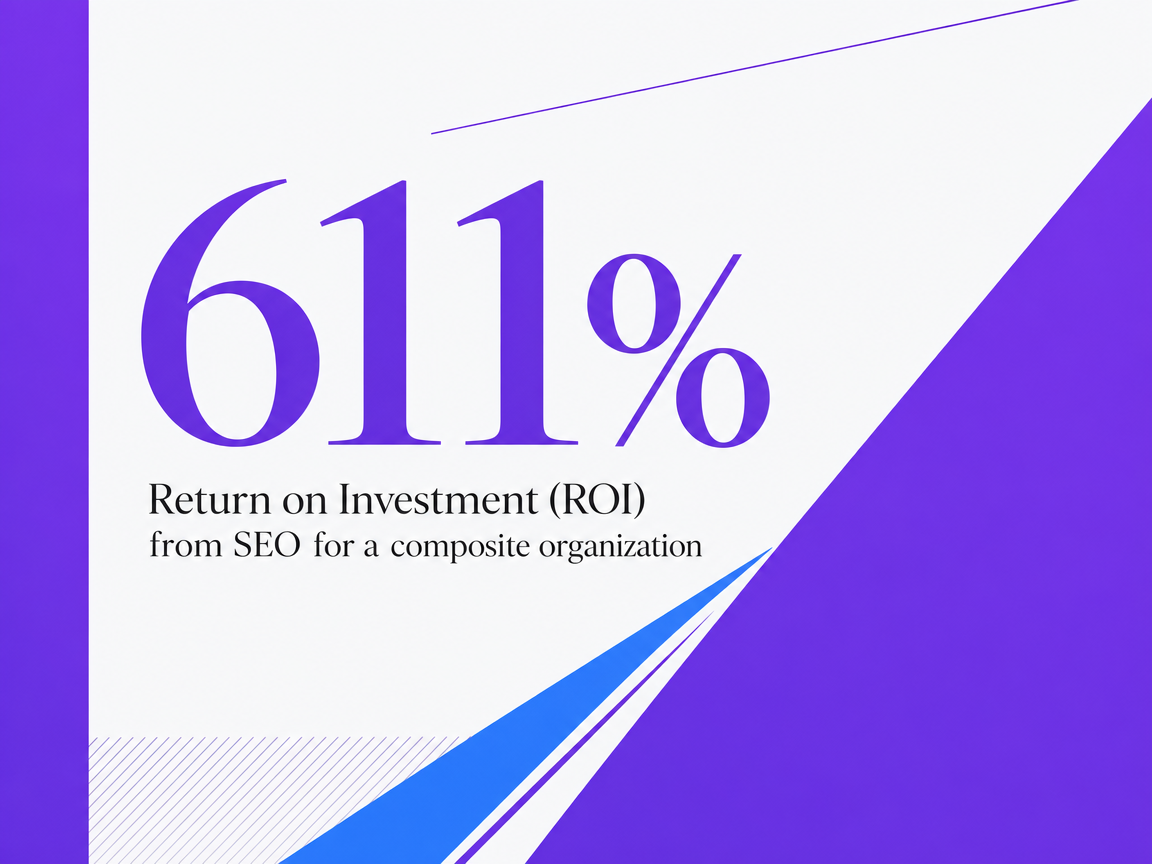 Return on Investment (ROI) from SEO for a composite organization
Return on Investment (ROI) from SEO for a composite organization
How this list is organized: three layers, one production loop
Ranking search optimization software by feature depth misses the point for an agency P&L. What matters is where each tool sits in the production loop and how well it hands off to the next step. This list groups ten tools into three functional layers: research and technical audit, content and on-page execution, and measurement and workflow orchestration. Each layer maps to a distinct set of Google's platform requirements, from crawlability and indexation 13 to the search-side and on-site data split that measurement stacks have to reconcile 3.
The layering also reflects where the productivity math actually lives. McKinsey estimates generative AI could raise marketing productivity by 5% to 15% of total marketing spend, but only when the technology is wired into workflow rather than bolted onto individual tasks 4. A rank tracker that exports to a spreadsheet a strategist then rebuilds in Looker is not workflow. Two tools that share a brief, a draft, and an approval state are. Read each entry with one question: does this compress the loop, or extend it?
Layer one: research and technical audit
1. Ahrefs — the reference layer for keyword and backlink data
Ahrefs earns its slot as the reference layer, not the production layer. Its crawler produces one of the larger backlink indexes commercially available, and its keyword database is deep enough that most agency strategists stop cross-checking against secondary sources within a few months of adoption. That is the compression: one query replaces three.
The production step Ahrefs actually removes is the discovery phase of a client engagement. Site Explorer surfaces referring domains, anchor distribution, and top pages in a form that a strategist can hand to a writer or a link acquisition specialist without rebuilding the export. Content Gap does the same for keyword whitespace against named competitors. Both feed directly into brief construction.
The limit is that Ahrefs is a research surface, not a workflow. Findings still have to be transcribed into a brief, a ticket, or a client deck. Agencies serving multi-location clients tend to hit that transcription tax hardest, because the same competitive analysis has to be replayed across ten or twenty markets. Ahrefs is the right tool for the question "what is the opportunity here." It is not the tool that ships the work.
2. Semrush — competitive gap analysis without the tab-switching tax
Semrush overlaps Ahrefs on core research functions, but its differentiator for agencies is breadth across paid, organic, and local within one login. Position Tracking, Keyword Gap, and the Listing Management module remove the tab-switching tax that eats an hour off every competitive audit. For agencies that sell integrated SEO and PPC retainers, that consolidation matters more than any single dataset's depth.
The tool most agency teams underuse is the Projects layer, which stores site audits, position tracking, and on-page checks in a persistent client workspace. Set up correctly, it turns a monthly reporting cycle into a standing view rather than a rebuild.
Semrush's platform-level relevance ties back to Google's Search Essentials, which frames technical requirements, spam policies, and best practices as the core of search eligibility 12. Semrush's Site Audit maps its checks against those categories, which shortens the argument with a client about what to fix first. Where it stops earning its keep is content production and client-ready reporting, both of which usually move to specialized layers downstream.
3. Screaming Frog — the crawl that catches what platforms miss
Screaming Frog is the desktop crawler that most senior technical SEOs still open before any dashboard. Its value is precision: JavaScript rendering, custom extraction with XPath or CSS selectors, redirect chain mapping, and hreflang validation at a level the all-in-one platforms treat as an afterthought. For an agency handling migrations, replatforms, or large multi-location sites, that precision is the difference between catching an indexation problem in staging and explaining a traffic drop to a client.
Google's developer SEO guide is explicit that crawlers need accessible links, sitemaps, descriptive titles, and text available in the DOM 13. Screaming Frog's rendered-DOM crawl is designed to verify each of those conditions on a page-by-page basis, which is exactly the diagnostic layer platform crawlers abstract away.
The operational cost is that Screaming Frog produces output, not action items. Its exports need a human to translate findings into a ticket queue or a client scorecard. Agencies that treat it as a diagnostic instrument rather than a reporting tool get the most out of it. Everyone else pays for a license they open twice a quarter.
4. Google Search Console — the free source of truth every stack needs
Search Console is the only tool on this list that speaks directly for Google, which makes it the anchor of any measurement conversation with a client. Impressions, clicks, average position, and index coverage come from the source, and no third-party rank tracker overrides that authority when a client asks why organic traffic moved.
Google's own documentation frames the split cleanly: Search Console provides search-side data, Google Analytics provides on-site behavior data, and the two should be compared rather than expected to match, because they use different systems, time zones, attribution models, and URL handling 3. Agencies that build reporting on that split up front avoid a recurring category of client dispute about whose numbers are right.
The tool's ceiling is analytical depth. Search Console's query-level data is sampled and capped, and its UI is not built for portfolio-wide analysis across dozens of client properties. That is why it functions as a source of truth feeding downstream layers rather than as a standalone reporting surface. Every other tool in the stack should reconcile to it, not replace it. Agencies that skip that step end up defending numbers a client can disprove in two clicks.
Test Real Search Optimization Workflows Risk-Free
Trial gives full access to publish and measure live search optimization outcomes for your agency clients.
Layer two: content and on-page execution
5. Clearscope — brief-to-draft alignment that survives client review
Clearscope's job in an agency stack is to make sure the brief a strategist writes and the draft a writer returns describe the same document. Its report grades a draft against a target keyword's SERP-derived term set and readability band, which sounds like a scoring toy until it replaces the round of markup a senior editor used to do by hand on every piece.
The compression is at the review stage. A writer working against a Clearscope brief hits the target grade before submitting, which means the editor spends time on argument, angle, and client voice rather than on whether the draft covers the terms competitors already cover. For agencies producing thirty to eighty pieces a month across a client book, that shift moves editorial hours from remediation to judgment.
Clearscope's ceiling is that it optimizes the artifact, not the pipeline. Briefs still have to be generated, assigned, drafted, approved, and published in other systems. It is a checkpoint, not a workflow, and agencies that treat it as one end up with cleaner drafts on the same slow production calendar.
6. Surfer SEO — on-page scoring as a production checkpoint
Surfer SEO covers similar ground to Clearscope with a heavier emphasis on structural signals: headings, word count bands, image counts, and internal linking density scored against the ranking set for a target query. The Content Editor is where most agency writers actually work, and the SERP Analyzer is where strategists confirm whether a target query is winnable before a brief is even opened.
The economic argument for tools in this layer is not the score itself. It is throughput. Deloitte's research on marketing content automation found that organizations using automation saw a 29% greater revenue impact from content marketing and were 24% more likely to meet content demands than peers without it 10. That is a study of content operations, not of any specific tool, but it is the yardstick this layer has to clear. If Surfer or a comparable scorer does not measurably raise the pieces-shipped-per-editor number or the on-target-first-pass rate, it is a license the agency is subsidizing.
Used as a production checkpoint tied to a defined score threshold, Surfer removes an editorial argument that used to happen live. Used as an optimization playground, it adds one.
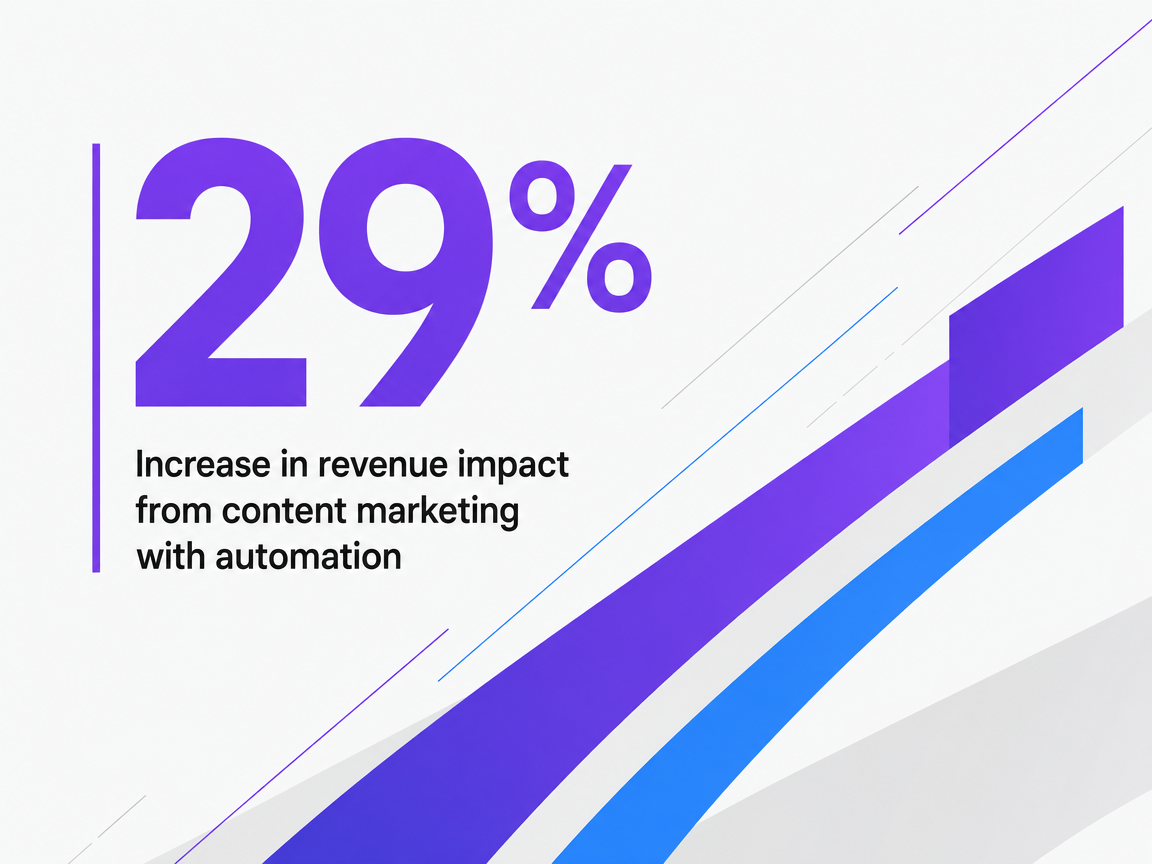 Increase in revenue impact from content marketing with automation
Increase in revenue impact from content marketing with automation
7. Frase — SERP-informed briefs that shorten the outline phase
Frase compresses the earliest and most expensive step in content production: the outline. It pulls the top-ranking pages for a target query, extracts headings and question patterns, and assembles a brief scaffold a strategist can edit rather than build from a blank document. For agencies where a senior strategist spends forty-five minutes per brief researching SERPs, that step collapses to ten.
The tool's answer engine and question extraction map neatly onto what Google's Starter Guide describes as the baseline of useful content: pages that answer the queries real users bring, structured so both readers and crawlers can find the answer 1. Frase does not replace the strategist's judgment about angle or client fit. It removes the manual SERP reading that used to precede that judgment.
Where Frase overlaps Clearscope and Surfer, agencies pick one lane. Stacking all three produces three scores on the same draft and no additional output. The right question is which tool the writers actually open when they sit down to work, and cutting the other two.
Layer three: measurement and workflow orchestration
8. Looker Studio — the reporting layer that plugs into Search Console and Analytics
Looker Studio is where most agency reporting stacks actually converge, because it is free, it accepts native Search Console and Google Analytics connectors, and it produces a client-facing view without a data engineer in the loop. Its job in this layer is reconciliation: pulling the search-side data Google flags as authoritative into the same canvas as the on-site behavior data an agency uses to argue conversion outcomes 3.
The compression is at the monthly reporting cycle. A template built once against a client's Search Console property and GA4 stream can be cloned across the book, which turns a two-hour report build into a fifteen-minute review of anomalies. Google's own documentation walks through the Search Console dashboard template and warns that clicks and sessions will not match exactly because the two systems use different attribution models, time zones, and URL handling 3. Agencies that surface that caveat in the report itself avoid a class of client argument that used to eat a call.
Looker Studio's ceiling is that it is a visualization layer, not a workflow. It shows what happened; it does not assign or track the work that responds to it.
9. AgencyAnalytics — client-facing dashboards without a data engineer
AgencyAnalytics sits one layer above Looker Studio in production convenience. Its connector library covers Search Console, GA4, the major rank trackers, call tracking platforms, and paid media sources, and its white-label dashboards ship with a client portal that most agencies could not build in-house without a developer on payroll. For agencies running fifty to two hundred client accounts, that packaging is the point.
Where Looker Studio requires template hygiene, AgencyAnalytics requires connector hygiene. The reporting is only as clean as the integrations behind it, and the tool inherits the same reconciliation problem Google documents between search-side and on-site data 3. Setting the expectation that Search Console is the authoritative visibility number, and GA4 is the authoritative on-site number, still has to happen in the narrative section of the report.
The tool earns its slot when it replaces a spreadsheet-and-slides ritual that a strategist rebuilds every month. It stops earning its slot the moment an account manager treats the dashboard as the deliverable rather than the artifact that supports one.
10. Vectoron — workflow orchestration with approval-first automation
Vectoron enters this list as the orchestration layer, not another reporting or research surface. Its argument is that the value gap in agency AI adoption is coordination, not model access. McKinsey's 2026 marketing organization research supports that framing: nearly 60% of marketers use AI multiple times per week, but fewer than 10% have started capturing value across end-to-end workflows 6. The gap between weekly use and end-to-end value is the space this layer is built to close.
Operationally, Vectoron connects specialist strategists for content, SEO, PPC, backlinks, social, and call intelligence into a single approval workflow. Recommendations arrive with the reasoning behind them, route to a human for sign-off, and only then execute against the connected channel. Nothing ships without approval, which is the concession the category has to make before an agency owner will hand it a client account. McKinsey's B2B efficiency findings put the coordination savings in a defensible range: technology-enabled teams report consistent efficiency upticks of 10% to 15% when automation replaces manual handoffs rather than augmenting them 7.
The trade Vectoron asks agencies to make is honest. It replaces the seams between the other nine tools with a governed loop, and it counts on the agency to keep judgment inside the approval step. The tools above it in the stack still do their jobs. This layer decides what actually gets shipped.
If you manage multiple locations: consolidation economics for DSOs, home services, and law firm groups
The primary reader of this list is the agency owner, but the math that decides whether a stack survives a renewal conversation lives on the client side. Multi-location clients — dental support organizations, home services franchises, senior living portfolios, law firm groups — pay per location, either directly or through the way an agency scopes its retainer. Every tool in the stack that charges per site, per project, or per user compounds against that count. A stack that pencils out at ten locations can quietly become the reason a fifty-location account gets shopped.
The consolidation question is whether five per-location licenses stacked together cost more than one workflow platform that covers the same functions. McKinsey's productivity work puts the ceiling on what integration can return: 5% to 15% of total marketing spend when generative AI is wired into workflow rather than bolted on 4. On a multi-location retainer, that range is the difference between a defensible margin and a rebid.
The variables below are the ones an agency owner should fill in from their own vendor invoices before the next renewal cycle. No industry averages are inserted, because per-seat and per-domain pricing across this category varies enough that a borrowed benchmark misleads more than it helps.
| Cost line, per location per month | Stacked point tools | Consolidated workflow platform |
|---|---|---|
| Rank tracking and keyword research | $A | Included |
| Technical crawler and site audit | $B | Included |
| Content briefing and on-page scoring | $C | Included |
| Client reporting and dashboards | $D | Included |
| Project management and approvals | $E | Included |
| Coordination labor (FTE hours × loaded rate) | $F | $F × (1 − 0.10 to 0.15) |
| Total per location | Σ(A–F) | Platform fee + reduced F |
The coordination line is where the argument is usually won or lost. McKinsey's B2B efficiency finding puts technology-enabled team gains at a consistent 10% to 15% when automation replaces handoffs rather than adding to them 7. On a book of fifty locations, a 10% reduction in coordination hours per account is the equivalent of hiring back a strategist without adding one.
See How Leading Agencies Streamline Search Optimization at Scale
Connect with a strategist to benchmark your current search stack, explore AI-powered workflow automation, and identify measurable opportunities to improve delivery margins across client portfolios.
What the AI search noise gets wrong
A quiet vendor category has grown up around the claim that AI Overviews and AI Mode require a separate optimization stack. Google's own documentation contradicts that pitch directly: there are no additional technical requirements to appear as a supporting link in AI Overviews or AI Mode beyond being indexed and eligible for snippets 2. The eligibility surface is the same one every tool in this list already targets.
That does not mean nothing has changed. Query patterns are longer, snippet competition is tighter, and the pages that surface in AI features are the ones that answer specific questions cleanly, structured the way Google's Starter Guide has described for years 1. Agencies buying a second content layer to chase AI search are usually paying twice for the same work. The productive move is auditing whether existing briefs answer questions directly and whether technical eligibility is intact, not adding a GEO license to the stack.
How to decide what to cut, keep, or add
The cut-keep-add exercise starts with a single question against every license line: what production step does this tool compress, and where does the saved hour actually go? A tool that saves ninety minutes of research but adds forty-five minutes of transcription into a brief has compressed one step and added another. The net is what belongs on the invoice.
Keep the tools that anchor to Google's own authority. Search Console is the visibility source of truth, and any downstream reporting layer has to reconcile to it rather than argue with it 3. Keep one research surface, one technical crawler, and one on-page scorer. Stacking two in any of those slots produces duplicate outputs on the same draft.
Cut the licenses that generate reports nobody opens and the AI content layers bought to chase AI Overviews, since eligibility runs through standard indexation and snippet rules 2. Add orchestration only when the coordination tax between existing tools has grown into its own line item on the delivery P&L.
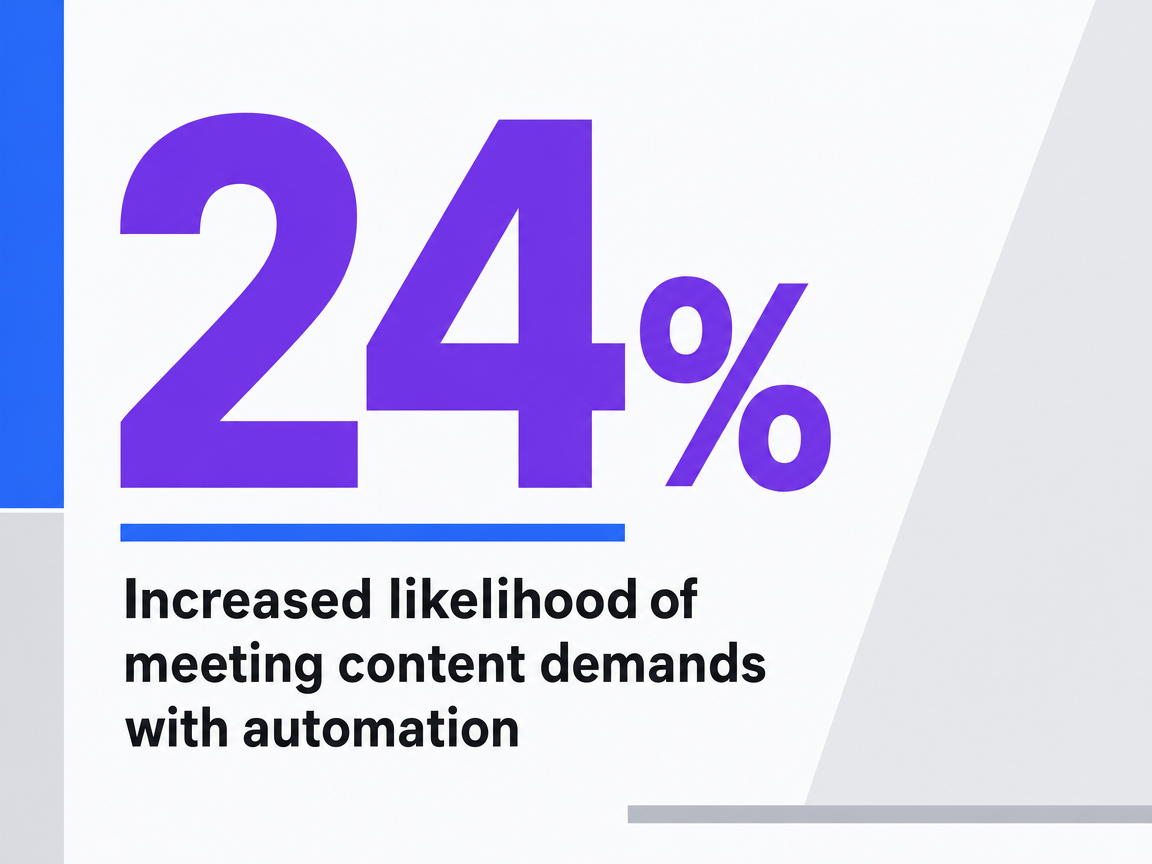 Increased likelihood of meeting content demands with automation
Increased likelihood of meeting content demands with automation
Frequently Asked Questions
References
- 1.Search Engine Optimization (SEO) Starter Guide.
- 2.AI Features and Your Website.
- 3.Using Search Console and Google Analytics Data for SEO.
- 4.Economic potential of generative AI.
- 5.How generative AI can boost consumer marketing.
- 6.A marketing organization that thrives with AI.
- 7.Harnessing generative AI for B2B sales.
- 8.The ROI Of SEO - Forrester.
- 9.You Can Quantify The ROI Of SEO.
- 10.Marketing content automation.
- 11.Automation and the content supply chain.
- 12.Google Search Essentials (formerly Webmaster Guidelines).
- 13.SEO Guide for Web Developers.
- 14.Marketing and sales soar with generative AI.