
Key Takeaways
- Classic rank should move from a client-facing KPI to an internal diagnostic, because position numbers no longer predict qualified traffic when AI Overviews and SERP features intercept clicks.
- A defensible scorecard tracks five layers: classic rank, SERP feature presence, generative answer inclusion, citation accuracy scored against the NIST ladder 3, and qualified action from calls or bookings.
- Performance claims like guaranteed rankings or AI citations must meet the FTC's substantiation baseline 11, so agencies should drop average position, top-ten counts, and third-party traffic estimates they cannot defend.
- Strategist hours belong on citation-accuracy auditing and qualified-call review, especially for YMYL and multi-location portfolios where inaccurate AI mentions create clinical, legal, or market-level exposure.
Why Position Numbers Stopped Telling the Whole Story
A client's flagship term still shows position two in the agency's rank tracker. The AI Overview above it cites three competitors and a Reddit thread. Organic clicks are down 28% quarter over quarter. The scorecard says the campaign is winning. The P&L says otherwise.
This gap is the measurement problem agency SEO leaders now have to solve. Position numbers were never wrong, but they were only ever a proxy for the thing clients actually buy: qualified attention that converts into revenue. When the results page was ten blue links, that proxy held up. When answer cards, feature snippets, and generative summaries intercept the query before a user ever scans a URL, position becomes one input among several, not the output itself.
The useful question is no longer "where does the client rank" but "what share of the visibility surface does the client occupy, how accurately are they represented when they appear, and what qualified action follows." That reframing has evidentiary consequences, too. The FTC's advertising guidance requires that performance claims be truthful and supported by evidence 11, and "we rank #1" means less when the #1 position sits below an AI answer that never names the client.
The Five-Layer Visibility Stack That Replaces Rank-Only Reporting
Layer 1 — Classic Rank: Still Useful, No Longer Sufficient
Classic rank is now a diagnostic signal, not a scorecard headline. Position in the ten-blue-link list still tells an agency strategist whether a page is indexed, whether a topical cluster is cohering, and whether competitors have shifted into or out of a term's consideration set. Those are useful operational reads.
What classic rank no longer does is predict qualified traffic. When an AI Overview, a People Also Ask stack, and a local pack push the first organic result below the visible fold, position two for the organic listing describes shelf location on a shelf few shoppers reach. The number is honest; the inference drawn from it is not.
The operational move is to demote classic rank from a reported KPI to an internal health metric. Strategists still watch it to detect indexing problems, cannibalization, and competitor pressure. Clients see it only when a change in position materially explains a change in a higher-layer metric. That reclassification is the first edit to the client scorecard.
Layer 2 — SERP Feature Presence as a Measured Surface
The second layer measures whether a client occupies any of the non-link surfaces on the results page:
- featured snippets
- People Also Ask expansions
- image packs
- video carousels
- local packs
- knowledge panels
- sitelinks
Each of these is a distinct piece of real estate with its own retrieval logic and its own click behavior.
Semrush, Ahrefs, and STAT already report feature presence per keyword. The upgrade is treating that data as a first-class reporting layer rather than a sidebar. For each tracked term, the agency records which features appear, which features the client owns, and which features a competitor owns. That three-column view is what a client needs to see.
Feature ownership also behaves differently than classic rank. A featured snippet can swap weekly based on freshness or a small on-page edit. A local pack placement depends on review velocity, categories, and proximity. Reporting on these surfaces as a trend line, not a snapshot, is what makes the layer defensible against the question clients ask most: why did this move.
Layer 3 — Generative Answer Inclusion
The third layer measures whether the client appears inside the generative answer itself: AI Overviews on Google, Perplexity responses, ChatGPT search results, Copilot answers, and the equivalent surfaces across the generative stack. Inclusion means the client's domain, brand, product, or content is pulled into the synthesized answer, either as a cited source, a named entity, or a quoted passage.
The academic benchmark worth knowing here comes from the KDD 2024 Generative Engine Optimization research, which reported that tested GEO methods improved visibility by up to 40% in generative-engine responses, with effectiveness varying across domains 6. That number is useful as a directional signal that content structure, source citation, and quotation density move the needle in generative retrieval. It is not a Google AI Overview benchmark; GEO-bench evaluates controlled generative-search settings, and the authors are explicit that domain-level results differ. Treating the 40% figure as a universal uplift projection for client reporting would overstate the evidence.
Operationally, agencies measure this layer by sampling: a defined set of priority queries is run across the generative surfaces that matter for the vertical, the responses are captured, and inclusion is coded as a binary per surface per query. That sample becomes the client's generative visibility baseline, and it moves at a cadence agencies can actually staff.
Layer 4 — Citation Accuracy, Not Just Citation Presence
Appearing in an AI answer is not the same as being correctly represented in one. The fourth layer scores the quality of the citation itself, and this is where most agency reporting currently has no vocabulary.
NIST's framework for evaluating machine-generated reports provides the vocabulary. The framework scores completeness and accuracy through information nuggets and evaluates citations by mapping claims in a report back to source documents for verifiability 3. Applied to AI-answer appearances, that produces a graded ladder rather than a yes/no inclusion check.
The ladder has four rungs an agency can audit against:
- The client is mentioned by name or domain.
- The client is accurately represented, meaning the claim attached to the mention matches the source page.
- The mention is linked, meaning the generative surface produces a traceable citation the user can follow.
- The mention is associated with a commercially useful action, such as a service, location, price range, or contact path.
A client cited inaccurately in an AI Overview is worse off than a client not cited at all, because the misstatement propagates and the client cannot correct it directly. Scoring each appearance against the ladder gives strategists a defensible way to flag which generative mentions need an on-page correction, which need schema or source hardening, and which are already working. That audit is the layer that converts generative visibility into something an agency can act on.
Layer 5 — Qualified Action: Calls, Bookings, Revenue
The terminal layer is the only one the client's finance team cares about: did the visibility produce qualified inquiry, qualified booking, or revenue. Everything above this layer is a leading indicator. This layer is the lagging one that settles the argument.
Zero-click search makes this harder to measure through session analytics alone. When a user reads a client's hours, service area, or pricing inside an AI Overview and then dials the number without visiting the site, GA4 records nothing while the phone rings. The measurement has to move to the point of inquiry: tracked call numbers, booking widgets, form submissions, and the qualification logic that separates a sales call from a vendor pitch or a wrong number.
Call intelligence sits here as the system of record. Recorded calls, tagged for intent and qualification, close the loop between what the SERP showed, what the generative answer said, and whether a revenue conversation actually started. That closure is what lets the agency defend the top four layers against a client who looks only at the bottom one.
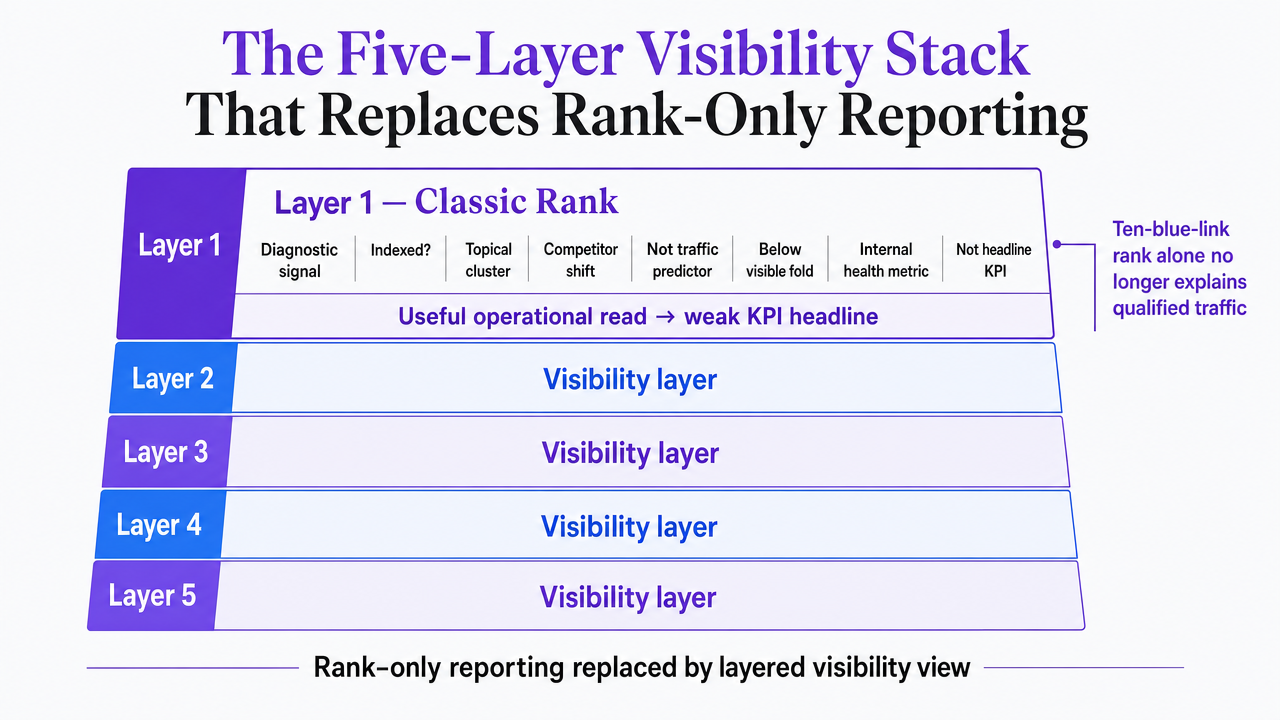 Visualize the five-layer visibility stack described in the section, giving readers a clear framework reference for Layers 1 through 5
Rebuilding the Client Scorecard Around the Stack
What Each Layer Measures and Which Data Source Produces It
A scorecard that reports five layers has to tell the client, in one view, what each layer measures, where the data comes from, and what action the agency takes when a number moves. The layers do not share a tool, and pretending they do is how reports lose credibility.
- Classic rank comes out of the agency's existing tracker (Semrush, Ahrefs, STAT) and answers one question: is the page still competitive in the ten-link index.
- SERP feature presence comes from the same trackers, but reported as owned-versus-competitor-owned per feature per term.
- Generative answer inclusion comes from a sampled query panel run across AI Overviews, Perplexity, ChatGPT search, and Copilot, coded as binary inclusion per surface.
- Citation accuracy comes from a manual or structured audit of those captured answers, scored against the NIST framework that evaluates citations by mapping claims back to source documents for verifiability 3.
- Qualified action comes from the call-tracking, booking, and CRM systems the client already pays for.
Five layers, five data sources, one scorecard. The chart below is the artifact strategists hand to clients when the question is why the report changed shape.
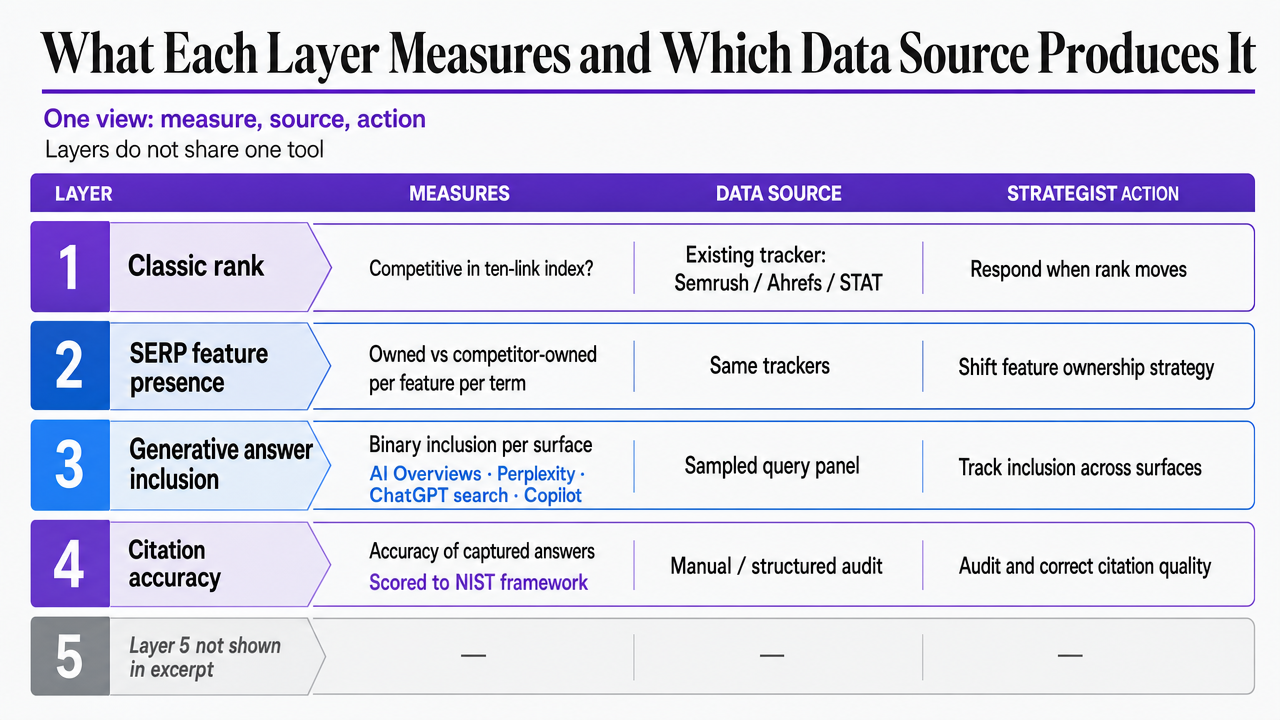 Map each of the five layers to its data source and the strategist action, as explicitly described in the section
What to Stop Reporting, and How to Explain It to Clients
Three things come off the client-facing report:
- Average position across a keyword set, because it averages shelf locations on shelves of different sizes.
- Total keywords in the top ten, because it inflates with low-intent terms that never produced inquiry.
- Estimated traffic from third-party volume models, because those models were calibrated on a results page that no longer exists.
The explanation clients accept is evidentiary, not editorial. The FTC's advertising guidance requires that performance claims be truthful and supported by evidence 11. An average-position number the agency cannot tie to qualified action is a claim the agency cannot substantiate if asked. Removing it protects both parties.
The replacement conversation is shorter and harder to argue with. The report shows what surfaces the client occupies, how accurately they are represented when AI answers cite them, and how many qualified calls or bookings followed. Clients who push back usually push back once. The number that used to feel like winning is the number that stopped predicting revenue, and the new report is what the agency is willing to defend.
Measure ranking shifts with real campaign data
See how AI-driven insights impact your search term rankings using actual published content and tracked results.
Regulatory Standards That Now Govern Visibility Claims and Scaled Content
Substantiation: The FTC Baseline for 'We Rank' and 'We're Cited'
Agency pitch decks and client reports now operate under the same evidentiary rule that governs any other advertising claim. The FTC's advertising guidance requires that claims be truthful, nondeceptive, and supported by evidence 11. "Guaranteed first-page rankings" and "guaranteed AI citation" both qualify as performance claims, and both now have to meet that bar.
Recent enforcement makes the standard concrete. The FTC's 2025 order against DoNotPay required the company to stop claiming its AI service performs like a real lawyer unless it has sufficient evidence to back the claim, and imposed $193,000 in monetary relief 2. A separate order against an online marketer barred claims that an automated product could make any website WCAG-compliant without supporting evidence 5. Neither case is about SEO, and that is the point: the enforcement principle is category-agnostic, and it extends to automated capability claims an agency might inherit when it resells a vendor's tool.
The practical edit is to the agency's own language. Every performance claim in a pitch, scope document, or monthly report should have a documented evidence trail (sample size, measurement window, methodology, source) that the agency could produce under subpoena. Claims the agency cannot substantiate come off the deck.
High-Integrity Content as the Production Standard
When agencies scale content with AI assistance, the question clients and regulators both ask is what quality standard the output was held to. NIST's Generative AI Profile gives that standard a working definition: high-integrity information is accurate, reliable, verifiable, authenticated, linked to original sources, and transparent about uncertainty and the limits of what it claims 10.
Those six attributes translate into QA steps a production workflow can actually run. Accuracy and reliability require a human reviewer who can confirm the claim against a source. Verifiability and source linkage require that every substantive claim in a page carry a citation a reader can follow. Authentication requires preserving the editorial record of who approved what. Transparency about uncertainty requires that content avoid overstating what the client can deliver or what the data supports.
Vendor claims about automated content quality warrant the same scrutiny. The FTC's 2025 action against Workado challenged a 98% AI-detection accuracy claim after independent testing reportedly showed 53% accuracy on general-purpose content 4. Agencies buying AI-QA tooling should document the test population and measured error rate before relying on the vendor's number in client reporting.
Authorship, Reviews, and the Copyrightability of Scaled Output
Two authorship questions sit underneath any scaled content program. The first is whether the agency and its client actually own what gets published. The U.S. Copyright Office's Part 2 report concludes that wholly AI-generated material is generally not copyrightable, while human-authored expressive elements, including creative arrangement and modification, can support protection; providing prompts alone is not sufficient 1, 7. For agency delivery, that means preserving editorial records, revision history, source material, and documented human creative decisions is what makes a client's content portfolio defensible as an asset.
The second question is review and reputation content. The FTC's 2024 final rule prohibits creating, selling, buying, or disseminating fake reviews or testimonials, including AI-generated reviews that misrepresent nonexistent consumers or experiences, when the business knew or should have known the reviews were false 8. The rule does not restrict legitimate customer feedback or administrative AI assistance, but any workflow that generates, aggregates, or syndicates review-style content for local pack visibility now carries civil-penalty exposure if authenticity breaks down.
YMYL Verticals: Where Citation Accuracy Carries the Most Weight
Agencies serving law firms, dental groups, behavioral health, senior living, and healthcare systems operate under a stricter version of the measurement model described above. In these YMYL verticals, an inaccurate generative citation is not a reporting inconvenience; it is a clinical, legal, or financial misstatement attached to the client's brand.
A 2025 audit of generative AI chatbots responding to medical queries found frequent errors, fabrications, and hallucinations, with a median reference-completeness score of 40% 9. The audit evaluated chatbots rather than Google AI Overviews, but the pattern it documents, confident answers paired with incomplete or fabricated sourcing, is the same failure mode agencies see when auditing AI-answer appearances for YMYL clients. A dental group misquoted on anesthesia protocol, a behavioral health provider misrepresented on medication-assisted treatment, or a senior living community misattributed on licensing level each creates exposure the client cannot correct at the generative surface.
The operational response is to raise the citation-accuracy layer from a monthly audit to a weekly one for YMYL accounts, require clinical or legal reviewer sign-off on any on-page claim likely to be quoted, and treat inaccurate AI mentions as priority remediation tickets rather than reporting footnotes.
If You Manage Multiple Locations: Measuring Visibility Across a Portfolio
Agencies managing multi-location clients, dental support organizations, home services franchises, senior living portfolios, law firm networks, inherit a measurement problem the single-location version of this framework hides. Visibility is not one number per client; it is the five-layer stack repeated per location, then rolled up into a portfolio view that still has to be defensible per market.
Three operator rules keep that rollup honest:
- Generative inclusion is sampled per metro, not per brand. A dental group that appears in the Phoenix AI Overview for "emergency root canal near me" may be absent in Tucson for the same query; averaging the two obscures the market-level fix.
- Citation accuracy is scored per location, because an AI answer that attaches the wrong service line, licensing level, or hours to Branch 14 is a Branch 14 problem the regional manager has to resolve.
- Local pack and review-driven surfaces require their own authenticity discipline: the FTC's final rule prohibits creating or disseminating fake reviews or testimonials, including AI-generated reviews that misrepresent nonexistent consumers, when the business knew or should have known the reviews were false 8, and portfolio operators carry that exposure across every location they publish for.
The portfolio scorecard reports per-location stack performance, then flags only the locations where a layer dropped below a defined threshold. That is where strategist attention goes next.
See How Leading Agencies Are Rethinking Search Term Rankings with AI-Powered Data
Request a demo to explore how real-time call analysis and search term intelligence can streamline reporting, surface qualified opportunities, and drive measurable SEO efficiency at scale.
Operator Economics: Running the Expanded Stack Without Adding Analysts
A five-layer scorecard sounds like a four-analyst problem. For most agency P&Ls, it is not, because the first three layers are data problems and only the last two are judgment problems. The margin question is whether the agency keeps paying strategists to do the data work.
The table below uses variables rather than invented dollar figures, so each agency can plug in its own strategist blended rate. The columns describe hours per client per month under a traditional model versus an approval-first automated workflow, where monitoring, feature auditing, and generative-answer sampling run as a continuous data layer and strategists are routed into the work only when a layer breaches a threshold.
| Activity | Traditional hours / client / month | Monitored data layer + strategist review |
|---|---|---|
| Classic rank tracking and reporting | 3–5 | <1 (exception review only) |
| SERP feature auditing per tracked term | 2–4 | <1 (owned-vs-competitor delta review) |
| AI Overview and generative-answer citation sampling | 4–8 | 1–2 (ladder scoring on flagged mentions) |
| Call/booking qualification, attribution, judgment | 2–3 | 4–6 (strategist time reallocated here) |
| Total hours / client / month | 11–20 | 6–10 |
Two numbers decide the model: hours per client per month and clients per strategist. Collapsing the first three rows into a monitored layer roughly halves total hours and lets clients-per-strategist rise without the citation-accuracy layer degrading, because the ladder scoring from Layer 4 3runs against a captured sample rather than against ad-hoc screenshots. Strategist time moves to the layer the client's finance team actually pays for: qualified action.
One governance constraint sits on top of the economics. Any AI-assisted content shipped under this workflow should meet the high-integrity attributes NIST defines, accurate, verifiable, authenticated, source-linked, and transparent about uncertainty 10, which means the hours saved on data collection are reinvested in human review and approval, not stripped out of the delivery cost entirely. The margin gain is real; it is not a license to ship unreviewed output.
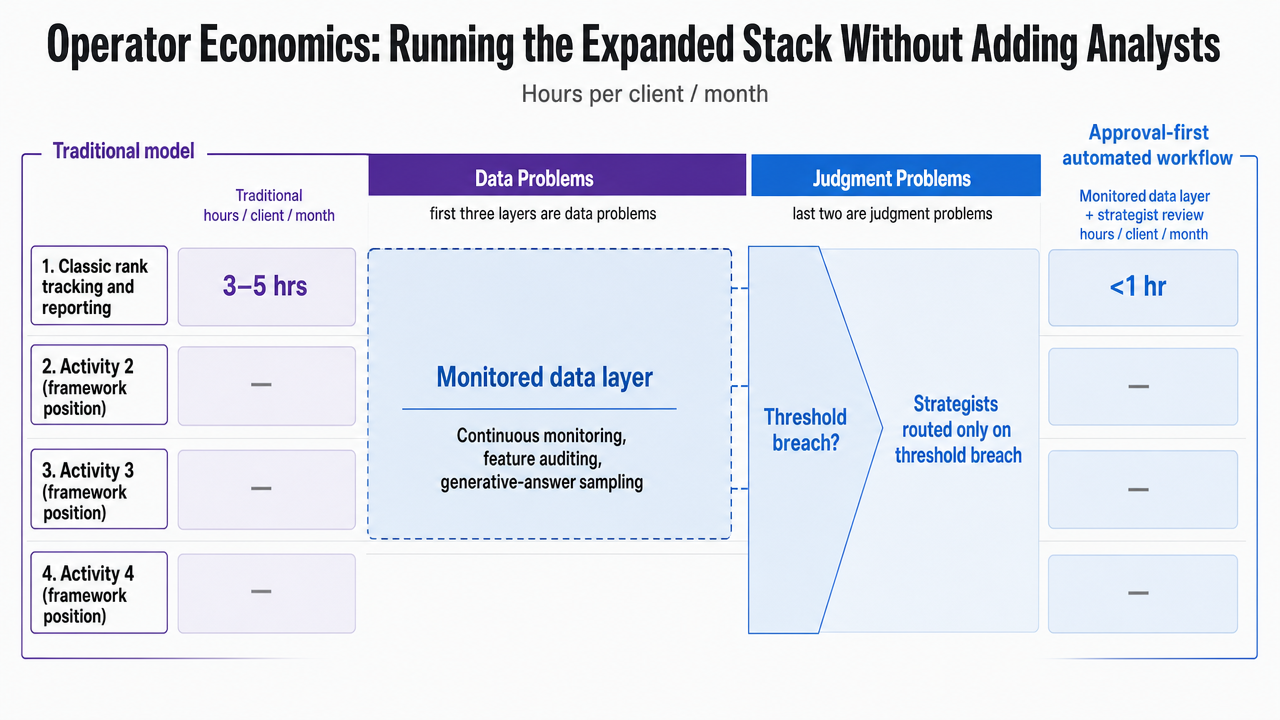 Compare traditional vs monitored-layer hours per client per month across the four activities, using the ranges explicitly cited in the article's table
Call Intelligence as the Honest Terminal Metric
Every layer above this one is a leading indicator. The honest terminal metric is whether the phone rang, who was on the line, and whether the conversation qualified as revenue. That is the number clients fund budgets against, and it is the number the first four layers have to earn their place against.
Call intelligence closes the measurement chain that zero-click search opens. When an AI Overview displays a client's hours or service area and the user dials directly, session analytics capture nothing. Recorded calls, tagged for intent and qualification, replace the missing session with evidence a strategist can act on: which campaigns produced sales conversations, which produced vendor pitches, and which produced wrong numbers routed to the wrong location.
That evidence also keeps the agency on the right side of the FTC's substantiation baseline 11. Reporting qualified calls, with the tagging logic documented, is a performance claim the agency can defend. Reporting "traffic" from a tracker the AI Overview bypassed is not. Platforms like Vectoron treat call intelligence as the terminal signal that governs every layer above it.
Frequently Asked Questions
References
- 1.Copyright Office Releases Part 2 of Artificial Intelligence Report.
- 2.FTC Finalizes Order with DoNotPay That Prohibits Deceptive AI Lawyer Claims.
- 3.On the Evaluation of Machine-Generated Reports | NIST.
- 4.FTC Order Requires Workado to Back Up Artificial Intelligence Detection Claims.
- 5.FTC Order Requires Online Marketer to Pay $1 Million for Deceptive Claims Its AI Product Could Make Websites.
- 6.GEO: Generative Engine Optimization.
- 7.Copyright and Artificial Intelligence.
- 8.Federal Trade Commission Announces Final Rule Banning Fake Reviews and Testimonials.
- 9.Generative artificial intelligence-driven chatbots and medical misinformation: an accuracy, referencing and readability audit.
- 10.Artificial Intelligence Risk Management Framework: Generative Artificial Intelligence Profile.
- 11.Advertising and Marketing.