
Key Takeaways
- Treat vendor selection as evidence collection across four gates—claim substantiation, data governance, channel coordination, and accountability—where a missing artifact at any single gate disqualifies the vendor.
- Demand a substantiation file with analytics exports, cohort definitions, measurement methodology, and endorsement disclosures, since the FTC reasonable-basis standard requires evidence in hand before any quantitative claim runs 1, 4.
- Require a vendor-completed NIST SP 800-53 control mapping and a current cross-system data inventory provisioned per resource, consistent with the zero-trust model in SP 800-207 11, 12.
- Ask for an integration log showing shared keyword definitions, audience cohorts, and one attribution model across organic, paid, and link work—fragmented retainers multiply coordination cost and split substantiation chains.
- Lock accountability into the contract with a named metric, fixed attribution model, reporting cadence, change log, and a termination clause governing who keeps the substantiation file and credentials at exit.
- For multi-location healthcare operators, scope a BAA covering every system and subprocessor touching PHI, map proposed communications to HIPAA authorization rules, and document cross-location tenant isolation 8, 9, 10.
Why Vetting Is an Evidence Exercise, Not a Pitch Review
A renewal decision on an SEO advertising company rarely fails because the sales deck was weak. It fails six months later, when the ranking lift cited in the pitch cannot be reproduced from the analytics export, the case-study client turns out to have run three other campaigns in parallel, and the security questionnaire comes back with vague references to "industry-standard encryption." By then the contract is signed and the attribution argument is already lost.
The Federal Trade Commission has been explicit on the underlying standard for three decades: advertisers and their agencies must hold a reasonable basis for objective claims before those claims are disseminated 1. That obligation runs to both express promises and the implied ones a reasonable reader would take away 2. An SEO vendor saying "we deliver 3x organic leads" is making an advertising claim about its own service, and the evidentiary bar does not soften because the buyer is a sophisticated marketing leader.
Treating vendor selection as an evidence exercise reframes the work. The buyer is not auditioning a partner; the buyer is collecting artifacts. Four gates structure that collection: claim substantiation, data governance, channel coordination, and accountability. A vendor that cannot produce evidence at any single gate fails the screen, regardless of how the other three look.
Gate One: Claim Substantiation
The Reasonable-Basis Standard Applied to SEO Vendor Decks
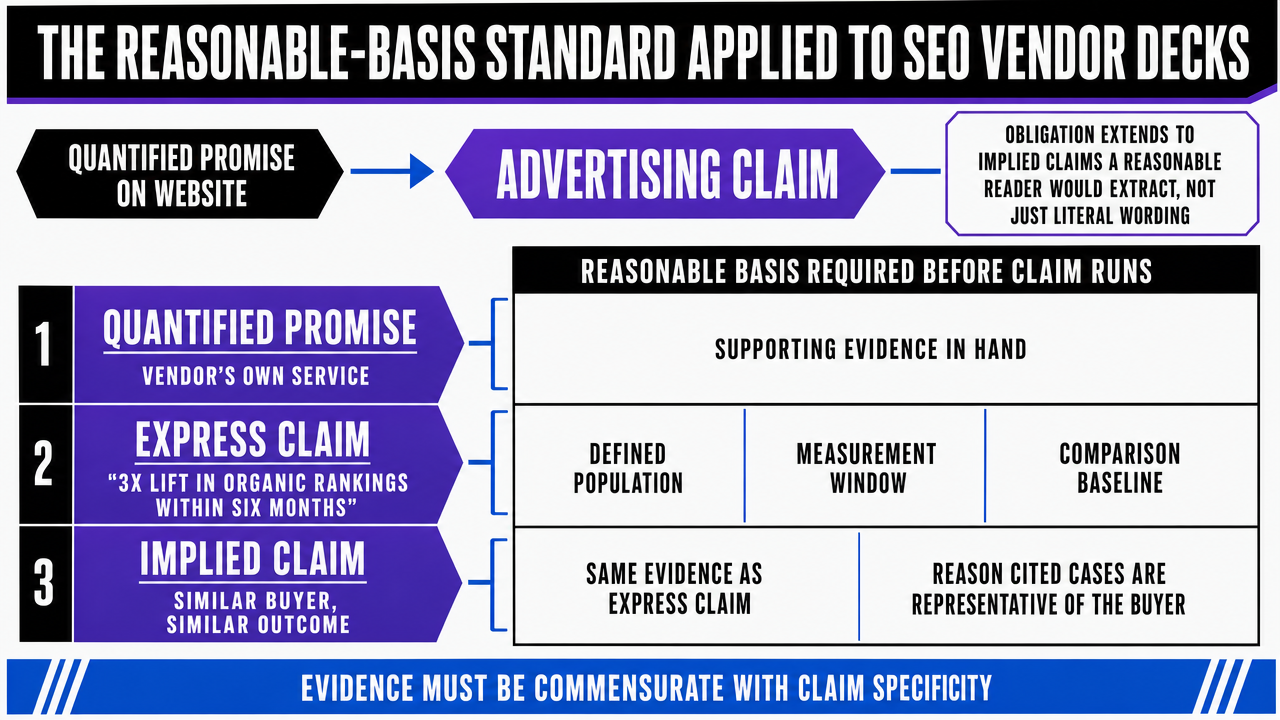
Every quantified promise on a vendor's website is an advertising claim about the vendor's own service, and the FTC treats it that way. The reasonable-basis doctrine requires that an advertiser hold supporting evidence in hand before the claim runs, and that the evidence be commensurate with the specificity of the claim 1. The obligation extends to implied claims a reasonable reader would extract, not just the literal sentence on the page 2.
This distinction is crucial during vetting. An express claim such as "clients see a 3x lift in organic rankings within six months" needs a defined population, a measurement window, and a comparison baseline. The implied claim sitting next to it — that a similar buyer can expect a similar outcome — needs the same evidence plus a reason the cited cases are representative of the buyer's situation. The FTC has separately flagged unsupported substantiation conduct as deceptive or unfair, which means the enforcement exposure is not theoretical when a vendor inflates outcomes 3.
The infographic below maps the three claim types that dominate SEO advertising decks — express ranking lifts, implied revenue gains, and comparative CPA reductions — to the evidence class each one requires under the reasonable-basis standard 1, 2. A buyer working through the gate should ask for the artifact in column three, not a restatement of the claim in column one. If the vendor cannot produce the underlying analytics export, the cohort definition, or the controlled comparison, the claim does not meet the standard the vendor's own marketing is held to.
 Maps the three claim types common in SEO vendor decks to the evidence each requires under the FTC reasonable-basis standard, directly supporting the section's argument
Testimonials, Case Studies, and the Endorsement Guides Test
Vendor case studies are endorsements, and the FTC Endorsement Guides set the rules for how they can be presented. Endorsements must reflect the honest opinions or experiences of the endorser, and any material connection between the endorser and the marketer — paid retainers, equity, free services, ongoing relationships — must be clearly disclosed 4. The 2023 revision tightened expectations around what counts as a clear disclosure across formats.
The harder test is representativeness. An unrepresentative testimonial can be misleading unless it is paired with what consumers can generally expect from the service 5. "Generally expect" is the operative phrase during vetting. If a vendor's top-billed case shows a 400% traffic gain, the implied claim is that the buyer's account can produce something in that range. The vendor either holds aggregate performance data across its book of business that supports the implication, or the case study needs a qualifier disclosing typical results.
A useful screen runs three questions against every published case the vendor cites.
- Is the endorser identified specifically enough that the result can be independently verified?
- Are material connections — active retainer, affiliate fee, equity stake — disclosed in proximity to the claim?
- Does the vendor publish or share on request the distribution of results across all comparable engagements, so the cited outcome can be placed against a median rather than presented as a standalone proof point 4, 5?
The Substantiation File: What to Demand Before Signature
The artifact that closes this gate is a substantiation file produced by the vendor at the buyer's request. It is not a sales asset. It is the documented evidence the vendor would hand to counsel if any quantitative claim in its marketing were challenged under the reasonable-basis standard 1, 2.
A complete file contains five elements:
- The raw analytics exports underlying each cited outcome, with timestamps and account identifiers.
- The cohort definition explaining which clients were included, which were excluded, and why.
- The measurement methodology, including baseline period, attribution model, and any control for confounding campaigns the client ran in parallel.
- The disclosure log showing how material connections are surfaced in published testimonials 4.
- When the vendor produces content on behalf of clients in regulated categories, the FTC compliance review process applied to that content 6, 13.
Vendors that have done this work hand the file over in days. Vendors that have not will offer a call with the case-study client instead. The substitution is the answer. A buyer that signs without the file is accepting the substantiation risk on behalf of the vendor.
Gate Two: Data Governance and Security Posture
Mapping Vendor Controls to SP 800-53 and Zero Trust Principles
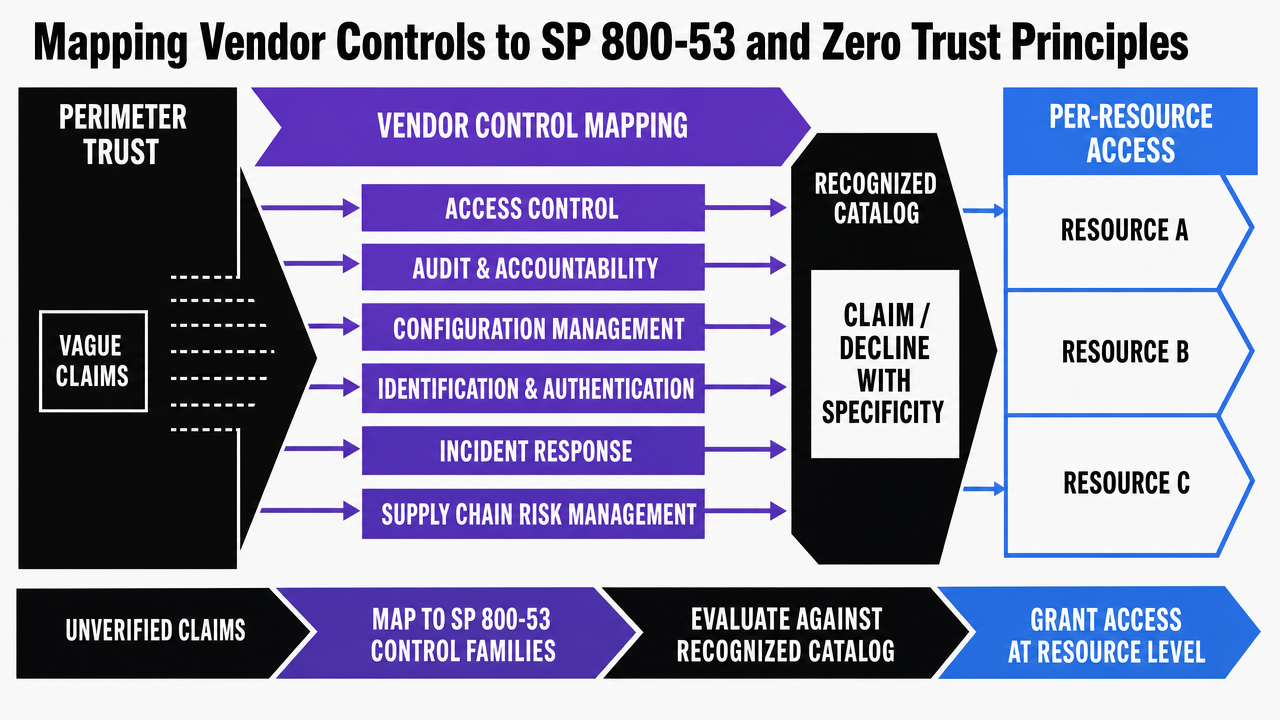
A security questionnaire that comes back full of phrases like "enterprise-grade encryption" and "SOC-aligned practices" is not an answer. It is a deflection. The artifact that actually closes the data governance gate is a vendor-completed control mapping against a recognized catalog, and NIST SP 800-53 Rev. 5 is the catalog buyers should be asking for. The publication offers a documented set of security and privacy controls for information systems and organizations, organized into control families that a vendor can either claim or decline to claim with specificity 12.
The infographic below pairs the SP 800-53 control families most relevant to a marketing vendor — access control, audit and accountability, configuration management, identification and authentication, incident response, and supply chain risk management — with the architectural shift NIST formalized in SP 800-207. Zero Trust Architecture moves defenses from wide network perimeters down to individual or small groups of resources, which is the model a vendor must operate under once it is touching analytics accounts, ad platforms, search consoles, and CRM exports across multiple client tenants 7, 11. Perimeter language is the tell. A vendor still describing its security in terms of a corporate firewall has not internalized the shift.
The deliverable to request is straightforward: a spreadsheet that lists each applicable SP 800-53 control, the vendor's implementation summary, the system or process where it lives, and the date of the last internal review 12. Vendors that have this document treat it as routine procurement. Vendors that have to build it from scratch will say so, and the timeline they quote is the real answer to the security question.
 Visualizes the six SP 800-53 control families most relevant to a marketing vendor alongside the zero-trust shift from perimeter to per-resource access, supporting the section's specific governance argument
Cross-System Data Flows: What Auditable Looks Like
An SEO advertising company in active execution touches more systems than most security reviews assume. GA4 properties, Search Console, ad platform APIs, call-tracking platforms, CRM exports, and tag management containers all carry identifiers that can be joined back to a person. The question is not whether the data flows exist. It is whether the buyer can audit them on demand.
An auditable flow has four observable properties:
- Each system-to-system connection is documented with the data fields in transit, the authentication method, and the business purpose.
- Access is provisioned per resource rather than per network, consistent with the zero-trust model NIST published in SP 800-207 7, 11.
- Logs capture who pulled which export and when, and the logs are retained long enough to support a year-end review.
- The vendor can produce, within a contracted window, a current list of every place client data sits — including analyst laptops, BI sandboxes, and any subprocessors.
A vendor that cannot produce that inventory does not have a data governance program. It has a trust request.
Test Autonomous SEO and Paid Search Coordination
Experience unified SEO, PPC, and backlink execution on live campaigns before making any commitments.
Gate Three: Channel Coordination Across SEO, Paid, and Links
The Fragmentation Tax in Three Separate Retainers
Three retainers produce three plans. The SEO agency builds a keyword universe around organic intent. The paid search agency builds a different keyword universe around Quality Score economics. The link acquisition vendor builds a third around domain authority targets and outreach lists. None of the three plans is wrong on its own terms. The problem is that the account underneath them is one account, with one budget, one set of landing pages, and one customer.
The fragmentation tax shows up in predictable line items. Keyword research gets done three times against the same SERPs. Landing pages get optimized for organic ranking by one vendor and rewritten for ad relevance by another, with neither change reviewed against the conversion funnel the third vendor is sending links into. Audience definitions drift, so the cohort the paid team is bidding against and the cohort the SEO team is writing for stop matching. Attribution arguments then consume the monthly review, because each vendor's report credits its own channel for conversions the others touched.
The coordination overhead is not a soft cost. It is account-manager hours, internal marketing-ops hours, and executive review cycles that exist only because the work is split. A vendor that cannot explain how its plan reconciles with the other two has not solved the problem. It has joined it.
Fragmented vs. Consolidated Execution: A Cost and Risk Comparison
The comparison below isolates the structural differences between running three siloed retainers and running one account-level plan across SEO, paid search, and link acquisition. It uses variables rather than invented dollar figures, because the dollar impact varies by footprint and the structural impact does not.
| Cost or Risk Driver | Fragmented Vendor Stack | Consolidated Account-Level Execution |
|---|---|---|
| Number of retainers | Three separate contracts, three scopes | One contract, one scope |
| Coordination hours per month | Recurring cross-vendor syncs plus internal reconciliation | Single review cycle against one plan |
| Per-location billing multiplier | Multiplied across each vendor and each location | Account-level pricing across sites and service lines |
| Attribution reconciliation overhead | Three vendor reports, three attribution models | One attribution model owned by one team |
| Substantiation file ownership | Distributed across vendors; each holds part of the evidence for its own claims 1 | One file, one chain of custody, one reasonable-basis record 1 |
| BAA count required (where PHI is in scope) | One BAA per vendor that touches PHI 9 | One BAA covering the consolidated scope 9 |
| SP 800-53 control-mapping duplication | Each vendor maps controls separately; gaps appear at the seams 12 | One control mapping reviewed once 12 |
The rows that matter most during contract review are the last three. Substantiation evidence under the FTC reasonable-basis standard has to be reconstructable on demand, and a chain of custody split across three vendors is harder to defend than one held by a single execution team 1. BAA scope multiplies the same way for healthcare operators with PHI in scope 9. Control mappings against SP 800-53 duplicate effort and leave handoff gaps that no single vendor owns 12. Consolidation does not eliminate any of these obligations. It collapses them to a single accountable surface.
Integration Logs: Proving One Plan Instead of Three
The artifact that closes this gate is an integration log. The vendor produces a current record of every system its strategists read from and write to — GA4, Search Console, the ad platforms, the CRM, the tag manager, the link database — along with the cross-channel decisions made against that data in the last review cycle.
A working log shows three things:
- Keyword and audience definitions that are shared across organic, paid, and link work rather than rebuilt per channel.
- Landing page changes reviewed against ranking, ad relevance, and conversion impact in the same record.
- Attribution decisions resolved against one model the vendor will defend, not three reports that disagree.
A vendor running one plan can hand the log over from the last cycle. A vendor running three plans under one logo will offer to assemble one. The assembly time is the answer.
Gate Four: Accountability and Attribution
The first three gates filter out vendors that cannot prove what they have done. The fourth filters out vendors that cannot be held to what they will do.
Accountability is a contract artifact, not a relationship promise. The deliverable is a scope of work that names the metric the vendor owns, the measurement window, the attribution model that will resolve disputes, and the consequence when the metric is missed. "Increase organic traffic" is not a metric. Qualified organic sessions to a defined set of conversion pages, measured against a baseline period the vendor signs off on at kickoff, is.
Attribution is where most accountability arguments collapse. A vendor that reserves the right to choose its own attribution model at reporting time has reserved the right to be correct in every monthly review. The contract should fix the model — last non-direct, data-driven, or position-based — before the first invoice runs, and it should specify how cross-channel touches are credited when SEO, paid, and link work all appear in the same conversion path. The substantiation logic from the first gate applies here too: any performance number the vendor will eventually cite in a renewal conversation is a claim that needs a reasonable basis at the time it is made 1.
Three artifacts close the gate:
- A reporting cadence with named owners on both sides.
- A change log that captures every strategic decision and the data behind it.
- A termination clause that defines who keeps the substantiation file, the integration credentials, and the content assets when the engagement ends.
Vendors that resist any of the three are negotiating for ambiguity.
See How Leading SaaS Teams Coordinate SEO, Ads, and Backlinks—All in One Platform
Request a walkthrough of unified marketing workflows proven to cut coordination time by up to 60% while aligning SEO content, Google Ads, and backlink strategies for measurable acquisition gains.
For Multi-Location Healthcare Operators, the Bar Rises in Three Places
BAA Scope and the HIPAA Marketing Definition
The reader changes here. For multi-location healthcare operators — practice groups, specialty networks, hospital-affiliated outpatient brands — the four gates still apply, and three additional questions sit on top of them.
The first is BAA scope. HHS defines a business associate as a person or entity that creates, receives, maintains, or transmits PHI on behalf of a covered entity, and the covered entity must obtain satisfactory assurances through a written contract before that work begins 9. An SEO advertising company that ingests call-tracking recordings, syncs CRM exports containing patient identifiers, or runs retargeting against authenticated portal traffic is performing functions involving PHI. A BAA is not optional in those engagements, and its scope should name every system the vendor touches, every subprocessor in the chain, and the breach-notification timeline.
The second is the HIPAA marketing definition. HHS treats most communications that encourage the purchase or use of a product or service as marketing, which generally requires patient authorization when PHI is involved 8. Treatment-related communications carry different rules. A vendor proposing patient-segmented email campaigns or condition-targeted ad audiences should be able to map each proposed use to the authorization status it requires before the work is scoped.
ePHI Handling, Security Rule Safeguards, and Cross-Location Posture
The third question is technical. The HIPAA Security Rule sets administrative, physical, and technical safeguards for electronic protected health information, and any vendor that qualifies as a business associate inherits those obligations directly 10. NIST SP 800-66 Revision 2 was drafted specifically to help organizations maintain the confidentiality, integrity, and availability of ePHI in healthcare environments, and it is the document a buyer should expect the vendor to reference by name 15.
Cross-location posture is where most vendors falter. A network with twenty sites does not have twenty independent risk surfaces; it has one analytics account, one tag manager, and a shared CRM that joins identifiers across the footprint. The HHS 405(d) program exists to align cybersecurity approaches across the healthcare sector precisely because ad hoc, per-location controls leave gaps at the seams 16. The artifact to demand is a written description of how the vendor isolates tenant data across locations, how access is provisioned per resource rather than per network, and how audit logs reconcile activity to a named operator. A vendor that treats multi-location work as twenty single-site engagements has not done the architecture.
Putting the Four Gates Into a Defensible Scorecard
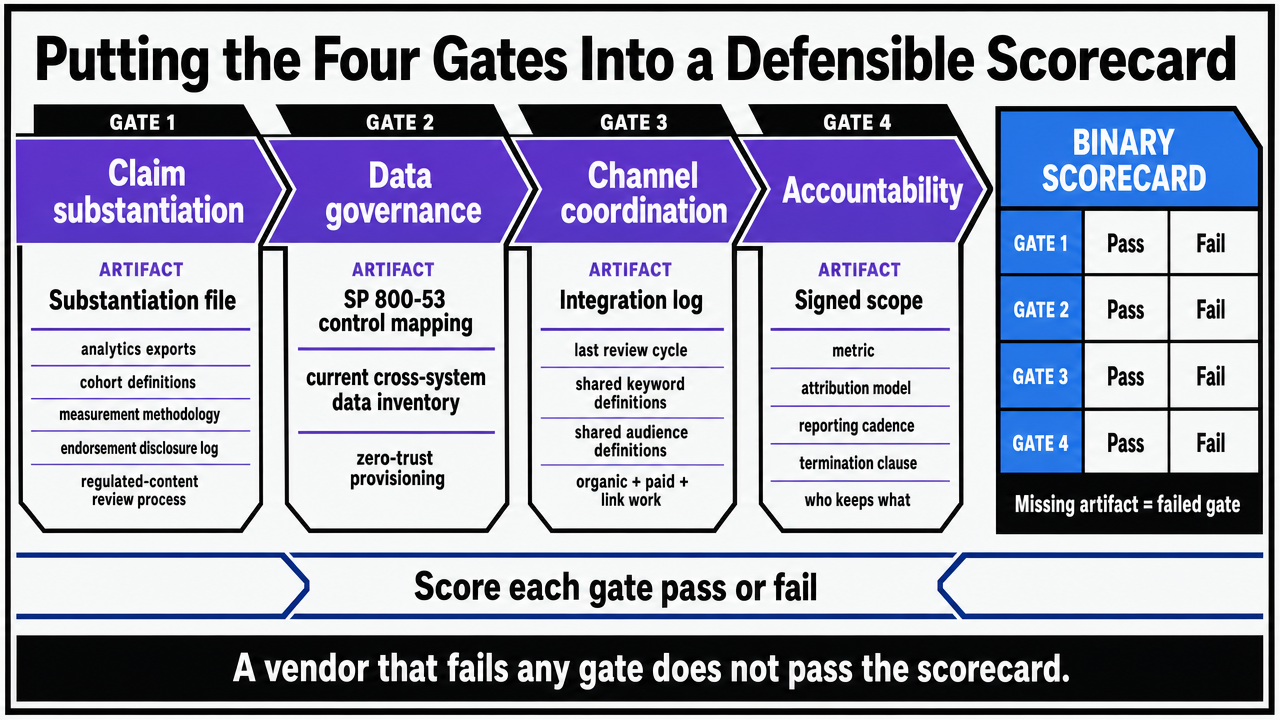
The scorecard is binary by design. Each gate produces a single artifact, and a missing artifact is a failed gate.
Claim substantiation closes with the substantiation file: analytics exports, cohort definitions, measurement methodology, endorsement disclosure log, and regulated-content review process 1, 4. Data governance closes with the SP 800-53 control mapping and a current cross-system data inventory consistent with zero-trust provisioning 11, 12. Channel coordination closes with an integration log from the last review cycle showing shared keyword and audience definitions across organic, paid, and link work. Accountability closes with a signed scope naming the metric, the attribution model, the reporting cadence, and the termination clause governing who keeps what.
Score each gate pass or fail. A vendor that fails any single gate is not a finalist, regardless of references or pitch quality. The scorecard does not rank vendors against each other. It filters out the ones that cannot operate at the standard the engagement already requires. What remains is a short list of execution teams that can defend their work on the day a renewal, an audit, or a counsel review puts the question on the table — which is the only standard worth signing against.
 Summarizes the four-gate vetting framework and the single artifact that closes each gate, reinforcing the article's central operating model
Frequently Asked Questions
References
- 1.FTC Policy Statement Regarding Advertising Substantiation.
- 2.Advertising Substantiation Principles.
- 3.Penalty Offenses Concerning Substantiation.
- 4.FTC's Endorsement Guides: What People Are Asking.
- 5.Advertisement Endorsements | Federal Trade Commission.
- 6.Health Products Compliance Guidance.
- 7.Zero Trust Architecture: NIST Publishes SP 800-207.
- 8.Marketing | HHS.gov.
- 9.Business Associate Contracts | HHS.gov.
- 10.The Security Rule | HHS.gov.
- 11.SP 800-207, Zero Trust Architecture.
- 12.SP 800-53 Rev. 5, Security and Privacy Controls for Information Systems and Organizations.
- 13.Advertising and Marketing.
- 14.Advertising and Marketing Basics.
- 15.NIST Updates Guidance for Health Care Cybersecurity.
- 16.The NIST Privacy Framework - HHS 405(d).