
Key Takeaways
- Agency margin and retention now hinge on the delivery operating model, not tactical checklists, because AI Overviews and revenue-attribution demands have outpaced the old ranking-report playbook.
- Replace ranking dashboards with four outcome metrics in the QBR: assisted revenue, qualified calls, branded search lift, and AI-citation share, with rankings demoted to diagnostic support.
- Run production as a signal, recommendation-with-reasoning, human sign-off, execution loop so specialists stay in the chair for prioritization, editorial judgment, and client interpretation.
- Treat governance as margin by aligning authorship logs, substantiation files, and model documentation to Copyright Office guidance, the 2024 FTC review rule, and NIST AI 600-1 2, 7, 6.
The Agency Operating Model Has Changed Before the Tactics Did
Agency SEO leaders keep asking the wrong question. The debate over schema updates, internal link ratios, and EEAT checklists misses what actually shifted: the delivery model itself. AI Overviews compress the SERP, clients demand revenue attribution instead of ranking screenshots, and senior specialist supply has not caught up to the client books agencies signed during the 2021-2023 growth cycle. Tactics still matter. They no longer decide margin or retention.
The usable data point is narrower than the headlines suggest. Stanford's AI Index reports that 78% of surveyed organizations used AI in 2024, up from 55% in 2023, and among marketing and sales adopters, 71% reported revenue gains, most commonly below 5% 1. This is a self-reported survey figure, not an audited return, and the sub-5% ceiling is the tell. Adoption without a disciplined operating model produces marginal gains at best.
What follows treats SEO advice as an operating-model question. How production is structured, where specialists stay in the chair, what governance clients will pay for, and which metrics replace rankings in a QBR. The tactics work fine. The agencies scaling from 15 to 40-plus accounts without a hiring wave are winning on how the work moves, not what the work is.
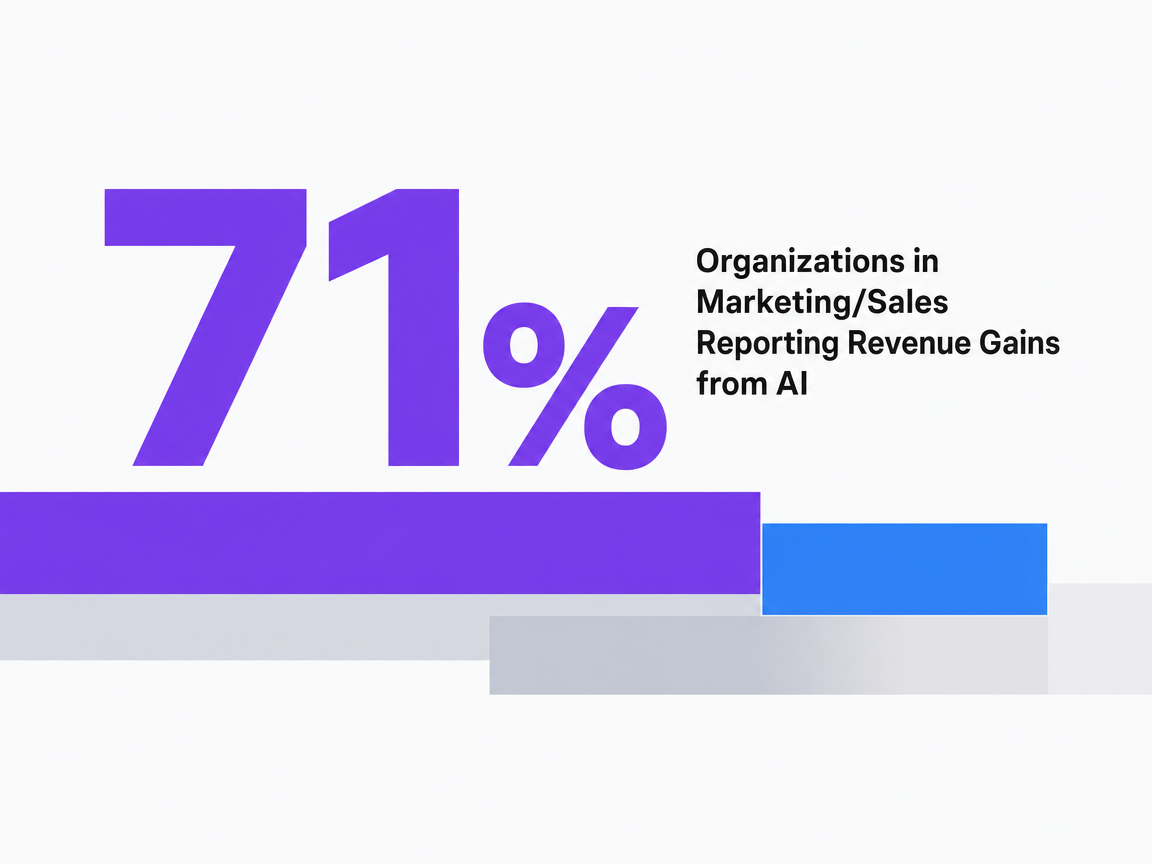 Organizations in Marketing/Sales Reporting Revenue Gains from AI
Organizations in Marketing/Sales Reporting Revenue Gains from AI
From Rankings to Qualified Demand: A New Measurement Stack
What Rankings Stop Telling a Client When AI Compresses the SERP
A position-one ranking used to end the conversation. It no longer does. When an AI Overview answers the query above the blue links, a top rank can coexist with a click decline, and the ranking screenshot stops predicting revenue. Clients notice the disconnect before agencies do.
The ranking itself has not lost meaning. What has changed is its correlation to sessions, and the correlation of sessions to qualified demand. A dental group ranking first for a procedural query may see the answer summarized in-panel, with citation credit but fewer visits. A law firm ranking for a jurisdictional question may lose informational traffic while retaining the high-intent consultation clicks that actually convert. Both patterns look identical in a rank tracker and completely different in a revenue report.
The practical consequence for the delivery team is that ranking dashboards need a second layer: which queries still drive clicks, which are being answered upstream, and which are producing branded follow-up searches days later. Without that layer, the QBR becomes a defense of numbers the client cannot connect to pipeline.
The Four Metrics That Belong in the Next QBR
Four metrics reframe the conversation from visibility to contribution. Each maps to a client question an SEO director should be able to answer inside sixty seconds.
- Assisted revenue is the first. Not last-click SEO conversions, which understate the channel by design, but the pipeline value of deals that touched an organic session or an organic-sourced call in the attribution window. This is the number that survives contact with a CFO.
- Qualified calls come second. For law firms, dental groups, home services, behavioral health, and senior living, the phone is still the conversion event, and call intelligence that scores intent, service line, and geography turns raw call volume into a defensible SEO output.
- Branded search lift is third. When AI answers reduce mid-funnel clicks, the compensating signal is whether the brand's own name is being searched more often after exposure. Branded query volume, measured week over week against content and PR cadence, isolates demand creation from demand capture.
- AI-citation share is fourth. When an AI Overview, AI Mode, or third-party assistant answers a query in the client's category, how often is the client cited, and against which competitors? This is the new share-of-voice metric, and it can be sampled manually before any vendor tool is required.
The traditional stack of rankings, sessions, and domain authority does not disappear. It becomes diagnostic rather than declarative. Rankings explain why assisted revenue moved. Sessions explain why qualified calls rose. Domain metrics explain why AI-citation share is compounding or stalling. The QBR agenda inverts: outcome metrics lead, diagnostic metrics support.
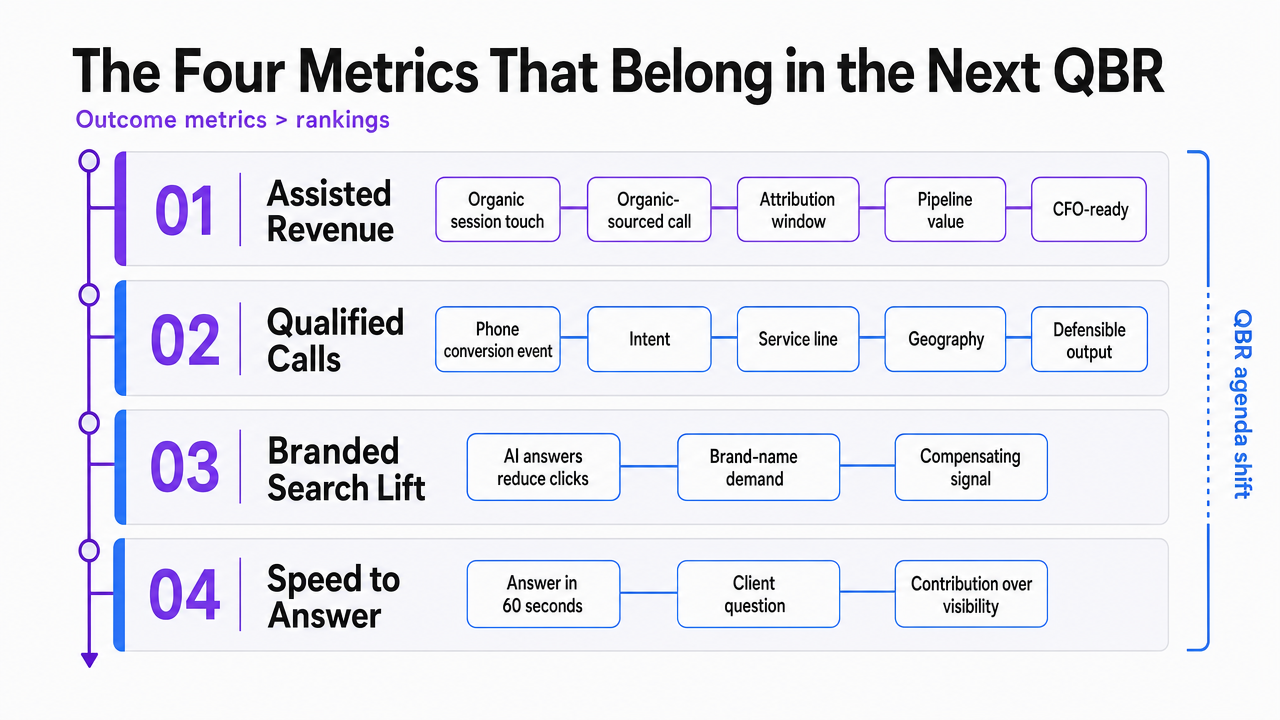 Visualize the four outcome metrics that replace rankings in the QBR agenda, directly supporting the section's core framework
Instrumenting Branded Demand and AI-Citation Share Without New Vendors
Most agencies already own the data required to report the new stack. The instrumentation gap is analytical, not technical.
Branded demand can be pulled from Google Search Console by isolating queries containing the client's brand tokens, then charting week-over-week volume against publishing and off-site activity. A rising branded curve during a flat non-branded period signals that upper-funnel work is producing demand even when AI answers compress mid-funnel clicks. Assisted revenue can be constructed inside GA4 using data-driven attribution and a defined organic path, joined to the client's CRM export by session ID or UTM. Qualified calls require call-tracking numbers already deployed on most service-business sites; the scoring layer is a rubric, not a product.
AI-citation share is the one metric without a mature tool market. A manual sampling protocol works: define twenty to fifty priority queries per client, run them monthly across the assistants the client's buyers actually use, and log whether the client, a competitor, or neither is cited. It is tedious. It is also the metric clients ask about most, and being the agency with an answer is a retention advantage.
Experience full-scale AI SEO execution firsthand
Test real-time, AI-driven SEO delivery workflows on your own active projects for one week.
Approval-First Production: Where AI Compounds Specialist Judgment
Why Bulk Publishing Loses on Both Ranking and Trust
The volume play is already producing thin returns. Widespread AI adoption is not producing widespread material gains, as evidenced by the sub-5% revenue gains reported by 71% of marketing and sales adopters 1. Undifferentiated output is the reason.
Bulk publishing fails on two fronts at once. Ranking systems reward pages that resolve a query with evidence a human reviewer stood behind; unedited AI drafts tend to hedge, repeat, and cite nothing verifiable, which shows up as flat rankings and rising bounce. Client trust fails on the second front. When a general counsel or CMO reads a page their firm published and cannot identify the human who approved it, the retention conversation gets shorter. Volume without approval discipline turns SEO into a cost center the client can defend cutting.
The Signal-to-Approval Loop: Recommendation, Reasoning, Sign-Off, Execution
The production model that survives contact with a client book runs as a four-step loop, and each step has a named owner.
- Signal comes first. Live data from the client account, qualified calls, booked appointments, cost per lead, ranking movement, AI-citation samples, feeds a prioritization layer that ranks what to work on this week rather than what the annual plan said in January.
- Recommendation with reasoning comes second. Every proposed brief, technical fix, or link target arrives with the evidence behind it: the query it addresses, the competitor gap it closes, the revenue path it touches, and the source material it draws on. A recommendation without reasoning is not reviewable, and unreviewed work is what clients now catch.
- Human sign-off is third, and it is the step most agencies underweight. A specialist reviews the reasoning, edits the substance, checks the sources, and either approves, revises, or rejects. This is where authorship is established, which matters for both quality and the copyright posture covered later.
- Execution is fourth. Once approved, publishing, submission, and monitoring can run automatically, with the KPI impact routed back into the signal layer for the next cycle.
Nothing ships without a name attached to it. That single rule is what separates AI-assisted production from bulk generation, and it is what a client-side procurement team will ask about first.
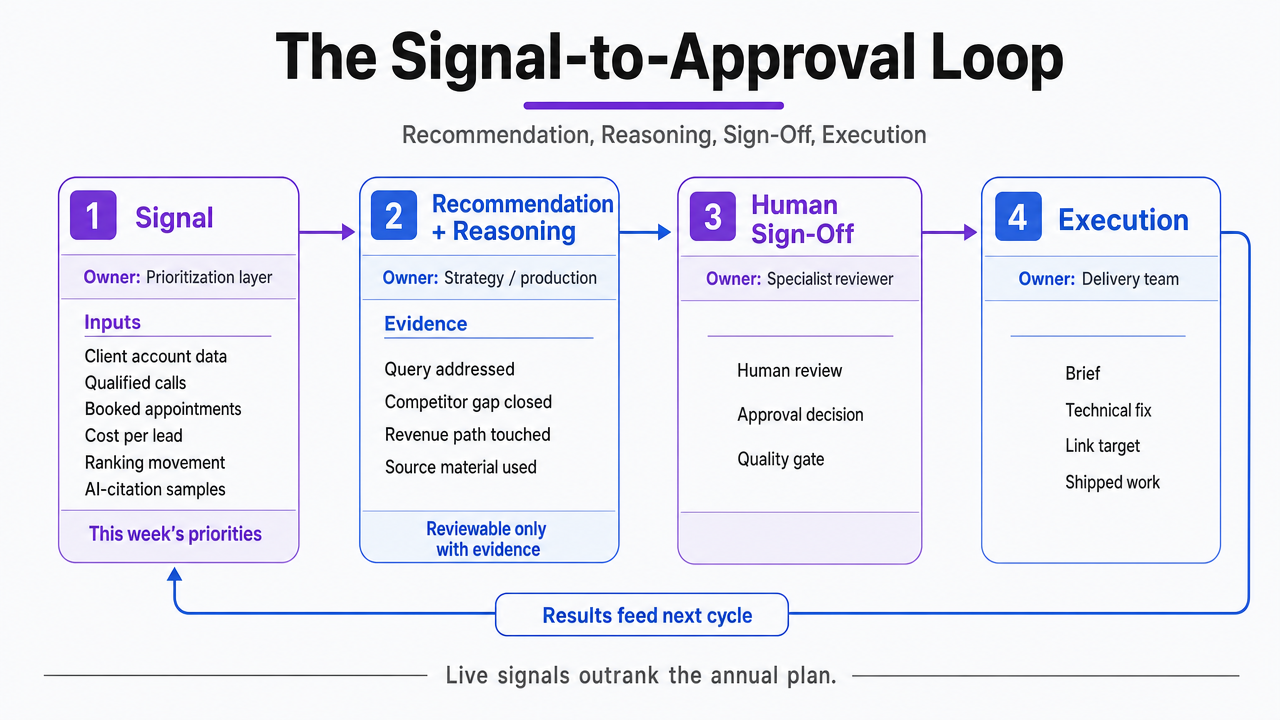 Illustrate the four-step production loop described in the section, with each step and its owner clearly identified
Where Specialists Must Stay in the Chair
Three decisions do not delegate to a model, regardless of how mature the tooling gets.
- Strategic prioritization is the first. Ranking a client's opportunities against pipeline math, competitive posture, and seasonality is a judgment call informed by the account manager's read of the business, not a scoring function. AI can surface options; a specialist chooses.
- Substantive editorial judgment is the second. On a personal injury landing page, a behavioral health intake page, or a senior living community page, the difference between a claim that converts and a claim that draws a demand letter is a specialist reading the draft against the client's evidence and the regulatory posture of the vertical.
- Client-facing interpretation is the third. When assisted revenue drops in a month, someone has to explain why in a room, tie it to a specific cause, and defend the next move. That conversation is not a report. It is the reason the retainer renews.
Scaling a Client Book Without Scaling the Team
The Labor Reality Behind the Hiring Freeze
Senior SEO specialists are not arriving at the pace client books grew. The Bureau of Labor Statistics projects 6% employment growth for advertising, promotions, and marketing managers from 2025 to 2035, with roughly 36,300 openings annually on average across the whole occupation 3. That is a wide-frame figure covering every marketing management role in the economy, not a count of qualified SEO leads an agency can recruit in a given quarter. The narrower reality is that the pool of specialists who can run technical audits, edit legal or medical content, and defend a QBR is smaller than the demand.
Agencies responding by freezing headcount and stretching existing specialists produce the predictable outcome: senior time drifts toward client-facing rework, and junior time drifts toward tasks that AI now does faster. The scaling question is not whether to hire. It is what the specialist chair is actually for.
Where the Hours Actually Go Across a 30-Client Book
The consolidation math only works when the delivery team knows which workstreams AI absorbs, which stay with specialists, and which grow under governance. The table below is a template, not a benchmark. Hours per client per month are variables the delivery team should populate from its own time-tracking data, then multiply by blended specialist rate. The BLS labor context above frames why hiring more of those specialists to fill the gap is not the default answer 3.
| Workstream | Traditional hrs/client/mo | AI-assisted hrs/client/mo | Oversight direction |
|---|---|---|---|
| Keyword and query research | [agency variable] | [agency variable, typically lower] | Flat |
| Brief creation | [agency variable] | [agency variable, typically lower] | Flat |
| Drafting | [agency variable] | [agency variable, typically lower] | Flat |
| Technical audits | [agency variable] | [agency variable, typically lower] | Flat |
| Internal linking | [agency variable] | [agency variable, typically lower] | Flat |
| Substantive review and edit | [agency variable] | [agency variable, often higher per page] | Increases |
| Client approval and revision cycles | [agency variable] | [agency variable] | Increases |
| Reporting and QBR prep | [agency variable] | [agency variable, lower for data pull, higher for interpretation] | Mixed |
| Governance: authorship log, source register, substantiation file | Often absent | [agency variable, new line item] | Increases |
Two patterns show up once a delivery team runs this against its own data. Production workstreams compress meaningfully, which is where the 15-to-40-client scaling story lives. Review, approval, and governance expand, which is where the specialist chair earns its rate. The net is not that agencies need fewer people. It is that the mix shifts toward judgment and documentation, and the retainer needs to price that mix rather than the old page-count math.
If the Delivery Org Runs Multiple Practice Lines or Franchise Portfolios
The math changes for agencies serving multi-location operators, franchise systems, or DSO and practice-group portfolios. The scope shift matters because the unit of work is no longer a single client site. It is a parent brand plus dozens or hundreds of location pages, each with its own reviews, service menu, and regulatory posture.
AI absorbs the location-level production load that made portfolio SEO uneconomical under the old model: templated but non-duplicative location pages, per-location schema, review response drafting, and geo-specific brief generation. What does not delegate is the substantiation layer. A 40-location home services brand publishing service-area pages needs the same authorship and endorsement discipline covered in the governance section, applied at forty times the volume. The specialist chair moves up a level, from writing individual pages to designing the template, the review rubric, and the exception queue that surfaces the pages a human must read before they ship.
Explore Scalable SEO Operations with AI-Driven Oversight
See how leading agencies are automating SEO workflows to deliver measurable revenue impact—without expanding headcount or sacrificing strategic control. Request a walkthrough tailored to your current delivery model.
Governance as Margin: FTC, Copyright Office, and NIST in One Stack
Authorship and Client IP Transfer After the Copyright Office's Part 2
The Copyright Office's Part 2 report resolves a question that had been sitting under most agency master service agreements without an answer. Copyright protects original expression created by a human author even when the work includes AI-generated material, but purely AI-generated output, or output where the human did not control sufficient expressive elements, is not protected 2. Prompting alone does not clear the bar; the Office was explicit that the human contribution must extend to creative arrangement, selection, or modification of the expressive result 9.
That has direct consequences for the IP transfer clause most agencies still copy from a 2019 template. If a client's landing page or pillar article was drafted by a model with a specialist doing only light cleanup, the agency may not own copyright it can transfer. The fix is not legal theater. It is a production record: which specialist made which substantive edits, what expressive choices they made, and when. The authorship log covered later in the governance stack is what turns an AI-assisted deliverable into a copyrightable work the client can actually be assigned.
Endorsements, Reviews, and Local Pages Under the 2024 FTC Rule
The FTC's final rule on fake reviews and testimonials went into effect October 21, 2024, and it prohibits creating, selling, buying, or disseminating reviews the business knew or should have known were fake or false, including AI-generated reviews that misrepresent nonexistent consumers or nonexistent experience 7. It also prohibits incentives conditioned on a particular sentiment. For agencies running reputation programs for law firms, dental groups, home services, behavioral health, and senior living, the rule closes off tactics that were already risky and were becoming trivially cheap to automate.
The adjacent rule set matters just as much. 16 CFR Part 255 requires that endorsements reflect the honest experience or opinion of the endorser, and that material connections a consumer would not reasonably expect are clearly disclosed 5. FTC guidance reinforces that disclosure alone does not cure a false or unsubstantiated claim 4. The operational consequence for local SEO teams is a substantiation file per client: the source of every testimonial, the relationship behind every endorsement, and the evidence behind every performance claim on a service or location page. If a model drafts a testimonial block, the review step verifies that the underlying review exists, was given by a real customer, and is presented without misleading edits.
A NIST-Aligned Control Set Agencies Can Sell Into Procurement
NIST released the Generative Artificial Intelligence Profile, NIST AI 600-1, on July 26, 2024, extending the broader AI Risk Management Framework with risks and mitigations specific to generative systems 6. It is voluntary guidance, not law. That is precisely why it is useful in a procurement conversation: enterprise buyers and their security teams already recognize it, and an agency that can map its production controls to the framework enters a shorter due-diligence cycle than one that cannot.
The four RMF functions map cleanly onto artifacts an agency SEO team can produce today.
Govern : Becomes a written AI use policy covering approved models, prohibited uses, and escalation paths.
Map : Becomes a per-client risk register noting vertical-specific exposures such as HIPAA-adjacent content for behavioral health or advertising rules for law firms.
Measure : Becomes the authorship log, source register, and substantiation file already required by the copyright and FTC posture above, plus periodic accuracy sampling of published pages.
Manage : Becomes an incident log with defined response steps when a hallucinated claim, unverified endorsement, or unapproved page reaches production.
None of this is new work invented for compliance. It is the same review discipline that produces better rankings, packaged in a form a client's general counsel can read in one sitting.
Model Selection and Training-Data Posture for Enterprise Clients
The Copyright Office's Part 3 report analyzes whether existing copyright doctrines, licensing markets, and fair-use principles adequately address generative-AI training, and it treats the question as unresolved and actively contested 10. Enterprise clients read that and ask a narrower question during procurement: which model is drafting our content, what was it trained on, and what is the agency's exposure if a training-data claim reaches our brand?
The defensible answer names the models in use, favors providers that publish training-data posture and offer indemnification, and documents the retrieval sources feeding client-specific prompts. Pairing that with the authorship log from the copyright section gives the agency a two-page answer to a due-diligence questionnaire that would otherwise stall a renewal.
Proving Revenue Contribution to a Skeptical Client
The skeptical client is not asking for better reporting. They are asking whether the retainer produces revenue they can defend to a board, and the answer has to arrive in the language of pipeline, not the language of visibility. Three moves shorten that conversation.
- Tie every published asset to a specific revenue path before it ships. A pillar page addresses a query that produced X qualified calls last quarter at Y average deal value; a technical fix restores indexation on Z high-intent templates. The reasoning attached to each approved recommendation, established in the production loop covered earlier, becomes the audit trail the client's finance team asks for later.
- Report against the four-metric stack, not the ranking dashboard: assisted revenue, qualified calls, branded search lift, and AI-citation share, with rankings and sessions demoted to diagnostic support.
- Run a quarterly counterfactual. Isolate one service line or one geography where SEO investment paused or scaled, and show the branded demand curve and qualified-call trend against the active book.
Clients renew when the number they see matches the number their CFO tracks. That is what the approval-first model, run by platforms such as Vectoron, is built to produce.
Frequently Asked Questions
References
- 1.Economy | The 2025 AI Index Report | Stanford HAI.
- 2.Copyright and Artificial Intelligence.
- 3.Advertising, Promotions, and Marketing Managers.
- 4.Endorsements, Influencers, and Reviews - Federal Trade Commission.
- 5.16 CFR Part 255: Guides Concerning the Use of Endorsements and Testimonials in Advertising.
- 6.AI Risk Management Framework.
- 7.Federal Trade Commission Announces Final Rule Banning Fake Reviews and Testimonials.
- 8.CHAPTER 4: Economy.
- 9.Copyright Office Releases Part 2 of Artificial Intelligence Report.
- 10.Part 3: Generative AI Training pre-publication version.