
Key Takeaways
- Google Search Console remains the unlimited free baseline for every client account, feeding query and page data into every downstream research, brief, and reporting tool 15, 16.
- Bing Webmaster Tools instruments Microsoft-side query behavior and Copilot-adjacent visibility signals with no caps, closing a gap most agencies never bothered to measure 16.
- Ahrefs Webmaster Tools delivers free backlink data and site audits for verified properties, handling recurring technical work until enterprise-scale URL counts force a paid seat 15, 16.
- Semrush's free tier allows roughly 10 requests per day, which suits competitor spot-checks and pitch prep but collapses under portfolio-wide keyword refreshes 16.
- Ubersuggest's three-searches-per-property daily cap works as the junior ideation layer when specialists run disciplined weekly sessions instead of always-on lookups 17.
- ChatGPT's free tier scaffolds briefs, synthesizes SERP intent, and generates FAQs from GSC exports, provided outputs pass through a human editor before drafting 11, 17.
- Claude's long context window absorbs full competitor articles and style guides in one conversation, making it the honest free choice for voice-consistent editing 17.
- AIOSEO Analyzer grades title tags, headings, internal links, and keyword placement inside WordPress, moving on-page checks from a specialist checklist to an editor-visible surface 16, 17.
- seo.ai scores citation density, statistic coverage, and quote attribution — the signals Princeton's GEO-BENCH linked to AI visibility lifts up to 40% 13, 16, 17.
- Looker Studio delivers unlimited dashboards and viewer seats for client reporting, though predictive intelligence and natural-language insights still require paid AI reporting platforms 19, 20.
- An approval-first orchestration layer sits above the eleven free tools to sequence outputs, enforce human sign-off, and preserve the hybrid workflow the research links to better SEO outcomes 11.
Why agency margin now depends on assembling a free AI stack
The economics of SEO delivery have quietly inverted. Forrester's 2024 agency survey found that 61% of U.S. advertising agencies are already using generative AI and another 30% are actively exploring use cases, leaving only 9% on the sidelines 9. When 91% of the competitive set has moved, free AI tooling stops being a pilot line item and becomes a baseline cost structure. Agency heads who still price retainers against pre-2023 labor assumptions are subsidizing the margin of every competitor who has already rebuilt their workflow.
The pressure is arriving at the same moment the underlying market is expanding. Coherent Market Insights projects the global SEO software and tools segment to grow from roughly USD 97 billion in 2026 to USD 239 billion by 2033, a 12.5% CAGR 2. More client demand, more content surfaces to optimize for, and more measurement work per account — without a matching supply of senior SEO talent to staff against it.
That gap is why the assembly question matters more than the tool question. Independent testing of more than 60 SEO tools identified only 17 with genuinely usable free tiers — not credit-card trials, not seven-day demos 15. A separate 2026 review confirmed that Google Search Console, Bing Webmaster Tools, Ahrefs Webmaster Tools, AIOSEO Analyzer, and seo.ai each maintain permanent free access with defined caps 16. Assembled deliberately across foundation data, research, briefs, GEO, and reporting, those tiers absorb the recurring workload that eats delivery margin. Picking a favorite free tool solves nothing. Building a governed five-stage stack — with a human approval gate at the top — is the move that resets the cost curve for agency heads managing more accounts than headcount.
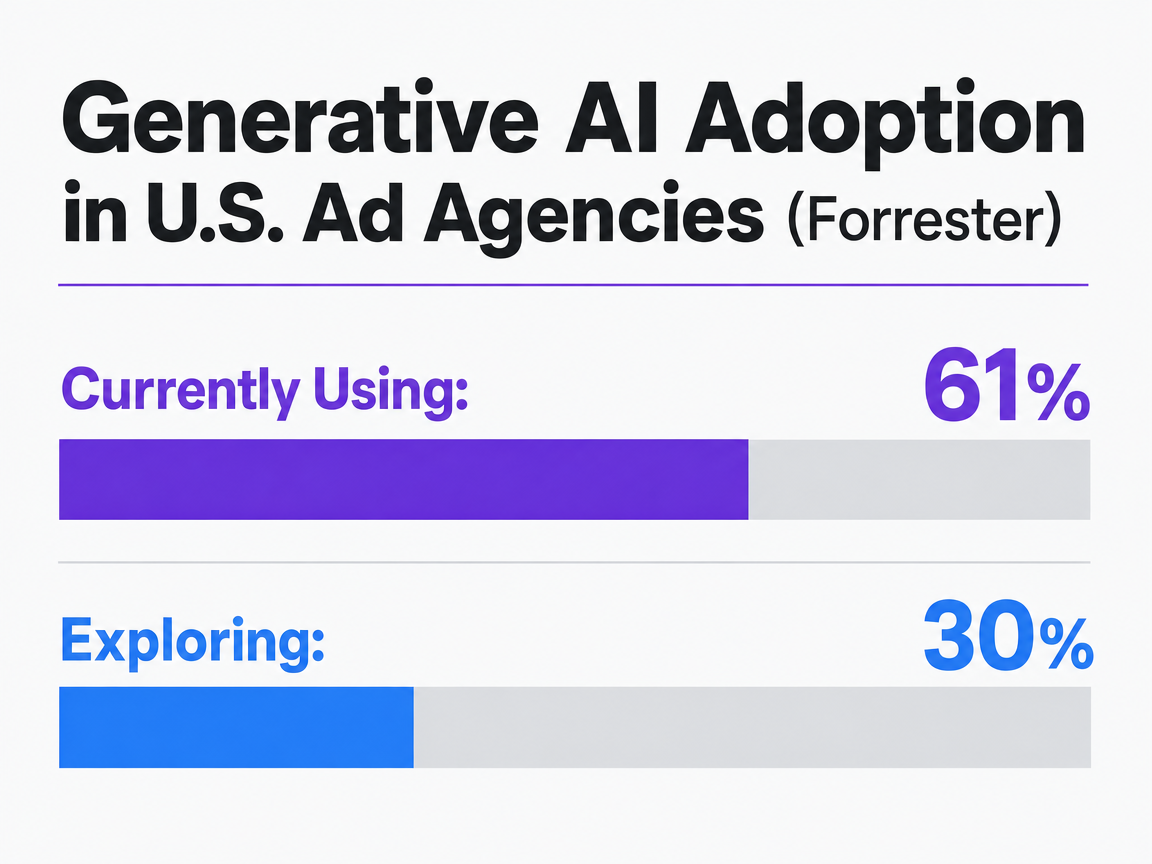 Generative AI Adoption in U.S. Ad Agencies (Forrester)
A breakdown of generative AI adoption among U.S. advertising agencies, showing the percentage currently using it versus those exploring its use cases.
The five-stage workflow the free stack has to cover
Agency heads who try to pick a single "best" free SEO AI tool are solving the wrong problem. The recurring delivery workload splits into five stages, and no free tier covers more than one or two of them well. The stack has to be assembled deliberately across foundation data, keyword and topic research, brief generation and drafting, GEO and AEO optimization, and client reporting — with a human approval gate sitting on top of the whole pipeline.
The urgency behind that assembly is measurable. In the 2024 State of Marketing AI survey, only 20% of respondents said more than a quarter of their marketing tasks were already intelligently automated, while 78% expected to cross that threshold within three years 10. That is the gap agency margins have to close. Closing it by hiring more specialists inverts the economics. Closing it by buying a full paid stack per client wipes out retainer profitability. Closing it by stitching free tiers across the five stages — and governing the outputs through a single approval loop — is the operational path that actually works.
The sections that follow map the 11 free picks to those five stages, name each free-tier ceiling, and flag the break point at which paid tooling becomes unavoidable.
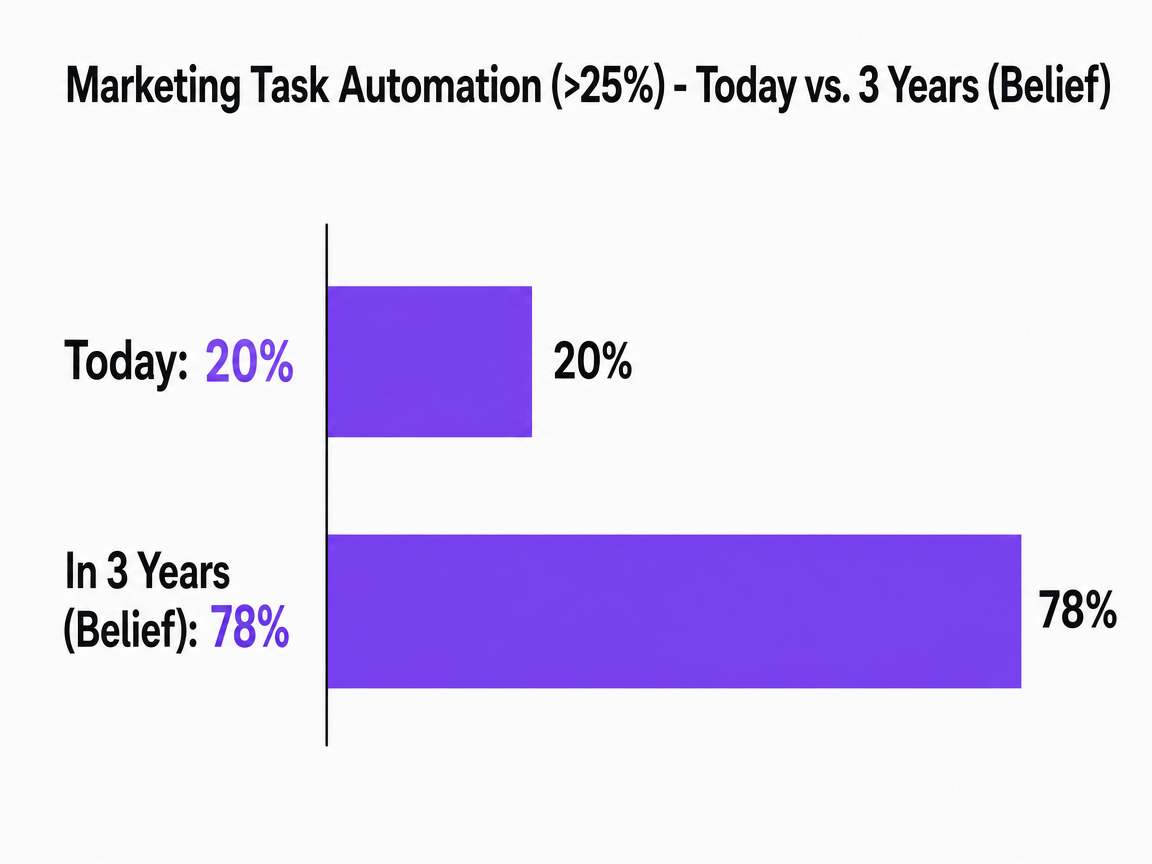 Marketing Task Automation (>25%) - Today vs. 3 Years (Belief)
A comparison of the percentage of marketers who say more than 25% of their tasks are automated by AI today versus the percentage who believe that will be the case in three years.
Stage 1 — Foundation data: the three free tools every client account already needs
Google Search Console: the unlimited free baseline
Google Search Console is the only tool in this article that carries a five-star rating with unlimited usage in independent testing of more than 60 SEO tools 15. That distinction matters because every downstream free tier — keyword research caps, brief scoring, GEO checks, reporting dashboards — assumes the delivery team already has clean query, impression, and page-level data flowing in. GSC is the source of that data, and a separate 2026 review confirms it remains "100% free, forever" with no query ceiling and no seat cap 16.
For agency heads, the operational point is that GSC scales linearly with client count. Adding the 25th or 40th verified property costs nothing and adds no query throttling. The friction is verification hygiene and permissioning — not licensing. Delivery leads who pipe GSC data into Looker Studio at onboarding get a portable, non-vendor-locked performance record for every account, which becomes the reference dataset for every AI research and reporting tool stacked above it.
Bing Webmaster Tools: free Copilot-adjacent keyword data
Bing Webmaster Tools earns its place in the free stack for one specific reason: it delivers keyword research data and Copilot-adjacent visibility signals with "100% free, no caps" access 16. That is the only free source of Microsoft-side query behavior an agency can wire into a client account without a paid seat.
The strategic read for SEO directors managing portfolios with B2B, enterprise, or older-demographic client bases is that Bing traffic is often underweighted in reporting because agencies never bothered to instrument it. Bing Webmaster Tools closes that gap with the same permanent free access model as GSC, and its keyword research module supplements the Semrush and Ubersuggest daily caps discussed later. Verify every client property at onboarding, even when Bing traffic looks trivial. The Copilot answer surface is not going backward, and free instrumentation now avoids paid retrofits later.
Ahrefs Webmaster Tools: free backlink and site audit coverage
Ahrefs Webmaster Tools is the free-tier entry that most closely resembles a paid enterprise SEO platform, and it appears on multiple curated 2026 lists of tools with genuinely free access rather than credit-card trials 15, 16. Verified property owners get backlink data, a site audit crawler, and top-keyword reporting without a paid Ahrefs seat.
The break point at portfolio scale is that free access is scoped to properties the agency can verify, and audit crawl depth is capped well below the paid tier. For most sub-500-page client sites, the free crawler catches the technical issues that actually move rankings — indexation blocks, redirect chains, broken internal links. For enterprise clients with faceted navigation or six-figure URL counts, the free tier stops being sufficient and the first paid Ahrefs seat becomes the honest recommendation. Until then, Ahrefs Webmaster Tools handles the recurring audit and backlink work that would otherwise consume a full Semrush or Moz license per account.
Stage 2 — Keyword and topic research inside free-tier caps
Semrush free tier: where the daily query cap actually breaks
Semrush retains a permanent free plan in 2026, and independent review confirms it belongs on the shortlist of tools that offer real free access rather than a credit-card trial 16. The account gives delivery leads roughly 10 free requests per day across the keyword overview, domain overview, and position tracking modules — enough to spot-check a competitor gap or vet a new client pitch without opening a paid seat.
The break point is arithmetic. Ten queries a day covers one or two active research sessions per specialist, not portfolio-wide keyword refreshes. An SEO director running research across even 8–10 client accounts exhausts the daily cap before lunch, and the tool silently degrades to blurred metrics rather than a hard error. Semrush earns its slot for the discovery moments that matter — a new competitor emerging in a client's SERP, a suspicious ranking drop, a pitch requiring a fast landscape read. For recurring keyword refreshes across the portfolio, this tier is not the workhorse. Junior specialists should be routed to Ubersuggest for daily volume, with Semrush reserved for the queries that need its data depth.
Ubersuggest free plan: the cheap ideation layer for junior specialists
Ubersuggest's free plan sits below Semrush in data depth but well above it in daily volume, which is exactly the trade agency heads want for the ideation layer. The account permits a fixed number of free daily searches — typically three per property — covering keyword ideas, content suggestions, and basic SERP analysis without a paid seat 17.
For a small team of junior specialists building topic clusters across a dozen client accounts, this cap is workable when the workflow is disciplined: one bulk ideation session per client per week, exported to a shared brief document, then closed. The failure mode is treating Ubersuggest as an always-on research surface. Delivery leads who let specialists run one-off searches across the day burn the cap on questions GSC could have answered for free. Position Ubersuggest as the first stop for topic expansion after a GSC query pull has already narrowed the field, and the free tier absorbs the recurring ideation load that would otherwise justify a Semrush or Ahrefs upgrade.
Experience full-scale AI SEO workflows risk-free
Test real client campaigns in production and measure workflow gains before committing.
Stage 3 — Briefs and drafting: AI models as the content research desk
ChatGPT free tier: brief scaffolding, outline logic, and SERP synthesis
ChatGPT's free tier earns its place in the agency stack as the brief-scaffolding layer that sits between keyword research and the drafting queue. A 2026 review of free AI SEO tools names it among the top picks with no credit card required, alongside Google Search Console and Claude 17. For SEO directors, the operational use is narrower than the marketing hype suggests: outline logic, SERP intent synthesis from pasted competitor headers, entity mapping, and first-pass FAQ generation from GSC query exports.
The free tier's ceiling is model access, not query volume. Specialists get the current default model with rate limits that tighten during peak hours, and image generation and advanced reasoning modes gate quickly. For brief production across a portfolio, that ceiling is workable when the workflow is standardized — one reusable brief prompt per content type, fed with GSC data and competitor headers, output routed to a human editor for approval before it reaches a client draft. Fully automated brief-to-publish loops are the failure mode the research literature explicitly warns against: hybrid AI-plus-human workflows outperform fully automated ones for SEO outcomes 11.
Claude free tier: long-context editing and voice-consistent drafting
Claude's free tier complements ChatGPT rather than duplicating it, and independent 2026 curation lists both models as core free picks for agency content workflows 17. The differentiator for SEO directors is context window depth. Specialists can paste a full 3,000-word competitor article, a client's existing top-ranking page, and a style guide into a single conversation without truncation — the input volume that breaks most free chat interfaces.
That capacity makes Claude the honest choice for two recurring agency tasks: editing long-form drafts against a client's established voice, and rewriting sections that AIOSEO Analyzer flags for readability or entity coverage. The free tier caps message volume per session and throttles during peak load, which is manageable for editing but not for bulk generation. Delivery leads should route drafting through Claude only after a human editor has approved the brief. The hybrid model — AI drafts, human approves — remains the SEO-safe path 11.
AIOSEO Analyzer: free on-page grading inside the CMS
AIOSEO Analyzer closes the drafting stage by grading on-page SEO where the content actually lives — inside WordPress. A 2026 review of genuinely free tools identifies it alongside GSC and seo.ai as a permanent free foundation for multi-client delivery 16, and a separate curated list names it among the top free AI SEO software picks with no credit card required 17. The analyzer scores title tags, meta descriptions, heading structure, internal links, and keyword placement per URL.
For agency heads running WordPress-heavy portfolios, the operational value is that on-page grading moves from a specialist checklist to a plugin surface every content editor already sees. The free tier covers the core analyzer without the schema, redirect, and sitemap automations reserved for the paid version. Route it as the final gate before a draft leaves the editing stage — after Claude has polished the copy and before the reporting layer picks up the published URL.
Stage 4 — GEO and AEO: optimizing for AI answer surfaces
seo.ai free tier: GEO scoring and citation-density checks
seo.ai closes the gap most agency stacks still ignore: whether a client's page is structured to be quoted by generative search, not just ranked in classic SERPs. The tool appears on the 2026 shortlist of AI SEO software with genuine free access — no credit card, no time-boxed trial — alongside GSC, ChatGPT, and Claude 17, and a separate curated review confirms its permanent free tier as a foundation for multi-client delivery 16. Free-tier users get GEO scoring against a page's citation density, statistic coverage, quote attribution, and entity clarity — the exact signals the Princeton GEO-BENCH study measured across 10,000 queries and found could lift AI visibility by up to 40% when applied to source content 13.
For SEO directors, the operational point is that GEO scoring exposes a defect classic on-page tools do not surface. A page can pass AIOSEO's readability and heading checks, rank on page one, and still get skipped by ChatGPT and Google's AI Overviews because it lacks the sourced statistics and named-expert quotes generative models prefer to cite. Route seo.ai after AIOSEO, before publish. Specialists paste the URL, read the citation-density and statistic-coverage flags, and hand the draft back to the editor with a specific list of authoritative sources to add — not a vague "needs more depth" note. The free tier caps analyses per day, so batch GEO checks across a client's priority pages rather than spot-checking one URL at a time.
Stage 5 — Reporting: Looker Studio as the free client-facing layer
Looker Studio is the only fully free reporting surface that appears alongside paid suites like Ahrefs and Semrush in independent 2026 comparisons of AI SEO reporting tools, with a starting price of "Free" and no time-boxed trial 19. For agency heads, that placement matters because reporting is the workflow stage where paid tooling costs escalate fastest. AgencyAnalytics, Semrush, and similar white-label reporting platforms charge per client account or per user, and portfolios of 20+ accounts turn reporting into a five-figure annual line item 18.
The operational move is to pipe GSC, GA4, and Bing Webmaster Tools data directly into a single Looker Studio template, then clone it per client. One template maintained centrally, verified data sources refreshed automatically, and white-label headers swapped per account. The free tier carries no dashboard cap and no viewer-seat cap, which is what lets it scale to a portfolio without a licensing conversation.
Two failure modes limit the free reporting layer. Predictive intelligence and natural-language insight generation — the features that explain why metrics moved and recommend next actions in plain English — sit inside paid AI reporting tools, not Looker Studio 20. And clients accustomed to Ahrefs-style visuals may push back on the aesthetic. Neither breaks the stack. Delivery leads write the narrative layer manually, using GSC exports and the GEO scores from earlier stages, and route every client-facing report through a human approver before send.
See How Leading Agencies Deploy AI-Powered SEO Workflows at Scale
Connect with our team for a walkthrough of unified AI-driven SEO management—eliminating manual overhead while maintaining strategic oversight across multi-client portfolios.
What the free stack replaces: the consolidation math
The free stack is only useful if agency heads can name what it takes off the paid line. Mapping each workflow stage against the paid alternative — and the point at which the free tier stops carrying the load — turns this from a tool list into a delivery-cost decision. The paid pricing column below is qualitative because the supplied research does not publish per-seat rates for every named platform; delivery leads should slot in their own current invoices to run the math against real numbers.
| Workflow Stage | Free Tool Pick | Free-Tier Ceiling | Paid Equivalent | Break Point |
|---|---|---|---|---|
| Foundation data | Google Search Console, Bing Webmaster Tools, Ahrefs Webmaster Tools | Unlimited GSC and Bing access; Ahrefs free scoped to verified properties 15, 16 | Enterprise SEO suites with per-seat licensing | Faceted or six-figure-URL sites where free crawl depth caps out |
| Keyword and topic research | Semrush free, Ubersuggest free | ~10 Semrush requests/day; ~3 Ubersuggest searches/property/day 16, 17 | Mid-tier SaaS keyword platforms | Portfolio-wide refreshes across 8+ accounts in one session |
| Briefs and drafting | ChatGPT free, Claude free, AIOSEO Analyzer | Model rate limits at peak; AIOSEO core analyzer only 16, 17 | Per-seat AI content platforms and premium CMS SEO plugins | Bulk drafting without human editor gating outputs |
| GEO and AEO | seo.ai | Daily analysis cap per account 16, 17 | Content optimization platforms with GEO-style visibility tracking 21 | Batch AI-visibility scoring across every priority URL in a portfolio |
| Client reporting | Looker Studio | No dashboard or viewer-seat cap 19 | White-label reporting suites charging per client account 18 | When clients demand predictive intelligence or natural-language insights 20 |
Read across the rows: the free stack absorbs the recurring workload in every stage except predictive reporting and enterprise-scale crawling. Agency heads should price the first paid upgrade against the row that breaks first for their portfolio — not against the tool with the loudest sales team.
If you manage multiple client accounts: where the free stack breaks first
Scope shift: this section is written for delivery leads running 15+ client accounts, not solo consultants. At portfolio scale, the free stack does not fail evenly. Three specific ceilings hit before the others, and knowing the order lets agency heads plan the first paid upgrade against the constraint that actually blocks delivery.
Semrush breaks first. The daily request cap disappears the moment a delivery lead tries to run competitor gap analysis across the portfolio in a single sitting, and independent testing confirms the free tier's practical use is spot-checks, not recurring research 16. Ubersuggest breaks second, because the three-searches-per-property model assumes disciplined weekly ideation windows that most junior specialists do not maintain 17. When those two caps hit, keyword research quality degrades before anyone notices — briefs get thinner, and rankings drift.
The third break is reporting sophistication. Looker Studio scales to unlimited dashboards and viewers 19, but predictive intelligence and natural-language insight generation live inside paid AI reporting platforms 20. Clients paying premium retainers eventually ask why metrics moved, and manual narrative writing consumes senior time. The honest sequence: upgrade keyword research first, GEO scoring second, reporting AI third. Foundation data and drafting tiers hold longest.
The 12th entry: an approval-first orchestration layer above the free stack
The eleven picks above solve stage-level problems. None of them solve the coordination problem that emerges when a delivery lead has to route GSC data into a brief, run it through ChatGPT and Claude, grade it in AIOSEO, score it in seo.ai, and land it in a Looker Studio report — for 20 clients, every week. That coordination overhead is where free-stack economics quietly leak back into staffing costs, and it is the twelfth entry in any honest 2026 shortlist.
The research literature is direct about why this layer matters. A hybrid model combining AI efficiency with human oversight yields better SEO outcomes than fully automated or fully manual workflows 11. Approval-first orchestration platforms — Vectoron is one, positioned as an AI marketing execution platform with specialist strategists coordinated through a unified Command Center — operationalize that finding by ranking recommendations, routing every output for human sign-off, and executing only approved work across the stack. The free tools handle the tasks. The orchestration layer handles the governance, the sequencing, and the audit trail that keeps senior specialists in the loop without keeping them in every draft.
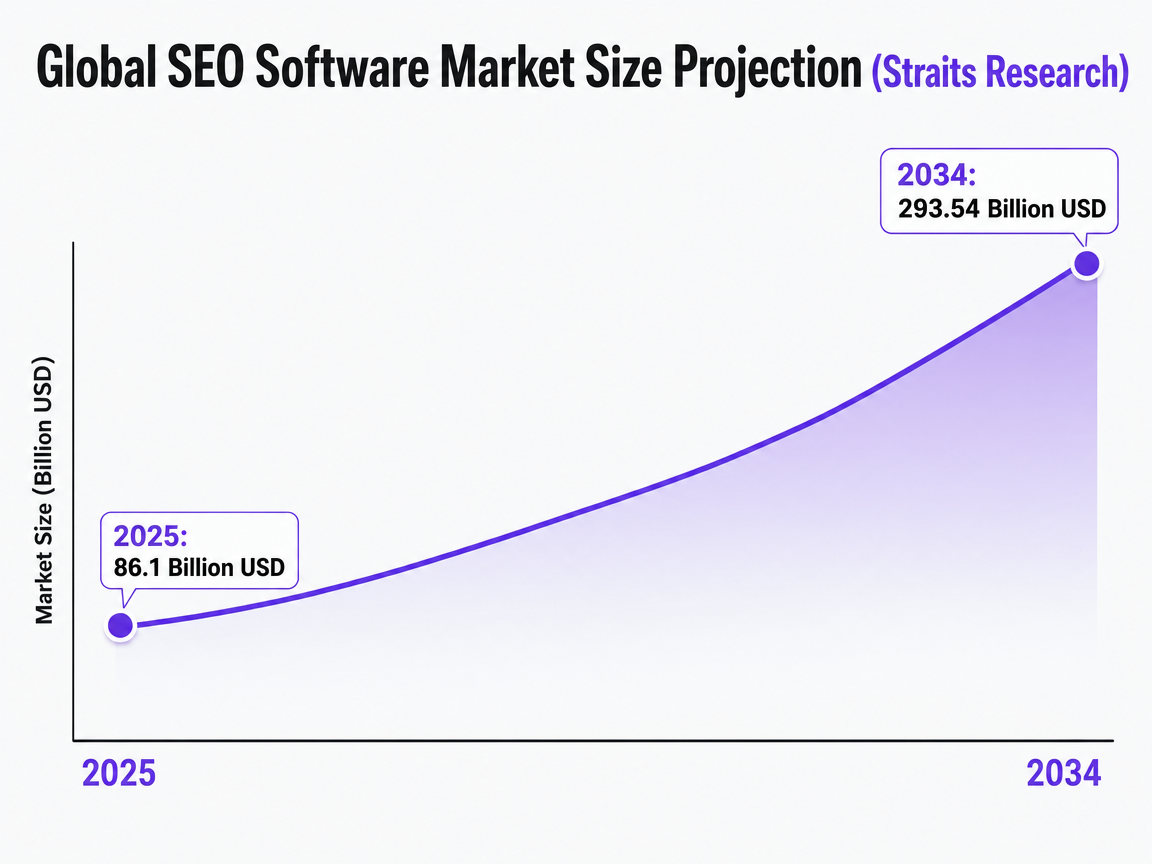 Global SEO Software Market Size Projection (Straits Research)
Shows the projected growth of the global SEO software market from 2025 to 2034, according to Straits Research.
Frequently Asked Questions
References
- 1.SEO Software Market Size, Share, Growth, Analysis, 2034.
- 2.Search Engine Optimization (SEO) Software & Tools Market.
- 3.SEO Software Market Size, Share and Trends 2026 to 2035.
- 4.SEO Software Market Statistics, Key Players | Forecast.
- 5.SEO Software Market Size, Growth, Forecast Till 2032.
- 6.SEO Software Market Trends & Growth Analysis 2035.
- 7.SEO Software Market Size, Share & Growth Report.
- 8.Search Engine Optimization (SEO) Services Market Size.
- 9.Forrester: 91% of US ad agencies are currently using, exploring generative AI.
- 10.The 2024 State of Marketing AI Report from Marketing AI Institute and Drift.
- 11.AI-Based Automated Content Generation and its SEO Implications.
- 12.The Original GEO Paper: Princeton & IIT Delhi Study Findings and Playbook.
- 13.GEO Experimental Techniques: 9 Research-Backed Methods That Boost AI Visibility 40% (Princeton Study).
- 14.Optimizing for the Artificial Intelligence Driven Search Era: An Integrated Framework for SEO, GEO, and AEO.
- 15.40+ Free AI SEO Tools: I Tested Every One (17 Actually Work).
- 16.Free AI SEO Tools: 12 Worth Using (No Trials, Just Free).
- 17.The 12 Best Free AI SEO Software Tools to Use in 2026.
- 18.10 Powerful AI SEO Reporting Tools For 2026.
- 19.Best AI SEO Reporting Tools in 2026.
- 20.Dashthis Ai: Best Value For....
- 21.15 best SEO content optimization tools for agencies (2026).