
Key Takeaways
- Google Search Console's generative AI performance report delivers first-party impressions and clicks from AI Overviews, replacing third-party tools that only infer citations from scraped SERPs 4.
- Google Trends validates rising demand before briefing by comparing up to five terms, letting strategists downgrade declining topics and prioritize growing ones 5.
- The Rich Results Test catches malformed JSON-LD and missing properties pre-publish, serving as a single-URL sign-off gate for structured data QA 6.
- Google's AI content and generative AI policy pages function as a free audit rubric, distinguishing acceptable AI assistance from scaled low-value output that risks spam penalties 1, 3.
- Google's 2026 AI optimization guide works as an anti-hack checklist, debunking vendor pitches around llms.txt, entity engineering, and paid AI Overview optimization subscriptions 4.
- Bing Webmaster Tools' AI Performance preview surfaces Copilot citations and Bing summary appearances, covering a Microsoft-side footprint Google-only monitoring misses 13.
- Bing Chat content controls give agencies a NOARCHIVE lever to opt regulated or proprietary client content out of Microsoft's AI answers and training data 12.
- Google's Helpful Content self-assessment converts into an editor checklist that gates AI-assisted drafts on original information, added value, and transparent disclosure 2.
- Vectoron fills the orchestration gap the free tools leave open, consuming first-party signal and routing approved work across multi-client portfolios 9.
Why free first-party tools now outrank paid AI SEO gadgets
Every SEO vendor pitch in 2026 opens with the same slide: an adoption curve. Stanford HAI reports that generative AI use in at least one business function jumped from 33% of surveyed organizations in 2023 to 71% the following year, based on its 2025 AI Index survey of enterprise respondents 8. This rapid adoption has led to a proliferation of AI SEO tools promising AI Overview optimization, entity engineering, and llms.txt tuning for a monthly fee.
However, many of these tools repackage data that agencies can access for free through first-party consoles. Google's 2026 guide on generative AI features advises publishers to disregard many emerging "AEO" and "GEO" tactics, clarifying that AI Overviews operate on the same retrieval and ranking systems as traditional search results 4. There is no distinct AI search algorithm to manipulate; instead, the focus should be on understanding and utilizing existing Search Console reports.
For agency heads, "free" now refers to first-party consoles from Google and Microsoft that provide ground-truth data, along with official guidance documents that serve as audit rubrics. The following nine tools were selected based on their ability to provide genuine, free insights without the limitations of throttled "free tiers" or repackaged third-party data.
How this shortlist was filtered
Three criteria were applied to select these tools:
- Genuinely free, without credit card requirements, trial timers, or restrictive "free tiers" that cap usage. This eliminated most AI SEO platforms marketed as free but unsuitable for agency-wide standardization across multiple client accounts.
- The tools needed to provide first-party or authoritative data, rather than simply repackaging information already available from paid platforms like Ahrefs or Semrush. For example, a Search Console report offers unique data directly from Google, unlike a free keyword tool that scrapes the same clickstream data as paid alternatives.
- The tools had to align with Google's 2026 guidance, which states that most AEO and GEO tactics do not influence AI Overview visibility because generative features use the same ranking systems as classic search 4. Any tool primarily focused on "AI answer optimization" was excluded.
The remaining selection includes a mix of consoles, validators, policy documents, and one workflow layer.
Test AI-driven SEO workflows with real outputs
Evaluate real-time SEO content production on your live site before making a commitment.
The 9 free AI SEO tools worth agency shelf space
Google Search Console generative AI performance report
The Google Search Console generative AI performance report is a crucial free tool for monitoring content visibility within AI Overviews and other generative experiences 4. This report provides first-party data on impressions and clicks from AI features, which cannot be replicated by third-party "AI answer tracking" tools that infer citations from scraped SERPs.
For agencies, this report offers direct evidence of AI visibility, neutralizing pitches from paid tools that claim to track AI answers. However, Search Console access is property-based, meaning agencies managing multiple clients need to verify each property individually. While bulk data export to BigQuery is free, it also requires per-property setup. Agencies should establish a verification and permissions playbook before integrating this report into client reporting.
Google Trends for demand validation before briefing
Google Trends is an invaluable tool for validating demand and identifying rising search interest before content creation. It allows strategists to compare up to five terms simultaneously, helping to refine content briefs by prioritizing topics with growing interest and downgrading those with declining search volume 5.
While effective for comparative validation, Google Trends lacks an API for bulk export, saved comparison sets, or client-account structures. Agencies managing numerous briefs may need to create internal tracking sheets to manage Trends validation. Integrating Trends as a mandatory checkpoint within the brief template can help manage its five-term limit, ensuring prioritization rather than frustration.
Rich Results Test for pre-publish structured data QA
Google's Rich Results Test is a free, browser-based tool that helps prevent structured data errors by checking how rich results can be generated from a page's structured data 6. It provides a preview of eligible enhancements and a list of warnings, making it essential for pre-publish QA.
This tool helps agencies confirm that Google can parse structured data markup, catching issues like malformed JSON-LD or missing properties before a page is indexed. Its limitation is that it tests one URL at a time and only live URLs or pasted code. For large-scale audits, agencies often combine it with the URL Inspection API in Search Console, but it remains the go-to for single-URL sign-off.
Google's AI content and generative AI policy pages as an audit rubric
Google's documentation on AI content and generative AI policies serves as a free audit rubric for agencies. These pages clarify that appropriate AI use is not against Google's guidelines, and AI-generated content is evaluated for helpfulness and originality 1. They also warn against generating low-value content at scale, which could violate spam policies 3.
Agencies can translate this guidance into a pre-publish checklist: does the content offer original information, is the production scale justified by unique value, and is AI use transparent where beneficial to readers? This rubric acts as a cost-free insurance against Google's scaled content abuse policy, which can impact an entire domain.
Google's 2026 AI optimization guide as an anti-hack checklist
Google's 2026 AI optimization guide directly addresses common client questions about llms.txt files, entity engineering, and paid "AI Overview optimization" subscriptions. It explains that generative AI features rely on existing search ranking systems and advises publishers to ignore many emerging AEO and GEO tactics 4.
This guide can be used as a client-facing "anti-hack" checklist. When clients inquire about vendor pitches promising AI answer placement, agencies can refer them to the guide to debunk such claims. The document also directs users to the Search Console generative AI report for accurate AI visibility measurement, shifting the conversation from tool purchases to data analysis. Agencies should monitor updates to this guide quarterly, as changes often spark new client questions.
Bing Webmaster Tools AI Performance report
Microsoft's AI Performance report in Bing Webmaster Tools, currently in public preview, shows how publisher content appears across Microsoft Copilot, AI-generated summaries in Bing, and partner integrations 13. This report is valuable even for Google-dominant clients, as Copilot answers surface citations within Windows, Edge, Office, and third-party applications.
Agencies that only monitor Google-side AI visibility miss a significant Microsoft-side footprint, especially for B2B and enterprise clients using Copilot. Similar to Search Console, access is per-property, and the preview status means schema and export options are still evolving. Agencies should use it as a monitoring baseline and defer heavy reporting integration until general availability, but the unique first-party view of AI answer performance justifies the verification effort.
Bing Chat content controls (NOCACHE / NOARCHIVE) for client visibility policy
Microsoft's documentation on Bing Chat controls provides agencies with a policy lever for client content. Content without NOCACHE or NOARCHIVE directives may be included in Bing Chat answers, while NOARCHIVE content will be excluded from answers and training data 12. This allows agencies to make explicit decisions about content inclusion.
For clients in regulated industries or with proprietary research, the NOARCHIVE meta tag offers a free way to opt out of Microsoft's AI answer surface. Conversely, for clients prioritizing AI answer visibility, the absence of these directives is the correct default. Agencies should integrate a Bing content-control field into client onboarding to ensure a deliberate choice, avoiding blanket policies that may not suit all clients.
Helpful Content self-assessment as a free AI-draft quality gate
With 66% of organizations globally piloting or using generative AI in marketing and CX operations 11, a human-readable rubric is essential for quality control. Google's Helpful Content page provides such a rubric for free, outlining questions publishers should ask before publishing content 2.
These questions—whether the content provides original information, substantial coverage, and added value, and if AI-generated content is transparent—can be converted into a quick review checklist for editors. Agencies can implement a two-column review sheet for AI-assisted briefs, requiring editors to detail original information, added value, and necessary AI disclosure. This acts as a cost-effective quality gate, directly addressing Google's penalties for low-quality content.
Vectoron as the workflow layer that consumes free-tool signal
While the aforementioned tools generate valuable signal, they do not manage workflow, approvals, or connect insights to shipped pages across multiple client accounts. This is where a workflow layer like Vectoron becomes essential. Vectoron is an approval-first AI marketing execution platform that coordinates specialist strategists for content, SEO, PPC, backlinks, social, and call intelligence through a Command Center, ensuring human sign-off before execution.
McKinsey's 2025 state-of-AI report highlights that AI is frequently used for content support in marketing strategy, drafting, idea generation, and knowledge presentation 9. Vectoron's role is to consume first-party signals from tools like Search Console, Trends, Rich Results Test, and Bing Webmaster Tools, rank recommendations against client KPIs, and route approved work to production. Although Vectoron is a paid solution, it is included here because the free tools alone cannot be scaled effectively across a portfolio without such a workflow layer. This trade-off is crucial for agencies to understand when evaluating their tech stack.
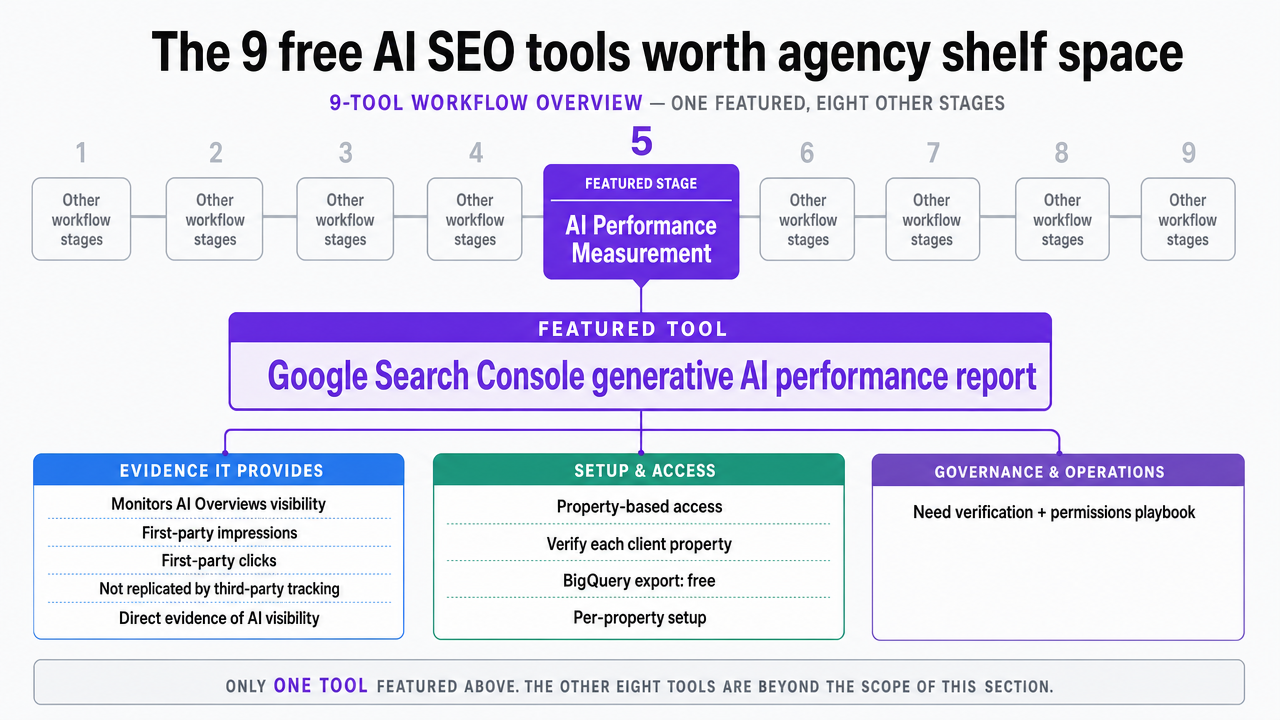 Give readers a scannable overview of the nine tools grouped by the workflow stage each supports, reinforcing the article's core list structure
Free-tool coverage vs. agency workflow gaps
Mapping the nine tools against the four stages of an agency SEO production loop reveals their coverage and limitations. Google's 2026 AI optimization guide emphasizes that generative AI visibility is measured within Search Console, anchoring the monitoring column 4.
| Tool | Workflow stage | Client-scale ceiling | Signal type |
|---|---|---|---|
| Search Console generative AI report | Monitoring | Per-property verification, no multi-account view | First-party |
| Google Trends | Research | Five-term Explore limit, no bulk export | First-party |
| Rich Results Test | QA | One URL per test, no bulk validator | First-party |
| AI content policy pages | Production, QA | No ceiling, quarterly re-read cadence | Authoritative guidance |
| 2026 AI optimization guide | Research, monitoring | No ceiling, edition drift | Authoritative guidance |
| Bing AI Performance report | Monitoring | Per-property, preview schema | First-party |
| Bing Chat content controls | Production policy | Per-client onboarding decision | Authoritative guidance |
| Helpful Content self-assessment | QA | Per-draft editor review | Authoritative guidance |
| Workflow layer (paid) | Orchestration across all stages | Priced per portfolio | Derivative + routing |
This mapping highlights that while free tools adequately cover research and QA, their per-property or per-URL limitations necessitate manual repetition at scale. Crucially, no free tool addresses the orchestration layer, which is why agencies often invest in a workflow solution or develop one internally.
See How Top Agencies Automate SEO Delivery—Without Sacrificing Oversight
Request a walkthrough of unified AI workflows proven to streamline content approvals, reduce manual effort, and increase campaign throughput for agency teams managing multiple client accounts.
If you manage a multi-property portfolio: where free tiers break
For agencies managing 20 to 60 verified properties, the free tools, while powerful individually, present significant scaling challenges. Search Console and Bing Webmaster Tools require per-property verification, leading to linear increases in setup time and permissions overhead. There is no consolidated view across clients, and the generative AI performance report also operates on a per-property basis 4. While bulk BigQuery export can help, it still requires individual property configuration. Similarly, the Rich Results Test's single-URL validation limits its utility for large-scale migration audits 6.
Google Trends also imposes a research-side ceiling with its five-term comparison limit and lack of saved sets across users 5. The solution for these scaling issues is not another free tool, but rather internal process standardization, such as shared tracking sheets, and a portfolio-level workflow layer that can aggregate first-party signals and route work efficiently.
A production loop that turns free signal into shippable work
The free tools provide four key inputs for agencies:
- Validated demand from Google Trends 5
- Structured data sign-off from the Rich Results Test 6
- Quality gates from the Helpful Content rubric 2
- AI visibility measurement from the Search Console generative AI report and Bing AI Performance preview 4, 13
A production loop can integrate these inputs on a weekly cadence per client property:
- Monday — Read signal: strategists review generative AI reports for impression shifts and cross-check rising Trends queries against editorial calendars.
- Tuesday and Wednesday — Convert signal into briefs, incorporating Helpful Content questions for writers to address proactively.
- Thursday — Drafting and validation, ensuring all structured data pages pass the Rich Results Test before moving forward.
- Friday — Publishing and logging, setting up a clean attribution window for the following week's report.
This systematic approach replaces reliance on vendor dashboards with first-party data, human review, and a scalable, repeatable rhythm.
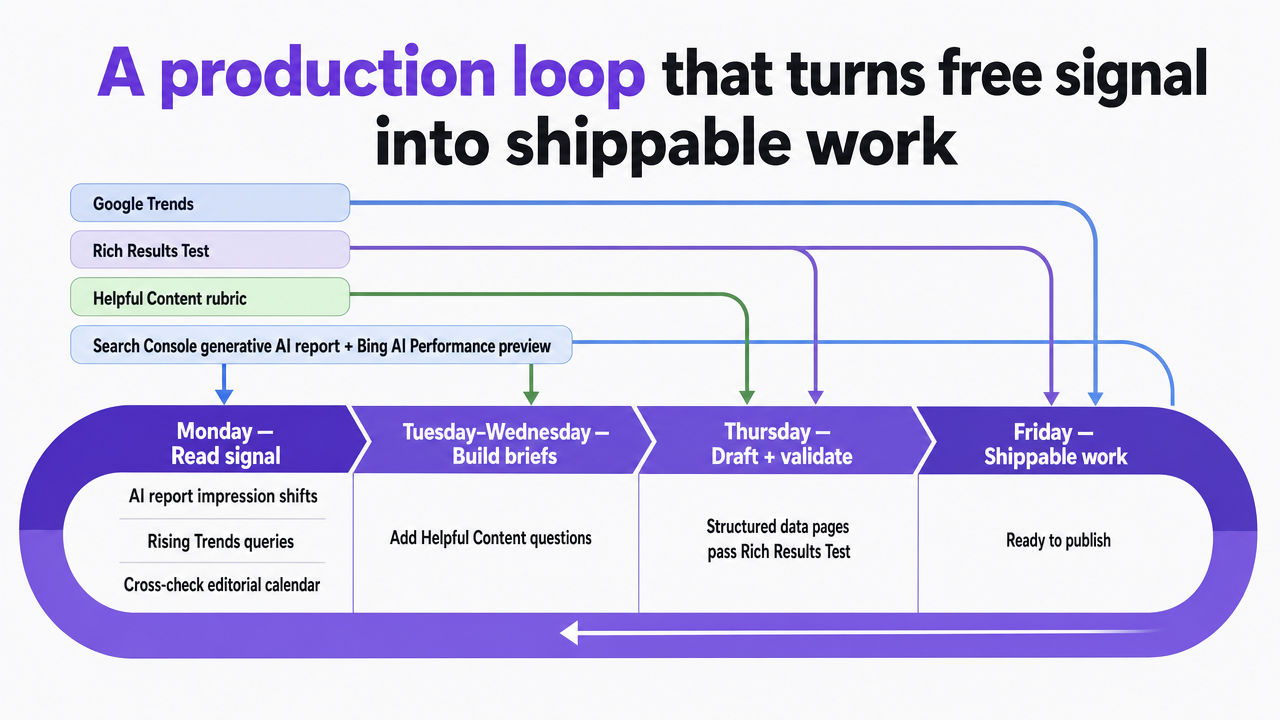 Visualize the weekly Monday-to-Friday production loop described in the section so readers can operationalize the free-tool stack
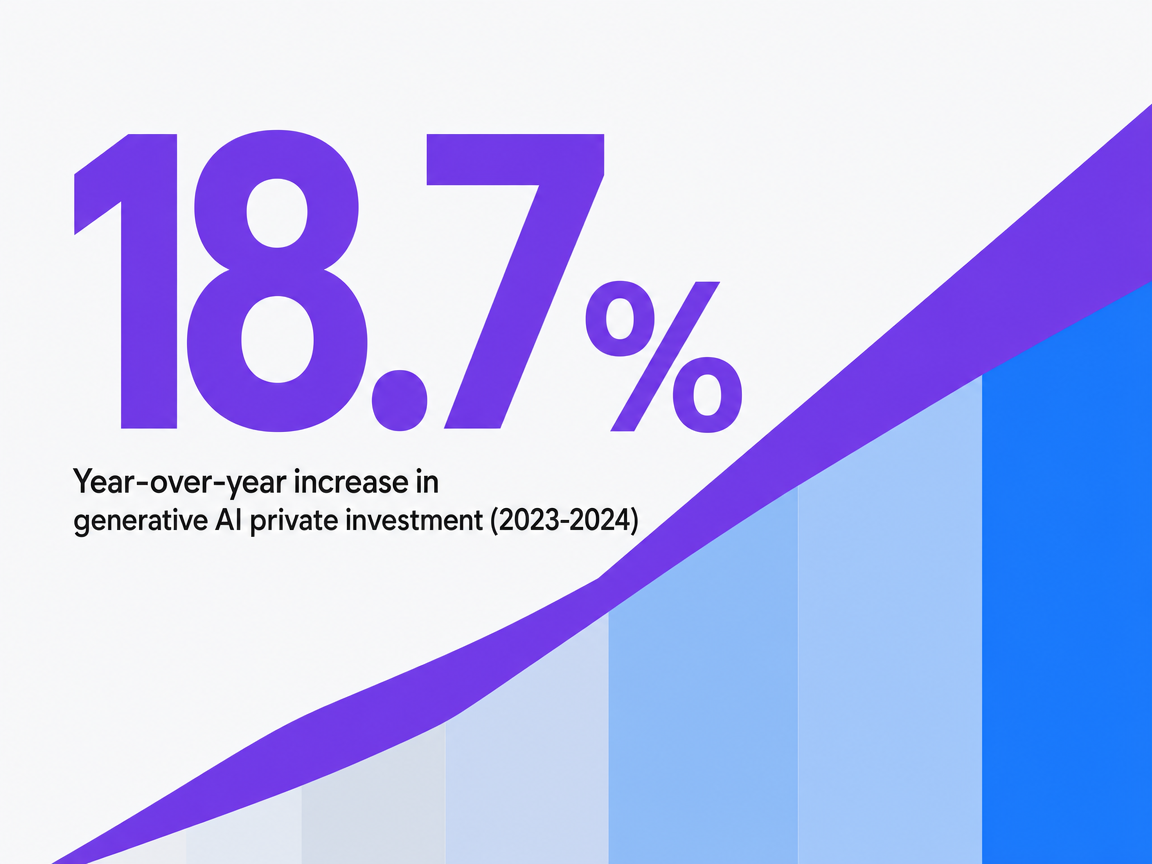 Year-over-year increase in generative AI private investment (2023-2024)
Year-over-year increase in generative AI private investment (2023-2024)
Frequently Asked Questions
References
- 1.Google Search's guidance about AI-generated content.
- 2.Creating Helpful, Reliable, People-First Content.
- 3.Google Search's Guidance on Generative AI Content on Your Website.
- 4.Google's Guide to Optimizing for Generative AI Features on Google Search.
- 5.Get started with Google Trends.
- 6.Rich Results Test - Google Search Console.
- 7.The 2025 AI Index Report | Stanford HAI.
- 8.AI Index 2025: State of AI in 10 Charts.
- 9.The state of AI in 2025: Agents, innovation, and transformation.
- 10.2025 Digital Trends Report.
- 11.2025 AI and Digital Trends: Data and Insights.
- 12.Announcing new options for webmasters to control usage of their content in Bing Chat.
- 13.Introducing AI Performance in Bing Webmaster Tools Public Preview.