
Key Takeaways
- SEO writing splits into five layers—drafting, strategy, originality, editing, and accountable authorship—and only drafting has been meaningfully absorbed by generative models.
- Articles published without a named human editor making substantive expressive choices cannot be registered or defended as owned brand assets 1, 8.
- Cost-per-first-page-ranking, not cost-per-published-page, is the metric that justifies keeping writers and reallocating their hours from drafting to editing and originality 7, 9.
- Multi-location portfolios benefit most from the hybrid model, where editing hours scale linearly while AI handles drafting, preventing near-duplicate pages and unverifiable local claims 4.
The Emory Finding That Reframes the Writer Question
In a controlled experiment by researchers at Emory University's Goizueta Business School, lightly edited AI-generated articles achieved first-page Google rankings approximately 80% of the time. In contrast, articles written by human SEO experts reached the first page only 22% of the time. This AI-assisted approach also reduced production time by over 90% 7. This stark comparison is prompting many marketing leaders to reassess their writer headcount strategies.
It's important to note the scope of this finding. The Emory study is a single academic experiment, not a comprehensive market audit. The 80% success rate specifically applies to AI drafts that underwent light human editing before publication, not to raw AI output pushed directly to a CMS. While the human contribution was minimal, it was not absent.
The study does not suggest that writers are obsolete. Instead, it indicates that first-draft production is no longer the primary area where writers generate value. The AI drafts still required human editing, and this editorial layer was crucial for achieving page one rankings.
For content marketing managers, the strategic question is therefore more nuanced than headlines might suggest. It's not about whether to retain writers, but rather which aspects of a writer's job contribute significant value in a workflow where a model can produce a competent draft in minutes. Conversely, it identifies which tasks have become commoditized and no longer justify professional rates. This analysis will explore this decomposition, the legal constraints involved, and the operating model adopted by mature AI users.
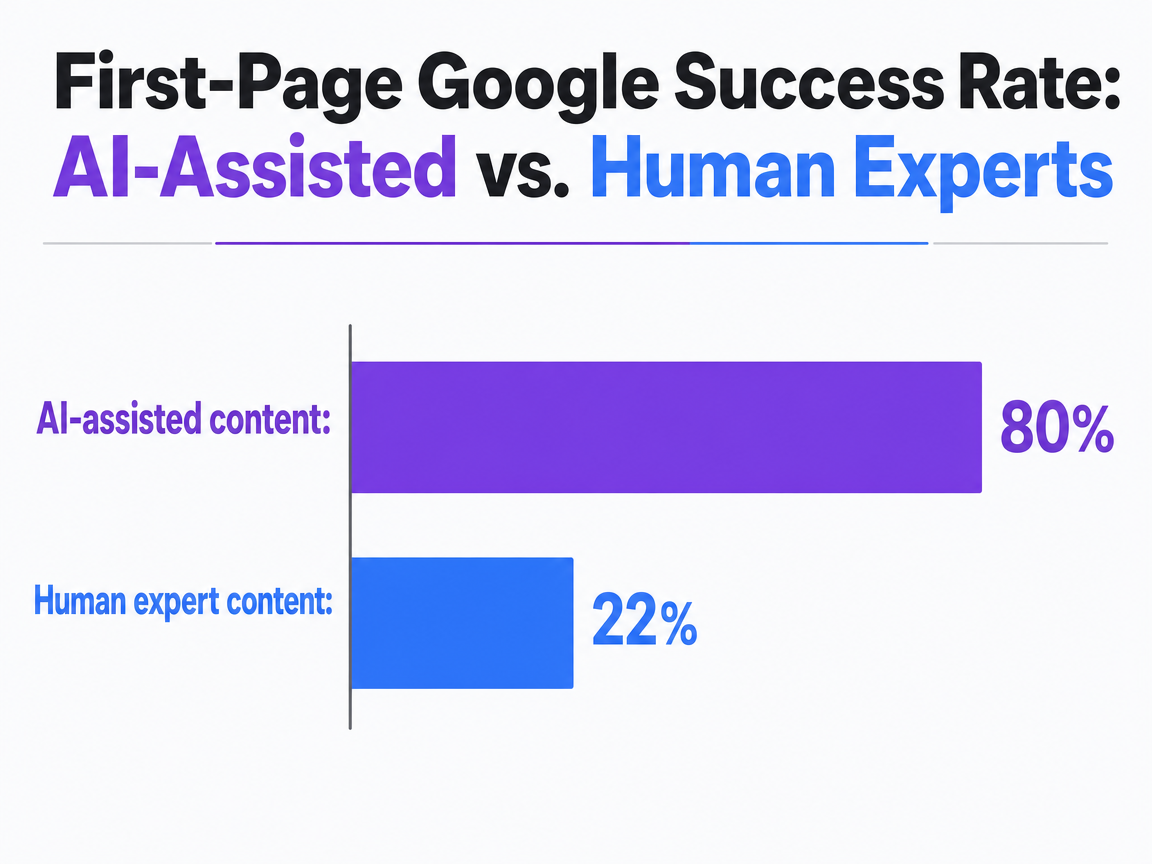 First-Page Google Success Rate: AI-Assisted vs. Human Experts
Comparison of the percentage of articles achieving a first-page Google ranking in an experiment comparing lightly-edited AI content with content written by human SEO experts.
What SEO Writers Actually Do, Decomposed
Five Layers Inside a Single Job Title
The term "SEO writer" encompasses at least five distinct work products. Understanding these separate layers is essential to determine which tasks a language model can effectively handle.
The first layer is drafting: transforming a brief into coherent paragraphs, headings, and transitions. This is the most visible output and what most people envision when they think of a writer's job. It is also the layer where generative models perform most competently.
The second layer is strategy: this involves selecting topics, identifying target search intents, positioning the content within a cluster, and developing angles to outperform competitors. Strategy occurs before drafting and determines the commercial viability of the finished article.
The third layer is originality: incorporating proprietary data, specific customer examples, novel arguments, or unique observations that only an insider would possess. Originality makes an article citable and distinct, rather than easily replaceable.
The fourth layer is editing: this includes fact-checking claims, refining prose, ensuring brand voice consistency, and correcting errors confidently produced by models. Editing is where quality is established, not merely polished.
The fifth layer is accountable authorship: a named individual who has reviewed the piece, vouches for its claims, and can be identified if regulatory bodies, clients, or copyright authorities inquire about its origin. This layer appears bureaucratic until its importance becomes critical.
Which Layers AI Absorbs and Which It Structurally Cannot
Drafting is the layer most readily absorbed by AI. The Emory experiment showed a 90% reduction in production time when models handled drafting with light human editing 7. McKinsey's analysis of generative AI's marketing value, estimated at 5% to 15% of total marketing spend, largely attributes this to accelerated ideation and drafting cycles 9. A competent language model can generate a serviceable 1,500-word article in minutes, making it difficult to justify professional rates for this specific output.
Strategy and originality are layers that resist AI absorption. While a model can replicate patterns from its training data, it cannot independently decide that a growth-stage brand should target a defensive comparison keyword, nor can it invent the internal benchmark that makes an article uniquely valuable. The U.S. Bureau of Labor Statistics notes that writers who are "adaptable and can work with new technologies" have better career prospects 3, indicating that the enduring value of a writer's role lies upstream of the drafting process.
Editing and accountable authorship resist AI absorption for a different reason: they serve as control layers. The U.S. Copyright Office explicitly states that copyright protects only human authorship and requires disclosure and disclaimer for non-trivial AI-generated content 1. Their 2025 conclusions further clarify that AI outputs qualify for protection only when a human author has contributed sufficient expressive elements, and mere prompting does not meet this standard 8. An organization that publishes content without a named human editor is not only bypassing a cost line but also publishing work it cannot legally own.
The Authorship Constraint Most Content Teams Underweight
Search performance is only one aspect of the AI content discussion. The other crucial element is ownership of the finished article, a point on which the U.S. Copyright Office has been exceptionally clear. Their policy states that copyright protects only human authorship, and applicants submitting works with more than de minimis AI-generated material must disclose and disclaim that content during registration 1. A blog post drafted entirely by a model, published under a brand name, and never reviewed by a human editor, cannot be registered or defended as the brand's intellectual property.
The 2025 conclusions from the Copyright Office's broader AI study further solidified this stance. Generative AI outputs are eligible for copyright protection only when a human author has contributed sufficient expressive elements. Simply providing prompts, regardless of their complexity, does not meet this threshold 8. Prompt engineering is not considered authorship. The Part 2 copyrightability report reiterates this logic: while assistive AI use is acceptable, and human selection, arrangement, or modification of AI output can create protectable expression, the human contribution must be genuine and perceptible within the work itself 2.
For a content marketing manager, the operational implication is precise. Any article a company intends to treat as an owned asset—one that can be syndicated, defended against scrapers, licensed, or used for takedown notices—requires a named human whose editorial contribution shaped the expression on the page. This person does not necessarily need to write the first draft. However, they must make substantive decisions about what to retain, alter, add, and remove. Workflows that publish AI drafts directly, without an editorial hand, produce content the brand cannot fully own. The cost of this exposure may not appear in monthly reports, but it becomes evident when a competitor republishes the work verbatim, and there is no clear authorship record to assert ownership.
Test AI-driven SEO content workflows in real time
Experience measurable improvements in content velocity and SEO output with live publishing during your trial period.
How Mature AI Adopters Actually Run the Workflow
Adoption data suggests that full automation is not the ultimate goal. McKinsey's 2026 State of AI survey revealed that 71% of organizations regularly use generative AI in at least one business function. Among these adopters, 27% mandate that employees review all AI-generated content before use 4. Organizations furthest along in AI adoption have not eliminated human involvement; rather, they have formalized its place within the workflow.
This governance pattern warrants close examination. A quarter of respondents implement full-review policies not because their models are inadequate, but because the potential cost of publishing flawed content—such as an unsubstantiated claim, a hallucinated statistic, or an off-brand tone—outweighs the marginal time saved by skipping review. The remaining adopters employ partial-review or risk-tiered workflows, where higher-stakes content is routed to a named editor, and lower-stakes content undergoes a lighter check. Crucially, neither group operates a workflow where AI drafts are published without human oversight.
Within a content operation, this translates to a specific sequence. A model generates the first draft based on a brief developed by a strategist. A writer or editor then refines the draft: verifying all sourced claims, replacing generic examples with proprietary ones, tightening the voice, and making the substantive editorial choices required to meet the Copyright Office's authorship threshold. An approver signs off before publication, establishing a record of accountable review. In this model, AI accelerates drafting time, while the human layer mitigates risk.
The operational takeaway is that mature adopters view AI review as a control mechanism, not an overhead. Content teams still debating the necessity of an editorial layer are addressing a question that leading organizations have already resolved.
Market Baseline: How Fast Marketing Teams Have Moved
Before delving into the economics of a hybrid workflow, it's helpful to understand the current adoption landscape among peers. Deloitte Digital's research on generative AI in marketing content found that 26% of surveyed marketers were already using generative AI, with an additional 45% planning to implement it by the end of 2024 6. The remaining marketers either had no plans or were undecided. This means roughly seven out of ten marketers were either committed to or actively planning for generative AI tools within a single year.
McKinsey's broader adoption data reinforces this trend from a different perspective. Their 2024 State of AI survey reported regular generative AI use in 65% of organizations overall, with adoption in marketing and sales more than doubling from the previous year and ranking among the most common business functions for the technology 5. This figure further climbed to 71% in the 2026 survey 4. Marketing is not a laggard in this adoption cycle; it is a leader.
The operational interpretation is straightforward. Content marketing managers are largely past the point of deciding whether their function will use generative AI, as this decision has been made across most of their peer group. The remaining decision concerns the nature of the human layer surrounding the AI model and whether the writer function is structured to safeguard output quality and ownership. The subsequent section will explore the costs and benefits of this reallocation.
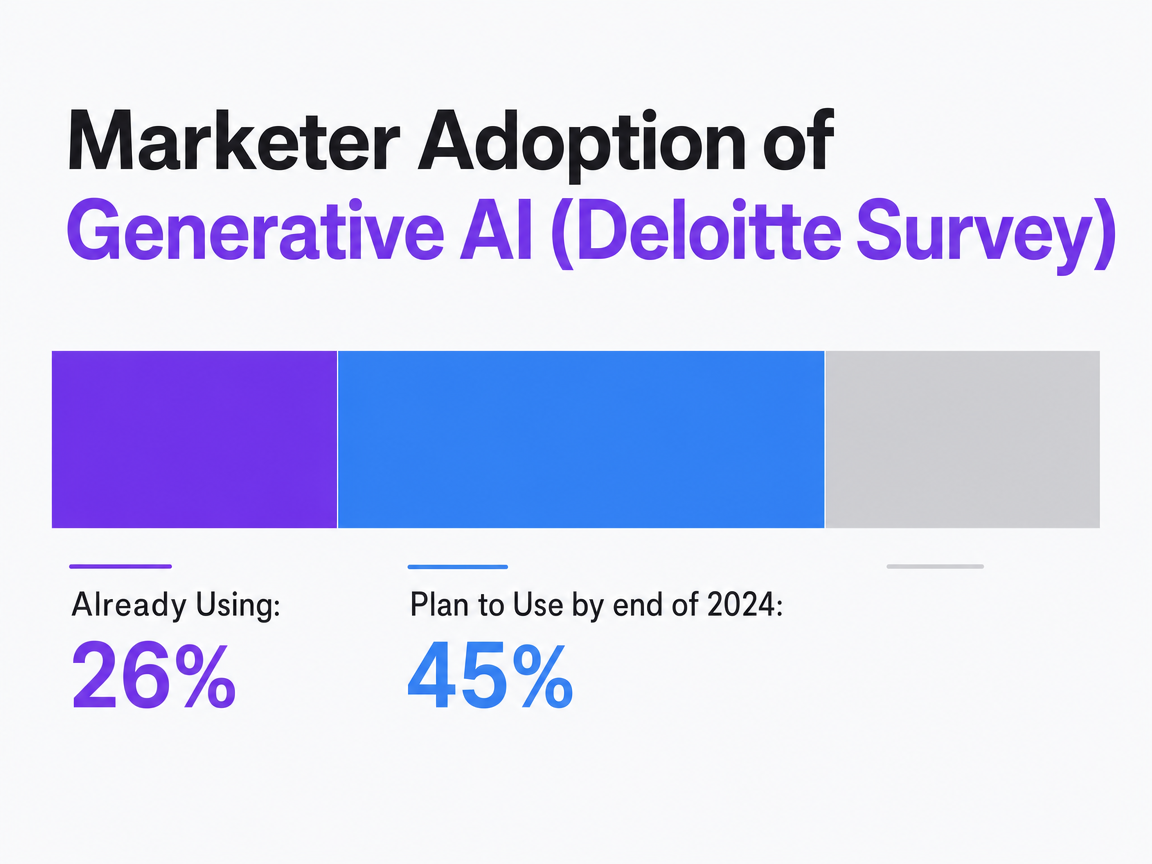 Marketer Adoption of Generative AI (Deloitte Survey)
Breakdown of generative AI adoption among marketers surveyed by Deloitte. The remaining 29% are not specified (e.g., no plans, undecided).
The Reallocation Math: Cost Per Published Page vs. Cost Per First-Page Ranking
The metric "cost-per-published-page" is an inadequate denominator because it rewards volume without considering whether an article ranks, is cited, or withstands legal scrutiny. A more appropriate metric for content marketing managers is "cost-per-first-page-ranking," as this directly correlates with pipeline generation.
Three configurations are worth comparing against both metrics. Configuration A represents the traditional workflow: a strategist briefs, a writer produces the full draft, and an editor reviews. Configuration B eliminates the writer entirely: prompts are fed in, an AI draft is generated, and it's published directly. Configuration C is the hybrid model: AI drafts the piece, and a writer edits it, verifies claims, injects originality, and signs off as the accountable author.
Two key findings from research anchor this analysis. The Emory experiment demonstrated a roughly 90% reduction in production time when AI handled drafting with light human editing 7. McKinsey estimates that generative AI can boost marketing productivity by 5% to 15% of total marketing spend, primarily through compressed drafting and ideation 9. Both estimates describe hybrid workflows, not pure automation.
The variables influencing the outcome include the writer's hourly rate, articles produced per month, editing hours per article, and the first-page ranking rate for each configuration. Configuration A incurs the highest hours-per-article but offers the strongest quality controls. Configuration B drastically reduces hours-per-article and lowers cost-per-published-page. However, the Emory data suggests that without editing, the first-page hit rate declines, thereby increasing the cost-per-ranking. Configuration B also carries the copyright exposure discussed earlier: articles published untouched cannot be registered or defended by the brand 1, 8. Configuration C balances cost-per-page and excels in cost-per-ranking. The editing hours that make the difference are less expensive than a full draft and produce the ranking rate that justifies the program.
The implication is not that writers are cheaper, but that reallocating writer hours from drafting to editing and originality improves the critical metric while maintaining the necessary accountability layer.
See How Leading Teams Replace Manual SEO Writing with AI-Driven Workflows
Request a walkthrough of unified AI content production, approval, and publishing—built for agencies and enterprise marketers seeking measurable SEO impact at scale.
If You Manage Multiple Locations, Practices, or Branches
Why the Old Location-Page Workflow Breaks First
The economics shift significantly when managing a portfolio of locations rather than a single brand site. This includes scenarios like forty dental practices under one DSO, sixty law firm office pages, or a home services franchise with location pages in every major metro. The unit of production is no longer a flagship article but rather location pages, service-area variants, practitioner bios, and local FAQs. Each of these needs to align with the brand voice, rank geographically, and avoid appearing as duplicates.
Traditional workflows were designed for smaller catalogs. A writer would produce each page based on a location brief, an editor would review for voice, and a marketing manager would approve. This sequence becomes unsustainable at forty or four hundred pages. Writers quickly become a bottleneck, and the pages that are published often converge on a template due to the volume pressure on human writers.
Generative AI eliminates the drafting bottleneck but introduces two new failure modes at portfolio scale: near-duplicate output across locations and unverifiable local claims that no editor has time to check. Both are content risks already highlighted by the Copyright Office and search guidance at the single-site level 1. At scale, these issues compound.
Three Workflow Configurations Compared
The three configurations from the earlier economics section behave differently when applied to portfolio volume. For multi-location operators, key variables include pages per month, editing hours per page, the ranking rate each configuration achieves, and the rework rate caused by near-duplicate output or unverified local claims.
| Configuration | Drafting | Editing hours per page | Portfolio risk | Cost driver |
|---|---|---|---|---|
| A. Writer drafts every page | Human | Full drafting plus editing | Low duplication risk, high time-to-publish | Writer hours per page × pages per month |
| B. AI drafts, no editorial layer | AI | Near zero | High near-duplicate and unverified-claim risk; unregistrable output 1, 8 | Rework, takedown exposure, lost rankings |
| C. AI drafts, writer edits and signs off | AI | Reduced editing budget per page | Managed via voice enforcement and local fact-checks | Editing hours per page × pages per month |
Configuration A protects quality but does not scale for portfolio volume; writers cannot produce hundreds of location pages monthly at a professional rate. Configuration B scales drafting cost to near zero, but it bypasses the control mechanism described by McKinsey's 2026 finding that 27% of adopters review all AI-generated content 4. Furthermore, the Copyright Office's stance on unauthored output 1, 8means such content cannot be owned. Configuration C is the only model where cost-per-first-page-ranking decreases as the portfolio grows. This is because editing hours scale linearly, while AI absorbs the drafting time savings observed in the Emory experiment 7. For multi-location managers, the writer's role is not a headcount issue; it is the mechanism that prevents a large portfolio from devolving into unranked, unownable pages.
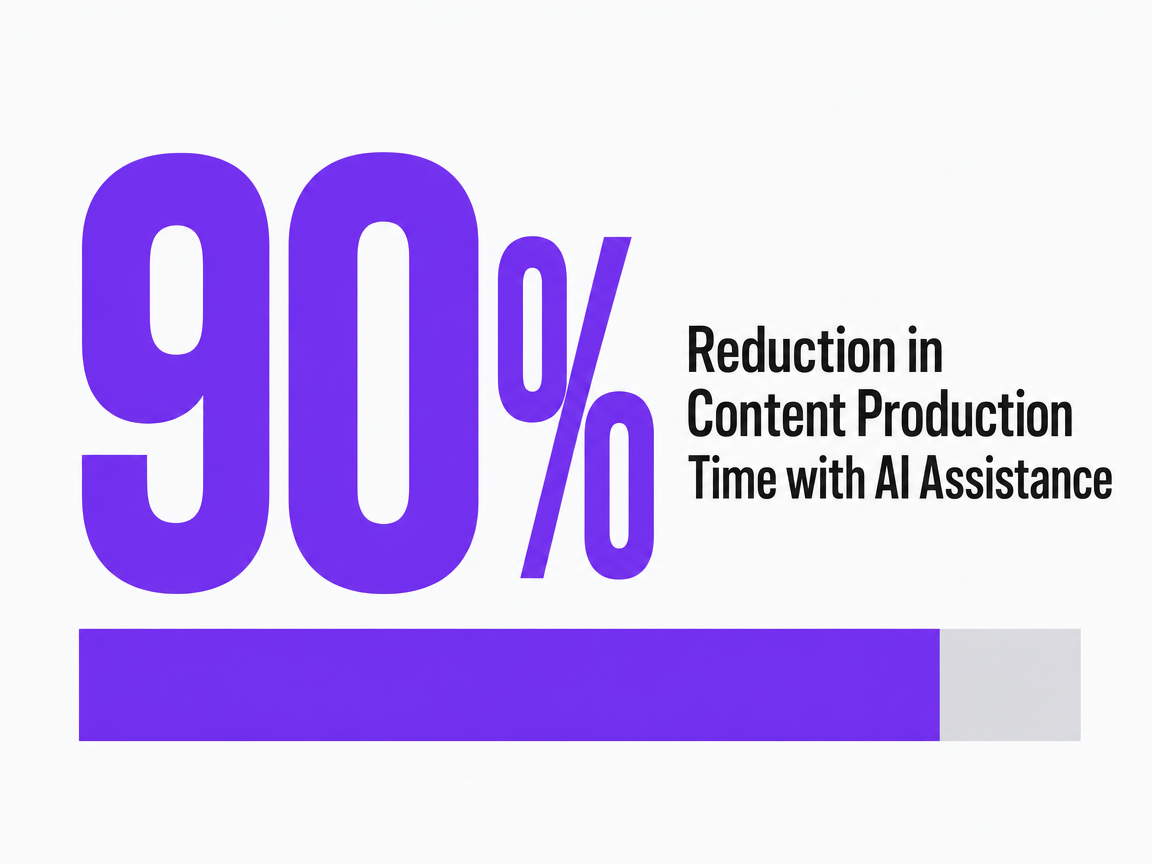 Reduction in Content Production Time with AI Assistance
Reduction in Content Production Time with AI Assistance
The Operating Model That Keeps Writers and Cuts Waste
The workflow that effectively implements the reallocation math has a distinct structure that differs from the traditional brief-and-draft cycle with an AI tool merely appended.
It begins with the strategist, not the model. A content lead develops the brief, specifying the target query, search intent, cluster position, the proprietary angle or data point that will differentiate the piece, competitor articles to displace, and internal sources for the writer. Briefs for AI drafting are typically more detailed and specific than those for human drafting, as the model lacks the inherent business knowledge a human writer possesses.
The model then generates the first draft based on this brief. This is where the approximately 90% time reduction measured in the Emory experiment truly manifests 7. A draft that would have taken a writer four to six hours arrives in minutes.
The writer then engages with the draft as an editor and originality contributor, rather than a primary producer. Their time is dedicated to verifying every sourced claim, replacing generic examples with specific ones, integrating the proprietary data or arguments outlined in the brief, refining the prose according to voice guidelines, and making the substantive editorial choices required by the Copyright Office for human authorship 2, 8. A named approver signs off before publication, completing the accountability loop that McKinsey's data shows mature adopters maintain 4.
This approach specifically eliminates waste. Writers no longer spend hours on paragraphs that a model can competently produce. Editors transition from being downstream cleanup to becoming the layer where quality is actively manufactured. The program stops paying professional rates for commoditized drafting and instead allocates resources to work that genuinely improves ranking rates and defends ownership.
What This Means for Hiring, Contracts, and Headcount Defense
The reallocation model alters what a content marketing manager should advocate for in a headcount review and how job descriptions should be framed. The role being funded is no longer "produces X articles per month." Instead, it becomes "owns ranking rate, brand voice, source verification, and accountable authorship across the publishing program." These are distinct roles with different measurable outputs, justifying different conversations with finance.
Three specific changes follow. Job descriptions should prioritize editorial judgment, source verification, and originality contribution over words-per-week throughput. Contractor agreements should explicitly state that a named human editor makes substantive expressive choices on every published piece, aligning with the U.S. Copyright Office's standard for protectable AI-assisted work 2, 8. Performance metrics should shift from articles published to first-page ranking rate and cost-per-first-page-ranking, as these are the metrics directly impacted by the Emory data and McKinsey's productivity estimates 7, 9.
The BLS occupational outlook notes that writers adaptable to new technologies have better prospects 3. This reflects the internal argument managers should make: the writer function is not being defended as a drafting cost, but as the control layer that ensures an AI-accelerated program remains compliant, ownable, and achieves high rankings.
Frequently Asked Questions
References
- 1.Works Containing Material Generated by Artificial Intelligence (U.S. Copyright Office Policy Statement).
- 2.Copyright and Artificial Intelligence, Part 2: Copyrightability.
- 3.U.S. Bureau of Labor Statistics – Writers and Authors.
- 4.The State of AI: Global Survey 2026.
- 5.The state of AI in early 2024: Gen AI adoption ....
- 6.Deloitte Digital's latest research forecasts generative AI's impact on marketing content production.
- 7.AI-Generated Content is a Game Changer for Marketers, but at What Cost?.
- 8.NewsNet Issue 1060 – U.S. Copyright Office AI Study Conclusions.
- 9.The economic potential of generative AI: The next productivity frontier.
- 10.The economic potential of generative AI (full report PDF).
- 11.The state of AI in 2023: Generative AI’s breakout year.