
Key Takeaways
- Agencies misprice audits when they ignore how site complexity, evaluation breadth, and billing model each move fees independently, producing 8x median swings between small and enterprise engagements 1.
- JavaScript rendering, hreflang matrices, and faceted navigation drive audit hours far more than raw page count, so scoping on URL totals alone routinely underquotes headless and international sites.
- Adding performance, accessibility, and UX to a pure-SEO audit expands scope with measurable gaps, since sites scoring 83-92 on SEO often drop to 51-72 on performance 6.
- Hourly, fixed-project, and retainer-bundled billing each carry distinct margin profiles, and the choice is a portfolio decision that determines whether audits generate revenue or protect retention.
- The 2026 rate card anchors around $1,750 median for sub-500-page sites and $15,000 for 5,000+ pages, with a convex curve that rewards segmenting the upper band 1.
- Technical, content, and backlink audits carry different fee ceilings tied to labor mix, so blending them into one comprehensive price compresses technical margins and inflates backlink expectations 2.
- Core Web Vitals diagnostics against LCP, INP, and CLS thresholds and WCAG 2.2's nine new success criteria justify explicit premium line items rather than being absorbed silently 14, 19.
- Delivery hours scale roughly 6x between $2,500 and $15,000 audits, so staffing enterprise fees with mid-market ratios converts the premium into overruns instead of profit 4.
Why agencies mis-price their own audit deliverables
Most agency rate cards treat SEO audits as a single line item with a single price. However, market data reveals a significant disparity. Technical audits for sites under 500 pages range from $1,000 to $3,000, while sites exceeding 5,000 pages can command $8,000 to $25,000+, with median prices differing by roughly 8x 1. Broader surveys indicate SEO audit costs can vary from $500 to $30,000, depending on the type and depth 2.
This wide range is not arbitrary; it reflects three key cost drivers agencies directly control: site complexity, the scope of evaluation, and the billing model. Agencies that fail to account for these variables often under-scope enterprise projects and over-scope smaller sites, leading to reduced margins on both ends.
This article provides a scope-to-price framework based on 2026 market ranges, a detailed breakdown of delivery costs at common fee points, and a portfolio perspective for agencies managing 20+ client accounts, considering the national average hourly rate of $82.66 for digital marketing work 4.
The three variables that actually move audit price
Site complexity: pages, JS rendering, and internationalization
Page count is a primary indicator of complexity, explaining much of the fee variation. A site with fewer than 500 URLs and one with over 5,000 URLs represent opposite ends of the 2026 technical audit pricing spectrum, with median costs of $1,750 versus $15,000, respectively 1. However, page count is merely a proxy; the actual time consumption depends on the content and functionality behind each URL.
Three complexity multipliers significantly impact audit hours:
- JavaScript rendering: sites built with frameworks like React, Vue, or Next.js without server-side rendering require a rendered crawl in addition to the raw HTML pass, effectively doubling crawl time and necessitating manual verification of what Googlebot perceives.
- Internationalization: managing hreflang matrices across country code top-level domains (ccTLDs) or subfolders introduces validation work that scales with the number of language-country pairs, not just total pages.
- Faceted navigation: e-commerce and directory sites can generate parameter combinations that transform a 5,000-page site into a 500,000-URL crawl footprint, demanding higher-tier tooling and often increased license costs per audit.
Scoping discussions should focus on these multipliers rather than solely on a stated page count. A 2,000-page headless commerce site with three locales often costs more to audit than a 10,000-page static publisher. Rate cards that only consider URL count tend to underquote the former and overquote the latter.
Evaluation breadth: SEO alone vs. performance, accessibility, and UX
The second pricing lever is the scope of what the audit evaluates. A pure-SEO audit focuses on crawlability, indexation, on-page signals, and internal linking, adhering to Google's basic requirements for search-friendly sites 16. This work has a natural limit on hours due to its bounded diagnostic surface. When performance, accessibility, and user experience (UX) are included in the Statement of Work (SOW), the scope expands, and so does the fee.
Data supports this expansion. A WebQual 4.0 and Lighthouse evaluation of live websites showed SEO scores typically between 83 and 92, while accessibility scores ranged from 68 to 79, and performance scores dropped to 51 to 72 6. This diagnostic gap highlights that sites appearing healthy from an SEO-only perspective often underperform on dimensions Google now directly measures through Core Web Vitals and regulators measure through WCAG conformance.
Three additions typically justify a premium tier. Core Web Vitals (CWV) scoping, against Google's thresholds of LCP under 2.5 seconds, INP under 200 milliseconds, and CLS under 0.1, requires field-data analysis via CrUX and lab testing through Lighthouse or the PageSpeed Insights API 14, 20. WCAG 2.2 conformance review adds nine new success criteria beyond 2.1, covering aspects like focus appearance, dragging movements, and accessible authentication 19. UX and usability testing introduce task success and error-rate measurement, which cannot be achieved with pure crawlers.
Agencies that quote a single price for "an SEO audit" without explicitly defining the included dimensions risk buyers assuming all of them. Clearly naming and pricing each dimension as a defined tier transforms potential scope creep into an upsell opportunity.
Delivery model: hourly, project fee, or retainer bundle
The third variable influencing audit pricing is the billing method, which affects both realized margin and pipeline behavior. The 2026 pricing literature identifies six common approaches in digital marketing services, with website audits and technical SEO reviews most frequently structured as project-based work in the $2,500 to $10,000 range 3. This range represents the typical operating zone for most mid-market agency audits, but each billing structure presents a distinct economic profile.
Hourly billing, at rates near the $82.66 national average for digital marketing agencies, protects against scope creep but limits upside and necessitates detailed time tracking, which many senior technical SEOs find cumbersome 4. This model is suitable for exploratory or migration-related engagements where the project's endpoint is genuinely undefined. Fixed project fees productize the audit into a defined deliverable, which is where margin is generated once the delivery process is repeatable. The inherent risk here is under-scoping complex sites, which the complexity variables discussed earlier aim to prevent.
Retainer-bundled audits offer an underutilized alternative. Instead of selling a one-time $5,000 audit, an agency can integrate a quarterly diagnostic into a $1,500 to $3,000 per month retainer that already covers SEO execution 13. The audit then becomes a recurring deliverable rather than a standalone project, also serving as an account review mechanism that helps reduce client churn. The choice among these three models is a portfolio decision, not a client-specific one, as it dictates whether audits function as direct revenue events or as infrastructure for client retention.
A scope-to-price matrix for the 2026 market
Technical audit fees indexed to site size
Site size is the most predictable factor in the 2026 pricing data. The aggregated consultant report shows technical audits for sites under 500 pages priced between $1,000 and $3,000, with a median of $1,750. For sites over 5,000 pages, prices range from $8,000 to $25,000+, with a median of $15,000 1. The median-to-median increase is approximately 8.5x, significantly higher than the page-count multiplier, indicating a convex rather than linear fee curve.
Three anchor points help structure a robust rate card. The low end applies to brochureware, local service sites, and single-locale content properties with crawl footprints under a few thousand URLs after parameter collapse. The middle band, roughly $3,000 to $8,000, covers sites in the 500 to 5,000-page range, where most mid-market clients reside. Here, headless rendering, structured data, and internal-link topology begin to require senior-level expertise. The upper band, above 5,000 pages, necessitates log-file analysis, advanced sampling methodologies, and cross-template diagnosis.
The $25,000+ ceiling in the reported range suggests that the true enterprise curve extends beyond the median. Agencies that quote a single figure within the upper band without segmenting for JavaScript rendering, hreflang scope, and faceted URL count risk delivering enterprise-level work at mid-market prices. By using the medians as reference points and adjusting based on the complexity multipliers, agencies can transform a broad market spread into a consistent pricing strategy.
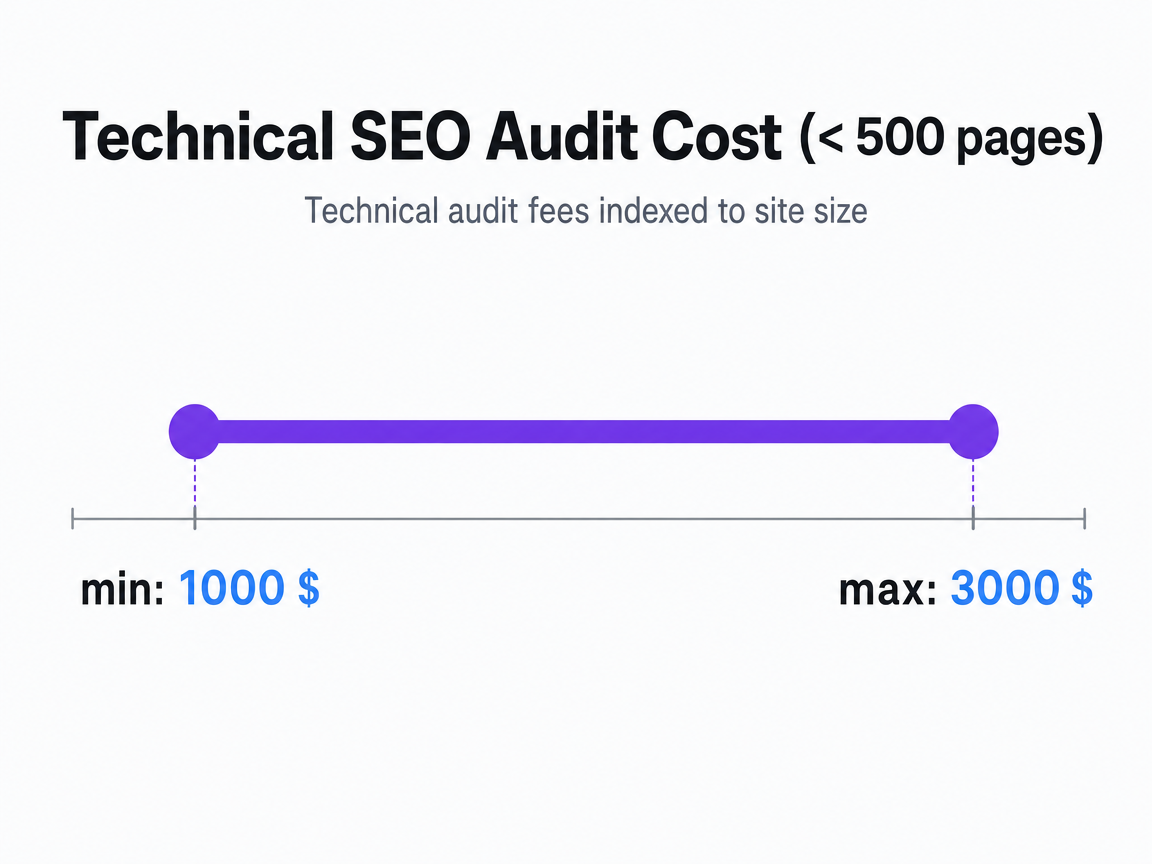 Technical SEO Audit Cost (< 500 pages)
Cost range for technical SEO audits on websites with under 500 pages, based on 2026 pricing data from a report aggregating data from SEO consultants.
Pricing bands by audit type: technical, content, backlink, full-stack
Audit type establishes a fee ceiling that site size alone cannot override. The broader 2026 cost survey indicates overall SEO audit prices between $500 and $30,000. Specifically, technical audits range from $5,000 to $75,000, content audits from $3,000 to $30,000, and backlink audits from $500 to $5,000 2. These bands reflect distinct labor mixes and tooling requirements. Treating them interchangeably on a rate card can compress margins for technical work and inflate expectations for backlink analysis.
Technical audit fees are typically the highest because they involve senior engineering hours, log-file processing, rendered crawls, and often custom scripts against APIs like PageSpeed Insights 20. Content audit fees align more with editorial and analyst rates, with scope defined by URL count, topic-cluster mapping, and semantic overlap analysis rather than infrastructure diagnostics. Backlink audits have the tightest ceiling, as the deliverable primarily consists of a disavow file and a link-quality classification pass; additional hours beyond classification offer diminishing returns for the client.
Full-stack audits transcend these individual bands. When a scope encompasses technical infrastructure, on-page content elements, keyword integration, backlink profiles, and user experience design as a unified framework 12, the fee should reflect the sum of its component tiers, potentially with a bundle discount, rather than an average. Agencies that price full-stack audits as a generic "comprehensive" fee often underprice the technical component and over-promise on the backlink component, which are common sources of scope disputes.
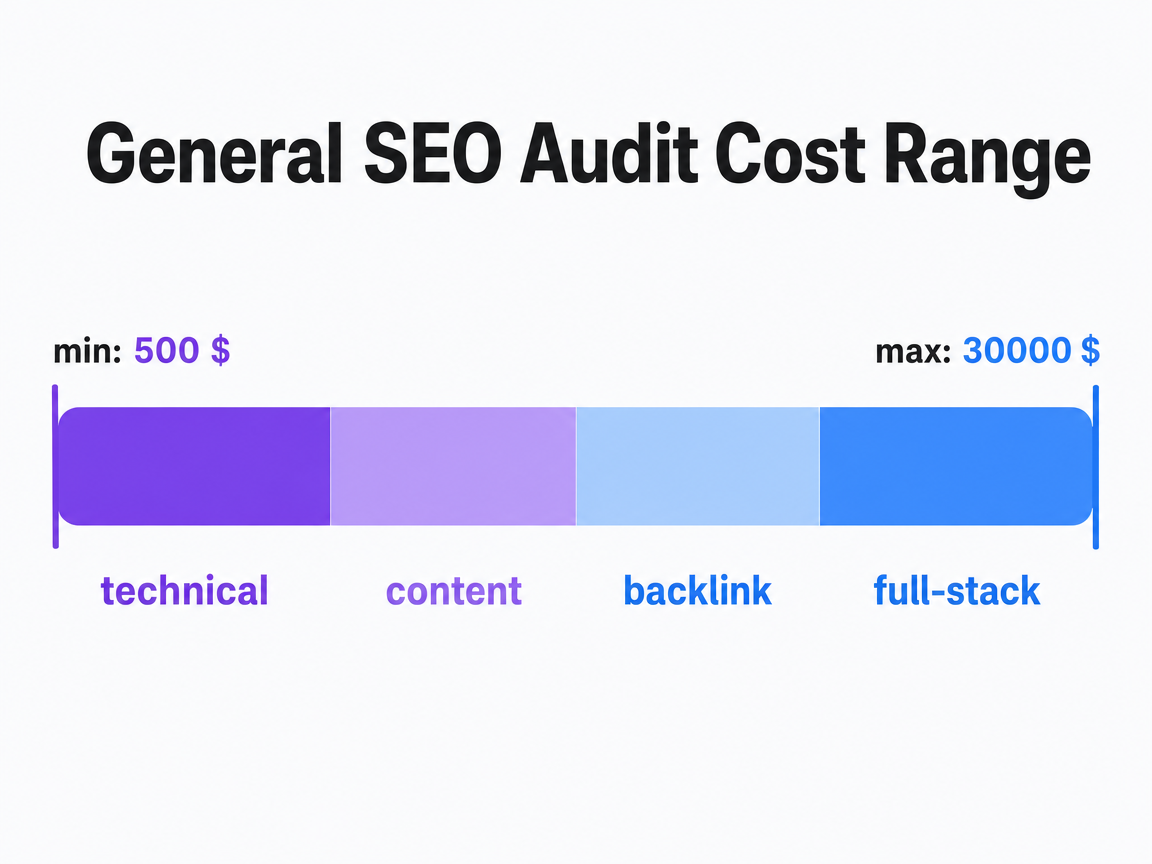
Wide-ranging price band for an SEO audit, which can be further broken down by type (technical, content, backlink).
Where WCAG 2.2 and Core Web Vitals justify a premium tier
A premium tier is not merely a marketing term; it represents a justifiable fee increase linked to specific, measurable scope additions explicitly recognized by regulators and Google. In 2026 SOWs, two additions carry significant weight: Core Web Vitals field and lab diagnosis, and WCAG 2.2 conformance review.
Core Web Vitals (CWV) scoping adds substantial hours because the metrics are field-derived, threshold-based, and directly linked to technical remediations. Google's current guidelines set LCP under 2.5 seconds, INP under 200 milliseconds, and CLS under 0.1 as the benchmarks for a good user experience 14. Achieving these thresholds requires pulling CrUX field data, running Lighthouse or the PageSpeed Insights API across representative templates 20, 21, and translating the output into actionable engineering recommendations. This constitutes a defined workstream with a clear output, making it straightforward to price as a $1,500 to $4,000 line item in addition to the base technical fee.
WCAG 2.2 is the second critical addition, gaining prominence with the W3C's inclusion of nine new Success Criteria beyond WCAG 2.1 18, 19. These criteria—covering focus appearance, dragging movements, target size, and accessible authentication—demand both automated scanning and manual keyboard and screen-reader testing. Content conforming to WCAG 2.2 also meets the requirements of 2.0 and 2.1 17, allowing a single conformance review to satisfy multiple regulatory frameworks. Agencies serving clients in healthcare, financial services, and government-adjacent sectors can price this accordingly.
The pricing logic is clear: a base technical audit, priced according to site-size medians, addresses crawlability and indexation questions outlined in Google's Search Essentials 16. Adding Core Web Vitals and WCAG 2.2 transforms the deliverable into a diagnostic that legal, compliance, or product stakeholders will endorse, thereby influencing both the buyer and their fee tolerance. Agencies that explicitly define these tiers in the SOW can capture the premium, whereas those that integrate them into a generic "comprehensive" audit risk devaluing their services.
Test Real-Time SEO Audit Delivery at Scale
Run comprehensive audits and deploy actionable recommendations on live projects using full platform capabilities during your trial.
Delivery-cost teardown: what actually goes into a $2,500 vs. $15,000 audit
Fee bands are only meaningful when correlated with the actual resources consumed during delivery. Two key price points from the 2026 dataset—$2,500 for a mid-market technical audit and $15,000 for an enterprise audit exceeding 5,000 pages—represent vastly different labor mixes, tooling requirements, and turnaround times 1, 3.
A $2,500 audit typically allocates 25 to 30 delivery hours, based on the $82.66 national average hourly rate for digital marketing agencies 4. This budget covers a Screaming Frog or Sitebulb crawl of a sub-500-page site, a Lighthouse and PageSpeed Insights pass across five to eight representative templates 20, a manual review of indexation and internal linking against Google's Search Essentials 16, and a written deliverable with prioritized recommendations. Tooling costs at this tier are typically a few hundred dollars per month in shared license fees. The reported minimum for technical audit tooling, around $1,100 per month 2, must be amortized across multiple concurrent audits to maintain margin. The labor mix usually involves one senior technical SEO for scoping and interpretation, and one analyst for crawl setup and data preparation. Turnaround time is typically two to three weeks.
A $15,000 audit represents a significantly different production. Using the same blended rate, this budget supports 150 to 180 delivery hours—six times that of the mid-market tier—which is necessary for a 5,000+ page site with rendered JavaScript, hreflang, and faceted URLs 1. The workflow expands to include log-file analysis, a rendered crawl pass, CrUX field-data pulls against Core Web Vitals thresholds (LCP under 2.5 seconds, INP under 200 milliseconds, and CLS under 0.1) 14, structured data validation across templates, and an internal-link topology model. If WCAG 2.2 conformance is in scope, automated scanning combined with manual keyboard and screen-reader testing against the nine new success criteria is added 19. The labor mix broadens to include a technical lead, a performance specialist, an accessibility reviewer, and an analyst. Tooling costs escalate into the low four figures per audit, accounting for enterprise crawler licenses, log processors, and accessibility validators.
The delivery ratio is crucial: while the fee scales 6x from $2,500 to $15,000, the hours also scale approximately 6x, and specialist headcount doubles. Agencies that quote within the enterprise band but staff at mid-market ratios risk converting the fee premium directly into project overruns rather than profit.
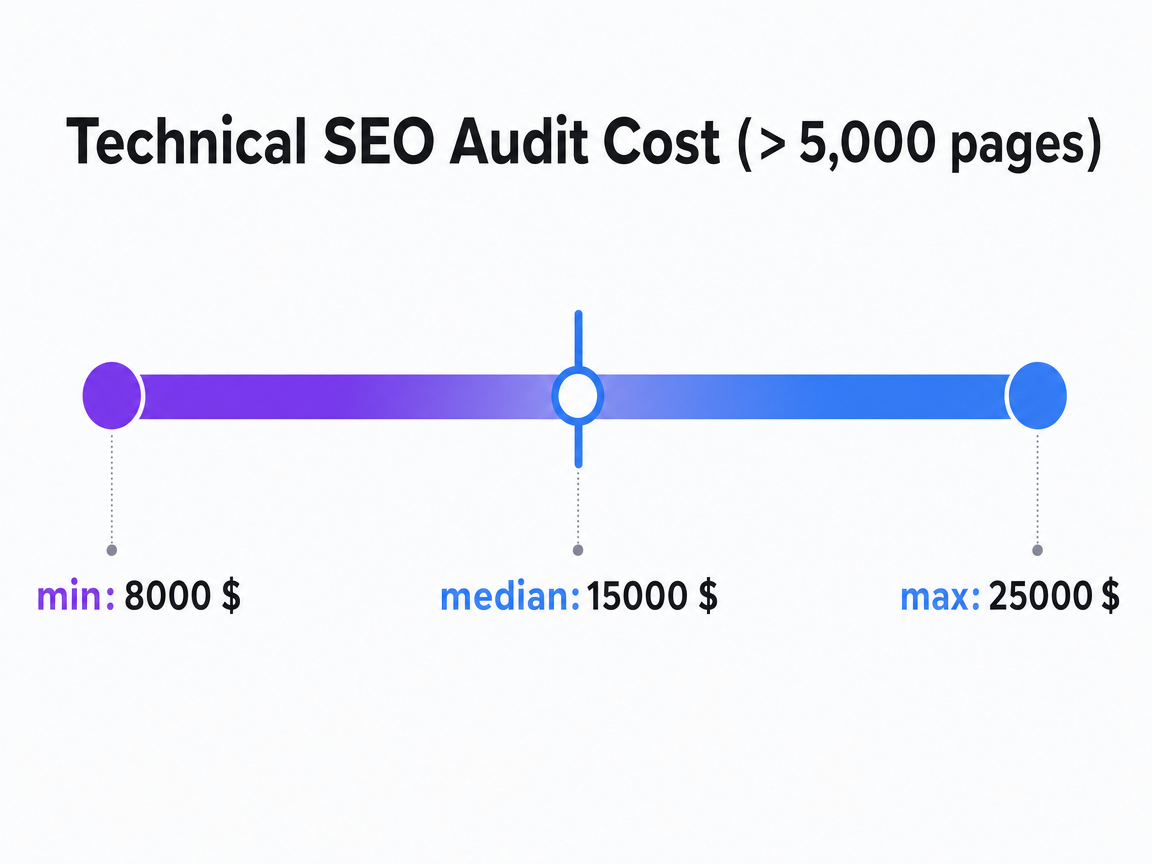 Technical SEO Audit Cost (> 5,000 pages)
Cost range for technical SEO audits on websites with over 5,000 pages, with a cited median of $15,000, based on 2026 pricing data.
Portfolio economics for agencies auditing 20+ client sites
For agencies managing 15 to 80 client accounts, or multi-location operators overseeing 50+ sites, the focus shifts from individual audit pricing to portfolio economics. The goal is to ensure profitability at scale. The variables—audit tier, delivery hours, and tooling costs—remain constant, but their impact compounds across the entire client base.
Consider a mid-market portfolio with three audit tiers, aligned with 2026 market ranges. At a blended hourly rate of $82.66 for digital marketing agencies 4, and tooling minimums for technical audit software exceeding $1,100 per month 2, margin bands quickly diverge by tier.
| Audit tier | Project fee (sourced) | Delivery hours @ $82.66 | Tooling floor | Implied gross margin band |
|---|---|---|---|---|
| Small-site technical (<500 pages) | $1,000–$3,000 1 | 12–36 hrs ($1,000–$3,000 labor) | ~$1,100/mo amortized 2 | Thin to negative unless amortized across 4+ concurrent audits |
| Mid-market project audit | $2,500–$10,000 3 | 30–120 hrs ($2,500–$9,900 labor) | ~$1,100/mo amortized 2 | Break-even to ~40% at the upper band |
| Enterprise technical (>5,000 pages) | $8,000–$25,000+ 1 | 96–300+ hrs ($7,935–$24,800+ labor) | Low four figures per audit | 25–45% when specialist mix is staffed correctly |
Two key conclusions emerge from this table. First, small-site audits priced at the $1,000 floor are unprofitable unless tooling licenses are shared across multiple concurrent projects. This highlights the need for portfolio operators auditing 20+ sites to utilize shared crawler and PageSpeed API infrastructure 20 rather than client-specific stacks. Second, the enterprise band only yields healthy margins when the specialist mix is correctly priced in; billing a $15,000 median audit with mid-market staffing ratios directly leads to overruns.
Get Custom SEO Audit Pricing Insights for Multi-Location and High-Stakes Verticals
Connect with a strategist to benchmark audit pricing, scope, and deliverables against industry standards for agencies managing complex client portfolios. Gain clarity on cost structures and workflow efficiencies tailored to your operational scale.
Build, buy, or automate: the audit production decision
While most pricing guides focus on what to charge, a more challenging question for agencies managing 15 to 80 accounts is how to produce audits efficiently without dedicating excessive senior hours to tasks that could be automated. Three production models compete for this budget, each with a distinct margin profile.
Building in-house is the default approach and is viable when the audit book leans towards enterprise clients. With fees ranging from $8,000 to $25,000+ for sites over 5,000 pages 1, the fee can absorb the costs of a technical lead, performance specialist, and accessibility reviewer without margin collapse. However, this model struggles in the small-site tier, where a $1,000 to $3,000 fee cannot support senior-hour scoping and cover tooling costs exceeding $1,100 per month 1, 2.
Buying through white-label subcontractors reverses the economics. Paying a subcontractor 40 to 60 percent of a $2,500 to $10,000 project fee 3 preserves margin on volume but shifts quality control to an external delivery process. This approach is effective for addressing capacity gaps but not for developing a repeatable diagnostic asset.
Automating the production line is the third option, directly targeting the labor mix. Crawlers, the PageSpeed Insights API, and Lighthouse already generate raw data 20, 21; the time-consuming aspects are interpretation, prioritization, and remediation write-ups. AI-orchestrated workflows that draft these layers against a pre-defined template can significantly reduce the 25 to 30 hours typically required for a mid-market audit, without eliminating the essential human sign-off that clients value. Platforms like Vectoron exemplify this automated approach.
Turning audits into retainer pipeline
An audit that remains a static PDF on a client's desktop is a cost center. An audit that initiates a retainer conversation, however, becomes a pipeline. The key difference lies not in the deliverable's quality, but in what the Statement of Work (SOW) commits the agency to do next.
The pipeline mechanism works because audit fees and retainer fees often occupy similar price points. A mid-market audit, typically ranging from $2,500 to $10,000 3, is comparable to a $1,500 to $3,000 monthly retainer covering SEO execution, content, and reporting 13. When structured as a single commercial motion, the audit fee serves as an anchor for a six- to twelve-month retainer, eliminating the need for the client to re-evaluate their need for assistance, as the audit has already demonstrated it.
Three structural strategies convert audit output into retainer commitment:
- Price the audit at parity with two to three months of the target retainer, positioning the diagnostic as a proportional entry point rather than a standalone purchase.
- Present recommendations as a prioritized backlog with effort estimates and owner assignments, rather than a mere scored report. A backlog implies ongoing work; a report suggests completion.
- Link the closing meeting to a scope proposal that directly references the audit's findings—such as Core Web Vitals remediation against LCP under 2.5 seconds and INP under 200 milliseconds 14, or WCAG 2.2 gaps against the nine added success criteria 19—making the retainer a logical continuation.
The productized diagnostic subscription is an underutilized variation. Instead of selling a single audit and hoping for retainer conversion, agencies serving multiple clients can offer a quarterly diagnostic at a fixed monthly rate. This includes crawl monitoring, PageSpeed API tracking 20, and a written review. This transforms the audit into recurring revenue, and the retention effect is amplified as clients receive diagnostic insights every ninety days instead of just once at the outset.
Frequently Asked Questions
References
- 1.SEO Consultant Pricing Report 2026: Aggregated Audit ....
- 2.SEO Audit Pricing: How Much Does an SEO Audit Cost?.
- 3.6 Proven Digital Marketing Agency Pricing Models.
- 4.Digital Marketing Pricing Data: Agency rates comparison ....
- 5.A Comprehensive Examination of Search Engine Optimization (SEO) Audit and Optimization Strategies.
- 6.Website Quality Evaluation Using WebQual 4.0 and Google Lighthouse.
- 7.Research Report on Web Accessibility Metrics.
- 8.Accessibility engineering in web evaluation process.
- 9.Large-scale study of web accessibility metrics.
- 10.7 Metrics for Testing Accessibility Performance.
- 11.The Definitive Website Quality Assessment: 12 Expert Metrics That Reveal Your Site's True Potential – Lume Global.
- 12.Comprehensive Website SEO Analysis.
- 13.Digital Marketing Cost and Budget Benchmarks for 2026.
- 14.Understanding Core Web Vitals and Google search results.
- 15.SEO Link Best Practices for Google | Google Search Central.
- 16.Google Search Essentials (formerly Webmaster Guidelines).
- 17.Web Content Accessibility Guidelines (WCAG) 2.2.
- 18.W3C WCAG 2.2 Now Available.
- 19.What's New in WCAG 2.2 | Web Accessibility Initiative (WAI).
- 20.Get Started with the PageSpeed Insights API.
- 21.Pagespeedapi: runpagespeed | PageSpeed Insights.
- 22.Web Content Accessibility Guidelines (WCAG) 2.2 is a W3C Recommendation.