
Key Takeaways
- The 45-point content demand gap is a structural operating-model problem, not a headcount shortage, and adding writers or agency retainers scales linearly against a non-linear demand curve.
- A three-layer model — ranked strategy briefs, assisted production scoped to sections, and a governed publishing gate with named editors — is what converts individual AI usage into team-level throughput.
- Expect the 40% time and 18% quality gains from Noy & Zhang on mid-complexity SEO drafts 1, with the largest lifts landing on mid-level writers rather than senior editors 3.
- Reinvest the 11.4 hours per week AI returns 8into cluster architecture, subject-matter interviews, and refresh audits, and close the loop with 30/60/90-day and six-month rank and pipeline checkpoints.
The content demand gap in-house teams inherited in 2024
The math facing most in-house content teams stopped working sometime around 2023. Deloitte Digital surveyed 650 US marketing and e-commerce leaders and found that content demand grew 1.5 times year over year, while marketing teams met only 55% of that demand 8. That shortfall is not a scheduling problem or a briefing problem. It is the baseline reality of the function in-house managers now run.
The shortfall shows up in the same places every quarter: keyword clusters that never get covered, refresh cycles that slip past their SEO half-life, product launches that ship without the supporting library, and paid campaigns that outrun the landing pages meant to catch them. The organic pipeline gets rationed, and the rationing gets defended in planning meetings as prioritization.
Hiring is the reflex answer, and it is the answer CFOs increasingly refuse. Headcount solves a linear capacity problem with linear cost, and the demand curve is not linear. Even teams that win the hiring argument watch onboarding, editorial calibration, and brand-voice ramp consume months before net new output arrives.
The more useful framing treats the 45-point gap as a signal that the operating model itself is undersized for the workload it inherited. Closing it requires a different production system, not a larger version of the current one. The rest of this piece lays out what that system looks like and what the evidence says it can actually deliver.
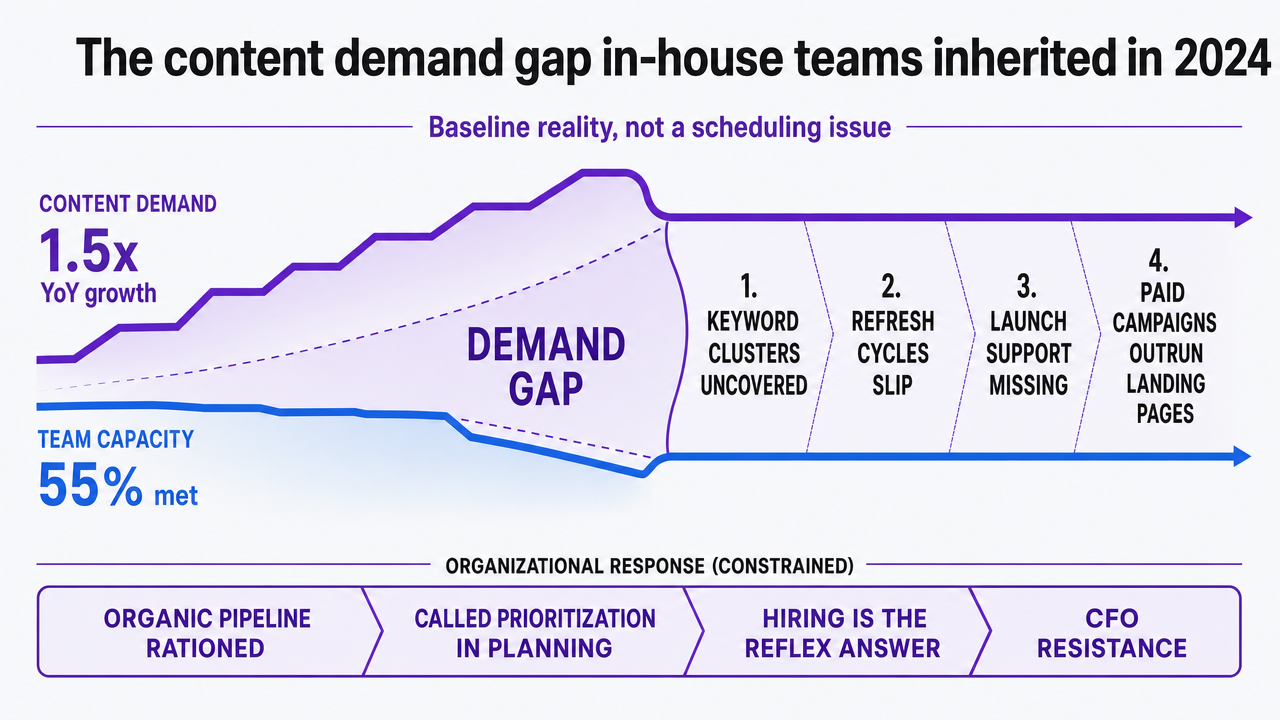 Visualize the gap between content demand growth and team capacity to fulfill it, which is the core framing of this section
Why hiring more writers is the wrong answer to the wrong question
Adding writers assumes the constraint is drafting hours. For most in-house teams, it is not. The bottleneck sits upstream in prioritization and downstream in editorial review, and adding another salaried writer or freelancer only widens the middle of a pipeline whose ends are already choked.
The cost story is worse than it looks on the spreadsheet. Each new writer requires a brief, a brand-voice ramp, a subject-matter interview cycle, and a review queue that pulls senior editors off strategy. Agencies compress some of that onboarding but add coordination tax: kickoffs, revisions, and status calls that scale linearly with word count. Neither model absorbs a 1.5x demand curve without a matching 1.5x cost line, which is precisely what CFOs are refusing to approve.
There is also a market-timing problem with the hiring reflex. McKinsey's 2024 global survey found that 65% of organizations regularly use generative AI in at least one business function, and marketing and sales adoption more than doubled year over year 9. Peer teams are not solving the demand gap by adding headcount. They are solving it by redesigning the work.
The right question is not how many more writers the budget can carry. It is which parts of the production system still require a human hand, which parts can be assisted, and which parts should be governed rather than performed. That reframing is what the rest of this article addresses.
What the productivity evidence actually says
The Noy & Zhang finding and its scope
The most cited productivity number in this category comes from a randomized experiment run by Shakked Noy and Whitney Zhang and published in Science in 2023. Working with 453 college-educated professionals, the researchers assigned mid-complexity writing tasks — press releases, short reports, analysis memos — and measured what happened when half the group got access to ChatGPT. Average completion time dropped 40%, and evaluator-rated output quality rose 18% 1.
Those two numbers matter together. A speed gain that costs quality is a false economy, and a quality gain that takes twice as long is not scalable. The Noy & Zhang result shows both moving in the right direction on the same tasks, which is why it functions as the operational anchor for most serious AI content programs.
Scope discipline matters as much as the headline. The tasks were bounded, professional, and mid-complexity — closer to a briefed marketing article than to a regulated white paper, a technical explainer requiring domain interviews, or a thought-leadership piece with a specific point of view. The researchers explicitly note that results may not generalize to highly complex, creative, or domain-specialized work 2. For an in-house content manager, the honest read is this: expect the 40%/18% range on standard SEO briefs and comparable assets, and expect diminishing returns as complexity climbs toward the top of the editorial calendar.
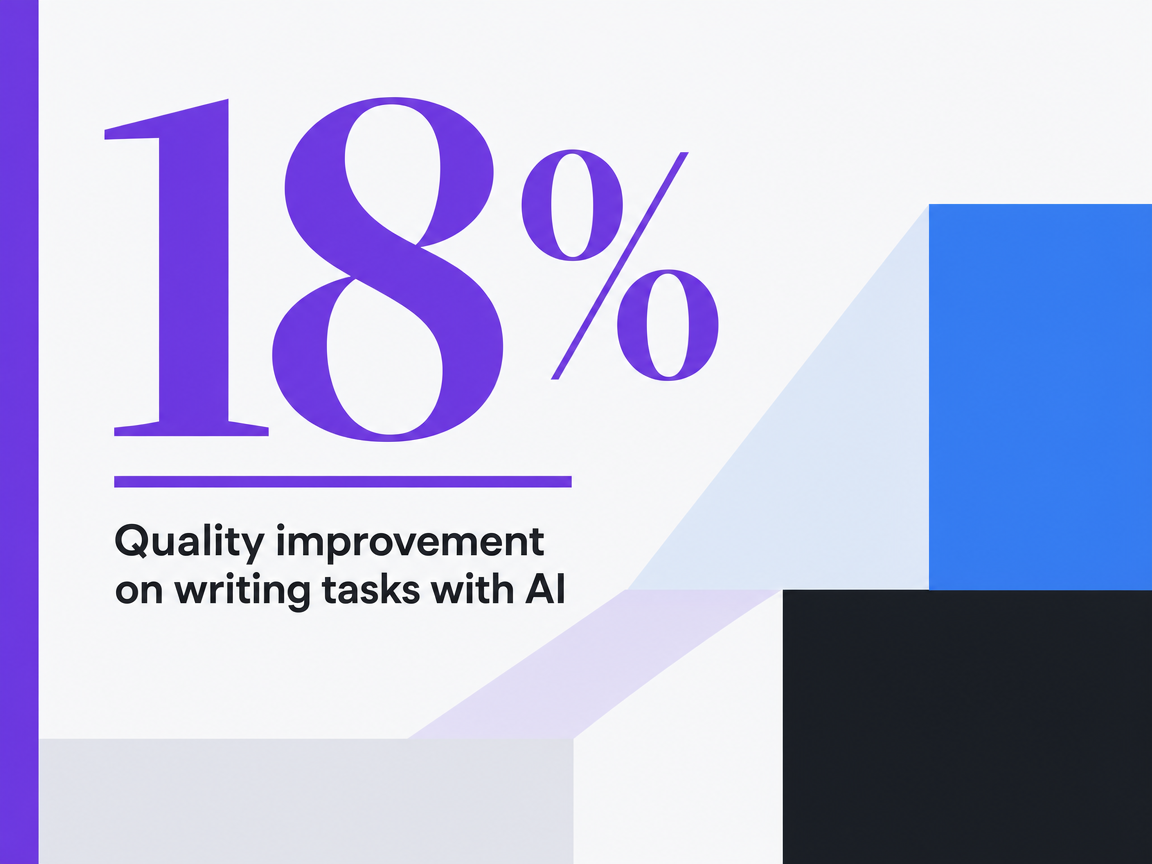 Quality improvement on writing tasks with AI
Quality improvement on writing tasks with AI
Skill-level effects: where AI codifies best practice and where it stalls
The Noy & Zhang averages hide a more useful pattern: gains are not distributed evenly across a team. A Stanford GSB working paper studying 5,179 customer support agents equipped with a generative AI assistant found a 14% average lift in issues resolved per hour, with a 34% jump for novice and low-skilled workers and minimal impact on experienced and highly skilled workers 3. The tool was not making everyone faster in equal measure. It was closing the gap between the median performer and the top of the bench.
That pattern reframes what AI actually does inside a content operation. It codifies the practices of the strongest editors and writers into a system that less-tenured team members can draw on, which is why the biggest throughput gains tend to appear in the middle of the skill distribution rather than at the top. Senior editors do not draft 34% faster with a chatbot in the loop. Their value shifts to judgment: framing, argument structure, source selection, and the editorial calls a model cannot make.
For a manager sizing the opportunity, this changes the staffing math. AI does not replace the senior editor whose taste sets the bar. It expands the group of people who can produce work that clears that bar without a full rewrite, which is where the compounding capacity gain lives.
Adoption reality: marketing is already the leading genAI function
The evidence on peer behavior is unambiguous. The American Marketing Association's September 2024 survey of more than 1,000 professional marketers found that nearly 90% had used generative AI tools at work, 71% used them weekly or more, and roughly 20% used them daily 7. Usage in this role is no longer early or experimental. It is habitual.
McKinsey's 2024 global survey adds the organizational view: 65% of organizations regularly use generative AI in at least one business function, and marketing and sales showed the largest year-over-year adoption increase across all functions covered 9. The competitive question is no longer whether peer teams are using AI to produce content. It is whether they have redesigned the operation around it.
That gap is where in-house managers still have room to move. Individual adoption at the desk level does not automatically produce team-level throughput gains. Without ranked briefs, an editorial review lane sized for the new draft volume, and a KPI feedback loop, daily AI usage tends to shorten individual tasks while leaving total output roughly flat. The evidence points to opportunity; capturing it depends on the operating model, which is the subject of the next section.
Test AI-driven SEO content workflows risk-free
Publish live SEO content and measure performance impact before making any commitment.
A three-layer content operations model
Strategy signal layer: ranked briefs, not open backlogs
Most in-house teams still run their calendar as an open backlog: a spreadsheet of keywords, a wishlist from product marketing, a few refresh flags from the SEO lead. The problem with that structure is not organization. It is that every item looks roughly equal in priority, which pushes ranking decisions into weekly meetings and pushes execution decisions onto whichever writer is free.
The strategy signal layer replaces the open backlog with a ranked queue driven by live inputs:
- search-console impressions on the edge of page one,
- cluster gaps against ranking competitors,
- refresh candidates whose traffic has decayed past a threshold, and
- demand signals from paid campaigns and sales calls.
Each brief carries an explicit rationale, a target intent, and a projected impact band. The ranking is the deliverable.
Forrester's content operations research frames this as treating AI as an operational capability rather than a creative novelty, and notes that teams that make that shift see sustained gains in throughput and quality 6. The mechanism is not mysterious. When briefs arrive pre-ranked with the reasoning attached, the assisted production layer downstream stops burning cycles debating what to write and starts compounding on what to write next. Prioritization becomes an artifact of the system instead of a recurring meeting.
Assisted production layer: where the 40% time saving lives
This is the layer where the Noy & Zhang result actually lands. Given a ranked brief with intent, outline, and source material attached, an assisted drafting workflow compresses first-draft time on standard SEO articles into the range the study measured on comparable mid-complexity writing tasks 1. The gain is not from letting a model publish. It is from removing the blank-page tax on drafts that a human editor was going to rewrite anyway.
The production layer has three moving parts that tend to distinguish teams capturing the gain from teams stalling at individual-desk usage.
- Briefs are structured enough that the model has real constraints: primary and secondary intent, mandatory sources, brand-voice examples, and disallowed patterns.
- Drafting is scoped to sections rather than whole articles, so the writer or editor accepts, rejects, or rewrites at paragraph granularity instead of judging a 1,500-word wall.
- The review lane is sized for the new draft volume. A team that triples draft output and staffs editorial review at the old rate simply moves the bottleneck one step downstream.
Deloitte Digital's survey of 650 US marketing leaders quantifies the reallocation this produces: generative AI users report saving an average of 11.4 hours per week, freed to focus on higher-value or more strategic tasks 8. Those hours are the operational dividend of the production layer, not the goal of it.
Governed publishing layer: the human approval gate
Nothing ships without a human sign-off. That is the single non-negotiable design rule of the third layer, and the evidence for it is direct. McKinsey's 2024 global survey found that 44% of organizations using generative AI have already experienced at least one negative consequence, most often inaccuracy, followed by cybersecurity and explainability issues 9. Inaccuracy at scale is what turns a productivity gain into a brand-risk story, and the approval gate is what keeps that from happening.
The gate does three things at once:
- It routes drafts to a named editor with authority to approve, revise, or kill.
- It enforces fact-check, source-citation, and brand-voice checks as gating criteria rather than post-publication cleanup.
- It captures the reasoning behind each decision so the ranking model upstream and the drafting layer in the middle learn from what actually clears the bar.
Governance at this layer also handles disclosure and provenance, which the next section covers in operational detail. What matters at the model level is that publishing is a controlled release, not an automated push. The economic case for AI-assisted operations depends on volume clearing quality, and the approval gate is the mechanism that keeps those two variables from decoupling as throughput climbs.
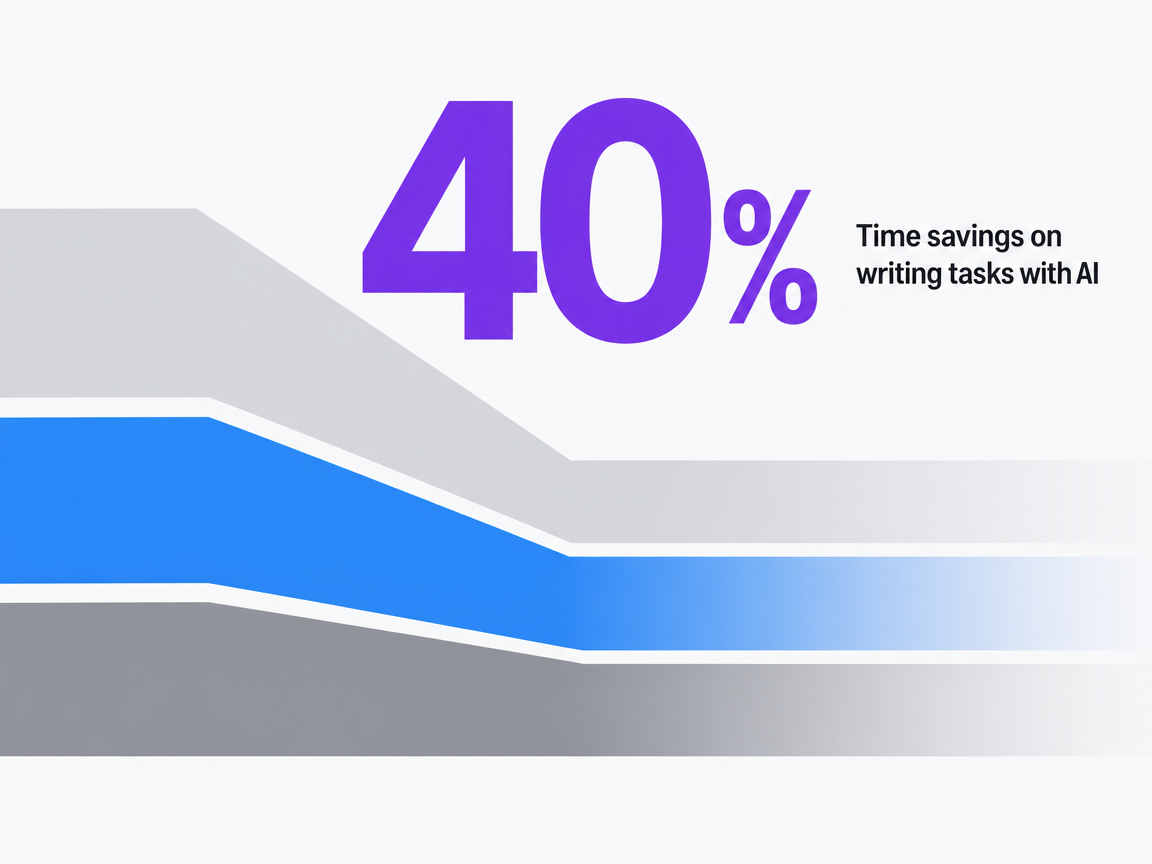 Time savings on writing tasks with AI
Time savings on writing tasks with AI
Content operations economics: three staffing models against a fixed output target
Consider a fixed monthly output target of 20 SEO articles at roughly 1,500 words each, with intent research, editorial review, and publishing included. Three operating models can hit that number, and their cost structures diverge in ways spreadsheets rarely capture.
The in-house-only model scales linearly. Each additional writer adds roughly 40 hours of drafting capacity per week, minus the review time a senior editor absorbs to keep brand voice and factual accuracy intact. Onboarding runs eight to twelve weeks before net-new output stabilizes, and every subsequent doubling of the target requires another hire. The bottleneck migrates from drafting to editorial review as soon as headcount climbs past three or four writers.
The agency retainer model swaps capacity for coordination. Draft hours move off the internal ledger, but briefing cycles, revision rounds, and status calls scale with the word count on the retainer. Forrester's 2025 research on generative AI inside US marketing agencies notes that agencies are themselves restructuring around AI-assisted delivery, which reshapes the value proposition for the in-house buyer paying full-service rates for output an AI-augmented team could produce internally 14.
The AI-assisted model with the existing team changes the variable. Applying the Noy & Zhang 40% time reduction on mid-complexity SEO drafts to a two-writer team frees roughly 32 drafting hours per week, before accounting for the 11.4 hours per week that Deloitte Digital's users report reallocating to strategic work 1, 8. The Stanford GSB pattern adds a second lever: mid-level writers pick up 14% average and up to 34% novice throughput gains, which is exactly the segment most in-house teams staff heaviest 3. Same headcount, materially different output ceiling.
The honest caveat is that the AI-assisted model requires a review lane sized for the new draft volume. Triple the drafts without expanding editorial capacity and the bottleneck simply moves. The economics work when the operating model is redesigned around the shift, not when AI is bolted onto the existing calendar.
Governance, provenance, and the risks that stall AI content programs
The programs that stall are rarely the ones that fail technically. They stall because a legal, brand, or accuracy incident lands on the CMO's desk and the response is a moratorium instead of a control. McKinsey's 2024 survey found 44% of organizations using generative AI had already experienced at least one negative consequence, and Deloitte Digital reported that 65% of surveyed marketing leaders are very or extremely concerned about intellectual property and legal risks tied to genAI content 9, 8. Governance is what keeps those numbers from becoming the reason the operating model gets rolled back.
Three controls do most of the work:
- Provenance and disclosure come first: NTIA defines provenance as the origin of data or AI outputs and treats watermarking and content credentials as practical mechanisms for establishing it, and NSA guidance published in January 2025 encourages creators to adopt durable content credentials for AI-assisted material 10, 11. Peer-reviewed work on the C2PA standard argues that metadata, fingerprinting, and watermarking function as complementary layers rather than substitutes, which is the right mental model for a content team choosing what to implement 12, 13.
- The fact and source-substantiation lane inside editorial review. Inaccuracy is the most-cited negative consequence in the McKinsey data, and it is the failure mode that erodes organic rankings fastest once search engines and readers notice 9. Every claim in a draft either resolves to a cited source or gets cut before publication.
- A documented brand-voice and disallowed-pattern spec that the drafting layer is constrained by and the review layer enforces.
Together these three controls turn AI-assisted output from a policy risk into a governed release, which is what makes the volume gains defensible when they reach the CFO and general counsel.
Accelerate SEO Content Production—No Additional Headcount Required
See how leading agencies and enterprise teams are scaling SEO-based content writing through AI-driven workflows that maintain brand voice, quality, and measurable search impact—without increasing internal resources.
Reallocating the hours AI gives back
The 11.4 hours per week that Deloitte Digital's genAI users report reclaiming is not a bonus. It is capital that either compounds or evaporates, and most teams let it evaporate by absorbing the freed time back into more drafts of the same kind 8.
The higher-return move is to route those hours into work the drafting layer cannot do. Three uses tend to pay back fastest:
- Cluster architecture and internal linking maps convert isolated articles into ranked topic authority, which is where organic traffic actually compounds.
- Subject-matter interviews with product managers, sales engineers, and named customers produce the specific detail and point of view that models cannot fabricate and that senior editors previously did not have time to gather.
- Structured refresh audits — decayed pages, thin competitors on page one, schema and intent mismatches — recover ranking positions the team already earned.
Forrester's operational-capability framing lands hardest here: teams that reinvest AI-saved hours into strategy see sustained gains, while teams that reinvest them into raw volume plateau 6. The manager's job is to name the reinvestment target before the hours arrive, not after. A calendar block for cluster work and interviews on the same day the drafting cycle shortens is how the dividend gets banked instead of spent.
KPI feedback loops: closing the gap between publish and rank
Publishing more is only half the operating model. The other half is measuring which briefs actually earned rank, traffic, and pipeline, and routing that signal back to the strategy layer that ranked them in the first place. Without that loop, AI-assisted volume produces a larger library of unranked pages rather than a compounding organic asset.
The loop has four checkpoints on a fixed cadence:
- At 30 days, indexation, initial impressions, and average position confirm the piece entered the ranking pool.
- At 60 to 90 days, CTR on served impressions and position drift show whether intent and title match reality.
- At six months, assisted conversions and pipeline contribution separate traffic that browses from traffic that buys.
- Pages that miss thresholds at each gate get refresh briefs, not obituaries.
McKinsey's 2024 survey found that high performers attribute more than 10% of EBIT to genAI, and the pattern separating them from peers is disciplined measurement of AI-influenced outcomes, not raw adoption 9. The feedback data reranks the backlog, tightens brief templates, and tells the editorial layer which patterns keep clearing the bar. That is what turns throughput into ranking.
If you manage multiple brands or business units
For managers running content across a portfolio — multiple brands, regional business units, or a franchise system — the three-layer model changes shape rather than substance. The strategy signal layer runs per brand, because keyword clusters, competitor sets, and intent patterns rarely transfer cleanly across markets. The assisted production layer is where consolidation pays: a single set of brief templates, brand-voice specs, and disallowed-pattern rules, instantiated per brand, lets one editorial team support output that previously required parallel agency retainers.
The governed publishing layer stays local. Each brand keeps its own approval gate and named editor, because inaccuracy risk and brand-voice drift compound across a portfolio faster than across a single site 9. Forrester's 2025 agency research points to the same pattern reshaping outsourced delivery, which is the retainer line most portfolio managers are already paying 14. The reallocation math is straightforward: consolidate production tooling, distribute governance.
Frequently Asked Questions
References
- 1.Experimental evidence on the productivity effects of generative artificial intelligence.
- 2.Experimental Evidence on the Productivity Effects of Generative Artificial Intelligence.
- 3.Generative AI at Work.
- 4.The economic potential of generative AI: The next productivity frontier.
- 5.State of Generative AI in the Enterprise.
- 6.AI And Content Operations For Marketers.
- 7.Generative AI Takes Off with Marketers.
- 8.Deloitte Digital’s latest research forecasts generative AI’s transformation of content marketing.
- 9.The state of AI in early 2024: Gen AI adoption, using AI, and capturing value.
- 10.AI Output Disclosures: Use, Provenance, Adverse Incidents.
- 11.Strengthening Multimedia Integrity in the Generative AI Era.
- 12.Can provenance save us from a barrage of synthetic media?.
- 13.To Authenticity, and Beyond! Building Safe and Fair Generative AI Upon the Three Pillars of Provenance.
- 14.The State Of Generative AI Inside US Marketing Agencies, 2025.