
Key Takeaways
- Scaling portfolio SEO depends on a four-layer governance stack: Google's public baseline, the Search Quality Rater rubric, agency templates, and a named approval gate that senior strategists control 1, 3.
- AI summaries changed click economics, with traditional-result clicks dropping to 8% versus 15% when no summary appeared, so production hours should shift toward transactional, local, and first-party-data queries 16.
- Prioritize accounts and locations on three signals that survive client review: revenue potential, competitive intensity, and current performance gap, then tier multi-location work so senior hours concentrate on Tier 1 markets 14.
- Focus next on codifying E-E-A-T into pass/fail brief and QA fields, choosing an operating model with a real approval gate, and reporting indexation health, eligible-query CTR, and assisted conversions rather than impression averages.
The Governance Problem Behind Portfolio SEO
The bottleneck in scaling SEO across a client book is rarely tactical knowledge. Most agency SEO leaders already know what a canonical tag does, what a helpful content update rewards, and what a Core Web Vitals threshold means. The unresolved problem is governance: how to make 40 or 80 client sites move in the same direction, at the same quality bar, without a senior specialist babysitting each account.
That problem gets harder because Google's own baseline keeps expanding. The Starter Guide alone now covers crawlability, indexation, structured data, mobile UX, internal linking, and Search Console monitoring 1, while the technical documentation adds crawl budget policy, hreflang, HTTPS migration rules, and site-move procedures for large properties 2. Enterprise governance guides layer stakeholder alignment, duplication audits, and Core Web Vitals prioritization on top of that 7. No agency scales by asking senior strategists to hold all of it in their heads across every account.
The agencies that grow margin instead of headcount treat those standards as source material for repeatable artifacts: briefs, QA checklists, prioritization matrices, and approval queues. The sections that follow describe how that operating model actually gets built, where AI-assisted execution fits, and which measurement signals hold up when a client asks what the retainer is buying.
Codifying Google's Standards Into Repeatable Templates
The Four-Layer Governance Stack
A portfolio SEO operation runs on four stacked layers, each one narrower and more opinionated than the layer beneath it. Agencies that skip a layer end up rebuilding it under deadline pressure.
The base layer is Google's public baseline. The Starter Guide defines the minimum on crawlability, indexation, structured data, mobile UX, titles and descriptions, image optimization, internal linking, and Search Console monitoring 1. The technical documentation adds crawl budget policy, robots.txt rules, HTTPS migration procedures, hreflang, and site-move mechanics for larger properties 2. Treat these two documents as the specification a client site is measured against, not as reading material.
The second layer is the quality rubric. Google's Search Quality Rater Guidelines define Page Quality, Needs Met, and E‑E‑A‑T criteria that human raters apply, with instructions to evaluate the main content and the reputation of the website behind it 3. That rubric translates into scoring criteria a QA reviewer can actually mark up.
The third layer is the agency template stack: brief formats, on-page checklists, schema libraries, internal linking rules, and content models tuned to each vertical. This is where the first two layers stop being documents and become artifacts a mid-level operator can execute against.
The fourth layer is the approval workflow. Every artifact produced against the templates routes to a named reviewer before publish, with the underlying reasoning attached. That gate is what lets a lean senior team supervise output volume that would otherwise require a floor of specialists. The four layers together give an agency a defensible answer when a client asks what governs the work.
Translating E-E-A-T Into Brief and QA Artifacts
E‑E‑A‑T is a rubric, not a ranking factor, and treating it as free-form guidance is where scaled content operations lose consistency. The Search Quality Rater Guidelines direct raters to assess the purpose of the page and whether the content fulfills its intended user need 4, and to weigh the reputation of the website alongside the quality of the main content 3. Those instructions convert cleanly into brief fields and QA checkpoints.
On the brief side, four fields carry most of the weight. Author identity captures the named human accountable for the content, their credential, and a link to a bio page with verifiable experience. Source discipline names the specific studies, official documents, or first-party data the piece must cite, with URLs supplied at brief time rather than sourced by the writer. Intent match specifies the query cluster and the dominant user need, tied to a Needs Met framing. Reputation signals list the third-party references, review sources, or professional citations that reinforce the site's standing in the topic.
On the QA side, the checklist mirrors those fields. A reviewer confirms author attribution renders on the page and links to a populated bio, verifies every factual claim resolves to a cited source, checks that the dominant user question is answered above the fold, and flags any assertion that reads as opinion without evidence. Pages that fail any check route back to production before the approval queue.
Codified this way, E‑E‑A‑T stops being a workshop topic and becomes a set of pass/fail conditions a mid-level operator can enforce across every account without escalation.
Technical Baselines That Belong in Every Client Setup
Technical baselines are the fastest layer to standardize and the one where portfolio consistency pays the most compounding interest. A single documented policy replaces dozens of ad-hoc audits.
Six items belong in every client's initial technical setup. XML sitemaps that list only the most important URLs, with less important URLs excluded via robots.txt, follow Google's own guidance on crawl budget for larger sites 2. Canonicalization rules resolve duplication conflicts before they reach the index 1. State-changing URLs, such as cart, filter, and comment submission endpoints, are blocked from crawling per Google's technical documentation 2. Shallow site hierarchy, hard sitemap size limits, and noindex rules for thin or near-duplicate templates come from enterprise site structure guidance that argues agencies should eliminate most thin or low-quality pages and noindex duplicates as a governance function, not a cleanup task 8. Search Console is provisioned at kickoff so performance monitoring starts on day one 1. HTTPS, mobile-friendliness, and Core Web Vitals are audited against the enterprise checklist that names them as first-order technical debt 7.
These items are not novel. What makes them scale is that the policy is written once, applied to every new client through the same onboarding template, and enforced by the same QA pass. When a client site drifts, the drift is visible against the template rather than against a specialist's memory. That is the difference between an agency running 20 accounts and an agency running 80 with the same senior bench.
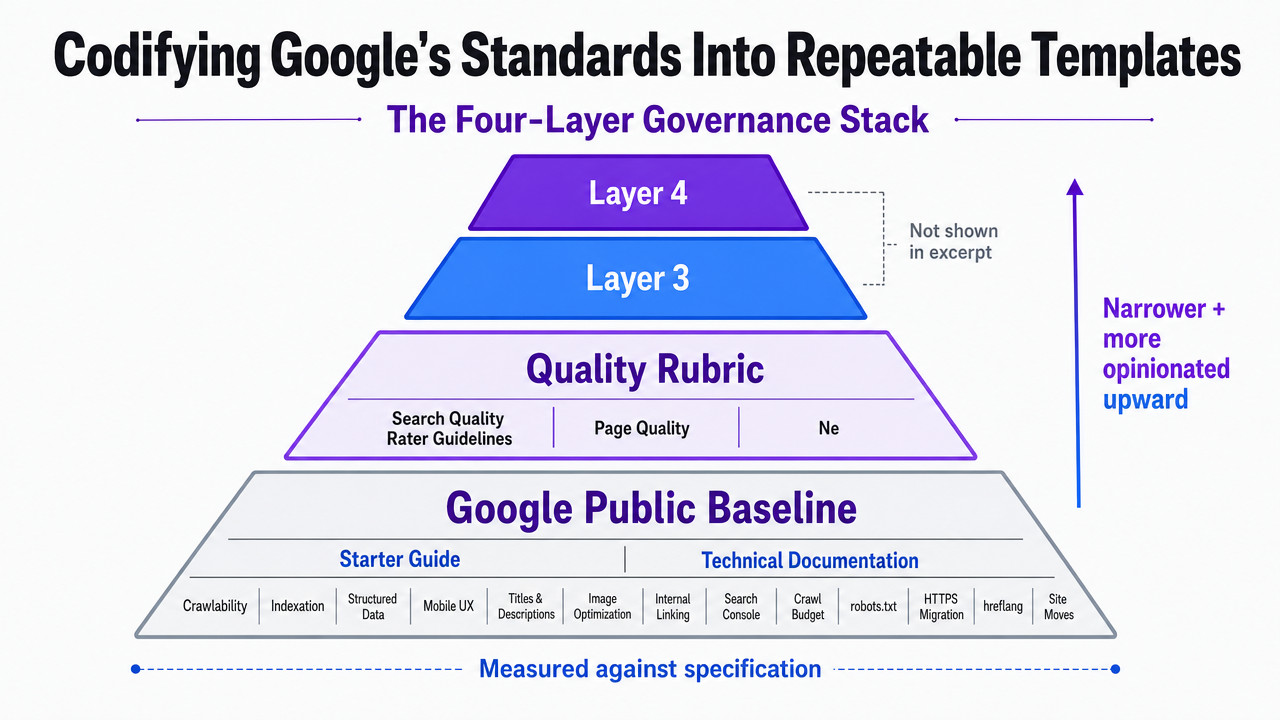 Visualize the four-layer governance stack described in the section, showing how each layer narrows and becomes more opinionated than the one beneath it
How AI-Summary Result Pages Reshape Scaling Priorities
The click economics on Google shifted in a measurable way when AI summaries entered the results page. Pew's 2025 study of U.S. adults found that users clicked a traditional result on 8% of visits when an AI summary was present, compared with 15% when no summary appeared, and 26% of pages with an AI summary ended the browsing session versus 16% without 16. The sample is U.S. adult behavior on Google, not a global claim about every vertical, but the direction is clear enough to change how a portfolio allocates hours.
The practical consequence is that middle-of-the-funnel informational queries, the ones AI summaries answer most cleanly, are worth fewer hours per unit of production than they were two years ago. That does not mean deprioritizing content. It means reweighting what gets produced. Queries with transactional intent, local intent, or answers that require first-party data, pricing, comparisons, or specific practitioner experience are harder for a summary to compress and easier to defend as a click-earning asset. Those are the briefs that deserve senior review time.
For a portfolio operation, three adjustments follow. Keyword clusters get re-scored by summary vulnerability: how often the query already returns a summary, and how much of the answer the summary captures. Content depth targets increase for surviving pages, with structured data, primary sources, and named-expert attribution treated as production requirements rather than options. And measurement shifts from raw impression counts toward click-through on eligible queries and assisted conversions from organic sessions. The agencies that route summary-vulnerable work through cheaper production while concentrating senior review on defensible pages preserve margin without cutting client output.
Test AI-driven SEO execution at scale now
Experience measurable SEO impact across multiple client sites before you commit.
A Portfolio Prioritization Model Agencies Actually Use
Scoring Signals: Revenue Potential, Competitive Gap, Current Performance
Portfolio prioritization fails when it runs on gut and account history. It works when it runs on three signals that survive a client review: revenue potential, competitive intensity, and current performance gap. Search Engine Journal's multi-location guide names those exact three criteria for ranking where SEO effort should concentrate, prioritizing branches based on highest revenue potential, highest competition, and weakest current performance 14. The same logic applies one level up, at the account level, across a portfolio.
Revenue potential is the size of the addressable outcome, not the size of the retainer. For a law firm client, it is the case value times the query volume in the practice area. For a home services client, it is average ticket times booked jobs from organic. The number does not need to be precise. It needs to be consistent across accounts so a scoring pass can compare them.
Competitive intensity captures how much work a ranking move actually costs. A query cluster with three national aggregators sitting above the fold is not the same investment as a cluster where the top ten are local operators with thin content. The signal is answered by SERP composition and referring-domain gaps against the top three competitors, both readable from standard toolset outputs.
Current performance gap is the delta between where an account ranks and where its site profile suggests it should rank. Accounts with strong technical baselines and weak visibility usually respond fastest to content and internal linking work. Accounts with the reverse profile need architectural investment before content moves the needle. Scoring each account on all three signals monthly produces a ranked queue that senior strategists can defend to the client and to their own P&L.
Approval-Based Automation as the Execution Layer
A ranked queue is only useful if the work behind it ships. That is where most agencies lose the compounding advantage the scoring model creates. Briefs sit in draft. QA reviews stall against a senior calendar. Publish dates slip past the window where the ranking opportunity was live. The execution layer, not the strategy layer, is where scaled SEO programs bleed margin.
Approval-based automation compresses that distance. Production work runs against the templates and rubrics already codified in the governance stack, including the Starter Guide baseline 1, the technical policies for crawl budget and structured data 2, and the E‑E‑A‑T scoring criteria drawn from the Search Quality Rater Guidelines 3. Because the standards are explicit, mid-level operators or AI-assisted drafts can produce output that hits the specification without a senior strategist writing it. What senior strategists do instead is review, mark up, and approve.
Two properties make this model hold under portfolio load. First, every deliverable arrives at the approval queue with the underlying reasoning attached: which scoring signal triggered the work, which template it was built against, which QA checks it passed. A reviewer approves the artifact and the rationale together, in the same pass. Second, nothing publishes without that approval. The gate is what keeps client-facing quality consistent when volume climbs from 20 accounts to 80.
The economic effect is direct. Senior hours shift from producing work to governing work. A lean bench can supervise output that a traditional staffing model would require three or four times the headcount to produce, and the client-facing artifact, the approved brief with its reasoning, is more defensible than the ad-hoc equivalent.
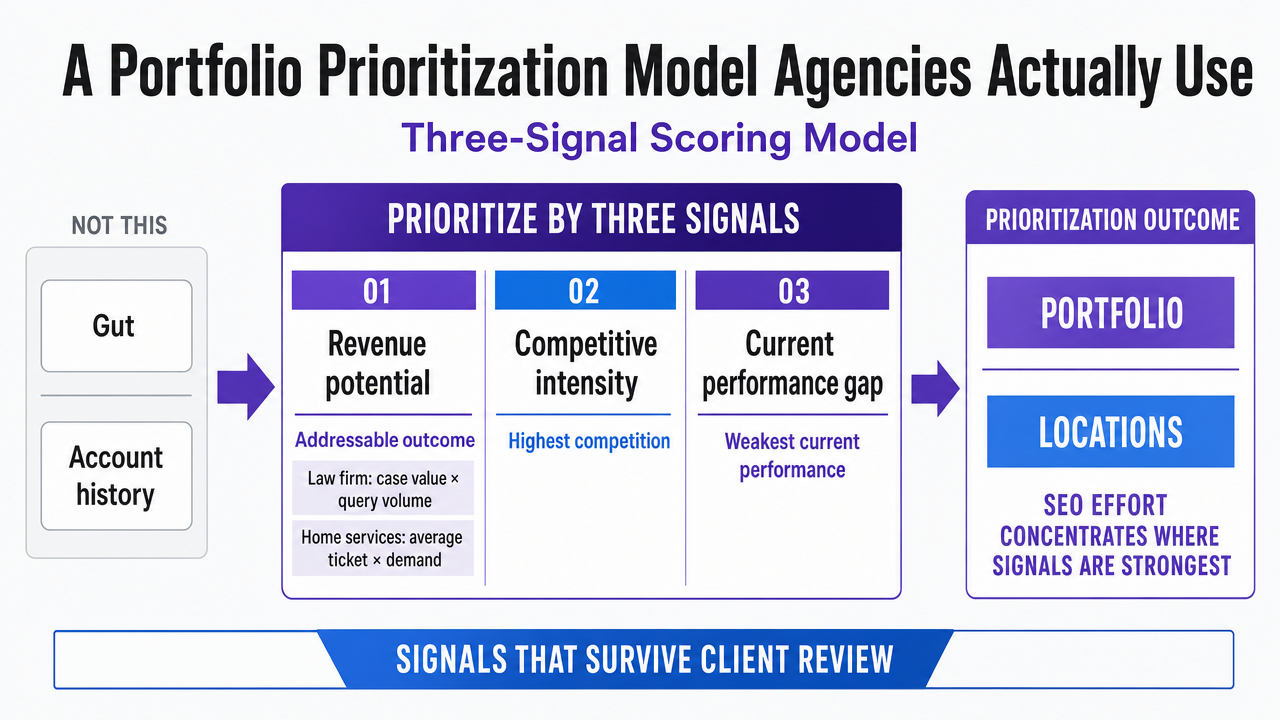 Illustrate the three-signal scoring model (revenue potential, competitive intensity, current performance gap) that drives portfolio and location prioritization as cited from source 14
If You Manage Multi-Location Clients: The Execution Economics
Three-Tier Architecture and the 60/40 Content Mix
The scaling pain in agency SEO concentrates in multi-location accounts. A dental group with 40 practices, a law firm with 12 offices, or a home services franchise with 80 territories carries the same governance overhead as a large enterprise site but arrives with the operational messiness of dozens of local owners, hours, and reputational profiles. The execution economics only work when the site architecture and the content model are decided once and applied uniformly.
The architecture is a three-tier hierarchy: a homepage that owns brand and service authority, state or region hubs that consolidate metro-level intent, and individual location pages that carry local relevance. URLs are never structured as flat domain.com/location1 patterns; they follow the hierarchy explicitly, with state and city segments in the path 12. That structure gives internal linking a defensible logic and lets crawl budget concentrate on the pages that convert 2.
Content on location pages holds to roughly 60% core brand content and 40% local context, a ratio designed to keep pages substantive enough to avoid doorway-page treatment while still carrying the neighborhood, staff, review, and hours specificity a local query rewards 11. The 60% is templated once at the brand level and reused. The 40% is where local execution happens: named practitioners, local photography, review pulls, and area-specific service notes. Centralized strategy and templates with localized execution is the hybrid model that scales without collapsing quality 13.
Location Tiering Table: Where Hours Actually Move Rankings
Not every location deserves the same monthly cadence. An agency that spreads hours evenly across a 40-location account subsidizes underperforming markets with the work that could compound in the strong ones. The prioritization signals from earlier in the portfolio model apply again at the location level: highest revenue potential, highest competition, and weakest current performance are the three criteria that decide where hours move rankings 14.
Tiering translates those signals into a schedule a production team can run against.
- Tier 1 locations combine strong revenue potential with either a competitive gap that can be closed or a performance deficit relative to the site's technical baseline.
- Tier 2 locations have solid revenue but stable rankings that need maintenance rather than intervention.
- Tier 3 locations are low-volume or already dominant, and their hours are limited to what keeps the profile intact.
| Tier | Signal weights | Recommended cadence | Content mix (60/40 rule) |
|---|---|---|---|
| Tier 1 | High revenue potential + high competition or weak current performance | Monthly on-page updates, quarterly local content refresh, active GBP management | 60% brand template, 40% deep local: named staff, local case examples, neighborhood-specific service pages |
| Tier 2 | Moderate revenue, stable performance, moderate competition | Quarterly on-page review, biannual local refresh, monthly GBP monitoring | 60% brand template, 40% standard local: hours, reviews, area served, staff bios |
| Tier 3 | Low revenue potential or already dominant SERP position | Semiannual audit, GBP monitoring only | 60% brand template, 40% baseline local: NAP, hours, one local paragraph |
Location tiering model adapted from prioritization criteria in 14 and the 60/40 content ratio in 11.
The economic effect is that senior review time concentrates on Tier 1, where a ranking move produces revenue that funds the rest of the account. Tier 3 runs on templates and monitoring alone. That distribution is what makes a lean bench profitable across a portfolio of multi-location clients instead of drowning in undifferentiated location-page updates.
See How Leading Agencies Scale SEO Execution Without Adding Headcount
Request a detailed walkthrough of AI-powered workflows that streamline content, approvals, and reporting—enabling your team to deliver consistent, measurable SEO results across every client portfolio.
Choosing an Operating Model: In-House, Offshore, Freelance, or AI-Assisted
The operating model decision sits underneath every other scaling choice an agency makes. It determines fixed cost, ramp time, quality variance, and the ceiling on how many accounts a senior bench can supervise. Four models dominate the market, and each carries a distinct tradeoff profile.
In-house specialist hiring produces the tightest quality control and the deepest institutional knowledge, at the cost of the slowest ramp and the highest fixed burden. A senior technical SEO or content strategist takes months to onboard against agency-specific templates, and the model scales linearly: doubling client count roughly doubles headcount. For agencies that hold the enterprise governance principles in Search Engine Land's guide as non-negotiable 7, in-house senior hires remain the reference standard for accounts that require stakeholder coordination and custom judgment.
Offshore production pods trade fixed cost for coordination overhead. Throughput improves, but the governance stack has to be airtight. Without codified templates against Google's baseline 1 and the technical policies for crawl budget and structured data 2, offshore output drifts from the specification and senior reviewers spend their hours rewriting rather than approving. Offshore models reward agencies that have already done the template work.
Freelance networks handle spike capacity and specialist gaps well, and handle consistency poorly. Every freelancer interprets briefs differently, which pushes QA burden back onto the senior bench. The model is a supplement, not a foundation.
AI-assisted execution with human approval is the newest model and the one that changes the headcount curve. Production runs against the same codified templates and E‑E‑A‑T rubric 3, and senior strategists spend their time reviewing and approving rather than producing. The model only holds under portfolio load when the approval gate is real: nothing publishes without a named human sign-off, and the underlying reasoning arrives with the artifact. Agencies evaluating it should test it against a defined subset of accounts before shifting portfolio weight, and should keep in-house senior bench for the strategy and governance layers that no model produces on its own.
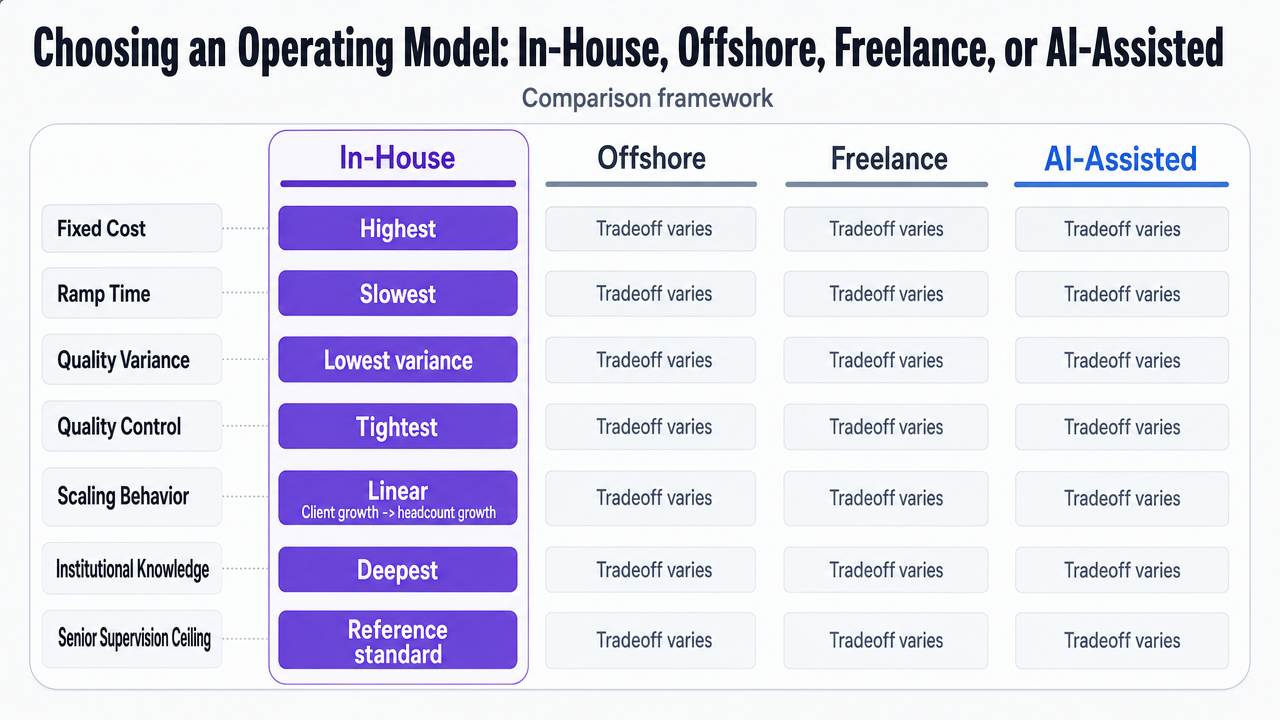 Provide a comparison framework of the four operating models discussed in the section, since the article explicitly compares them across tradeoffs like fixed cost, quality control, and scaling behavior
Measuring What Scales: Signals That Hold Up Under Client Scrutiny
Measurement is where scaled SEO programs either earn renewal or start losing accounts. The metrics that hold up in a client review are the ones that connect production work to business outcomes, not the ones that fill a dashboard. Impression counts and average position have lost most of their explanatory power now that AI summaries compress query visibility for U.S. adult searchers on Google 16. The signals that survive scrutiny are narrower and more defensible.
Four categories carry the review. Indexation health tracks the ratio of submitted-to-indexed URLs in Search Console against the sitemap policy set at onboarding 1, with crawl stats read against the crawl budget rules for larger properties 2. Eligible-query click-through measures CTR on queries where a traditional result is still the primary answer, isolating the pages where content investment actually earns clicks. Assisted conversions from organic sessions tie ranking movement to booked outcomes, using the client's own CRM or call data rather than session counts. Location-level visibility, for multi-location accounts, reports rankings and GBP performance per tier rather than as a portfolio average that hides the Tier 1 gains inside Tier 3 noise 14.
Reported monthly against the scoring model that ranked the work in the first place, these signals give a client the same view the senior bench uses to prioritize hours. That alignment is what makes the retainer defensible when volume climbs.
Frequently Asked Questions
References
- 1.Search Engine Optimization (SEO) Starter Guide.
- 2.Technical SEO Techniques and Strategies.
- 3.Search Quality Rater Guidelines: An Overview.
- 4.General Guidelines (Google Search Quality Evaluator Guidelines PDF).
- 5.The SEO Starter Guide got a makeover.
- 6.A revamped SEO Starter Guide | Google Search Central Blog.
- 7.Enterprise SEO Guide: Strategies for Scalable Search Success.
- 8.Enterprise SEO Site Structure: 14 Essential Optimizations.
- 9.Usability Standards | NIST.
- 10.دليل تحسين نتائج محرّكات البحث للمبتدئين: الممارسات الأساسية.
- 11.Local SEO for Multiple Locations: Best Practices & Multi-Location Strategy.
- 12.Local SEO Strategies for Multi-Location Businesses.
- 13.The Real Playbook for Multi-Location Local SEO in 2026.
- 14.The Complete Guide To Local SEO For Multiple Locations.
- 15.SEO Metrics for Enhanced Academic Research Visibility.
- 16.Do people click on links in Google AI summaries?.
- 17.Main findings.
- 18.Search Engine Use.
- 19.Search Engine Users.
- 20.Evaluation Infrastructure for the Measurement of Content-based Video Quality and Video Analytics.