
Key Takeaways
- Every blog post now serves two surfaces at once—the classic SERP and generative answers—so production should build one artifact that satisfies both rather than splitting workflows.
- Generative engines retrieve at the passage level, and passages with inline citations, direct quotations, and quantified statements saw up to a 40% source-visibility lift in controlled experiments 8.
- Governance sits inside the same production run: FTC disclosure and substantiation, Copyright Office human-authorship records, and NIST provenance and review roles gate what ships 1, 6, 9.
- Focus next on rewriting briefs around evidence units, replacing AI-detection reflexes with source-based review, and reporting classic SERP metrics beside passage citations on one dashboard.
The Blog Post Is Now a Dual-Surface Asset
A single blog post now has to earn its keep on two surfaces at once: the classic search results page and the generative answer. The same URL that a content team publishes for a target query is also a candidate passage for AI Overviews, Google's AI Mode, ChatGPT, Perplexity, and other retrieval-augmented systems. Each surface reads the page differently. The SERP rewards topical coverage, links, and page experience. The generative engine reads at the passage level, selects short spans of text, and prefers material that is directly cite-worthy.
This shift does not retire traditional SEO practice. Crawlability, indexability, structured data, and useful, people-first content remain the foundation regardless of whether the destination is a blue link or a synthesized answer. What has changed is what content teams optimize within the post. Passages that generative engines are more likely to include tend to carry specific features documented in peer-reviewed research on Generative Engine Optimization: explicit citations, direct quotations, and quantified statements 8.
For an in-house editorial lead, the practical consequence is that the production model has to serve both surfaces from one artifact. Splitting the workflow into an "SEO post" and a separate "GEO post" duplicates cost without improving either outcome. The rest of this playbook treats every blog post as a dual-surface asset and builds the strategy, evidence unit, governance layer, and measurement stack around that premise.
What Actually Gets Cited by Generative Engines
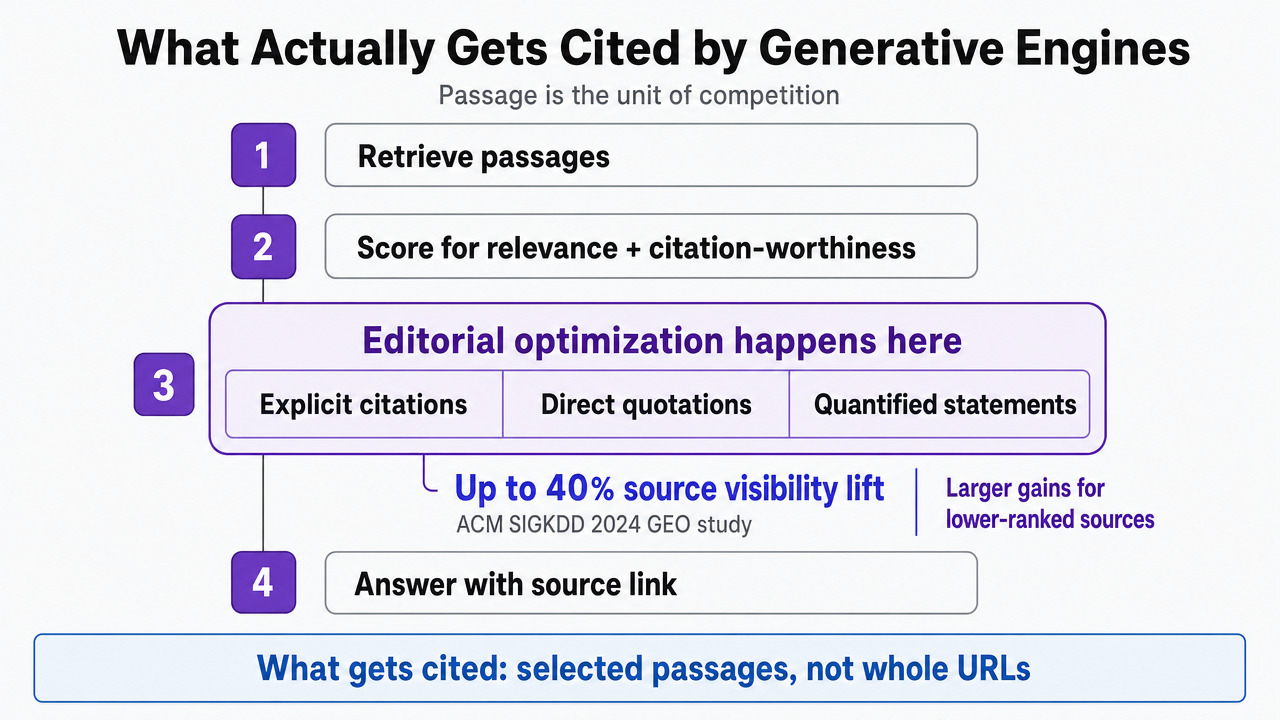
Generative engines do not rank pages the way a SERP does. They retrieve passages, score them for relevance and citation-worthiness, and stitch selected spans into an answer with a source link. The unit of competition is the passage, not the URL. That reframes what an editorial team should optimize inside a post.
The clearest empirical signal on what raises passage-level inclusion comes from the ACM SIGKDD 2024 paper that formalized Generative Engine Optimization. In its controlled experiments, passages rewritten to include explicit citations, direct quotations, and quantified statistics achieved up to a 40% improvement in source visibility inside generative-engine responses, with disproportionately larger gains for lower-ranked sources that would otherwise be crowded out 8. The study measured source-visibility metrics across a defined query set and set of engines; effects varied by engine, prompt, domain, and model version, and the ceiling should be read as an experimental upper bound rather than a guaranteed lift on any single post 8.
The operational read is narrower than the headline number. Three passage features did the work:
- Citations. To primary sources placed adjacent to the claim they support.
- Direct quotations. From named authorities, kept short and attributed inline.
- Quantified statements. Specific figures, dates, percentages, and thresholds, rather than vague qualifiers.
Passages that lacked these features tended to be paraphrased or omitted entirely when a retrieval system had denser alternatives available 8. For an editorial lead, that changes the brief. A 1,500-word post written as continuous argument, without inline sources or hard numbers, is functionally invisible to the retrieval layer even if it ranks on the SERP. A post of the same length built around ten discrete, self-contained evidence passages gives the engine ten separate chances to be cited.
Two structural implications follow. First, passage independence matters. Each cite-worthy paragraph should read correctly when lifted out of context, because that is how generative engines will present it. Pronoun-heavy or context-dependent sentences fragment poorly. Second, source proximity matters. A statistic in paragraph two supported by a citation in paragraph nine loses the association during retrieval. The citation belongs in or next to the sentence that carries the claim.
This does not replace classic on-page work. It layers on top of it. Crawlable HTML, accurate structured data, and topical depth still determine whether a page is in the candidate pool at all. The GEO features determine which passages inside that page get pulled forward once the engine starts assembling an answer.
 Visualize the three cited passage features (citations, direct quotations, quantified statements) from the ACM SIGKDD 2024 GEO study that produced the up-to-40% source-visibility lift referenced in the section prose
The Citable Evidence Unit: An On-Page Content Model
If the passage is the unit of competition, then the paragraph is the unit of production. A citable evidence unit is a self-contained on-page block engineered to be lifted verbatim into a generative answer without losing its meaning or its source. Editorial teams that shift from writing sections to writing units get more shots on goal from the same word count.
Each unit has five parts:
- Claim. A single declarative sentence that resolves a specific sub-question a reader or engine might ask.
- Quantifier. A specific figure, date, threshold, or bounded range inside the claim sentence, not deferred to a later paragraph.
- Source link. An inline citation to the primary document, placed adjacent to the quantifier so retrieval preserves the association.
- Expert attribution. A named authority, institution, or credentialed reviewer tied to the claim, either as the source or as an on-page byline reviewer.
- Schema wrapper. Article, FAQPage, or HowTo structured data that mirrors the passage content and makes the block machine-legible.
The structure maps directly to the passage features that raised inclusion in the ACM SIGKDD 2024 GEO experiments: citations, direct quotations, and quantified statements produced up to a 40% lift in source visibility across the tested engines and query set, with larger effects for sources that would otherwise rank below the fold 8. A unit that carries all three features is doing the work the study measured. A paragraph missing the quantifier or the inline source is not.
Two writing rules make units portable. Open each block with the noun the claim is about rather than a pronoun, so the passage reads correctly out of context. Keep the quantifier and the citation inside the same sentence, or in immediately adjacent sentences, so the retrieval layer preserves the pairing. A statistic supported by a citation eight paragraphs later reads as an orphan claim once it is lifted.
For briefs, this changes the deliverable. Instead of an outline of H2s, editors specify the sub-questions each post must answer and the evidence unit required for each one: the claim to make, the source that supports it, the quantifier to include, and the schema type to wrap it in. Writers assemble units against that spec. Reviewers verify the claim-source-quantifier triple before approving publication.
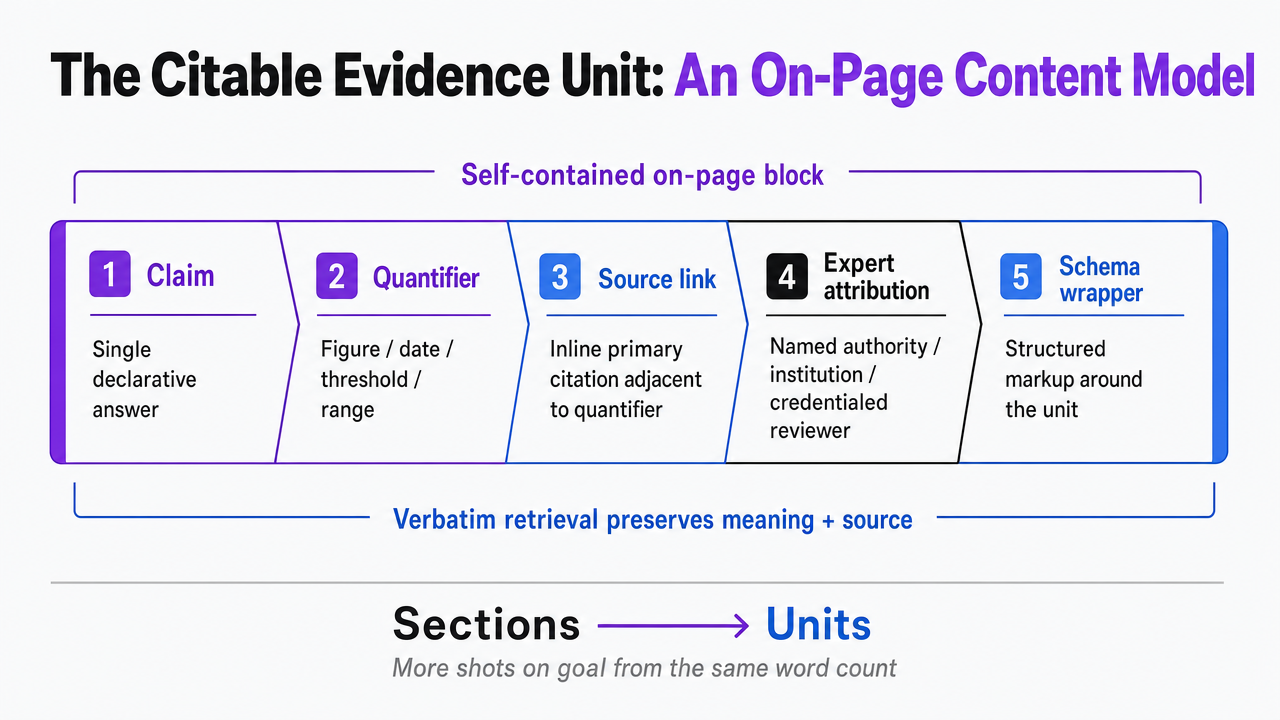 Diagram the five-part citable evidence unit (Claim, Quantifier, Source link, Expert attribution, Schema wrapper) described in the section as an on-page content model
Test Your SEO Blog Strategy in Real Time
See how AI-optimized blog posts impact search rankings before making a commitment.
One Production System, Two Surfaces
Running parallel workflows for classic SEO and generative-engine visibility doubles cost without improving either result. The features that make a passage cite-worthy inside an AI answer—inline citations, direct quotations, quantified statements—also strengthen the same page in traditional ranking: they raise topical depth, add outbound authority signals, and give reviewers concrete claims to verify. One artifact, produced once, serves both destinations when the production spec is built around evidence units rather than word count.
The unified workflow has five stages. Briefs specify sub-questions and the evidence unit required for each, not just target keywords and H2s. Drafting assembles units against that spec, with quantifier and source paired inside the same sentence. Human review verifies the claim-source-quantifier triple, checks that each unit reads correctly when lifted out of context, and confirms schema wraps the right block. Approval logs who reviewed what and what changed. Publishing pushes the post with structured data intact, because AI Overviews and AI Mode rely on the same crawlable HTML, indexable content, and accurate schema that classic search has always required—no separate machine-readable feed exists for generative surfaces.
This collapses the tooling stack too. The same CMS, the same schema library, the same fact-checking checklist, and the same analytics tags serve both KPI columns. What differs is the review lens. An editor optimizing only for the SERP asks whether the post covers the topic; an editor optimizing for both asks whether ten specific passages inside the post can stand alone as citations. The brief drives that answer before a writer opens the document.
Governance: Compliance, Copyright, and Provenance in One Layer
Disclosure and Substantiation Under FTC Rules
Blog posts that carry testimonials, customer stories, affiliate links, influencer quotes, or AI-assisted endorsements sit inside the FTC's Endorsement Guides. A material connection that a significant minority of consumers would not expect—payment, free product, employment, an affiliate relationship—must be disclosed clearly and conspicuously next to the endorsement itself, not buried in a footer or terms page 1. Sponsored or partner posts styled to resemble editorial coverage fall under the FTC's native-advertising guidance, which treats misleading format as deceptive even when the underlying product claims are accurate 2.
Substantiation is the other half. In January 2025 the FTC required an AI marketer to pay $1 million and stop claiming its product could make websites WCAG-compliant without supporting evidence, and it flagged undisclosed material connections tied to reviews of that product 7. The September 2024 Operation AI Comply sweep alleged that a generative service produced detailed reviews containing material facts unrelated to user input, treating fabricated evidence in AI-drafted copy as a consumer-protection violation 12.
The editorial control is a pre-publish checklist: every endorsement carries an inline disclosure of the material connection, every performance or capability claim carries a source or is cut, and every customer quote is verified against a real interaction record.
Human Authorship, Contribution Records, and Copyright
The U.S. Copyright Office's Part 2 report, issued January 29, 2025, is the operating document for AI-assisted blog production. Copyright protects original expression created by a human even when a work contains AI-generated material, but it does not extend to purely AI-generated output or to material where a human lacks sufficient control over expressive elements. The Office judges human contribution case by case and states that merely supplying prompts is not enough on its own 6, 10, 11.
For content teams, that translates into three artifacts kept per post. First, a byline record showing which human editor selected sources, wrote or rewrote passages, and made structural decisions. Second, a revision history preserved in the CMS or a version-control layer so substantial human edits are demonstrable, not asserted. Third, a contribution log noting where AI drafted, where a human rewrote, and which passages were left substantially machine-generated.
The Office's February 2024 update adds a disclosure rule for registration: when a work contains more than de minimis AI-generated material, applicants should disclose that material and briefly explain the human author's contributions 3. Teams that plan to register flagship posts or repurpose them into registrable long-form assets need that record from day one.
Provenance and Review Roles from NIST
NIST's November 2024 report on synthetic content recommends provenance tracking—recording the origin and edit history of digital content—as a way to support later determinations about authenticity and credibility 4. Applied to a blog operation, provenance is not a watermark project. It is a set of records: which sources informed the draft, which model produced which passage, which human reviewer approved which change, when the post was published, and which media assets came from where.
The governance role assignment comes from NIST's Generative AI Profile, released July 26, 2024 as part of the AI Risk Management Framework. It directs organizations to identify generative-AI-specific risks and to define review responsibility, documentation, testing, monitoring, and escalation for inaccurate, biased, or unsafe output 9. For an editorial team, that becomes a named reviewer for factual claims, a named approver for publication, and a defined escalation path when a live post is flagged for a fabricated statistic or an unverified endorsement.
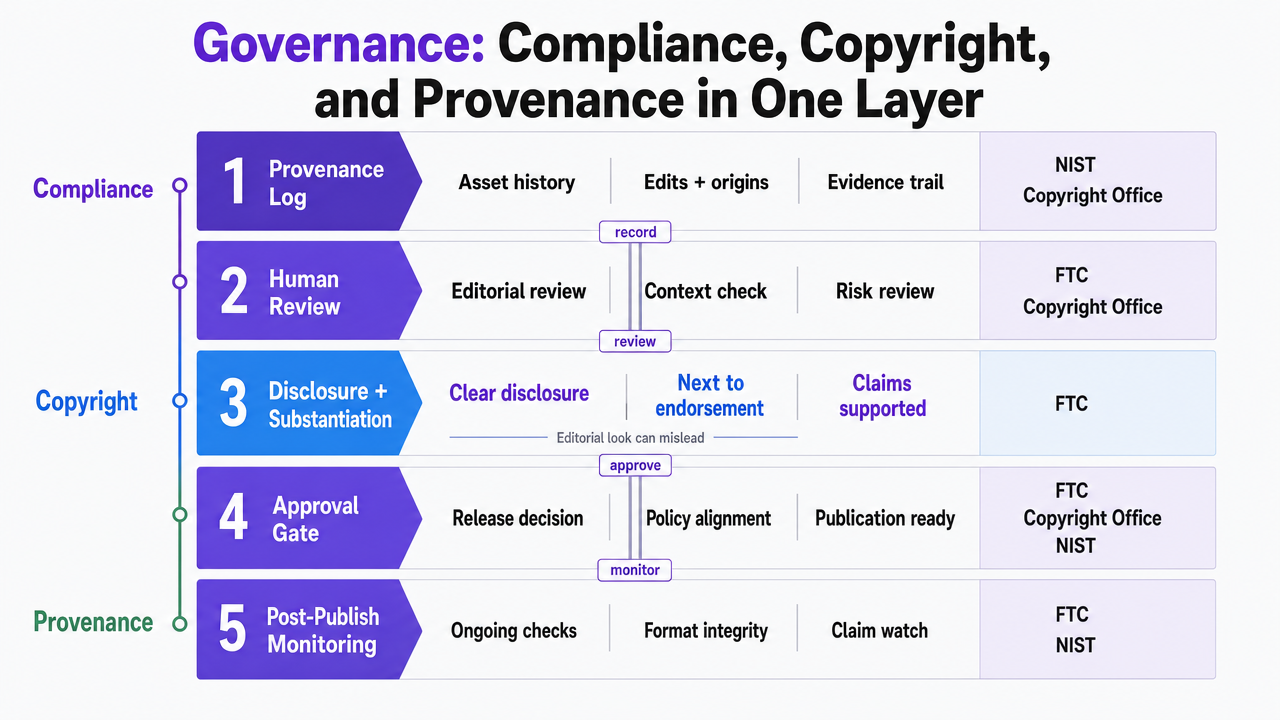
Stacked together, the layers form one operational picture: provenance log at the base, human review above it, disclosure and substantiation checks next, the approval gate before publication, and post-publish monitoring on top—each mapped to the FTC guidance, the Copyright Office report, or the NIST framework that requires it 1, 2, 4, 6, 9.
 Show the stacked governance layers the section explicitly describes (provenance log, human review, disclosure and substantiation, approval gate, post-publish monitoring) each mapped to FTC, Copyright Office, and NIST sources cited in the prose
Quality Control Without AI-Detection Theater
AI-detection tools have become a reflex quality gate for editorial teams worried about publishing machine-drafted copy. The reflex is misplaced. NIST's 2024 GenAI text-to-text pilot evaluated both text-generation systems and the discriminators designed to distinguish AI-generated from human-written text, and its findings caution against treating detector scores as a proxy for quality: detection accuracy varies, generated text can mimic human writing closely, and a detector verdict says nothing about whether a passage is accurate, sourced, or useful 5.
A passage can score as human-written and still contain a fabricated statistic. A passage can score as AI-generated and be fully sourced, expert-reviewed, and legally defensible. The score answers the wrong question.
The gate that matters is evidence-based. Reviewers check three things before approval: whether every quantifier in the post traces to a primary source cited inline, whether every endorsement or capability claim carries substantiation on file, and whether a named subject-matter reviewer has signed off on the technical accuracy of each claim. That checklist maps directly to the FTC's substantiation posture and to the human-authorship record the Copyright Office expects 6, 11. Detector scores can stay in the toolkit as a signal. They should not decide what ships.
Accelerate SEO Blog Production Aligned for AI Search Dominance
Connect with specialists to see how leading brands streamline SEO content workflows, maintain editorial control, and adapt blog strategy for generative search—without scaling headcount or losing quality.
Measurement: Classic SEO KPIs Alongside Generative Citation KPIs
A dual-surface asset needs a dual-column scorecard. Reporting only on rankings and organic sessions understates the value of a post that gets quoted in an AI Overview but never earns the click. Reporting only on AI mentions ignores the classic SERP traffic that still drives the majority of qualified sessions for most content teams. Both columns belong on the same dashboard, tied to the same URL.
The classic column stays familiar: indexed URLs, target-query rankings, impressions and clicks from Search Console, organic sessions by landing page, assisted conversions, and pipeline attributed to organic. These metrics answer whether the post is in the candidate pool and whether the SERP is sending qualified traffic.
The generative column tracks passage-level performance. Four measures are practical to instrument today: citation count across AI Overviews, AI Mode, ChatGPT, Perplexity, and Copilot for the queries the post targets; share of answer, meaning the proportion of the generated response drawn from the post's passages; referral sessions from generative engines identified in analytics by source or user-agent; and inclusion rate on branded and unbranded prompts the team monitors on a fixed cadence. The GEO study that produced the up-to-40% source-visibility lift measured inclusion at the passage level across a defined query set, not organic clicks, which is why passage citations belong in a separate column rather than folded into traffic reports 8.
Two rules keep the scorecard honest. Every metric maps to a pipeline outcome downstream—qualified leads, booked calls, trial signups—so citation counts do not become a vanity number disconnected from revenue. And every capability claim the team makes about content performance carries substantiation on file, because the FTC's January 2025 order made clear that unsupported performance claims about AI-driven outcomes create direct liability 7. Report the numbers the team can defend.
If You Manage Multiple Locations or a Content Portfolio
This section shifts audience. The rest of the playbook speaks to a single in-house team running one editorial calendar. What follows is for content leads at multi-location brands, franchise systems, DSO or MSO groups, and agencies managing content across a portfolio of sites, where the unit economics of production dominate the strategy discussion.
Consolidation math is the reason. When each location commissions its own posts—through a local agency retainer, a freelance roster, or a regional marketing coordinator—the same evidence unit gets researched, drafted, reviewed, and schema-wrapped separately for every site. A shared production system with locally variable inputs (service lines, geography, named reviewers, disclosure language) produces the same artifact once and adapts the surface details per location. The governance layer described earlier travels with the artifact rather than being reinvented per market.
The framework below is variable-driven. Populate it with the team's own numbers rather than assumed benchmarks.
| Input | Per-location model | Consolidated model |
|---|---|---|
| Locations | L | L |
| Posts per location per month | P | P |
| Blended cost per post (writing + editing + SEO) | C_local | C_shared |
| Monthly content tooling | T × L | T (single stack) |
| Monthly content spend | (L × P × C_local) + (T × L) | (L × P × C_shared) + T |
Two constraints keep the consolidation defensible. Endorsements, customer stories, and location-specific results claims still require inline disclosure of material connections and substantiation on file at the location level, because a shared template does not absorb per-market evidence obligations 1, 7. And the human-authorship record has to name a reviewer per post per location, not a corporate byline pool, since the Copyright Office assesses contribution case by case 11. Consolidate the production spine. Keep the accountability local.
A 90-Day Rollout for Content Teams Already in Production
Teams that already ship posts on a calendar do not need a greenfield rebuild. They need a sequenced retrofit that layers evidence units, governance records, and dual-column measurement onto the calendar they run today.
- Days 1–30: Rewrite the brief. Replace the H2 outline template with a sub-question spec that names the claim, the primary source, the quantifier, the expert reviewer, and the schema type for each unit. Audit the last quarter of published posts and tag every paragraph that carries a claim without an inline source or a specific figure—that list becomes the first backlog. Assign a named factual reviewer and a named publication approver per post, per the review-responsibility direction in the NIST Generative AI Profile 9.
- Days 31–60: Instrument the governance layer. Turn on CMS revision history, start a per-post contribution log noting which passages a human rewrote, and add an inline disclosure block for any post carrying testimonials, customer stories, or affiliate links 1, 11. Cut or substantiate every unsupported performance claim already live 7.
- Days 61–90: Stand up the dual-column scorecard. Track classic SERP metrics and passage citations across AI Overviews, AI Mode, ChatGPT, and Perplexity on a fixed cadence, mapped to pipeline outcomes.
Frequently Asked Questions
References
- 1.FTC's Endorsement Guides: What People Are Asking.
- 2.Native Advertising: A Guide for Businesses.
- 3.February 23, 2024 Letter on AI and Copyright Initiative Update.
- 4.Reducing Risks Posed by Synthetic Content An Overview of Technical Approaches to Digital Content Transparency.
- 5.2024 NIST GenAI (Pilot Study): Text-to-Text Evaluation Overview and Results.
- 6.Copyright and Artificial Intelligence, Part 2: Copyrightability.
- 7.FTC Order Requires Online Marketer to Pay $1 Million for Deceptive Claims Its AI Product Could Make Websites.
- 8.GEO: Generative Engine Optimization.
- 9.AI Risk Management Framework.
- 10.Copyright and Artificial Intelligence.
- 11.Copyright and Artificial Intelligence, Part 2: Copyrightability.
- 12.FTC Announces Crackdown on Deceptive AI Claims and Schemes.