
Key Takeaways
- Treat topic selection like portfolio allocation: every candidate must name the service line it feeds, the buyer-journey stage it serves, and the business problem it ranks for 4.
- Score each topic on four inputs—search intent as the gating classification, then business value, demand-versus-difficulty, and journey stage—so calendars can be defended in pipeline terms rather than pageview terms.
- Judge topics against the metric that matches their stage: MQL volume for awareness, MQL-to-SQL conversion for consideration, and pipeline-influenced revenue for decision-stage articles 12, 15.
- Keep SEO and thought-leadership slots separate on the calendar, and move AI-assisted execution to the production step so operator judgment stays on selection and E-E-A-T approval 1, 6.
Topic selection is a capital allocation problem
Most editorial calendars fail at the selection step, not the writing step. A content team can produce clean drafts on schedule and still miss pipeline targets by a wide margin because the topics on the calendar were never scored against the constraints that matter: which service line the article feeds, which buyer-journey stage it addresses, how much competition sits on page one, and whether the intent behind the query maps to any commercial outcome at all.
Framed correctly, choosing SEO blog topics is closer to portfolio allocation than brainstorming. Every candidate topic is a capital request against a fixed production budget. The manager approving it should be able to explain, in one sentence, what business problem the topic ranks for, what stage of the buyer's journey it serves, and how it connects to a specific offering 4. Topics that cannot answer those three questions are speculative bets dressed up as strategy.
The research on cluster planning reinforces this. Sedestral's framework recommends rating each candidate on business value, search demand, and competition on a 1–5 scale, then building satellite content around the pillars that score highest across all three 5. Moz reaches a similar conclusion from a different angle, arguing that pillar topics should carry “a direct link to a problem your product solves,” with each supporting keyword mapped to a defined journey stage 4. Neither source treats topic ideation as the hard part. The hard part is triage under scarcity.
What follows is the scoring system that separates topics worth producing from topics that quietly consume capacity. The four inputs—intent, business value, demand versus difficulty, and journey stage—combine into a repeatable decision that a content manager can defend to a CMO or CFO in pipeline terms rather than pageview terms.
The four inputs every candidate topic must score against
Search intent as the gating classification
Before a topic gets a business-value score or a difficulty estimate, it needs an intent classification. Mangools groups queries into four buckets—informational, commercial, transactional, and navigational—and recommends inspecting the current page-one results to confirm what searchers actually want when they type the phrase 2. That SERP check is the gate. If page one for a target query is dominated by comparison articles and page one for a related query is dominated by product pages, those are two different intents, and one calendar slot cannot serve both.
The Siteimprove intent guide pushes the same idea toward a measurement discipline: apply intent scoring alongside event-based analytics to identify which commercial queries drive downstream conversions and which informational queries simply attract browsers who never re-engage 3. For a content manager working against a fixed production budget, this is the first triage cut. A topic whose SERP is 90% top-of-funnel definitions cannot be forced into a decision-stage brief without misaligning the article with what actually ranks.
Intent classification is not a label applied at the end of a brief. It is the first field on the scoring sheet, and it constrains every downstream choice—format, CTA, internal linking target, and which service page the article should feed. Topics that fail the intent check should not advance to business-value scoring.
Business value: the direct line to a service offering
The second input asks a blunter question: which service line does this topic feed, and how directly? Moz frames the standard as pillars carrying “a direct link to a problem your product solves,” with every supporting keyword mapped to a defined journey stage 4. A topic that cannot be traced to a specific offering—an implant consult, a bankruptcy filing, an HVAC install—does not earn a slot regardless of how much traffic it might attract.
Business value is where most calendars leak. Articles that sound topical (“the history of dental crowns,” “why estate planning matters”) score high on relevance to the vertical and near zero on connection to a paid service. Sedestral's framework treats business value as one of three axes worth rating on a 1–5 scale, alongside search demand and competition 5. A 5 signals a topic where the search query names a service the operator sells; a 1 signals a topic that pulls readers who will never book, quote, or file.
Google's helpful content documentation adds a constraint that keeps this scoring honest. Content produced primarily for search engines rather than users can be devalued, so a high business-value score does not excuse thin coverage of the underlying question 6. The topic must be commercially relevant and genuinely useful.
Search demand and difficulty as directional signals
Demand and difficulty are the third input, and they belong together because neither is useful alone. Victorious defines keyword difficulty as an estimate of how hard it is to outrank current page-one results, driven by domain authority, page authority, and content quality 17. Ahrefs' methodology takes a weighted average of referring domains pointing to the top-ranking pages and flags the resulting score as a directional metric, not a verdict 18. Neither source treats difficulty as a gate. A high-value topic with a punishing difficulty score is still worth producing if the program has authority to build; a low-difficulty topic with no commercial connection is not worth producing at any cost.
Applied on the 1–5 scale Sedestral proposes, demand and difficulty become tradeable 5. A dental group evaluating four candidate topics can see the pattern quickly.
Scoring four candidate topics for a multi-office dental group (1–5 scale) 5
| Topic | Business value | Search demand | Competition (5 = easiest) |
|---|---|---|---|
| Cost of Invisalign | 5 | 5 | 2 |
| Clear aligners vs braces | 4 | 4 | 2 |
| How to whiten teeth at home | 1 | 5 | 3 |
| Signs you need a root canal | 4 | 3 | 4 |
The at-home whitening query wins on demand and loses on business value, because the searcher is explicitly avoiding the operator's service. It gets cut. “Signs you need a root canal” carries less raw demand than Invisalign queries but pairs a strong business link with far weaker competition, which is exactly the profile that clears production faster and compounds sooner. Difficulty scores earn their keep as a tiebreaker between topics with similar business-value scores, not as a filter applied before business value is considered.
Journey stage: mapping topics to awareness, consideration, and decision
The fourth input is journey stage, and it prevents the calendar from concentrating in a single band of the funnel. Hyphadev defines the B2B buyer's journey as the process from problem recognition through solution selection, across awareness, consideration, and decision stages, with different information needs at each step 8. Consensus extends the map to include retention and advocacy, but for topic scoring the three commercial stages carry the weight 16. A portfolio dominated by awareness topics can rank widely and still starve sales; a portfolio dominated by decision topics can convert well and never fill the top of the funnel.
Coverage across stages is not a stylistic preference. Salesgenie's compilation of MQL statistics—drawn from multiple industry sources rather than one controlled study—reports that companies which nurture leads across the journey generate up to 50% more sales at roughly 33% less cost than competitors that do not 11. The figures should be read as a directional benchmark from an aggregated dataset, not a controlled experiment, but the direction has been consistent enough that InformaTech's demand-generation guide treats stage-mapped content as the default architecture for pushing prospects deeper into the funnel 9.
On the scoring sheet, journey stage functions as a coverage constraint rather than a 1–5 rating. Each new topic gets tagged awareness, consideration, or decision, and the calendar is reviewed quarterly to confirm the mix reflects the operator's pipeline shape. A dental group carrying strong decision-stage rankings for “Invisalign cost near me” but nothing at awareness for “why do my teeth shift after braces” has a gap that the scoring model should surface before the next quarterly brief goes out. Journey-stage tagging turns the calendar into a portfolio that can be rebalanced instead of a queue that can only be extended.
 Increase in sales from lead nurturing
Increase in sales from lead nurturing
A worked example: scoring topics for a multi-office dental group
Consider a dental group operating six offices across two metros, with Invisalign, implants, and general restorative work as the three revenue lines the marketing team is asked to feed. The content manager has capacity for eight articles per month across the whole group and a backlog of forty candidate topics pulled from keyword research, sales-call transcripts, and competitor gap analysis. Without a scoring model, the calendar defaults to whatever the last stakeholder meeting shouted loudest about. With one, the forty candidates collapse into a defensible short list within a working session.
Each topic gets tagged for intent first, then rated on business value, search demand, and competition using the 1–5 scale Sedestral proposes 5. Journey stage is tagged separately as a coverage constraint. The exercise typically eliminates a third of the backlog before scoring even begins—queries with navigational intent aimed at competitors, generic health-education topics with no service link, and duplicate coverage of pages the group already ranks for.
Applied scoring for eight surviving candidates, dental group calendar (1–5 scale) 5
| Candidate topic | Intent | Stage | Value | Demand | Ease |
|---|---|---|---|---|---|
| Invisalign cost with insurance | Commercial | Decision | 5 | 4 | 3 |
| Dental implants vs bridges | Commercial | Consideration | 5 | 4 | 2 |
| Signs you need a root canal | Informational | Awareness | 4 | 3 | 4 |
| How long do dental implants last | Informational | Consideration | 4 | 4 | 3 |
| What to expect at first Invisalign visit | Informational | Decision | 5 | 2 | 5 |
| Is teeth grinding covered by insurance | Commercial | Awareness | 3 | 3 | 4 |
| Best mouthwash for gum health | Informational | Awareness | 1 | 5 | 3 |
| Dental implant recovery timeline | Informational | Decision | 4 | 3 | 4 |
Two patterns fall out immediately. The mouthwash topic carries the highest demand score and the lowest business value, which is exactly the kind of traffic magnet that has starved dental content programs for years. It gets cut. The first-visit article scores low on demand but tops the value and ease columns because it feeds booked appointments directly and faces almost no competition on branded, geo-modified variants—a fast win that the demand-only view would miss. The Moz framing holds: pillars earn slots by tracing back to a service the group sells, and supporting articles inherit that connection through internal linking rather than through raw volume 4. The scored calendar is not shorter than the unscored one. It is defensible.
Test Data-Driven SEO Topic Selection Instantly
Validate and publish SEO-optimized blog content for your pipeline during a risk-free 7-day trial.
Measuring whether the scoring model actually built pipeline
A scoring model earns its keep only if the metrics used to judge it point at revenue. Fullcast's argument is blunt on this point: teams that keep reporting on marketing qualified lead counts alone tend to prioritize topics that generate form fills, not topics that generate closed deals, and the gap between those two portfolios can be substantial 12. Pipeline-influenced revenue—the dollar value of opportunities that touched a given content asset before closing—is the metric that validates topic choices at the level a CFO will accept.
Metrics hierarchy for validating topic selection, from engagement signal to revenue outcome 12, 13, 14, 15
| Metric | What it measures | What it tells a content manager |
|---|---|---|
| MQL | Prospects who engaged with content and met qualifying criteria, but are not yet ready for sales outreach 13 | Which topics attract the right audience 14 |
| SQL | Leads sales has accepted as worth active pursuit, with demonstrated buying intent 13 | Which topics attract audiences with commercial intent |
| MQL-to-SQL conversion rate | Percentage of MQLs that progress to SQL status 15 | Which topics qualify leads efficiently versus attract browsers |
| Pipeline-influenced revenue | Opportunity dollars touched by the asset before close 12 | Which topics actually built revenue, not just leads |
Read from top to bottom, the hierarchy answers different questions. MQL volume tells the content manager whether topics are attracting the right audience shape. MQL-to-SQL conversion rate, defined by DashThis as the percentage of MQLs that both marketing and sales agree merit active pursuit, exposes which topics qualify well and which pad the top of the funnel with browsers 15. Amplitude frames lead qualification as the pivot point where behavioral and demographic signals decide whether an article is producing prospects worth a sales conversation 14.
Operationally, this means each scored topic carries a target metric before it enters the calendar. Awareness-stage articles are judged on MQL volume and time-to-first-conversion; consideration articles are judged on MQL-to-SQL rate; decision articles are judged on pipeline-influenced revenue and closed-won contribution. Topics that miss their assigned metric after one full sales cycle get retired or rewritten, not defended. That feedback loop is what turns the scoring rubric from a planning exercise into a portfolio the content manager can rebalance quarterly against the numbers the CMO actually reports upward.
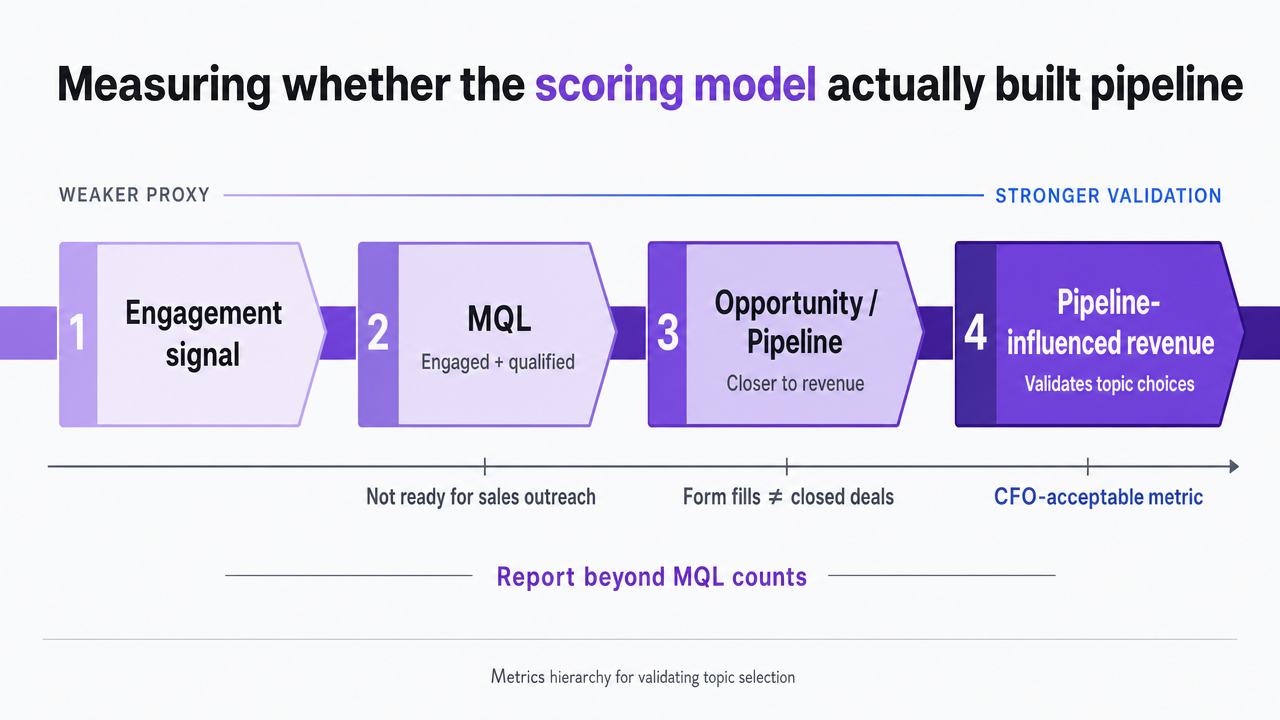 Reinforce the metrics hierarchy from MQL to pipeline-influenced revenue, matching stage-based measurement discipline discussed in this section
SEO content versus thought leadership: two slots in the same portfolio
The scoring rubric handles the SEO slot. It does not handle the slot next to it, which is thought leadership, and confusing the two is how content programs end up producing articles that neither rank nor build authority. Erika Heald's argument on this is direct: SEO best practices belong inside thought leadership, but an SEO-optimized article without original perspective is not thought leadership no matter how carefully it is briefed 19. The two formats answer different questions and earn different metrics.
WSI frames the practical risk. SEO and thought-leadership work can each show progress in isolation—traffic curves creeping upward, LinkedIn impressions climbing—while pipeline stays flat, because neither was selected against the same portfolio logic 21. The B2B Playbook's guidance closes the loop: thought-leadership topics should be chosen for the trust and pipeline they generate, not for the follower counts or view counts that look encouraging in a monthly report 20.
On the calendar, the two slots split cleanly. SEO topics are scored on the four inputs already established—intent, business value, demand-versus-difficulty, and journey stage—and judged on rankings and MQL-to-SQL performance. Thought-leadership topics are chosen for point of view rather than search demand and judged on whether named accounts engage, whether sales teams cite them in deal conversations, and whether they produce inbound requests from buyers who skipped the awareness stage entirely. A dental group's “Invisalign cost with insurance” article is an SEO asset. A managing dentist's argument that DSO consolidation has changed how insurance networks negotiate is a thought-leadership asset. Trying to make one article do both jobs tends to produce neither.
The portfolio split usually settles around 80% SEO to 20% thought leadership for growth-stage service operators, weighted more heavily toward SEO when the site has not yet cleared the authority threshold to rank on commercial queries. The ratio matters less than the discipline of tagging each slot before it enters the calendar. Untagged content drifts toward whichever format the writer is most comfortable producing, which is rarely the format the pipeline needed.
See How Leading Teams Source High-Impact SEO Blog Topics—Faster
Connect with our specialists to review real workflows for identifying, prioritizing, and executing SEO blog topics that drive measurable pipeline results—without increasing headcount or diluting quality.
If you manage multiple locations: economics of scoring discipline
For content managers running calendars across multiple offices, practices, or branches, the scoring model does more than defend individual topic choices. It changes the unit economics of production. A single-location operator can absorb a few wasted drafts per quarter; a six-office dental group or a twelve-attorney firm cannot, because every wasted brief consumes capacity that another location needed.
The math is straightforward once the waste rate is named. Most unscored calendars carry a rework or dead-draft rate somewhere between 25% and 40%—articles that get published but never rank, or that rank but pull the wrong intent, or that get killed in review after two revision cycles. The exact figure varies by team; operators should measure their own before accepting the range. What scoring changes is not the cost per draft but the share of drafts that actually earn a slot in the portfolio.
Per-location content coverage under scored vs. unscored calendars (variables the operator populates)
| Input | Unscored calendar | Scored calendar |
|---|---|---|
| Locations | N | N |
| Drafts produced per month (total) | D | D |
| Waste rate on selection | 25–40% | <10% (target) |
| Productive drafts per location | (D × 0.65) / N | (D × 0.9) / N |
| Cost per productive draft | $X / 0.65 | $X / 0.9 |
The gap compounds. A twelve-office group producing twenty-four drafts monthly at a 35% waste rate delivers roughly 1.3 productive articles per location per month. Cutting waste to 10% pushes that to 1.8—a 38% coverage lift with no additional headcount and no change to the per-draft cost variable. That capacity recovery is what makes disciplined topic selection a P&L conversation, not just an editorial one 4.
Where AI-assisted execution earns its keep
Scoring discipline exposes a second bottleneck. Once the calendar is defensible, the constraint moves from selection to production, and that is where most in-house teams stall. A twelve-office group with a scored calendar of eighteen decision-ready briefs per month cannot draft, edit, and publish that volume with a two-person content team without either extending timelines or lowering the bar on E-E-A-T—the originality, expertise, and trust signals Google's helpful content documentation treats as non-negotiable for ranking 6.
AI-assisted execution belongs at the production step, not the selection step. The scoring rubric—intent, business value, demand-versus-difficulty, and journey stage—is where operator judgment carries the most weight, because those inputs require reading sales-call transcripts, understanding which service lines the CFO wants filled, and knowing which locations are behind on coverage. Drafting against an approved brief is where a specialist AI content strategist reclaims the capacity a scored calendar creates, so long as every recommendation and every draft routes through human approval before publication 1.
Vectoron's Command Center is built around that split: strategists score, the platform executes, and nothing ships without sign-off. That is how a content manager scales output without adding headcount and without giving up the oversight the scoring model was designed to enforce.
Frequently Asked Questions
References
- 1.A creator's guide to SEO content strategy.
- 2.Search Intent: What Is It & Why Is It Crucial for SEO?.
- 3.Search Intent Strategy to Rank Higher and Prove SEO ROI.
- 4.SEO Topic Clusters: Complete Guide, Examples & Free Templates.
- 5.Topic cluster strategy guide: master pillar pages for SEO.
- 6.Creating Helpful, Reliable, People-First Content.
- 7.Search Quality Rater Guidelines: An Overview.
- 8.The Buyer's Journey: Understanding the Three Stages (B2B Guide).
- 9.The Complete Guide to B2B Demand Generation.
- 10.B2B Lead Generation: The Ultimate Guide for 2024.
- 11.20 Marketing Qualified Lead Statistics in 2025.
- 12.Beyond MQLs: How to Measure Marketing's Impact on Pipeline.
- 13.Marketing Qualified Lead vs Sales Qualified Lead.
- 14.MQL vs SQL - Marketing and Sales Qualified Leads Guide.
- 15.MQL to SQL conversion rate.
- 16.B2B Customer Journey Mapping: Guide Every Buyer to Yes.
- 17.Keyword Difficulty - Competition Analysis.
- 18.Free Keyword Difficulty Checker.
- 19.Is it Thought Leadership or SEO Content? Can it be Both?.
- 20.Thought Leadership Strategy: Build Pipeline, Not Vanity Metrics.
- 21.How SEO and Thought Leadership Work Together to Build Market Authority and Drive Growth.
- 22.Google's Algorithm and Helpful Content.