
Key Takeaways
- Search Engine Land works as the industry news wire, giving strategists a fast morning scan to surface stories that will trigger client questions that week.
- Search Engine Roundtable delivers the fastest signal on unconfirmed algorithm movement by aggregating webmaster forum chatter, best assigned to whoever owns rank-tracking dashboards.
- Google Search Central Blog is the only first-party source for documentation and spam policy updates, making it the citation account teams need when client disputes turn on guidelines.
- Search Engine Journal blends news with how-tos, giving account directors client-facing explainers, though contributor variance means posts should be verified before entering a playbook.
- Ahrefs Blog sets the standard for data-backed tutorials, converting posts on internal linking or content decay into one-sprint test templates across multiple client sites.
- Semrush Blog covers organic alongside paid, social, and local, which suits integrated engagements but assumes the platform is already in the agency's stack.
- The Backlinko archive still holds up as reference canon for link-building and on-page work, though it needs pairing with current sources since nothing new ships 4.
- Optimising's blog pairs strategy with diagnostic tools like PageSpeed Insights and Mozcast, useful for the performance lead owning Core Web Vitals reporting 8.
- Moz Blog and the Learning Center provide the closest thing to canonical curriculum, making them the right fit for onboarding and internal training rather than tactical spec work.
- iPullRank publishes dense, senior-level posts on large-site architecture, entity strategy, and generative search readiness, assuming readers are past the fundamentals.
- Aleyda Solis's Crawling Mondays and SEOFOMO newsletter act as a curated filter over the wider ecosystem, saving triage time for heads of SEO who still need a second data-backed read.
- An execution layer turns approved tactics into audited playbooks by spec'ing them against live account data and routing recommendations for human approval before shipping.
The filter: what makes an SEO blog worth an agency's reading hour
Most SEO blog roundups treat reputation as a proxy for usefulness. For a head of SEO running delivery across dozens of accounts, that proxy fails. The relevant question is narrower: how often does a post from this source convert into a tactic a strategist can spec, test, and roll out across client sites within two weeks?
Four axes decide that.
- Tactical density measures how much of a post is executable instruction versus framing.
- Evidence quality asks whether claims are backed by first-party data, controlled tests, or official documentation, rather than assertion.
- Update cadence captures whether the blog ships often enough to catch SERP volatility and product changes.
- Portability is the hardest to fake: can the tactic be adapted to a legal client, a dental group, and a home services franchisee without rewriting the underlying logic?
The standard behind these axes is not academic. As one practitioner-focused resource puts it, agencies and freelancers need strategies they can use immediately—if the tactic doesn't work, they won't use it 3. That filter is why the twelve picks below are graded against operator utility, not brand recognition, and why the shortlist is capped at what a working delivery team can actually consume.
The scoring rubric that follows applies to every entry. Blogs that publish weekly explainers with no data attached score low on evidence even when their audience is large. Blogs that publish rigorous tests once a quarter score high on evidence but require pairing with a faster news source to stay current.
How to build a 3-5 blog shortlist that matches how your team is staffed
The most useful advice on blog consumption comes from a curator who reviewed 100 SEO and marketing blogs and concluded that following that many creates information overload. The recommendation: pick three to five, commit, and structure the mix around one data-focused blog (Ahrefs or Semrush), one news source (Search Engine Roundtable), and one that matches the reader's skill level 6. That template maps directly onto how a delivery team is actually staffed.
An agency head managing 15 to 80 accounts typically has three functions competing for the same reading hour: a technical or on-page specialist who needs tested tutorials, a link-building or digital PR lead who needs tactics with evidence behind them, and a strategist or account director who needs to catch algorithm and SERP shifts before a client email arrives. A three-blog core covers those functions if each pick is chosen for its function, not its brand.
For a mid-sized agency, the working shortlist looks like this: one data-backed tutorial blog assigned to the specialist bench, one algorithm and news feed assigned to the strategist layer, and one skill-matched or conceptual blog assigned to whoever is building internal training. Two optional specialty picks cover verticals a portfolio leans into—local SEO for multi-location clients, or programmatic and technical for large-site work.
The twelve entries below are organized against this staffing logic. Buckets one through three correspond to the three seats a shortlist must fill; the twelfth pick sits outside the reading list because it addresses what happens after the reading is done.
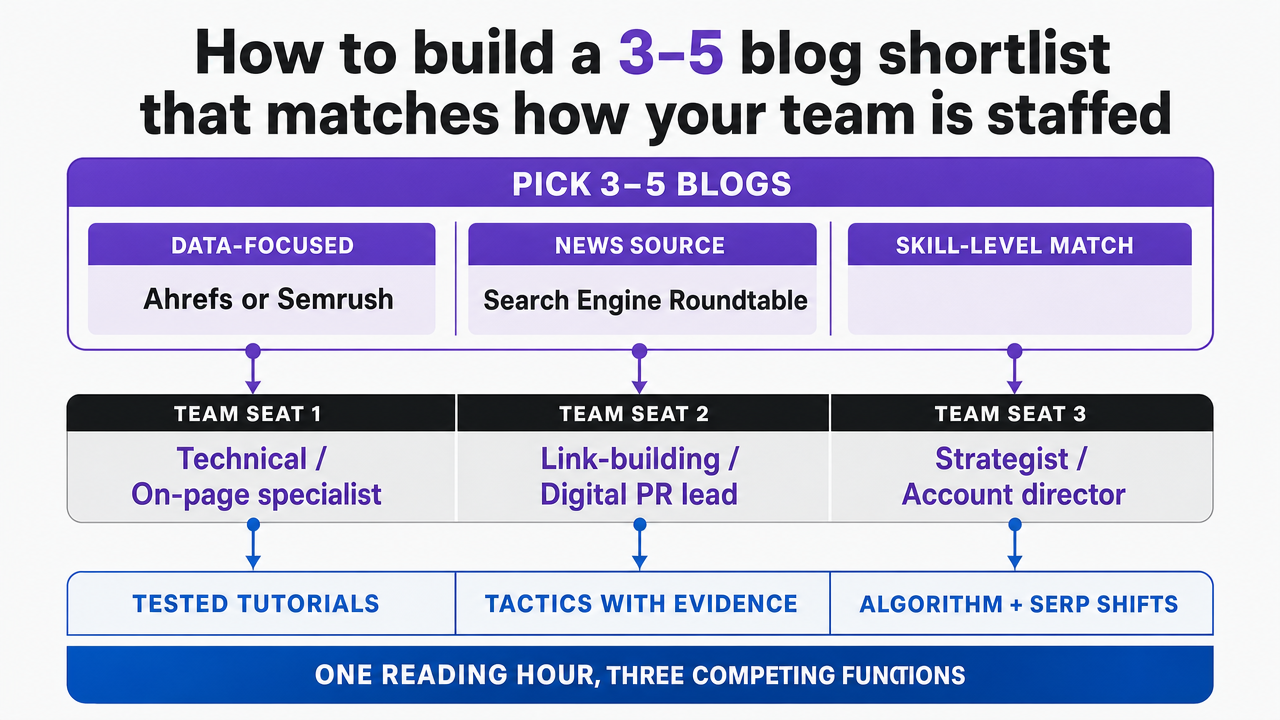 Visualize the three-bucket staffing model that structures the article's blog picks, mapping team seats to reading assignments
Bucket one: algorithm and news monitoring
Search Engine Land
Search Engine Land functions as the news wire for the industry. It publishes multiple times a day, covers ranking volatility, product launches, and policy changes, and pairs reporting with practitioner commentary. An Ahrefs-authored meta-guide names it as one of the first places its author checks to see what is happening in SEO, a habit going back to 2006 7. For an agency, its value sits with the strategist or account director layer: a morning scan surfaces the two or three items likely to trigger client questions that week. Its limitation is density. News posts rarely include tested tactics, so pair it with a data-backed source before touching a client site.
Search Engine Roundtable
Barry Schwartz's Search Engine Roundtable is the fastest signal an agency has for unconfirmed algorithm movement. It aggregates chatter from webmaster forums and cross-references it against tracking tools within hours. One curated shortlist recommends it explicitly as the single news source in a three-to-five blog rotation 6. The right seat for it is the strategist or technical lead who owns rank-tracking dashboards, not the content team. Its limitation is signal-to-noise: forum-sourced volatility reports sometimes precede a confirmed update by weeks, and sometimes precede nothing at all.
Google Search Central Blog
The Google Search Central Blog is the only source in this bucket that is not a third party interpreting Google. It publishes documentation changes, spam policy updates, and structured data guidance directly. When a client dispute turns on whether a practice is against guidelines, the citation the account team wants is here, not on a vendor blog. Practitioner meta-guides consistently include Google-owned properties among their core resources 7. The limitation is tone and cadence: posts are terse, infrequent, and rarely translate into a tactic without a second read from a data-backed blog that ran the test.
Search Engine Journal
Search Engine Journal sits between pure news and tactical tutorial. A 2026 curated guide describes it as covering news plus how-tos, which is the exact hybrid an account director needs when a client emails about a headline they read 4. Posts often include practitioner quotes and screenshots that translate into client-facing explainers with minor editing. The right seat is the account strategist or the person building weekly client updates. Its limitation is variance: contributor quality is uneven, so treat individual posts as leads to verify against Google's own documentation or a data-backed test before rolling a tactic into a playbook.
Bucket two: data-backed tactical tutorials
Ahrefs Blog
Ahrefs Blog is the reference implementation of a data-backed tutorial. A 2026 curated guide describes it as offering data-driven tutorials with clear step-by-step examples, and separate community mapping names Ahrefs the go-to for backlink analysis 4, 10. Posts routinely pull from the tool's index to quantify claims, which is what a specialist needs before spec'ing a test. The right seat is the technical or on-page lead running experiments across accounts; a single post on internal linking or content decay usually converts into a one-sprint test template that ports across five or six client sites. Its limitation is vendor gravity: tutorials often assume the reader has Ahrefs open, so a strategist without the tool has to substitute a diagnostic equivalent before rolling anything into a playbook.
Semrush Blog
Semrush Blog covers similar ground with a broader marketing surface—paid, social, and local sit alongside organic. For an agency running integrated engagements, that breadth is useful; a post on branded search often lands next to a paid brand-defense angle the account team can price. One curated shortlist names Ahrefs or Semrush as the single data-focused blog in a three-to-five rotation, treating them as interchangeable at that slot 6. The limitation matches Ahrefs Blog: tutorials assume the platform is in the stack, and generalist posts occasionally trade depth for breadth.
Backlinko archive
Backlinko stopped publishing as an independent brand after the Semrush acquisition, but the archive still earns a slot. A 2026 curated guide notes that the archived guides remain valuable for deep link-building and on-page optimization work 4. The Skyscraper post, the on-page ranking factors study, and the outreach templates are the reference material a link-building or digital PR lead cites when defending a tactic in an internal review. The right seat is the outreach or on-page owner using the archive as a canon rather than a feed. Its limitation is date: nothing new is being added, so pair it with a source that catches current SERP feature changes before applying an older tactic verbatim.
Optimising blog and diagnostic-tool coverage
Optimising's blog is smaller in volume but disciplined about pairing strategy posts with the diagnostic tools that measure impact. Its practitioner meta-guide highlights Google PageSpeed Insights and Mozcast as recurring fixtures in the working stack 8. That pairing matters for agencies because a tactic without a measurement surface tends to stall at the QA step. The right seat is the technical SEO or performance lead who owns Core Web Vitals reporting across accounts. The limitation is cadence; treat it as a supplement to a higher-frequency data blog, not a replacement.
Test AI-driven SEO execution on live projects
Experience real-time SEO workflow automation and measure content impact before making a long-term commitment.
Bucket three: strategic and conceptual depth
Moz Blog and the Learning Center
Moz earns its slot on conceptual coverage rather than shipping speed. A 2026 curated guide describes the Moz Blog as offering beginner-friendly explainers anchored by the long-running Whiteboard Friday series, while a separate community mapping calls the Moz Learning Center a comprehensive tutorial library covering all aspects of SEO 4, 10. The right seat is whoever owns internal training and onboarding. New hires need a shared vocabulary before they can spec tests, and the Learning Center is the closest thing the industry has to a canonical curriculum. Its limitation is depth-per-post: individual blog entries often trade tactical specificity for accessibility, so pair Moz with a data-backed source when a strategist needs a testable playbook, not a definition.
iPullRank
iPullRank publishes less frequently than the news outlets in bucket one, but its posts carry the density that a senior strategist or technical lead can actually cite in a client review. Its own resource guide argues that blogs earn their reading time only when the tactics can be used immediately, which sets the standard it holds itself to 3. The right seat is the enterprise or technical SEO lead working on large-site architecture, entity strategy, and generative search readiness. Its limitation is cadence and reading level: posts assume the reader is past the fundamentals.
Aleyda Solis's Crawling Mondays and newsletter
Aleyda Solis's Crawling Mondays videos and the SEOFOMO newsletter function as a curated filter over the wider ecosystem. Practitioner meta-guides consistently include independent curators alongside the vendor blogs and news outlets that dominate a reading list 7. The right seat is the strategist or head of SEO who needs a weekly digest that has already been triaged by another operator. The limitation is that curation is a starting point, not evidence; every surfaced tactic still needs a data-backed second read before it enters a client playbook.
The twelfth pick: an execution layer for turning posts into client-ready playbooks
The first eleven picks solve for input quality. The twelfth solves for what happens after a strategist highlights a paragraph and closes the tab. Across a 15-to-80 account book, the failure mode is rarely finding good tactics—it is translating them into specs, running them past account leads, and tracking which ones moved a KPI on which client. A curator who reviewed 100 blogs makes the same point in reverse: the constraint is not access to ideas but disciplined application of a small set 6.
An AI marketing execution platform sits in that gap. Vectoron's specialist strategists take an approved tactic—say, an internal linking pattern pulled from a data-backed tutorial—and spec it against live account data, rank it against other pending work, and route the recommendation for human approval before anything ships. The blog stays a blog; the playbook becomes an audited artifact that every strategist on the team applies the same way.
A 7-day consumption workflow that survives a full client book
The gap between reading and shipping is where most agency reading programs die. A 2025 practitioner guide closes that gap with a specific sequence: pick three to five credible SEO blogs, pull three actionable takeaways per post that can be tested within a one-to-two-week sprint, and run a simple seven-day plan that moves from capture to published playbook 9. The structure below assigns that sequence to real seats on a delivery team.
- Day 1 — 30-minute audit. The strategist assigned to a bucket scans that week's posts from their two or three sources and flags anything that clears the tactical density and evidence bar set earlier. Anything without a first-party test, a documentation link, or a reproducible workflow drops out before the timer ends 9.
- Day 2 — Extract three takeaways per surviving post. Each takeaway is written as a testable statement, not a summary. "Adding a specific FAQ schema pattern lifts featured snippet capture on service pages" is a takeaway. "FAQ schema matters" is not.
- Days 3 and 4 — Spec the test. The specialist writes the account list it applies to, the control, the measurement surface, and the rollback condition. One takeaway per sprint is enough; the constraint is not ideas but disciplined application 9.
- Days 5 through 12 — Run the sprint. The tactic ships on the selected accounts. The account lead is notified in advance so client questions do not surprise anyone.
- Day 13 — Review. The specialist compares the measurement surface against the control and writes a one-paragraph verdict: keep, kill, or expand.
- Day 14 — Publish to the internal playbook. Wins become named plays with the source post, the spec, the accounts tested, and the delta. That artifact is what a new hire reads on their second week, and what an account director cites when a client asks why a change was made.
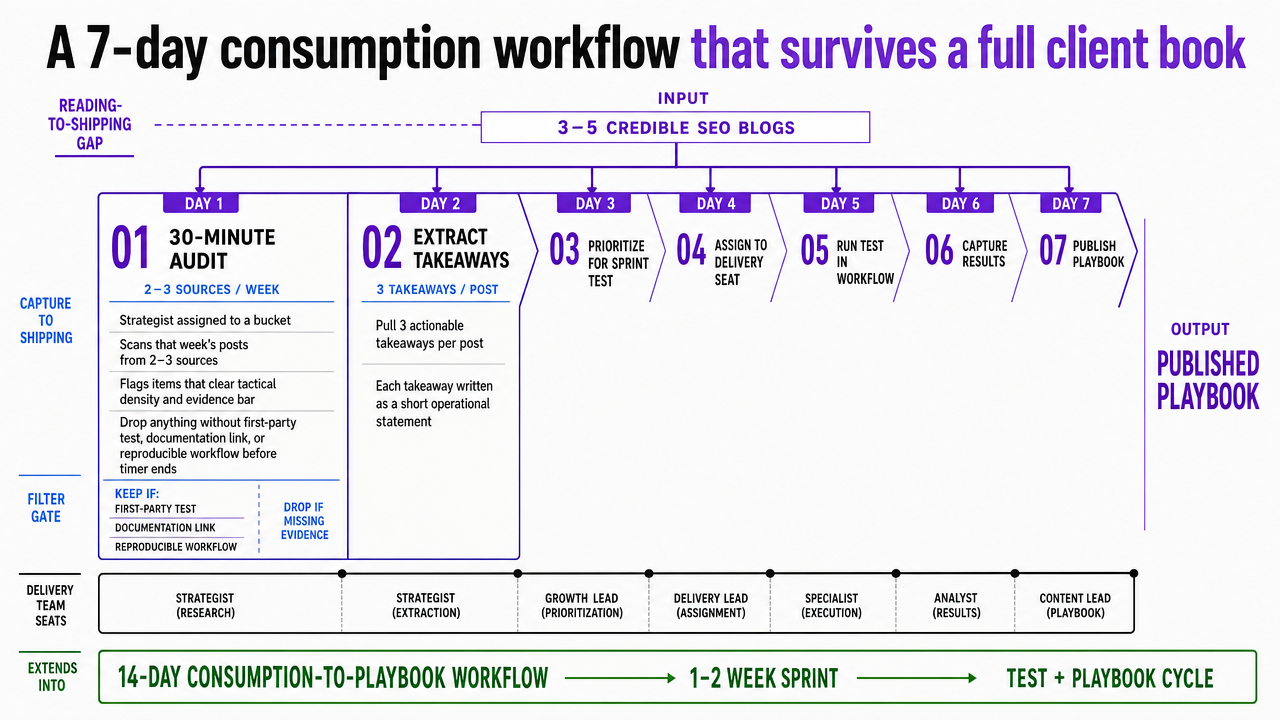 Visualize the cited 7-day (extended to 14-day) consumption-to-playbook workflow that the section walks through day by day
The reading-time economics of an unfiltered feed
The case for a shortlist is not a taste argument. It is a time budget one. An agency running twelve or more blogs across a delivery team burns hours that never appear on a timesheet, and the output rarely reaches a client account. A curated five-blog rotation with a shared playbook layer changes the math because reading time converts into a tested tactic instead of a bookmark.
The table below models the weekly cost using only the sourced 30-minute audit figure from a 2025 practitioner guide 9. Dollar figures are omitted intentionally; the variable is hours, and every agency should apply its own loaded rate.
| Consumption model | Weekly reading time | Tactics spec'd per week | Tactics reaching a client account ||---|---|---|---|| Unfiltered feed (12+ blogs, no audit protocol) | 4–6 hours across the team | 0–1, ad hoc | Rarely; most posts stall at the bookmark stage || Curated 5-blog shortlist with 30-minute audit 9 | ~2.5 hours across the team | 3 takeaways per surviving post, one sprint per week | 1 tested tactic per sprint, logged to the internal playbook |
The unfiltered model looks cheaper per post and is more expensive per outcome. The shortlist model treats reading as an input to a specification, not a habit.
Scale Your Agency’s SEO Execution—No Extra Headcount Required
See how leading agencies are automating multi-client SEO workflows while maintaining strategic oversight, measurable quality, and faster turnaround—backed by real performance benchmarks.
What to stop reading: vendor bias and dated claims
Two categories of content quietly waste a delivery team's reading hour. The first is tool-vendor tutorials that assume the tool is already in the stack. Long-form resource guides that lean heavily on vendor-linked blogs make this trade-off visible: the tactics are real, but the reader is expected to run them inside a specific product 5, 10. A specialist without that license spends the sprint rebuilding the diagnostic, not testing the tactic. Cross-check any vendor tutorial against a diagnostic equivalent—Google Search Console, PageSpeed Insights, or Mozcast—before it enters a playbook 8.
The second is old statistics dressed as current market truth. A 2011 credibility study still circulates figures on search satisfaction and Google market share pulled from 2012 Pew data 2. Those numbers describe a search landscape that predates featured snippets, AI Overviews, and the current SERP layout entirely. Any post citing pre-2020 usage stats to justify a 2026 tactic should be treated as background, not evidence.
The rule is simple: if a post's central claim rests on a tool the team does not own or a stat older than the last major algorithm era, it does not clear the audit.
Credibility signals to apply to every blog claim before it hits a client site
A blog post is a hypothesis, not a source. Before a tactic reaches a client account, the strategist reviewing it should apply the same credibility checks that Stanford's Web Credibility Project codified for any high-stakes web content: third-party support for claims, visible organization and authorship, clear freshness signals, and absence of obvious errors 1. Academic work on credibility assessment reinforces the same instinct—judgments improve when a page carries features that make its evidence base legible rather than assumed 2.
For an agency review, that translates into four quick questions the strategist runs on any post before it enters the sprint pipeline:
- Does the post name its author and their operator context, or is the byline generic?
- Does a central claim link to a first-party test, a Google documentation page, or a peer-reviewed source—or does it link sideways to another blog post making the same unsupported assertion?
- Is the publish or update date recent enough to reflect the current SERP layout, or does the tactic assume a pre-AI-Overviews results page?
- Are the screenshots, queries, and account examples real enough to reproduce, or generic enough to be filler?
A post that clears all four earns a spec. A post that clears two earns a second read from a stronger source before anything ships. A post that clears none is background reading, not a playbook input.
If you manage multiple locations or a franchise portfolio
A shift in scope is worth flagging here. The buckets above assume a mixed client book. Agencies running multi-location brands, franchise systems, or DSO and MSO portfolios face a narrower reading problem: the same tactic has to survive replication across 30 or 300 location pages without losing the local signal that made it work on one.
Two adjustments to the shortlist earn their slot. First, add a local-SEO specialty pick to the two optional seats described earlier, and assign it to whoever owns Google Business Profile hygiene across the portfolio. Second, treat community discussion as a required cross-check, not a nice-to-have. A 2026 resource mapping names /r/SEO among the communities where agencies validate tactics against other operators before rolling them into a playbook 10. For multi-location work, that second read matters more, because a schema pattern or internal-linking change ships to every location page at once.
The consumption workflow stays the same, but the spec step gets one added field: which location cohort the test runs on first. Portfolio-wide rollouts skip the sprint. That is the discipline the shortlist model buys.
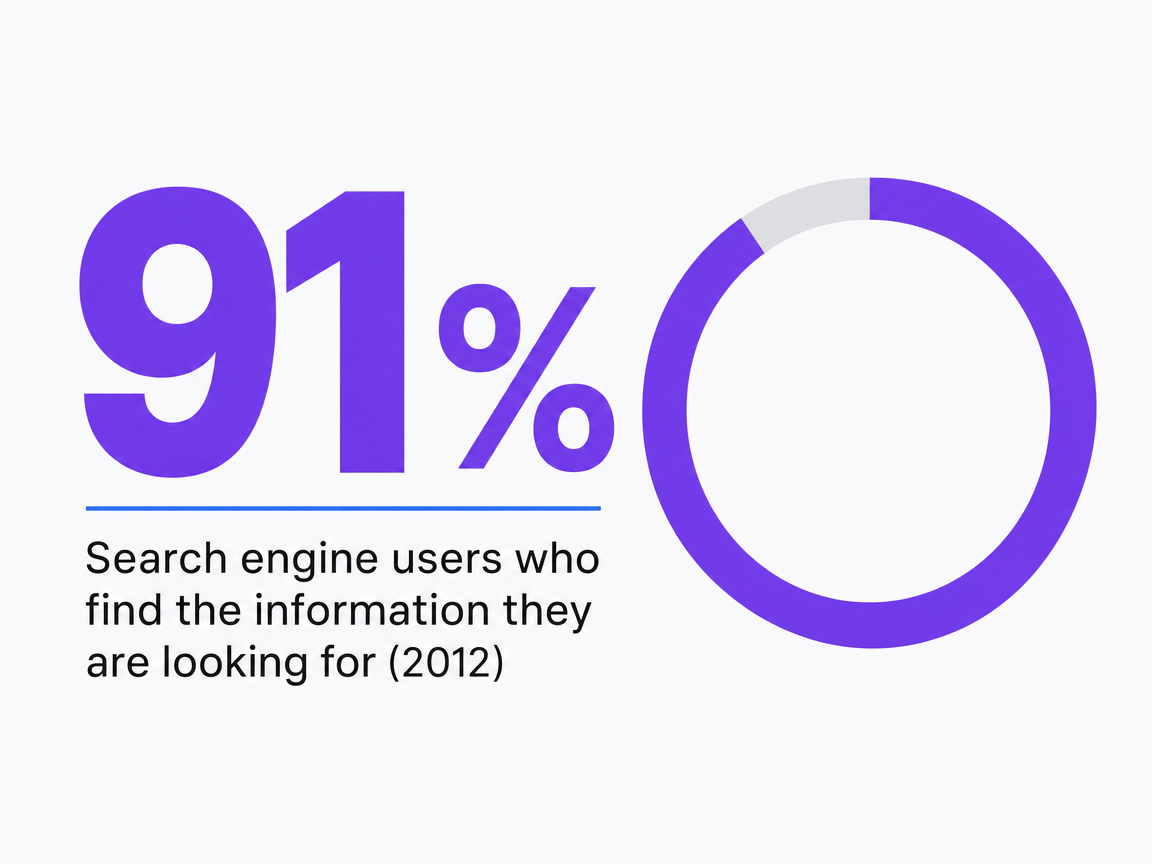 Search engine users who find the information they are looking for (2012)
Search engine users who find the information they are looking for (2012)
Frequently Asked Questions
References
- 1.The Web Credibility Project: Guidelines.
- 2.Augmenting Web Pages and Search Results to Support Credibility Assessment.
- 3.Best SEO Blogs & Resources to Learn SEO.
- 4.Best SEO Resources 2026: Curated by Skill Level - CO Consulting.
- 5.50+ of the Best SEO Resources - Tools, Educational ....
- 6.100 Best SEO and Marketing Blogs That Set the Standard for ....
- 7.75 SEO Resources I (Probably) Can't Live Without.
- 8.35 SEO resources I couldn't live without | Optimising.
- 9.15 Best SEO Blogs to Help You Dominate the SERPs in 2025.
- 10.Best SEO Resources: Tools, Courses & Communities for 2026.