
Key Takeaways
- Google Analytics Individual Qualification paired with an internal Search Console workflow assessment gives juniors a proctored external signal plus the diagnostic backbone most vendor programs skip.
- SEMrush Academy's Technical SEO and Site Audit exams work as a level-one hiring screen and audit QA gate, but need Google fundamentals reading to survive developer pushback.
- Ahrefs Certification's Advanced modules use applied tool exercises that produce competitor research artifacts, making it a defensible level-two promotion gate for specialists moving into strategy.
- Moz Academy SEO Essentials trades assessment rigor for client-facing legibility, working best as a baseline generalist screen or onboarding capstone for career-changers entering SEO.
- CXL's Technical SEO and Content Optimization minidegrees carry graded assignments and peer review, producing the strongest competency signal and a proof-of-investment artifact for enterprise pitches.
- HubSpot's SEO Certification adds little diagnostic capability but earns legibility with HubSpot-native clients, so use it as onboarding for content specialists on those accounts.
- Yoast SEO Academy uses course-embedded quizzes rather than exams, but its plugin-level specificity makes it a practical badge for editors and WordPress-focused specialists.
- Lumar and Screaming Frog operator badges produce a narrow but sharp technical audit signal, and belong on any specialist owning crawl configuration for enterprise sites.
Why credential stacks stopped closing agency pitches
A wall of badges on the pitch deck used to signal rigor. It no longer does. Procurement teams and CMOs now open conversations with skills-based evaluation: audit samples, GSC diagnostic walk-throughs, and evidence that a specialist can debug a traffic drop without a template. NACE's 2026 data shows 70% of surveyed employers using skills-based hiring, up from 65% the prior year, with 71% applying it at least half the time 5. That shift in how talent is evaluated inside client organizations is now shaping how those same organizations evaluate the agencies they retain.
Certifications still carry weight, but the weight has moved. RAND defines a certification as a credential awarded for demonstrated knowledge and skills tied to a specific job, and its labor-market research finds returns that vary sharply by credential quality and occupation 1, 2. Translated to agency delivery: a credential is worth what its assessment proves, not what its logo suggests.
Agency SEO leaders running 20 to 200 client books face a sharper question than which programs to buy. The question is which certifications standardize junior output, which ones survive contact with a QBR, and which ones simply cost renewal fees. The rest of this piece ranks credentials against that operating test.
The agency-scale criteria that separate a useful credential from a resume line
Six criteria decide whether a certification earns its place in an agency's operating stack. Assessment rigor comes first. A proctored exam or a graded project produces a defensible signal; a video-completion checkbox does not. RAND's distinction between credentials awarded for demonstrated knowledge and credentials awarded for attendance is the cleanest test to apply 1. If a junior can pass the assessment by autoplaying lessons at 2x speed, the credential proves nothing to a CMO reviewing an audit sample.
Curriculum coverage is second. In 2025-2026, a credible SEO curriculum has to cover the Google fundamentals stack in a form specialists can operationalize: crawlability, canonicalization, structured data, and content quality 7; people-first editorial standards 8; generative AI search behavior 9; and Search Console workflows for both monitoring and traffic-drop diagnostics 10, 11. Programs that skip GSC or treat AI search as a bolt-on module leave the delivery team unprepared for the questions clients now ask in QBRs.
The remaining four criteria are operational. Tool relevance determines whether the credential maps to the stack junior specialists already use. Renewal cadence signals whether the issuer keeps pace with algorithm shifts. Transferability across hires decides whether the certification can anchor a hiring rubric for a book of 20 to 200 clients. Client-facing legibility asks a blunter question: will a procurement lead recognize the badge without a footnote.
The shortlist: eight SEO certifications ranked by operating fit
Google Analytics and Search Console literacy paths
Google does not issue a formal Search Console certification, which is precisely why agency leaders should build an internal one around it. The Search Console documentation is the source-of-truth curriculum: property verification, index coverage, sitemaps, and the Performance report's breakdowns of impressions, clicks, queries, and pages 10. Layer in the traffic-drop debugging guide, which walks through period comparisons, algorithmic update checks, and technical or security triage 11, and a junior specialist has the diagnostic backbone that most vendor programs skip.
The Google Analytics Individual Qualification remains the closest thing to a proctored measurement credential in the free tier. It tests event-based data modeling, attribution, and reporting mechanics that specialists need to translate GSC signals into client-facing narratives. Pair the two: GAIQ as the graded external signal, an internally graded Search Console workflow assessment as the delivery-quality signal.
This pairing standardizes the two artifacts every QBR needs — a traffic diagnostic and an outcome report — and it costs nothing beyond time. For a 20-person delivery team, that is the highest-leverage credential decision on the list.
SEMrush Academy Technical SEO and Site Audit exams
SEMrush Academy's Technical SEO and Site Audit exams score well on tool relevance for agencies already standardized on the platform. The assessments are timed, multiple-choice, and cover crawl configuration, log-file interpretation, hreflang, structured data, and Core Web Vitals — the concrete audit inputs a junior specialist will handle in the first thirty days on a client book.
The curriculum limitation is scope. SEMrush's exams teach the platform's interpretation of technical issues, not the underlying Google guidance a specialist should be able to cite when a developer pushes back. Agencies get durable value by pairing the Technical SEO exam with a required read-through of Google's fundamentals documentation on crawlability, canonicalization, and structured data 7, then testing both in a graded internal audit exercise.
Best internal use: a level-one hiring screen and an audit-quality QA gate. The badge is legible to clients who already use SEMrush and adds little for those who do not. Renewal is annual, which keeps the credential current with platform releases but requires a recurring time budget across the specialist bench.
Ahrefs Certification Course and Advanced modules
Ahrefs' certification structure splits into a free foundational course and a paid Advanced track covering keyword research, link building, and technical audits. The assessments lean toward applied exercises inside the tool rather than trivia recall, which produces a more defensible skills signal than pure video-completion certificates. RAND's framework for evaluating credentials — demonstrated knowledge tied to a specific job task — favors this format 1.
The curriculum's strength is depth in backlink analysis and SERP feature research, areas where the tool leads. The gap is generative search coverage: as Google's own guidance frames AI visibility as an extension of helpful, non-commodity content rather than a separate discipline 9, Ahrefs' modules on that topic need to be supplemented with editorial standards the certification does not teach.
Best internal use: a level-two promotion gate for specialists moving from execution into strategy. The Advanced modules produce the kind of research artifacts — competitor gap analyses, content cluster maps — that specialists can walk a CMO through in a pitch without a translation layer.
Moz Academy SEO Essentials Certification
Moz Academy's SEO Essentials Certification bundles six courses into a single exam covering keyword research, on-page optimization, link building, technical fundamentals, local, and reporting. The assessment is a timed multiple-choice test, which produces a weaker skills signal than a graded audit but a stronger one than course-completion badges. RAND's distinction between demonstrated competency and attendance applies directly 1.
The credential's client-facing legibility is its main asset. Moz's brand recognition among mid-market CMOs and in-house marketers predates most competing platforms, and the badge reads clearly in a pitch deck without explanation. The curriculum, however, treats Search Console as a reporting tool rather than a diagnostic environment, which leaves a gap that agencies should close with the internal GSC workflow described earlier.
Best internal use: a baseline hiring screen for generalist specialists and an onboarding capstone for career-changers entering SEO from adjacent marketing roles.
CXL Technical SEO and Content Optimization minidegrees
CXL's minidegrees are the most rigorous paid option on this list. The Technical SEO and Content Optimization tracks run multi-week, with graded assignments, peer review, and instructors who actively work in the field. The assessment format produces the strongest demonstrated-competency signal among the credentials reviewed here, which aligns with the standard RAND uses to distinguish a certification from a completion certificate 1.
The curriculum covers the Google fundamentals stack in operational depth 7, integrates people-first content standards into editorial workflows 8, and treats Search Console as a diagnostic environment rather than a dashboard 10. The generative search coverage lags the pace of Google's own guidance updates 9, but the underlying frameworks transfer cleanly.
Best internal use: a level-three specialist credential and a proof-of-investment artifact for enterprise pitches. The cost per seat is meaningful and the time commitment is real, which makes the minidegree unsuitable as a broad hiring screen but valuable as a differentiator for the two or three specialists an agency puts in front of its largest accounts.
HubSpot SEO Certification for content-led teams
HubSpot's SEO Certification is short, free, and easy to complete, which sets a low bar for the skills signal it produces. The curriculum focuses on topic clusters, on-page optimization, and content strategy inside HubSpot's marketing ecosystem. For an agency delivering technical SEO or complex site migrations, the badge adds little diagnostic capability.
The credential earns a place on the shortlist for one reason: content-led delivery teams working inside HubSpot instances gain legitimate client-facing legibility from it. HubSpot-native clients recognize the badge, and the certification's coverage of editorial planning aligns loosely with Google's people-first content guidance 8.
Best internal use: a required onboarding badge for content specialists assigned to HubSpot accounts. Do not confuse it with a technical credential and do not weight it heavily in a hiring rubric for senior specialists.
Yoast SEO Academy for editorial and WordPress delivery
Yoast SEO Academy's certifications cover on-page optimization, technical SEO for WordPress, structured data, and copywriting. The assessments are course-embedded quizzes rather than proctored exams, which places the credential closer to attendance than to demonstrated competency by RAND's definition 1. The value lies in operational specificity for agencies with a heavy WordPress book.
The structured data and technical modules align with Google's fundamentals guidance in practical, plugin-level detail 7, and the copywriting track translates people-first content principles into editorial checklists a junior editor can actually apply 8. That translation layer is the reason the credential belongs on the shortlist despite the weaker assessment format.
Best internal use: a required badge for editors and WordPress-focused specialists, and a QA reference for content briefs. Client-facing legibility is limited to WordPress-native buyers.
DeepCrawl (Lumar) and Screaming Frog operator badges
The Lumar (formerly DeepCrawl) and Screaming Frog credentials are tool-operator certifications, not curriculum-driven SEO programs. Both test the specialist's ability to configure crawls, interpret output, and translate findings into remediation tickets. The skills signal is narrow but sharp: a certified Screaming Frog operator can run a defensible technical audit on day one of a client engagement.
The curriculum gap is intentional. Neither program teaches SEO strategy, content standards, or measurement — they assume the specialist brings that context and needs a rigorous operator layer on top. Pair either badge with the Search Console diagnostic workflow described earlier 10, 11 and the agency gets a complete technical delivery capability.
Best internal use: a required credential for any specialist owning technical audits, and a client-facing signal for enterprise accounts where site complexity makes crawler proficiency a purchasing criterion.
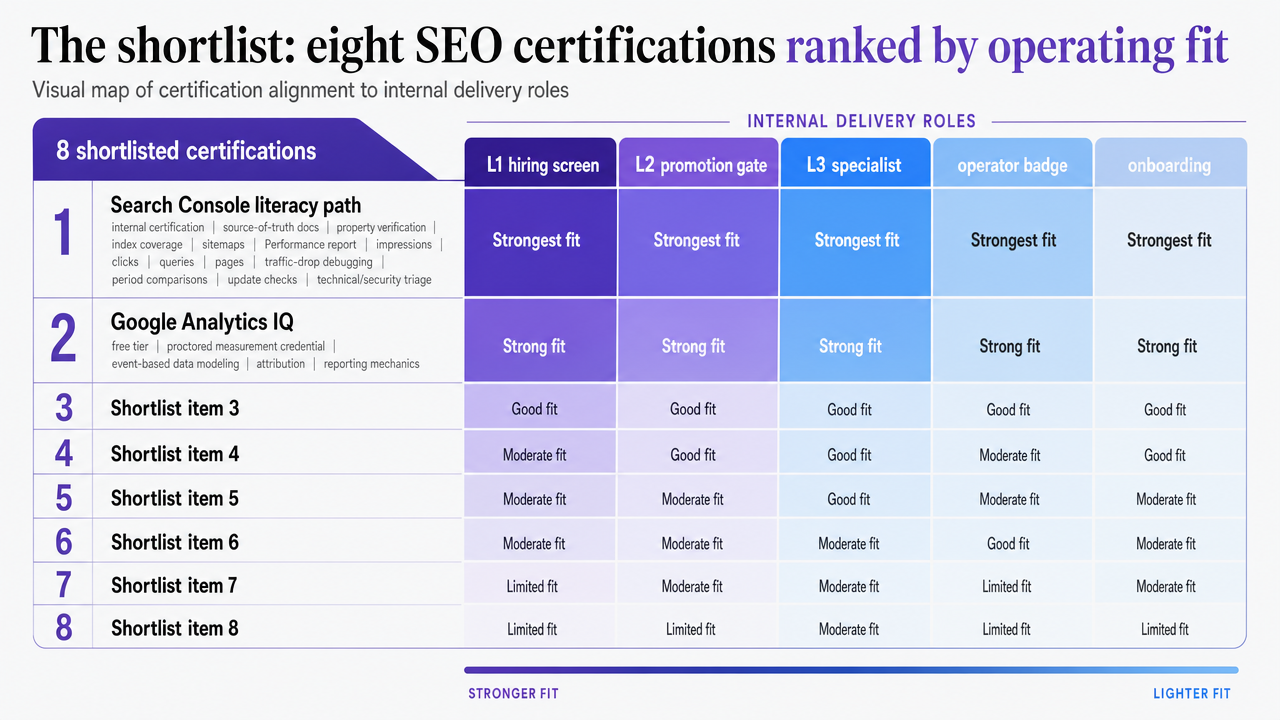 Give readers a visual map of how the eight shortlisted certifications align to internal delivery roles (L1 hiring screen, L2 promotion gate, L3 specialist, operator badge, onboarding), reinforcing the section's ranking-by-operating-fit thesis
Test AI-driven content workflows before certification investment
Evaluate real-time SEO execution results alongside your certification progress, risk-free.
Shortlist scorecard: cost, assessment rigor, renewal, and best internal use
The scorecard below compresses the eight programs into the columns an agency leader actually needs when defending a training budget: assessment type, renewal cadence, curriculum fit against Google's own fundamentals documentation 7, and the internal role the credential should play. Cost is marked 'varies' where the issuer does not publish a fixed public price, because invented numbers do not survive a procurement review.
| Program | Cost (USD) | Assessment Type | Renewal | GSC + AI Search Fit | Best Internal Use ||---|---|---|---|---|---|| Google Analytics Individual Qualification | Free | Proctored exam | 12 months | Partial (measurement) | Baseline hiring screen || SEMrush Academy Technical SEO | Free | Timed exam | ~12 months | Partial (tool-scoped) | L1 hiring screen, audit QA gate || Ahrefs Certification (Advanced) | Varies | Applied exercises | Rolling | Partial (weak on AI search) | L2 promotion gate || Moz Academy SEO Essentials | Varies | Timed exam | None stated | Weak on GSC diagnostics | Generalist screen, onboarding capstone || CXL Technical SEO / Content Optimization | Varies (premium) | Graded assignments, peer review | Rolling | Strong on fundamentals, GSC | L3 specialist, enterprise pitch signal || HubSpot SEO Certification | Free | Course-embedded exam | ~24 months | Weak (content-only) | Content specialist onboarding || Yoast SEO Academy | Varies | Course-embedded quizzes | Rolling | Partial (WordPress-scoped) | Editor and WordPress specialist badge || Lumar / Screaming Frog Operator | Varies | Applied tool tasks | Rolling | Narrow (crawler-only) | Required for technical audit owners |
Read the table by column, not by row. Assessment type separates credentials that survive a client walk-through from those that do not; RAND's framework treats demonstrated-knowledge assessments as the signal that actually predicts on-the-job capability 1. Curriculum fit against Google's fundamentals stack — crawlability, canonicalization, structured data, and Search Console monitoring 7 — decides whether the credential holder can answer the questions a technical CMO asks in month one. Best internal use is the column most agency leaders skip and later regret: a credential without a defined slot in the hiring rubric or QA workflow becomes a renewal invoice with no owner.
Mapping certifications to the delivery workflow they actually standardize
A credential earns its keep when it standardizes a named step in the delivery workflow. Four steps carry the weight in most agency operating models: the technical audit, the content brief, the Search Console diagnostic, and the client-facing report. Mapping each certification to the step it standardizes turns a training budget into a QA system.
The technical audit is the first slot. Lumar and Screaming Frog operator badges standardize crawl configuration and output interpretation. SEMrush Academy's Technical SEO exam standardizes platform-level issue triage. Neither program teaches the underlying rules a specialist should be able to cite when a developer challenges a recommendation, which is why the audit step also requires a working knowledge of Google's fundamentals guidance on crawlability, canonicalization, and structured data 7.
The content brief is the second slot. Yoast SEO Academy's copywriting track and HubSpot's SEO Certification translate people-first editorial standards into checklists a junior editor can apply 8. CXL's Content Optimization minidegree pushes the same standards into graded assignments, which produces a stronger briefing template for enterprise accounts.
The Search Console diagnostic is the third slot and the one most vendor programs skip. Google's Performance report breaks down impressions, clicks, queries, and pages 10, and the traffic-drop debugging guide walks through period comparisons, algorithmic checks, and technical triage 11. No paid certification on the shortlist teaches this workflow as its primary artifact, which is why the internal GSC assessment described earlier does more for delivery quality than any external badge in this slot.
The client-facing report is the fourth slot. GAIQ standardizes the measurement layer that converts GSC signals into a narrative a CMO can read without translation. Ahrefs' Advanced modules standardize the competitive research a specialist walks through in a QBR.
A certification without a named slot becomes a renewal invoice with no owner. A certification tied to one of these four steps becomes QA infrastructure.
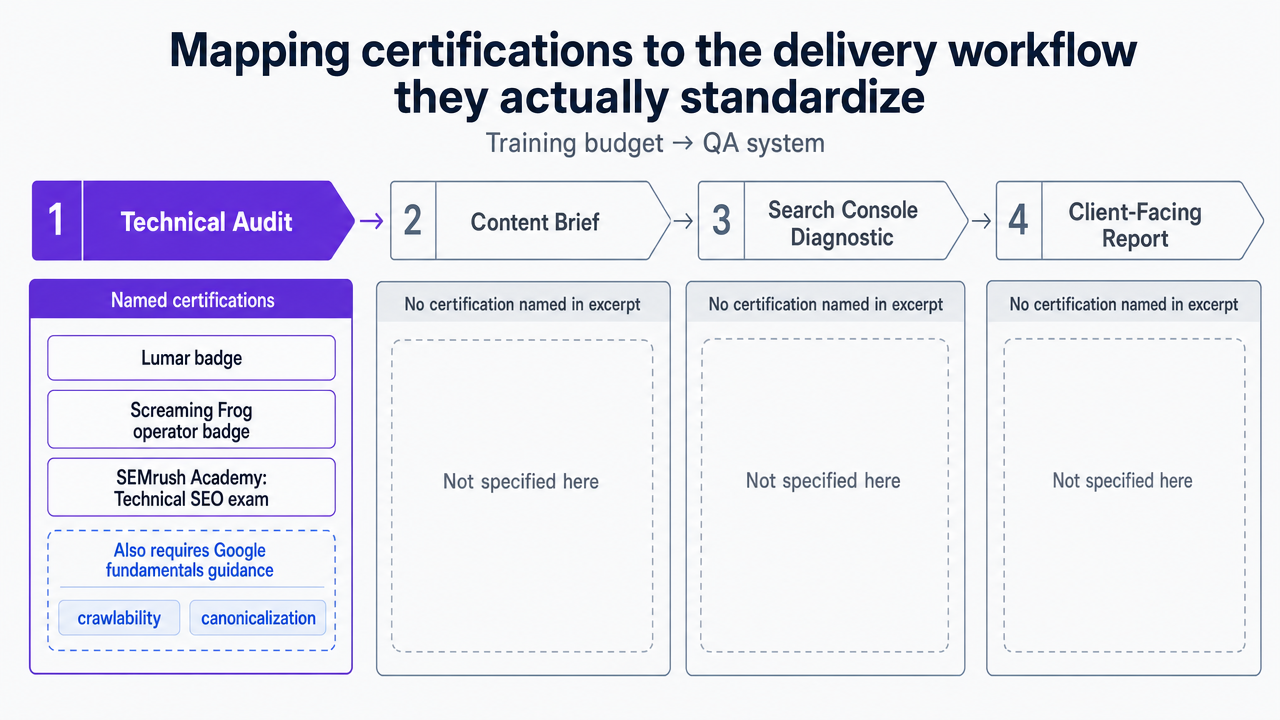 Visualize the four-step delivery workflow (Technical Audit → Content Brief → Search Console Diagnostic → Client-Facing Report) with the certifications that standardize each step, directly reinforcing the section's mapping argument
Where certifications fail to prove value: attribution, causality, and generative search drift
No credential on the shortlist teaches an agency how to prove its own work moved a client's number. That gap is structural. Search Console data measures Google Search activity — impressions, clicks, queries, and pages 10 — and stops short of qualified-lead quality, pipeline contribution, or revenue causality. A certified specialist can produce a clean Performance report and still leave a CMO asking whether the agency caused the lift.
Attribution is the first failure mode. RAND's own caveat on credential research applies directly: observed differences in outcomes do not automatically prove the credential caused them, because selection effects and context distort the signal 1. The same logic runs in reverse for client reporting. A ranking gain in a quarter with three algorithmic updates, a competitor's site migration, and a paid media pulse is not cleanly attributable to a certified specialist's audit — and no certification teaches the controls needed to isolate that contribution.
Causality is the second failure mode. Google's traffic-drop debugging guide lists seasonality, shifting user interest, industry trends, and algorithmic updates as competing explanations for any change in impressions or clicks 11. Certifications teach the diagnostic steps but not the discipline of documenting rival hypotheses in a QBR deck. Agencies that skip that discipline win the pitch and lose the renewal.
Generative search drift is the third failure mode and the fastest-moving. Google's guidance frames AI-feature visibility as an extension of non-commodity, people-first content rather than a separate optimization surface 9, and the measurement methods for those surfaces continue to shift. A certification updated on an annual cadence lags the guidance it is supposed to teach. The operational fix is not another badge; it is a monthly internal review that reconciles the current certification curriculum against Google's live documentation and retires anything that no longer matches.
See How Top Agencies Quantify SEO Expertise and Certification Impact
Request a tailored agency demo to benchmark your team's certification credentials, deployment velocity, and measurable SEO performance outcomes against industry-leading standards.
If you run a multi-office agency or portfolio: the cost-per-certified-specialist math
Scope shift: this section is for leaders running multi-office agencies or portfolio holdcos with two or more delivery pods, not a single-office team. The math changes at that scale because certification cost compounds across headcount, offices, and renewal cycles, and because the credential's marginal value drops once every specialist in every pod holds the same badge.
The cost-per-certified-specialist formula worth defending in a budget review has three variables: headcount per pod (H), program cost per seat (C), and renewal frequency in years (R). Annualized cost per pod is (H × C) / R. A ten-specialist pod on an annually renewing paid credential carries ten times the recurring cost of a single-office team, and a portfolio with four pods carries forty. Free credentials such as GAIQ and HubSpot's SEO Certification zero out C but not the time cost, which runs six to twelve hours per specialist and should be tracked as billable-hour opportunity cost.
Two levers reduce the total without weakening the delivery signal. First, tier the credential stack by pod role: L1 hiring screens sit at the free tier, L2 promotion gates concentrate paid credentials on the two or three specialists per pod who front enterprise accounts, and operator badges attach only to the technical audit owner in each office. Second, use AI execution capacity to reduce the certified-specialist count required per client book. When a platform handles brief generation, audit output formatting, and GSC reporting under human approval, the certified specialist reviews and signs off rather than producing from scratch, which lets one L3 credential holder anchor a larger book without diluting the skills-based evidence buyers now expect 5.
Building the internal system: hiring rubric, L2 promotion gate, and client-facing trust artifact
The credentials on the shortlist produce agency value only when they slot into three named artifacts: a hiring rubric, an L2 promotion gate, and a client-facing trust document. Without those slots, the badges become renewal invoices.
The hiring rubric is the first artifact. Score candidates on four columns: a required baseline credential (GAIQ or SEMrush Technical SEO), a graded work sample (a two-hour audit exercise scored against Google's fundamentals documentation on crawlability, canonicalization, and structured data 7), a GSC diagnostic walk-through using the Performance report and the traffic-drop debugging steps 10, 11, and a reference check on prior client outcomes. The credential column carries the least weight of the four. NACE's 2026 data — 70% of employers using skills-based hiring and 71% applying it at least half the time 5 — is the reason to weight the work sample and the diagnostic walk-through above the badge.
The L2 promotion gate is the second artifact. Require one paid credential with a demonstrated-competency assessment (CXL minidegree or Ahrefs Advanced), a documented lead role on three technical audits, and a QBR deck the specialist presented without a senior overlay. RAND's distinction between credentials that measure demonstrated knowledge and credentials that measure attendance is the standard that keeps the gate defensible 1.
The client-facing trust artifact is the third. Build a one-page capability sheet per pod listing certified specialists by name, the assessment format behind each credential, and the delivery step each one standardizes. That single page does more in a procurement review than a wall of badges, because it answers the question buyers now ask first: what did this person prove, and what will they own on our account.
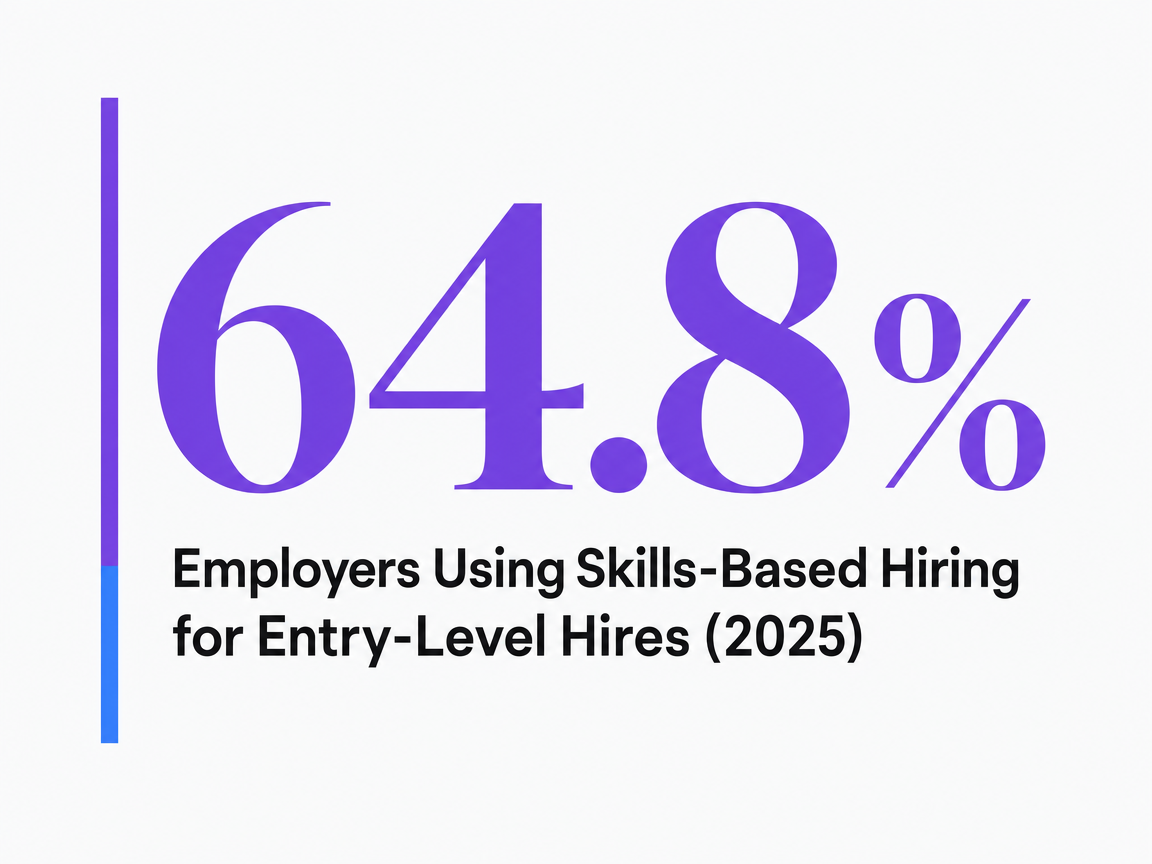 Employers Using Skills-Based Hiring for Entry-Level Hires (2025)
Employers Using Skills-Based Hiring for Entry-Level Hires (2025)
Frequently Asked Questions
References
- 1.Beyond Traditional Academic Degrees: The Labor Market Returns to Occupational Credentials in the United States.
- 2.Beyond Traditional Academic Degrees.
- 3.Demand For Ai Skills In....
- 4.2025-nace-job-outlook-jan-2025.
- 5.Employer Use of Skills-Based Hiring Practices Grows.
- 6.Job Outlook 2025.
- 7.SEO Starter Guide: The Basics | Google Search Central | Documentation | Google for Developers.
- 8.Creating helpful, reliable, people-first content.
- 9.Google's Guide to Optimizing for Generative AI Features on Google Search.
- 10.How to use Search Console.
- 11.Debugging drops in Google Search traffic.
- 12.Professional certifications and occupational licenses.