
Key Takeaways
- Score consulting firms against four axes before pricing: pipeline attribution integrity, compliance posture in the client's vertical, operating-model fit with internal review capacity, and unit economics per qualified opportunity.
- Attribution integrity means writing identified leads back to CRM objects with deduplication across organic, direct, and branded paid, not delivering ranking exports or traffic charts as proof of pipeline.
- Compliance disqualifiers override pricing conversations, including review workflows under the FTC's 2024 rule 2, 3, HIPAA-aligned analytics configuration 8, substantiation logs 9, and WCAG 2.1 AA accessibility 1, 6, 7.
- Judge vendors on twelve-month cost per qualified opportunity using the client's slowest reviewer and actual throughput, not vendor reference figures, then run procurement by requiring self-scoring with artifacts for any rating above three.
Why Vendor Evaluation Fails Before the First Pitch Deck
Most SEO consulting evaluations fail because the scoring criteria do not align with desired business outcomes. Procurement often focuses on quantifiable deliverables like ranking reports or backlink volumes, while executive teams measure success by qualified pipeline, cost per booked opportunity, and conversion rates against a defined Ideal Customer Profile (ICP). This misalignment means vendors can win contracts based on metrics that do not reflect the business's strategic goals.
A second common failure occurs in regulated industries such as legal, healthcare, and financial services. These sectors operate under strict rules that render certain SEO tactics inadmissible, regardless of their potential performance. For example, review generation workflows that ignore the FTC's 2024 Trade Regulation Rule on consumer reviews, analytics setups that risk exposing protected health information, or keyword strategies that violate state bar ethics opinions are not merely performance issues; they are immediate disqualifiers.
The third failure mode is operating-model drift. Even a consulting firm with a strong playbook can be a poor fit if its workflow demands a briefing cadence, review capacity, or publishing authority that the client's internal team cannot realistically provide. The rubric presented here evaluates firms on four critical axes—attribution integrity, compliance posture, operating-model fit, and unit economics per qualified opportunity—before any proposal is even considered.
The Four-Axis Scorecard for Scoring Consulting Firms
Axis One: Pipeline Attribution Integrity
Attribution integrity assesses a consulting firm's ability to directly link its work to revenue recognized within the client's CRM, rather than merely producing dashboards that appear to correlate with revenue. This distinction is crucial because CFOs typically do not consider ranking exports, Search Console screenshots, or traffic growth charts as evidence of pipeline generation.
A firm demonstrating strong attribution integrity will clearly articulate, prior to any strategy discussion, how organic sessions translate into identified leads, how these leads are accurately stage-stamped in the CRM, and how closed-won revenue is traced back to its originating keyword cluster, landing page, or content asset. Key instrumentation details to inquire about include UTM governance, server-side event forwarding, call-tracking logic for voice-dominant industries, form routing to lead-source fields, and the deduplication rules that prevent double-counting across organic, direct, and branded paid channels.
To differentiate genuine attribution from superficial reporting, ask three specific questions:
- Which CRM object does the consultant write to, and who is responsible for field mapping?
- How does the firm manage offline conversions, same-session multi-touch interactions, and the inflation of organic numbers due to branded search leakage?
- What is the firm's stated accuracy tolerance, and do they report confidence intervals or only point estimates?
A consultant unable to provide clear answers to these questions during procurement is unlikely to do so post-contract. This axis functions as a binary filter initially—either the firm instruments to pipeline or to proxies—with granular scoring only applied after this fundamental requirement is met.
Axis Two: Compliance Posture in the Buyer's Vertical
Compliance posture is frequently underestimated by procurement teams but poses significant post-contract risks. A consulting firm's risk profile is determined by the client's regulatory environment, not by the firm's internal policies. The core question is whether the firm's standard operating procedures already incorporate the specific regulations governing the client's industry.
Several regulatory frameworks are particularly relevant:
- The FTC's 2024 Trade Regulation Rule on consumer reviews and testimonials prohibits fake, undisclosed incentivized, and materially misleading reviews, directly impacting any proposed review-generation or reputation workflow 2.
- The FTC's updated Endorsement Guides extend this scrutiny to employee reviews, virtual influencers, and intermediary liability, meaning the consultant's subcontractors and tools fall within the client's risk perimeter 3.
- For healthcare and related entities handling protected health information, HHS guidance on online tracking technologies dictates how tools like GA4 and Meta pixels can be configured, often requiring a business associate agreement and specific disclosures 8.
- The FTC's Health Products Compliance Guidance mandates substantiation for objective outcome claims before dissemination, which applies to AI-generated content and service pages 9.
- Legal SEO is subject to jurisdiction-specific constraints, such as the North Carolina State Bar's 2023 Formal Ethics Opinion 4 regarding keyword bidding on competitor trade names 10.
- Accessibility, governed by DOJ guidance and the 2024 Title II rule adopting WCAG 2.1 Level AA as a technical standard, applies to all public-facing digital properties, serving as a benchmark for private operators to mitigate litigation risk 1, 7, 6.
The scoring criterion here is concrete: the consultant must provide artifacts, not just assurances, demonstrating how each applicable rule influences their deliverables. For instance, a dental support organization would require a review-generation SOP referencing the 2024 rule, an analytics configuration document addressing HIPAA tracking, and a content review log substantiating clinical claims. Firms offering only vague assurances like "we follow best practices" fail this critical gate.
Axis Three: Operating-Model Fit With the Internal Team
Operating-model fit is the often-overlooked factor that determines whether a technically proficient consulting firm can actually deliver results within a client's specific organizational context. Every firm's playbook assumes a certain rhythm of briefings, a specific volume of subject-matter review, a particular speed for legal or clinical sign-offs, and a defined level of publishing authority. If these assumptions clash with the internal team's actual capacity, the engagement will falter, regardless of the strategy's quality.
Evaluation on this axis focuses on four operational variables:
- Briefing load: how many hours per week does the firm's process demand from the internal marketing team, and where will this time come from? (briefing load)
- Review capacity: who within the client organization is authorized to approve content involving legal, clinical, or financial claims, and what is their realistic turnaround time? A single compliance reviewer with a 10-day backlog, for example, presents a significant constraint.
- Publishing authority: does the firm directly push changes to the CMS, or must every update go through an internal web team with specific deployment windows? (publishing authority)
- Decision latency: how long, in business days, does it take from the firm identifying an opportunity to that opportunity being live?
The scoring criterion is based on realistic throughput, not aspirational targets. A consulting firm proposing 40 pages per quarter to an organization with a two-week legal review queue and biweekly deployment windows will likely produce only 12 to 15 pages quarterly in practice. This discrepancy erodes retainer value. The VP should assess the firm's proposed velocity against the slowest actual reviewer in the client's chain, not against the firm's reference-client performance.
Axis Four: Unit Economics Per Qualified Opportunity
Unit economics provides a unified metric for comparison: the cost per qualified opportunity, as defined by the client's CRM criteria. Factors like retainer size, deliverable count, or hours logged are secondary. The primary concern is the fully-loaded cost of generating one sales-accepted lead, divided by the volume the firm can realistically deliver given the client's operational constraints.
This calculation requires three inputs. The numerator includes the retainer and any add-ons (per-location, per-content-asset, per-campaign). Crucially, the internal cost of supporting the engagement—briefing hours, review hours, legal/clinical sign-off, deployment time, and required client-licensed tooling—must be added to this numerator at loaded cost. The denominator is the qualified-opportunity volume the firm can produce after accounting for the throughput limitations identified in Axis Three, not the volume projected in the proposal.
Honest application of this calculation reveals two common patterns. Firms with seemingly low headline retainers often incur high internal support costs, reversing the economic advantage once review hours are factored in. Conversely, firms with higher retainers but robust compliance and attribution workflows frequently yield a lower cost per qualified opportunity because the client's internal team spends less time correcting or re-briefing work. The scoring criterion is the projected twelve-month cost per qualified opportunity, calculated using the client's actual constraints, not the vendor's reference figures. Any firm reluctant to provide the necessary inputs for this calculation is implicitly signaling a less favorable outcome.
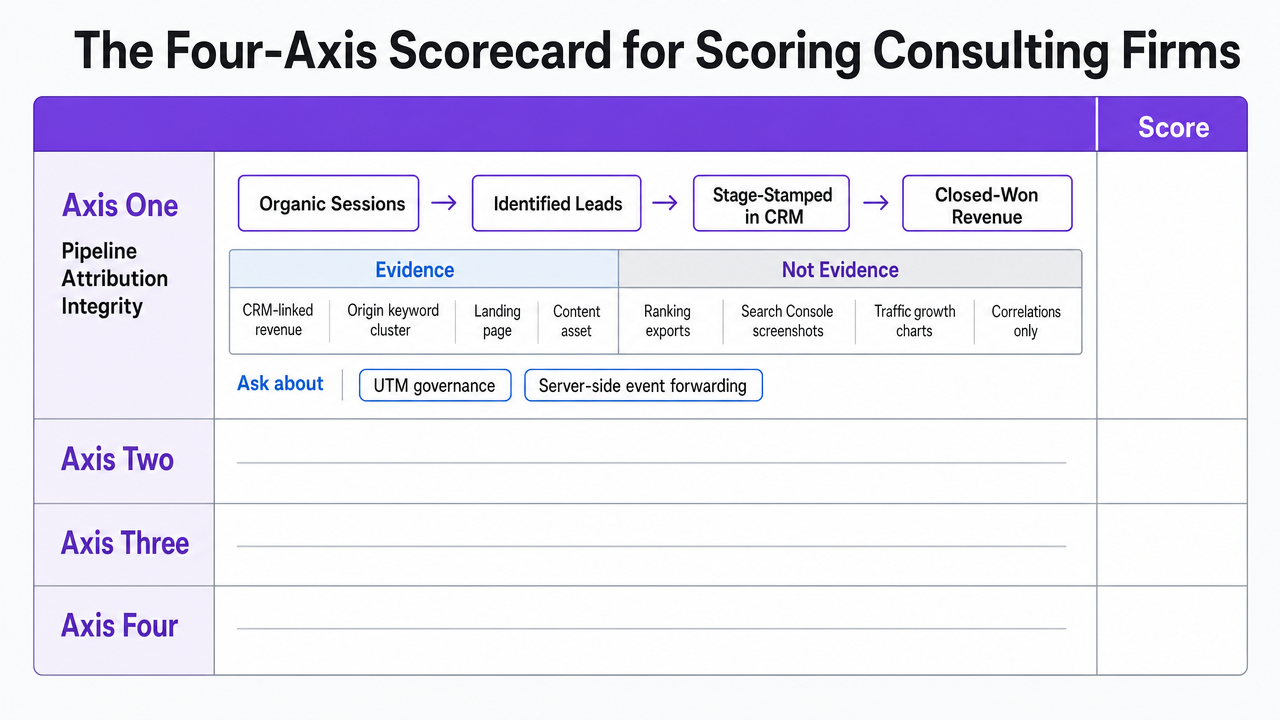 Visualize the four evaluation axes as a structured scorecard framework that readers can use directly when assessing vendors, mirroring the section's explicit rubric
Test real SEO workflows for pipeline impact
Publish live content and measure organic pipeline results before committing to a full engagement.
Compliance Disqualifiers That Precede Any Pricing Conversation
Review Generation, Testimonials, and Reputation Claims
Any consulting firm proposing review generation, reputation management, or testimonial-driven landing pages assumes the client's exposure under the FTC's 2024 Trade Regulation Rule. This rule prohibits fake reviews, materially misleading testimonials, undisclosed insider reviews, and the suppression of authentic negative feedback 2. Since the advertiser is held responsible for practices from which it benefits, the consultant's Standard Operating Procedures (SOPs) become part of the client's liability record.
The FTC's 2023 Endorsement Guides extend this scrutiny to employee reviews, incentivized reviews, virtual influencers, and the intermediaries involved in soliciting or filtering them 3. A firm proposing an outreach strategy that offers discounts or other incentives for reviews must demonstrate its disclosure language, filtering logic, and audit trail. Firms that gate review requests to only likely five-star customers, or route negative feedback to private channels while publishing only positive sentiment, are engaging in practices targeted by these regulations.
Three specific disqualifiers should be on the initial checklist:
- If the firm cannot explain how incentive disclosures appear at the point of solicitation;
- If it cannot produce a written policy on handling negative reviews that differentiates service recovery from suppression;
- Or if it offers "reputation cleanup" or review removal without a documented basis under platform terms.
Any of these issues should immediately end pricing discussions.
Analytics and Tracking Stacks in Regulated Verticals
For healthcare, behavioral health, dental groups, and any HIPAA-covered entity or business associate, the analytics stack is primarily a compliance artifact. HHS guidance on online tracking technologies mandates that the use and disclosure of protected health information (PHI) via pixels, tags, and analytics scripts comply with the Privacy Rule, and that electronic PHI transmitted through these technologies is secured under the Security Rule 8. This guidance distinguishes between unauthenticated page activity and situations where tracking collects health-related information—a distinction often overlooked by junior analysts configuring these tools.
The evaluation question is precise: can the firm provide, pre-contract, a configuration document detailing how it instruments GA4, Meta pixels, LinkedIn Insight tags, call tracking, chat widgets, and form submissions on pages referencing conditions, treatments, provider directories, or appointment scheduling? Does the firm have a Business Associate Agreement (BAA) in place if required by the data flows it will establish? Is remarketing based on URL patterns that could reveal health conditions explicitly disabled and documented? A firm that relies solely on "IP anonymization" has not adequately addressed current guidance. A firm that proposes server-side tagging, consent-governed event forwarding, and PHI-scrubbed parameters, and can show the review log for these decisions, demonstrates appropriate compliance. The consultant's analytics proposal is a clear indicator of whether the engagement will create unforeseen regulatory exposure for the internal privacy officer.
Content Substantiation, Sponsored Placement, and Accessibility
Content making objective claims about health outcomes, treatment efficacy, or service results must meet the FTC's substantiation standard: advertisers must possess adequate support for claims before dissemination, including implied claims 9. For SEO programs generating service pages, condition pages, or AI-assisted drafts at scale, this necessitates a medical or clinical review workflow with a retrievable evidence record, not merely a post-publication edit queue. A firm unable to describe who approves substantiation, their evidence standard, and where records are kept, lacks the necessary workflow.
Link building and digital PR also carry compliance risks. The FTC's native advertising guidance states that paid or sponsored placements must not mislead consumers through their format, even when appearing in organic search results or syndicated feeds 5. A consultant proposing sponsored articles or paid guest placements must disclose which placements are compensated, how disclosure language is enforced on the publisher's side, and how they manage republication. The broader FTC guidance on online advertising applies these truth-in-advertising principles to endorsements, influencer content, and native formats 4.
Accessibility is another critical gate. The DOJ's 2024 Title II rule adopts WCAG 2.1 Level AA for state and local government web content and mobile apps 1, 7, and broader DOJ guidance for public-facing businesses covers alt text, color contrast, keyboard access, captions, and accessible forms 6. While private operators may not be uniformly bound by Title II, a consultant unable to audit a lead-generation form against WCAG criteria is leaving both conversion value and litigation exposure on the table.
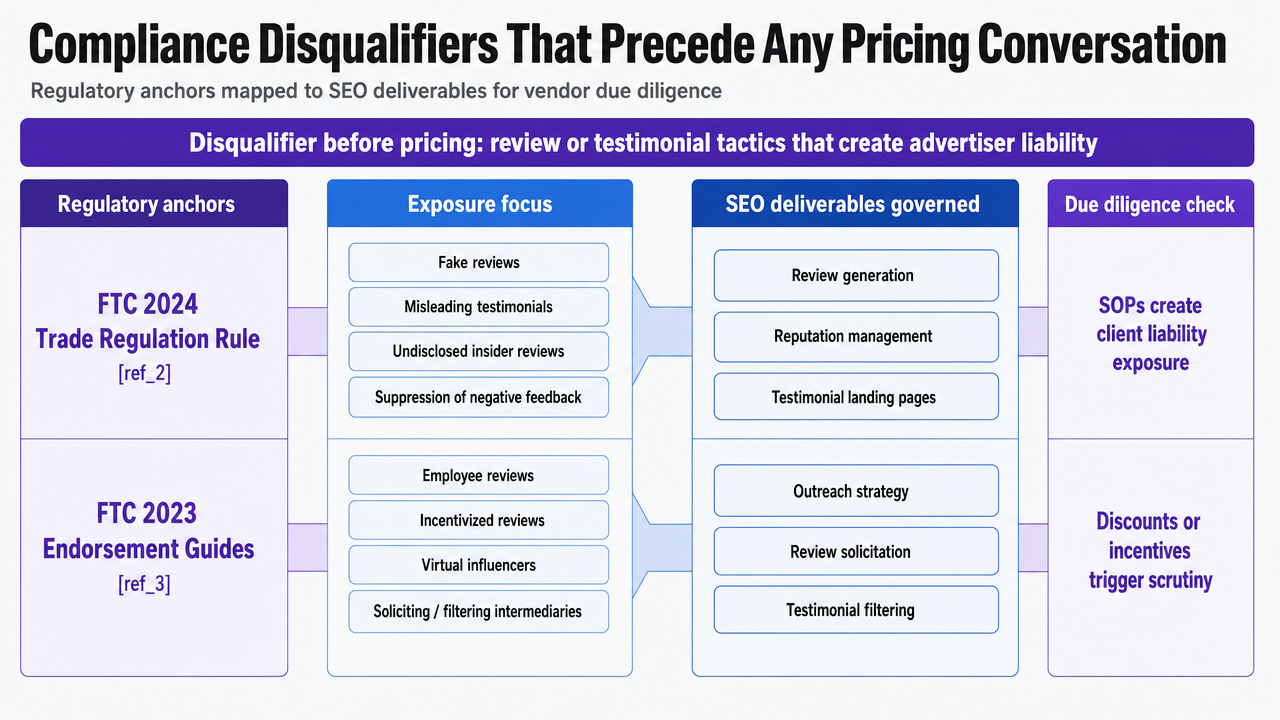 Map the regulatory anchors cited in the section to the specific SEO deliverables they govern, giving readers a reference table for vendor due diligence
Build, Buy, or AI-Augment: An Honest Operating-Model Comparison
Different operating models for SEO—consulting, in-house, or AI-augmented—come with distinct cost structures and potential failure points. A consulting retainer provides external expertise but can introduce briefing overhead, review bottlenecks, and attribution gaps. An in-house hire, typically a senior SEO lead supported by contractors, builds institutional knowledge and speeds decision-making but concentrates key-person risk and rarely covers the full spectrum of technical SEO, content production, link acquisition, and analytics in depth.
AI-augmented execution with human approval reallocates labor. Strategic functions like compliance review, substantiation sign-off 9, attribution governance, and publishing authorization remain internal. Production, research, and recommendation ranking are handled by the platform. This model changes the economics by compressing briefing hours, making the internal review queue the primary throughput constraint rather than vendor capacity.
The true comparison is not which model has the lowest headline cost, but which yields the lowest cost per qualified opportunity when internal review hours, deployment latency, and compliance exposure are factored in. For most mid-market organizations, the model that minimizes internal review friction is often the most effective, a calculation highly dependent on the specific vertical and existing team capabilities.
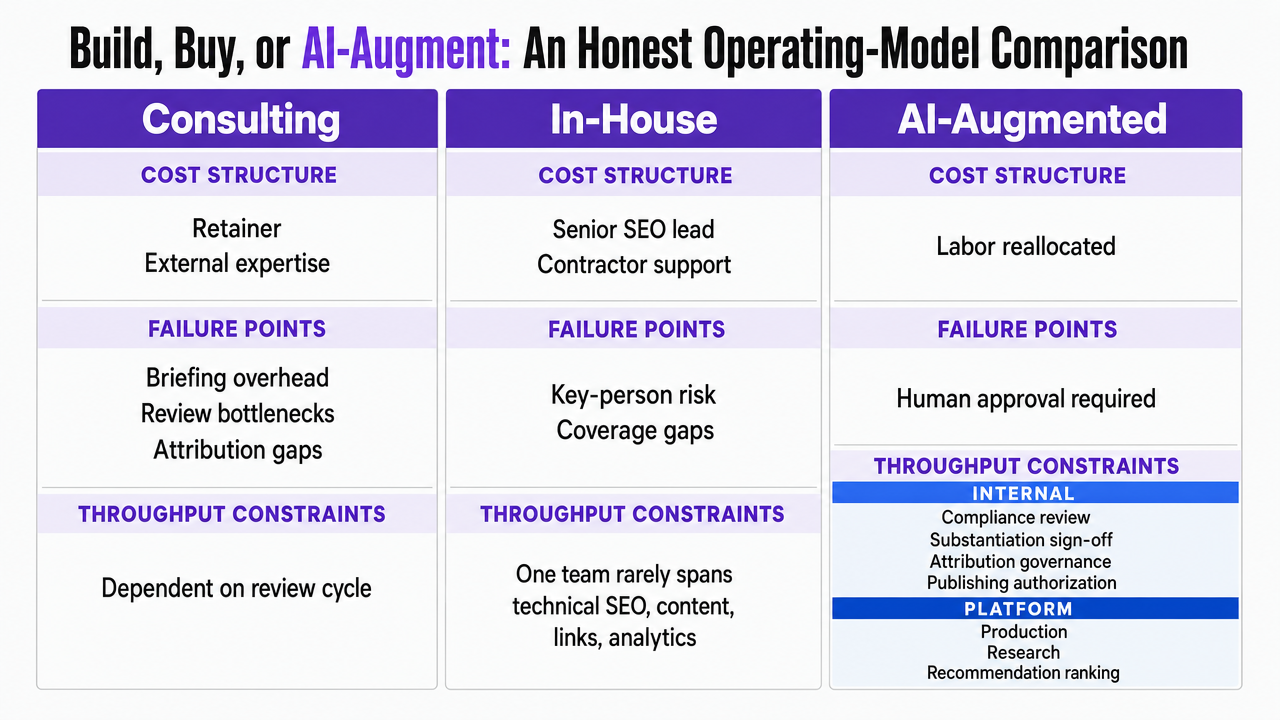 Compare the three operating models side by side on the dimensions the section explicitly contrasts: cost structure, failure points, and throughput constraints
See How Leading Brands Build Predictable SEO Pipeline Without Expanding Headcount
Request a data-backed assessment of your current SEO pipeline process and learn how unified, AI-driven execution platforms are outperforming traditional consulting models for enterprise-scale marketing teams.
If You Manage Multiple Locations: Consolidation Economics
For operators managing five or more locations, the dynamics of retainer scaling, per-location add-ons, and multiplied review queues significantly alter the comparison between consulting, in-house, and AI-augmented models. Single-site operators may skip this section.
A multi-location SEO consulting retainer typically involves a base fee plus a per-location charge, with content production, local listings management, and reporting billed separately. The in-house alternative places one senior lead over the entire portfolio, which can lead to coverage gaps proportional to the number of locations. The AI-augmented model shifts production and recommendation ranking to a platform, while compliance review, substantiation sign-off 9, and publishing authorization remain with the internal team for each location.
The following table uses variables that a VP already controls. Agency pricing is marked "RFP" to avoid fabricated benchmarks. The only disclosed anchor is a published trial price for one AI-augmented execution platform, Vectoron.
| Input | Traditional Retainer | In-House Hire + Tooling | AI-Augmented + Approval |
|---|---|---|---|
| Base monthly cost | RFP base retainer | Loaded FTE / 12 | Platform subscription (Vectoron trial: $599/mo) |
| Per-location cost | RFP per-location fee | Marginal tooling only | Variable by seat or location, RFP |
| Content production | Tiered add-on | Freelance pass-through | Included in platform output |
| Internal review hours / location / month | VP estimate | VP estimate | VP estimate |
| Qualified-lead target / location / month | Client-defined | Client-defined | Client-defined |
| Twelve-month cost per qualified opportunity | Computed | Computed | Computed |
Populating this table with real numbers reveals two key patterns. Retainers that appear competitive for ten locations often become uneconomical at twenty-five, as per-location fees compound and the internal review queue becomes a throughput bottleneck. In-house economics may look favorable initially but often fail to cover the necessary depth in technical SEO, content, and analytics across a large portfolio without additional contractor spend, which is rarely budgeted upfront. The AI-augmented column's success largely depends on whether the internal team can maintain the review-and-approval cadence required by the platform's output rate.
Running the Procurement Conversation With the Scorecard in Hand
This scorecard fundamentally alters the vendor meeting dynamic. Instead of passively receiving a capabilities presentation, the VP initiates by presenting the four axes and asking the consulting firm to self-score, providing supporting artifacts, before any discussion of ranking methodology. Firms accustomed to leading with case studies may resist this inversion, which itself can be diagnostic.
The rubric is concise:
- Pipeline Attribution Integrity evaluates CRM write-back, offline conversion handling, branded-search deduplication, and stated accuracy tolerance.
- Compliance Posture assesses adherence to relevant regulatory anchors: the FTC's 2024 reviews rule 2and updated Endorsement Guides 3for review workflows; HHS tracking guidance 8and FTC substantiation standards 9for healthcare; state bar ethics opinions like NC 2023 FEO 4 10for legal keyword strategies; and DOJ ADA/WCAG guidance 1, 6, 7for accessibility.
- Operating-Model Fit scores briefing load, review capacity, publishing authority, and decision latency against the slowest actual reviewer.
- Unit Economics calculates cost per qualified opportunity using the client's CRM definition and the throughput discount from Axis Three.
Each criterion is rated one to five, with evidence required for any score above three. A firm claiming a four on Compliance Posture without providing a review-generation SOP, an analytics configuration document, or a substantiation log has not genuinely earned that score. This process provides the VP with a defensible artifact for executive discussions and a shortlist filtered by criteria that resonate with the CFO.
Frequently Asked Questions
References
- 1.Web Rule.
- 2.16 CFR Part 465: Trade Regulation Rule on the Use of Consumer Reviews and Testimonials.
- 3.Federal Trade Commission Announces Updated Advertising Guides to Combat Deceptive Reviews and Endorsements.
- 4.Online Advertising and Marketing.
- 5.Native Advertising.
- 6.Guidance on Web Accessibility and the ADA.
- 7.Fact Sheet: New Rule on the Accessibility of Web Content and Mobile Apps Provided by State and Local Governments.
- 8.Use of Online Tracking Technologies by HIPAA Covered Entities and Business Associates.
- 9.Health Products Compliance Guidance.
- 10.2023 Formal Ethics Opinion 4.