
Key Takeaways
- Publishing velocity is constrained by brief quality, not writer headcount, because ambiguous inputs force writers and AI models to guess at intent, angle, and acceptance criteria 6.
- Underspecified briefs create compounding rework costs, with editors spending hours re-making strategic decisions that should have been finalized once, upstream, by the content owner.
- A velocity-optimized brief pre-decides intent, audience, and a distinct angle in single lines, preventing writers from defaulting to SERP consensus and triggering editorial rewrites.
- SERP fields should encode decisions already validated by ranking pages, listing format, depth range, and required entities so the drafter treats them as mandatory rather than optional.
- Voice can be handled in three lines—perspective, reading level with formality, and banned phrases—which stops rewrite cycles more effectively than a full brand guide.
- Draft instructions should decompose research, outline, draft, and edit steps, marking which sections an AI model can write end-to-end and which need a human first pass 4.
- Governance condenses to three lines naming the single approver, the evidence source for every factual claim, and the KPI plus dashboard the content is accountable to 5.
- The complete template fits on one page with eleven fields, and any proposed addition should be rejected unless it eliminates a question a writer or editor would otherwise ask.
Why briefs decide content velocity, not writer headcount
Content managers often assume that adding more writers will increase publishing output. However, this approach frequently falls short because the core bottleneck isn't headcount, but rather the quality of the content brief. A new writer introduces additional briefing overhead, extends editorial review times, and can lead to inconsistencies in brand voice. The problem simply shifts rather than disappearing.
The real constraint lies in the brief itself. Forrester's 2024 review of generative AI in marketing highlighted that many organizations "lack standardized prompts and input structures, leading to inconsistent AI outputs and added editorial burden" 6. This issue is not exclusive to AI; it equally impacts human writers. When a brief is ambiguous about intent, angle, or acceptance criteria, writers are forced to either make assumptions or seek clarification. Both scenarios consume valuable time that directly impacts content velocity.
The ability to ship significantly more content at comparable quality, moving from four posts a month to twenty, hinges on the operational maturity of the briefing process. Forrester's 2025 B2B content research emphasizes that standardized processes, templates, and measurement are crucial for teams to achieve measurable ROI from their content investments 1. The key factor is not the number of talented individuals, but the specificity of the input provided to whoever, or whatever, is drafting the content.
This shift is particularly important now because the drafting phase itself is becoming more efficient. McKinsey estimates that generative AI can boost marketing function productivity by 5 to 15 percent of total marketing spend, primarily by reducing ideation and drafting time 2. These gains are only realized when the brief provides sufficient pre-decided information, allowing the drafter to proceed without needing a second briefing cycle.
This article approaches the brief as a decision document, not merely a research summary. Each field in a well-structured brief serves to eliminate a question a writer or editor would otherwise have to ask, streamlining the entire content production process.
The hidden cost of brief debt
Every underspecified brief creates a small, accumulating liability. A writer may pause to clarify the desired angle, an editor might rewrite an introduction due to misaligned intent, or a strategist may need to re-explain the target audience in a chat. While these individual moments may not appear on a timesheet, their cumulative effect across the content calendar is significant. This accumulation of rework costs, resulting from briefs that defer decisions, can be termed "brief debt."
This pattern is particularly evident in AI-assisted workflows, where input quality is paramount. Forrester's 2024 review found that a lack of standardized prompts and input structures leads to "inconsistent AI outputs and added editorial burden" 6. This "editorial burden" is a clear indicator: when a drafter, whether human or AI, receives a brief that only specifies keywords and word count without defining intent, angle, or acceptance criteria, the resulting output is often generic. The editor then has to perform the strategic work that should have been completed during the briefing stage, asset by asset.
The true cost isn't the extra hour spent on a single piece of content; it's the compounding interest. For example, a team producing twelve posts monthly, each requiring two hours of avoidable editor rework due to brief gaps, loses twenty-four editor hours to brief debt each month. This equates to three full working days spent re-making decisions that should have been finalized once, upstream, by the individual closest to the content strategy.
Brief debt also limits the effectiveness of AI. AI models scale the output based on the quality of their input. A vague brief will generate vague drafts more quickly, forcing the editor to bridge the quality gap at an increased volume. Standardizing the brief is therefore essential to translate drafting speed into actual publishing speed. All subsequent decisions, including tooling and headcount, depend on this foundational input layer.
What a velocity-optimized brief actually contains
Strategy fields: intent, audience, and the pre-decided angle
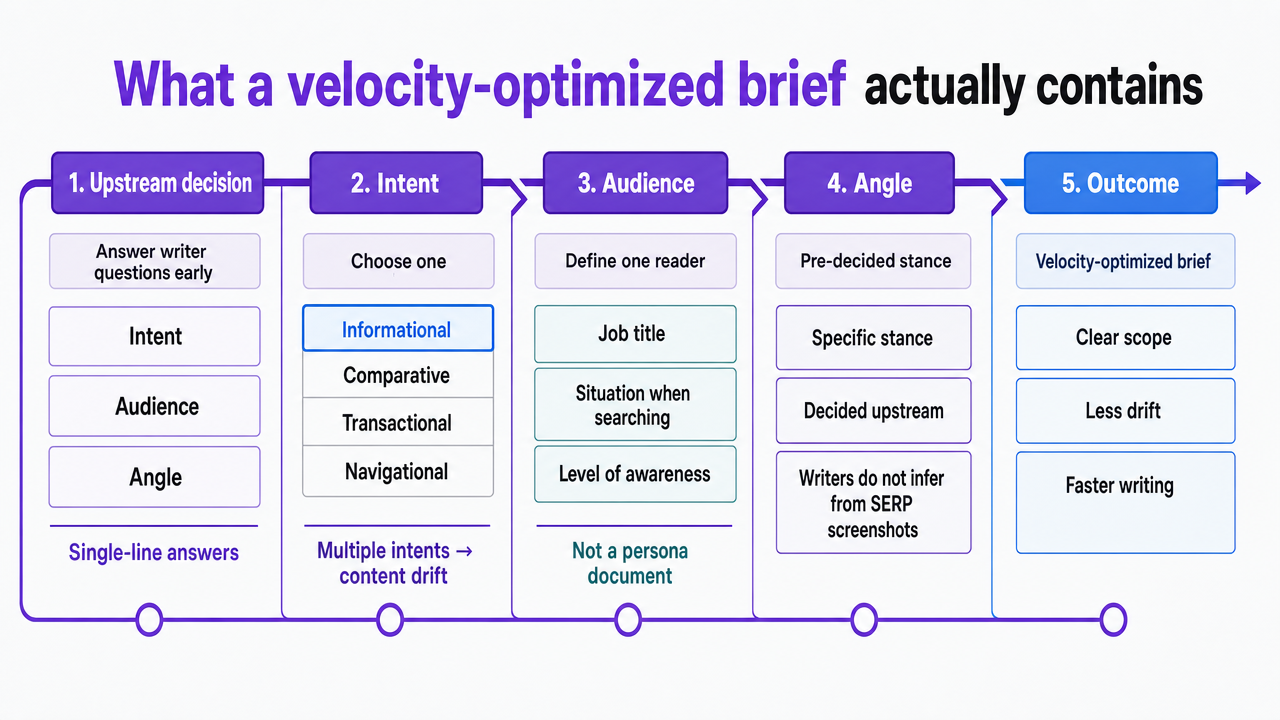
The initial section of the brief is designed to proactively address the fundamental questions a writer typically asks: who is the target audience, what information do they seek, and what specific stance will the content adopt? A brief optimized for velocity provides concise, single-line answers to all three.
Intent is defined by a single value: informational, comparative, transactional, or navigational. Briefs that attempt to cover multiple intents are a primary cause of content drift, as writers often prioritize the intent most apparent in SERP screenshots. This decision must be made upstream.
The audience follows a similar principle. Instead of a detailed persona document, the brief identifies a single reader in one line, specifying their job title, their situation when searching, and the desired outcome. For instance, a "content manager under a publishing quota" has different needs than a "director building a business case." The brief clarifies which audience is being addressed.
The pre-decided angle is a critical field often overlooked in standard templates, yet it significantly reduces editorial cycles. It articulates, in a single sentence, the unique argument the content will make that differentiates it from existing search results. Without this, writers tend to conform to SERP consensus, leading to editors having to redefine the thesis post-drafting. Forrester's research indicates that such standardized inputs are key to distinguishing between AI-assisted content that successfully publishes and that which gets stuck in review 6.
SERP fields: what the ranking set already proves
The SERP section of the brief is not a repository for raw research. Instead, it distills decisions that the top-ranking results have already validated, preventing the drafter from re-evaluating these established factors.
Three key fields convey this information. First, format: Is the dominant content type among top results a listicle, a how-to guide, a definitional explainer, or a comparison? Google has already determined the most effective format for that query, and content that disregards this will struggle to rank, regardless of its quality.
Second, depth signal: This is expressed as a word-count range derived from the top five results, rather than an arbitrary company standard. Targeting 1,200 words for a query where the minimum ranking content is 2,400 words will result in a wasted publishing effort.
Third, the entity and subtopic set shared by ranking pages. Two or three sentences listing the concepts consistently covered by competitors are sufficient. The drafter should treat these as mandatory inclusions, not mere suggestions. Forrester's 2025 research directly links this type of standardized input to measurable ROI in B2B content investment, highlighting its importance for operational excellence 1.
Voice fields: the three lines that stop a rewrite cycle
Brand voice is a common point of failure in content briefs. Many templates either omit it entirely or include a comprehensive brand guide that often goes unread. A velocity-optimized brief addresses voice concisely, using just three lines.
The first line specifies the perspective: first person, second person, or third person. Inconsistent perspective within a single piece of content is a frequent reason for editors to send drafts back for extensive revisions.
The second line defines the reading level and formality, using a grade band and a single adjective. For example, "Ninth grade, high formality" provides more actionable guidance than a lengthy set of style notes.
The third line lists two or three banned phrases, drawn directly from the brand's style guide. Negative examples are often more effective than positive ones. A writer or AI model instructed "do not use 'unlock,' 'leverage,' or 'seamless'" will produce cleaner copy than one given a paragraph on brand aspirations. Forrester's 2024 review of AI in marketing highlights this precise issue: teams without standardized input structures end up correcting voice issues during editing instead of resolving them at the briefing stage 6.
Draft instructions: task decomposition for human and AI drafters
The draft instructions section acknowledges the reality of modern content teams, which often employ a hybrid workflow. A single asset might involve an AI-generated outline, a human-written first draft, an AI-assisted second pass on specific sections, and a human editor. If the brief treats drafting as a monolithic task, these handoffs can become points of failure.
The solution is task decomposition. Research from Cal State LA on integrating generative AI into marketing workflows suggests that AI is most effective when applied to "repeatable, well-structured tasks" like content research and drafting, with human oversight for "high-stakes brand, legal, or ethical decisions" 4. The brief should directly reflect this structure.
Four sub-fields facilitate this. Research specifies approved and off-limits sources, along with the maximum number of external citations, preventing AI models from inventing references. Outline provides the H2 and H3 structure or delegates its creation to the drafter with clear acceptance criteria. Draft designates which sections an AI model can write end-to-end versus those requiring a human first pass, typically content involving customer proof, legal claims, or original positioning. Edit defines the human checkpoint and its specific focus: factual accuracy against cited sources, compliance with the three voice guidelines, and alignment with the pre-decided angle, rather than a vague instruction to check for "quality."
Decomposing the work in this manner transforms a brief from a mere assignment into a runnable pipeline. It also establishes a clear audit trail distinguishing AI-generated content from human decisions, which is increasingly important as governance requirements become stricter.
Governance fields: one line each for owner, evidence, and measurement
Governance is often managed as a separate standard operating procedure. In a velocity-optimized brief, it is condensed into three concise lines visible to both the drafter and editor.
Owner identifies the single individual responsible for approving publication. Relying on a channel or team for approval often leads to calendar delays; the absence of this field is a common cause for two-week lags between draft completion and asset launch.
Evidence specifies the authoritative source for every factual claim the content will make. If the brief indicates three external sources and one internal data pull, the drafter understands the scope, and the editor knows what to verify. Fabricated citations, a common failure mode in AI-assisted drafting, are almost always a symptom of an empty evidence field.
Measurement names the key performance indicator (KPI) the content is designed to impact and where its performance will be tracked. This could be organic sessions in month three, assisted conversions in month six, or ranking position for a target query by a specific date. The NIST AI Risk Management Framework organizes AI oversight around Govern, Map, Measure, and Manage 5. These three lines represent the most compact application of that discipline within the brief, without turning it into a compliance document.
 Visualize the five-section framework of the velocity-optimized brief as a process infographic, reinforcing the structural argument of the section
Test a full workflow with live publishing
Experience real-time content brief creation and publishing with measurable SEO impact during your free trial.
The template, field by field
The following outlines a complete content brief template, designed for inclusion in a content operations document. Each field is typically a single line, with its rationale provided directly alongside it, eliminating the need for a separate legend.
Strategy
- Target query: The exact keyword the content aims to rank for. Only one query, not a cluster.
- Intent: Informational, comparative, transactional, or navigational. Select one.
- Reader (one line): Job title, situation at the moment of search, and outcome needed. Example: "Content manager under a publishing quota, needs to ship more without hiring."
- Pre-decided angle: The unique argument this content makes that differentiates it from existing ranking results. One sentence.
SERP
- Format: Listicle, how-to, definitional, or comparison, aligned with the top five search results.
- Depth range: Word-count floor and ceiling derived from the ranking cohort, not a company default.
- Required coverage: Two to three sentences listing the entities and subtopics consistently present in competing pages.
Voice
- Perspective: First, second, or third person. One choice, maintained throughout the asset.
- Reading level and formality: Grade band plus one adjective. Example: "Ninth grade, high formality."
- Banned phrases: Two or three words or phrases the brand explicitly avoids.
Draft instructions (task decomposition per 4)
- Research: Approved sources, off-limits sources, and the maximum number of external citations.
- Outline: H2 and H3 skeleton, or delegation to the drafter with acceptance criteria.
- Draft: Sections a model may write end-to-end versus sections requiring a human first pass (e.g., customer proof, legal claims, original positioning).
- Edit: The human checkpoint and its three specific checks: factual accuracy against cited sources, voice compliance against the three voice lines, and alignment to the pre-decided angle.
Governance (Govern, Map, Measure, Manage per 5)
- Owner: The single individual who approves publication.
- Evidence: The source of record for every factual claim, including a citation count ceiling.
- Measurement: The KPI the content is accountable to, the read window, and the dashboard where its performance is tracked.
This template comprises eleven fields, designed to fit on a single page. The criterion for adding any new field is whether it eliminates a question a writer or editor would otherwise need to ask. If it does not, it should be excluded.
What velocity actually looks like when briefs are standardized
The velocity gains from AI-assisted content are not uniformly distributed; they are concentrated in teams that first optimize their input layer. McKinsey's 2026 analysis of AI in marketing indicates that properly configured AI-enabled marketing organizations are achieving two- to threefold improvements in productivity, 60 to 70 percent savings in execution tasks, two- to fivefold increases in creative productivity, and 10 to 30 percent reductions in creative costs 7. These figures apply to optimized operations, not average ones. For content teams, the most crucial configuration is the brief.
The reason is purely mechanical. A model or a writer operating with a standardized brief can dedicate their drafting time to crafting prose, rather than spending it on re-discovering intent, angle, and necessary coverage. Conversely, a model working from a vague brief will produce plausible-sounding filler that an editor then has to rewrite. The same model or writer yields different output curves based on the brief's quality. The reported 60 to 70 percent execution savings materialize only when the execution step is no longer burdened with decisions that should have been made earlier in the process.
The creative productivity range is where the benefits compound. A two- to fivefold increase in drafting throughput means a content manager overseeing twelve posts monthly could realistically manage twenty-four to sixty posts with the same headcount, provided the editorial checkpoint remains robust. This checkpoint holds only when the brief has already addressed voice, evidence, and acceptance criteria. Without these elements, the editor becomes the bottleneck, and throughput reverts to baseline levels.
Cost reduction follows the same logic. The 10 to 30 percent creative cost reduction reported by McKinsey is not about discounted rates; it's about eliminating rework hours, secondary briefing cycles, and revision passes that a standardized brief prevents from occurring 7. Teams that bypass this input-layer work and attempt to gain velocity solely through tools tend to achieve the lower end of these ranges, or even fall below them. Teams that standardize the brief, however, reach the higher end because the input quality finally matches the capabilities of the model or writer.
Get a Proven SEO Content Brief Template Designed for High-Velocity Teams
Access a data-driven brief template that streamlines content production, maintains brand consistency, and accelerates SEO outcomes—purpose-built for agencies and enterprise marketing teams managing large-scale content programs.
Brief-driven velocity math for a four-person content team
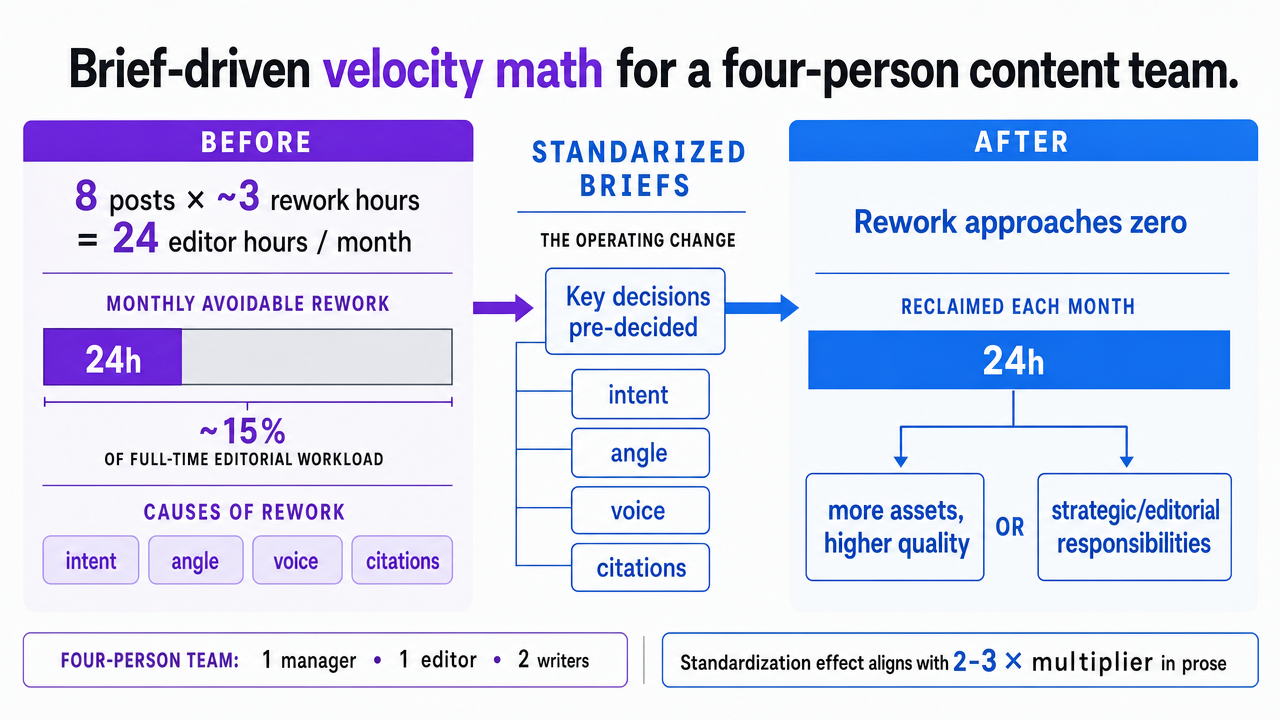
The argument for standardizing briefs is supported by straightforward calculations. Consider a four-person in-house content team: one manager, one editor, and two writers (staff or contract). This team typically ships eight long-form posts per month. Each post incurs approximately three hours of avoidable editor rework due to brief deficiencies—such as clarifying intent, rewriting angles, fixing voice issues, or chasing citations. This totals 24 editor hours monthly, representing about 15 percent of a full-time editorial workload, spent re-making decisions that should have been finalized in the brief.
Implementing standardized briefs directly addresses this issue. The rework time approaches zero as intent, angle, voice, and evidence are pre-decided. These 24 reclaimed hours can then be reallocated to either editing more assets at the same quality standard or to strategic work that the team previously had to forgo.
The impact on drafting further compounds these effects. McKinsey's 2026 analysis of optimized AI-enabled marketing organizations reports two- to fivefold increases in creative productivity when the input layer is fixed 7. Applying this conservatively to two writers, each producing four assets monthly, a 2x lift would increase the team's output from 8 to 16 posts without additional headcount. A 3x lift, still within McKinsey's reported range, would push output to 24 posts.
A compact worksheet illustrates this:
| Variable | Baseline | With standardized brief ||---|---|---|| Assets shipped per month | 8 | 16–24 || Editor rework hours per asset | 3 | ~0 || Monthly editor hours reclaimed | — | ~24 || Drafting throughput multiplier | 1x | 2–3x 7|
While the specific variables will differ for each team, the math consistently demonstrates that headcount alone cannot achieve the same output curve. A fifth hire adds only one writer's output and their associated briefing overhead. A standardized brief, however, enhances the output of every writer and model already in the pipeline, with benefits appearing in the first full production cycle after implementation.
 Present the concrete before/after operating math cited in the section, matching the worksheet numbers and the McKinsey 2-3x multiplier already in the prose
Rolling the template out without stalling the calendar
Template adoption is a common hurdle, often leading to inconsistent usage across a team. To avoid this, a rollout must integrate seamlessly into existing production cycles without causing delays.
A three-week sequence proves effective. In week one, the manager personally drafts the next two briefs using the new format, alongside the old version. This allows writers to observe the practical differences on live assignments. In week two, writers begin drafting against the new template, with the manager available to answer real-time questions. The editor tracks which fields still generate clarifications, viewing each question as an opportunity to refine the template's wording, not as an indication of its failure. By week three, the old format is retired, eliminating parallel versions.
Two critical guardrails ensure successful adoption. First, a standing 20-minute weekly review of one published asset against its brief, comparing the pre-decided angle and acceptance criteria to the final output. Second, a continuously updated list of banned phrases and off-limits sources, which the team adds to as new edge cases emerge. These artifacts represent the operational scaffolding that Forrester describes as distinguishing content teams that generate measurable ROI from those still burdened by editorial rework 1. The template itself is merely a tool; the consistent discipline of using it for every asset is the true deliverable.
Frequently Asked Questions
References
- 1.The State Of B2B Content In 2025: Operational Excellence Pays Dividends.
- 2.The economic potential of generative AI.
- 3.How generative AI can boost consumer marketing.
- 4.Integrating Generative AI Into Team-Based Marketing Workflows.
- 5.AI Risk Management Framework | NIST.
- 6.The State of Generative AI in Marketing, 2024.
- 7.The future of marketing in the age of AI | McKinsey.