
Key Takeaways
- A governed content loop replaces checklists with seven connected stages—intent research, cluster architecture, briefs, AI drafting, expert editing, optimization, and pipeline attribution—each with defined artifacts, owners, and rejection criteria.
- Briefs act as the contract between strategy and draft: primary query, cluster position, angle, and named evidence must be set upstream so editors verify rather than rewrite, keeping edit ratios at 20–30%.
- The economic case combines a 4.2x velocity multiplier with a drop from $2,310 to $847 per long-form asset under AI-augmented workflows 10, defensible only when E-E-A-T checkpoints and cluster discipline hold.
- Optimization and attribution should target a SERP that answers before the click 8: publish extractable structure with original artifacts, then measure pipeline per cluster against the 27% organic baseline 9.
Why content teams need an operating system, not another checklist
Most in-house content teams possess tactics but lack a repeatable production system that seamlessly connects strategy to published content. The traditional content stack—keyword spreadsheets, brief templates, freelance rosters, and monthly review decks—is no longer effective in the current search environment.
Two significant pressures drive this change. Gartner predicts a 50% or greater decline in organic search traffic to brand websites by 2028 due to AI Overviews directly answering informational queries 8. Simultaneously, generative AI has transformed content production: McKinsey identifies marketing and sales as key areas for generative AI deployment, offering substantial value 6. Content managers leading small teams are now expected to increase publishing volume, defend organic search as a pipeline channel, and adapt to a search landscape that provides answers before a click.
A checklist cannot manage this complexity; an operating system can. A checklist guides a writer on a single asset, whereas an operating system defines inputs, outputs, and ownership for every stage, from intent research to pipeline attribution. It treats content as searchable assets derived from customer questions, not merely a queue of blog topics 11. This article outlines such a system, stage by stage, including throughput calculations and quality rubrics for content managers.
The seven stages of a governed content loop
A governed content loop is a closed system where each stage has defined inputs, outputs, and a clear owner. The seven stages are:
- intent research
- cluster architecture
- briefs
- AI-assisted drafting
- expert editing
- optimization
- pipeline attribution
The loop concludes when attribution data informs future intent research and planning. While the individual stages are not new, the discipline lies in ensuring each stage produces a necessary artifact for the next.
The process begins with intent research, yielding a ranked list of customer questions and query clusters. This list then informs cluster architecture, which creates a pillar-and-cluster map with internal linking instructions. Next, each mapped page is developed into a brief detailing its angle, evidence, structure, and success criteria. AI-assisted drafting follows, using the brief as a guide. Expert editing ensures accuracy, incorporates experience signals, and maintains brand voice. Stage six focuses on on-page optimization, schema, and formatting to align with current SERP rendering. Finally, stage seven measures pipeline contribution, feeding this data back into the initial intent research phase.
The purpose of these defined stages is to achieve measurable results. Organic search contributed a median of 27% to sourced pipeline for B2B SaaS companies in 2024, according to a survey of 1,200 marketers 9. This metric underscores the importance of each stage. A team that views content as a queue of blog topics will publish more pages but generate less pipeline than one that treats content as searchable assets tied to buyer questions 11. These stages ensure that intent, architecture, and measurement remain connected throughout the quarter, avoiding repeated strategic rediscovery.
A governed loop differs from a simple workflow in two key ways. First, each stage has a rejection criterion: a brief without a primary query cannot proceed to drafting; a draft lacking a cited primary source cannot enter editing; and a published page without attribution tagging does not count towards quarterly output. Second, ownership is single-threaded per stage. A content manager might oversee multiple stages in a small team, but no stage operates by committee. The following sections detail each stage, including artifacts, throughput calculations, and quality checks for managers.
Stage one and two: intent research and cluster architecture
The initial two stages are critical for determining content topics and their interrelationships. Errors here can negate downstream drafting efforts. Intent research identifies and ranks customer questions, while cluster architecture transforms this list into a durable map of pillars, subtopics, and internal links. Both stages precede any brief writing.
Anchoring topics in searchable customer questions
Intent research begins with the actual language prospects use, not aspirational terms. Each potential topic is framed as a searchable content asset, built from the questions, objections, and vocabulary of target buyers before they engage with sales 11. The deliverable is a ranked inventory of questions, including the query, its estimated intent stage, and the internal expert who can credibly answer it.
For smaller teams, a practical approach involves extracting the top 40–60 queries the site already ranks for on pages two through five. This is supplemented with questions from sales call transcripts and support tickets. Each candidate query is then scored based on buyer proximity, competitive difficulty, and available in-house evidence. Topics with low evidence scores are flagged for subject-matter expert interviews before being integrated into the cluster map. This scored question list, rather than a simple spreadsheet of search volumes, is the artifact passed from stage one to stage two.
Pillar-and-cluster topology as the site's memory
Cluster architecture translates the scored question list into site structure. The topic cluster model organizes content around a central pillar page, which serves as a hub for an overarching topic. Multiple cluster pages cover related subtopics, linking back to the pillar and to each other 1. This framework defines a cluster as "a content framework based on hubs of related themes" encompassing pillar pages, cluster pages, and reinforcing internal links 2. For a content manager, this topology acts as the site's long-term memory, tracking answered questions, open topics, and how new assets connect to existing content.
To maintain the topology's integrity, two rules are enforced. First, each page is assigned one primary query, enforced at the brief stage. This prevents cannibalization and confusion in the internal link graph. Second, every new cluster page is published with its outbound links to the pillar and inbound link from the pillar simultaneously, avoiding later cleanup. The cluster map serves as a single source of truth, consulted by stage three (briefs) before new content creation and by stage seven (attribution) to identify which clusters drive pipeline.
Accelerate SEO content output risk-free this week
Test a full production workflow and publish live SEO content before you commit.
Stage three: the brief as the contract between strategy and draft
The brief transforms strategic discussions into an actionable document for writers. For small teams, it is the critical artifact that determines whether AI-assisted drafting produces a usable first draft or requires extensive rewriting. Neglecting angle, evidence, or success criteria in the brief pushes these decisions to the editing stage, which significantly hinders throughput.
An effective brief for a cluster asset includes seven essential fields:
- primary query and intent stage (from stage one)
- position in the cluster map (pillar, cluster child, or supporting page, from stage two)
- the page's angle or thesis
- minimum evidence set (named sources, internal data, subject-matter expert quotes)
- required structural elements (H2 outline, schema type, on-page assets)
- named editor and target publish date
- the pipeline metric the page aims to influence
A brief lacking any of the first four fields is rejected from drafting, serving as the rejection criterion for stage three.
Two operational practices prevent briefs from becoming ineffective. The primary query field is enforced as unique against the cluster map, preventing cannibalization before content reaches the SERP. Additionally, the brief author, not the writer, populates the evidence set. Expecting an AI-assisted drafter to "find good stats" often leads to fabricated information and rejected drafts; providing citations upfront makes the subsequent drafting stage efficient. When managed this way, the brief acts as a contract between strategy and draft, signed by the content manager, executed by the writer, and reviewed by the editor before any changes are made.
Stages four and five: AI-assisted drafting and expert editing
Stages four and five are where the operating system's efficiency is either realized or undermined. A well-crafted brief should make drafting the most cost-effective stage, while editing becomes the point where a senior human ensures content quality. Teams that reverse this—writers struggling for angles and evidence, and editors focusing on superficial polish—fail to achieve the throughput gains promised by the system.
The throughput math: writers × briefs × edit ratio
Velocity in a governed loop is quantifiable: it depends on the number of writers, the briefs each writer can complete weekly, and the edit ratio (the proportion of a draft that remains after expert editing). When AI handles the initial draft based on a comprehensive brief, the writer's role shifts from prose generation to directing evidence, structure, and voice. This shift is what the benchmark measures.
B2B teams utilizing AI-augmented workflows publish 4.2 times more assets per writer per quarter compared to their pre-AI baseline, as observed in the 2024 benchmark 10. For a three-writer in-house team producing one long-form asset per writer per week under traditional methods (approximately 36 assets quarterly), the same team using this loop could aim for around 150 assets per quarter, assuming briefs are ready and editors are not a bottleneck.
Two factors determine if a team reaches this potential. First, brief supply: a writer working 4x faster will quickly run out of approved briefs without a steady upstream inventory. Second, the edit ratio: if editors rewrite 60% of every AI-assisted draft, effective velocity drops to near baseline. Teams that achieve the multiplier maintain an edit ratio of 20–30%, focusing on targeted edits for accuracy, experience, and voice on structurally sound drafts, because the brief has already addressed strategic requirements.
 Increase in content output per writer with AI
Increase in content output per writer with AI
Where AI-assisted drafts fail and what editors actually catch
AI-assisted drafts exhibit predictable failure points, and understanding these transforms editing into quality control. Three common failure modes occur in long-form SEO assets.
- The first is fabricated evidence. An AI drafter asked to "support this claim with a benchmark" may generate a plausible-sounding statistic with a credible-looking attribution, neither of which will withstand a source check. The solution is upstream: the brief must provide citations. The editor's role is verification, not generation. Every numerical claim in the draft must be matched to the brief's named source before approval.
- The second is a lack of experience signals. Google's raters are instructed to evaluate "the first-hand experience of the creator" as a distinct aspect of page quality 4. AI-assisted drafts often produce well-structured summary prose that reads as if written by someone who has researched a topic rather than performed the work. Editors address this by incorporating concrete artifacts that AI cannot invent, such as screenshots of internal dashboards, quotes from subject-matter expert interviews documented in the brief, or specific operational numbers from the team's own activities.
- The third is cluster drift. A draft might inadvertently re-explain a point already covered on a related page or introduce a secondary query belonging to a different cluster. The editor reviews the draft against the cluster map from stage two before approval. This check prevents the internal link graph from cannibalizing itself as publishing volume increases.
The economics a content manager can defend to a CMO
A content manager presenting to a CMO needs to articulate the cost per asset under current operations versus the proposed system. The 2024 B2B benchmark data provides these figures directly, based on actual comparisons rather than models.
The median fully loaded cost per long-form asset for B2B teams is $2,310 with traditional workflows, dropping to $847 with AI-augmented workflows—a 63% reduction per asset, measured alongside the 4.2x velocity multiplier 10. McKinsey's marketing research supports this, suggesting broad generative AI adoption in marketing can lead to 20–40% total marketing cost savings and 50–80% reductions in campaign creation time 7. The per-asset figure is a specific line item, while the McKinsey range provides a broader context that a CFO would recognize from other departments.
The argument for a CMO is not simply that "AI content is cheaper." Instead, it's that the same headcount, operating within a governed loop and a fixed cluster map, produces more assets at a lower marginal cost, with editing—not drafting—as the primary throughput constraint. A three-writer team publishing 36 long-form assets per quarter at $2,310 each incurs approximately $83,000 in per-asset costs. The same team, leveraging the governed loop to reach benchmark ceilings, reallocates this spend towards more assets, deeper evidence, and enhanced senior editing capacity, rather than merely increasing marginal drafts.
Two important caveats should be included in this discussion. First, these benchmarks represent median outcomes, not guarantees; teams that bypass stages one through three of the loop often incur traditional costs even with AI tools. Second, the cost savings are a floor, not a ceiling, for value. The pipeline attribution work in stage seven is what transforms a lower cost per asset into a quantifiable contribution to sourced revenue. Cost savings initiate the conversation, but pipeline contribution sustains the budget.
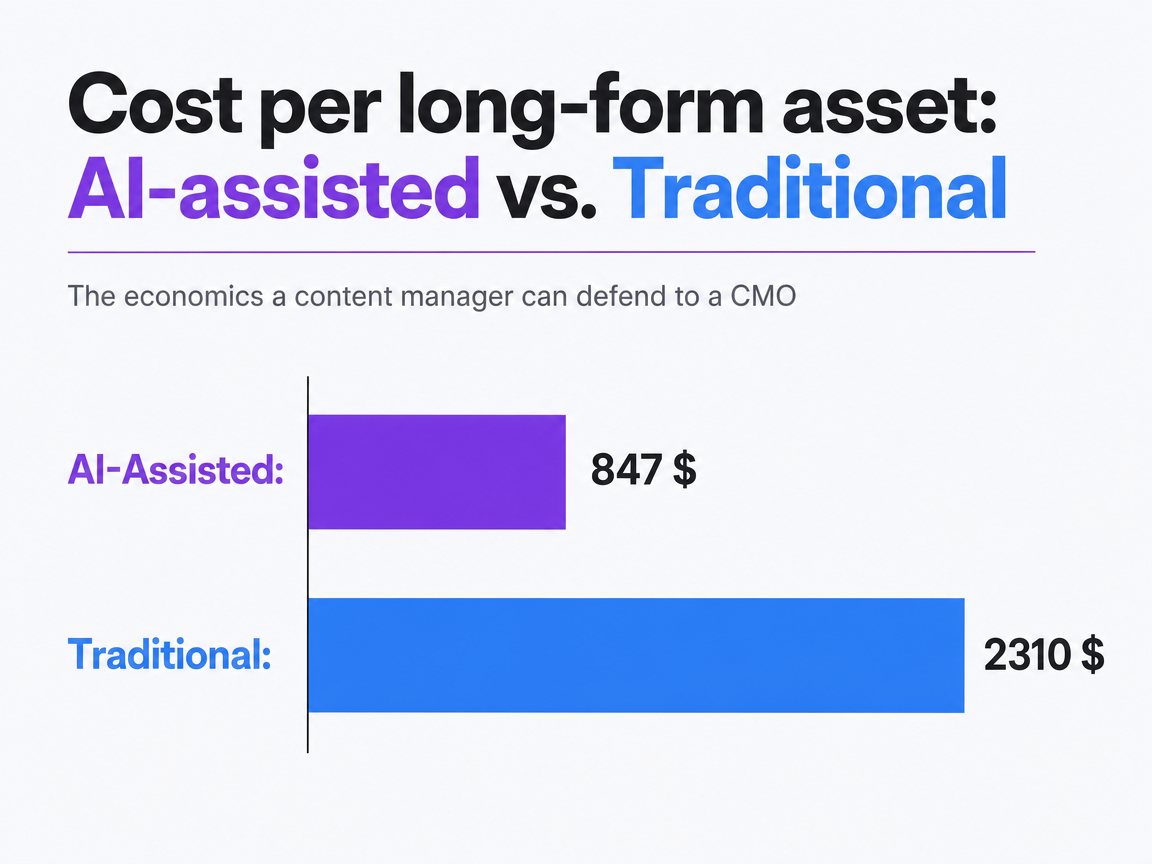 Cost per long-form asset: AI-assisted vs. Traditional
Median fully loaded cost per long-form asset for B2B teams drops from $2,310 to $847 when using AI-augmented content production workflows.
See How Leading Teams Systematize SEO Content at Scale—Without Adding Headcount
Request a walkthrough of an AI-powered workflow for accelerating SEO content development, maintaining editorial oversight, and achieving measurable gains in production efficiency for agencies and enterprise teams.
E-E-A-T as an editorial QA rubric, not a slogan
Many content teams mention E-E-A-T in strategy decks but fail to operationalize it. Google's rater guidelines provide explicit criteria for human evaluators, making operationalization possible. Raters assess four distinct dimensions of page quality: the creator's first-hand experience, their expertise, the authoritativeness of both the creator and the website, and trust—defined by accuracy, honesty, safety, and reliability 4. This framework serves as a practical QA rubric. A content manager can translate it into four editorial checkpoints for editors to apply before any draft is published.
The experience checkpoint verifies if the page contains unique insights that an AI drafter couldn't generate by simply summarizing other content. This could be a logged interview quote, an internal screenshot, a specific operational number, or a named case study—one concrete artifact per major claim. The expertise checkpoint confirms that the primary source cited for each technical claim is verifiable. The authoritativeness checkpoint ensures proper author attribution, relevant credentials, and the page's strategic placement within a cluster that reinforces the site's topical coverage. The trust checkpoint involves a source-and-accuracy review of all numerical claims, dates, and named entities, as trust is considered "the most important" of the four dimensions when content impacts reader decisions 3.
Two habits ensure the rubric functions efficiently. Each checkpoint receives a binary pass/fail in the editor's comments, avoiding subjective scoring. Any single failure sends the draft back to the writer with a clear request for the exact artifact needed. Furthermore, the rubric is applied against the brief's specific requirements, not a general standard. For example, if the brief specified an interview quote and the draft provided a paraphrase, it constitutes an experience failure, regardless of the paragraph's readability. Applied this way, E-E-A-T becomes the final stage before a page joins the cluster map, determining whether the site's authority grows or diminishes with each new asset.
Stage six: optimization for a search page that answers before the click
Optimization traditionally focused on title tags, headers, and internal anchors. While these remain important, the SERP now answers many informational queries directly, often before a user clicks. Gartner's projection of a 50% or greater decline in organic clicks by 2028 8necessitates a redefinition of stage six. On-page work must aim for inclusion in AI Overviews and provide compelling reasons to click, as pages relying solely on traditional blue-link results are optimizing for a shrinking surface.
Three operational strategies define stage six in a governed loop:
- Structure every asset for extractability: include a direct answer to the primary query within the first 60 words, use clear definitional H2s, and apply schema markup appropriate for the content type (Article, FAQPage, HowTo, or Product).
- Incorporate assets that AI-generated summaries cannot replicate: up-to-date statistics with dates and sources, original charts, and screenshots from actual work. These are crucial for maintaining visibility as generative summaries expand 12.
- Fully resolve the primary query on the page. Users who click past an AI Overview do so because the summary was insufficient; a page that offers only a shallow answer wastes their visit.
The rejection criterion for stage six is clear: no asset publishes without a direct-answer opening, matching schema, at least one dated primary statistic, and one original visual. Assets failing these checks are returned to the editor, not the writer.
Stage seven: measuring pipeline, not just sessions
Stage seven completes the loop by feeding revenue signals back into stage one. Session counts and keyword rankings are diagnostic, not outcome metrics, and their reliability is decreasing as AI Overviews absorb informational clicks. This stage's objective is to answer a quarterly question: which content clusters generated sourced pipeline, and which merely produced pages?
The baseline for the entire loop is the median 27% contribution of organic search to B2B SaaS sourced pipeline in 2024 9. A content manager should present three attribution artifacts to the CMO during quarterly reviews:
- A cluster-level pipeline report mapping published assets to influenced opportunities using first-touch and multi-touch attribution, focusing on pipeline per cluster rather than aggregate organic sessions.
- A decay report identifying clusters that are stalling, compounding, or being displaced in the SERP.
- A next-quarter question list derived from high-performing clusters and areas where the site currently under-answers.
The rejection criterion for stage seven is that no page enters production in the subsequent quarter unless it is tied to a cluster that has either generated pipeline or represents a deliberate coverage bet against a mapped gap. This discipline transforms a governed content loop from an operational exercise into a defensible line item in the marketing plan, preventing the next planning cycle from restarting strategic debates from scratch.
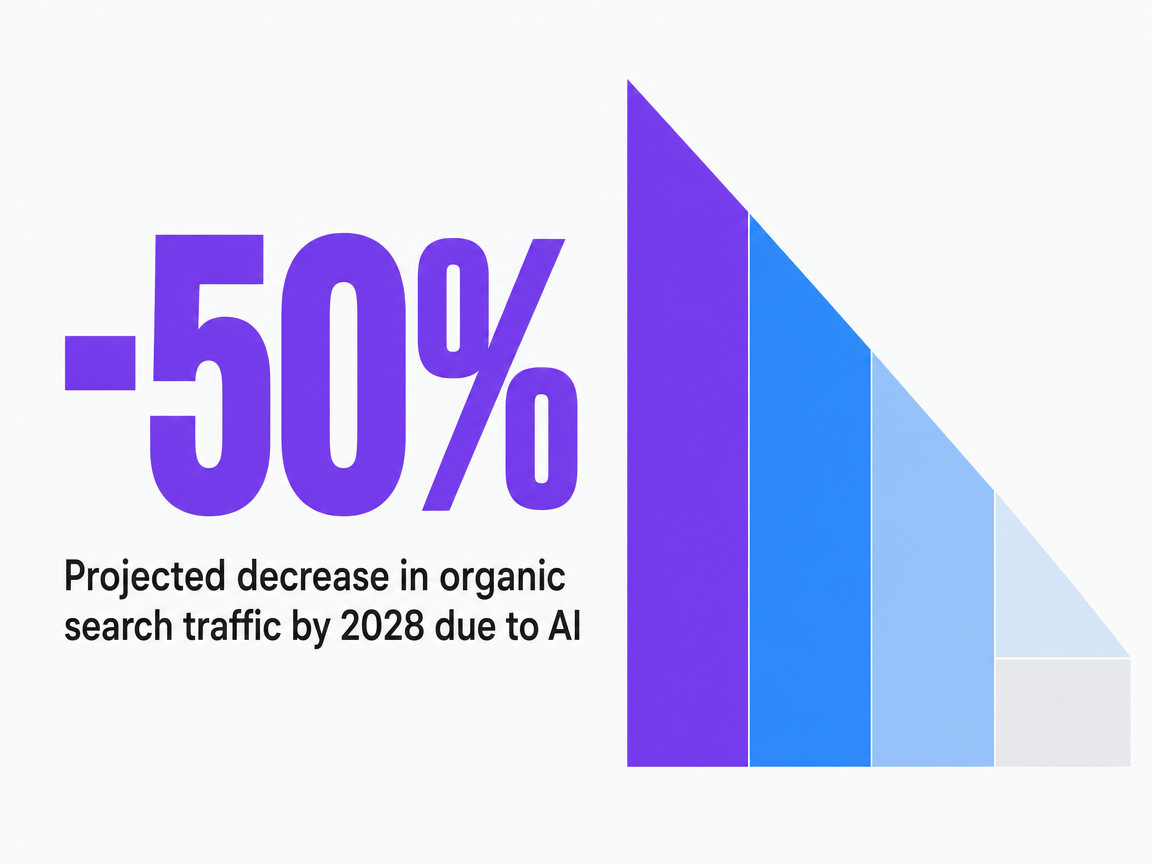 Projected decrease in organic search traffic by 2028 due to AI
Projected decrease in organic search traffic by 2028 due to AI
References
- 1.TOPIC CLUSTERS.
- 2.How to use topic clusters and pillar pages for SEO.
- 3.General Guidelines.
- 4.Search Quality Rater Guidelines: An Overview.
- 5.Google Search Quality Rater Guidelines.
- 6.The state of AI in early 2024: Gen AI adoption ....
- 7.KI im Marketing | McKinsey.
- 8.Gartner: 20% of brands to go 'acoustic' amid rising ....
- 9.B2B SEO + Content Engine Benchmarks 2024.
- 10.AI Content Production Benchmarks B2B 2024.
- 11.SEO and Content Strategy: A Framework for Building Searchable ....
- 12.How Google's AI Overviews Change SEO Strategy for ....