
Key Takeaways
- Research and brief generation kills the blank-page tax by consolidating SERP structure, questions, and entities into a spec, though briefs risk regressing to the topical middle without a unique angle.
- Outline builders convert research into a defensible structure with sequence and hierarchy, but managers must enforce structural deviation to avoid every piece following the same SERP-derived skeleton.
- Long-form drafting assistants delivered 40% faster completion and 18% higher quality in the MIT study 5, yet voice collapse and factual drift require brand-voice references and human review.
- On-page optimization software replaces manual SERP audits with topical scoring, but capping the target grade prevents score chasing that produces comprehensive-but-flat pages indistinguishable from competitors.
- Editing and fact-check layers catch hallucinated citations and factual drift documented in AI writing research 6, though detector output is never final and every numeric or sourced claim needs human sign-off.
- Governance and provenance records covering model, version, timestamp, and reviewer 3let managers answer which drafts came from which model when quality shifts, and should not be skipped.
- Orchestration platforms route work between the other six layers and gate publication on recorded approvals, removing the coordination tax that turns managers into ticket dispatchers.
- Portfolio operators running dozens of sub-sites face multiplied per-seat and per-domain costs across every layer, making consolidated orchestration math worth checking against active seat counts.
The lean content team squeeze in 2025
Content demand is climbing faster than headcount budgets. Deloitte Digital's research on generative AI and content production reports a 54% increase in the volume of content needed over the past year, while generative AI users save an average of 11.4 hours per week that can be redirected to higher-value work 7. These figures reflect self-reported time savings across mixed content types rather than a controlled experiment on SEO output specifically, but the trend is consistent across analyst coverage.
For an in-house content marketing manager running a team of one to four people, this gap defines the year. Organic pipeline targets keep expanding, and editorial calendars have doubled, but freelance budgets have not. The temptation is to buy a general AI writer and call it a stack.
This shortcut often fails on two fronts. Search performance suffers when drafts skip topical research and human review, and brand voice erodes when every layer of the workflow runs on the same generic model. Forrester's 2025 assessment of generative AI inside U.S. marketing agencies documents a similar pattern: agencies are restructuring around AI-assisted execution rather than replacing craft entirely 4.
The more useful question is not which writing app to buy, but which capability layers a lean team actually needs, and which ones can be skipped without breaking the brief-to-publish cycle.
Seven capability layers, not ten interchangeable apps
Most "best SEO writing tools" roundups collapse into a flat list of drafting apps that largely perform similar functions. This framing obscures the actual bottlenecks in a lean team's workflow. The brief-to-publish cycle is not a single task; it comprises seven distinct jobs, each with its own software category and potential failure mode.
The seven layers a small content team touches weekly include:
- research and brief generation
- outline building
- long-form drafting
- on-page optimization
- editing and fact-checking
- governance and provenance
- orchestration across the full approval workflow
A manager can staff each layer with a dedicated tool, combine two or three into a single platform, or skip a layer entirely and absorb the cost as editorial rework.
The remainder of this article examines each layer sequentially. Each section identifies the category, quantifies the time it saves using research rather than vendor claims, and highlights the critical failure mode that can quietly damage search performance if the layer is neglected.
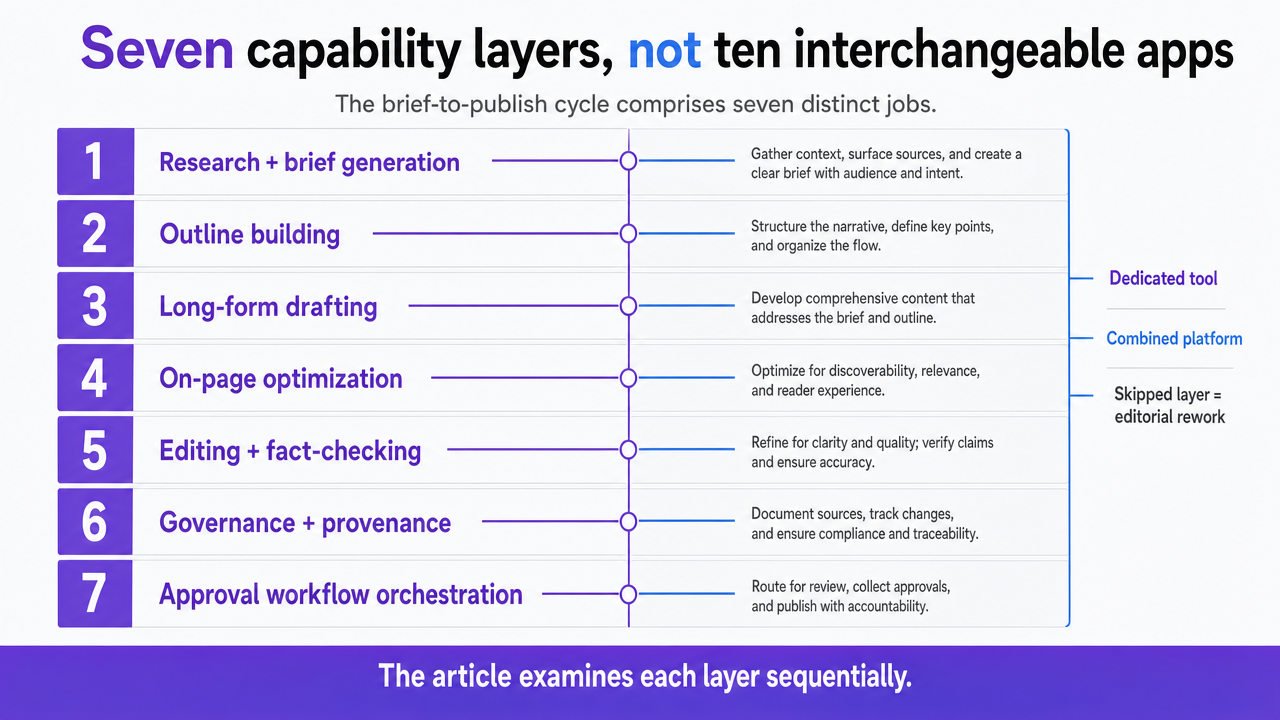 Visualize the seven distinct capability layers in the brief-to-publish workflow that structure the entire article
Research and brief generation: killing the blank-page tax
Every draft that starts from a blank Google Doc incurs a hidden tax. A writer typically spends time skimming top SERP results, copying competitor H2s, checking People Also Ask, and only then begins outlining. For a two-person team publishing three long-form pieces a week, this pre-work can consume a full day of capacity before any writing begins.
Research and brief generation software streamlines this step. This category includes SERP analyzers, question-mining tools, entity extractors, and brief builders that consolidate competitor structure, related queries, semantic terms, and internal link candidates into a single document. The output is a specification for the writer, not a draft.
A scoping review of generative AI in writing workflows found that the clearest, most consistent gains appear in organization and planning stages rather than in final prose quality 6. While this review synthesized studies of academic writers, the pattern holds: AI excels at retrieval, structuring, and comparison, which are central to brief generation.
The failure mode of this layer is briefs that resemble averaged competitor summaries. When inputs are solely derived from the current top ten results, the output tends to regress toward the topical middle, lacking distinctiveness. Managers should require every generated brief to include at least one unique angle, data point, or original argument not already present in the SERP. The software should serve as a floor for topical coverage, not a ceiling for editorial ambition.
Outline builders: turning SERP data into a defensible structure
An outline is where a piece either establishes its value or commits to mediocrity. Research provides raw material; the outline dictates its arrangement. Outline builders bridge these two stages, converting entity lists, competitor headings, and question clusters into a structured argument for the writer.
While overlapping with brief generators, outline building is a distinct task. A brief defines topic coverage, whereas an outline establishes sequence, hierarchy, and point of view. Modern outline tools score candidate H2 and H3 structures against SERP topical models, suggest optimal ordering for user intent, and flag missing subtopics found in competing pages. Some even integrate schema recommendations and internal link targets at this early stage.
The productivity benefits of structured planning are well-established. The scoping review of generative AI in writing tasks concluded that AI gains are concentrated in organization and fluency work 6. Outlining, by definition, is organizational work, which is why this layer often delivers disproportionate time savings relative to its cost.
The failure mode is outline convergence. If every piece on a topic follows the same SERP-derived skeleton, ranking becomes a race based on domain authority rather than depth. Managers should treat generated outlines as starting drafts, then enforce at least one structural deviation per piece: a reordered section, an added counterargument, or a subtopic the top ten omitted.
Test SEO content workflows with live publishing
Evaluate real-time production speed and SEO impact before making a commitment.
Long-form drafting assistants: where the productivity math lives
Drafting is the layer most content managers associate with "SEO content writing software." It is also where productivity numbers are most concrete yet often misunderstood. A 2023 MIT experimental study by Noy and Zhang assigned professional writing tasks to mid-level knowledge workers, half with access to ChatGPT and half without. The AI-assisted group finished tasks 40% faster and produced output that blinded evaluators scored 18% higher on quality 5. Gains were largest for lower-ability writers, who caught up to stronger peers.
Two important caveats for content managers: the tasks were short professional writing exercises (e.g., press releases), not 2,000-word SEO pillar pages with citations and internal linking. Also, "quality" was evaluated on clarity and coherence, not search performance or brand-voice fidelity. The study demonstrates AI's ability to compress drafting time for well-defined tasks, but not its capacity to independently ship publish-ready long-form content.
This category includes long-context drafting assistants designed for marketing copy. These tools ingest a brief and outline, maintain the full document in working memory, and generate section-by-section prose following the outline's hierarchy. Advanced versions accept brand-voice samples, style rules, and forbidden-phrase lists as constraints. Less sophisticated tools produce generic, hedged prose that Google's helpful-content signals are designed to filter.
The failure mode is voice collapse. When multiple writers use the same assistant with default prompts, their pieces converge on a shared cadence that surface editing cannot fully remove. Managers should require every drafting session to load a brand-voice reference document and a rejected-phrase list before generation, treating raw output as a first draft. The scoping review of generative AI in writing found that while efficiency gains are real, overreliance on unedited output correlates with fluency-without-substance and factual drift 6.
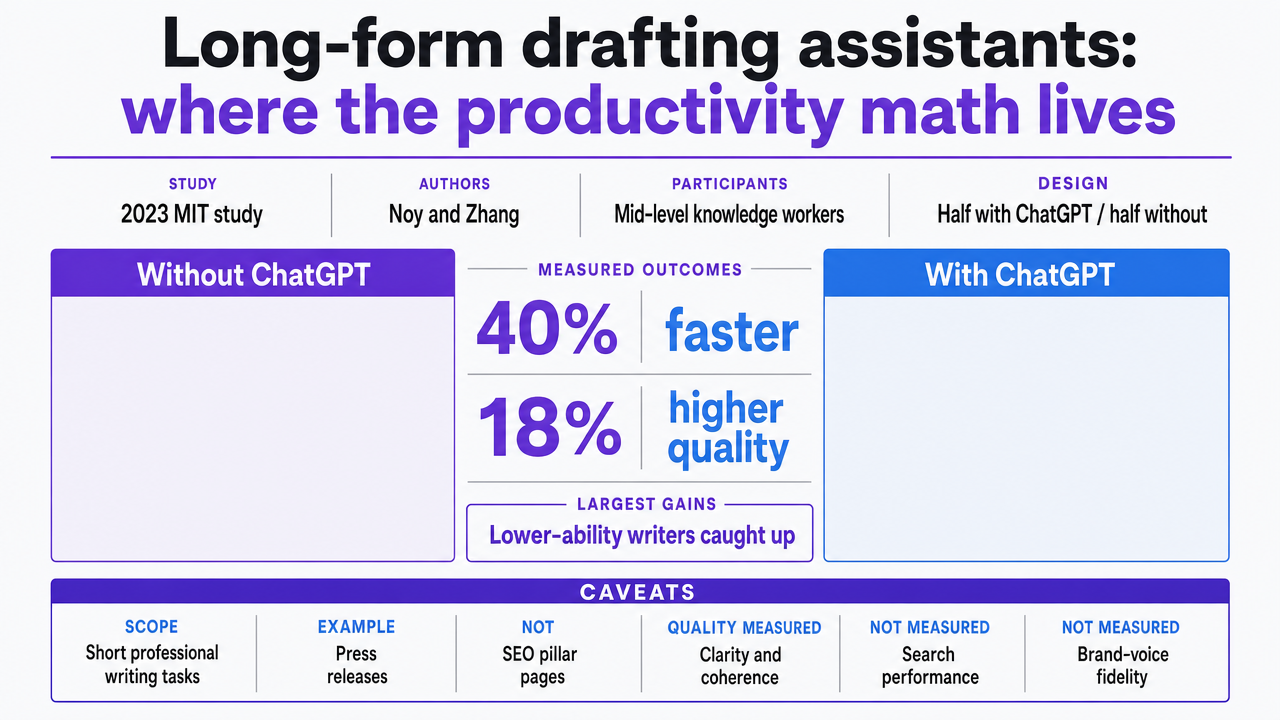 Show the MIT study's measured productivity gains from ChatGPT-assisted professional writing, which is the core quantitative claim of this section
On-page optimization software: from keyword lists to topical coverage
Optimization software is where the "SEO" in "SEO content writing software" truly resides. This category has evolved beyond simple keyword density counters. Modern optimizers score drafts against a topical model derived from current top results, identify missing entities and subtopics, highlight question coverage gaps, and estimate content grades that loosely correlate with ranking probability. Some integrate directly into drafting interfaces, providing live scores as prose develops.
The economic case for this layer is strong. McKinsey's analysis of generative AI's economic potential estimates it could increase marketing productivity by 5% to 15% of total marketing spend 8. This macro model suggests the potential contribution of disciplined AI-assisted optimization, but a lean team should view it as a ceiling, not a guaranteed lift on a single page.
What optimizers remove from a manager's week is the manual SERP audit. Instead of a writer or editor manually checking ten competing pages for entity coverage, related questions, and internal link candidates, the software provides a diffed list in seconds. For a weekly cadence of three to five long-form pieces, this saves several hours of senior editorial time, redirecting it toward angle development and internal linking strategy.
The failure mode is score chasing. While optimizers reward topical completeness, writers who optimize purely to the score produce comprehensive-but-flat pages that resemble every other top-ten result. Managers should cap the target grade at a threshold indicating topical parity, not maximum score, and require each piece to include at least one section not suggested by the optimizer. The score is a floor check; ranking still depends on the argument, evidence, and internal link graph.
Editing and fact-check layers: the mandatory human checkpoint
Every preceding layer produces text; this layer determines its publishability. Editing and fact-check software includes grammar and style engines, plagiarism scanners, citation verifiers, and AI-output detectors that flag hallucinated statistics, fabricated quotes, and passages deviating from a brief's factual claims. This category has rapidly expanded to keep pace with drafting assistants, and lean teams that skip it inherit significant risk.
The scoping review of generative AI in writing catalogs specific failure modes:
- plagiarism from training-data echoes
- hallucinated citations
- factual drift on numerical claims
- overreliance on fluent-sounding but unsupported prose 6
While this review focused on academic writers, the failure categories are transferable. An AI drafting assistant that invents a plausible-looking statistic in an academic paper will do the same in a pillar page.
This layer removes the line-by-line source checking that senior editors would otherwise perform on every AI-assisted draft. A modern fact-check pass identifies unverifiable claims, mismatched citations, and high-probability AI output in minutes. The human editor then adjudicates these flags rather than spending hours hunting for them.
The failure mode of this layer is treating software output as the final verdict. Detectors can produce false positives on well-edited human prose and false negatives on AI text run through a paraphraser. The critical rule: a person must sign off on every claim tied to a number, name, or source, and this sign-off must be recorded before publication.
See How Leading Teams Accelerate SEO Content Production—Without Adding Headcount
Request a demo to benchmark your current workflow against AI-powered content execution built for agencies and enterprise brands operating at scale.
Governance and provenance: treating AI content like regulated output
Every layer discussed so far assumes content will be published. Governance is the layer that tracks who approved what, which model produced it, and whether the record can be reconstructed if a claim is challenged. Lean teams often skip this because it's not yet explicitly requested, but standards bodies are already addressing it.
NIST's synthetic content transparency report identifies provenance tracking, labeling, and watermarking as core methods for authenticating machine-generated output 1. The accompanying draft specifies that digital watermarking, metadata recording, and origin history should travel with the artifact 2. NIST's comment document details minimum provenance record requirements: model name, version, generation timestamp, and optional fields for unique IDs and training-data references 3. While these documents address broader synthetic media, the record structure applies cleanly to editorial workflows.
For a content manager, this means every AI-assisted piece should carry a governance record detailing the model used, the human reviewer, the approval timestamp, and the prompt or brief version that produced the draft. This record doesn't need to be public, but it must be retrievable. Governance platforms in this category range from lightweight metadata plugins for CMS integration to full approval systems that gate publication on recorded sign-offs.
The failure mode is treating provenance as a compliance checkbox rather than an editorial tool. A team that logs model and reviewer for each piece can answer critical questions: which drafts came from which model version, and did quality shift when the model changed? Skipping this layer leaves such questions unanswered.
Orchestration and approval workflow: the seventh layer
What orchestration platforms actually do
While the first six layers address individual tasks, orchestration solves the complexity that arises when all six are simultaneously active. A manager coordinating a brief tool, drafting assistant, optimizer, fact-checker, governance log, and CMS across multiple writers and reviewers becomes a dispatcher of tickets rather than an editor.
Orchestration platforms route work between the other six layers, manage the approval status of every piece, and ensure no draft ships without a recorded sign-off. This category spans from lightweight editorial project managers with AI integrations to comprehensive execution platforms that ingest business signals, prioritize topics, generate briefs, coordinate drafting and optimization, and gate publication on human approval. Examples include Narrato and StoryChief for lighter needs, and Vectoron for a more comprehensive solution, coordinating specialist strategists across content, SEO, and other channels through a single approval queue.
This layer removes the coordination tax from a manager's week. Forrester's 2025 assessment of generative AI in U.S. marketing agencies notes a similar restructuring on the vendor side: agencies are collapsing handoff steps rather than replacing craft 4. The failure mode is orchestration without gates; automation that publishes without a recorded human decision reintroduces every risk the fact-check and governance layers are designed to prevent.
If you manage multiple locations or brands: stack math for consolidation
This subsection is for content managers overseeing portfolios rather than single sites, such as DSOs with 40 practice pages, home services franchises with 120 location landers, multi-office law firms, or senior living operators coordinating brand and property-level content. The math changes when the seven capability layers are multiplied across 20 or 200 sub-sites.
A point-tool stack, effective for a single-brand team, quickly becomes expensive at portfolio scale. Most SaaS in this category charges per seat, per project, or per tracked domain. Licensing a brief tool, drafting assistant, optimizer, fact-checker, governance plugin, and orchestration layer separately across a portfolio results in a subscription line item for every layer multiplied by every operating unit. McKinsey's estimate that generative AI could capture 75% of its value in functions like marketing, sales, and customer operations depends explicitly on redeploying freed hours rather than layering tool costs on top of existing spend 9. Stack sprawl is the mechanism that consumes this potential redeployment.
| Capability layer | Typical standalone tools | Seat/subscription pattern | Consolidation benefit |
|---|---|---|---|
| Research and brief | SERP analyzer + brief builder | Per seat, per project | One brief spec across locations |
| Drafting | Long-form AI writer | Per seat, per word | Shared brand-voice profile |
| Optimization | Content grader + CMS plugin | Per tracked page or domain | Portfolio-wide scoring |
| Editing and fact-check | Grammar engine + AI detector | Per seat | Uniform review rules |
| Governance and provenance | Metadata plugin + approval log | Per site or per user | Single audit trail |
| Orchestration | Editorial PM tool | Per seat, per workspace | One approval queue |
Consolidated orchestration platforms collapse these line items into a single seat cost. Vectoron, for example, publishes a post-trial price of $599 per month for its full platform, which covers the orchestration layer and the specialist strategists that feed the layers above it. Whether this math beats a point-tool stack depends on the portfolio's current subscription count and seat spread, not on any single vendor claim. Portfolio managers should count active seats across all six point layers before comparing.
Assembling a lean stack without buying every layer
Seven layers do not necessitate seven purchase orders. Most one-to-four-person content teams already possess two or three of these capabilities under different labels. The fastest way to increase output is often to address missing gaps rather than replace working components.
A practical assembly rule: start by investing in the layer that consumes the most senior editorial time each week. For most in-house teams, this is typically optimization or fact-checking, not drafting. Drafting assistants garner significant attention due to their prominent productivity claims, but the MIT results only quantified short-form task time, not full pillar-page throughput 5. The actual bottleneck a manager experiences is usually earlier in the week, during brief work, or later, during review and sign-off.
Three viable stack configurations exist for lean teams:
- A point-tool stack pairs best-of-breed apps at each layer, suitable for teams with strong operational discipline and a preference for component swapping.
- A hybrid stack uses a drafting-and-optimization suite for middle layers and dedicated tools for governance and orchestration.
- A consolidated stack, like Vectoron, collapses most layers into a single approval-driven platform, ideal for managers who spend more time dispatching than editing.
McKinsey's estimate that generative AI can optimize page layouts, ad copy, and SEO strategies through structured testing assumes the stack supports experimentation, not just generation 10. Regardless of the chosen configuration, the governance layer should never be skipped. All other layers can be deferred.
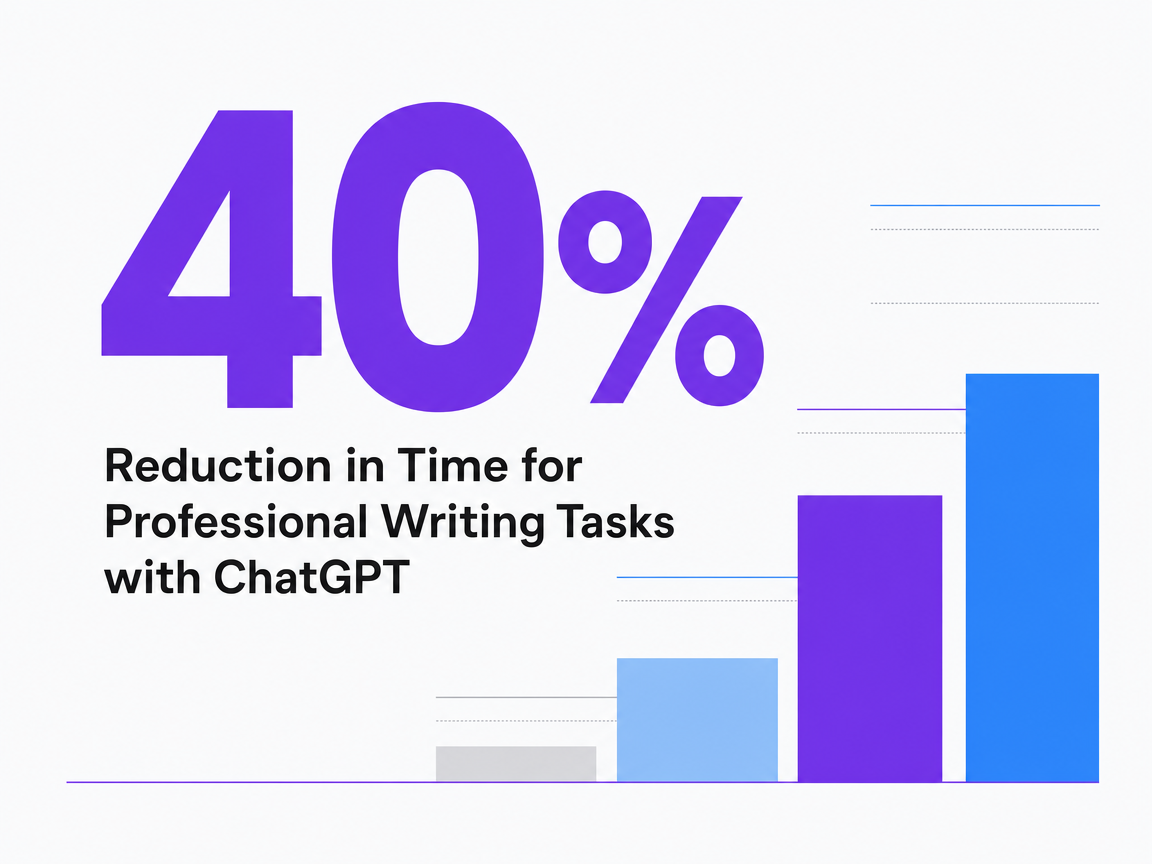 Reduction in Time for Professional Writing Tasks with ChatGPT
Reduction in Time for Professional Writing Tasks with ChatGPT
Frequently Asked Questions
References
- 1.Reducing Risks Posed by Synthetic Content: An Overview of Technical Approaches to Digital Content Transparency.
- 2.Reducing Risks Posed by Synthetic Content.
- 3.NIST Request for Comments on Draft Documents Responsive to NIST's Assignments under.
- 4.The State Of Generative AI Inside US Marketing Agencies, 2025.
- 5.Experimental Evidence on the Productivity Effects of Generative Artificial Intelligence.
- 6.Generative Artificial Intelligence (GenAI) for Academic Writing: A Scoping Review.
- 7.Deloitte Digital's latest research forecasts generative AI's transformation of content production.
- 8.Economic potential of generative AI.
- 9.How generative AI can boost consumer marketing.
- 10.Marketing and sales soar with generative AI.