
Key Takeaways
- Scaling SEO output is a production-system problem, not a writing problem; the real bottleneck sits in coordination, review queues, and briefs rather than drafting speed itself.
- Controlled research shows AI assistance cuts drafting time by 40% and lifts quality 18%, but gains concentrate at the drafting stage and among less-experienced writers 9, 10.
- Keep strategic selection, original research, expert review, claim substantiation, and measurement human-owned; use AI for drafting, revision passes, and ideation, backed by a claims register and NIST-aligned oversight 6, 3.
- Deploy AI first with junior and freelance contributors where quality variance is widest, then roll out AI-assisted revision across the bench, and reserve ideation support for senior strategists.
The production-system reframe behind scaled SEO
Content marketing managers under pressure to double or triple output are discovering that the bottleneck is rarely writing speed. It is coordination: briefs circulating in Slack, drafts stuck in review queues, SMEs who owe comments, legal flags surfacing a week before publish. Hiring another writer compresses one stage of a pipeline that has five.
The shift worth paying attention to is not that AI drafts have gotten better. It is that enough organizations now use these tools in production that the baseline assumption of a content operation has changed. Stanford's 2025 AI Index reports that 78% of surveyed organizations used AI in at least one business function in 2024, up from 55% in 2023, with generative AI use jumping from 33% to 71% over the same window 1. Marketing strategy and content support rank among the most common applications.
That adoption curve is doing two things at once. It is giving CMOs permission to ask for more output from the same editorial headcount, and it is making "we use AI" a non-differentiator. What separates teams who scale from teams who publish faster versions of mediocre pages is how they redesign the pipeline around that assumption.
Treating SEO creation as a writing problem leads to tool shopping. Treating it as a production-system problem leads to a different question: which stages of the lifecycle — research, drafting, review, publishing, measurement — benefit from machine throughput, and which stages still need human judgment to defend search performance, factual accuracy, and legal exposure. The sections that follow work through that mapping, starting with what the controlled evidence actually says about where the speed gains are real.
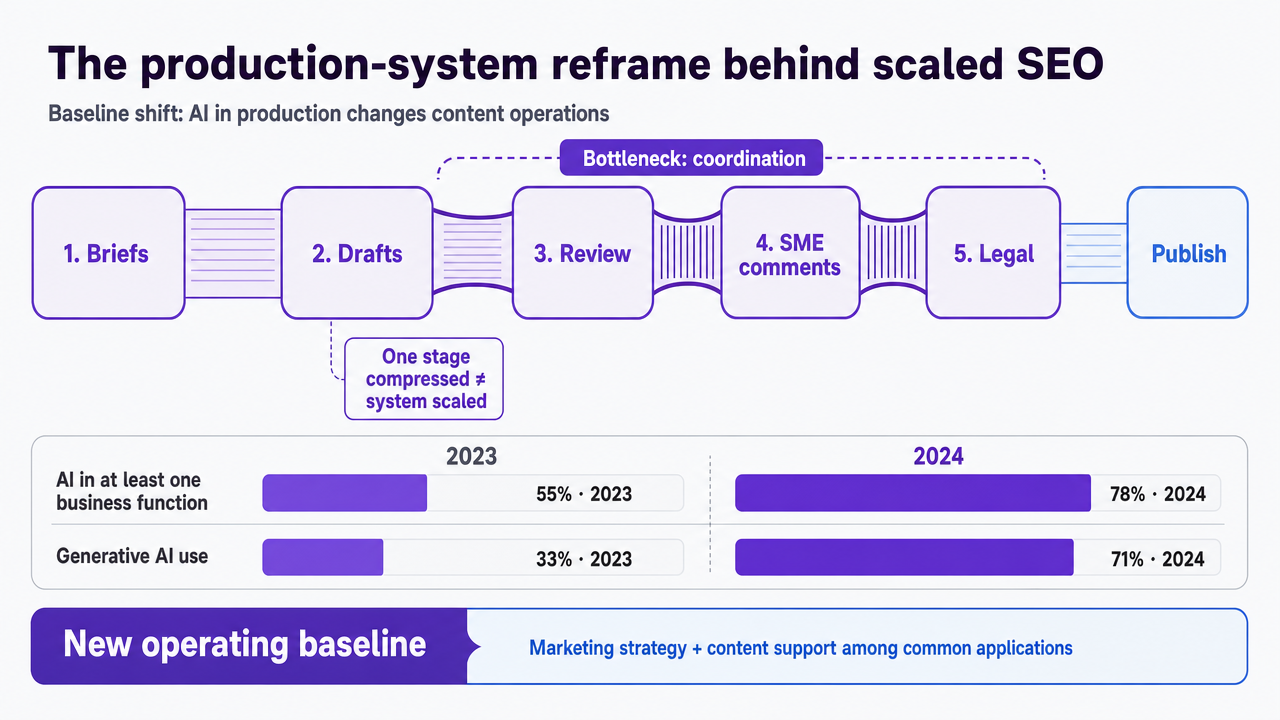 Anchor the section's claim about organizational AI adoption shifting the baseline for content operations, using the exact 2023 vs 2024 figures cited in the prose
What the controlled evidence actually says about AI writing speed
The most-cited productivity figure in AI content discussions comes from a single preregistered experiment, and content leaders who want to defend an operating budget should know its exact shape. Shakked Noy and Whitney Zhang, writing in Science, assigned occupation-specific writing tasks — press releases, short reports, analysis plans, sensitive emails — to 453 college-educated professionals, then randomly gave half of them access to ChatGPT. The treatment group finished tasks 40% faster, and blind graders scored their output 18% higher on quality 9.
That 40%/18% pairing is the number worth anchoring internal projections to, because it was measured under conditions a vendor pitch rarely matches: incentivized participants, bounded tasks completed in roughly 20 to 30 minutes, graders who could not see which drafts came from which condition. It is a clean read on where AI assistance helps a single professional complete a single piece of writing. It is not a read on whether a 2,500-word pillar page will rank, whether a regulated-industry claim will survive legal review, or whether an entire editorial calendar can be compressed by the same proportion.
The working-paper version of the study adds a second finding that matters more for staffing decisions than the headline numbers. Quality gains were concentrated among workers with weaker initial skills; stronger writers mostly got faster rather than better 10. For an editorial lead managing a bench of mixed experience — a senior strategist, two mid-level writers, a junior associate, a rotating cast of freelancers — that pattern argues for deploying AI assistance earliest where quality variance is highest, not where senior writers already produce clean copy.
Two caveats belong in the same breath as the numbers. The tasks studied were self-contained writing exercises, not the full SEO lifecycle of keyword selection, original research, source verification, internal linking, publishing, and iterative updating. And the experiment measured drafting output under supervision, not autonomous publishing. Any projection that extrapolates 40% time savings across an entire content operation is reading the study for more than it says.
What the evidence does support is narrower and still useful: a content team can reasonably expect meaningful compression at the drafting stage, with the largest quality lift accruing to less-experienced contributors, provided a human remains accountable for the stages the experiment did not measure. That boundary — where the controlled gains stop and the production system takes over — is where the next section begins.
Mapping AI and human accountability across the SEO lifecycle
Research and strategic selection: where humans still decide what gets written
The first stage of the pipeline is also the one most resistant to automation, and the reason is strategic rather than technical. Keyword research tools can surface thousands of queries, cluster them by topical overlap, and estimate difficulty. What they cannot do is decide which cluster is worth a quarter of an editorial team's capacity, which competitor's ranking page is defensible to attack, or which internal subject-matter expert can supply the original data that makes a page worth linking to.
Strategic selection is where in-house marketing managers earn their keep. A cluster that looks attractive on volume may be dominated by publishers whose brand authority took a decade to build. A low-volume query may map directly to a product line that generates most of the pipeline. Those judgments draw on commercial context — margin per customer, sales cycle length, which pages the sales team actually sends — that lives in the heads of the people running the content function, not in a scraped SERP.
Original research sits in the same category. Primary data, proprietary benchmarks, customer interview quotes, and SME commentary are the raw materials that distinguish a ranking page from a passable one. AI assistance can draft the questions, summarize transcripts, and surface patterns across a dataset. The decision about what to investigate, whom to interview, and what counts as a defensible finding stays with the humans who will answer for the claim if it is wrong. The research stage is where the pipeline sets its ceiling; nothing downstream fixes a weak premise.
Drafting and ideation: the stage where throughput gains are real
Drafting is the stage where the controlled-study numbers from the prior section actually apply. A writer given a sharp brief, a vetted outline, and access to source material can produce a first draft substantially faster with AI assistance than without it. The Noy and Zhang experiment measured this directly on bounded professional writing tasks, and the pattern — faster completion, modestly higher assessed quality — is the shape editorial leads should expect at this stage.
Ideation benefits in a different way. AI assistance is useful for generating angle variations, headline options, section-break alternatives, and counterargument stress tests that a solo writer would otherwise spend an hour producing. The gain is less about speed per word and more about the breadth of options a writer can evaluate before committing to a direction. Writers who treat the model as a brainstorming partner report fewer stuck starts; writers who treat it as a ghostwriter produce drafts that review teams flag for sameness.
The operational implication is that drafting throughput can rise without compromising quality only when the stages around it hold. A faster draft on a shaky brief produces a faster shaky page. Editorial leads scaling this stage should expect to reinvest some of the recovered hours into tighter briefs and sharper outlines, because those inputs become the governing constraint once drafting is no longer the slow step. Capacity gained at the keyboard is spent upstream, on the thinking that makes the keyboard worth using.
Review and revision: AI as a feedback layer, not a replacement author
The most defensible place to put AI in the review stage is as a feedback layer that runs before human review, not as a substitute for it. A randomized controlled trial of 259 undergraduate writers found that AI-generated feedback produced a statistically significant improvement in overall writing scores, with a difference-in-differences estimate of β = 0.149 (SE 0.044, p < 0.001) 8. The population was students, not commercial editors, which is why the finding supports a specific operational position rather than a sweeping claim: AI commentary catches structural, clarity, and consistency issues reliably enough to be worth running on every draft before it reaches a senior editor.
That positioning changes what a review queue looks like. Instead of a senior editor spending the first pass on sentence-level fixes, the AI layer surfaces them; the human pass concentrates on claims, evidence, voice, and strategic fit — the parts of the review that determine whether the page is worth publishing. For teams running 50 to 100 pages a month, the compounding effect of pulling mechanical edits out of the human queue is where real capacity shows up.
The stage-by-stage ownership map that emerges from this is worth stating plainly:
- Keyword research and strategic selection stay human-led.
- Outlining is co-owned.
- Drafting is AI-accelerated with human direction.
- Revision runs AI-first, human-final.
- Expert review, factual accuracy, and claim substantiation stay human-owned.
- Optimization is co-owned.
- Publishing and measurement stay human-owned.
That map is the operating model the rest of the article builds on.
Publishing and measurement: the stages that still determine search performance
Publishing is deceptively mechanical. Schema markup, canonical tags, internal linking decisions, image optimization, and the choice of which existing pages to update versus which new pages to create all shape whether a draft actually earns traffic. These decisions depend on knowing the state of the site — which URLs are already ranking for adjacent queries, which clusters are cannibalizing each other, which pages have decayed and need a refresh instead of a replacement. That institutional context sits with the humans running the site.
Measurement is where the pipeline closes the loop or fails to. Rankings, organic sessions, assisted conversions, and pipeline attribution tell the editorial lead which clusters are earning their production cost and which are not. AI assistance can summarize analytics output and flag anomalies; it cannot decide whether a cluster underperforming on volume is still worth defending because it converts at three times the site average. That judgment feeds back into strategic selection at the top of the pipeline, which is why measurement is a human-owned stage even when the dashboards are automated. A production system without a measurement loop produces faster pages, not better ones.
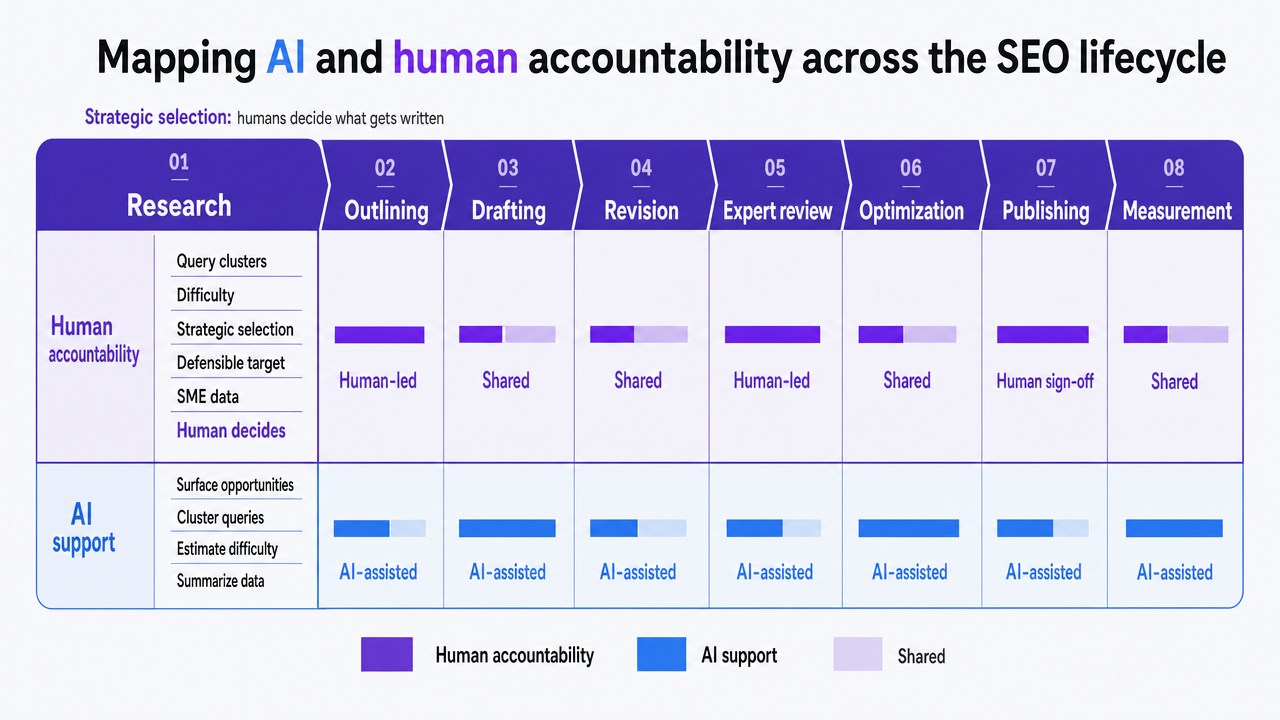 Visualize the stage-by-stage ownership map the section explicitly lays out (research, outlining, drafting, revision, expert review, optimization, publishing, measurement) with human vs AI accountability
Test AI-driven SEO content workflows yourself now
Experience faster SEO content delivery and measure real performance impact in your own environment.
Governance obligations that scaled publishing creates
Hallucinations, oversight, and the NIST generative AI profile
Scaling drafting throughput multiplies the number of factual assertions moving through the pipeline each week, which is where hallucination risk becomes an operational concern rather than a theoretical one. A model that fabricates a statute, misattributes a quote, or invents a statistic once in fifty drafts produces a different exposure profile at 20 pages a month than at 100.
NIST's Generative AI Profile frames this as a lifecycle problem rather than a prompt problem. The profile recommends identifying, measuring, and managing risks across design, development, deployment, and evaluation, with explicit attention to confabulation, intellectual property leakage, privacy, harmful bias, and human oversight 6. For a content operation, that translates into named owners for each risk category and documented checkpoints where a human verifies a specific class of claim before publish.
The practical shape most editorial teams land on is a tiered review model. Low-risk pages — top-of-funnel explainers with no regulated claims — move through AI-first revision and a single editor pass. Pages that touch regulated verticals, cite statistics, name third parties, or make performance claims route to a second reviewer with subject-matter authority. The profile does not prescribe that split, but it supplies the vocabulary and governance scaffolding to defend the split internally when a VP asks why review cost did not fall proportionally with drafting cost.
Claims and substantiation under FTC scrutiny
The FTC's advertising guidance predates generative AI and applies to it without modification: claims must be truthful, non-deceptive, and supported by solid proof 3. What changes at scale is the volume of claims a content operation puts into the market each month, and the probability that an unverified assertion slips through when drafting is faster than verification.
The Commission has also signaled active interest in AI-specific claims. In 2023 it authorized compulsory process for investigations involving AI-related products and services, broadening the enforcement surface for performance, automation, and capability claims 2. For in-house teams, the implication cuts two directions. Claims the brand makes about its own products — guaranteed outcomes, comparative performance, testimonials, before-and-after results — need the same substantiation file whether a human or an AI drafted the sentence. Claims the brand makes about AI itself — "human-level quality," "fully automated," "indistinguishable from human writers" — attract their own scrutiny and should be narrowed to measurable, bounded statements.
The operational response is a claims register maintained alongside the editorial calendar. Each performance statistic, customer quote, comparative statement, and regulated claim links to a source document, a date, and a reviewer initial. Pages do not leave the review stage without the register filled in. That discipline costs editorial hours; it costs less than a consent decree or a correction cycle across a few hundred published URLs.
Authorship, ownership, and reuse rights for AI-assisted pages
Teams planning to syndicate, license, or repurpose their content library have a separate reason to care about how AI assistance is documented. The U.S. Copyright Office's Part 2 report, released in January 2025, concludes that AI-assisted outputs may receive copyright protection where a human author determines sufficient expressive elements, but that the mere provision of prompts is generally not enough on its own 5. The Office's companion newsletter restates the point directly: AI assistance or inclusion of AI-generated material in a larger human-authored work does not automatically bar copyrightability, provided human expressive contribution is present 7.
For a content operation, that guidance argues for process documentation that would already exist in a well-run editorial pipeline: outlines authored by named strategists, source selection logged, revision history preserved, substantive editorial changes attributable to a human editor. The record that defends copyrightability is the same record that defends editorial quality.
The reuse case is where this matters commercially. Pages a team expects to turn into gated reports, syndicated columns, sales enablement decks, or paid licensing deals need defensible authorship. Pages that will only ever sit on the site have lower stakes, but the pipeline cost of maintaining the documentation is marginal once the workflow exists.
Where to deploy AI first in a team of mixed experience
The staffing question most editorial leads actually face is not whether to adopt AI assistance but which seats on the bench benefit first. The working-paper version of Noy and Zhang's experiment answers that directly: quality improvements concentrated among participants with weaker initial skills, while stronger writers mostly completed tasks faster rather than producing meaningfully better output 10. That asymmetry has specific implications for how an editorial lead sequences rollout.
The highest-leverage first deployment is at the junior and freelance tier, where quality variance is widest and review cost is highest. A junior associate drafting a product-category page with AI assistance plus a structured outline tends to produce copy closer to the senior bar on first pass, which collapses the back-and-forth cycle that consumes editor hours. The gain shows up in the review queue, not in the draft itself.
Senior strategists are the second priority, deployed differently. For experienced writers, AI assistance pays off at the ideation and revision stages rather than the first draft — angle generation, structural stress tests, counterargument checks, and pre-edit cleanup. Pushing senior writers to draft with AI tends to flatten the voice that made them senior in the first place.
The sequence worth running:
- AI-assisted drafting for junior and freelance contributors first
- AI-assisted revision across the full bench second
- AI-assisted ideation for senior strategists third
Rollouts that invert this order spend capacity where the evidence shows the least quality return.
Cut Content Bottlenecks: Deploy AI-Driven SEO Creation at Scale
See how leading teams accelerate SEO content output with unified workflows, AI-powered approvals, and measurable results—without expanding writer headcount or losing editorial control.
Economics of a stage-restructured pipeline for portfolio operators
This section shifts scope from a single in-house team to the operators running content across multiple brands, locations, or practice groups — franchise marketing leads, DSO and MSO content heads, multi-brand agency directors managing a shared editorial function across ten or more sites. The pipeline math changes at that scale, because fixed costs spread across more pages and because inconsistency between locations becomes its own liability.
The model worth running is a stage-cost comparison rather than a per-article price. In a traditional pipeline, drafting typically consumes the largest share of fully-loaded cost per page: writer hours plus the editor hours spent fixing structural and clarity issues that an AI feedback pass would catch earlier. In a stage-restructured pipeline, drafting hours fall — the Noy and Zhang experiment measured a 40% reduction in task completion time under controlled conditions 9 — and the recovered hours migrate upstream into tighter briefs and downstream into expert review, claim substantiation, and site-state decisions about which existing pages to update versus which new pages to create.
For a portfolio operator publishing 80 pages a month across 15 locations, that migration matters more than it does for a single-site team. The failure mode at scale is not undercapacity; it is 15 location pages that look like 15 variations of the same template, none of them earning local authority. Capacity recovered from drafting is best spent on the location-specific inputs — proprietary data from each market, named practitioners, local case references — that make a page defensible to rank. A stage-restructured pipeline that shifts cost from drafting to research and review tends to produce fewer but more distinctive pages per location, which is the shape that compounds in local organic performance.
The variables worth modeling internally are the ones already visible in the operator's own system:
- current fully-loaded cost per published page
- current average review cycle time
- current pages published per location per month
- the share of editor hours currently spent on mechanical versus substantive edits
Applying the 40% drafting-time benchmark 9 as an upper bound on the drafting line, and reinvesting the recovered hours proportionally into research and review, produces a defensible internal projection without inventing a vendor ROI number. The output of that exercise is usually not a lower total cost per page; it is a comparable cost per page with a higher share going to the stages that determine whether the page ranks.
The new editorial org chart
The restructured pipeline produces a different staffing shape, not a smaller one. Writer headcount tends to hold steady or shift in composition; what changes is where those seats sit in the workflow. Senior strategists move upstream into brief authoring, cluster selection, and SME coordination, because tighter inputs now govern the output quality of every downstream draft. Mid-level writers absorb more pages per cycle at the drafting stage, operating from sharper briefs with AI assistance. Junior and freelance contributors produce closer to the senior bar on first pass, which collapses editor cycles.
Two roles tend to appear that did not exist in the pre-restructure org:
- A review-stage owner responsible for the AI-first revision pass, the claims register, and the governance checkpoints the NIST profile frames as lifecycle controls 6.
- A measurement owner who closes the loop between published pages and pipeline attribution, feeding cluster-level performance back into strategic selection.
The org chart that scales is flatter at the drafting layer and denser at the research, review, and measurement layers. Vectoron's platform is built around that shape, routing specialist recommendations through a human approval workflow so editorial leads keep the judgment seats and reclaim the hours spent coordinating them.
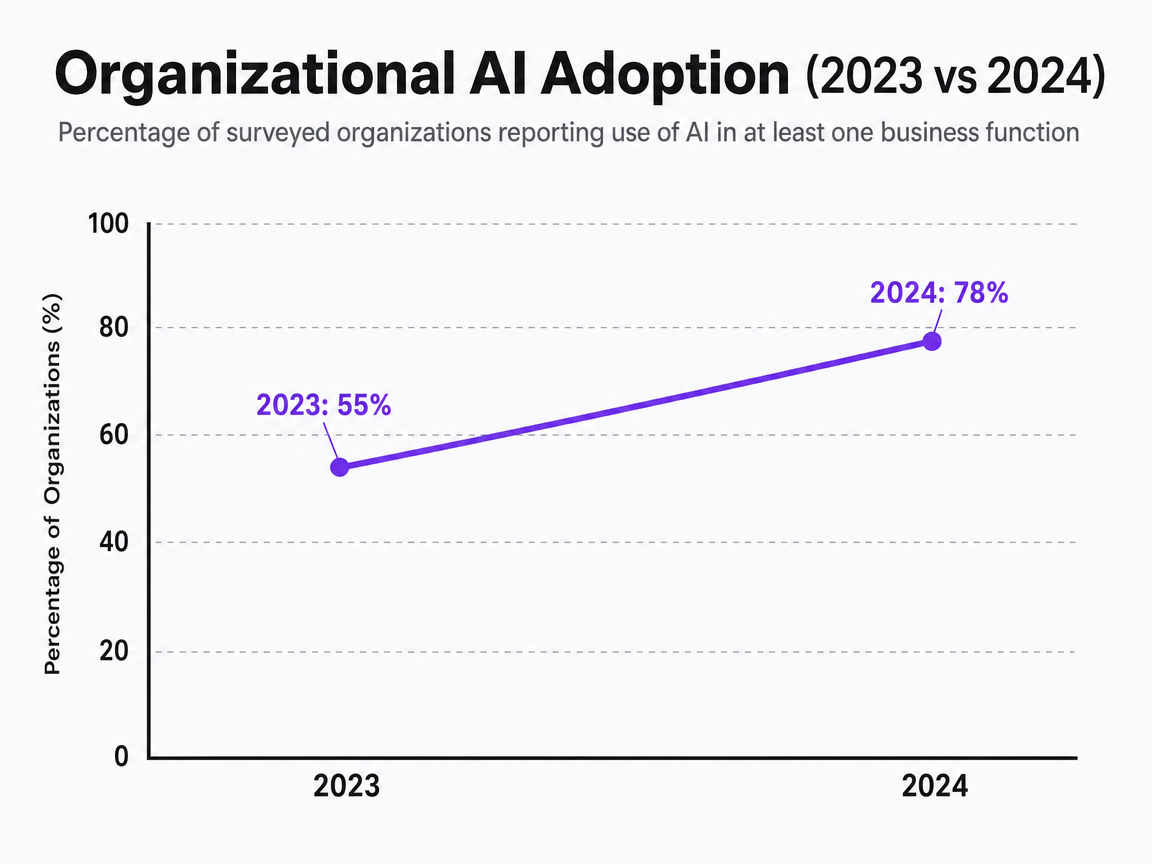 Organizational AI Adoption (2023 vs 2024)
Percentage of surveyed organizations reporting use of AI in at least one business function, comparing 2023 to 2024. From the Stanford AI Index Report.
Frequently Asked Questions
References
- 1.Economy | The 2025 AI Index Report | Stanford HAI.
- 2.FTC Authorizes Compulsory Process for AI-related Products and Services.
- 3.Advertising and Marketing | Consumer Advice.
- 4.Copyright and Artificial Intelligence, Part 1: Digital Replicas.
- 5.Copyright and Artificial Intelligence, Part 2: Copyrightability.
- 6.Artificial Intelligence Risk Management Framework: Generative Artificial Intelligence Profile.
- 7.NewsNet Issue 1060.
- 8.Enhancing Critical Writing Through AI Feedback.
- 9.Experimental evidence on the productivity effects of generative artificial intelligence.
- 10.Experimental Evidence on the Productivity Effects of Generative Artificial Intelligence.