
Key Takeaways
- Field data shows traditional-result CTR drops from 15% to 8% when an AI Overview appears, while in-summary citations deliver only about 1% of visits 1.
- YMYL informational queries carry the heaviest exposure, with AI Overviews triggering on roughly 84%-92% of health-related searches, while local and commercial queries remain closer to historical performance 3.
- Traditional rank no longer guarantees AI Overview citation, so agencies must track citation presence as a separate line item rather than inferring it from blue-link position 4.
- Heads of SEO should resegment client books by exposure class, replace rankings-plus-sessions with a four-signal QBR model, and build regulatory volatility into 12-to-18-month retainer scoping 10.
The field data is finally specific enough to forecast against
The conversation about AI Overviews' impact on Click-Through Rate (CTR) has moved beyond speculation. A field experiment conducted by the Indian School of Business, involving over 1,000 U.S. participants, revealed a significant shift. When an AI summary appeared, the traditional-result click rate was 8%, compared to 15% when no AI summary was present. Clicks on sources cited within the summary accounted for approximately 1% of visits, and overall organic clicks decreased by about 39.8% when AI Overviews were displayed 1.
This 8% versus 15% gap is a critical data point for agency forecasting. However, it's important to note the study's scope: it was U.S.-based, utilized a browser extension for delivery, and focused on general informational queries rather than specific verticals or client intent profiles. Agency Heads of SEO must consider these nuances to avoid overstating the impact on transactional queries or understating it for symptom-level health searches.
The practical takeaway is clear: informational CTR has measurably compressed. In-summary citation, at a 1% click rate, is not a viable replacement channel. Agencies can now build defensible forecasts based on these facts, incorporating vertical-specific adjustments, rather than relying on mere hunches.
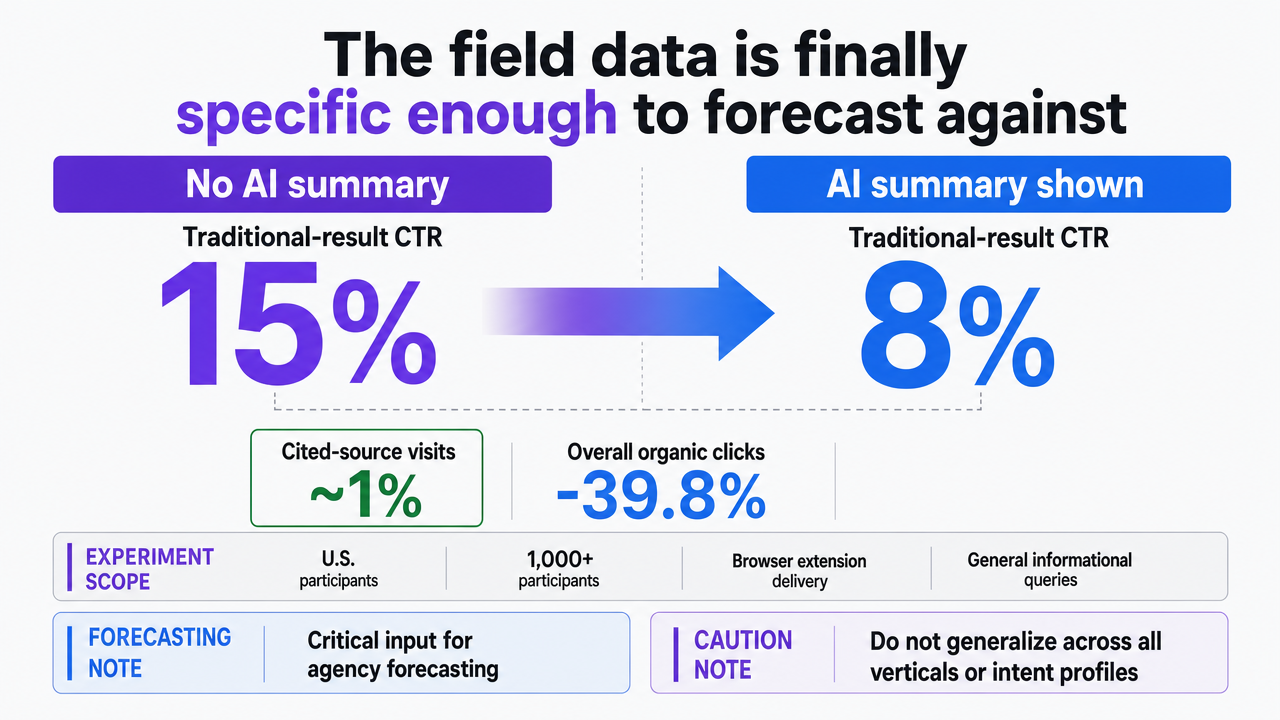 Visualize the core CTR shift from the ISB field experiment that anchors the article's forecasting argument
Which parts of the client book are structurally exposed
YMYL verticals are not experiencing the same shift as the rest
The impact of AI Overviews is not uniformly distributed across an agency's client portfolio. The Stanford AI Index medicine chapter indicates that AI Overviews appeared on approximately 84%-92% of health-related queries across five primary types, with symptom and common-health questions triggering a summary roughly 92% of the time 3. For agencies serving dental DSOs, behavioral health networks, senior living operators, and multi-specialty healthcare groups, this represents a near-universal trigger rate for the exact informational queries these clients have historically ranked for.
This shift disproportionately affects the top of the marketing funnel. Content inventories for behavioral health clients, focusing on queries like "signs of," "symptoms of," "how long does," and "what causes," are now almost universally preceded by an AI Overview. Similarly, dental groups' content on tooth pain or extraction aftercare, and senior living operators' resources on memory care signs or assisted living qualifications, face the same high summary trigger rate.
In contrast, clients like home services ranking for "emergency plumber near me" or law firms ranking for "personal injury lawyer [city]" experience AI Overviews far less consistently. These local-intent and commercial-intent queries continue to route traffic through traditional local pack and organic results. Therefore, a single forecast model cannot apply to both client types.
Operationally, this necessitates forecasting split by vertical and intent class, rather than a single blended CTR assumption. Agency Heads of SEO should model YMYL informational queries with a sharply reduced click rate, while local and commercial queries can be modeled closer to historical performance. Branded queries represent the most stable segment. A blended number across a diverse client book risks underpredicting damage for healthcare accounts and overpredicting it elsewhere, leading to inaccurate reporting.
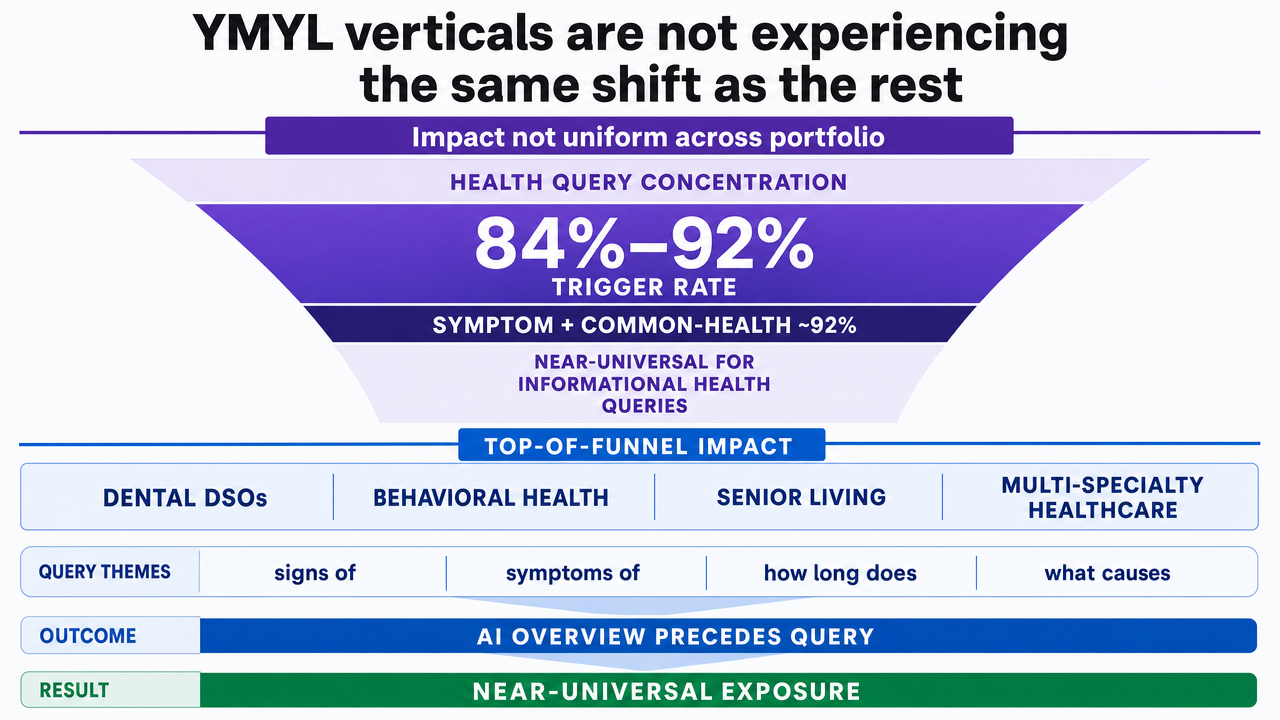 Show the AI Overview trigger rate concentration in health queries that justifies the YMYL exposure argument
Why ranking well traditionally no longer guarantees AI Overview citation
A common assumption in agency reporting is that a page ranking in the top three traditionally will automatically be cited when an AI Overview appears. Empirical evidence contradicts this. A large-scale ACM SIGIR comparison of traditional Google Search, AI Overviews, and Gemini found significant divergence between the sources returned by each surface. What ranks in the blue links is not necessarily what generative surfaces pull from 4.
This means an agency can no longer assume that "ranking well equals citation." A page holding position two for a target query might be absent from the AI Overview citation strip, while a page ranked seventh or even outside the top ten could be included. The selection logic for AI Overviews utilizes signals that overlap with, but are not identical to, traditional ranking factors.
Consequently, agencies cannot report AI Overview visibility as a direct derivative of traditional rank tracking. It requires its own measurement, using SERP monitoring tools that identify Overview presence and citation inclusion per query, tracked as a separate line item against the keyword set. Assuming citation presence based on traditional ranking will lead to confident client reports that misrepresent actual SERP visibility.
A portfolio triage for Heads of SEO forecasting the next two quarters
Given the concentrated exposure in YMYL informational queries and the decoupling of citation from traditional rank, forecasting becomes a triage exercise. Most agency books can be categorized into three buckets:
- The first bucket is high-exposure, high-informational: This includes healthcare, behavioral health, dental, senior living, and legal content libraries focused on symptoms, conditions, procedures, eligibility, and "what is" queries. These accounts require an immediate forecast reset. Applying historical CTR curves to current rankings will significantly overstate expected sessions, especially given the 84%-92% trigger rate observed for health queries 3. Client conversations about these adjustments should occur proactively, before the next monthly report.
- The second bucket is mixed-exposure: This covers multi-location service businesses where local-intent queries are primary, but a secondary content library targets informational and educational queries. Examples include home services, dental practices with strong local SEO, and law firms with service-area pages. The local layer can be forecasted close to historical performance, but the informational layer needs a separate, adjusted treatment.
- The third bucket is lower-exposure: This comprises predominantly transactional, commercial, and branded query sets where AI Overviews appear less consistently, and the funnel primarily involves local pack, Maps, and direct branded search. Forecasts here can remain closer to prior models, with only a modest downward adjustment for general drift.
This triage process, which a senior strategist can complete for each account in about half a day using current SERP data, allows agencies to proactively address QBR conversations rather than reactively.
The measurement contract clients should be reading on the next QBR
Retiring rankings-plus-sessions as the headline frame
The "rankings-plus-sessions" framework for QBRs was effective when a high SERP position reliably translated into clicks. This direct correlation has weakened. When traditional-result clicks drop from 15% to 8% in the presence of an AI summary, the ranking might remain high, but sessions collapse, forcing agencies to explain a discrepancy between a green ranking column and a red session column 1.
The issue isn't that rankings are irrelevant, but that rankings and sessions no longer tell a consistent story on the same slide. A keyword in position two can still generate an impression but lose the click to an inline summary. This means the headline metric needs to reflect user behavior, not just URL position.
The solution is to relegate rankings and raw session counts to supporting tables and elevate a select set of outcome signals to the forefront of the QBR. Clients don't need more data; they need the most relevant data presented first.
A four-signal model: citation presence, branded demand, qualified conversions, first-party audience
A four-signal model provides a robust QBR narrative that acknowledges the changes brought by AI Overviews. These signals, when read together, offer a comprehensive view:
- The first signal is AI-answer citation presence. This should be tracked per query using a SERP monitoring tool that identifies Overview appearance and citation inclusion. It should be reported as a coverage rate across the target keyword set, not merely a vanity count. A crucial caveat: citation presence indicates visibility, not traffic, as clicks on in-summary citations were only about 1% of visits in the ISB field experiment 1. Report it accurately, without overstating its traffic impact.
- The second signal is branded search demand. This includes direct, branded, and navigational query volume from Search Console and brand-tracking tools. It measures whether content efforts are building brand recognition that persists despite AI mediation. As informational CTR compresses, branded demand becomes a key indicator that content is still generating downstream intent.
- The third signal is qualified conversion volume, defined specifically for each client's pipeline event, not just form fills. For a dental DSO, this might be booked new-patient appointments; for a behavioral health network, intake calls passing clinical screening; for a law firm, signed-case consultations. This signal directly links content investment to revenue outcomes, making it highly relevant to managing partners and resilient to SERP interface changes.
- The fourth signal is first-party audience growth: metrics like email list size, SMS opt-ins, returning-visitor cohorts, and owned-channel engagement rates. A Tow Center report on publishers' responses to AI platforms noted significant declines in search referral traffic and cited a TollBit estimate that AI search bots generated substantially less click-through traffic than traditional Google Search 5. This suggests that search referral is becoming less predictable, necessitating a focus on building directly controlled audience assets.
Together, these four signals provide a holistic view of visibility, demand, revenue, and resilience, ensuring that no single metric dictates the quarter's narrative.
What belongs on the QBR slide and what belongs in the appendix
The primary QBR slide should feature four key numbers: citation presence rate across the tracked keyword set, branded search demand trend quarter over quarter, qualified conversion volume against the client's defined pipeline event, and first-party audience growth across owned channels. Each should be accompanied by a sparkline, a delta, and a concise, pre-written commentary sentence.
Detailed rankings tables, session counts by landing page, impression trends, and SERP feature breakdowns should be moved to the appendix. These remain available for clients who wish to drill down and are appropriate for monthly reports where diagnostic detail is needed. However, they should no longer be the headline metrics, as they no longer fully answer the critical questions about user behavior and business outcomes.
Account managers who adopt this reporting structure will find themselves better prepared for discussions about AI Overviews, as the QBR slide will already address the core concerns.
Test AI-Driven SEO Execution on Live Campaigns
Evaluate real-time SEO performance impact by publishing live content during your trial—no commitment required.
Content production standards when citation quality is uneven
If AI Overviews are now the primary surface for surfacing sources to users, content production must adapt to ensure accurate citation. Evidence suggests that generative systems themselves have limitations: a Stanford HAI evaluation of generative search engines found that approximately 50% of generated statements lacked supportive citations, and about 25% of provided citations did not actually support the associated claim 2.
For agency content programs, this implies that pages written with claim-level sourcing, precise entity references, and verifiable numeric statements are more likely to be cited accurately. When a claim is intrinsically linked to its source within the page, the probability of it being correctly pulled into an AI Overview, rather than loosely paraphrased from a weaker source, increases.
This necessitates a change in content production standards:
- Every substantive statistic must include an inline source and a publication date.
- Entity names should be consistent throughout the page.
- Definitions should be placed immediately next to the term.
- Numeric claims must specify unit, scope, and time period within the same sentence.
While these are not entirely new editorial best practices, what is new is their elevation from a premium upsell for thought-leadership assets to a baseline requirement for any informational page an agency wants accurately cited in an AI Overview. Pages that are well-cited under conditions of uneven citation quality are those that leave the least room for interpretation.
The increased production cost associated with this standard will directly impact the content P&L.
If you run the content P&L: the staffing math under the new standard
Why the senior-plus-junior pod breaks on retainer margins
This section is aimed at agency operations leads responsible for content delivery margins, distinct from Heads of SEO who manage client narratives. While their roles are interconnected, their operational concerns often differ.
The traditional content pod for a mid-market retainer typically includes a senior strategist, a junior writer, an editor, and an SEO specialist. This model was effective when a 1,500-word informational asset could be produced in ten to twelve blended hours, with minimal sourcing and standard internal linking.
However, the requirement for claim-level sourcing fundamentally alters these inputs. Every substantive statistic now demands an inline source, a publication date, and a verification pass. Entity references must be consistently resolved, and numeric claims require unit, scope, and time period within the same sentence. For a 1,500-word asset, this adds significant verification hours that a junior writer is not equipped to handle, and an editor is not typically budgeted to cover.
The pod structure fails not due to individual role shortcomings, but because the critical verification layer is wedged between the writer and editor without dedicated resources, forcing retainer margins to absorb the additional cost.
Three delivery models compared on hours, cadence, and claim-level sourcing
Agencies currently employ various content delivery models. The following comparison uses hours per 1,500-word informational asset and a monthly cadence target, with blended rates omitted due to market variability:
| Model | Hours per asset | Assets per month | Claim-level sourcing | Margin pressure point |
|---|---|---|---|---|
| Traditional pod (senior strategist + writer + editor + SEO specialist) | 14-18 hrs | 8-12 | Added as overflow to editor | Verification hours uncompensated; editor becomes the bottleneck |
| Offshore writer + in-house editor | 10-14 hrs | 12-16 | Inconsistent; editor rewrites to standard | Rework rate climbs as sourcing standard tightens |
| AI-assisted production with human approval checkpoints | 5-8 hrs | 16-24 | Built into draft generation and verification pass | Approval queue depth; reviewer capacity, not writer capacity |
The operational implication is less about which model is superior for a single asset, and more about identifying the primary constraint. In the traditional pod, it's editor hours and the hidden cost of verification. For the offshore model, it's the rework rate caused by inconsistent sourcing, especially given that generative systems themselves fail to provide accurate citations roughly half the time 2. In the AI-assisted model, the constraint shifts to approval throughput, which requires different staffing considerations.
Agencies that are maintaining retainer margins while increasing cadence and tightening sourcing standards are not doing so with the old pod structure. Those that retain the traditional pod are either quietly absorbing the verification costs or producing content to a lower standard than they would publicly admit. Platforms like Vectoron are designed to address this by supporting an approval-first production model.
Quantify the Impact of AI Overviews on Your Clients’ SEO CTR
Connect with experts to review CTR benchmarks, analyze your agency’s exposure to AI Overviews, and identify actionable steps to retain organic traffic in evolving SERPs.
Regulatory volatility belongs in a 12-to-18-month forecast
Agency planning now extends beyond algorithmic shifts to include policy risk. In September 2025, the Department of Justice announced remedies in the Google search monopolization case that explicitly address generative-AI technologies. These include restrictions on exclusive distribution agreements and requirements to make certain search-index and user-interaction data available to rivals 6. The court's remedies opinion further stated that competition between general search engines and generative-AI products must be considered, treating AI products as capable of fulfilling the same broad informational needs traditionally met by search engines 9.
For agencies pricing 12-to-18-month engagements, this is not mere background noise; it's an additional layer of volatility on top of algorithmic changes.
Two specific items warrant attention in client planning. A DOJ filing proposed a mechanism for publishers to selectively opt out of having their content used in search indexing or Google generative-AI products, with a prohibition on retaliation for exercising this opt-out 7. Additionally, a November 2025 filing argued that advancements in AI, including Google's AI products, could worsen conditions for open-web publishers by siphoning traffic away from their websites 10. While neither is a settled rule, both signal that the terms governing how client content is displayed, cited, or withheld within AI surfaces are actively being contested.
The practical approach is to incorporate regulatory volatility into retainer scoping rather than treating it as an unexpected cost. Longer engagements should include a scenario clause allowing for a mid-term rework of measurement and content standards if publisher controls significantly shift. Agencies that implement this clause now will avoid renegotiating under pressure later.
What a defensible agency position sounds like next quarter
Agencies that successfully navigate the next two QBR cycles will share common strategic positions. They will have resegmented their client books based on exposure class, applying a distinct forecast curve to YMYL informational libraries and maintaining closer-to-historical models for local-commercial accounts. They will have transitioned their headline QBR slide from rankings-plus-sessions to a four-signal model: citation presence, branded demand, qualified conversions, and first-party audience growth. Furthermore, they will have elevated content production standards to include inline sourcing and consistent entity treatment for all informational assets, not just thought-leadership pieces.
They will also have factored regulatory volatility into longer engagements, rather than absorbing it mid-term 10.
These actions do not require predicting the exact future of the SERP. Instead, they demand reporting based on current field data and staffing the production line to meet the new content standards. Platforms like Vectoron are designed to manage the verification and approval workload that disrupted traditional content pod economics. Regardless of the tools used, the strategic imperative remains: measure what survives AI mediation, and produce content that generative AI can cite accurately without guesswork.
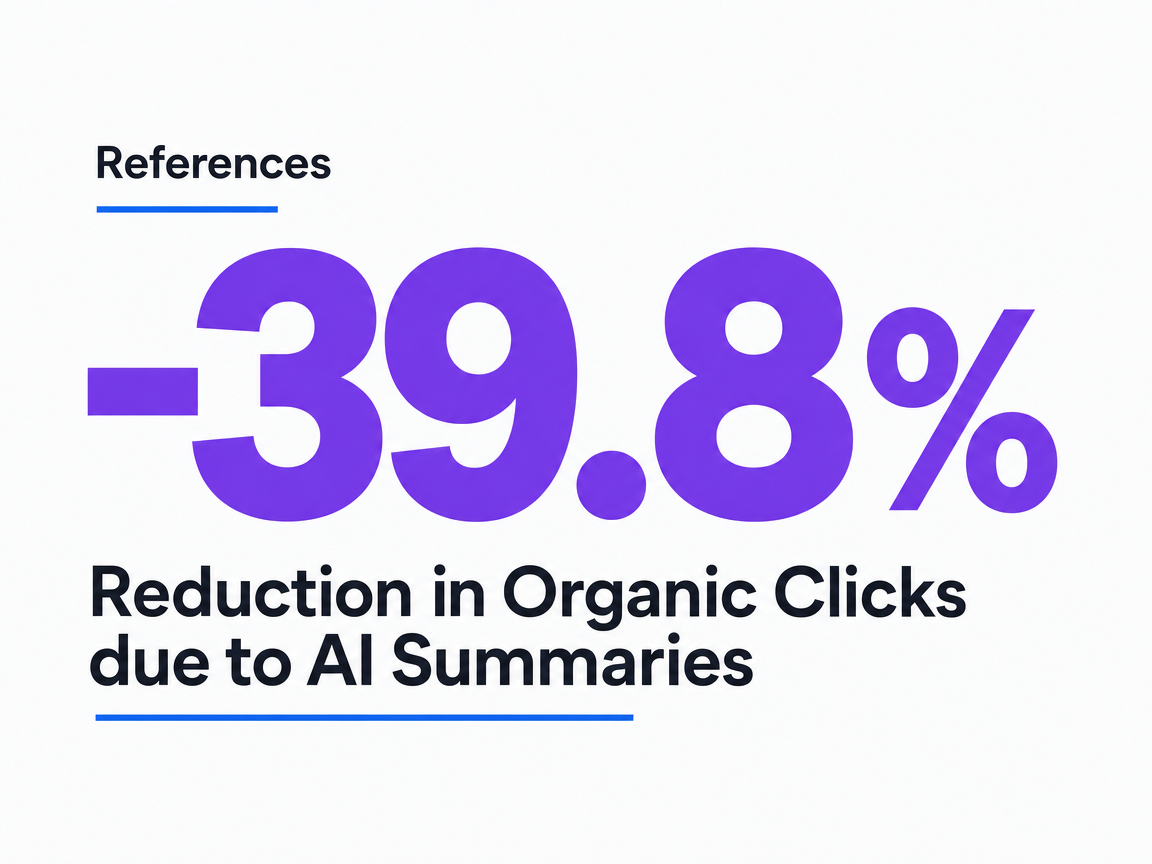 Reduction in Organic Clicks due to AI Summaries
Reduction in Organic Clicks due to AI Summaries
Frequently Asked Questions
References
- 1.AI Summaries in Search and Their Impact on Publisher Traffic.
- 2.Generative Search Engines: Beware the Facade of Trustworthiness.
- 3.Medicine.
- 4.An Empirical Study of Google Search, Gemini, and AI Overviews.
- How Platforms and Publishers are Navigating AI. https://towcenter.columbia.edu/sites/towcenter.columbia.edu/files/content/Journalism%20Zero%20How%20Platforms%20and%20Publishers%20are%20Navigating%20AI.pdf
- 6.Department of Justice Wins Significant Remedies Against Google.
- 7.Plaintiffs' Revised Proposed Final Judgment.
- 8.U.S. and Plaintiff States v. Google LLC.
- 9.Memorandum Opinion: U.S. and Plaintiff States v. Google LLC.
- 10.U.S. and Plaintiff States v. Google LLC.