
Key Takeaways
- Structured briefs and reusable content components cut per-page specialist time by roughly two-thirds on multi-location portfolios, with breakeven typically falling between the eighth and fifteenth location 10.
- Automated technical audits on a schedule convert quarterly manual sweeps into weekly exception triage against sitemaps, robots.txt, titles, meta descriptions, and status codes 12.
- Provenance logs record source material, prompts, draft versions, editors, and approvers so an agency can reconstruct who touched a disputed paragraph within minutes 1.
- Approval queues gate publication behind a named decision and log it, giving the agency the signature it needs if AI-assisted claims are challenged 3.
- Client-data isolation and permission controls wall each account's transcripts, prompts, and indexes off from others, since there is no AI exemption from existing data laws 4.
- Accessibility QA at the publish step flags alt text, keyboard access, headings, captions, and contrast against deterministic Section 508 and WCAG criteria before approval 5, 6.
- Plain-language and readability review matters for YMYL clients because 97% of diabetic-retinopathy pages exceeded median U.S. health literacy, with readability correlating to SEO metrics 8.
- Discoverability monitoring watches nightly deltas between submitted sitemaps and indexed URLs, catching deindexation and crawler blocks that vanity rank trackers miss entirely 12.
- Outcome tracking that reports qualified calls, form fills, and booked appointments by source URL defends retainers at renewal, with rank and traffic sitting underneath as diagnostic context.
- Approval-first automation ties the other features into one queue, one reviewer, and one log, matching NIST's documented sources, testing, records, and provenance pattern 2.
Where specialist hours actually go in a modern SEO retainer
Pull a timesheet from any mid-sized SEO team and the hours don't cluster where the pitch deck says they do. Strategy and keyword research rarely consume the majority of a specialist's week. The bulk goes to brief preparation, draft revision, technical audits that repeat across clients, meta and schema cleanup, accessibility fixes, screenshot-heavy status reports, and the quiet work of chasing approvals through client Slack channels. These are the hours that compound as client count grows, and they are also the hours that resist delegation to junior staff because mistakes cost retainers.
The question for an agency Head of SEO is which of these recurring tasks can be converted into a reviewable system rather than a human-dependent ritual. Digital.gov frames the same problem on the content side: structured content separates information from presentation and uses metadata to make material machine-readable and reusable across devices and services 10. The principle generalizes. Any task that follows a repeatable pattern, produces a reviewable artifact, and ends in a human decision is a candidate for feature-level leverage.
The ten features that follow are ranked on that criterion. Each one targets a category of specialist hours that currently scales linearly with client count, and each one is paired with the governance control that keeps the output defensible when volume increases. Features without governance create liability. Governance without execution speed creates bottlenecks. The pairing is the point.
Ranking the ten features by leverage per specialist hour
The ranking that follows uses a single criterion: how many recurring specialist hours per client the feature removes once it is in place, net of setup and oversight time. Features that save ten minutes per publish on a twenty-page-per-month retainer rank above features that save two hours on a quarterly deliverable. Governance features are ranked by the hours they prevent being spent on remediation, legal review, and client incident calls, not by the compliance box they check.
Context matters for how fast an agency can act on the list. Stanford's 2025 AI Index reports that organizational AI use rose from 55% in 2023 to 78% in 2024, and that generative AI use in at least one business function climbed from 33% to 71% 7. Those are survey-based adoption figures across functions, not SEO outcome measurements. Adoption is the ambient condition, not the proof that any specific feature produced ranking gains or pipeline lift. The ten entries below are ordered on hours saved per client, with the governance pairings called out where the feature breaks without them.
Structured briefs and reusable content components
Most agencies brief every page from scratch. A specialist opens a blank template, pulls competitor outlines, writes an intake summary, drops in local proof points, and hands it to a writer who repeats the research the strategist just did. On a twenty-location dental DSO, that pattern burns the same two to four hours per page across pages that share 70% of their structure.
Structured content attacks that waste at the source. Digital.gov describes the approach as separating information from presentation and tagging the pieces with metadata so they can be reused across devices and services, with search engines drawing on the structure to produce more meaningful descriptions 10. For an SEO team, that means the brief itself becomes a component tree: a service definition, a geographic modifier, a proof block, a trust block, an FAQ module, and a schema object, each written and approved once, then recomposed per location rather than rewritten.
For agencies managing multi-location client portfolios, the economics change at a predictable crossover point. The variables below use specialist hours rather than invented dollar figures, since labor cost per hour varies across markets.
| Metric | Before component library | After component library |
|---|---|---|
| Specialist hours per location page (brief + QA) | H | roughly H × 0.25 to 0.35 |
| One-time component build cost | 0 | C hours (shared across the portfolio) |
| Breakeven location count | n/a | C ÷ (H × 0.65) |
The practical read: for a component build that takes 40 specialist hours and a per-page savings of roughly two-thirds of H, the investment pays back somewhere between the eighth and fifteenth location, after which every additional page compounds margin. The risk Digital.gov flags is also real—templated structure without unique local inputs produces near-duplicate pages that underperform in local search. The component library has to carry unique slots for review language, staff credentials, service variations, and intake details, not just swap the city name in an H1.
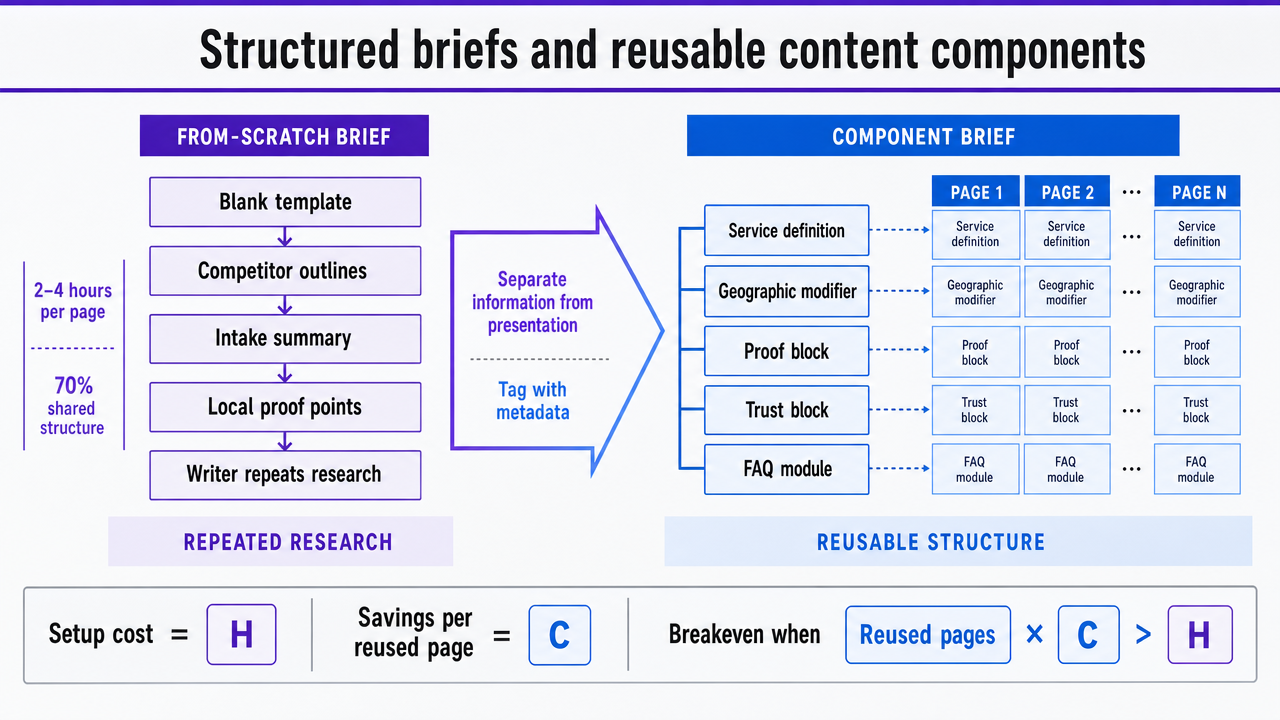 Visualize the before/after component library comparison table in this section, which has specific metrics but no chartable numeric data (uses variables H and C). A process infographic clarifies the breakeven economics described in prose
Automated technical audits on a schedule
Technical audits are the clearest case of specialist hours wasted on repetition. A senior strategist checking XML sitemaps, robots.txt directives, title tags, meta descriptions, and status codes across fifteen client sites once a quarter is doing work that a scheduled script should surface as exceptions. Digital.gov's optimization guide lists exactly these controls—sitemaps, robots.txt configuration, descriptive titles and meta descriptions, and status-code validation—as the baseline of search optimization work 12. None of them require human judgment to detect; all of them require human judgment to fix.
The feature that scales is the audit cadence, not the audit itself. A weekly crawl that compares current state to the last approved state, flags only the deltas, and routes them to a specialist with the diff and recommended fix converts a four-hour quarterly review into a fifteen-minute weekly triage. On a thirty-client book, that difference is roughly one specialist FTE reclaimed per year.
The failure mode is treating the audit output as the deliverable. Digital.gov is explicit that technical discoverability is necessary but insufficient; a clean crawl report does not compensate for weak content or broken conversion paths 12. Scheduled audits earn their keep only when the exceptions queue feeds a remediation workflow with named owners and a close-out log, not a monthly PDF that clients file and ignore.
Provenance logs that record what the model touched
A provenance log answers one question under pressure: when a client's general counsel asks who wrote the paragraph that triggered the complaint, can the agency produce the source material, the model prompt, the draft version, the editor who revised it, and the approver who published it, within minutes rather than days? NIST's synthetic content review identifies provenance tracking, labeling, detection, testing, and auditing as the core approaches for reducing synthetic-content risk, with provenance specifically capable of recording origins, modifications, and whether AI tools were involved 1.
For an agency publishing across thirty clients with any AI assistance in the pipeline, the log is a scaling feature as much as a defense artifact. NIST's Generative AI Profile recommends documenting training-data sources, testing for synthetic content risks, analyzing provenance, and retaining records for testing, evaluation, validation, and verification 2. Treated as a design requirement rather than a bolt-on, those records remove the hours specialists currently spend reconstructing what happened on a given page: which research document fed the brief, which model version drafted the section, which editor changed the citation, and which approval closed the loop.
The log fails when it exists only as a database no one queries. Useful provenance surfaces at the point of review—attached to the draft, visible to the approver, and exportable to the client on request. Without that surfacing, the record is an insurance policy no one knows how to file.
Test enterprise-grade SEO workflows, risk-free
Experience real-time SEO execution and publish live content directly within your existing client processes during your trial.
Approval queues that gate publication, not just review it
A review step is not an approval gate. Many agency workflows route drafts into a shared doc, collect comments, and publish on the strategist's own authority once the obvious edits are made. That is a review loop. An approval gate holds the publish action behind a named decision, logs who made it, and refuses to push the page live until the record is complete. The distinction matters because the FTC's Operation AI Comply made clear that AI-related marketing claims remain subject to ordinary consumer-protection law, with the agency stating that
"using AI tools to trick, mislead, or defraud people is illegal"
and bringing actions over fake reviews, an "AI lawyer," and guaranteed earnings claims 3. The approver is the person whose signature the agency will have to produce if a claim is challenged.
NIST's Generative AI Profile gives the gate its structure. The profile recommends documenting training-data sources, testing for synthetic content risks, retaining records for testing and verification, and analyzing provenance and authenticity 2. Mapped onto the SEO workflow, those four controls sit at four distinct stages:
- Documented sources attach to the brief.
- Testing runs against the draft.
- Retained records close around the approval decision.
- Provenance review precedes publication.
An approval queue that enforces all four stops the common failure where a specialist approves a page based on surface read and discovers two months later that the supporting citation was fabricated.
The operational payoff is batch-level throughput. One senior reviewer clearing a queue of twenty pre-checked drafts in an hour outperforms five specialists each reconciling their own loose edits. The gate is the leverage.
Client-data isolation and permission controls
SEO platforms that touch call transcripts, intake form submissions, lead lists, or booking data are processing information that often carries contractual and regulatory weight. The FTC has stated plainly that there is
"no AI exemption from the laws on the books"
and that companies face liability when they deceive users about how data is collected or used, including quiet repurposing of customer data for training or targeting 4. For an agency running shared tooling across a book of legal, behavioral health, and dental clients, that guidance translates into a specific feature requirement: each client's data has to be walled off from every other client's models, prompts, retrieval indexes, and audit logs by default.
Permission controls make that isolation operational. Role-based access that limits which specialists can read call recordings for a given account, retention policies that purge raw transcripts after the SEO insight is extracted, and prompt-level controls that prevent one client's proprietary language from leaking into another client's draft are the mechanics behind the promise. The hours saved are not visible on a timesheet; they appear as the incident calls that never happen and the client security questionnaires that get answered in an afternoon rather than a week.
Accessibility QA built into the publish step
Accessibility review that lives in a separate quarterly audit is accessibility review that never happens on time. The scalable version runs at the publish step, flags missing alt text, unlabeled form fields, empty link text, heading-order breaks, and insufficient contrast against the draft before the approver sees it, and attaches the finding to the specific element rather than to a page-level pass/fail score. Section508.gov translates the underlying requirements into practical web-development checks, including text alternatives for non-text content, keyboard access, navigation, language identification, captions, and limits on flashing 5. Each of those checks is deterministic enough to automate at the draft stage, which is where remediation costs the least.
For agencies serving government, healthcare, education, or any client subject to procurement review, the audit output has to map to the standard the client will be measured against. The Section 508 crosswalk ties WCAG 2.0 Level A and AA success criteria to functional performance criteria and the revised 508 standards 6, which lets a specialist route a specific finding to a specific requirement and a named remediation owner rather than filing a generic accessibility ticket. The leverage is in the mapping: a flagged missing alt attribute arrives in the queue tagged to the WCAG criterion, the responsible editor, and the fix pattern, so the approver closes the loop in minutes rather than scheduling a separate compliance review.
Plain-language and readability review for YMYL clients
Readability review earns its slot on this list because of what the research shows about health-adjacent search. A 2024 peer-reviewed analysis of diabetic-retinopathy websites found that 97% of educational pages exceeded the median U.S. health-literacy level, and that better readability was correlated with stronger SEO metrics across the sample 8. The authors were explicit that the finding is correlational, not causal, and that the sample is bounded to one condition and one search context. Even with those caveats, the direction of the signal matters for any agency serving legal, behavioral health, dental, senior living, or financial clients: content pitched above the audience's reading level tends to underperform on the measures the agency is paid to improve.
The scalable version of plain-language review runs against the draft, not the published page. A reading-grade check, a sentence-length flag, a jargon list drawn from the client's own disallowed-term glossary, and a passive-voice counter attached to each section give the editor a specific list of fixes rather than a vague instruction to simplify. Digital.gov's content guidance reinforces the pattern, calling for plain language, audience-based localization, and manual validation of machine-produced copy before publication 11. The leverage is in the specificity: a specialist handed a flagged sentence with a suggested rewrite closes the loop in under a minute, where a strategist handed a page with the note "simplify" spends twenty.
Scale SEO Execution Without Expanding Your Team
See how AI-powered workflows deliver measurable SEO results across clients—without adding headcount or sacrificing quality. Designed for agencies managing complex, multi-channel programs.
Discoverability monitoring tied to indexation, not vanity rankings
Rank tracking has a well-known failure mode at agency scale: a client site can hold position three on a flagship term while twenty location pages sit deindexed, and the weekly dashboard shows green. The feature that scales is monitoring tied to what Google can actually retrieve and serve, not to where a cached SERP placed a URL yesterday. Digital.gov's optimization guide anchors the control set: XML sitemaps, robots.txt configuration, descriptive titles and meta descriptions, and status-code validation are the discoverability surface that determines whether a page is eligible to rank at all 12.
The scalable implementation watches the delta, not the snapshot. A nightly check compares the submitted sitemap against the indexed URL set, flags pages that fell out of the index, catches robots.txt changes that quietly blocked a crawler, and surfaces 4xx and 5xx responses on URLs that were serving 200s the week before. Each exception routes to a specialist with the affected URL, the previous state, the current state, and the probable cause. On a thirty-client book, that converts a monthly rank-tracker review into a daily triage queue measured in minutes.
The payoff is that pipeline-affecting problems surface before the client notices traffic drop, not after. A deindexed location page costs real bookings; a position-four-to-position-five shift on a head term usually does not. Monitoring the thing that moves revenue is the leverage.
Outcome tracking that reports pipeline, not positions
The reporting layer is where most agency retainers quietly lose their defensibility. A monthly deck full of average position, impressions, and click deltas tells the client the work happened; it does not tell the client whether the work produced bookings, qualified calls, or signed engagements. Specialists then spend hours each month assembling screenshots that the client's finance team cannot tie to revenue, which is how retainers die at renewal.
The scalable version flips the hierarchy. Pipeline metrics—qualified calls by source URL, form submissions by landing page, booked appointments by campaign, cost per qualified lead by service line—sit at the top of the report. Rank and traffic sit underneath as diagnostic context for why pipeline moved, not as the headline. The data model behind that flip is unglamorous: call tracking tied to session source, form fills tagged with entry URL and query, and a weekly join between the SEO platform's URL-level traffic and the client's CRM status on each lead. Once that join exists, the specialist stops writing narrative explanations of ranking changes and starts flagging which pages drove revenue and which pages produced traffic that never converted.
The reporting shift also changes what gets prioritized in the following month's work. Pages ranking well with no pipeline contribution become candidates for conversion review or deindexation, not more link building. That reallocation is the leverage.
Approval-first automation: where Vectoron fits in the stack
Nine of the ten features above describe capabilities that any sufficiently disciplined agency could assemble from a mix of crawlers, CMS plugins, review templates, and spreadsheets. The tenth describes what happens when those capabilities are wired together under a single approval model rather than scattered across tabs. Vectoron sits in that slot. The platform coordinates specialist strategists across content, SEO, backlinks, PPC, social, and call intelligence, and routes every recommendation through a Command Center that holds execution behind a named human decision.
The design choice that matters for a Head of SEO is the sequence: analysis and drafting run automatically, but publishing, outreach, bid changes, and schema updates wait for sign-off. That matches the NIST pattern of documented sources, tested output, retained records, and provenance review attached to the approval moment 2, and it keeps the agency on the defensible side of the FTC's position that AI tools do not change underlying truth-in-advertising obligations 3. The leverage shows up where the earlier features converge: one queue, one reviewer, one log, across the full client book.
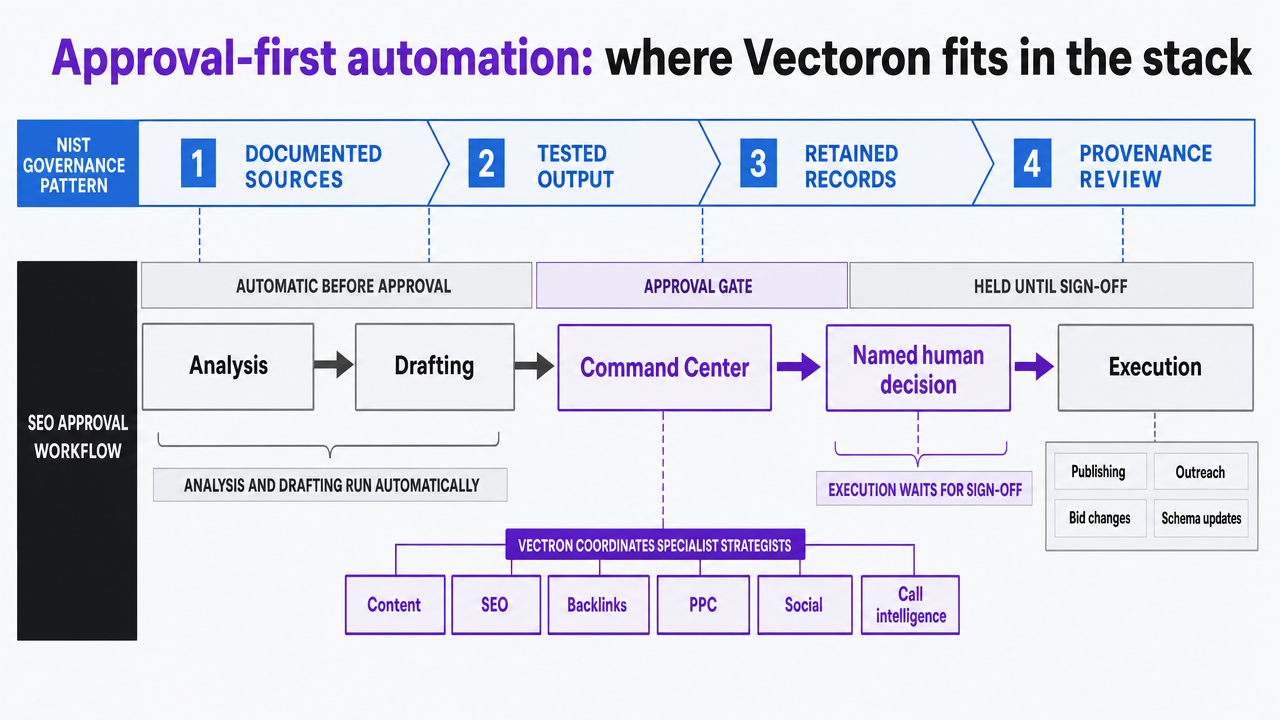 Visualize the NIST four-stage governance pattern (documented sources, tested output, retained records, provenance review) mapped onto the SEO approval workflow described in this section and the Approval queues section. This is a process infographic grounded in cited NIST guidance
If the agency has zero of these: the three to deploy first
An agency starting from scratch does not need all ten at once. The three that return the most hours per client in the first quarter, in order, are:
- Scheduled technical audits
- Structured briefs with reusable components
- An approval queue that logs the publish decision
The sequence is deliberate.
Scheduled audits go first because the exceptions queue starts producing time savings in week one, and the controls are deterministic: sitemaps, robots.txt, titles, meta descriptions, and status codes 12. Structured briefs go second because the component library takes real setup hours but compounds across every subsequent page, and the gains show up fastest on multi-location books where one brief fans out across a portfolio 10. The approval queue goes third because it only matters once the first two features are producing enough volume that an unlogged publish decision becomes a liability, and because it brings the governance structure NIST recommends—documented sources, tested output, retained records, and provenance review at the point of sign-off 2.
Deploy in that order and the agency reclaims specialist hours before it needs to defend them. Reverse the order and the governance layer gates work that was never going to scale in the first place.
Frequently Asked Questions
References
- 1.Reducing Risks Posed by Synthetic Content: An Overview of Technical Approaches to Digital Content.
- 2.Artificial Intelligence Risk Management Framework: Generative Artificial Intelligence Profile.
- 3.FTC Announces Crackdown on Deceptive AI Claims and Schemes.
- 4.AI Companies: Uphold Your Privacy and Confidentiality Commitments.
- 5.Guide to Accessible Web Design & Development.
- 6.Mapping of WCAG 2.0 to Functional Performance Criteria.
- 7.Economy | The 2025 AI Index Report.
- 8.Search engine optimization and its association with readability and accessibility of diabetic retinopathy websites.
- 9.Artificial Intelligence Risk Management Framework: Generative Artificial Intelligence Profile.
- 10.An introduction to structured content.
- 11.An introduction to content.
- 12.Optimize your content.