
Key Takeaways
- Local search for accountancy firms is governed less by ranking tactics than by what can lawfully appear on the page under FTC Endorsement Guides and, for adviser-affiliated practices, SEC Rule 206(4)-1 9, 14.
- Every public claim — from a Google Business Profile description to a trimmed review snippet — needs a substantiation chain linking the wording to a source document, required disclosures, and a named approver's sign-off.
- Reviews and service-area pages carry the highest per-asset risk: incentives cannot be conditioned on sentiment, and unrepresentative outcome claims require the generally expected result, not just disclaimer language 1, 3.
- Sizing offices through SUSB establishment data and Census Business Builder income overlays, then tagging intake by source, service, qualification, and disposition, is where SEO spend maps to booked consultations rather than rankings 4, 5.
Why Local Search Behaves Differently for Regulated Practices
Accountancy firms sit inside an advertising perimeter that most local-search advice ignores. A dentist can publish a five-star client quote without triggering a federal review. A CPA firm affiliated with an RIA cannot. The same testimonial that would be routine marketing for a home services operator can trigger substantiation obligations under the FTC Endorsement Guides and, for adviser-adjacent practices, written-agreement and disclosure obligations under SEC Rule 206(4)-1 9, 14. Local visibility for regulated firms is therefore not a ranking question. It is an intake question governed by what can lawfully appear on the page.
The demand side is real. A 2011 Pew Research study of local businesses outside restaurants, bars, and clubs found that 47% of respondents said they most rely on some kind of online source for information about local businesses 6. That figure is more than a decade old and limited to non-hospitality categories, so it should be read as historical baseline rather than current behavior. What it establishes is that even in the early consumer-search era, online discovery had already displaced older channels for the exact category accountancy sits in: professional local services outside food and nightlife.
The competitive baseline has shifted since. Research on search and local web presence finds that advertising effects on search engine usage rise where more local businesses maintain websites 7. As nearby firms build web assets, the value of appearing in local results increases for every practice in the market, including the ones that would prefer to compete on referrals alone.
Regulated firms respond to that pressure inside a narrower lane. Every asset that produces a local lead — profile, review, service description, landing page claim — must be defensible under federal advertising rules before it is optimized for rankings.
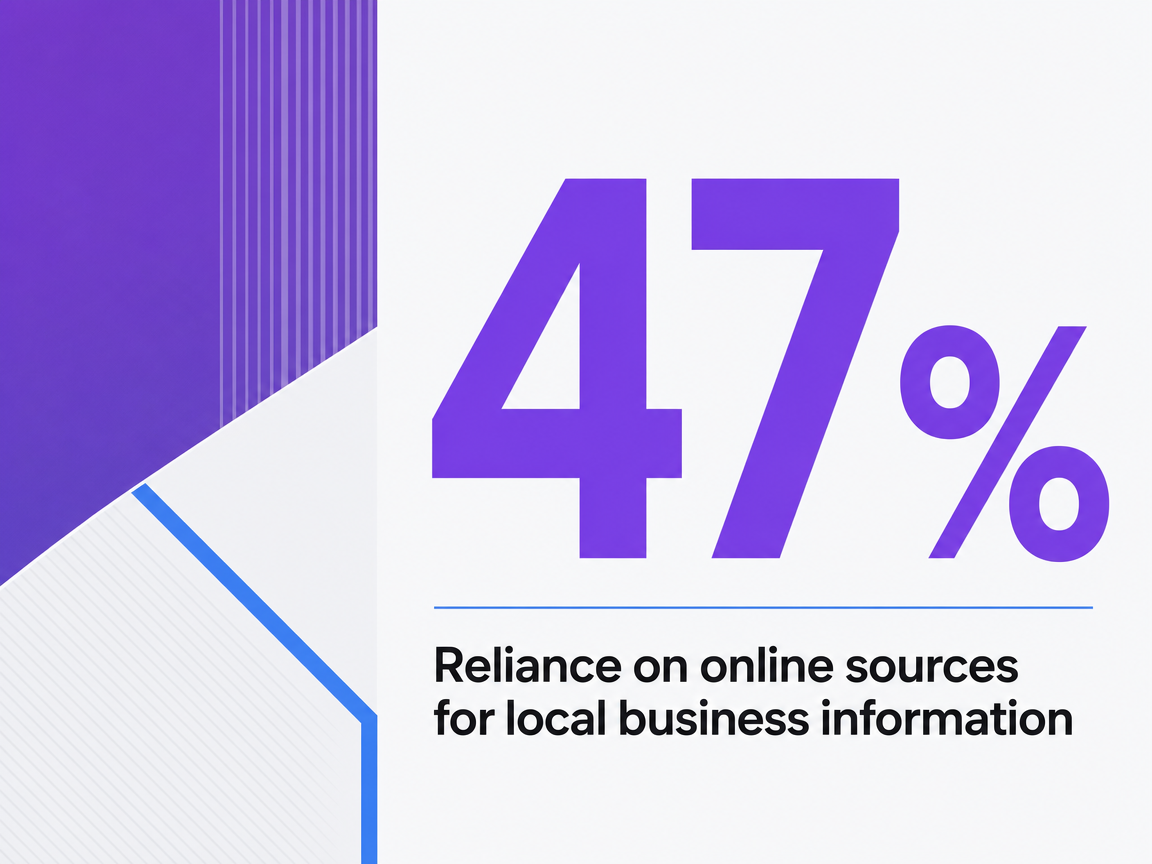 Reliance on online sources for local business information
Reliance on online sources for local business information
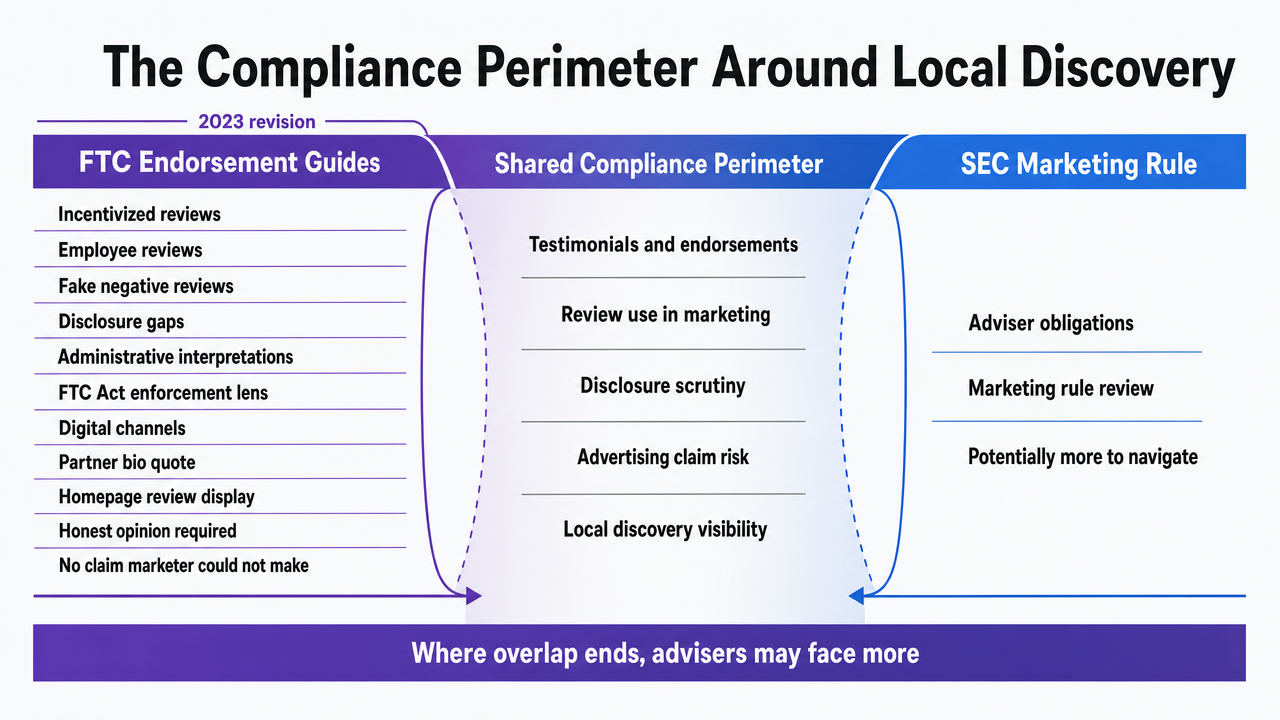
The Compliance Perimeter Around Local Discovery
FTC Endorsement Guides After the 2023 Revision
The FTC revised its Endorsement Guides in June 2023 to address incentivized reviews, employee reviews, fake negative reviews, and disclosure gaps that had emerged across digital channels 2. The Guides are administrative interpretations under the FTC Act, published in the Federal Register, and they set the enforcement lens the agency uses when evaluating deceptive advertising claims 8. For accountancy firms, that lens covers everything from a partner bio quoted on a service page to a five-star Google review displayed on the homepage.
Two operational rules do most of the work. First, an endorsement must reflect the honest opinion of the endorser and cannot be used to make a claim the marketer could not legally make on its own 1. A client quote saying a firm "saved us $40,000 in taxes" is only usable if the firm can substantiate that figure and would be permitted to advertise it directly. Second, the FTC Consumer Reviews and Testimonials Rule prohibits misrepresenting that a business does not control independent reviews about its own services, and it does not ban incentives outright — it prohibits conditioning any incentive on a particular sentiment 3.
Substantiation is the through-line. Advertisers must possess adequate substantiation for claims made through endorsements, and practices inconsistent with the Guides can trigger FTC action 10. Firms that treat review snippets as marketing copy — trimmed, reordered, or paraphrased — inherit the same substantiation burden as any other advertising claim.
SEC Marketing Rule Obligations for Adviser-Adjacent Firms
Accountancy practices that operate a registered investment adviser, share ownership with one, or refer clients into advisory services fall under a second regulatory layer. SEC Rule 206(4)-1, adopted in 2020 as the modernized Marketing Rule, governs how investment advisers may use testimonials, endorsements, third-party ratings, and performance information in advertisements 12. The rule replaced a prior regime that had broadly prohibited testimonials, and it now permits them only when specific disclosure, oversight, and disqualification conditions are satisfied 14.
The operational requirements are stricter than the FTC baseline. Advertisements cannot contain testimonials, endorsements, third-party ratings, or performance information unless disclosures are clear and prominent, and written agreements are required in many compensated cases 11. "Compensated" reaches beyond cash. Discounts on fees, waived minimums, and non-cash benefits given in exchange for a testimonial all pull the arrangement into the written-agreement requirement.
Promoter due diligence adds another gate. An adviser generally cannot compensate a person for a testimonial or endorsement if the adviser knows or should know that person has a disqualifying event within the prior 10 years 13. That obligation applies to review-solicitation vendors, referral partners, and any third party paid to place favorable content. Firms that outsource review generation to a marketing agency inherit the diligence requirement — the SEC does not treat the vendor as an intermediary that absorbs the risk.
Where FTC and SEC Requirements Overlap and Where Advisers Face More
The two regimes share a foundation. Both require that public-facing claims be truthful, non-misleading, and substantiated, and both treat material connections between a firm and an endorser as something that must be disclosed 2, 3. A pure accountancy practice with no advisory affiliation operates primarily under the FTC framework. A hybrid firm — one that offers tax work alongside investment advisory services, or shares partners with an RIA — carries both sets of obligations simultaneously, and the SEC layer imposes obligations the FTC does not 12, 13.
Three differences drive the added burden:
- The SEC Marketing Rule requires clear and prominent disclosure of whether the endorser is a client, whether compensation was paid, and any material conflicts of interest — a level of specificity the FTC Guides recommend but do not codify with the same rigidity 12.
- Compensated testimonials above a de minimis threshold require a written agreement between the adviser and the endorser, a document the FTC framework does not demand 12.
- The 10-year promoter disqualification window forces adviser-affiliated firms to run background checks on any paid endorser or review-solicitation partner — a diligence step with no FTC parallel 13.
A side-by-side view of the two regimes, covering the honest-opinion standard, material-connection disclosure, the written-agreement threshold, and the 10-year disqualification window, is the fastest way for a hybrid firm to see which obligations stack.
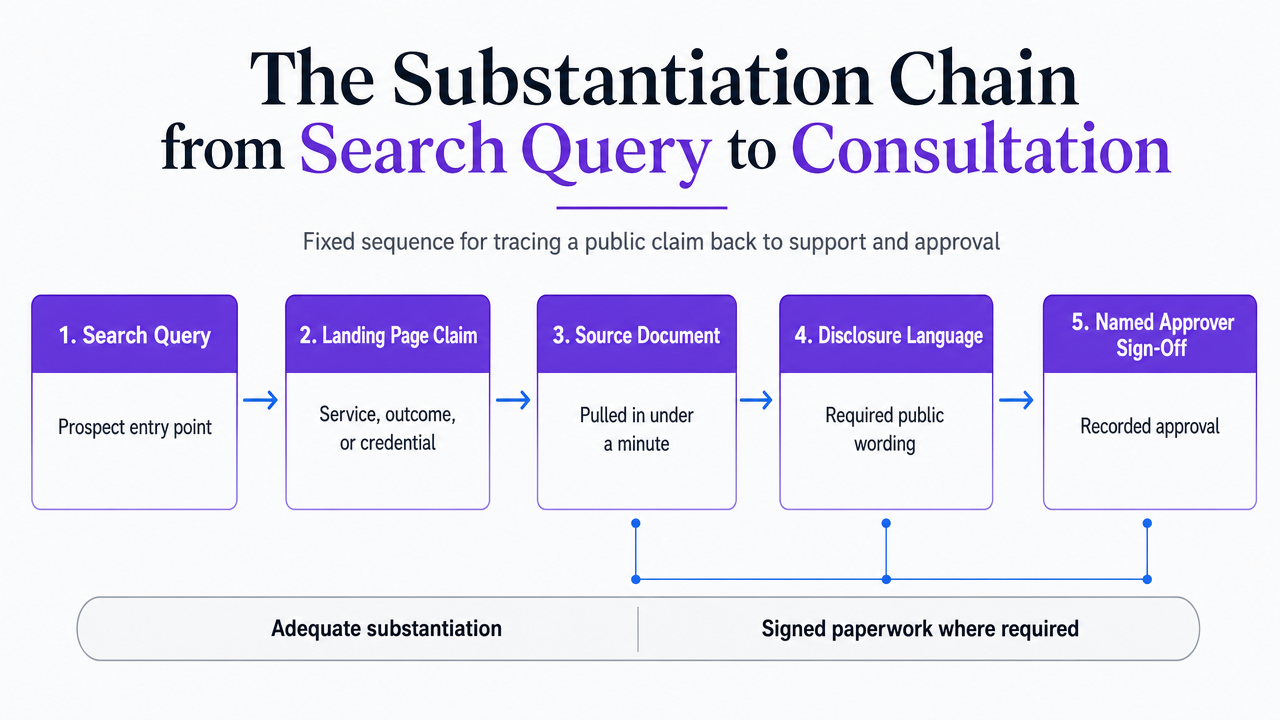
The Substantiation Chain from Search Query to Consultation
Mapping a Public Claim Back to a Source Document
Every public-facing claim a firm makes on a landing page, profile, or review snippet should trace to a specific document a compliance reviewer can pull in under a minute. That is the operating definition of a substantiation chain. The FTC framework requires advertisers to possess adequate substantiation for claims made through endorsements, and practices inconsistent with the Guides can trigger enforcement action 9. The SEC layer adds a written-agreement requirement for many compensated testimonial arrangements, which means the chain has to hold not only source documents but also signed paperwork 11.
The chain runs in a fixed sequence:
- A search query lands a prospect on a page.
- The page carries a claim — a service description, a client outcome, a partner credential.
- Behind that claim sits a source document: an engagement letter, a tax return work paper, a professional license, a client email granting permission.
- Attached to the claim is the disclosure language required by the applicable rule — material connection under the FTC framework, or the clear-and-prominent disclosures required by SEC Rule 206(4)-1 11.
- That combination is reviewed and signed off by a named approver before publication, and the approval record itself becomes part of the chain.
Firms that skip the approval-record step tend to fail the same way. A partner rewrites a service page, a review snippet gets trimmed for the homepage, or an intake script adds a new promise about turnaround time. None of those changes are inherently deceptive. They fail the chain because no reviewer signed them, and no source document is on file when a regulator asks.
Handling Reviews, Testimonials, and Third-Party Ratings
Reviews carry the highest per-asset risk in a local SEO program because they are the most visible, the most frequently edited, and the most often solicited. Three practical rules govern how they enter the substantiation chain.
- Reviews must reflect the honest opinion of the reviewer and cannot support a claim the firm could not make directly 1. A quote reading "reduced our effective tax rate by twelve points" is only usable if the firm can substantiate the twelve-point figure with a work paper and would be permitted to advertise it as its own claim. Trimming a longer review to isolate that number does not cure the problem — it concentrates it.
- Incentives are permitted but cannot be conditioned on sentiment. The FTC Consumer Reviews and Testimonials Rule prohibits misrepresenting that a firm does not control independent reviews, and it draws the line at conditioning any incentive on a positive review rather than on the act of leaving one 3. A firm can ask every client for a review. It cannot ask only satisfied clients, and it cannot offer a fee discount contingent on stars.
- Third-party ratings and compensated endorsements carry additional weight for adviser-affiliated firms. The SEC requires clear and prominent disclosure of whether the endorser is a client, whether compensation was paid, and any material conflicts, and it imposes a 10-year promoter disqualification screen on paid endorsers and review-solicitation vendors 13. Firms that outsource review generation inherit that diligence — the vendor does not absorb it.
Test Local SEO Results for Accountancy Firms
See how your firm ranks for key local search terms by publishing live SEO content during your trial.
Google Business Profile and Service-Area Content as Governed Assets
Profile Fields That Carry Advertising Risk
A Google Business Profile reads like a directory entry, but every editable field is an advertising surface. The business description, service categories, appointment links, attributes, Q&A, and posts all publish claims to a public audience, which means they sit inside the same substantiation perimeter as any landing page. The FTC Endorsement Guides apply across digital channels, and reviews and social posts are included in that scope 9.
Three fields concentrate the risk:
- The description field invites superlatives — "trusted," "leading," "top-rated" — that require the same substantiation a firm would need to run the phrase in a paid ad 10.
- The Q&A field allows both the firm and the public to post answers, and firm-posted answers that quantify outcomes or promise turnaround times carry direct advertising risk.
- Google Posts, which surface as short updates, function as ads for compliance purposes when they announce services, promotions, or client outcomes.
Reviews displayed on the profile inherit two rules simultaneously. The firm cannot misrepresent that it does not control independent reviews about its services, which means selectively removing or reordering visible reviews through Google's owner tools can create exposure 3. And any review-solicitation workflow — email requests, in-office prompts, follow-up texts — must ask every eligible client, not only those expected to respond favorably 3. For adviser-affiliated firms, paid review-solicitation vendors trigger the 10-year promoter disqualification screen 13.
Service-Area Pages Without Unrepresentative Claims
Service-area pages are where local SEO programs most often collide with the FTC's unrepresentative-testimonial standard. A page targeting "tax planning in [city]" that leads with a single client outcome — a refund figure, a penalty abated, a tax rate reduced — is publishing a claim the firm must be able to substantiate as generally expected, or must clearly disclose the generally expected result alongside it 1.
"Results not typical" language does not cure the problem on its own; the FTC guidance treats it as insufficient unless the generally expected outcome is also disclosed 1.
The construction rule is simpler than it looks. Service-area pages should describe what the firm does, who it serves, and how engagements are structured, and should reserve outcome claims for cases where the firm holds source documents supporting the figure and can characterize the typical range. A page listing three cities the firm serves is not a compliance event. A page claiming average tax savings across those cities is.
Duplicate service-area pages introduce a separate risk. Publishing near-identical pages for twelve towns to capture local queries produces claims the firm has not individually reviewed, and each page carries the same substantiation burden as a single flagship page 10. Firms that scale service-area content should route each page through the same approval record used for the main site, treating geography as a variable inside a governed template rather than as a reason to relax review.
Instrumenting Intake So Search Maps to Booked Meetings
Ranking reports and traffic dashboards do not tell a firm whether local SEO is producing revenue. The signal that matters lives in the intake channel: how many search-sourced inquiries arrived, how many were qualified for the firm's actual service mix, and how many converted to a booked consultation. Firms that instrument that channel treat every inbound call, form submission, and chat as a tagged event with a documented source and disposition.
The tagging schema is where most programs break. A single call can be logged as "new client inquiry" without capturing the query that produced it, the service the caller asked about, or whether the caller met the firm's minimum engagement threshold. That gap makes it impossible to distinguish a qualified prospect for tax planning from a caller asking about a $200 return the firm does not accept. A workable schema captures four fields per inquiry:
- Acquisition source
- Service requested
- Qualification status against a documented threshold
- Disposition — booked, disqualified, or no-fit
Call recordings carry a secondary compliance function. Any promise made during intake — turnaround time, savings figure, service scope — becomes an advertising claim if the caller relies on it, and the same substantiation obligations that govern published copy apply to what the intake team says on the phone 9. Firms operating an adviser affiliation carry the additional obligation that intake scripts referencing performance, testimonials, or third-party ratings must satisfy the disclosure conditions in SEC Rule 206(4)-1 11. Reviewing a sample of recorded calls each month against the firm's approved claim inventory closes that loop.
The output of a well-instrumented intake channel is a monthly view that ties search-sourced inquiries to booked consultations by service line, with disqualified inquiries analyzed for pattern — wrong service, wrong geography, wrong asset threshold — so that landing pages and Google Business Profile fields can be adjusted to filter earlier. That is the point at which SEO spend maps to pipeline rather than to rankings.
See How Leading Firms Use Data-Driven SEO to Acquire High-Value Local Clients
Request a walkthrough of real accountancy SEO campaigns, including intake analytics and call intelligence that help agencies and enterprise brands qualify local leads more efficiently.
Sizing the Local Market Before Content Investment
Local SEO spend for an accountancy practice should be sized against the actual firm density and household economics of the target service area, not against generic industry benchmarks. Two Census Bureau sources make that diligence possible before a single page is written.
The Statistics of U.S. Businesses (SUSB) series publishes annual subnational data on firms, establishments, employment, and payroll by industry and geography, with breakouts available by state, MSA, county, and congressional district 4. Pulled at the NAICS 5412 level, SUSB tells a firm how many accounting, tax preparation, bookkeeping, and payroll establishments already operate in the target county, how their employment is distributed, and how concentrated the market is around a small number of larger practices. A county with 240 establishments and a long tail of one-to-four-employee shops is a different SEO problem than a county with 40 establishments dominated by three regional players. The first rewards narrow service-area targeting and specialty content; the second rewards profile authority and review volume against a small competitive set.
Census Business Builder (CBB) layers demographic and economic data onto that map, combining household income, business counts, and industry sales into a single location-planning view tailored to small businesses 5. For a firm evaluating whether to invest in service-area pages across four adjacent zip codes, CBB shows which of those zip codes hold the household income and small-business density that match the firm's actual engagement profile. A tax planning practice with a $500,000 income threshold has no reason to publish content targeting zip codes where median household income sits well below that line.
The output of that diligence is a shortlist of service areas ranked by fit, not a list of every town within a 30-mile radius. Firms that skip the sizing step tend to publish geography for its own sake, which multiplies the substantiation workload described earlier without expanding the pool of qualified inquiries.
If A Firm Operates Multiple Offices or Partner Practices
The scope now shifts from a single-practice reader to operators running two or more offices, partner-affiliated locations, or a portfolio holding both accountancy and advisory entities. The compliance and intake mechanics described earlier still apply, but they compound with each additional location, and the economics of local search only close when the operator can model them across the network.
Multi-office firms carry a duplication risk the single-office case does not. Each location produces its own Google Business Profile, its own review stream, and often its own service-area pages, which multiplies the number of public claims a reviewer has to substantiate. The FTC framework treats each location's assets as separate advertising surfaces, and the SEC Marketing Rule applies at the entity level for any office affiliated with a registered adviser 11, 14. Portfolio operators that share a review-solicitation vendor across locations inherit the 10-year promoter disqualification screen once, not per office, but the diligence still has to be documented for the network 13.
Sizing the network before scaling content is the diligence step most operators skip. SUSB density figures at the county level show where existing office footprints overlap with saturated markets versus underserved ones, and CBB overlays the household-income and small-business inputs that determine which offices sit in service areas matching the firm's actual engagement profile 4, 5. An operator running six offices often finds that two carry the qualified-inquiry economics that justify local content investment, two break even, and two are structurally mismatched to the firm's service mix.
The intake model that ties search to pipeline is a variable equation, not a benchmark. Qualified-call rate multiplied by booked-consultation rate, multiplied by close rate, multiplied by average client revenue, applied across N offices, produces the network view. Operators populate each variable from their own call-tagging data. Firms that run recorded intake through pattern analysis surface the disqualification reasons that repeat across offices — wrong service, wrong geography, wrong asset threshold — and that is where platforms like Vectoron's call intelligence layer fit into the workflow.
Frequently Asked Questions
References
- 1.FTC's Endorsement Guides: What People Are Asking.
- 2.Revised FTC Endorsement Guides ....
- 3.The Consumer Reviews and Testimonials Rule: Questions and Answers.
- 4.Statistics of U.S. Businesses.
- 5.Census Business Builder (CBB).
- 6.Part 2: Local businesses other than restaurants, bars, and clubs.
- 7.Are Consumers Averse to Sponsored Messages? The Role of Search ....
- 8.Federal Register, Volume 88 Issue 142 (Wednesday, July 26, 2023).
- 9.Advertisement Endorsements.
- 10.Guides Concerning the Use of Endorsements and Testimonials in Advertising.
- 11.Investment Adviser Marketing.
- 12.SEC Adopts Modernized Marketing Rule for Investment Advisers.
- 13.Marketing Compliance - Frequently Asked Questions.
- 14.Investment Adviser Marketing (SEC Final Rule IA-5653).