
Key Takeaways
- Local search assets function as qualification tools, not just visibility plays: category selection, service-area boundaries, and page language decide whether inbound callers arrive with coverage questions or price comparisons.
- Inbound search calls carry a lighter compliance surface than purchased leads or outbound dialing because the consumer initiates contact, bypassing the written-consent architecture that governs autodialed outreach 8.
- The 2024 FTC Consumer Reviews Rule reshapes review programs: solicit across the full book, respond publicly to negatives, and disclose insider relationships, since suppression tools now carry civil penalty exposure 1.
- Measure producer minutes per bindable contact by source, not raw call volume, and build in this order: profile categories, website alignment, review discipline, then attribution before ranking spend.
The Call-Quality Problem Hiding Inside a Ranking Problem
Most agency owners describe their local search performance in ranking terms: map pack position, review count, competitor visibility. The operational problem underneath is different. When a producer picks up a call from a Google search, the question that determines margin is whether that caller has the risk profile, coverage need, and buying intent to bind a policy, or whether they are shopping four quotes and taking the cheapest number.
Ranking pulls more calls into the queue. It does not decide which calls are worth a producer's forty-five minutes. That distinction reframes what a Google Business Profile, a service-area page, and a review corpus are actually doing. They are not visibility assets. They are qualification assets.
Two regulatory shifts reinforce this framing. The FTC's Consumer Reviews and Testimonials Rule, effective October 21, 2024, exposes agencies to civil penalties for manipulated review corpora that would otherwise inflate call volume without lifting call quality 1. TCPA and TSR constraints on outbound telemarketing continue to raise the cost of chasing purchased contacts by phone 6, 7. Inbound search calls, by contrast, begin with consumer-initiated intent. The rest of this piece treats local SEO as the funnel that shapes who dials.
Why Inbound Search Beats Purchased Leads and Outbound Dials on Compliance Alone
The Consent Burden That Follows Outbound Contact
Outbound telemarketing to purchased contact lists carries a consent standard that most agency owners underestimate. The FCC's 2012 revisions to the TCPA require prior express written consent for autodialed or prerecorded telemarketing calls to wireless numbers and residential lines, and the same order eliminated the established business relationship exemption for those calls to residential lines 8. Written consent is not implied by a form fill on a lead vendor's landing page unless the disclosure language, checkbox behavior, and record retention meet the standard.
The FTC's Telemarketing Sales Rule adds a parallel layer. The TSR regulates outbound telemarketing involving interstate calls, including disclosure requirements and Do-Not-Call obligations, and it applies to businesses and individuals participating in telemarketing activity 7. Application to insurance sits alongside state regulation under the McCarran-Ferguson framework, which means agencies dialing across state lines cannot assume state licensure covers federal exposure 7. The FCC's own summary of TCPA obligations reinforces that autodialers, prerecorded messages, and the national Do-Not-Call registry all sit on top of the written-consent requirement 6. Purchased leads shift that documentation burden onto the buyer at the moment the phone rings.
The 18-Month EBR Window and What It Does Not Cover
There is a narrow lane for follow-up. An FCC declaratory ruling clarifies that intermediaries such as insurance agents and mortgage brokers may call consumers with whom they have arranged a policy or mortgage for up to 18 months after the transaction completes 10. That window supports retention outreach, renewal conversations, and cross-line calls to existing policyholders without triggering the full telemarketing consent standard.
It does not cover prospects who filled out a comparison form last quarter, shared-lead contacts sourced from a vendor, or households a producer met at a community event but never bound. The EBR is transaction-anchored, not interest-anchored. Agencies that treat the 18-month window as a general prospecting license misread its scope. The rule frames a policyholder base, once earned through an inbound path, as a compliant retention asset for a defined period 10.
Search-Initiated Calls Begin With Consumer Intent
A caller who dials from a Google Business Profile or a service-area page has selected the agency, chosen the moment, and initiated the contact. The consent architecture that constrains autodialed and prerecorded outreach to residential and wireless lines does not gate that inbound call in the same way 8. The compliance surface shrinks to standard call-recording disclosure and any state-specific requirements the agency already handles for licensed conversations.
That is the operational point. Inbound search reverses the direction of consent, which changes the risk profile of every conversation a producer has. Producers spend their hour on callers who chose to dial rather than on lists where the documentation trail behind each contact record has to be trusted, tested, and defended if a claim arrives.
Visibility Is the Floor, Not the Goal
Being present in local search is table stakes. A Harvard Business School working paper on the effect of online listings found that adding a business to a listing platform produced a positive average effect on business performance 4. The finding is real, but its scope is narrow: it measures what happens when a business goes from absent to represented, not what happens when a Google Business Profile moves from position five to position two in the map pack. Agencies that treat the study as a general ranking argument overread it.
The operational read is simpler. A verified profile with accurate hours, correct address, matched phone number, and a website URL that resolves to a live page puts the agency on the map. That baseline earns the right to be considered. It does not earn the bind.
What happens next is where local search does its real work. Two agencies can sit within a mile of each other, both verified, both ranking on the first screen, and produce very different producer economics. The difference sits in what the profile communicates before the caller ever dials: which lines of business appear, which service areas are named, how the review corpus reads, whether the linked website matches the categories claimed on the profile.
Ranking pulls the click. Relevance and trust signals decide whether the click becomes a call worth taking. Treating visibility as the finish line inflates raw call volume and leaves producers burning hours on shoppers the profile never filtered. The sections that follow work through the qualification layers that sit above the visibility floor.
Test Local SEO Tactics on Live Listings Now
See how targeted SEO changes impact your agency’s inbound call volume in a real-world environment.
Relevance Signals That Pre-Filter Price Shoppers
Categories, Services, and Service Area as Qualification Gates
The category selection on a Google Business Profile is not a taxonomy exercise. It is the first filter a searcher applies without knowing it. An agency that lists Insurance Agency as its primary category and then stacks Auto Insurance Agency, Home Insurance Agency, Life Insurance Agency, and Commercial Insurance Agency as secondaries surfaces on a different set of queries than one that lists only the primary. Each secondary category acts as a qualification gate, telling the algorithm which intents to route toward the profile and telling the searcher which conversations the office actually wants.
The services layer sits inside those categories. A profile that names specific products, such as landlord policies, umbrella coverage, high-value dwelling, or workers compensation for small contractors, will attract callers whose needs match those items and screen out those whose needs do not. Blank service fields default the profile to the widest interpretation of its category, which is the definition of a price-shopper magnet.
Service area boundaries do parallel work. An agency licensed and appointed for six ZIP codes should name those six ZIP codes rather than an entire metro. Overreach on service area pulls calls from households the agency cannot bind efficiently and pushes producer time toward unproductive quotes.
Website Alignment: Line-of-Business Pages That Match Carrier Appetite
The website linked from the profile has to confirm what the profile claims. A GBP listing four insurance categories that points to a homepage with a single generic quote form gives the algorithm a mismatch signal and gives the searcher a reason to bounce. The alignment work is line-of-business page depth: distinct pages for personal auto, homeowners, umbrella, term life, small business general liability, and any specialty lines the agency writes, each with content that matches what the appointed carriers actually want to quote.
Carrier appetite is the operational filter behind this. An agency whose primary personal lines carrier declines older roofs, coastal exposure, or dog-breed lists has no economic reason to rank for queries that will produce non-quotable submissions. Page content that names covered structures, eligible vehicle types, or the industries a commercial carrier will consider trims the top of the funnel to what the carrier will bind. Pages that omit those specifics collect submissions the underwriter rejects and burn producer follow-up time.
The website is where the profile's categories become sentences a carrier would recognize. That alignment is what turns a click into a callable prospect.
Language That Repels Low-Intent Clicks
Copy that promises the cheapest rate, the fastest quote, or a guaranteed price cut recruits the exact caller producers do not want. Price-anchored language reads as an auction invitation. It draws shoppers comparing four websites and taking whichever number is lowest, regardless of coverage adequacy, deductible structure, or carrier claims service.
The alternative is coverage-anchored language. Profile descriptions, service page headlines, and review-response copy that talk about coverage review, gaps analysis, replacement cost accuracy, or claims advocacy attract callers who already suspect their current policy has a problem. Those callers arrive with a question, not a number. They convert at a different rate because the click self-selected for a different conversation.
The local search surface is a set of language choices. Word by word, the profile decides whose call the producer is going to answer.
Trust Signals After the 2024 Reviews Rule
The review corpus is the single largest trust variable a searcher weighs before dialing. It is also the surface where agencies most often trade short-term ranking gains for long-term legal exposure. The FTC's Consumer Reviews and Testimonials Rule took effect on October 21, 2024, and it consolidated a set of previously scattered enforcement positions into a single rule with civil penalty authority against knowing violators 1. The prohibited categories are specific:
- Fabricated reviews
- Purchased reviews
- Insider reviews from employees or company relatives that lack clear disclosure
- Suppression tactics that hide or bury negative reviews to distort the overall picture 1, 2
Each category maps to a common agency shortcut. Buying a starter batch of reviews to escape a low-count profile falls inside the purchased-review prohibition. Asking staff or family to post five-star reviews without disclosing the relationship falls inside the insider-review prohibition. Filtering review requests to only satisfied policyholders while routing dissatisfied ones to a private form is the suppression pattern the FTC flagged in its earlier platform guidance and now enforces under the 2024 rule 5. Consumers have grown skeptical of clean five-star profiles for the same reasons regulators have; the FTC's own consumer-facing guidance warns that manipulated corpora, including positive plants and competitor attacks, are common enough to color how readers weigh star averages 9.
The operational read for agencies is a shift in what a review program is optimizing for. The goal is not the highest possible star average. It is a review corpus that reads as credible to a searcher who has already learned to discount perfection. That means soliciting reviews from the full book of business rather than only from happy customers, responding to negative reviews with specifics rather than removing or reporting them, and disclosing any relationship when a staff member or family policyholder does post. Response cadence matters here as a trust signal as much as a ranking signal. A profile where the agency answers a two-star review within days, addresses the substance, and leaves the review visible communicates more to a coverage-focused caller than a wall of unbroken fives.
The rule also reshapes vendor selection. Reputation-management tools that gate negative feedback behind an internal survey before allowing a public review, or that automate the removal of unfavorable content, now carry direct exposure for the agency that deploys them 2. Producer economics improve when the review layer filters callers toward substantive conversations, and that filtering only works when the corpus reads as real.
Call Handling as the Real Conversion Layer
Response Cadence and What Reviewers Actually Reward
The call itself is where relevance and trust signals either convert or evaporate. A profile that ranks in the map pack, names the right categories, and carries a credible review corpus still loses the bind if the phone rings out at 4:47 p.m. on a Thursday and rolls to a generic voicemail. Reviewers document that experience. The FTC's platform guidance is explicit that agencies cannot solicit only positive feedback or route unhappy callers away from public review surfaces 5, which means the operational fix is not filtering but performance: fewer missed calls, faster callbacks, and specific responses to the reviews that do surface.
What reviewers reward is legible on any two-year-old profile. Reviews that mention a producer by name, a coverage question answered on the first call, or a claim escalated the same afternoon read as genuine to searchers who have already learned to discount star averages 9. Response cadence to negative reviews carries the same weight. A public reply that addresses the substance within a few days signals that the agency does not need suppression tactics to maintain its reputation.
Producer Time per Bindable Contact, Not Calls per Day
The metric that determines whether local search pays back is producer time per bindable contact, not call volume. An office that fields forty inbound calls a week from a fully optimized profile and binds four policies is running a different economic model than one that fields eighty calls and binds the same four. The second office is subsidizing the first office's competitors with free quote comparisons.
The qualification work in the earlier sections, categories that match carrier appetite, service pages that name eligible risks, coverage-anchored language, a credible review corpus, is what compresses that ratio. When those filters do their job, the calls that reach a producer already carry a coverage question rather than a price question. Producer minutes flow toward callers who can be quoted, cross-sold within the 18-month EBR window on later contact 10, and retained past the first renewal.
Agencies that track call volume alone will optimize the profile toward more clicks and more shoppers. Agencies that track producer minutes per bind will optimize toward the language, categories, and review responses that repel the calls a producer should not be taking. The second measurement changes which SEO decisions get made.
See How Leading Agencies Operationalize Local SEO for Consistent Inbound Calls
Request a walkthrough of data-driven workflows that enable agencies and enterprise teams to execute scalable, localized SEO strategies proven to increase qualified inbound call volume—without wasted spend on low-intent traffic.
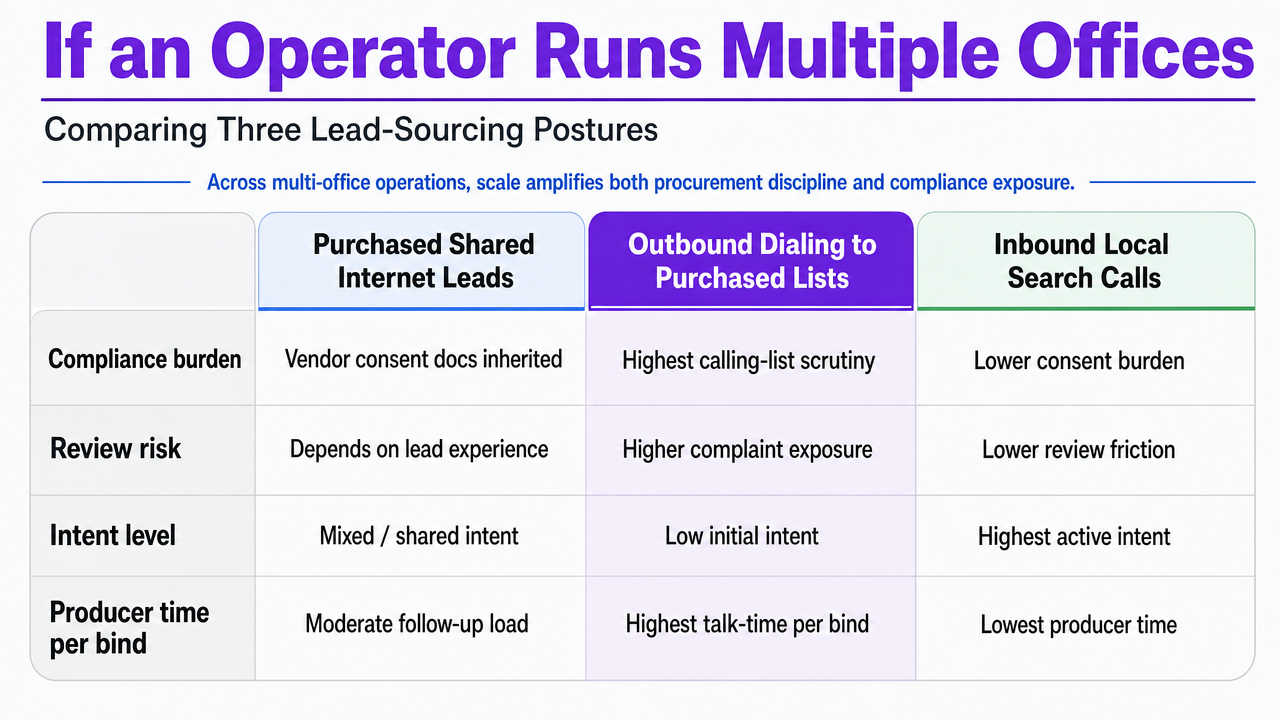
If an Operator Runs Multiple Offices: Comparing Three Lead-Sourcing Postures
The framing shifts here for owners running two or more offices, a branch network, or a rollup of previously independent books. At that scale, lead-sourcing decisions become procurement decisions, and the compliance surface multiplies across every producer seat that touches a contact record.
Three postures dominate the multi-office decision:
- Purchased shared internet leads
- Outbound dialing to purchased or rented lists
- Inbound calls originated from local search
The dimensions that matter across offices are the ones that either scale cleanly or compound risk with volume.
| Dimension | Purchased Shared Internet Leads | Outbound Dialing to Purchased Lists | Inbound Local Search Calls |
|---|---|---|---|
| Consent and compliance burden under TCPA/TSR | Buyer inherits the vendor's consent documentation for every contact; written-consent standard applies if the contact will be autodialed 6, 7 | Highest; prior express written consent required for autodialed or prerecorded calls to wireless and residential lines, with the EBR exemption eliminated for residential prerecorded telemarketing 8 | Consumer initiates the contact; the consent architecture that gates automated outbound outreach does not apply in the same way 8 |
| Review-corpus risk under the 2024 FTC rule | Vendors often bundle reputation-management tools that gate or suppress negative feedback, exposing the agency to civil penalty risk 1 | Low direct exposure, though follow-up review solicitation to dialed contacts inherits the same rule | Risk is controlled at the agency level and scales with review-program discipline across offices 1 |
| Intent level at first contact | Low to mixed; contact filled a comparison form, often shared with three to eight buyers | Cold; producer is interrupting a household or business that did not request contact | High; caller selected the office, chose the moment, and dialed a specific number |
| Producer time per bindable contact | Elevated; producers absorb the friction of duplicate outreach and price-anchored callers | Highest; dial-to-conversation ratios dilute producer hours across many uninterested contacts | Lowest when qualification signals in the profile and website are aligned |
The operational read across a multi-office group is that the two outbound-oriented postures scale their compliance surface linearly with producer count, while the inbound posture scales its qualification surface with content and review discipline. A twelve-office group running dialer-driven lists carries twelve times the consent-documentation exposure of a single office 7. The same group running an inbound local search program carries one set of review-program standards applied across twelve profiles.
Attribution: Knowing Which Search Behavior Produced the Bind
Local search programs fail attribution more often than they fail execution. A profile ranks, calls arrive, policies bind, and the owner cannot tell which of those binds began with a map pack impression, a service-area page visit, a review click, or a returning searcher who typed the agency name directly. Without that read, the qualification work in the earlier sections becomes guesswork about which relevance signals are actually pulling their weight.
Three tracking layers carry most of the load:
- Call tracking numbers assigned separately to the Google Business Profile, the website, and any paid placements let the agency separate organic map calls from website form-fill callbacks and from paid clicks.
- UTM parameters on the profile's website link and on any secondary CTAs distinguish profile-originated web sessions from direct traffic.
- A producer intake field that captures how the caller found the office adds the human check that quantitative tracking misses, especially for callers who searched on one device and dialed from another.
The measurement that matters is bindable calls per source, not calls per source. Volume alone will make a shared-lead vendor look competitive with organic search until close rates enter the calculation. Producer time per bind, tracked by origin, is what tells the owner whether the profile's categories, service pages, and review corpus are compressing the funnel or leaking it.
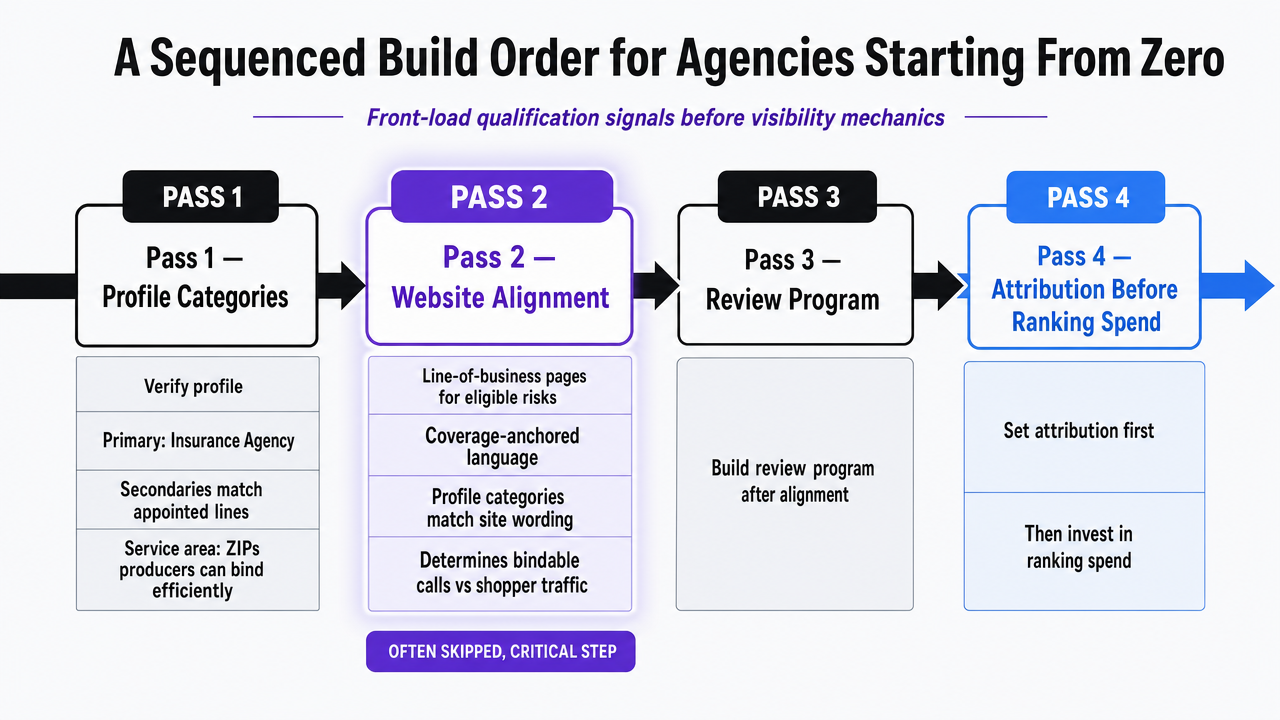
A Sequenced Build Order for Agencies Starting From Zero
Agencies without an existing local search footprint benefit from a build order that front-loads the qualification signals rather than the visibility mechanics.
- The first pass is profile verification and category discipline: primary category set to Insurance Agency, secondaries stacked to match the lines the appointed carriers actually want, and service area boundaries restricted to the ZIP codes producers can bind efficiently.
- The second pass is website alignment. Line-of-business pages named for eligible risks, coverage-anchored language throughout, and a clear match between the categories on the profile and the sentences on the site. This is the step most agencies skip on the way to reviews, and it is the step that determines whether ranking work later produces bindable calls or shopper traffic.
- The third pass is the review program, built to the standard the 2024 FTC rule now enforces: solicitation across the full book, public responses to negative reviews, and disclosure when insiders post 1.
- The fourth pass is call tracking and a producer intake field that captures origin.
Only then does ranking optimization become a rational investment, because by that point the funnel above it filters what arrives.
Frequently Asked Questions
References
- 1.The Consumer Reviews and Testimonials Rule: Questions & Answers.
- 2.Federal Trade Commission Announces Final Rule Banning Fake Reviews and Testimonials.
- 3.Rulemaking: Use of Consumer Reviews and Testimonials.
- 4.Getting on the Map: The Impact of Online Listings on Business Performance.
- 5.Featuring Online Customer Reviews: A Guide for Platforms.
- 6.Telemarketing | Federal Communications Commission.
- 7.Complying with the Telemarketing Sales Rule.
- 8.Report and Order (CG Docket No. 02-278).
- 9.Should we trust online reviews?.
- 10.Federal Communications Commission Declaratory Ruling (EBR).