
Key Takeaways
- Treat blog SEO as a five-stage production loop — signal, plan, produce, approve, measure — because most in-house programs leak leads between stages, not inside the writing itself.
- Educational depth compounds where company news does not: B2B blogs weighted toward educational content draw 52% more organic traffic than those focused on announcements 3.
- Cadence multiplies leads only when quality holds — publishing 16+ posts monthly correlates with 4.5x more leads 2, but thinner briefs erase the gain by attracting traffic that will not convert.
- Focus next on denser briefs, a fixed approval sequence with service levels, and a pillar-by-pillar reporting table that ties URLs to SQLs and influenced pipeline for the CFO conversation.
Why blog SEO stalls as a lead engine inside growing teams
Most in-house content teams do not have a keyword problem; they have a system problem. The blog produces posts, the posts rank for something, and traffic arrives, but the line from published URL to sourced pipeline stays fuzzy enough that leadership starts asking whether the paid budget could absorb the headcount.
The underlying data is not the issue. Companies maintaining an active blog generate 67% more leads per month than companies that do not, according to aggregated inbound benchmarks across multiple B2B studies 2. This figure describes monthly lead volume among companies that publish consistently, setting a ceiling, not a floor.
What breaks the ceiling for growing teams is rarely writing talent. It is the collision between three moving parts: topic selection drifting toward whatever the SME has time to discuss, briefs stalling in Slack while the calendar slips, and measurement stopping at organic sessions because the CRM handoff was never wired. B2B buying groups now research through multiple digital assets before a sales conversation ever opens 12, which means a blog operating without buyer-stage mapping is publishing into a void the buyer has already left.
The rest of this piece treats blog SEO as a production system with five stages — signal, plan, produce, approve, measure — and quantifies where the lead engine leaks between them.
The five-stage production loop: signal, plan, produce, approve, measure
Signal: mining buyer-stage questions instead of keyword lists
Signal gathering is where most in-house programs already lose the lead engine, because the intake looks like a keyword export instead of a set of questions a buying committee is actually asking. Forrester's 2023 Global Buyers' Journey Survey found that B2B buying groups are larger and more self-directed than in prior cycles, working through multiple digital assets across awareness, consideration, and decision stages before they ever open a sales conversation 12. That behavior turns a flat keyword list into an incomplete input.
A working signal layer captures three separate streams:
- The first is search demand: query clusters pulled from a keyword tool, filtered by whether the query implies a decision a buying group is trying to make, not just a term with volume.
- The second is stage-specific question inventory sourced from sales calls, support tickets, and RFP language — the phrasing prospects use before they know what to call their problem. LinkedIn's buyer journey research shows the same buyer wants different assets at different points: framing content when the problem is fresh, product information and demos when evaluation begins 11.
- The third stream is the delta between what marketers publish and what buyers request, a gap LinkedIn documents directly 11.
A signal review that logs all three, weekly, produces a topic queue that reflects buying-group behavior rather than whichever term ranked well in a tool that afternoon.
Buyer-stage question mapping across awareness, consideration, and decision — grounded in Forrester's finding that B2B buying groups consume multiple digital assets before sales engagement 12.
Plan: turning signals into a topical authority map
Signals become a plan when they cluster into pillars a search engine can recognize as topical authority and a buyer can recognize as a coherent point of view. The mistake is treating the editorial calendar as a queue of individual posts. The corrective move is treating it as a map: three to six pillar topics, each with a hub article and eight to fifteen supporting posts that answer the specific sub-questions a buying group raises around that pillar.
Google's own guidance frames content quality through originality, depth, and evident expertise across a subject area, not through isolated posts optimized in a vacuum 8. That standard rewards clusters over calendars. A pillar on merchant onboarding, for example, earns weight when the supporting posts cover chargeback thresholds, KYC document flows, and settlement timing — subjects a single onboarding manager would answer without hesitation.
The planning artifact worth maintaining is a live map: pillars on one axis, buyer stages on the other, existing URLs plotted inside, and gaps flagged with priority. Priority is set by two variables together — search demand from the signal layer and pipeline value of the buying question. Coverage without prioritization produces volume. Prioritization without coverage produces isolated wins that never compound.
Produce: briefs that eliminate the SME bottleneck
Production breaks down inside the brief, not the draft. When a writer receives a brief that names a keyword and a word count, the SME becomes the source for everything else — angle, examples, objections, technical accuracy — and the SME's calendar becomes the ceiling on output. A brief that carries the argument, the buyer question, the intended reader decision, and the supporting evidence collapses that dependency.
A production-grade brief includes:
- The specific buying-group question the post answers
- The reader's next action after reading
- Three to five source citations with the claim each supports
- The internal experts to quote (and the two or three questions to ask them)
- The format expected — comparison table, framework, implementation checklist, or narrative analysis
Google's helpful content guidance calls out original information and first-hand insight as signals of quality 8. Briefs that pre-load the substance and reserve the SME for judgment calls preserve that signal without holding the calendar hostage.
The measurable output of a good brief is cycle time. In teams where briefs carry the argument, drafts land in days rather than weeks, and SME involvement shifts from writing to review. That single change is often what separates a team publishing four posts a month from a team publishing twelve at comparable quality — the writers are the same people, but the input into their work is denser.
Approve: a governance loop that ships without diluting expertise
Approval is where velocity dies in most in-house programs. A draft enters a Slack thread, collects comments from three reviewers with overlapping mandates, and reappears two weeks later with the argument softened into consensus. The fix is not fewer reviewers — it is a defined loop with named roles and a fixed order.
A working approval sequence has three stops:
- Editorial review for argument, structure, and evidence
- SME review for technical accuracy and first-hand accuracy of examples
- Brand or legal review only when the topic triggers a defined risk category
Each stop has a written scope, a service-level target (48 hours is typical for editorial, 72 for SME), and an escalation path if the target slips.
Google's helpful content guidance rewards content that demonstrates real expertise and a clear point of view 8. Approval loops that convert every draft into a committee document strip both. The governance question is not whether experts sign off — they must — but whether the loop protects the expert voice already in the draft rather than sanding it down. Version control matters here: track the change from SME edit to editor edit, and the source of dilution becomes visible within a month.
Measure: from organic sessions to SQL contribution
Measurement that stops at organic sessions cannot survive a budget review. The measurement stack that does has three tiers, each answering a different question a CFO or CRO will ask.
- The first tier is traffic quality: organic sessions, engaged sessions, and scroll depth by pillar. This tier confirms the topical map is attracting the intended reader, not just any reader.
- The second tier is conversion behavior: assisted conversions, form fills sourced to specific URLs, and demo requests where organic touch is present in the path. This tier answers whether the blog is participating in pipeline, which matters because B2B buyers now consume multiple content assets before engaging sales 12. Attribution is imperfect, but attribution presence is the argument — a URL that never appears in a converting journey is not contributing regardless of its ranking.
- The third tier is SQL contribution and pipeline sourced or influenced by organic content, reported monthly against the pillar map.
McKinsey's B2B research points to orchestration and data-driven measurement as what separates go-to-market winners from tactical publishers 13. The reporting artifact that survives the CFO conversation is a single table: pillar, published URLs, organic sessions, assisted conversions, SQLs influenced, and pipeline value influenced — read left to right, it tells the story leadership needs.
Educational depth is the compounding asset, not company news
The single largest lever most in-house blogs never pull is the shift from company-centric copy to educational depth. Backlinko's analysis of thousands of B2B blogs found that those publishing primarily educational content receive 52% more organic traffic than blogs weighted toward company news, product announcements, and PR-style posts, with the average B2B blog drawing 282 organic visits per month 3. The sample is B2B blogs across industries, not a single vertical, so the delta describes a directional pattern rather than a guaranteed lift for any one site — but the direction is unambiguous.
The mechanics behind the gap are straightforward. Company news answers a question almost no one outside the company is searching for. Educational posts — a chargeback dispute walkthrough, a comparison of two onboarding architectures, a field-tested checklist for HIPAA-safe intake — answer questions buying groups actively type into search. Google's helpful content guidance points at the same standard from the other side, asking whether a post provides original information and substantial depth beyond the obvious 8.
The reason in-house teams under-produce educational content is not editorial preference. It is briefing friction. Company news writes itself from an internal announcement; educational depth requires an SME interview, a source review, and an argument the writer has to defend. Teams that fix the brief — pre-loading the argument, the buyer question, and the source list — convert that friction into a repeatable output. The compounding effect is what matters over twelve months: a single educational pillar keeps earning traffic and links long after a launch announcement has dropped out of the index.
Educational B2B blogs receive 52% more organic traffic than company-focused blogs, against an industry average of 282 organic visits per month 3.
Test an End-to-End SEO Blog Workflow Now
Experience a measurable SEO content workflow and publish live blog articles risk-free for seven days.
Cadence economics: what publishing frequency actually returns
Cadence is where most in-house programs discover their production system is theoretical. The aggregated inbound data reports a steep curve at the top end: companies publishing 16 or more blog posts per month generate 4.5 times more leads than companies publishing four or fewer, layered on top of the earlier finding that active blogs generate 67% more leads per month than sites without one 2. Both figures describe monthly lead volume across mixed B2B samples, not a controlled per-post lift, so the honest read is a strong directional signal — not a formula that guarantees 4.5x for any specific team crossing a threshold.
The economics matter because the curve is not linear. Four posts a month is roughly one per week, a rhythm most two- or three-person content teams can sustain if the brief system holds. Sixteen is a different operation entirely: four posts a week, sustained, at the quality bar Google's helpful content guidance describes — original information, first-hand expertise, substantial depth beyond the obvious 8. Hitting that cadence with the same headcount is the actual question, and the answer lives in the produce and approve stages, not in hiring.
The quality-versus-quantity tension is real and worth stating plainly. Google's guidance is explicit that content created primarily to rank rather than to help people will underperform regardless of volume 8. A team that doubles output by thinning briefs will publish more URLs and generate fewer leads, because the traffic those posts attract will not convert. The cadence multiplier in the underlying data assumes the posts remain useful — not that any 16 posts beat any four.
The operational path to higher cadence without quality decay runs through three levers:
- Denser briefs that carry the argument and evidence into the writer's first draft
- A fixed approval sequence with service-level targets rather than open-ended Slack review
- A topical map that keeps every new post reinforcing an existing pillar rather than starting a new one
Teams that pull those levers tend to move from four posts a month to eight or twelve before headcount becomes the constraint. Sixteen is achievable, but only when the system produces the marginal post at the same evidence density as the first.
Monthly lead volume by publishing tier: companies publishing 16+ posts per month generate 4.5x more leads than those publishing four or fewer, against a baseline where active blogs already generate 67% more leads than sites without one 2.
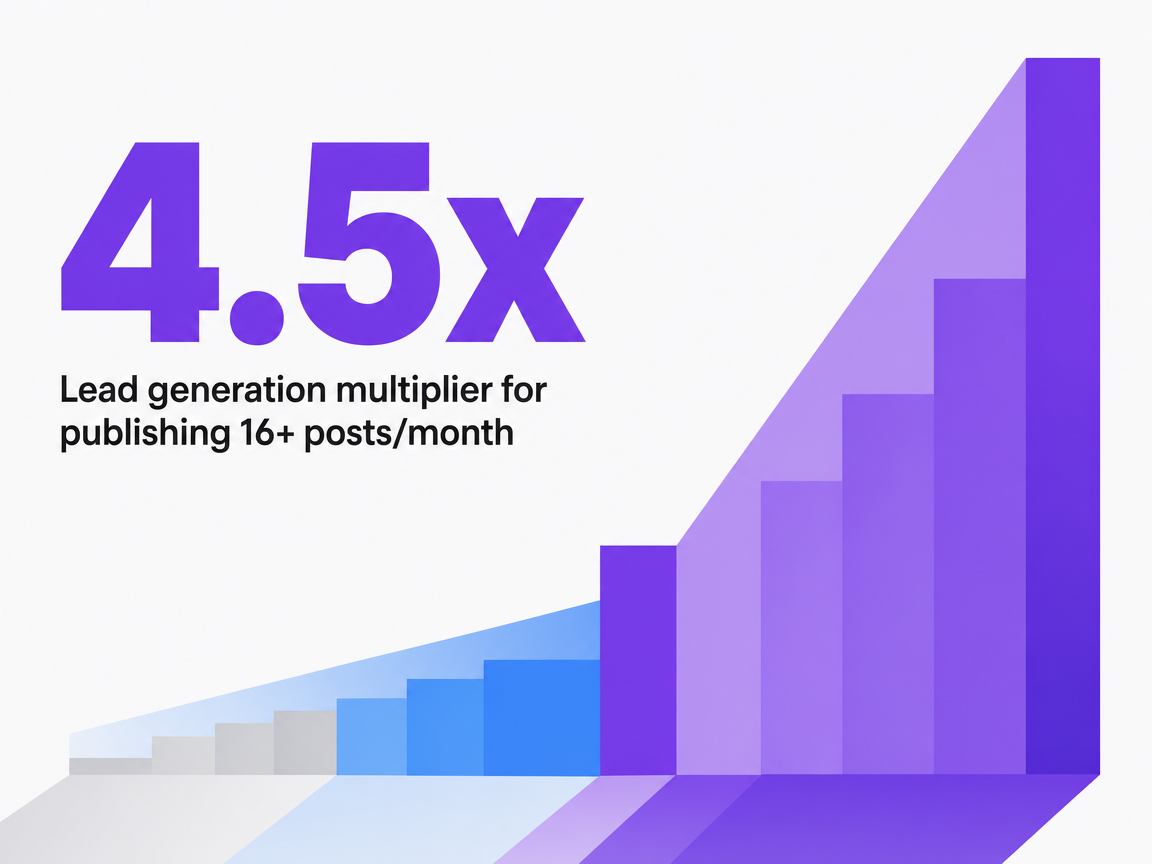 Lead generation multiplier for publishing 16+ posts/month
Lead generation multiplier for publishing 16+ posts/month
What ranks now: Google's guidance on helpful content and AI search
First-hand expertise as the ranking substrate
Google's public guidance has moved the ranking conversation away from surface signals and toward whether a post reads like it was written by someone who has actually done the work. The helpful content documentation asks writers to self-audit for original information, substantial depth, and insight beyond the obvious — and to consider whether a post was created primarily to help people rather than to rank 8. The 2022 update announcement made the same point in sharper terms: focus on content for people, and demonstrate first-hand expertise and depth of knowledge 9.
For in-house teams, that guidance changes what a good brief looks like. A post that recites what the reader could already find in the first three search results does not clear the bar. A post that walks through a decision the writer or SME has personally made — the trade-off, the failure mode observed, the number they landed on — does. The practical implication is that SME time is not a bottleneck to route around; it is the raw material the ranking system is looking for. Briefs that pre-load structure and evidence let the SME spend fifteen minutes on the parts a search engine cannot fake: the specific example, the counterintuitive finding, the framework built from repeated practice.
Structuring posts for AI search experiences
AI-mediated search changes the retrieval unit. Where classic search returned a ranked list of pages, AI experiences increasingly extract passages, synthesize across sources, and answer the query inline. Google's 2025 guidance on succeeding in AI search experiences emphasizes creating content that is easy for the system to understand and useful for users across evolving surfaces 10. The underlying quality standard has not shifted; the packaging around it has.
Three structural moves matter for posts intended to hold up in both classic and AI search:
- Self-contained sections: each H2 answers a discrete question in a way that reads correctly if pulled out of context, because AI experiences often surface a single passage rather than the whole post.
- Explicit claims paired with evidence in the same paragraph, so a passage carries its own source when extracted.
- Entity-clear language — naming the specific product category, workflow, or metric rather than relying on pronouns and prior context.
The same structural discipline improves classic organic performance, since Google's core guidance already rewards clarity, descriptive headings, and content that helps users make a decision 7. AI readiness, in practice, is a stricter version of the editorial habits a strong blog program should already be enforcing.
Defending the organic investment: a measurement stack for the CFO conversation
The organic budget rarely loses on merit. It loses because the reporting artifact does not answer the question a CFO is actually asking, which is whether the next dollar of content spend returns more than the next dollar of paid. The measurement stack that survives that conversation has to move past traffic and into pipeline participation, and it has to do so with market context that frames content spend as a category investment rather than a line item.
Market-scale data helps set the frame before the internal numbers arrive. The content marketing segment of the B2B lead generation market was valued at USD 3.2 billion in 2023 and is forecast to reach USD 7.4 billion by 2032, while the SEO segment grows from USD 1.8 billion to USD 4.2 billion over the same period, with SEO expanding at a projected CAGR of roughly 10.9% 4. Those are category-level forecasts across the global B2B market, not a promise of internal return — but they establish that competitors and adjacent categories are increasing organic investment, not retreating from it.
The internal artifact that closes the conversation is a single reporting table read left to right: pillar, published URLs, organic sessions, assisted conversions, SQLs influenced, and pipeline value influenced. McKinsey's B2B research points to orchestrated, data-driven measurement as what separates go-to-market winners from tactical publishers 13. Attribution will be imperfect at every column; presence in the converting journey is the argument the CFO can accept.
B2B lead generation market growth, 2023 to 2032: content marketing expands from USD 3.2B to USD 7.4B while the SEO segment grows from USD 1.8B to USD 4.2B at a projected CAGR of 10.9% 4.
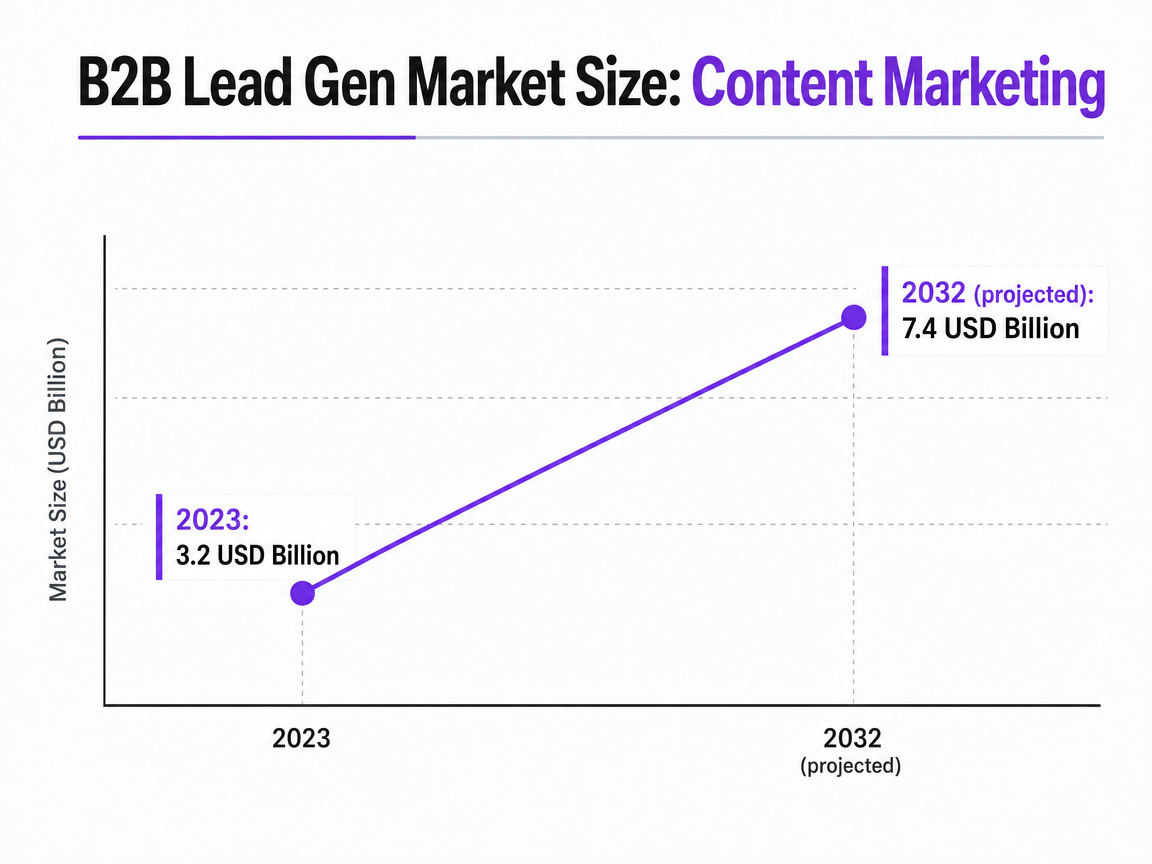 B2B Lead Gen Market Size: Content Marketing
Shows the actual (2023) and projected (2032) market size for the content marketing segment of B2B lead generation.
See How Leading Teams Systematize Blog SEO to Accelerate Lead Generation
Connect with a strategist to benchmark your current blog SEO workflow, identify high-impact automation opportunities, and model lead growth scenarios grounded in real performance data.
In-house economics vs. agency retainer: a variables-only comparison
The budget question underneath every content program is whether the next published post costs less produced in-house than procured through an agency retainer. The honest answer is that neither model wins on cost alone — the comparison depends on variables the operator controls and rarely quantifies in the same table.
Four variables carry the comparison:
- On the in-house side: the loaded cost of a writer FTE (salary, benefits, tooling, management overhead), monthly output at the team's current cycle time, and the share of SME hours consumed per post.
- On the agency side: the retainer fee, the contracted output per month, and the review hours the in-house team still spends briefing, editing, and approving agency drafts.
Cost-per-published-post is the shared denominator that makes the two models legible against each other.
| Variable | In-house team | Agency retainer |
|---|---|---|
| Fixed monthly cost | Loaded writer FTE + tooling | Retainer fee (tiered by output) |
| Output ceiling | Cycle time × writer capacity | Contracted posts per month |
| SME hours per post | Interview + review | Interview + brief + heavier review |
| Cost per published post | Fixed cost ÷ posts shipped | Retainer ÷ posts shipped |
| Marginal post cost | Near zero until capacity breaks | Overage rate or new tier |
The variable that flips the math is cycle time, not headline rate. A team publishing eight posts a month against a two-writer loaded cost lands at a different per-post number than the same team publishing four, without changing headcount. That is the lever the produce and approve stages actually move — and the reason the retainer comparison rarely settles on a single answer.
If the operator manages multiple locations: how a pillar compounds across sites
Scope shift: the reader here is a content manager working across a portfolio of locations — a dental group, a home services brand with regional sites, a senior living operator with property-level domains — rather than a single-brand blog. The production system does not change. The unit economics do.
A pillar built once at the brand level can be localized across sites without a second research and briefing cycle. The educational spine — the argument, the SME quotes, the evidence — is fixed. What varies per location is the local specificity: named service areas, regional regulations, staff quoted, and the internal links pointing to that location's booking or intake path. The compounding effect is that a single production pass funds discoverability across multiple domains, and the cost-per-published-post falls as the location count rises. Google's core guidance still applies to each localized version — clarity, descriptive headings, and content that helps a user decide 7 — but the marginal writing cost per site drops sharply once the pillar exists.
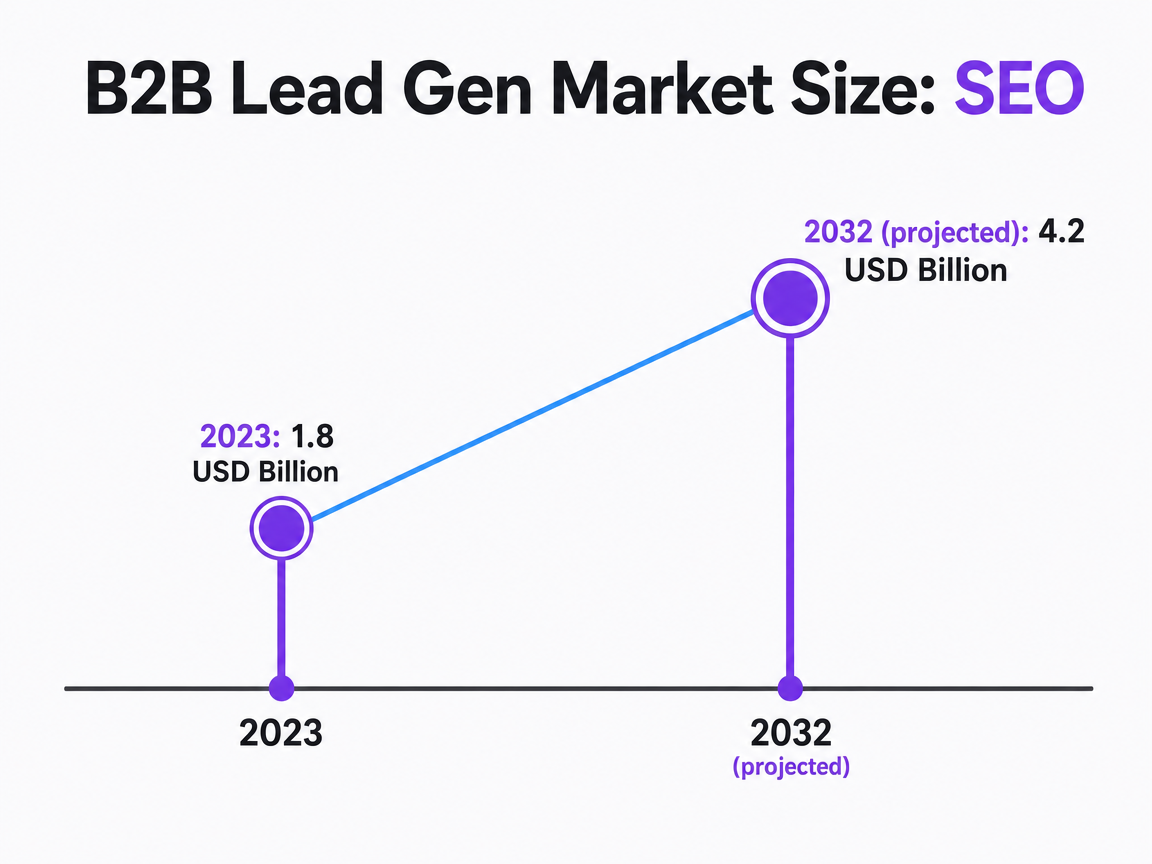
Shows the actual (2023) and projected (2032) market size for the SEO segment of B2B lead generation.
Frequently Asked Questions
References
- 1.Discover B2B Blog Content Marketing Stats in 2023.
- 2.Revenue And Business Impact of Content-Led Lead Generation Statistics.
- 3.The B2B Content Marketing Report.
- 4.B2B Lead Generation Market Size, Growth, Trends, Report.
- 5.B2B Content Marketing Trends to Boost Your 2026 Strategy.
- 6.Content Marketing Infographic: B2B Benchmarks.
- 7.Search Engine Optimization (SEO) Starter Guide.
- 8.Creating Helpful, Reliable, People-First Content.
- 9.What creators should know about Google's August 2022 helpful content update.
- 10.Top ways to ensure your content performs well in Google's AI search experiences.
- 11.Rethink The B2B Buyers Journey.
- 12.Forrester's 2023 Global Buyers' Journey Survey.
- 13.5 Fundamental Truths: How B2B Winners Go to Market.