
Key Takeaways
- Inquiry-share gaps trace back to production architecture: networks running one editorial calendar across all locations capture 34-42% of inquiries from organic search, while fragmented operators stall at 12-18% 68.
- Discovery has moved upstream to AI assistants and voice, where 41% of mobile healthcare queries originate and 34% include location qualifiers, making GBP and claim-ready content the new ranking surface 1.
- Reviewer capacity, not writer headcount, caps content output; pre-attached substantiation and a published claim taxonomy compress clinical review from 45-60 minutes to 15-20 minutes per asset 7.
- Sequence the rebuild: consolidate the editorial calendar, restructure reviewer workflow, centralize GBP production, then deploy a two-layer attribution stack that preserves multi-touch credit without exposing PHI 213.
The Inquiry-Share Gap Is a Production Problem
The widest performance gap in healthcare search today is not between strong and weak keyword strategies. It sits between operators that run a single, account-level content production system and those that run one per location. That gap shows up first in inquiry share, then in patient acquisition cost, then in the budget conversation with finance.
Why Coordinated Networks Pull 34-42% of New Patient Inquiries
Hospital systems running coordinated search programs report 34-42% of new patient inquiries originating from organic search 6. Single-location practices, benchmarked separately, average 12-18% of new patient inquiries from the same channel, with patient acquisition costs of $18-45 per booked appointment via search 8. This disparity is not solely explained by keyword sophistication or domain authority. It correlates with whether a network uses one editorial calendar across its entire footprint or manages separate programs for each site.
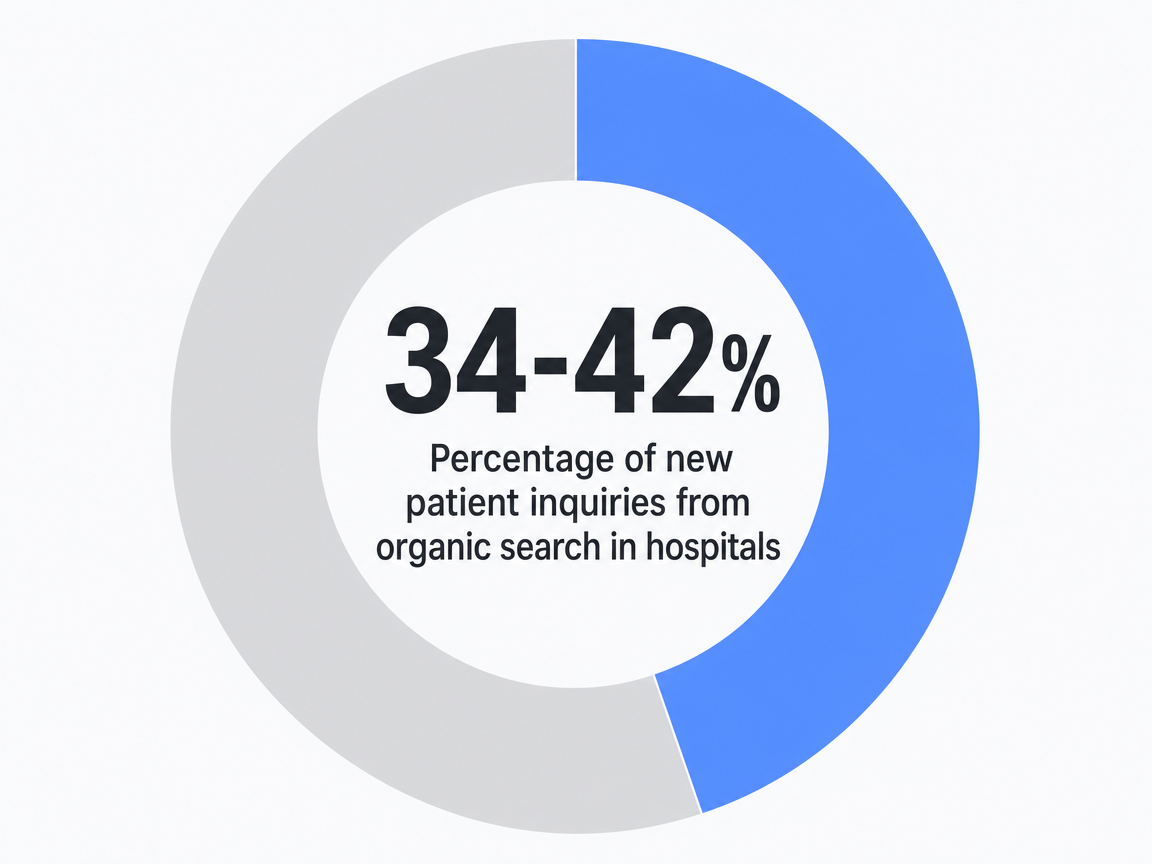 Percentage of new patient inquiries from organic search in hospitals: 34-42%
Coordinated networks share a reviewer pool, a service-line taxonomy, and an internal linking model that compounds across every location page. Fragmented operators rebuild these assets at each site, often through different agencies on different cadences. The same clinical service square footage produces a fraction of the indexable surface area, which is what search engines rank against local intent.
The gap also shows up in unit economics. When organic search delivers 34-42% of inquiries at a search-channel CAC inside the $18-45 band 8, the blended CAC for the network falls because paid channels carry less volume. When organic delivers only 12-18%, paid spend must compensate, and the same agency relationships that caused fragmentation often bill against that paid budget.
What Compounds Inside a Single Editorial Calendar
A single editorial calendar at the account level is a deceptively simple artifact, yet it generates most of the inquiry-share differential. Three behaviors compound within it: service-line content written once is adapted across every location offering that service, rather than commissioned multiple times from different agencies. Internal links resolve across the full network, giving a 25-location operator the link graph of a large network instead of 25 small ones. Reviewer time, a critical constraint, is scheduled against a unified queue rather than being a point of contention among competing vendors.
Gartner's analysis of healthcare digital transformation indicates a 2.3x efficiency delta for coordinated channel strategies compared to single-channel or single-site approaches, with meaningful ROI typically appearing in 5-7 months 13. This timeframe aligns with RAND's findings on healthcare workforce digital capability: the median time to implement a coordinated multi-location strategy is 5-7 months, with 78% of practices citing internal expertise gaps as the reason rebuilds stall 7.
For a VP of Marketing, the editorial calendar is not merely a scheduling tool; it is the asset that translates service-line investment into network-level visibility. Its absence often explains why budget feels overspent relative to output. This dynamic is further impacted by the evolution of generative search and voice technologies.
Generative Search and Voice Have Moved the Discovery Layer
The discovery layer above the SERP has undergone significant changes. AI assistants now answer initial healthcare queries before a blue link is clicked, and mobile voice queries have altered the requirements for location pages. Both changes impact production architecture before they affect rankings.
AI Assistants Now Sit Upstream of the SERP
Patient interaction with a network increasingly begins within an AI assistant, rather than on a search results page. This shifts the citation surface, not just the ranking surface. When an assistant summarizes a service-line answer and names a provider, the network either appears in the citation set or it does not, a nuance conventional rank-tracking dashboards often miss.
For a VP of Marketing, the immediate consequence is attribution, not ranking. Deloitte's patient journey research indicates an average pre-conversion path of 4.2 touchpoints, with search typically occupying the first or second position 12. When an assistant absorbs the position-1 touchpoint, the subsequent click to a location page arrives with thinner referrer data, leading last-click models to understate organic search's contribution to booked appointments.
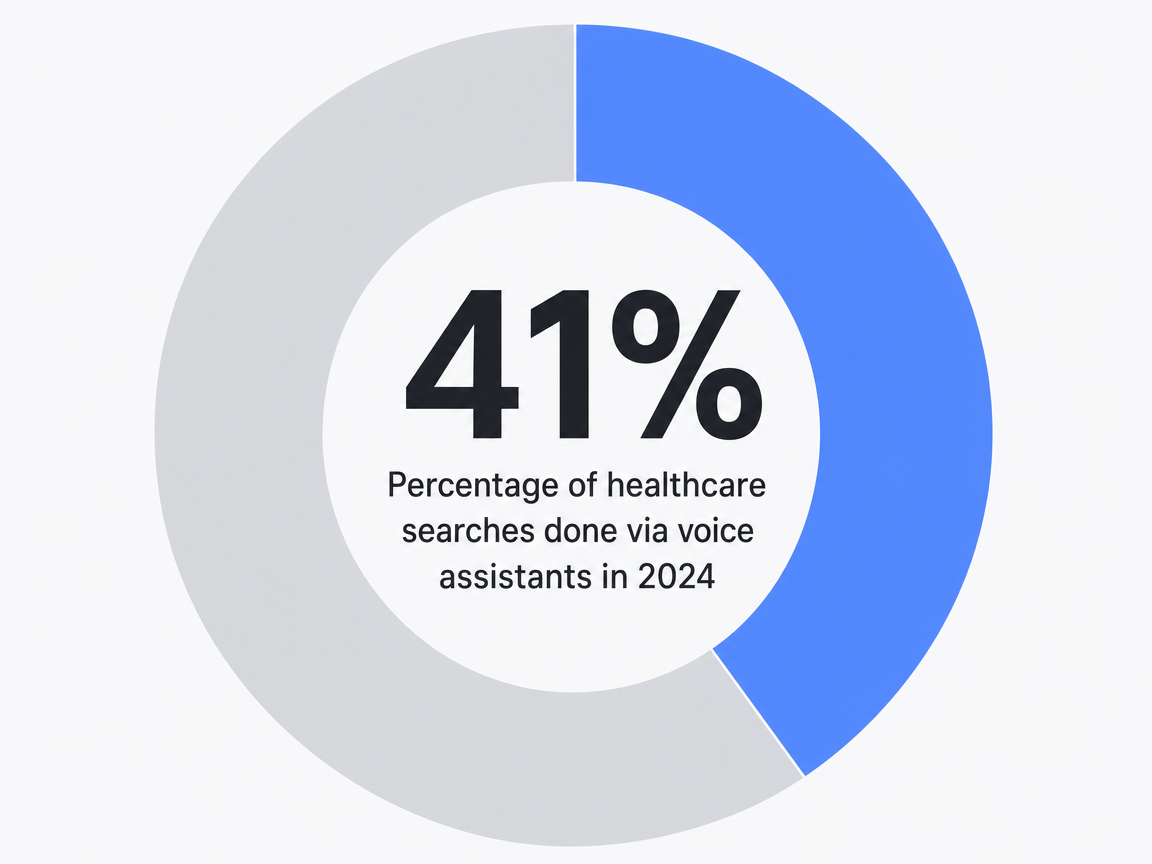 Percentage of healthcare searches done via voice assistants in 2024: 41%
The production response involves feeding AI assistants in the same way location pages previously fed the SERP. Service-line pages require clean clinical claims, structured FAQs designed to answer questions an assistant might summarize, and provider bios with verifiable credentials that models can cite without hallucinating. AMA survey data reveals that only 22% of physicians are confident in their practice's search visibility strategy, with 45% citing a lack of marketing expertise as a barrier 3. This gap widens when the citation target is an assistant rather than a traditional search results page, as the writing standard leans closer to clinical reference copy than marketing copy.
Voice Queries Reshape Local Pack Production
Voice search has evolved from a novelty to a measurable component of healthcare discovery. Peer-reviewed analysis indicates voice accounts for 41% of healthcare-influenced queries on mobile, with adoption reaching 19% among patients aged 55 and older and 15% in rural markets, compared to a 12% national baseline 1. Two behavioral details are particularly significant: 34% of voice queries include a location qualifier, and voice users convert to booked appointments at an 18% higher rate than text users 1.
These statistics highlight the importance of Google Business Profile (GBP) production over website production. A voice query like "orthopedic urgent care open now near me" resolves within the local pack and the assistant's answer layer before a website is rendered. Key ranking inputs include GBP categories, accurate hours, service attributes, location-specific Q&A, and review velocity per location. For a 25-location operator, this translates to 25 distinct production queues, each requiring its own update cadence, photo refresh, and Q&A moderation.
While per-location agencies often manage both a website and a GBP listing, GBP work frequently degrades first due to billing complexities. Networks achieving higher inquiry shares manage GBP as a centralized workflow, utilizing location-aware templates, a single moderation pool for Q&A, and a review-response SLA enforced across their entire footprint.
The practical implication is that a voice strategy is fundamentally a local-pack production strategy. Site-level technical SEO has minimal impact on voice queries that never reach the website. The effort lies in ensuring profile completeness across all locations, implementing schema that mirrors GBP categories, and maintaining a consistent review and Q&A cadence that signals an active, current operation to AI assistants.
Trial Real-World Healthcare SEO Content Production
Experience data-driven patient acquisition content live on your own healthcare site—no commitment required.
Compliance as a Production Constraint, Not a Review Step
Most healthcare marketing organizations treat HIPAA, CMS substantiation, and E-E-A-T as separate review gates at the end of a content workflow, creating bottlenecks. Networks that consistently ship review-cleared content at scale have integrated these compliance requirements directly into the production specification. This changes how writers draft content, what reviewers focus on, and how throughput is measured.
HIPAA, CMS Substantiation, and E-E-A-T Collapsed Into One Pipeline
HIPAA enforcement actions related to marketing practices increased by 43% in 2023-2024, with 62% of cases involving unauthorized patient data use in remarketing and average settlements reaching $1.2M 2. These violations typically stem from production processes that lacked privacy specifications at the briefing stage. Examples include agencies installing pixels, location pages collecting form data without a Business Associate Agreement (BAA), or remarketing audiences being built from PHI-adjacent signals that were not flagged.
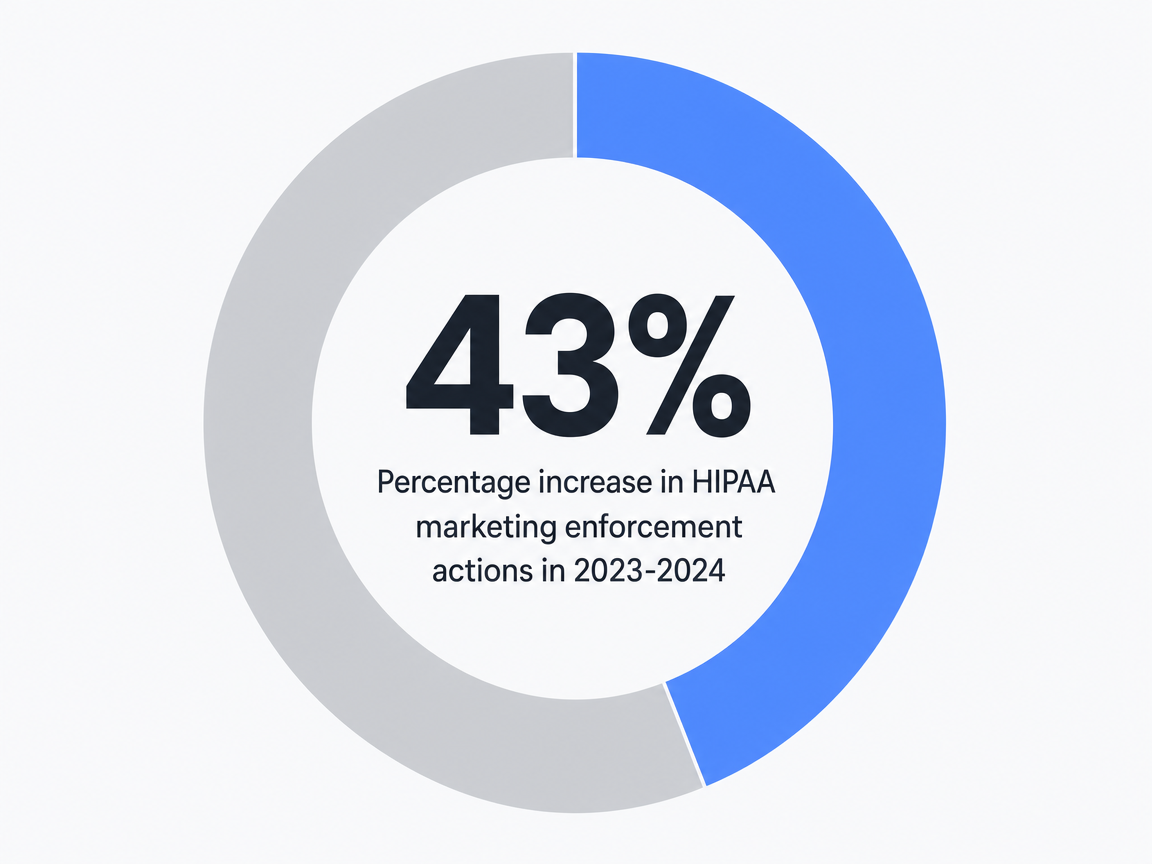 Percentage increase in HIPAA marketing enforcement actions in 2023-2024: 43%
The CMS layer introduces a second specification. Medicare-participating providers must adhere to claims substantiation requirements, meaning any service-line page asserting an outcome, wait time, success rate, or comparative claim must be supported by clinical evidence that can withstand an audit 5. The CDC's accuracy guidance for provider digital communications adds a third standard, requiring consistency with current clinical guidelines for all patient-facing copy 4.
Fragmented operators typically manage these as three sequential reviews: marketing drafts the page, legal reviews for HIPAA, and a medical director reviews for substantiation and clinical accuracy. The page then undergoes revisions, recirculates, and often ships weeks late or not at all.
Coordinated networks treat these three standards as a single upstream specification. Briefs include the substantiating clinical reference before a writer is assigned. Schema and form architecture are pre-cleared by privacy counsel at the template level, rather than per page. Reviewer comments are resolved against a published claim taxonomy instead of personal judgment. This approach allows medical directors, who might otherwise spend 45 minutes per page, to confirm a draft already written to specification in 15 minutes.
This integration allows compliance to scale with content volume. The 43% increase in enforcement actions did not change the requirements for healthcare publishers, but it significantly increased the cost of discovering those requirements late in the process.
The Reviewer Pool Is the Binding Constraint
Healthcare content output is rarely limited by writer capacity; reviewer capacity is the true bottleneck. RAND found that 78% of healthcare practices report insufficient internal marketing expertise 7, and a similar shortage exists upstream in the clinical reviewer pool responsible for approving every claim. Physicians, PAs, and clinical directors represent this bottleneck, and their hours are not elastic.
The arithmetic is stark. A 25-location operator aiming for a defensible content program targets approximately 600 review-grade assets annually, encompassing service-line pages, condition guides, location-specific FAQs, and provider bios. In a fragmented workflow where reviewers encounter drafts without prior context and must independently verify substantiation, each asset consumes 45 to 60 minutes of clinical time. At the midpoint, this totals roughly 500 clinical hours per year for the program, equivalent to a quarter-time physician dedicated solely to copy review.
A structured pipeline that pre-attaches substantiating references, pre-clears templates, and provides reviewers with a checklist against a claim taxonomy compresses each asset review to 15 to 20 minutes. The same 600 assets then require only 125 to 170 clinical hours, representing a 3-4x reduction in the use of this critical resource 7.
This efficiency gain directly impacts inquiry-share economics. Operators unable to recover these clinical hours cap content output based on available review capacity, regardless of writer headcount or agency retainers. Conversely, operators who restructure the upstream brief to include reviewer research before the reviewer begins work can ship 2-3x more pages using the same physician calendar.
The practical takeaway is that scaling healthcare content is a reviewer-workflow problem, not a writing problem. The next section examines three production models through this lens, allowing a CFO to compare them effectively.
Three Production Models a CFO Can Compare
A VP of Marketing presenting next year's plan to a CFO needs to articulate the production model concisely, rather than just a list of tactics. The three models below represent realistic options for multi-location operators: a per-location agency retainer, an in-house team augmented by contractors, and an account-level production platform. Key variables for finance include cost structure, content throughput, medical review processes, internal linking capabilities, attribution coverage, and time to first measurable lift.
Per-Location Retainer, In-House Plus Contractors, Account-Level Platform
The table below compares these three models across dimensions relevant to a CFO. Pricing reflects benchmarks and disclosed figures, while other aspects are qualitative due to significant variations in retainer rates and salary loads across different markets.
| Dimension | Per-Location Agency Retainer | In-House Team + Contractors | Account-Level Production Platform ||---|---|---|---|| Cost structure | Monthly retainer per location, billed independently; paid media often layered on the same invoice | Fixed salary load plus variable contractor spend; scales with headcount | Account-level subscription covering all locations under one plan; trial pricing disclosed at $599/mo || Content output cadence | Uneven across locations; faster sites pull reviewer attention away from slower ones | Capped by internal headcount; contractor surges produce quality variance | Capped by reviewer pool, not writer capacity; throughput compounds once the brief library is built || Medical review handling | Each agency manages its own reviewer access; substantiation is reconstructed per page | Centralized but unstructured; reviewers see drafts cold and chase down their own clinical references | Substantiating reference attached at brief stage; reviewers work against a published claim taxonomy || Internal linking behavior | Links resolve within each site or microsite; no cross-location authority transfer | Possible in principle, rarely executed; depends on whether the in-house lead owns the full sitemap | Links resolve across the full network by default; service-line and location pages share a single graph || Attribution coverage | Each agency reports on its own slice; blended view is reconstructed in spreadsheets | Unified if the analytics lead is senior; degrades when contractors touch tagging | Single measurement layer across all locations and service lines || Time to first measurable lift | Staggered per location; some sites lift in two quarters, others never | 5-7 months once the team is fully staffed 7 | 5-7 months for coordinated multi-location implementation 13 |
Two key metrics underpin the economics. McKinsey's channel analysis indicates an average organic search ROI of 340% for healthcare providers, with top performers allocating 28-35% of their digital budget to SEO 9. MGMA's benchmarking shows a similar 28-35% allocation band for multi-specialty groups and an $18-45 search-channel CAC 8. The model that effectively converts this allocation into the higher end of the inquiry-share band is one that can ship review-cleared content efficiently, aligning with the reviewer-hour calculations discussed previously. The retainer model rarely achieves this; the in-house model can if the reviewer workflow is restructured; and the platform model is specifically designed around this principle.
Where Each Model Breaks Within Two Quarters
Each model has a predictable failure mode, often evident to a CFO within two quarters of operating data.
The per-location retainer model fails at coordination. Each agency optimizes its own contract, preventing the network from achieving a single editorial calendar, cross-location internal linking, or a unified attribution view. The 78% of practices RAND identifies as lacking internal marketing expertise 7 cannot effectively manage these vendor gaps, which persist. Consequently, inquiry share stagnates in the 12-18% band observed by MGMA for fragmented operators 8.
The in-house team plus contractors model breaks due to reviewer throughput. Increasing writer headcount does not resolve the bottleneck because clinical review hours remain the binding constraint. AMA data shows only 31% of practices systematically measure marketing ROI 11, a symptom of teams constantly addressing review queues, which defers attribution and measurement. This model succeeds for operators who restructure the upstream brief but stalls for those who do not.
The account-level platform model fails when governance is treated as a mere sign-off rather than a foundational specification. If the marketing team approves briefs without the medical director's claim taxonomy embedded, the throughput advantage disappears at the review gate, regardless of the production layer's structure. Gartner's 5-7 month ROI window assumes coordinated execution, not parallel chaos under a single login 13.
The critical question for the CFO is not which model is cheapest per asset, but which model converts the 28-35% organic budget allocation into inquiry share within two quarters, and which one is still rebuilding its brief library a year later.
Scale Patient Acquisition with Data-Driven Healthcare SEO Automation
Connect to explore how leading healthcare groups and agencies streamline multi-site SEO, automate content workflows, and achieve measurable improvements in patient acquisition efficiency—without agency overhead.
Attribution Economics That Survive a HIPAA Audit
Attribution is where the argument for search-channel investment either succeeds with the CFO or quietly fails. Healthcare attribution must achieve two objectives simultaneously: assign credit across a multi-touch path averaging 4.2 touchpoints 12, and do so without transmitting protected health information (PHI) to ad platforms or analytics tools lacking a Business Associate Agreement. Most networks prioritize one objective at the expense of the other. Operators achieving higher inquiry shares implement an attribution stack designed to meet both constraints from the outset.
Modeling 4.2 Touchpoints Without PHI Exposure
The 4.2-touchpoint average for healthcare conversions, with search typically in position 1 or 2 12, renders last-click reporting inadequate. Last-click models credit the channel that closed the loop (usually direct or branded paid), thereby understating the organic touchpoint that initiated the path. A CFO reviewing such a report might conclude search is underperforming and reallocate budget away from the channel actually driving inquiries.
The HIPAA constraint exacerbates this problem. The 43% increase in marketing-related enforcement actions in 2023-2024, with 62% of cases involving unauthorized patient data use in remarketing pixels and similar tools 2, precludes the simple solution of routing appointment confirmation data back into ad platforms. Conversion APIs that hash patient identifiers still create exposure if the underlying event is a clinical visit. Most off-the-shelf multi-touch attribution products were not built with this constraint in mind.
The production response is a two-layer model. Layer one is a server-side measurement layer that captures pre-conversion behavior, search referrer, page sequence, and GBP interaction, without ever touching the appointment record. Layer two is a deidentified post-booking match against the practice management system, executed within the covered entity's environment, which attributes booked visits back to the upstream session. These two layers never share PHI. Attribution is preserved because credit assignment relies on session data, not patient data.
This architecture also provides a defensible answer to an auditor asking how marketing measures ROI without exposing PHI: it does not require PHI to do so.
The 28-35% Allocation Question and What It Actually Funds
The 28-35% digital budget allocation to organic search among top performers and multi-specialty groups 89, which VPs are asked to defend, is often presented to finance as an SEO line item. This framing weakens the argument. This allocation does not fund SEO as a discipline; it funds the production system that transforms service-line investment into indexable surface area across every location, along with the reviewer workflow necessary to publish that content.
Broken down, the allocation covers four cost centers a CFO can identify: the editorial calendar and brief library, the reviewer pool and claim taxonomy, the GBP and local-pack production queue, and the attribution layer described above. Removing any one of these components degrades the 340% organic ROI McKinsey records 9 towards the 12-18% inquiry-share band where fragmented operators reside 8.
The operator-readiness aspect is often overlooked by finance. AMA data indicates only 31% of practices systematically measure marketing ROI 11, and only 22% of physicians are confident in their practice's search visibility strategy 3. A network funding the 28-35% allocation using an outdated, fragmented architecture is essentially buying retainers, not output. The same funds, channeled through an account-level production system like Vectoron, finance the brief library, reviewer efficiency, and the measurement layer that genuinely converts allocation into inquiry share. The allocation question, therefore, is fundamentally a production-architecture question disguised as a budget item.
What to Rebuild Next Quarter
The rebuild list is concise, and the sequence is crucial. Networks attempting to fix everything simultaneously often stall due to reviewer capacity within ninety days. In contrast, networks that sequence the work effectively achieve the 5-7 month ROI window identified by Gartner for coordinated multi-location implementation 13.
First, consolidate the editorial calendar at the account level before commissioning any new content. Establish one queue, one service-line taxonomy, and one brief library. Without this, additional spending will only fund duplication.
Second, restructure the reviewer workflow around a published claim taxonomy and pre-attached substantiating references. This step is key to converting the 28-35% organic budget allocation of top performers 9 into actual published pages, by removing reviewer hours as the cap on throughput.
Third, centralize the GBP and local-pack production queue across all locations. Voice and AI assistant-layer discovery primarily resolve here before reaching the website.
Fourth, implement the two-layer attribution stack: server-side session measurement upstream and deidentified post-booking matching downstream. Without this, the CFO conversation will default to last-click attribution, leading to search losing budget it has earned.
The 78% of practices RAND identifies as lacking internal marketing expertise 7 cannot execute four parallel rebuilds with their existing teams. Vectoron serves as the account-level production layer for operators choosing to consolidate this work rather than staff it internally.
Frequently Asked Questions
References
- 1.Voice Search and Healthcare Provider Discovery: Emerging Trends in Patient Information-Seeking Behavior.
- 2.HIPAA Journal: Healthcare Marketing Compliance Enforcement Trends and Digital Strategy Implications.
- 3.American Medical Association: 2024 Physician Digital Health Strategy Survey Results.
- 4.CDC Guidance: Healthcare Provider Digital Communication and Patient Information Accessibility Standards.
- 5.CMS Program Operating Manual: Medicare Provider Marketing and Patient Solicitation Requirements.
- 6.American Hospital Association: Patient Acquisition Strategy and Digital Marketing for Hospital Systems.
- 7.RAND Corporation: Healthcare Workforce Digital Literacy and Patient Acquisition Capability.
- 8.Medical Group Management Association: Patient Acquisition Channel Benchmarks and Performance Metrics.
- 9.McKinsey: Patient Acquisition Through Digital Channels—ROI and Channel Mix Analysis.
- 10.U.S. Bureau of Labor Statistics: Healthcare Service Industry Employment Data.
- 11.American Medical Association: Patient Acquisition and Digital Marketing Best Practices.
- 12.Deloitte: Healthcare Digital Transformation and Patient Journey Mapping.
- 13.Gartner: Healthcare Digital Transformation and Channel Effectiveness.