Key Takeaways
- Hospital SEO succeeds or fails on coordination, not tactics, because fragmented vendors managing service lines, listings, and reputation produce contradictory data that search engines and AI agents penalize 8.
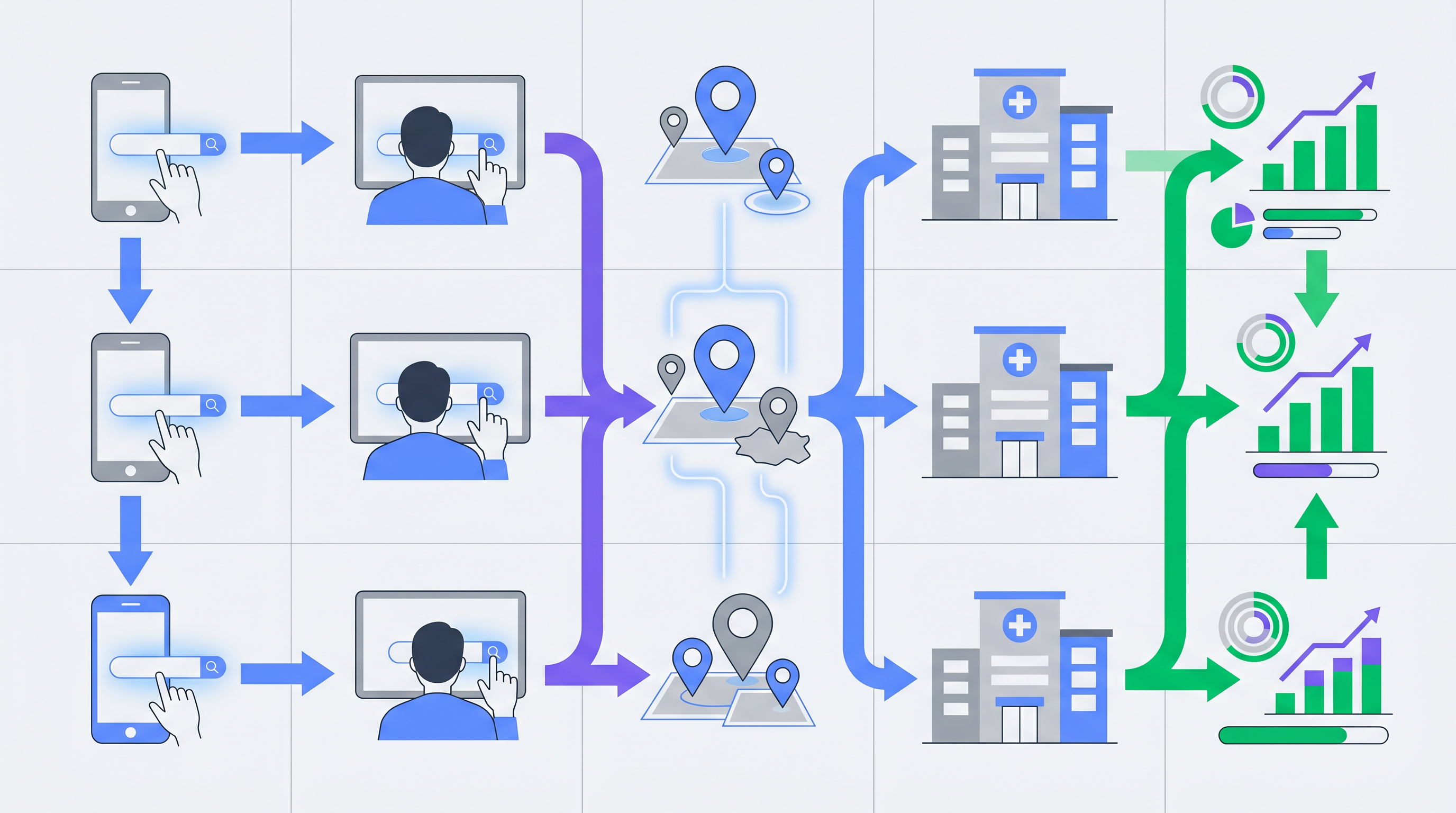
- Six workstreams—service-line content, local entity data, technical SEO, reputation, AI answer optimization, and measurement—must operate from a single plan to convert search visibility into scheduled appointments 2.
- Decision criteria should prioritize physician-authored service-line clusters mapped to clinical decisions, a canonical entity dataset reconciled across every surface, and attribution windows calibrated to each service line's actual decision timeline 4.
- Teams should focus first on a 90-day sequence: reconcile canonical entity fields, rebuild the three highest-revenue service-line clusters at the system level, then instrument call tracking and patient-volume reporting 9.
Why hospital SEO is now a coordination problem, not a tactics problem
Most hospital marketing teams understand SEO fundamentals. They know that 84% of consumers use search engines for medical information and that approximately 65% of patient journeys begin with a search 1. They utilize content calendars, Google Business Profile (GBP) listings for all locations, and reputation management tools integrated with platforms like Yelp and Google reviews. The challenge isn't a lack of tactical knowledge.
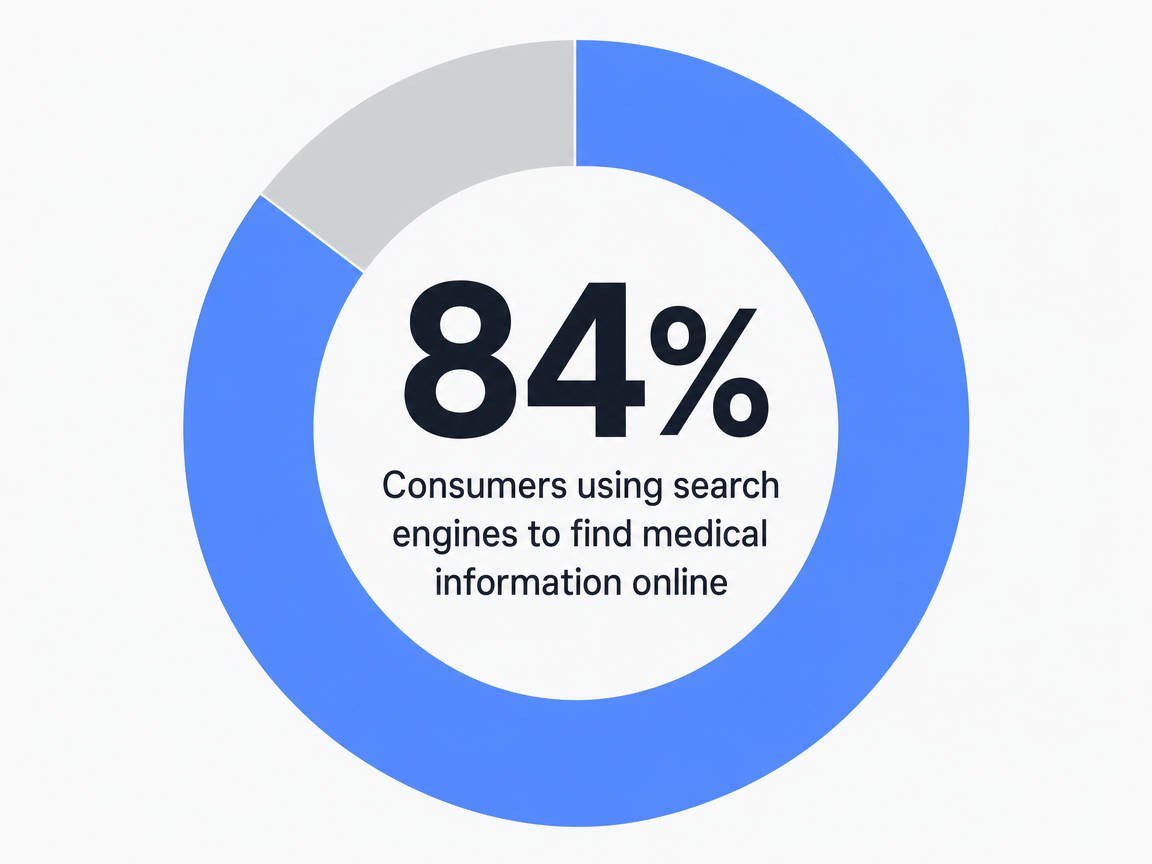 Consumers using search engines to find medical information online: 84%
The primary bottleneck is coordination. A hospital system with multiple facilities, managing orthopedic content through one agency, cardiology content through another, local listings via a regional vendor, and reputation through a fourth tool, is not operating a unified patient acquisition program. Instead, it's running several disconnected initiatives that happen to share a brand. This fragmentation leads to inconsistencies: service-line pages may contradict facility pages regarding procedure availability, provider bios on the corporate site might not align with staffing rosters on location pages, and schema markup could be consistent on the main campus but absent on satellite clinics. Each inconsistency results in lost scheduled appointments.
This fragmentation is increasingly problematic as patient touchpoints multiply. Google's answer panels, voice assistants, and emerging AI agents extract information from verified entity data and authored content to recommend providers before a patient even visits a hospital's website 8. When local entity data, physician credentials, and service-line content are inconsistent across a system, the AI layer cannot recognize the hospital as a cohesive entity. Consequently, it may favor a competitor that presents itself as a single, unified organization.
Therefore, patient growth is contingent on effective governance. Hospital systems successfully gaining organic market share have integrated SEO into an account-level operating model. This model unifies service-line content, local data, technical SEO, reputation management, and AI-answer optimization under a single strategic plan 2. The remainder of this article details this model and its economic implications.
Frequently Asked Questions
References
- 1.How Patients Find Doctors Online: Why SEO Matters.
- 2.The Impact and Challenges of Digital Marketing in Healthcare.
- 3.Online Reputation Management and Patient Acquisition.
- 4.Patient Attribution 101.
- 5.Creating Effective Hospital-Community Partnerships.
- 6.SEO for Healthcare: How to Boost Your Medical Practice's Organic Traffic.
- 7.2025 Healthcare Industry Trends and What to Watch in 2026.
- 8.How AI Agents Will Transform Healthcare.
- 9.7 Popular Medical Practice Marketing Tips.
The patient acquisition operating model
Six workstreams that have to run on one plan
Hospital SEO involves six distinct workstreams. While each has its own deliverables, none can independently generate scheduled appointments. They are effective only when they are integrated and reinforce each other under a single plan.
Service-line content addresses the clinical decisions patients are actively making, such as whether to consult a cardiologist, consider a knee replacement, or understand a sleep study. This demand-generation layer must be developed at the system level, ensuring a cardiology content cluster functions as a cohesive body of work rather than numerous location-specific rewrites of the same procedure page 6.
Local entity data manages how each facility is presented across Google Business Profiles, map listings, directory citations, and structured data. Consistency in Name, Address, Phone (NAP) information, operating hours, accepted insurance, and provider rosters is critical across all platforms and domains 9.
Technical SEO encompasses crawlability, schema implementation, page experience, and internal linking across what is often a complex network of legacy domains, microsites, and CMS instances. Without a system-wide audit, technical improvements are applied inconsistently.
Reputation management leverages review velocity, response consistency, and star ratings as key ranking and conversion factors. Even a one-star improvement on Yelp can lead to a 5–9% revenue increase in healthcare 3.
AI answer optimization involves structuring content and entity data to ensure generative answer engines can cite the hospital system as a verified source 8.
Measurement connects impressions, citations, clicks, calls, and scheduled appointments to a unified attribution model. This ensures the program is evaluated based on patient volume rather than superficial rankings 4.
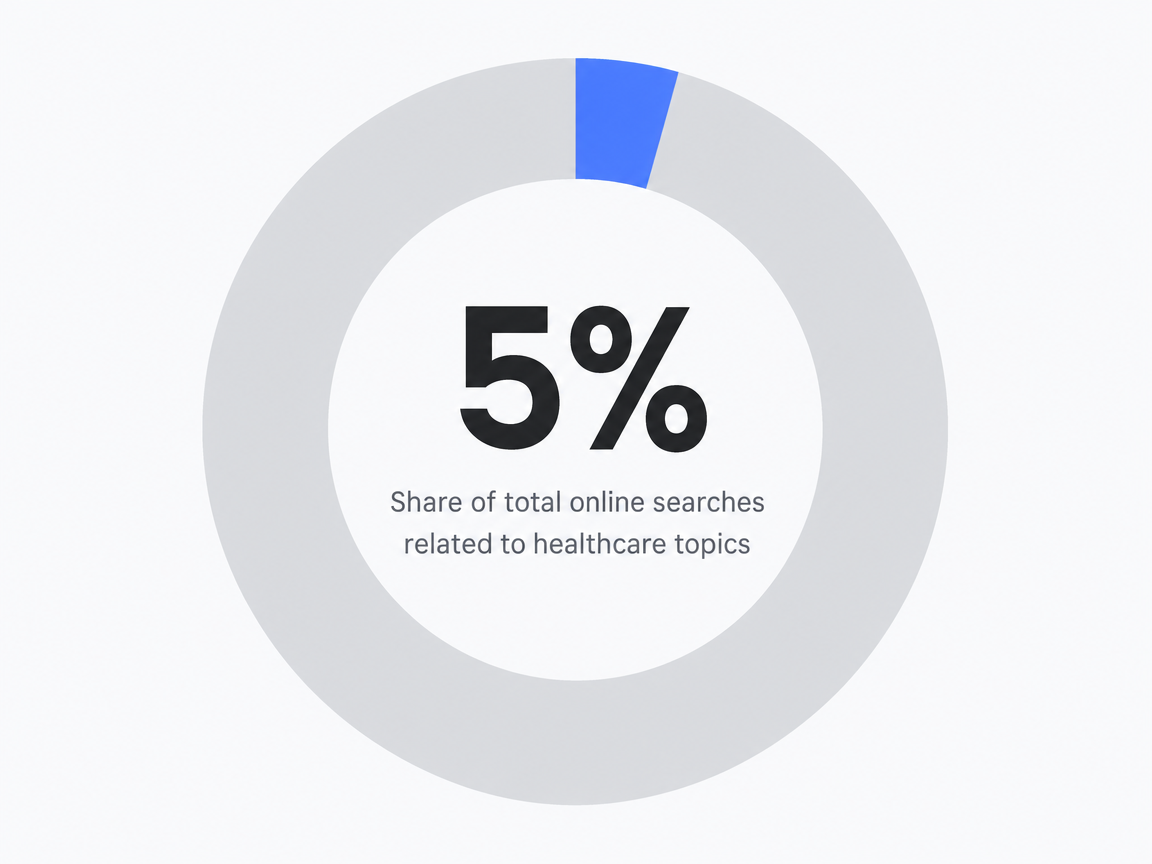 Share of total online searches related to healthcare topics: 5%
Where fragmented per-location execution leaks demand
When these six workstreams are managed by separate vendors, demand leaks become predictable. For instance, a regional agency might create a thoracic surgery page that ranks well but lists a procedure no longer offered at a satellite hospital. The local listings vendor might have accurate facility data, but the schema on the service-line page could contradict it. A reputation tool might collect Google reviews while an AI answer engine pulls provider credentials from an outdated directory. A patient searching for "minimally invasive thoracic surgery near [city]" might land on a page that doesn't match their location, call an incorrect number, and abandon their search.
This fragmentation is particularly detrimental at the service-line level. Healthcare queries constitute roughly 5% of all Google searches, meaning hospital systems compete for attention with pharmacies, payers, telehealth startups, and condition-specific publishers 3. When a system's own pages present conflicting information, search engines distribute this ambiguity, and clicks often go to competitors who offer clear, coherent answers.
Fragmentation also hinders responsiveness. A new procedure approval, a new provider hire, or a new payer contract should ideally be reflected across service-line content, location pages, provider bios, and schema within days. However, with multiple vendors and separate ticketing systems, this process can take weeks. By the time updates are implemented, the seasonal demand window for that service line may have closed, increasing the cost per acquired patient for that procedure 2.
Service-line content as the demand engine
Clusters mapped to clinical decisions, not keywords
Many hospital content libraries are structured around keyword volume. For example, a cardiology content cluster might exist because "heart attack symptoms" has high monthly search volume, rather than being designed to address the actual decisions a cardiac patient makes. This misalignment often results in hospital systems publishing extensive content that rarely converts into scheduled appointments.
A patient's decision-making process rarely aligns with a single search query. A patient considering a knee replacement, for instance, progresses through symptom assessment, self-diagnosis, comparing conservative versus surgical options, searching for a specific surgeon, and logistical questions about insurance and recovery. Each phase requires dedicated content, and the cluster is effective only if these pages are interconnected in a logical patient journey, and if every page consistently references the same provider roster and facility list 6.
Service-line content clusters designed this way share three key characteristics. First, they are authored at the system level, ensuring a thoracic surgery cluster functions as a unified body of work, not numerous location-specific rewrites. Second, they consistently cite the same provider bios and procedure schemas across all pages, providing search engines with a coherent entity graph to index. Third, every page is linked to a specific conversion point, such as a scheduling form, a nurse navigator line, or a second-opinion intake 2.
Hospitals operating in a market where healthcare accounts for approximately 5% of all Google searches cannot rely solely on content volume 3. Systems that successfully generate demand are those whose content clusters accurately reflect how patients make healthcare decisions.
Physician authorship and the trust economy
Authorship is now a crucial factor in content distribution. A service-line page attributed to the surgeon who performs the procedure, complete with a linked bio, credentials, hospital affiliations, and publication history, will rank differently than the same content published anonymously under a corporate brand. Both search engines and AI answer engines recognize verifiable physician authorship as an entity signal, and they are more likely to cite content linked to a real, credentialed person 8.
The economic impact of this signal is evident in review data. A one-star improvement on Yelp correlates with a 5–9% revenue increase in healthcare, indicating that trust is a direct conversion variable, not just a reputation footnote 3. Physician authorship strengthens this trust by connecting the content a patient reads to the same provider name they encounter in reviews, Google Business Profile, and scheduling confirmations.
Operationally, this means service-line content cannot be ghostwritten and published under a generic "hospital staff" byline. Each page requires a named clinical reviewer, a publication date, and a review date that is updated when guidelines change. Provider bios must maintain consistent NPI numbers, board certifications, and procedure specialties across the system website, hospital domain, and any directory feeding the AI layer 6.
Hospitals that are gaining organic market share implement physician authorship as a structured workflow, not merely a courtesy. Clinical leads regularly review and approve content, providing written sign-off and owning the entity record that propagates across all patient and AI-agent touchpoints.
Experience Hospital SEO Impact in One Week
Test drive data-driven hospital SEO strategies and publish live results within days.
Local entity data across dozens of facilities
Local entity data communicates to platforms like Google, Apple Maps, Yelp, and emerging AI agents that a hospital system is a single organization with multiple resolvable facilities, rather than numerous independent businesses with similar names. System-level marketing teams that excel in local search manage this entity graph as a unified dataset, which is then disseminated. Teams that struggle with local search often allow each facility to manage its own Google Business Profile, claim its own directory citations, and respond to reviews independently 9.
The core dataset is finite, comprising key information for each facility: name variations, primary address, phone number, website URL, departmental hours, accepted insurance plans, service list, and provider roster. Each provider's data includes their NPI, board certifications, hospital affiliations, and procedure list. When these fields are consistent across the Google Business Profile, location page schema, directory citations, and provider bios, search engines perceive the system as a coherent entity. Inconsistencies—such as an outdated phone number on Healthgrades, a missing department on the GBP, or a provider listed at three facilities but credentialed at only two—fragment the entity graph and dilute ranking signals across competing records.
Governance, not just tooling, is the critical factor. A centralized spreadsheet of canonical fields managed by one team, with a publishing schedule that updates all surfaces within days of clinical or operational changes, outperforms a premium listings platform managed by multiple vendors. Hospitals that successfully capture "near me" demand treat local entity data with the same rigor finance departments apply to the general ledger: a single source of truth, regularly reconciled, and audited against the platforms patients and AI agents actually use 8.
AI Overviews and answer engines as the new first impression
The initial impression a hospital makes on a prospective patient is no longer necessarily its homepage. It's increasingly a generated answer displayed above organic search results, within a chatbot conversation, or spoken by a voice assistant that has already shortlisted providers before the patient even sees a website. This AI layer doesn't use a separate index; it draws from the same content, schema, and entity data that power organic rankings, then re-presents it as a recommendation 8.
For hospital marketing teams, this shifts the definition of what constitutes a citation-worthy page. Generative answer engines favor content that clearly and structurally answers a clinical question: a procedure definition, a step-by-step recovery timeline, a comparison of treatment options, or an explicit list of insurance coverage. Pages written with marketing-centric language and hedges are less likely to be cited. Conversely, content resembling clinical reference material, authored by a credentialed physician and marked up with MedicalProcedure, Physician, and FAQPage schema, is highly favored 2.
The entity layer is as crucial as the content layer. AI agents will only recommend a hospital as a provider if the system's name, facility roster, provider credentials, and service list are consistent across the open web. A surgeon listed with one address on the hospital site, a different suite number on Healthgrades, and an outdated affiliation on a payer directory will fail this reconciliation 8.
Healthcare already accounts for roughly 5% of all Google searches, and a growing portion of these queries are resolved within an answer panel before any click occurs 3. Systems that appear in these panels actively manage AI answer optimization as a dedicated workstream, producing structured content blocks, comprehensive schema coverage by service line, FAQ pages addressing real patient queries, and provider entity records audited against directories used by AI agents. Hospitals that treat this as a secondary effect of traditional SEO risk becoming invisible in these critical first impressions.
The economics of consolidating per-location agency spend
Cost stack comparison across a 12-site system
The traditional model bills SEO as a per-location service. A 12-site hospital system might engage 12 separate agencies, each focusing on local listings, location-page content, and basic reputation management. Service-line content is often managed at the corporate level by another agency, and technical SEO is treated as a project rather than an ongoing workstream. Reporting typically arrives in 12 different formats and on varying schedules.
Account-level execution reorganizes this into a single, unified program. The cost drivers shift from headcount per location to deliverables per system, eliminating redundant work that arises from vendor handoffs 2.
-
Cost driver Per-location agency model (12 sites) Account-level program model Notes Monthly retainer 12 retainers at $X each, plus a corporate retainer for service-line content One account-level fee covering all sites and service lines Per-location pricing scales linearly with footprint; account-level pricing scales with output volume Service-line content production Mixed authorship across vendors, often duplicated per facility One cluster authored at the system level, syndicated to location pages Removes contradictory procedure listings and duplicate page penalties 6 Local entity data and GBP Separate listings vendor or in-vendor module per retainer One canonical dataset propagated to every surface NAP, hours, insurance, and provider rosters reconcile across all sites 9 Technical SEO Project-based audits, applied unevenly across legacy domains Continuous audit across the full domain footprint Schema, crawlability, and internal linking governed as one system Reputation workflow Per-location response cadence, varied by vendor SLA System-wide cadence with location-specific response templates Star-rating improvements compound into 5–9% revenue lifts 3 Reporting and attribution 12 dashboards, manually rolled up One attribution model tied to scheduled appointments Eliminates reconciliation drag and misaligned KPIs 4 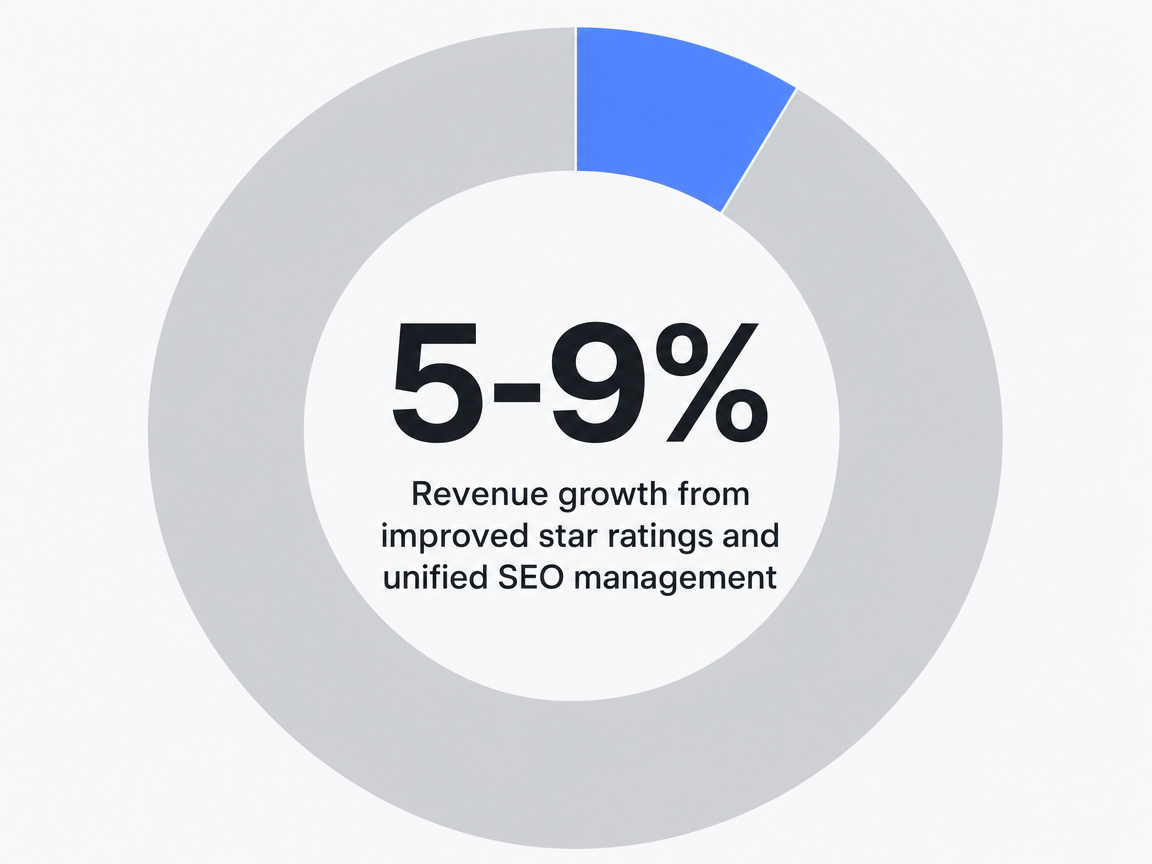 Revenue growth from improved star ratings and unified SEO management: 5-9%
The true economic impact isn't just about retainer costs. It's about the wasted production hours, the inconsistencies between vendor outputs, and the lost demand that occurs while multiple teams wait for each other to update the same provider record.
What account-level execution changes about content velocity
Consolidation most rapidly impacts content velocity. When a new procedure is approved at one facility, it should ideally be reflected in the service-line cluster, all relevant location pages, affected provider bios, and schema markup within days. With separate vendors, this update typically involves multiple ticket queues, several approval cycles, and at least one missed handoff. The seasonal demand window for the procedure often closes before the content is fully updated 2.
An account-level program significantly shortens this timeline because the dataset, content cluster, and publishing workflow share a single source of truth. A clinical lead approves the change once, and the service-line page, location pages, provider bios, and entity records are updated from the same brief. Reputation prompts and FAQ schema are released simultaneously.
This difference in output manifests in two key areas: how quickly a system can capitalize on new clinical capabilities and how frequently outdated information remains publicly available. Both directly influence the number of scheduled appointments per service line.
Unlock Scalable Patient Acquisition with Unified Hospital SEO
Discover how enterprise healthcare marketers and agencies drive measurable patient growth with centralized SEO, content, and PPC execution for all locations from a single command center. See unified strategies in action—request a demonstration.
Measuring patient growth without pretending attribution is clean
Hospital marketing teams that promise precise ROI on SEO often find themselves defending figures that clinicians find implausible. A more realistic approach acknowledges that patient journeys for elective procedures can span weeks or months, involve six to twelve touchpoints, and rarely result from a single click. Last-click attribution, which credits the channel active when a patient calls to schedule, systematically undervalues the organic content and entity work that initially built the patient's consideration set 4.
An effective measurement model for hospital systems abandons single-channel attribution and instead tracks the journey as a sequence of verifiable signals. This includes impression share by service line, AI Overview citation rate, branded versus non-branded query mix, Google Business Profile actions, call tracking by location, scheduled-appointment volume by referral source, and confirmed-arrival rate, each with its own dashboard. While none of these metrics individually prove SEO caused a booking, collectively they indicate whether the system is gaining or losing market share for revenue-generating queries 2.
Two practices distinguish hospitals that effectively manage this measurement from those that engage in quarterly debates. First, every conversion surface—scheduling forms, nurse navigator lines, second-opinion intakes—is tied to a specific service line and facility, allowing volume to be tracked at the cluster level rather than just the page level. Second, a fixed multi-touch attribution window is applied per service line, calibrated to its actual decision timeline. An urgent care visit might have a window of days, while bariatric surgery decisions can take ninety days or more. Applying the same window to both introduces noise 4.
The output a marketing leader should present to a CFO is not a 3:1 ROI claim. Instead, it's a trended view of qualified patient volume by service line, compared against the program's cost, with the understanding that organic search benefits compound over time. Marketing efforts that boost impression share in March can lead to booked appointments through Q3. Reporting that acknowledges this lag secures budget, while reporting that insists on clean attribution often loses it 2.
A 90-day path to running SEO at the account level
The initial thirty days are dedicated to reconciliation. The marketing team compiles all canonical entity fields—facility names, addresses, phone numbers, hours, accepted insurance, service lists, provider rosters, NPI numbers, and board certifications—into a single dataset. Every existing public-facing surface, including Google Business Profiles, location page schema, directory citations, payer directories, and provider bios, is audited against this dataset. The outcome is a single source of truth and a comprehensive list of all inconsistencies 9.
Days thirty-one through sixty focus on content consolidation. The team identifies the three service lines with the highest revenue potential and lowest impression share, then rebuilds these content clusters at the system level. Each cluster is designed around the clinical decisions patients make, includes a named physician reviewer, and directs to a single scheduling point. Location pages then reference these system-level clusters instead of duplicating procedure descriptions 6.
The final thirty days involve implementing the measurement model. This includes call tracking by location, tagging conversion surfaces to specific service lines and facilities, calibrating attribution windows for each decision timeline, and establishing a weekly dashboard that displays impression share, AI Overview citation rate, and scheduled-appointment volume side-byside 4. By day ninety, the program's reporting shifts to focus on patient volume rather than just rankings.
Vectoron specializes in executing this ninety-day plan and the subsequent work from a unified, account-level strategy, eliminating the need for additional agency retainers or internal headcount.