
Key Takeaways
- Roughly 34 percent of non-detained and 86 percent of detained immigrants appear pro se 10, defining a measurable demand pool that converts when content reaches it before directories or faster competitors do.
- Content priorities should track EOIR docket data by relief type and court venue 5, with dedicated procedural pages for the top two relief categories and quarterly refreshes as caseload trajectories shift.
- Native multilingual sites, ethics-screened keyword lists under ABA Model Rules and state opinions 6, 12, and court-catchment geographic targeting outperform translated dropdowns, competitor-name bids, and city-only location pages.
- Cost per signed case—qualified calls times show rate times consult-to-signed conversion against marketing spend—is the operating metric; rankings alone cannot reveal which variable in the intake funnel is failing.
The Representation Gap as an Addressable Market
Most growth conversations inside immigration firms start with rankings. They should start with court data.
Research on removal proceedings finds that roughly 34 percent of non-detained immigrants are unrepresented, and approximately 86 percent of detained immigrants appear pro se 10. These figures precisely define the addressable market for a private immigration practice, describing a population in need of counsel that has not yet retained it, and is often actively searching for help under time pressure.
The outcome stakes make that population valuable, not just large. Studies of millions of removal proceedings consistently show that represented respondents fare materially better than those without counsel 1, 2. Securing representation has been linked to higher rates of release from detention, court appearance, and favorable case resolution 9. A managing partner reading those findings is not looking at an abstract justice gap. They are looking at demand that converts when it reaches a qualified firm.
The practical question is how much of that demand a single firm can capture. Detained respondents are harder to reach through organic search because access is mediated by facility rules and family members searching on their behalf. Non-detained respondents, by contrast, are directly reachable. They use phones, search in their own language, and compare options within hours, not weeks.
Framing SEO around that population changes the investment thesis. The goal is not traffic. The goal is to convert a measurable share of the represented-but-shouldn't-be-pro-se pool into signed consultations, and to do it before a nonprofit directory or a faster competitor does.
How Immigrant Search Behavior Actually Works
Mobile, Multilingual, and Time-Pressured Queries
Immigrant search sessions look different from those of a typical legal consumer. Research on social media and digital app use among immigrants in the United States shows usage patterns shaped by cultural and linguistic barriers, with phones serving as the primary access point to information and services 3. This has direct consequences for what an immigration firm's website needs to accomplish in the first few seconds of a visit.
Queries are mobile-first. They are often typed in Spanish, Portuguese, Mandarin, Haitian Creole, or Arabic, sometimes mixed with English. They are short, transactional, and tied to a triggering event: a Notice to Appear, a workplace raid, an arrest of a relative, an expiring visa, or a denied I-130. The searcher is not researching attorneys as a category; they are looking for a person who can act today.
Three behaviors follow from that:
- First, page load speed and clarity matter more than depth. A long thought-leadership essay loses to a focused page that answers the specific procedural question and shows a phone number above the fold.
- Second, language signals trust before content does. A searcher who lands on an English-only page after a Spanish query often leaves before reading.
- Third, the decision window is short. The same study notes that digital platforms can either close information gaps or widen them depending on how accessible the content is to users with limited digital literacy 3. A firm that requires a form fill and a 48-hour callback loses to one offering an immediate call path in the searcher's language.
Why Pro Bono Directories Dominate the SERP
Search results for high-intent immigration queries do not resemble a clean attorney marketplace. They are crowded with government and nonprofit pages built for the same audience a private firm is trying to reach.
The Department of Justice publishes and distributes a List of Pro Bono Legal Service Providers, which is given directly to individuals in immigration proceedings and references nonprofit organizations and attorneys committed to providing services 7. That list, along with related EOIR resources, accumulates the authority signals search engines reward: a federal domain, inbound links from advocacy groups, frequent updates, and explicit query match for terms like "free immigration lawyer" or "low cost immigration help."
A firm cannot outrank .gov on government-services intent and should not try. The opportunity sits one query deeper. Searchers who scan a pro bono list, find no provider with capacity, or realize their case is too complex for a clinic, return to Google with a more specific query: a relief type, a court location, an employer, or a family situation. Those follow-on queries are where private firms compete on equal footing, provided the content matches the specificity of the search rather than the breadth of a homepage.
Mapping Case Mix to Content Priorities
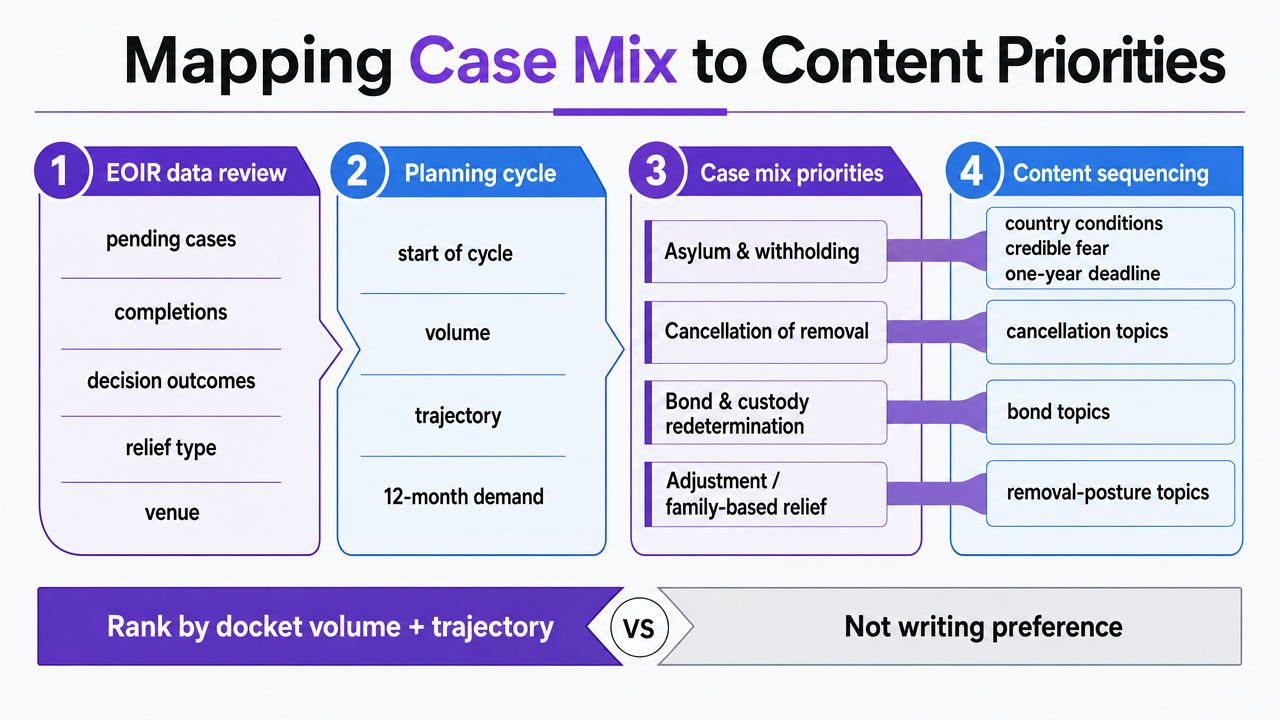
Practice-area pages should be ranked by the volume and trajectory of the underlying docket, not by what the firm enjoys writing about. EOIR publishes regularly updated workload and adjudication statistics that break down pending cases, completions, and decision outcomes by relief type and venue 5. That data, reviewed at the start of every planning cycle, informs a managing partner where search demand will actually originate twelve months from now.
Four categories dominate the mix and deserve separate content architecture:
- Asylum and withholding — queries skew toward country-conditions, credible-fear interviews, and one-year filing deadlines.
- Cancellation of removal — queries cluster around continuous-presence thresholds, qualifying relatives, and hardship standards.
- Bond and custody redetermination — queries spike around specific detention facilities and are time-compressed to days.
- Adjustment or family-based relief tied to removal posture — queries blend procedural questions with eligibility edge cases 5.
A firm that publishes one umbrella "removal defense" page covering all four loses to firms with dedicated, deeply specific pages for each relief type and the procedural questions within it.
Venue matters as much as relief type. EOIR statistics are published at the immigration court level, which allows a firm to see whether asylum grant rates, completion times, or pending volume at its local courts are rising or falling 5. A page targeting "asylum lawyer" in a city where the local court's asylum docket has doubled is a different investment than the same page in a venue where that docket is shrinking. The data is free and updated, yet most firms do not utilize it.
The practical sequence is short:
- Pull the most recent EOIR completions and pending tables for the firm's home courts.
- Rank relief types by volume and growth.
- Build out the top two relief types first with full procedural sub-pages, then the next two.
- Refresh the priority order each quarter as the docket shifts.
Content investment follows the docket, not the calendar.
 Visualize the four-step docket-driven content prioritization workflow described in this section, showing how EOIR data feeds content sequencing decisions
Test Data-Driven SEO Workflows for Immigration Firms
Experience a full week of publishing real SEO content tailored to qualified consultation intake for immigration attorneys.
Geographic Targeting Beyond Lawyer Density
A high count of immigration attorneys in a metro area does not mean the local market is saturated. Research on access to counsel finds that even regions with relatively high lawyer density continue to show significant representation gaps, driven by cost, detention placement, and information barriers rather than by raw supply 4. A managing partner in Houston, Los Angeles, or New York is not competing for a fixed pie. They are competing for the share of unrepresented respondents whose search queries currently land on directories, clinics with waitlists, or out-of-state firms running broad paid campaigns.
The geographic unit that matters for SEO is the immigration court catchment, not the city. Detention facilities pull cases across state lines. An immigrant arrested in rural Georgia may have a hearing at Stewart, where families search from Atlanta, Charlotte, and Birmingham. A firm targeting only its home city misses the cross-border search demand that the docket actually produces.
Three adjustments follow:
- Build separate location pages for each court a firm appears in, including the facility name and the towns families search from.
- Cover transportation, visitation, and bond posting logistics on those pages, because that is what relatives type into Google in the 48 hours after an arrest.
- Track local-pack visibility per court catchment, not per office address. The map result a searcher sees from a detention waiting room is the one that determines whether the call comes to the firm or to a nonprofit hotline.
 Immigrant adults with limited English proficiency (LEP)
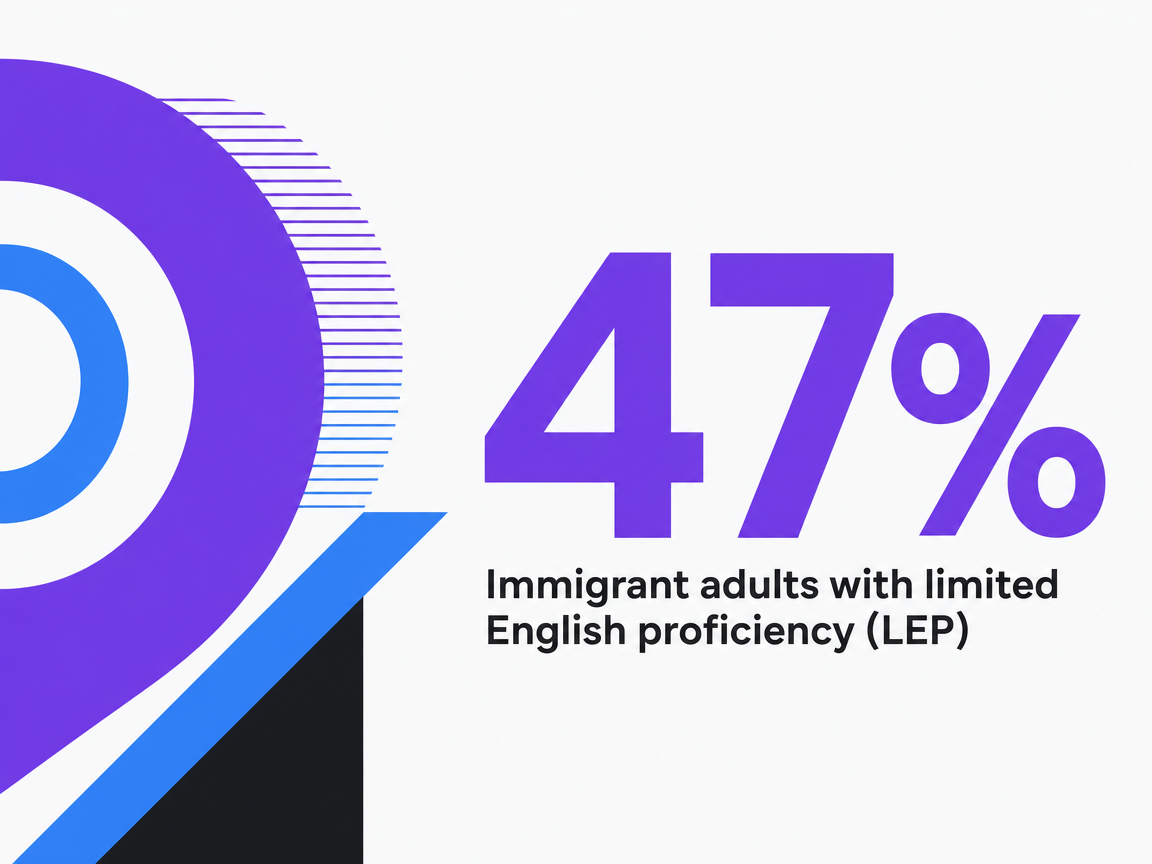
Immigrant adults with limited English proficiency (LEP)
Proving Representation Impact in Content
Search engines reward content that demonstrates expertise, but immigration clients reward content that demonstrates consequence. A page that explains the procedural steps of cancellation of removal is useful. A page that explains what changes when a respondent walks into that hearing with counsel is persuasive.
The evidence base is unusually strong here. An Iowa Law Review analysis of nearly 8 million deportation cases reaffirms that represented immigrants fare significantly better than unrepresented ones across case types and respondent characteristics 1. A mixed-methods study of immigrant families documents that securing legal representation increases the likelihood of being released from detention, appearing in court for subsequent hearings, and winning removal cases 9. These independent datasets offer converging findings.
A firm that cites those studies on its relief-type pages achieves two things at once. It answers the searcher's underlying question—does hiring a lawyer actually change anything—with peer-reviewed evidence rather than slogans. And it signals topical authority to search engines through outbound citations to law reviews and federal data.
One constraint governs the execution. Under ABA Model Rules, attorneys cannot make false or misleading statements about their services, and deceptive marketing loses the constitutional protection extended to commercial speech 12. That means published outcome claims must describe the research findings, not the firm's own win rate, unless the firm is prepared to substantiate every number with verifiable case data. The safer and more credible move is to attribute. Write "studies of more than two million removal proceedings find that represented respondents have materially better outcomes" 2, not "our clients win 90 percent of the time." The first claim ranks, converts, and survives a bar complaint. The second invites one.
Ethics-Compliant Keyword and Paid Search Strategy
Paid search is where immigration firms most often trip a bar rule without realizing it. The mistake is rarely the ad copy; it is the keyword list.
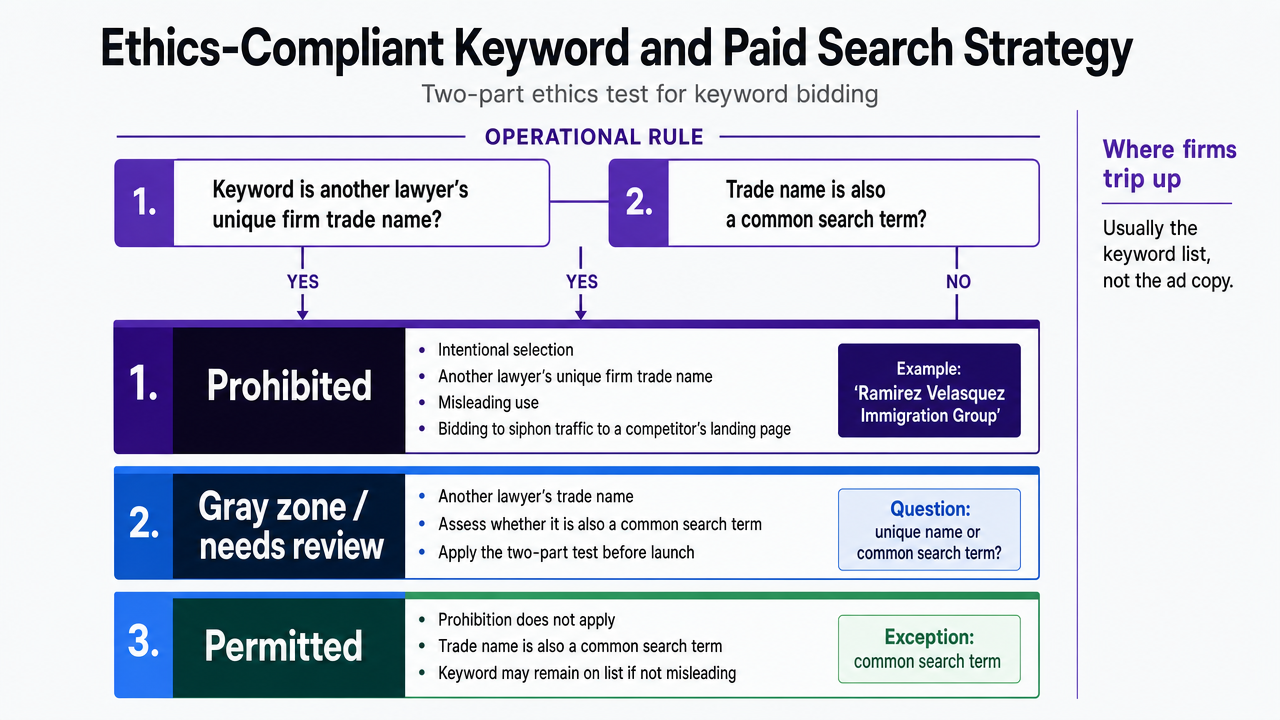
The North Carolina State Bar's 2023 Formal Ethics Opinion 4 addresses the practice directly. Intentionally selecting another lawyer's unique firm trade name as a keyword in an internet advertising campaign is prohibited when doing so would be misleading 6. The same opinion carves out an exception: the prohibition does not apply when the trade name is also a common search term 6. That two-part test is the operational rule a campaign manager needs.
Applied to a working keyword list, the distinction is sharper than it sounds. A made-up firm name like "Ramirez Velasquez Immigration Group" is unique. Bidding on it to siphon traffic to a competitor's landing page is the conduct the opinion prohibits. A surname-based firm like "Garcia Law" sits in the gray zone, because "Garcia" is also one of the most common surnames in the searcher population. Generic high-intent phrases—"asylum lawyer near me," "I-130 attorney," "bond hearing lawyer," "abogado de inmigración"—are common search terms by any reading and remain fully available.
Firms outside North Carolina should not treat the opinion as inapplicable. State bars regularly cite each other's reasoning, and the ABA Model Rules underlying it bar false or misleading statements about a lawyer's services in any channel, including paid search placement and the landing pages those ads serve 12. A landing page that uses a competitor's name in its body text, alt tags, or schema markup carries the same risk as the keyword bid.
Three controls keep a campaign defensible:
- Audit the keyword list quarterly for any term that matches only one firm.
- Maintain a documented rationale for any surname or city-name term that could be construed as targeting.
- Require that every ad-served landing page substantiate its claims with research citations or verifiable firm data, not adjective stacks 12.
A campaign built on generic intent terms, accurate copy, and clean attribution outperforms a competitor-name strategy on cost per qualified call anyway, because the searcher arrived looking for a category, not a specific firm.
 Visualize the two-part ethics test for keyword bidding described in the section, comparing prohibited, gray-zone, and permitted keyword categories with examples drawn directly from the article prose
See How Leading Immigration Firms Achieve Predictable SEO-Driven Case Intake
Request a demonstration of coordinated, data-driven SEO strategies designed for legal teams seeking measurable increases in qualified consultation calls and signed immigration cases.
Multilingual Content as Search-Share Strategy
Spanish, Mandarin, Portuguese, Haitian Creole, Arabic, and Vietnamese pages are not mere translations of an English site. They are separate search assets competing for separate query pools.
Immigrant users in the United States rely heavily on phones and on platforms accessed in their first language, with cultural and linguistic barriers shaping what they read, trust, and share 3. A Spanish-speaking searcher entering "abogado de asilo cerca de mi" is not the same lead as an English searcher entering "asylum lawyer near me." Different keyword, different intent signals, different competitive set. A firm publishing only in English concedes the Spanish query entirely to nonprofit directories and to firms that have built native-language pages.
Machine-translated pages do not close that gap. Google can detect thin translations, and so can the searcher. The same research on immigrant digital usage notes that accessibility depends on cultural framing, not just language 3. "Continuous physical presence" translated literally into Spanish reads as government paperwork. Rewritten as the question a family member would actually ask—how long does my mother need to have lived here to qualify—the page ranks and converts.
Three execution rules apply:
- Build each language as a parallel site with its own URL structure and hreflang tags, not as a translated dropdown.
- Staff or contract bilingual reviewers to validate procedural terms.
- Track conversions per language separately, because Spanish-language cost-per-qualified-call typically diverges from English by a wide enough margin to justify reallocating spend within the same quarter 3.
Intake Engineering and Consultation Economics
From Search Click to Signed Retainer
Ranking a page is the cheap part. Converting the click is where most immigration firms lose the case before it starts.
The path from search to retainer has five measurable steps: the click, the page interaction, the inbound call or form submission, the consultation, and the signature. Each step has its own drop-off, and each drop-off has a fix that lives outside the SEO vendor's scope.
The click-to-call gap is the largest leak. A searcher arriving from a Spanish-language asylum query in the 30 minutes after a relative's detention is not going to fill out a form and wait. Research on immigrant digital usage shows phones are the primary access point and that accessibility depends on cultural framing as much as language 3. A tap-to-call button in the header, staffed in the searcher's language during the hours queries actually arrive, converts a meaningfully higher share of clicks than a contact form routed to a paralegal's inbox.
The call-to-consultation gap is operational, not creative. Studies of removal proceedings consistently link representation to better outcomes 1, but a firm only realizes that value if the inbound caller reaches a person who can confirm jurisdiction, identify the relief type, and book a consultation in the same call. Voicemail kills the lead. So does a 24-hour callback policy when the competing nonprofit hotline answers in eight minutes.
The consultation-to-signature gap is where case selection discipline pays. Not every qualified call is a signable matter, and chasing the wrong ones erodes the economics of the entire funnel.
The Cost-Per-Signed-Case Formula
Ranking position is not the metric that pays salaries. Cost per signed case is.
The formula is straightforward and worth writing on a whiteboard at every quarterly review:
Cost per signed case = monthly marketing spend ÷ (qualified calls × consultation show rate × consult-to-signed conversion rate)
Four variables, each independently measurable, each independently improvable:
Qualified-call rate : A function of search visibility and intake responsiveness.
Show rate : A function of confirmation workflow and time-to-appointment.
Consult-to-signed conversion : A function of attorney intake skill and case selection.
Average matter value : The denominator's silent partner, depends on practice-area mix and fee structure.
A firm tracking only rankings and traffic cannot tell which variable is failing. A firm tracking all four can reallocate spend inside a single quarter. If Spanish-language qualified-call cost runs materially below English on the same relief type, more budget moves to Spanish content and call staffing 3. If consult-to-signed conversion drops on bond cases, the problem is rarely the website.
Operational responsiveness is part of the acquisition story, not separate from it. EOIR's electronic filing systems already set client expectations for digital fluency and speed across the case lifecycle 8. A firm that answers the phone, books the consultation, and files the appearance the same day signals competence the website cannot prove on its own.
Operating the Engine Without Agency Overhead
The strategy described across the prior sections—court-data content prioritization, court-catchment geographic targeting, parallel multilingual sites, ethics-audited paid search, and intake instrumentation—does not fail because managing partners disagree with it. It fails because executing it requires coordinating writers, translators, paralegals reviewing procedural accuracy, a compliance reviewer checking every claim against ABA Model Rules 12, a developer maintaining hreflang structure, and an analyst reconciling call data with EOIR case-mix shifts 5. That coordination is what agency retainers are sold to solve, and what they usually do not.
The Yale immigrant representation work makes a related point about service design. Coordinated delivery through a small number of institutional providers captures efficiencies of scale and reduces administrative complexity that fragmented retention cannot 11. The logic translates to the marketing operation. A firm coordinating six vendors—SEO, PPC, content, translation, web development, call tracking—pays a coordination tax that erodes whatever performance gain each vendor produces in isolation.
AI-driven execution platforms now collapse that coordination layer. The category handles content production, on-page SEO, paid search management, backlink work, social distribution, and call intelligence inside a single approval workflow, with a managing partner or marketing lead signing off on each recommendation before anything publishes. The output looks like a coordinated team. The cost structure does not.
Vectoron operates in that category. The practical effect for an immigration firm is that the docket-driven content calendar, the multilingual page builds, the ethics-screened keyword lists, and the cost-per-signed-case dashboard run as one governed loop—without adding marketing headcount or sustaining six vendor relationships to keep the engine moving.
Frequently Asked Questions
References
- 1.Access to Counsel in Immigration Court, Revisited.
- 2.Representation in Removal Proceedings.
- 3.Social media apps used by immigrants in the United States.
- 4.Beyond Legal Deserts: Access to Counsel for Immigrants Facing Removal.
- 5.Workload and Adjudication Statistics.
- 6.2023 Formal Ethics Opinion 4.
- 7.List of Pro Bono Legal Service Providers - Department of Justice.
- 8.ECAS: Attorneys and Accredited Representatives.
- 9.Legal Relief for Children in Immigrant Families: A Mixed-Methods Study.
- 10.Lack of representation in removal proceedings: How today's legal aid resources respond to a changing immigration landscape.
- 11.New York Immigrant Representation Study Report.
- 12.Ethics and Effectiveness in Use of Social Media.