
Key Takeaways
- Immigration SEO produces signed retainers when relief-category pillar pages, multilingual intake routing, and query-cluster attribution operate as one coupled system rather than as separate traffic tactics.
- Every page, schema field, and directory profile is lawyer advertising under rules modeled on ABA Rule 7.1, so partner-approved substantiation has to gate publication across each jurisdiction 6.
- Outsourced agencies, in-house marketers, and approval-gated platforms all leave the firm responsible for vendor language under Rule 7.2, making structured partner sign-off the decisive selection criterion 11.
- Reallocate budget away from recommendation-style directory profiles, generic 'near me' blog posts, and trackers on status-capturing intake forms toward native-language pillar pages and CRM joins that tie clusters to signed matters.
Signed Retainers, Not Rankings: How Immigration SEO Actually Pays
Immigration SEO pays when a partner can trace a signed retainer back to a specific query, page, and language. It does not pay when the dashboard shows traffic growth and the intake calendar shows the same eight consultations a week, half of which never qualify.
That distinction matters because immigration is one of the few practice areas where search demand is both deep and structurally fragmented. The U.S. unauthorized immigrant population alone reached roughly 11 million in 2022, with more than 3 million holding some form of temporary protection 9. Add lawful permanent residents pursuing naturalization, employment-based petitioners, and family-based sponsors, and the addressable pool dwarfs what any single firm can realistically serve. Volume is not the problem. Qualification is.
The firms producing predictable signed-case pipelines from organic search treat the channel as three coupled systems, not one. The first is a narrow set of relief-category pages built around how prospects actually phrase their situation. The second is a multilingual intake path that routes a Spanish-speaking U-visa inquiry differently than an English-speaking EB-2 inquiry. The third is attribution that ties consultation outcomes back to the originating query cluster, so the partner reviewing monthly performance sees retained matters per page, not sessions per page.
Every component sits inside a regulatory frame. Website copy, schema markup, landing pages, and review language are lawyer advertising under rules modeled on ABA Model Rule 7.1, and they carry the same truthfulness obligation as a billboard 6. Sections that follow treat that frame as a design constraint rather than a footnote.
Every Page Is Lawyer Advertising Under Rule 7.1
The first operating constraint for immigration SEO is that there is no editorial firewall between marketing and ethics. A homepage hero, a practice-area page, a meta description, a Google Business Profile post, and a schema-marked attorney bio are all communications about the lawyer's services. Under rules modeled on ABA Model Rule 7.1, each must be truthful and not materially misleading, and the same standard applies regardless of medium 6.
That has concrete drafting consequences. Phrases like "top immigration lawyer," "100% approval rate," or "former USCIS officer" carry different risk weights, and the rule's commentary flags unjustified expectations and unverifiable comparisons as primary failure modes 6. A page promising "fast green cards" without disclosing typical adjudication timelines is the kind of omission that creates exposure. So is a testimonial that implies a result the firm cannot routinely produce.
State variants tighten the frame further. California's Rule 7.2 requires that advertising identify a responsible attorney and restricts how referral and recommendation language can appear in paid placements 5. The full Chapter 7 text confirms that the prohibition on false or misleading communication is jurisdiction-wide and covers websites and online marketing alongside traditional media 1. A firm operating across California, Texas, and New York is not writing one set of pages; it is publishing under three overlapping rule sets, and partner review needs to reflect that.
The practical move is to treat the website as a regulated publication. Every relief-category page should carry a substantiation note in the CMS: which factual claims appear, what source supports each one, who approved the language, and which bar rule governs the jurisdiction. Review counts, satisfaction figures, case-outcome statistics, and "specializing in" language all require defensible backup before they go live. Pages without that backup do not get published, regardless of how well they target a keyword cluster.
This is not a one-time legal review. Search-driven content updates frequently, schema fields get edited by vendors, and review snippets pull dynamically from third-party platforms. Each of those entry points is a potential Rule 7.1 surface, which is why the firms that scale immigration SEO without discipline risk treat approval as a recurring workflow rather than a launch checkpoint.
The Relief-Category Page Architecture That Converts
Pillar Pages Mapped to Live Demand
A relief-category pillar page is built around a single form of immigration relief and the specific evidentiary, procedural, and timeline questions a prospect brings to that category. Asylum, U-visa, T-visa, VAWA self-petition, adjustment of status, consular processing, naturalization, TPS, DACA renewal, EB-2 NIW, and removal defense each deserve their own page. A single "immigration services" page targeting all of them converts poorly because the prospect's qualifying questions diverge sharply by category.
Demand sizing justifies the build. The U.S. unauthorized immigrant population reached approximately 11 million in 2022, including more than 3 million holding some form of temporary protection such as TPS, DACA, or pending asylum applications 9. That figure does not include lawful permanent residents pursuing naturalization, employment-based petitioners, or family-based sponsors, all of whom search distinct query clusters. A firm allocating content investment across ten relief categories should weight production toward categories with the largest local addressable pool, not the categories the partners find most intellectually interesting.
Each pillar page should answer the qualifying questions a paralegal would ask in the first ten minutes of intake:
- eligibility criteria
- documentation required
- typical adjudication timeline
- common bars to relief
- what happens if the petition is denied
Pages that answer those questions in plain language tend to attract prospects who are closer to retaining counsel, because the visitor has already self-screened against the eligibility framework before booking a call. Vanity blog posts on policy commentary rarely produce that effect.
Multilingual Variants and Intake Routing
Multilingual architecture is a ranking and conversion lever, not a translation afterthought. A Spanish-speaking prospect researching "abogado de asilo" or "visa U para víctimas" is not served by an English page with a translation widget. Search engines treat machine-translated content inconsistently, and prospects evaluating whether a firm can actually represent them in their language read the page copy as the test.
Each priority language deserves a parallel page with native-language copy, hreflang tags, and a localized intake form. The languages worth the investment depend on the firm's geographic catchment: Spanish is near-universal for U.S. immigration practice, while Mandarin, Vietnamese, Haitian Creole, Portuguese, Arabic, Russian, and Punjabi shift in priority by metro. Local consular data and census language tables inform which variants earn dedicated pages versus which receive a brief landing summary.
Intake routing is where the architecture pays off. A Spanish-language U-visa form should not drop into a generic intake queue that routes to whichever paralegal answers first. The form should tag the inquiry by language and relief category and route it to a bilingual intake specialist trained on U-visa eligibility screening. Firms that skip this step produce the worst possible outcome: organic traffic generates calls, calls reach staff who cannot communicate or qualify effectively, prospects hang up, and the partner reviewing the monthly report sees rising sessions and flat signed matters.
Phone systems, scheduling tools, and CRM tags should all carry the language and relief-category metadata captured at the form. That data later powers the attribution view that connects organic queries to signed retainers.
Trust Signals That Compete With Government Lists
Immigration prospects do not arrive at a firm's site cold. Many have first consulted the EOIR pro bono list, which the Department of Justice updates quarterly and which directs individuals in proceedings to non-profit organizations and committed pro bono attorneys 7. State bar consumer pages reinforce that channel: California's resources for immigrants direct prospects to verify a lawyer's license through the State Bar before engaging services and warn explicitly about unlicensed practitioners 8. University offices serving undocumented students compile their own referral lists, with UC Riverside's resource page pointing to on-campus legal services and external directories 4.
A paid firm's relief-category page competes against those official channels for credibility, not just for ranking. The trust signals that move signed retainers are concrete and verifiable: each attorney bio should link directly to the state bar license lookup, list jurisdictions admitted with admission dates, and identify the responsible attorney for the page under the applicable advertising rule. AILA membership, board certification where it exists, and named court admissions belong on the page in checkable form rather than as logos.
Case-outcome language is the most common failure point. Statements like "thousands of approvals" or "highest success rate" trigger the unverifiable-comparison concern flagged in Rule 7.1 commentary 6. Quantified outcomes need substantiation in the file, scope disclosure on the page (which case types, what timeframe), and language that does not imply guaranteed results. Pages that survive that filter tend to outperform pages that do not, because prospects who have already been warned about unlicensed providers read carefully.
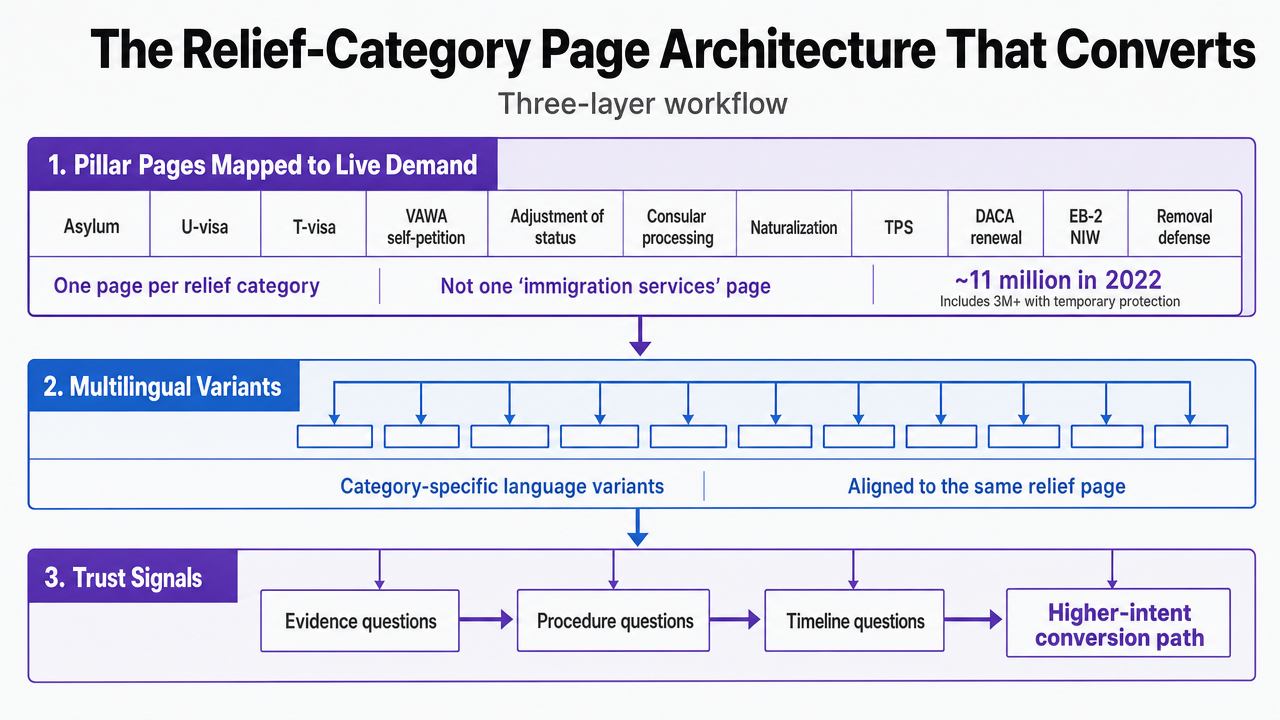 Visualize the three-layer relief-category page architecture (pillar pages, multilingual variants, trust signals) that the section explains as a workflow
Test SEO content that targets qualified consultations
See how targeted SEO attracts and converts qualified immigration prospects in your market before making a commitment.
Privacy-Forward Analytics for a Wary Audience
Immigration prospects open a law firm's website with a calculation most other legal consumers do not run: what does this site know about me, and where does that data go. The reluctance is not paranoia. Pew Research Center's 2019 survey of U.S. adults found that 72% say all, almost all, or most of what they do online or on their phone is being tracked by companies, and majorities in the same study reported feeling their data is less secure than in the past and that the risks of collection outweigh the benefits 3. That baseline distrust is the conversion environment for every immigration intake form.
The operational implication is that the analytics stack should be visibly restrained on the pages where prospects actually decide whether to call. Heavy third-party tag loads on a U-visa or asylum landing page produce two compounding problems. The first is technical: page weight and consent-banner friction degrade the mobile experience for a population that searches predominantly on phones. The second is behavioral: prospects who can see a half-dozen tracking pixels firing in their browser tools, or who hit a cookie wall before reading the eligibility content, often bounce before reaching the intake form.
A defensible setup keeps the high-intent conversion paths on first-party measurement. Server-side analytics, hashed identifiers for call tracking, and a single consent layer with plain-language disclosure of what is collected and why move the trust signal in the right direction. Remarketing pixels and session-replay tools do not belong on pages that capture immigration status, A-numbers, or country-of-origin details. Those fields should never enter an analytics payload, and intake forms should be configured so they cannot.
The same restraint applies to review and testimonial widgets that pull dynamically from third-party platforms. Each embedded widget is a tracking surface and a Rule 7.1 content surface at once. Firms that audit both layers together, rather than treating privacy and advertising compliance as separate workflows, tend to publish faster and defend more easily.
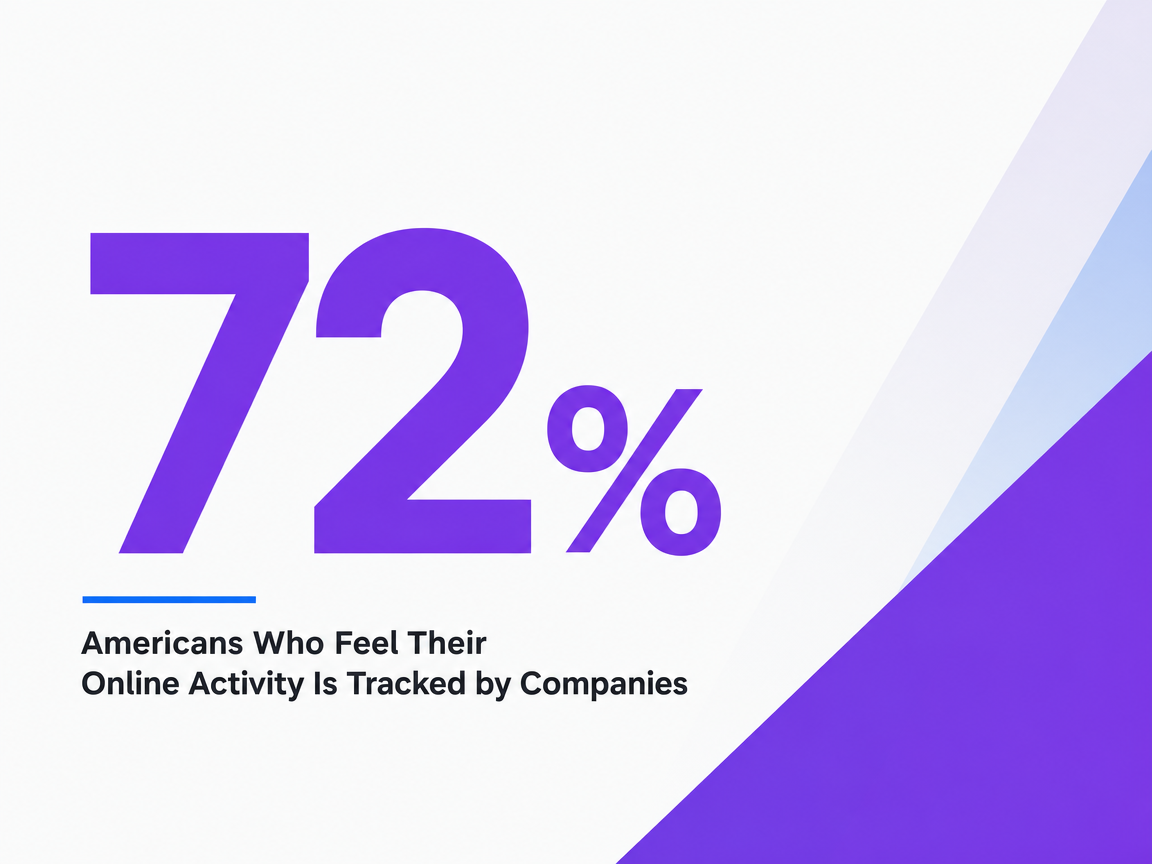 Americans Who Feel Their Online Activity Is Tracked by Companies
Americans Who Feel Their Online Activity Is Tracked by Companies
The Lead Generator and Directory Trap
Immigration is one of the most heavily pitched verticals in legal lead generation. Pay-per-lead vendors, sponsored directory placements, ranking widgets, and "best immigration lawyer" badge programs reach managing partners weekly, often priced as a low-friction alternative to building organic content. The economics rarely survive scrutiny, and the regulatory exposure is structural rather than incidental.
Rule 7.1's truthfulness obligation does not stop at the firm's own website. The ABA Model Rules outline used in law school instruction states plainly that a lawyer must not pay a lead generator that states, implies, or creates a reasonable impression that it is recommending the lawyer 2. North Carolina's Rule 7.2 commentary takes the same position from the opposite direction: a firm may compensate vendors who provide marketing or client-development services, including directory placements and internet-based advertisements, but the firm remains responsible for whether those communications comply with the rules 11. The vendor's marketing copy is the firm's marketing copy for discipline purposes.
That matters because the language most lead generators use to justify their fees—"top-rated," "verified," "recommended," "pre-screened"—is exactly the language Rule 7.1 commentary treats as creating unjustified expectations or unverifiable comparisons 6. A directory profile a partner has never read can publish a claim the firm could not publish directly. California's Chapter 7 framework reinforces that the prohibition on false or misleading communication applies across media, not only to firm-owned pages 1.
The operational filter is straightforward. Before renewing any directory contract or pay-per-lead agreement, the firm should pull the actual public-facing profile, read every adjective and rating claim, and confirm the language would survive a Rule 7.1 review if published on the firm's own homepage. Profiles that fail that test get edited or cancelled. Lead volume that depends on language the firm could not legally write itself is not a pipeline; it is a deferred sanction.
Measuring SEO by Consultation-to-Signed-Case Economics
The reporting view that matters to a managing partner is not sessions, rankings, or domain authority. It is signed matters per query cluster, with the cost of producing and maintaining the pages in that cluster sitting next to it. Everything upstream of that number is diagnostic; everything downstream is noise.
Building that view requires three data joins most firms never complete:
- Search Console query data has to connect to the landing page that received the click.
- The landing page has to tag the resulting form submission or call with the originating query cluster and language.
- The CRM has to mark the matter as signed, declined, or unqualified, with reason codes that paralegals actually populate.
Without all three joins, a partner sees consultation volume and matter volume in separate reports and cannot tell which content earned which retainer.
Query clusters should be grouped by relief category and durability of demand, not by individual keyword. DACA is a useful illustration: about three-quarters (74%) of U.S. adults say they favor granting permanent legal status to immigrants who came to the United States illegally as children, according to a 2020 Pew Research Center survey 10. That sustained public support has translated into persistent search interest across renewal, advance parole, and eligibility questions for over a decade, even as the underlying policy has moved through litigation. A query cluster tied to that kind of durable demand justifies deeper page investment than one tied to a single policy announcement.
The monthly review then becomes a short conversation:
- Which clusters produced signed matters this period, at what content and maintenance cost.
- Which clusters produced consultations that did not sign, and why the intake notes flagged them.
- Which clusters produced traffic but no consultations, indicating either the page does not match intent or the intake path is broken.
That sequence replaces the ranking report and changes what the marketing function is accountable for.
See How Leading Immigration Firms Streamline SEO for Qualified Case Intake
Request a data-driven demo showing how AI-powered workflows optimize SEO campaigns for immigration law, reduce wasted spend, and increase the volume of qualified consultation calls—backed by real performance metrics.
Execution Models: Agency, In-House, or Approval-Gated Platform
Who Carries the Rule 7.2 Responsibility
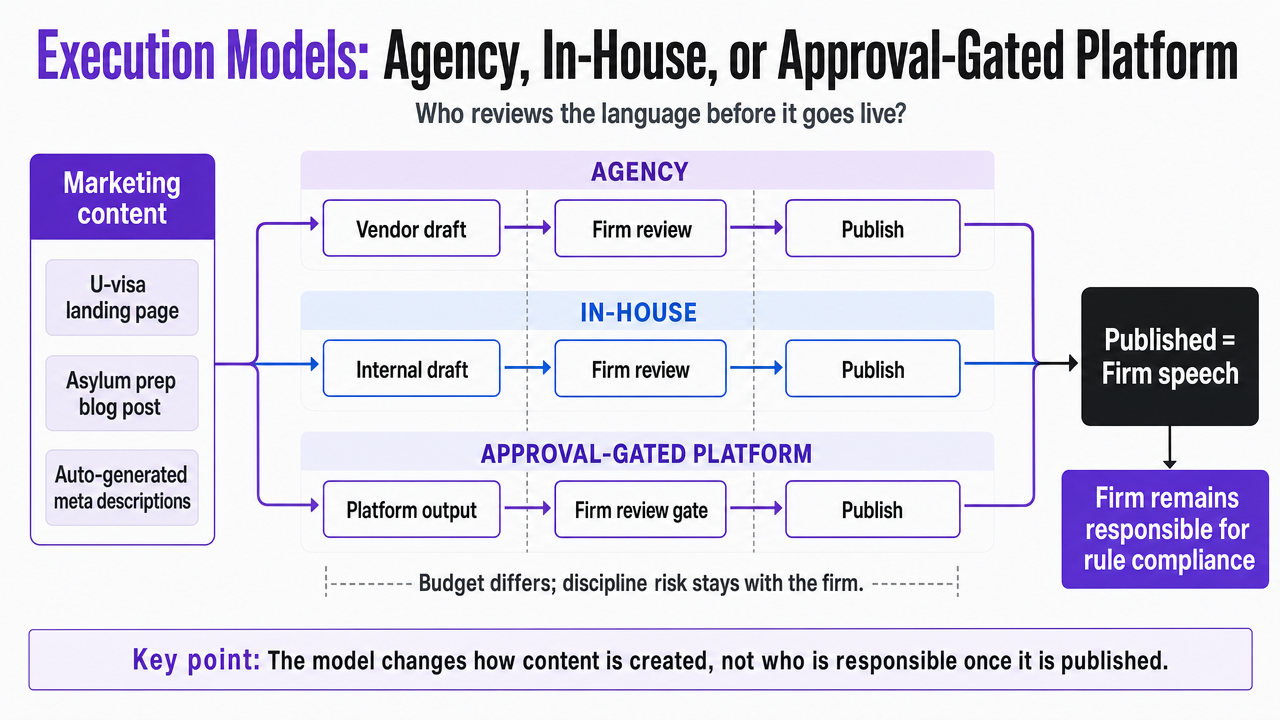
The choice between an outside SEO agency, an in-house marketer, or a platform-driven workflow is often framed as a budget question. The actual question is who reviews the language before it goes live, because the firm carries the discipline risk either way.
North Carolina's Rule 7.2 commentary states the position cleanly: a lawyer may compensate vendors who provide marketing or client-development services, including website designers and internet-based advertisements, but the firm remains responsible for whether those communications comply with the rules 11. An agency's draft of a U-visa landing page, a freelancer's blog post on asylum interview preparation, and a platform's auto-generated meta descriptions all become the firm's speech the moment they are published.
That responsibility does not transfer through a contract. Indemnification clauses with an SEO vendor may shift financial exposure between the parties, but they do not move the bar's view of who published the misleading claim. The partner whose name appears on the responsible-attorney disclosure under California Rule 7.2 5is the partner the bar contacts when a claim does not survive scrutiny.
The operational implication is that the execution model only matters to the extent it makes partner approval faster, traceable, and harder to bypass. A model that publishes content the partner has not read is a liability regardless of its monthly invoice.
If the Firm Operates Multiple Offices: A Cost-Structure Comparison
This section narrows to managing partners running multi-office immigration practices, where content volume, language coverage, and per-jurisdiction rule variation multiply the workload. A single-office firm can often manage execution through a part-time marketer and a careful approval habit. A firm with offices in three states publishing across two or three languages cannot.
The comparison below uses generic variable labels rather than fabricated dollar figures. The point is to surface what the firm pays for and what the partner has to do, not to benchmark vendor pricing.
| Variable | Traditional SEO Agency Retainer | In-House Marketer + Freelancers | Approval-Gated AI Platform |
|---|---|---|---|
| Monthly cost structure | Fixed retainer plus scope add-ons | Salary, benefits, freelance pool, tooling stack | Subscription plus partner review time |
| Content units per month | Capped by retainer scope | Capped by hire's bandwidth | Capped by approval throughput |
| Languages supported | Each language priced separately | Depends on hire's fluency and freelance access | Native-language drafting at parity cost |
| Partner approval hours required | Variable; often skipped under deadline pressure | Concentrated on the hire's drafts | Structured into the publishing workflow |
| Rule 7.1 substantiation tracking | Vendor-side, opaque to firm | Marketer's documentation discipline | Logged per claim, per jurisdiction |
| Attribution to signed cases | Reported by vendor, rarely joined to CRM | Depends on marketer's analytics skill | Built into the reporting layer |
The variable that distinguishes the three models for a multi-office immigration firm is not unit cost. It is whether partner approval is structured into the publishing workflow or bolted on after the fact. The agency retainer often produces the highest unreviewed publishing volume because deadline pressure pushes drafts past partners who do not have time to read every page. The in-house model concentrates review on a single bottleneck. An approval-gated workflow makes the partner sign-off a precondition of publishing rather than a courtesy.
Per-signed-case cost follows from that distinction. A model that publishes faster but produces consultations the firm cannot defensibly serve does not lower the cost per retainer; it raises it, because intake time spent on unqualified or misleading-promise prospects is the most expensive hour in the firm.
 Visualize the three-model comparison table from the section so partners can scan the tradeoffs at a glance
What to Stop Funding This Quarter
The fastest way to improve immigration SEO economics is usually subtraction. Three line items in particular tend to consume budget without producing signed retainers, and a quarter-end review is the cleanest moment to cut them.
- Blanket directory subscriptions whose profile copy uses recommendation or rating language the firm could not publish on its own homepage. Rule 7.1 commentary on paid lead generators is direct: a lawyer must not pay a vendor that implies it is recommending the lawyer 2, and the firm remains responsible for the vendor's published language under rules modeled on Rule 7.2 11. Profiles that fail a read-aloud test get cancelled, not renewed.
- Generic "immigration lawyer near me" blog content that does not map to a relief category with measurable local demand. These posts dilute the relief-category architecture and rarely produce qualified consultations.
- Any analytics or remarketing tag firing on intake pages that capture immigration status or country of origin. Those tags expose the firm without lifting conversion.
Redirect the recovered budget into native-language pillar pages, bar-license verification links on every attorney bio, and the CRM joins that connect query clusters to signed matters.
Frequently Asked Questions
References
- 1.Chapter 7. Information About Legal Services (Rules 7.1–7.6).
- 2.advertising & solicitation mrpc 7.1-7.6.
- 3.Americans and Privacy: Concerned, Confused and Feeling Lack of Control Over Their Personal Information.
- 4.Legal Resources | Undocumented Student Programs - UC Riverside.
- 5.Rule 7.2 Advertising (Redline Comparison to the ABA Model Rule).
- 6.7.1 Communications Concerning A Lawyer's Services.
- 7.List of Pro Bono Legal Service Providers.
- 8.Resources for Immigrants.
- 9.What we know about unauthorized immigrants living in the U.S..
- 10.74% favor legal status for those brought to US illegally as children.
- 11.7.2 Communications Concerning A Lawyer's Services: Specific Rules.