
Key Takeaways
- Per-location SEO retainers duplicate work across sites and fail the coordination math; account-level execution runs four lanes—content, technical, local, authority—under one strategy layer.
- Service-line masters with location-variant templates eliminate duplicate clinical content, while named credentialed authorship and dense schema feed both ranking and AI Overview citation eligibility.
- Local pack and 'near me' results remain the surface generative summaries have not displaced, defended through unified GBP management, NAP consistency, and review velocity tracked as portfolio metrics.
- Reporting belongs on five lines a CEO recognizes: blended CAC against the $155–$610 benchmark, booked appointments from organic, local pack share, topical authority, and LTV-to-CAC 2.
Why Per-Location SEO Math Stopped Working
The economics that made per-location SEO retainers defensible five years ago have inverted. When a 40-location dermatology group could buy a $2,500 monthly retainer per site and watch organic patient volume climb, the per-location model looked like math that worked. It no longer does. Three forces have collapsed that arithmetic at once: rising patient acquisition costs, compounding ranking decay across fragmented execution, and the structural shift in how Google surfaces health information.
Patient acquisition costs in healthcare now range from $155 to $610 per new patient depending on specialty, and acquiring a new patient costs five to twenty-five times more than retaining an existing one 2. That spread punishes any execution model that wastes inventory. A per-location agency producing duplicate service-line content, inconsistent schema, and uncoordinated GBP signals across 30 sites is not buying 30 SEO programs. It is buying 30 versions of the same mediocre output, billed in parallel.
The competitive intensity is not slowing. Healthcare marketing is projected to grow at 8.36% CAGR through 2032 3, which means every operator's competitors are spending more, not less, on the same organic real estate. Patient discovery still concentrates on Google as the entry point 1, but the page below the search box has been rebuilt around AI Overviews, expanded local packs, and zero-click answer formats.
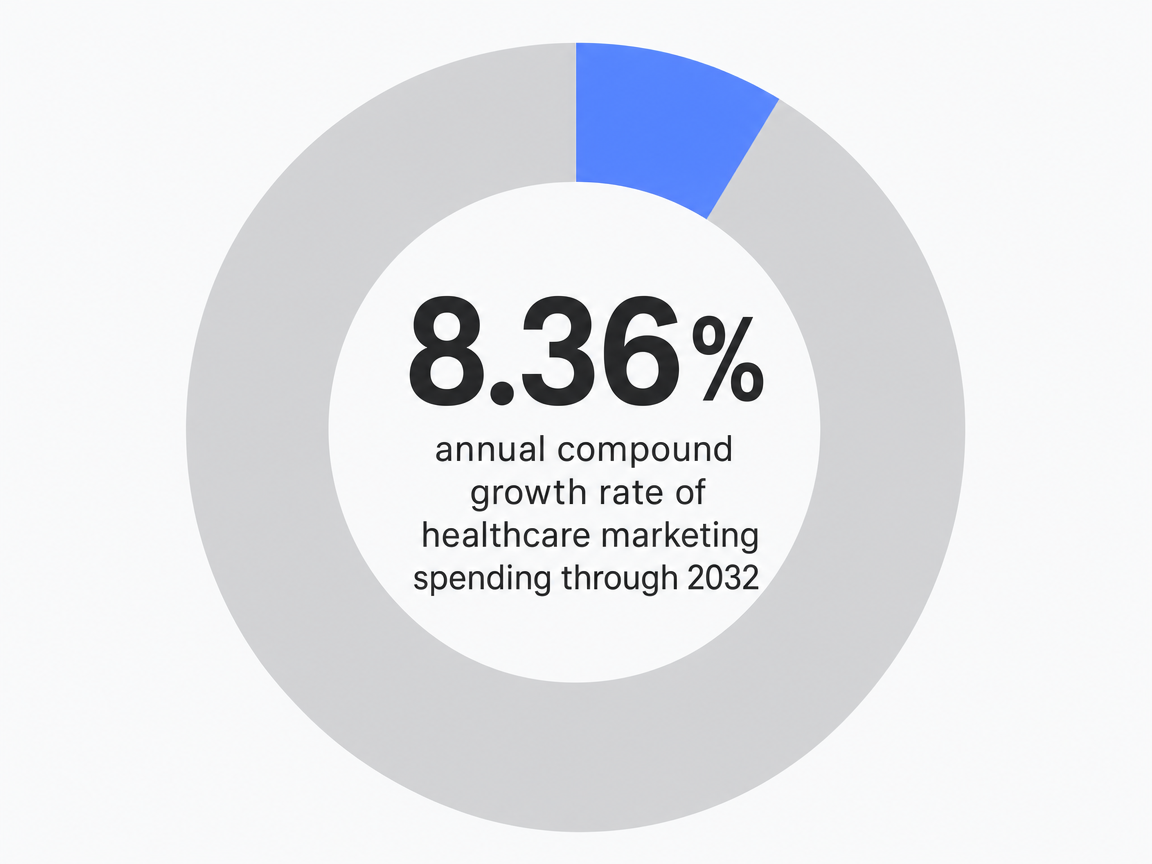 annual compound growth rate of healthcare marketing spending through 2032: 8.36%
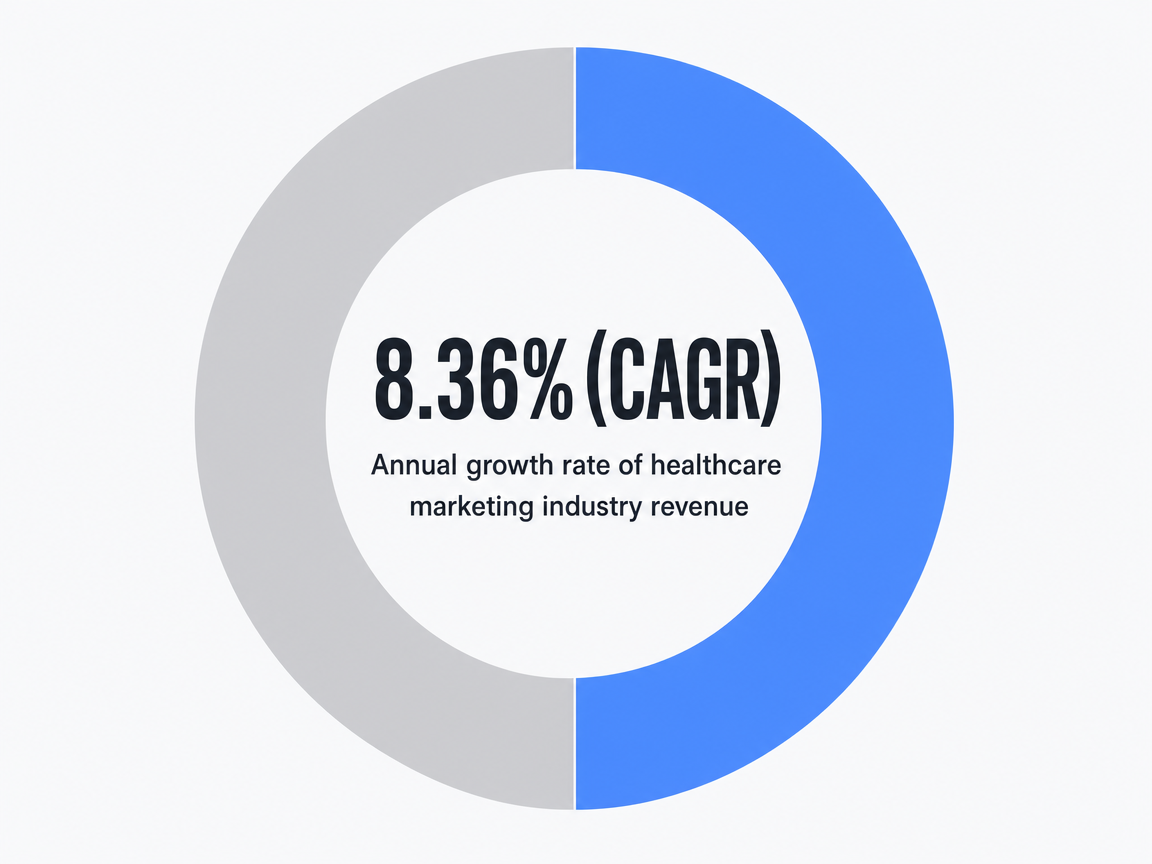 Annual growth rate of healthcare marketing industry revenue: 8.36% (CAGR)
Harvard Business Review framed the shift cleanly: medical marketing is no longer a campaign function but a system that compounds or decays based on coordination 4. Per-location retainers were built for the campaign era. The operators gaining patient share now run one plan across the entire footprint.
The Account-Level Operating System
Four Execution Lanes Under One Strategy Layer
An account-level SEO program runs four execution lanes under a single strategy layer rather than four parallel agency engagements stitched together at the reporting deck. The strategy layer owns the portfolio view: which service lines compound across which markets, which locations are under-indexed, where competitor gaps sit, and how budget allocates against patient acquisition cost benchmarks. The lanes underneath execute against that view.
Lane one is content. One service-line taxonomy, one clinical authorship pool, one set of templates that variant cleanly across locations. Lane two is technical SEO, run as a single codebase audit cycle rather than 30 separate WordPress engagements with 30 different plugin stacks. Lane three is local search, treated as a unified GBP and citation operation across the footprint, not a per-office afterthought. Lane four is authority building, where backlink targets are selected against the account's weakest topical clusters rather than a per-location link quota.
The reason this structure outperforms per-location retainers is coordination math. When a dermatology group publishes a definitive piece on Mohs surgery, every location page that lists Mohs as a service should inherit topical authority through internal linking, schema relationships, and consistent citation patterns. Fragmented agencies cannot produce that inheritance because they do not share a content graph. Google's helpful content guidance rewards depth and consistency over duplication 7, which makes the account-level structure not just cheaper but algorithmically better positioned.
Per-Location Retainer Math vs. Account-Level Execution
The cost comparison between traditional per-location retainers and account-level execution is less about the headline retainer number and more about what gets duplicated, what compounds, and how blended CAC moves over a 12 to 24 month horizon. The table below frames the variables operators should model against their own footprint rather than quoted dollar figures, since per-location retainers vary widely by market and agency tier.
| Cost Driver | Per-Location Agency Model | Account-Level Execution | Notes |
|---|---|---|---|
| Monthly SEO retainer | Variable fee × N locations | Single account fee covering all locations and service lines | Per-location billing scales linearly; account-level scales sub-linearly with footprint. |
| Content production per location | Duplicate service-line pages produced separately per site | One service-line library, location-variant templates | Eliminates parallel writing of the same clinical topic across sites. |
| Technical audit cycle | Per-site, often quarterly, inconsistent stacks | Account-wide continuous, unified codebase review | Core Web Vitals failures get patched once, not 30 times 5. |
| Local SEO management | Per-GBP, often outsourced to a separate vendor | Centralized GBP and citation operation | NAP consistency and review velocity managed as portfolio metrics. |
| Reporting overhead | N dashboards, N agency calls, manual roll-up | One account dashboard, portfolio KPIs | VP-level reporting time drops from hours to minutes per week. |
| Blended CAC impact | Each location absorbs full $155–$610 per-patient cost 2 | Compounding organic share lowers blended CAC over time | Retention multiplier of 5–25x makes organic compounding the highest-leverage line item 2. |
Two outputs matter from this comparison. First, the marginal cost of adding a new location to an account-level program approaches zero on the strategy and content lanes, while it is a full retainer line under per-location billing. Second, the quality ceiling rises because clinical authorship, schema architecture, and authority signals stop being reinvented per site and start reinforcing each other across the portfolio.
Content Production at Service-Line Scale
Service-Line Templates and Location Variants
Content at portfolio scale fails when each location page is written from scratch and succeeds when each page is a structured variant of a service-line master. The master holds the clinical depth: procedure mechanics, candidacy criteria, recovery expectations, alternatives, and outcomes data. The variant holds what changes per site: the treating clinicians, the room and equipment specifics, the insurance accepted, the booking path, and the geo-modifiers a patient actually types.
That separation eliminates the most expensive failure mode in multi-location healthcare content, which is writing the same Mohs surgery overview thirty times across thirty dermatology sites. Each rewrite costs production hours, introduces clinical drift, and produces near-duplicate content that competes against itself in search. A single authoritative master, syndicated through location-aware templates, lets one piece of clinical depth power thirty location pages without triggering duplicate-content dilution.
The template architecture should hold roughly five variant slots: provider roster with credentials, location-specific equipment and room descriptions, insurance and payer mix, address and hours block bound to schema, and a hyper-local FAQ that captures geo-modified queries. Everything else inherits from the service-line master. Operators running this structure can publish a new market in days rather than rebuilding the content stack per acquisition, which matters when the M&A cadence in DSO and MSO portfolios outpaces traditional content production cycles.
Clinical Authorship and E-E-A-T Signal Architecture
Google's helpful content guidance is explicit that demonstrable expertise, firsthand experience, authoritativeness, and trust are not metadata flourishes but ranking inputs the system actively rewards 7. For medical content, that translates into a specific authorship architecture rather than a byline at the bottom of a blog post.
The architecture has four components. First, every clinical page is attributed to a named, credentialed clinician with a profile page that lists board certifications, hospital affiliations, residency, and years in practice. Second, that clinician profile is wired to the page through schema relationships—Person, MedicalOrganization, and medicalSpecialty properties—so search systems can resolve the author as a real practicing physician, not a marketing pseudonym. Third, the content itself reflects firsthand procedural detail that only a practicing clinician produces: technique variants, complication rates from the practice's own caseload where defensible, and explicit citations to peer-reviewed sources for any claim outside common clinical knowledge.
Fourth, the review trail is documented. A page that lists who wrote it, who medically reviewed it, and when it was last clinically updated produces signals that fragmented per-location content cannot match. This architecture also feeds the AI Overview defense problem covered later, because generative systems preferentially cite content with verifiable expertise markers and resolvable entity relationships.
Unlock Data-Driven Patient Growth With SEO Automation
Experience measurable improvements in patient acquisition with a fully operational SEO system during your free trial.
Technical SEO as a Conversion Lever
Technical SEO in a multi-location healthcare program is not a checklist of meta tags. It is the layer where ranking eligibility and booked-appointment economics meet, and where fragmented per-site stacks bleed conversion at every step of the patient path.
Core Web Vitals set the floor. Largest Contentful Paint, Interaction to Next Paint, and Cumulative Layout Shift are the three measurements Google treats as page experience inputs, and they correlate directly with whether a patient who lands on a location page actually completes a booking flow 5. A dermatology location page that loads its hero image in 4.2 seconds on a mid-tier Android is not just losing rankings. It is losing the patient who tapped through from a local pack result while sitting in a parking lot.
The conversion math is sharper than most operators model. A one-second delay in mobile load time produces measurable drops in conversion rate across commercial verticals 6. In healthcare, where the patient is often making a same-day decision about an urgent care visit or a prescheduled specialty consult, that latency penalty compounds against an already expensive acquisition cost of $155 to $610 per patient 2.
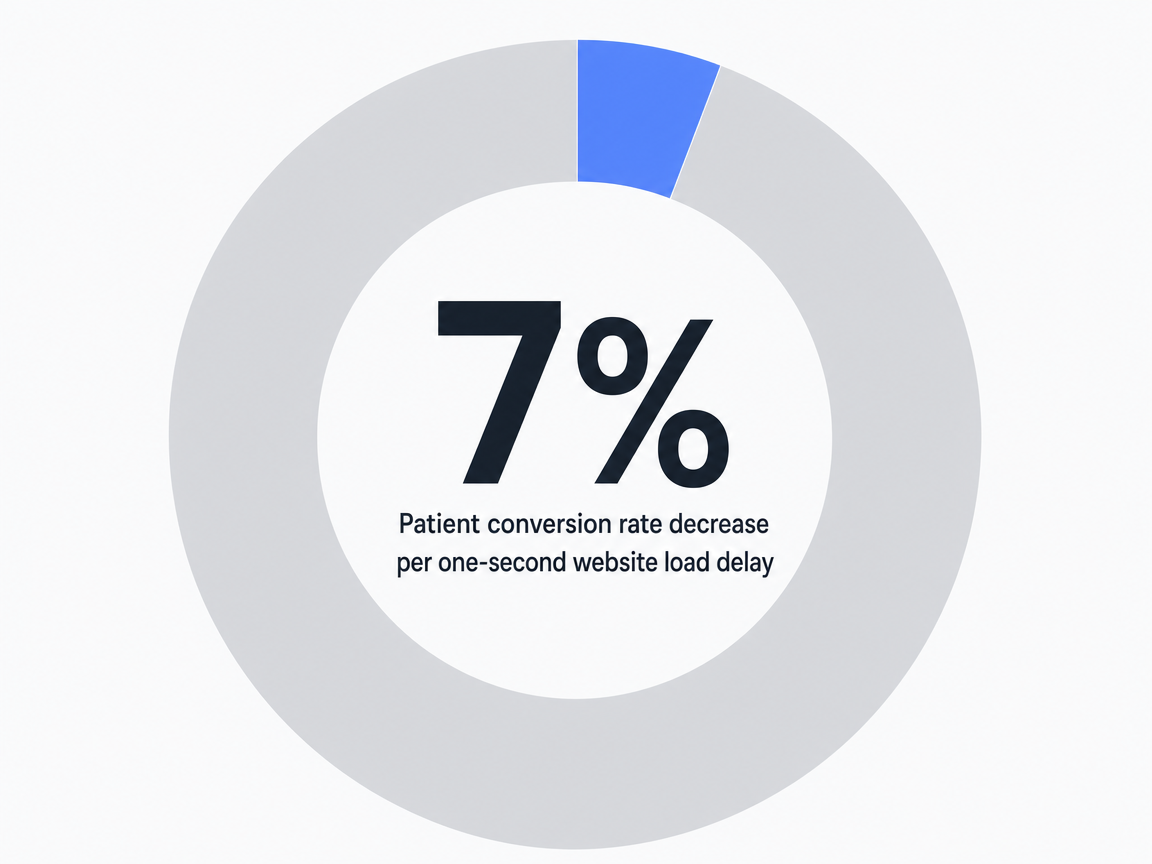 Patient conversion rate decrease per one-second website load delay: 7%
Per-location agency engagements rarely fix this at the root. Each site sits on a different theme, a different plugin stack, and a different hosting tier, which means a Cumulative Layout Shift problem in the appointment widget gets diagnosed thirty separate times and patched inconsistently. Account-level execution treats the codebase as one technical surface. Schema deploys uniformly. Image pipelines compress consistently. Server response times are measured against a single SLO across the portfolio.
The schema layer deserves its own line. MedicalBusiness, Physician, MedicalProcedure, and FAQPage markup, deployed densely and consistently across every location and service-line page, is what gives location pages a fighting chance in local packs and gives service-line content the entity scaffolding generative systems need to cite the practice. Schema density is not a vanity metric. It is the structured signal that converts crawl coverage into surface area in the formats that drive booked appointments.
Local Search: The Traffic Moat AI Overviews Still Exclude
GBP Profiles, NAP Consistency, and Review Velocity
Local pack results remain the one surface where generative summaries have not displaced the click. When a patient types a geo-modified query for an in-person provider, Google still returns a map, three local listings, and a path to a phone number or booking widget. That surface is defended through Google Business Profile management, citation hygiene, and review operations run as portfolio metrics rather than per-office tasks.
GBP profiles fail at scale for predictable reasons. Hours drift after a clinician schedule change. Service categories get edited inconsistently across markets. Photos go stale. A practice with 40 GBP profiles needs a single operator dashboard that monitors category accuracy, posting cadence, and Q&A response time across every listing, not 40 separate logins managed by office managers between patient intake.
Name, address, and phone consistency is the citation layer underneath the profile. Every directory entry, insurance portal, hospital affiliation page, and aggregator listing should resolve to identical NAP strings. Inconsistency at this layer suppresses local pack eligibility regardless of how strong the on-site signals are. 'Near me' search volume continues to expand as the dominant local discovery pattern 8, which means citation drift in a multi-location footprint is a direct revenue leak.
Review velocity—new reviews per location per month, response rate, and average rating trajectory—belongs on the same dashboard as organic traffic and CAC, not in a separate reputation tool no one opens.
Conversational and Voice Query Capture
Conversational queries behave differently than typed keyword strings. A patient asking a phone assistant for an urgent care that takes their insurance after 8 p.m. produces a long, natural-language string with embedded constraints—payer, hours, proximity, urgency. Voice search has restructured how patients phrase intent, particularly for time-sensitive care decisions 9.
Capturing that traffic requires content written against the actual question, not the head term. Service-line FAQs and location-page Q&A blocks should answer specific operator-known questions: which insurances are accepted, what walk-in hours look like on weekends, how same-day appointments are handled, what the typical wait time runs. Each answer becomes a discrete passage that can be surfaced as a featured response or read aloud by a voice assistant.
FAQPage schema wraps the structure into a format search systems can parse and attribute. Operators who build this layer once at the service-line level and inherit it through location templates capture conversational query volume that fragmented per-site content misses entirely. The compounding benefit is that the same passage architecture also feeds the AI Overview citation surface covered in the next section.
Defending Organic Share Against AI Overviews
Generative summaries have changed which queries return clicks and which return read-aloud answers. The defensive question for a multi-location operator is no longer whether AI Overviews will appear on health queries—they already do across symptom, condition, and procedure intent—but which content gets cited inside them and which gets buried below the fold.
Citation inside an AI Overview is not random. Generative systems preferentially surface content with resolvable expertise markers, structured data density, and passage-level clarity. That maps directly to what Google's helpful content guidance has been signaling for two release cycles: demonstrable experience, named clinical authorship, and content that answers the specific question a real patient asked 7. Practices that built clinical authorship architecture and dense schema for ranking purposes inherit AI Overview citation eligibility as a byproduct.
The defensive stack has four concentric layers. The outer layer is original clinical data—outcomes from the practice's own caseload, complication rates, recovery timelines drawn from real patients—because generative systems cite primary sources over aggregators. The next layer is entity resolution: clinicians wired to MedicalOrganization and Physician schema so the system can verify who wrote and reviewed the content. The third layer is passage architecture, where each FAQ answer and procedure subsection is structured to be lifted as a standalone citation. The innermost layer is freshness, with documented review dates that signal active clinical maintenance.
Operators who build that stack across the service-line library, rather than per location, defend share once and inherit the protection across the entire footprint.
Unlock Scalable Patient Growth with Data-Driven SEO for Healthcare Networks
Discover how top healthcare operators and agencies are using unified SEO strategies to drive measurable patient acquisition across all locations—see platform demos, benchmarks, and multi-site growth case studies.
FTC Compliance and Human Oversight of AI-Generated Medical Content
AI-assisted production at portfolio scale runs into a regulatory floor the FTC has stated plainly: claims about what AI does, and claims produced by AI, are subject to the same truthfulness standards as any other commercial speech 10. For medical content, that standard is harder to clear because the underlying claims touch clinical outcomes, candidacy criteria, and procedure risk.
Three controls belong inside any AI-assisted content workflow. First, every clinical page produced with AI assistance routes through a named credentialed reviewer before publication, with the review timestamp written to the page. Second, AI involvement is documented internally with version history, prompt logs, and source attribution—not as marketing transparency but as defensible record-keeping if a claim is challenged. Third, no AI-drafted passage stating outcomes, success rates, or comparative efficacy publishes without a citation to a primary source or an explicit attribution to the practice's own caseload data.
Operators running these controls at the account level rather than per location avoid the worst failure mode: a single unreviewed AI-generated outcomes claim propagating across thirty location pages and creating thirty parallel compliance exposures from one upstream error.
Measurement: KPIs a VP of Marketing Reports to a CEO
The measurement layer is where account-level SEO either earns its budget defense at the next board review or quietly loses it. Most per-location reporting decks fail this test by stacking traffic and ranking metrics that no CEO has ever asked about. The portfolio dashboard a VP of Marketing actually defends runs on five lines.
Blended CAC is the first. Organic-attributed patient acquisition cost, calculated against the $155 to $610 specialty range as a benchmark 2, should trend down quarter over quarter as organic share compounds. If it is flat after twelve months of execution, the content lane is producing volume without intent match. Booked appointments from organic, not sessions, is the second line. GA4 events tied to the booking widget and call tracking attached to location pages convert organic traffic into the unit a CEO recognizes as revenue.
Local pack share of voice across the footprint is the third, measured as the percentage of tracked geo-modified queries where a practice location appears in the top three map results. Service-line topical authority is the fourth, expressed as ranking distribution across the master content library rather than per-page averages. Patient lifetime value against acquisition cost—the 5x to 25x retention multiplier 2—is the fifth, because organic compounding only matters if the patients booked actually return.
Reported monthly. Tied to P&L. No vanity metrics.
Where Account-Level SEO Goes Next
The operators pulling ahead through 2026 will not be the ones running marginally better per-location campaigns. They will be the ones who collapsed the agency stack into a single production system and freed their marketing teams to work on demand generation rather than coordination overhead. Patient acquisition is now a system that compounds or decays based on how cleanly content, technical, local, and authority lanes execute against one strategy 4.
The decision in front of most VPs of Marketing is structural, not tactical. Continue paying retainers per location and absorbing the duplicate work, or run one plan across the footprint and reinvest the difference into the lanes that actually move booked appointments. Vectoron was built for the second path—account-level execution across every site and service line, billed once, measured against the KPIs the CEO already asks about.
Frequently Asked Questions
References
- 1.The Digital Patient Journey: How Americans Use the Internet for Health Information.
- 2.Benchmarking Patient Acquisition Costs and Lifetime Value in Healthcare.
- 3.Healthcare Marketing Market Size, Share & COVID-19 Impact Analysis.
- 4.The New Rules of Marketing for Medical Practices.
- 5.Core Web Vitals.
- 6.Milliseconds Make Millions: The Business Value of Web Performance.
- 7.Creating helpful, reliable, people-first content.
- 8.The Growth of 'Near Me' Searches and Its Impact on Local Business.
- 9.How Voice Search is Changing Consumer Behavior.
- 10.Keeping Your AI Claims in Check.