
Key Takeaways
- Local search revenue for movers depends on a linked pipeline of Google Business Profile visibility, map pack ranking, and compliant reviews governed by FTC and FMCSA rules.
- The FTC's 2024 rule makes fabricated reviewers, sentiment-conditioned incentives, undisclosed insider reviews, and contract-based suppression illegal, so review workflows need auditing before the next solicitation cycle 2.
- Service-area pages convert when they display USDOT numbers, legal carrier names, written estimate details, and a real claims process that matches what FMCSA tells shoppers to verify 7, 8.
- Multi-location operators should treat local SEO as a governed production pipeline with approval-first workflows, since violations and trust gaps are evaluated at the entity level across every branch.
Why Booked Jobs Now Depend on a Compliance-Aware Local Pipeline
Local search has become the primary driver for mover revenue. Homeowners use their phones to find moving services, often tapping on map pack results, scanning business profiles, and booking directly. This entire process, from initial search to signed estimate, relies heavily on Google-owned platforms, third-party review sites, and service pages that address verification concerns.
A significant shift occurred in 2024 with the Federal Trade Commission's (FTC) final rule on fake reviews and testimonials. This rule made previously tolerated tactics explicitly illegal, including fabricated reviewer identities, incentives conditioned on positive sentiment, undisclosed insider endorsements, and contract clauses that penalize honest feedback 2. Moving companies that relied on aggressive review-solicitation strategies now face enforcement risks.
This regulatory change integrates ranking in the map pack, converting mobile visitors, and generating reviews into a single, compliance-governed pipeline. This pipeline is shaped by federal regulations, FMCSA consumer expectations, and the operational efficiency of the moving company.
The Local Ranking Factors That Actually Move Revenue
Google Business Profile as the Primary Storefront
For moving companies, the Google Business Profile (GBP) is now more crucial for revenue generation than the website homepage. It displays essential information such as the phone number, operating hours, service radius, and review count, all of which influence a shopper's decision before they even read website content.
Treating GBP as merely a directory listing overlooks its function as a conversion tool. Proper category selection ensures visibility for relevant queries. Service attributes—like local moving, long-distance moving, packing, storage, and specialty handling—signal to Google the specific intents the business serves. High-quality photos of trucks, uniformed crews, and completed jobs help reduce perceived risk for potential customers.
The verification signals expected by shoppers on a GBP align with federal consumer guidance. For instance, the FMCSA advises consumers to verify an interstate mover's registration and USDOT number before hiring 8. A GBP that clearly displays licensing details, service areas, and a functional booking path addresses these verification needs within the same session, distinguishing a profile that not only ranks but also converts.
Map Pack Positioning and Mobile-First Behavior
The map pack is where local search intent narrows down to a few choices. When a homeowner searches "movers near me" on a mobile device, they see three business profiles above organic results, displaying stars, review counts, distance, and a call button. Ranking outside these top three positions significantly reduces visibility and engagement on a small screen.
The review signal within the map pack is critical. Research by Pew found that 82% of U.S. adults at least sometimes read online customer ratings or reviews before making a first-time purchase 10. Hiring a mover is typically a first-time purchase for most households, which explains why review count and rating heavily influence decisions made within the map pack.
Mobile behavior further shortens the evaluation window. Shoppers are often comparing profiles quickly, prioritizing those with more reviews and higher ratings, and expecting immediate connection when they call. Profiles that load slowly, obscure contact information, or lead to generic voicemails are likely to lose bookings to more efficient competitors.
NAP Consistency and Citation Hygiene Across Directories
Maintaining consistent name, address, and phone number (NAP) information across various directories is crucial for Google's trust in a business, which impacts map pack rankings. Moving companies often experience citation drift due to changes in vehicles, phone systems, business names, or new listings on broker sites with slightly different details. Each inconsistency weakens the business's online entity signal.
A thorough audit involves comparing citations from primary aggregators, moving-specific directories, BBB, Yelp, Apple Maps, Bing Places, and FMCSA registration records against the GBP. Any discrepancies should be resolved to match the GBP version. Duplicate profiles, often resulting from franchise transitions or acquisitions, should be retired.
Citation hygiene also reinforces the trust signals shoppers look for. The FMCSA advises consumers to check registration and complaint history before booking 6. A mover whose USDOT number and legal name are consistent across their GBP, website footer, and federal registry provides a seamless verification experience for the shopper.
Reviews as Regulated Inventory, Not a Branding Asset
What the FTC's 2024 Rule Prohibits in Review Generation
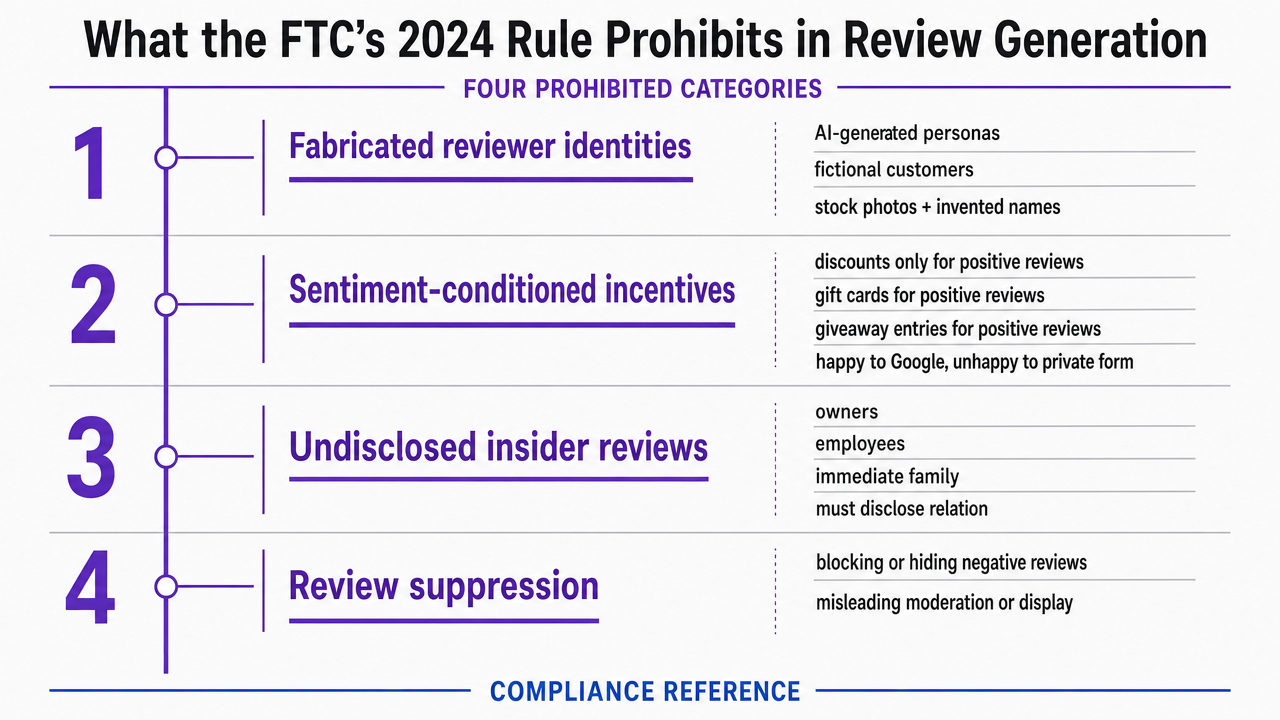
The FTC's 2024 rule on fake reviews and testimonials transformed several review-generation practices into enforceable violations. Four key categories are particularly relevant for moving companies:
- First, fabricated reviewer identities are strictly prohibited. This includes AI-generated personas, agency-written five-star testimonials attributed to fictional customers, and stock photos with invented names on testimonial pages 2.
- Second, sentiment-conditioned incentives are banned. Offering discounts, gift cards, or giveaway entries only for positive reviews is illegal. This means practices like routing happy customers to Google and unhappy ones to private feedback forms are now prohibited 2.
- Third, undisclosed insider reviews are forbidden. Owners, employees, and their immediate family members must disclose their relationship if they post reviews.
- Fourth, contract-based suppression, which penalizes customers for honest feedback through terms and conditions, is also illegal.
Moving companies should audit their review pipelines, including SMS follow-ups, referral incentives, testimonial pages, and employee handbooks, against these four categories before initiating new review cycles.
Incentives, Employee Reviews, and the 2023 Endorsement Guides
The 2023 revision to the FTC Endorsement Guides underpins the 2024 rule, emphasizing principles against distorting consumer perception through review manipulation. The guides specifically address incentivized reviews, employee reviews, and fake negative reviews of competitors 1.
For movers, this impacts several operational patterns. Bonus structures for crew leads tied to five-star reviews turn employees into incentivized endorsers. Internal contests encouraging office staff to post reviews of their employer fall under employee reviews. Reciprocal review swaps with partners like storage facilities or real estate agents create endorsements requiring disclosure of the material connection.
A compliant review program involves a neutral post-move request for honest feedback from all customers, without conditioning the request or any reward on the sentiment expressed.
Display Rules: Publishing Negative Reviews and Non-Misleading Presentation
While generation rules govern how reviews are obtained, display rules dictate how they are presented. FTC guidance mandates publishing all genuine reviews, including negative ones, and avoiding misleading presentation 3.
This affects how moving companies use testimonial carousels, review widgets, and curated quotes on landing pages. Cherry-picking only five-star reviews while suppressing lower-rated feedback creates a misleading impression of overall reputation. Reordering reviews to bury critical ones, editing reviews in ways that alter their meaning, or filtering by keywords to exclude complaints are also considered misleading practices.
The operational solution is to implement a display policy that pulls reviews based on neutral criteria, such as recency, verified job status, or service line, rather than sentiment.
Contract Language That Suppresses Reviews Is Illegal
Historically, some movers included non-disparagement clauses in their agreements. However, the Consumer Review Fairness Act makes it illegal for companies to use contract provisions that restrict a person's ability to review their products, services, or conduct 4.
Companies should review all customer-facing contracts—including estimate acknowledgments, move-day paperwork, claims releases, and storage agreements—to remove clauses that penalize honest reviews, require review takedown as a condition of claim payment, or transfer intellectual property rights of customer reviews to the company. Claims settlements that condition payment on review removal are a common area of exposure and must be revised.
Vendor Liability When Someone Else Buys the Reviews
Outsourcing review generation to a reputation-management vendor does not absolve a company of liability. FTC guidance states that a business can be held liable if it created fake reviews or purchased reviews it knew or should have known were false 5.
The "should have known" standard is crucial. If a vendor promises a fixed number of five-star reviews monthly, at a per-review price, in a market where the mover's actual booking volume cannot plausibly generate such numbers, this meets the "should have known" threshold. Contracts with review vendors should require attestation that all reviews come from verified customers, provide access to underlying customer records, and include termination clauses upon discovery of fabricated submissions.
Test Local SEO Strategies for Your Moving Company
Publish real campaigns and measure how local search improvements drive qualified calls during your free trial.
Reverse-Engineering Trust: What FMCSA Signals Tell Shoppers to Verify
DOT Numbers, Registration Checks, and Written Estimates on Service Pages
The federal moving checklist outlines exactly what shoppers should verify before booking, serving as a content specification for mover service pages. The FMCSA advises consumers to get estimates from at least three movers or brokers and to confirm that interstate movers and brokers are registered with FMCSA and have a U.S. DOT number 7. Shoppers comparing map pack profiles often perform this checklist in real-time.
Translating these verification steps into on-page elements is straightforward. The USDOT number should be prominently displayed in the header or footer of every service page, not hidden on an About page. The legal carrier name, MC number (if applicable), and state licensing details should be placed alongside it. The estimate process—detailing binding vs. non-binding, in-home vs. virtual surveys, and triggers for revised estimates—warrants its own section on the moving service page, rather than just a generic "get a quote" button.
The FMCSA also emphasizes that legitimate movers and brokers are registered for interstate operations involving household goods 8. For interstate service pages, linking directly to the FMCSA registration lookup for the operator's own USDOT number completes the verification process within the same session, preventing the shopper from having to navigate elsewhere to confirm.
Complaint-Intent and Claims-Process Pages as SEO Surface Area
Many movers create pages for booking intent but overlook the search volume associated with problem-solving intent, which is a missed opportunity. The FMCSA directs consumers to file complaints through its National Consumer Complaint Database or by calling 1-888-DOT-SAFT 9. This indicates that queries related to damaged goods, delayed delivery, missing items, and dispute resolution are actively searched, often by past customers seeking resolution.
A dedicated claims-process page can address this intent within the operator's own domain. Such a page should explain the internal timeline, valuation options selected at booking, required documentation for a claim, and the escalation path for disagreements. This demonstrates transparency to potential customers, as the page can also rank for pre-purchase research queries like "how do moving company claims work."
Operators who fear a claims page will invite problems misunderstand the dynamic. Complaints are often routed to the FMCSA and BBB 6when customers cannot find a clear internal channel. A well-structured claims page can reduce external complaint volume while capturing valuable search traffic that competitors often neglect.
Building the Service-Area Page Architecture Without Doorway Bloat
Service-area pages present a challenge: too few, and the mover lacks local visibility; too many, and the site risks accumulating near-duplicate "doorway pages" that Google's spam guidelines target. The optimal number depends on crew dispatch realities, meaningful content differentiation, and local search demand.
A robust architecture begins with service-line hubs (e.g., local moving, long-distance moving, commercial moving, packing, storage) and branches into city or metro pages only where genuinely distinct content can be supported. Distinct content includes route-specific details, actual crew presence, local pricing, market-specific storage facility addresses, and testimonials from customers in that geography. A page for a city serviced infrequently by a subcontracted partner does not meet this standard.
The trust elements previously discussed must appear on every service-area page, not just the homepage. The USDOT number, legal carrier name, licensing details, and links to registration verification should be present because shoppers often land directly on service-area URLs from map pack results and paid campaigns. FMCSA guidance directs consumers to verify registration before hiring 6, and a shopper on a Brooklyn moving page expects to complete this verification without further navigation.
Content depth on these pages must also match the information shoppers seek. Details on written estimate options, in-home versus virtual survey availability, binding versus non-binding quotes, valuation coverage tiers, and a condensed claims process (linked to the full claims page) reduce unanswered questions that might drive shoppers to competitors. Pages that lack this depth, relying instead on stock imagery and generic "trusted local movers" copy, fail to compete effectively.
See How Leading Movers Optimize Local SEO for Consistent Bookings
Request data-backed insights into multi-location SEO execution, including benchmarks for call conversions and cost efficiency in the moving industry. Designed for agencies and brands managing high-volume local campaigns.
If You Manage Multiple Locations: Workload Economics of Coordinated Local SEO
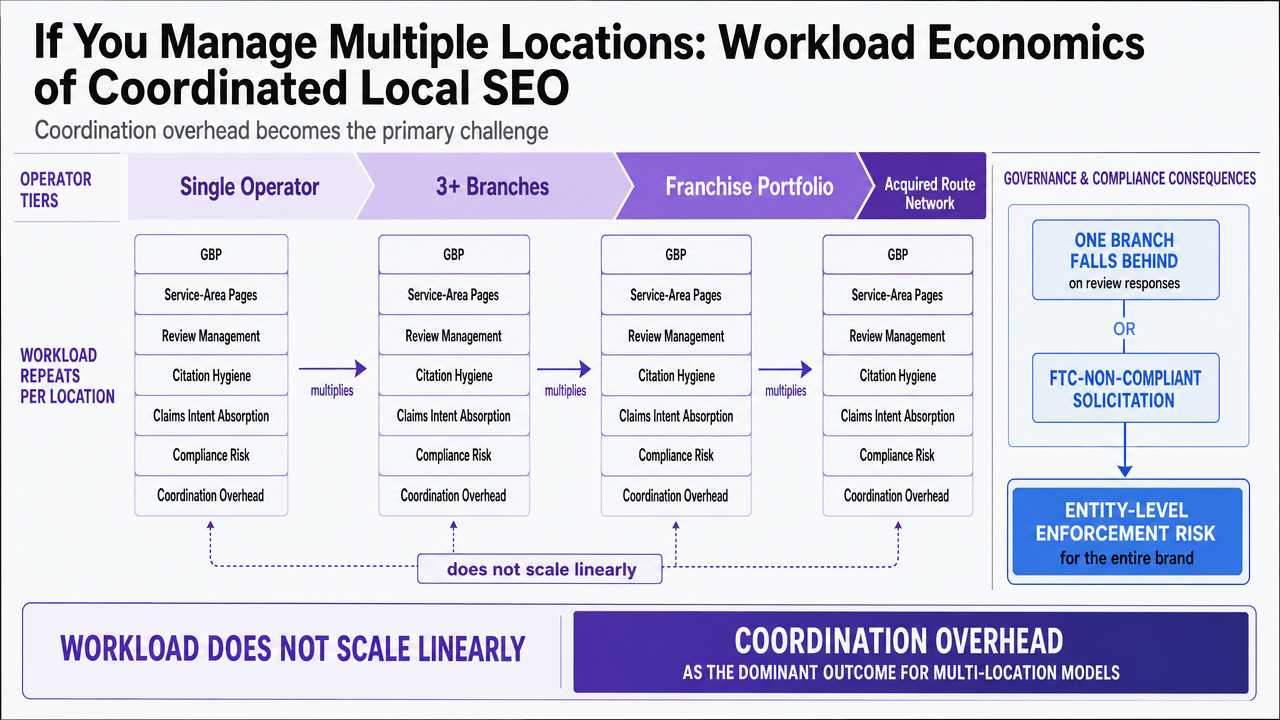
While the previous sections focused on single operators, this section addresses the complexities for multi-location businesses, such as restoration and moving companies with three or more branches, franchise portfolios, or acquired route networks. For these entities, the local SEO pipeline and its compliance requirements multiply, making coordination overhead the primary challenge.
The workload does not scale linearly. Each additional location requires its own GBP, service-area pages, review management, citation hygiene, and claims intent absorption. If even one branch falls behind on review responses or runs an FTC-non-compliant solicitation, the entire brand faces enforcement risk 2, as violations are evaluated at the entity level.
The table below illustrates workload variables across different operator profiles, focusing on operational load rather than pricing benchmarks.
| Workload Variable | Single Location | 3–5 Locations | Franchise / Portfolio (6+) ||---|---|---|---|| GBP management hours/week | 2–3 | 6–12 | 15+ centralized || Service-area pages to maintain | 5–15 | 20–60 | 75+ with template governance || Review response SLA | Within 24 hours | Within 24 hours, per branch | Within 24 hours, tiered escalation || Compliance review workload | Quarterly audit | Monthly audit across branches | Continuous with per-branch attestation || Coordination overhead | Owner + one lead | Regional manager layer | Central marketing + local approvers |
Two variables in this model require particular attention. Compliance review workload increases rapidly because each branch has its own solicitation cadence, and violations are attributed to the parent entity. Service-area page maintenance also compounds quickly, as trust elements—like USDOT numbers, registration status, and claims processes 7—must remain accurate across all location pages, adapting to changes in fleet, licensing, and dispatch coverage.
For multi-location operators, local SEO transforms from a marketing function into a governed production pipeline. This necessitates approval routing, template control, and per-branch attestation instead of ad-hoc updates. Companies relying on traditional monthly agency retainers often find that these retainers cover strategy but leave branch-level execution—such as review responses, page updates, and compliance audits—to already overburdened regional managers.
The Governance Layer: Approval-First Workflows That Ship Faster Than Retainers
The challenges in GBP maintenance, service-area page depth, FTC-compliant review generation, claims-intent content, and multi-location coordination often stem not from a lack of tactics, but from fragmented tools, ownership, and approval cycles.
Traditional monthly retainer arrangements often exacerbate these delays. Strategy decks arrive monthly, review responses are queued based on account manager availability, and critical service-area page edits related to new USDOT registration details can wait weeks for the next content sprint. Meanwhile, FTC rules evaluate violations at the entity level regardless of who published the content 2, and shoppers expect website information to match federal records immediately upon verification 8.
A more efficient governance model involves an approval-first workflow. Every proposed change—whether a review response draft, a service-area page revision, a citation correction, or a new claims-process paragraph—routes through a single approval queue, with the operator as the gatekeeper. Execution follows approval automatically. This allows the operator to retain control over what goes live, while the workflow eliminates coordination lag between decision and publication. Platforms built on this approval-first pattern, such as Vectoron, transform the local SEO pipeline into a governed production system rather than a series of monthly deliverables.
Frequently Asked Questions
References
- 1.Revised FTC Endorsement Guides to Combat Deceptive Reviews and Endorsements.
- 2.Federal Trade Commission Announces Final Rule Banning Fake Reviews and Testimonials.
- 3.Featuring Online Customer Reviews: A Guide for Platforms.
- 4.Consumer Review Fairness Act: What Businesses Need to Know.
- 5.The Consumer Reviews and Testimonials Rule: Questions and Answers.
- 6.Protect Your Move.
- 7.Moving Checklist | FMCSA - U.S. Department of Transportation.
- 8.Your Rights and Responsibilities When You Move.
- 9.How do I file a complaint against a moving company? | FMCSA.
- 10.2. Online reviews.