
Key Takeaways
- Treat organic search as a capacity-matching system measured by booked jobs per crew-day against available crew-days, not by sessions, rankings, or raw form fills.
- Weight content production toward ZIP and neighborhood pages inside the home county, since intra-county relocations made up 53.5 percent of 2022 moves 7.
- Convert FMCSA's five consumer selection steps, the 110 percent rule, and written-estimate procedures into dedicated on-page modules that double as ranking surfaces and trust proof 1, 3.
- For multi-territory operators, centralize federal trust modules under one governed source and localize ZIP-level specifics, then report bookings per crew-day per market and compliance signals at the portfolio level.
Why moving-company SEO is a capacity problem, not a ranking problem
Most moving-company SEO advice optimizes for the wrong target. Page-one rankings, branded impressions, and form fills all look like progress until a Saturday in June when three crews are double-booked and the phone keeps ringing, or a Tuesday in February when the same crews sit idle and cost-per-lead spikes because paid is filling the gap organic should have covered.
For marketing directors running multi-territory moving operations, organic search is best understood as a demand-shaping channel tied to crew utilization, not a volume firehose. The job is to produce qualified inbound that lines up with available crew-days in each service area, then to harden the trust signals that convert that demand into booked jobs at a margin worth the truck roll.
Two market realities make this discipline non-negotiable. First, household-goods moving operates under federal consumer-protection rules that govern what legitimate operators can and must communicate, including written estimates and the 110 percent cap on non-binding estimate overages 3. Second, the FMCSA's 2024 Operation Protect Your Move enforcement action against scam interstate movers and brokers has elevated consumer skepticism across the category, which means trust signals on the site now do measurable work that price and proximity alone cannot do 4. The framework that follows treats SEO as a capacity-matching system built on those two realities.
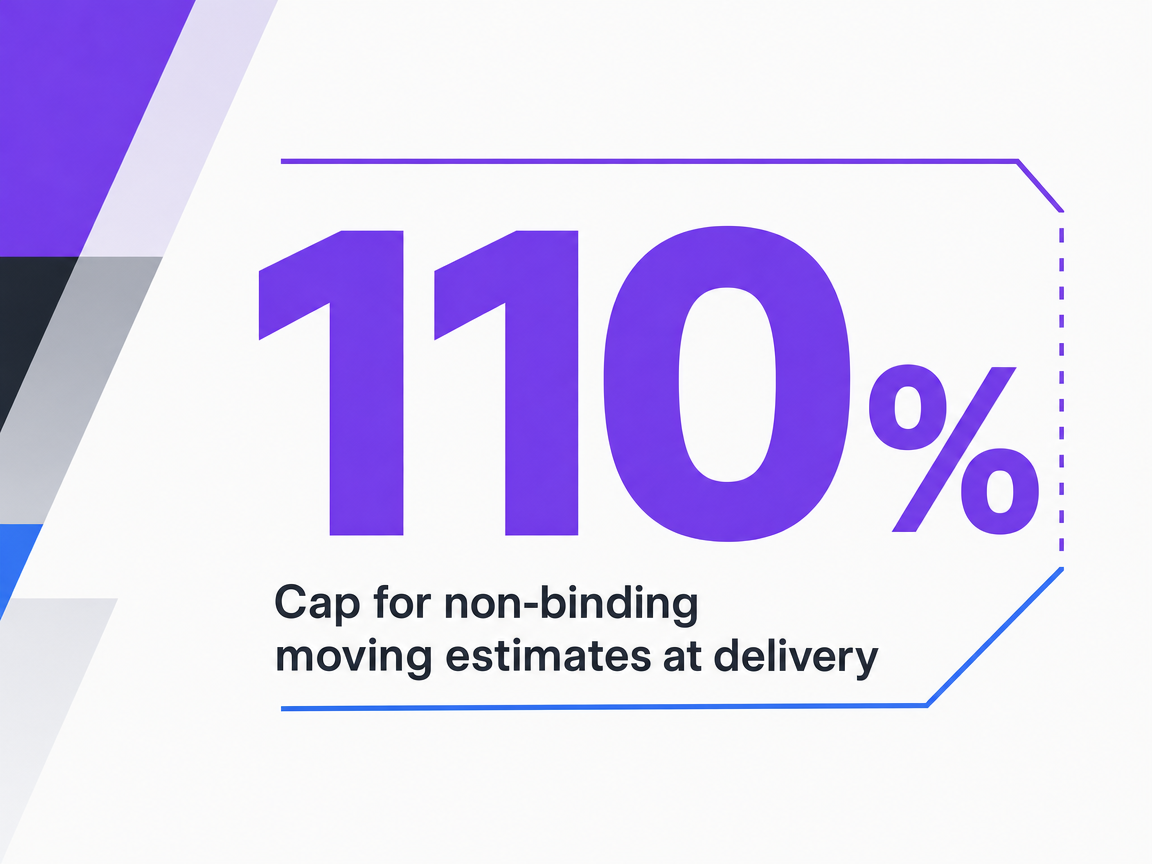 Cap for non-binding moving estimates at delivery
Cap for non-binding moving estimates at delivery
The demand-to-capacity ratio: a new lens for organic forecasting
Booked jobs per crew-day as the real SEO KPI
Sessions, keyword positions, and form submissions describe activity. They do not describe whether the dispatch board is full, half-empty, or overbooked. A more honest KPI for moving-company SEO is booked jobs per crew-day attributable to organic, measured against available crew-days in the same window.
The ratio works in both directions. When organic-sourced bookings consistently exceed crew capacity in a territory, the marketing team has license to raise price, tighten qualification, or stop spending paid budget that was covering the same demand. When organic-sourced bookings sit below capacity, the team can identify which service-area pages, lanes, or trust modules are under-converting before paid spend rises to compensate.
Reporting this way also reframes what counts as a qualified lead. A booking that fits a written estimate, accepts the FMCSA-required terms, and lands on a crew-day with open hours is worth more than a higher-volume mix of inquiries that arrive on saturated Saturdays in June 3. Directors who instrument organic against booked jobs per crew-day gain a reporting line that survives seasonal swings and translates directly into operations conversations about hiring, truck allocation, and territory expansion.
Mapping seasonal organic demand to crew utilization windows
Moving demand is not flat, and neither is crew supply. Search interest typically concentrates in late spring through early fall, while crew availability is shaped by hiring lead times, equipment maintenance windows, and the realities of running a payroll through slow months. Organic forecasting only earns its keep when it is read against that operational calendar.
The practical model is a rolling forecast that pairs two series for each territory: projected organic-sourced inquiries by week, and projected crew-days available by week. The conversion gate between the two is the written estimate, which under FMCSA rules must be issued in writing before an interstate household-goods move and governs how the booking is priced and confirmed 3. Estimates issued, estimates accepted, and estimates that land on open crew-days become the operational checkpoints organic is responsible for feeding.
This model changes the editorial calendar. Content that drives top-of-funnel research traffic, such as neighborhood guides and packing primers, is timed to publish ahead of the demand curve so it indexes and accumulates links before peak weeks. Conversion-critical pages, such as service-area, written-estimate, and licensing-disclosure modules, are audited and tightened immediately before peak. In slow months, the same organic surface is repurposed to capture storage, commercial, and long-distance lanes that smooth crew utilization across the year.
Geographic strategy: building around the intra-county majority
Why same-county movers should drive ZIP-level content depth
Most moving-company sites are built as if the average customer is comparing cross-country options. The data says otherwise. Census Bureau analysis of 2022 relocations found that 53.5 percent of people who moved stayed within the same county, making intra-county relocations the single largest move category by a wide margin and far larger than interstate movement 7. That measurement covers all U.S. movers in 2022, not just household-goods customers, but the distribution is directionally clear: the typical move is short.
The editorial consequence is that ZIP-level and neighborhood-level content earns more revenue per published word than state-level or metro-level pages. A page targeting "movers in [neighborhood name]" within a primary service county can speak to parking restrictions on specific streets, building loading-dock rules, walk-up versus elevator buildings, and the local landmarks that crews actually navigate. Generic city pages cannot match that specificity, and search engines increasingly read that specificity as a relevance signal.
Directors should audit existing service-area inventory against the intra-county majority. The right question is not how many cities the site covers, but how deeply it covers the ZIPs inside the two or three counties where crews are based. If a primary county contains thirty ZIPs and the site has one city page, the content depth is mismatched to where bookings actually come from. Reallocating production budget from distant metro pages to neighborhood pages inside the home county is the highest-leverage geographic decision in most mover SEO programs.
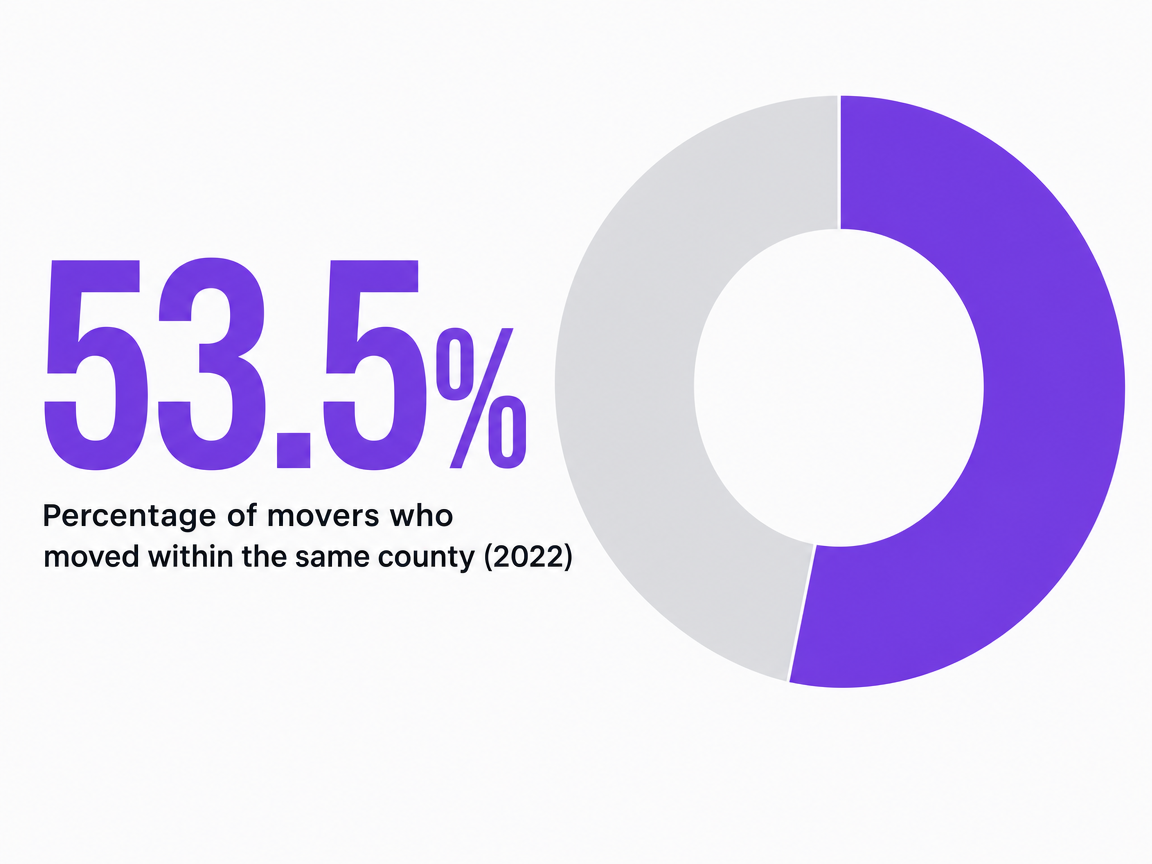 Percentage of movers who moved within the same county (2022)
Percentage of movers who moved within the same county (2022)
Interstate lanes: a smaller content surface with stricter rules
Interstate lanes deserve content, but the page count should match the share of revenue they produce, which for most regional operators is a minority of bookings. The trade-off is that each interstate page carries heavier compliance load than a local one. Interstate household-goods moves fall under FMCSA jurisdiction, while intrastate moves do not; the Surface Transportation Board explicitly notes its oversight applies only to interstate moves, with FMCSA holding primary authority over interstate movers 5. 49 CFR Part 375 sets the federal rules consumers expect interstate pages to reflect, including disclosure of whether the company is a motor carrier or broker and whether it is FMCSA-registered 6.
That means interstate landing pages need to do specific work:
- name the DOT number,
- distinguish carrier from broker status,
- link to the FMCSA mover-search tool, and
- describe the written-estimate process.
A handful of well-built lane pages, organized by origin-destination pair where the operator actually runs trucks, will outperform a sprawling set of thin state pages. Lane pages also support reciprocal content: the destination market gets a corresponding inbound page tuned for buyers searching from the originating state.
Service-area page architecture that matches crew radius, not metro boundaries
Service-area pages are often built around metro names because that is how marketers think about markets. Crews think in drive times. A page architecture that mirrors the actual radius a crew can serve in a single dispatch day produces better conversion and cleaner capacity reporting than one built around media-market boundaries.
The practical structure is a tiered set: a primary hub page for the county or core city where most crews are based, a layer of neighborhood and ZIP pages inside the 30-to-45-minute radius, and a thinner outer tier for adjacent communities served on lighter dispatch days. Each tier carries different content depth and different conversion expectations, which lets the analytics team segment organic-sourced bookings by radius and compare them against crew utilization in the same zone.
This architecture also keeps the site honest about where it can actually deliver. SBA guidance on competitive analysis emphasizes grounding market definition in real customer and operational data rather than aspirational geography 8. For movers, the operational data is the dispatch log.
Test real SEO strategies for your locations now
Launch and measure live SEO content performance across all service areas before making a long-term commitment.
Trust architecture: turning FMCSA rules into on-page content modules
The five FMCSA selection steps as five required content modules
The FMCSA publishes a five-step consumer guide for selecting an interstate mover:
- get multiple written estimates,
- verify the mover is authorized,
- confirm insurance coverage,
- check complaint history, and
- understand the rules that govern the move itself, including how non-binding estimates are capped at delivery 1.
Most moving sites treat that guide as something to link out to. The higher-leverage move is to read it as an editorial inventory and own each step as a dedicated on-page module.
Translated into content, the five steps become five required modules:
- A written-estimate page explains how the operator issues estimates, what the customer should expect on the inventory walkthrough, and what triggers a revision.
- An authorization page publishes the operator's DOT number, motor-carrier status, and a direct link to the FMCSA mover-search tool.
- An insurance page describes released-value protection versus full-value protection in plain language, with the dollar mechanics.
- A complaint-history page links to the FMCSA National Consumer Complaint Database and the BBB, and shows the operator's own resolution record.
- A rules page explains the 110 percent cap and the customer's right to refuse delivery if a mover tries to demand more.
Each module is a ranking surface, an answer to an actual query, and a conversion asset for buyers who are doing the homework FMCSA tells them to do. Built once and maintained, the set covers a meaningful share of the high-intent comparison traffic that competitors leave to review aggregators.
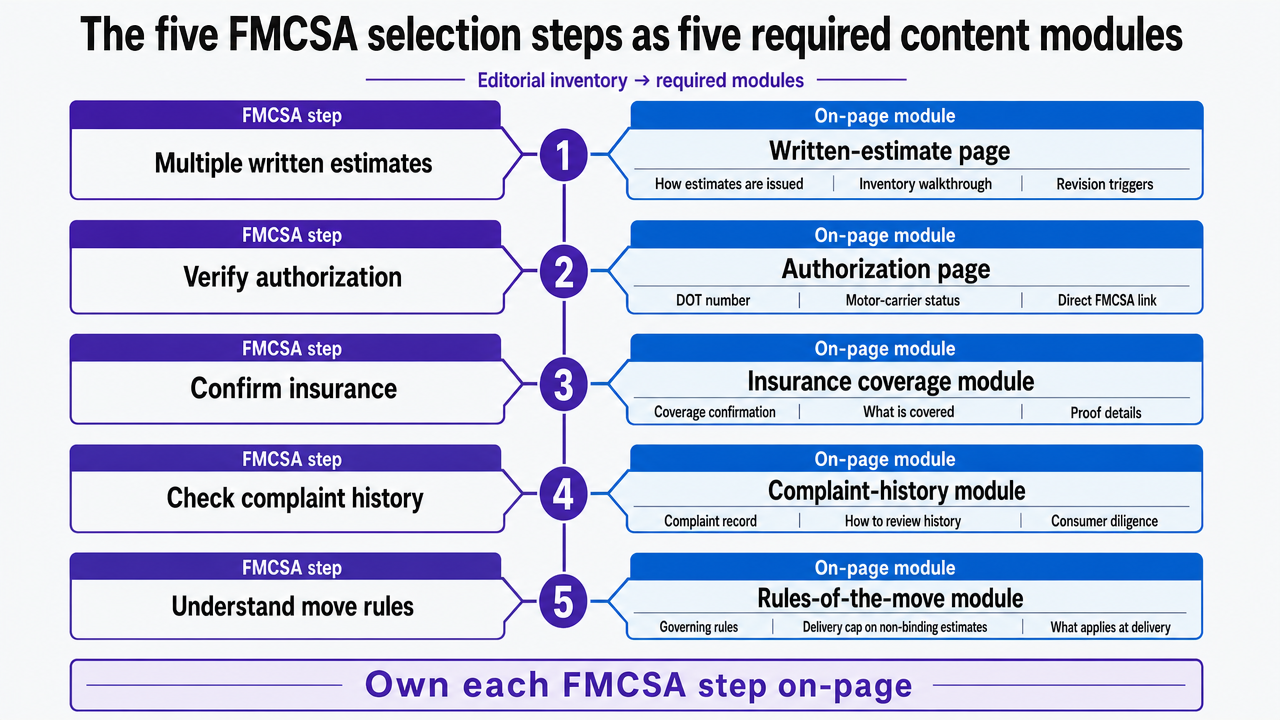 Visualize the five FMCSA consumer selection steps as the five corresponding on-page content modules described in the section
The 110 percent rule and written estimates as proof-of-legitimacy content
The 110 percent rule is the single most concrete consumer protection in the household-goods rulebook: a mover holding a non-binding written estimate is required by law to deliver goods for no more than 110 percent of the estimated price at the time of delivery, with any balance billable on standard terms after that 3. Buyers researching movers have heard about it, often in the context of horror stories where a mover demanded more cash on the truck.
That makes the rule a content asset, not a footnote. A dedicated explainer page can walk through what a non-binding estimate is, how the 110 percent cap functions at delivery, and what the customer should do if a mover tries to override it. The same page can clarify that estimate revisions cannot be required as a condition of loading without mutual agreement 2. Operators that publish this content in plain language signal compliance to buyers and to search engines indexing for queries about moving-day disputes, which converts skepticism into a reason to choose the operator that already answered the question.
Fraud enforcement as a market opening for compliant operators
The 2024 Operation Protect Your Move enforcement action did two things at once. It removed bad actors from the interstate market, and it raised the skepticism level of every buyer researching a move, including buyers shopping intrastate operators who fall outside FMCSA jurisdiction 4. DOT OIG continues to direct consumers to red-flag indicators and to the FMCSA complaint database before booking 12. The buyer that lands on a moving company site in 2025 is more likely to be checking for fraud signals than for price.
That shift is a market opening. State consumer-protection alerts, such as the New York Department of State's guidance to verify credentials, read ratings, and get multiple estimates 10, and Arizona DPS's pointer to the FMCSA fraud hotline 11, establish the questions buyers are now trained to ask. A site that answers them on the page, with the DOT number visible above the fold, a written-estimate process documented, and links to the same federal and state resources buyers are checking anyway, converts a defensive buyer into a confident one.
Operators that ignore this shift compete on price against the same operators consumers were warned about. Operators that build trust modules into the page architecture compete on legitimacy, which is the variable buyers are now actively scoring.
Review signal engineering
Reviews are not a soft signal in this category. Pew Research found that 82 percent of U.S. adults at least sometimes read online customer ratings or reviews before purchasing an item for the first time, with 40 percent doing so always or almost always; the study measured general first-purchase behavior across U.S. adults, not moving customers specifically, but the floor it sets is the relevant one for any operator a buyer has never hired before 9. Every moving inquiry is a first purchase from that operator's perspective.
That makes review acquisition an engineering problem, not a goodwill exercise. The two variables worth instrumenting are timing and surface. Timing means triggering the review request at the operational moment the customer is most likely to respond, which for movers is the day of delivery after the final walkthrough and signed inventory, not a week later when the boxes are still stacked. Surface means routing requests to the platforms buyers actually check during research, including Google, the BBB, and the FMCSA complaint history that state guidance directs them to verify 10.
Negative reviews deserve a documented response protocol tied to the same FMCSA-defined touchpoints. A response that references the written estimate, the inventory record, and the 110 percent process turns a complaint thread into proof of a compliant operation for the next prospect reading it.
See How Top Moving Brands Use Data-Driven SEO to Balance Crew Capacity and Demand
Get a walkthrough of AI-powered workflows that align lead volume with operational capacity across territories—built for agencies and multi-location moving companies managing seasonal swings.
If you manage multiple territories: consolidating content operations
The audience switch: from single-market operator to portfolio director
The framework so far assumes one operator running one market. Directors managing three, five, or fifteen territories face a different problem set. The unit of analysis shifts from a single service-area architecture to a portfolio of them, each with its own crew base, ZIP coverage, lane mix, and review surface. Decisions about content production, trust modules, and reporting cascade across markets, which means the cost of getting them wrong scales linearly with territory count.
The sections below address that operator profile directly. The question is not whether to do SEO, but how to run one governed content operation across markets without paying for the same work five times.
Per-market agency retainers versus a centralized content operation
The default model in multi-territory mover marketing is one agency relationship per market, or one agency with a per-market fee schedule. The economics are linear: every new territory adds another retainer, another account manager, another approval cycle, and another voice trying to interpret FMCSA rules for a content brief. Output quality varies by market because each agency reads the regulatory layer differently, and the director ends up auditing five versions of a written-estimate page instead of governing one.
A centralized content operation inverts the cost curve. Fixed central capacity produces the trust modules, service-area templates, and lane pages once, then localizes them per market. The variables a director should model are below; the only fixed figure shown is the supplied trial price.
| Variable | Per-market agency model | Centralized content operation |
|---|---|---|
| Monthly cost | Markets × per-market retainer (operator input) | Central platform cost + localization hours |
| Content output per market | Capped by retainer scope | Shared templates, per-market overlays |
| Compliance consistency | Varies by agency interpretation | Single governed source |
| Time to launch a new territory | New retainer, new onboarding | Localize existing templates |
| Reference platform price | — | $599/mo after a 2-week trial |
The point is not that centralization is always cheaper at two markets. It is that fixed central cost stops scaling at the same rate as territory count, while per-market retainers do not. Directors should run the math against their own retainer and market figures before committing to either side.
Governance: keeping voice, compliance, and local specificity consistent across markets
Centralization fails when it produces generic content that could run in any market. It works when the central layer enforces what should be uniform and the local layer captures what should not. Uniform: the written-estimate explainer, the 110 percent rule page, the DOT number disclosure, the carrier-versus-broker language drawn from 49 CFR Part 375 6. These read the same in every market because the federal rule reads the same in every market.
Local: the ZIP-level service pages, neighborhood specifics, parking and building notes, and the state consumer-protection references that vary by jurisdiction, such as the New York DOS verification guidance or the Arizona DPS fraud hotline pointer 10, 11. A governance model assigns each content type to the right layer and routes changes accordingly. When FMCSA updates guidance, the central trust modules update once and propagate. When a crew opens a new ZIP, the local layer adds a page without touching the federal language.
The reporting line follows the same split. Compliance and trust signals are measured at the portfolio level. Bookings per crew-day are measured per territory. Both feed the same dashboard, but they answer different questions for different operators inside the company.
What to measure, what to cut
The reporting line for a mover SEO program should hold three metrics and drop the rest.
- Booked jobs per crew-day attributable to organic is the headline number, because it ties content output to operations.
- Estimates issued per service-area page, segmented by ZIP tier, is the second, because it identifies which geographic pages are converting research traffic into the FMCSA-required written estimate that gates every booking 3.
- Trust-module engagement, measured as scroll and click activity on the written-estimate, authorization, and 110 percent pages, is the third, because it shows whether buyers are doing the homework federal and state guidance tells them to do before contacting any operator 1.
What to cut:
- keyword position dashboards that are not tied to a service-area or trust page,
- blog traffic that does not feed an estimate request, and
- city pages outside the crew radius that produce inquiries the dispatch board cannot serve.
Backlink counts as a standalone metric belong in the cut pile too. Each removed report frees attention for the three that govern revenue, and each removed page frees crawl budget for the ZIP-level inventory that actually matches where customers are moving.
Frequently Asked Questions
References
- 1.Steps to Select a Mover | FMCSA - Department of Transportation.
- 2.May household goods movers require shippers to sign "Revised ...".
- 3.FMCSA Issues Rule Enhancing Household Goods Consumer ....
- 4.FMCSA Continues Nationwide Crackdown on Fraudulent ....
- 5.Household Goods Moving - Surface Transportation Board.
- 6.49 CFR Part 375 -- Transportation of Household Goods in Interstate ....
- 7.Why People Move - Census Bureau.
- 8.Market research and competitive analysis | U.S. Small Business Administration.
- 9.Online reviews and ratings.
- 10.CONSUMER ALERT: THE NEW YORK DEPARTMENT OF STATE'S ....
- 11.HHG - Arizona Department of Public Safety.
- 12.Household Goods Moving Fraud.
- 13.A look at small businesses in the U.S..