
Key Takeaways
- Treat product descriptions as decision-support tools that inform title tags, meta snippets, schema, and AI retrieval, since ranking gains compound across every SKU without new ad spend.
- Prioritize information quality over word count by answering shopper decision questions—what it is, who it's for, what it replaces, and purchase conditions—rather than padding copy to hit benchmarks.
- Coordinate the description, meta snippet, alt text, and JSON-LD schema from a single canonical SKU record so AI retrievers and buyers see consistent facts across the page.
- Use a five-stage workflow of research, draft, schema binding, QA, and measurement to reduce handoff costs, since throughput per writer matters more than headcount 1.
- For multi-brand or franchise catalogs, split content into a shared attribute layer and a local overlay so long-tail, location-specific terms drive conversions without duplicating manufacturer copy 15.
- Measure rewrites at the SKU level using organic traffic, bounce rate, and conversion rate against untouched control cohorts to isolate copy impact from seasonality 14.
The Economics of Effective Product Descriptions
The difference between a first and second organic search ranking is substantial. Position one captures an average click-through rate of 45.44%, while position two drops to 17% 8. This significant traffic differential, applied across every SKU in a catalog, highlights the economic impact of product descriptions. For content teams managing numerous product pages, improving descriptions can lead to substantial revenue increases without additional ad spend, development, or headcount.
Product descriptions have become high-leverage assets in e-commerce. They are more than just body copy; they inform title tags, meta snippets, structured data, and increasingly, the retrieval layer of AI-generated answers 1. When descriptions effectively answer buyer questions, they help maintain rankings and reduce bounce rates 6. Conversely, relying on generic manufacturer boilerplate means competing with other resellers using the same content, often resulting in lost clicks.
For in-house content teams, the strategy is clear: traffic potential per product detail page (PDP) depends on ranking, which is influenced by description quality and structured signals. Conversion rates are then affected by the quality of information once a user lands on the page. This guide treats the description as the crucial link between these three variables, focusing on its role as a decision-support tool rather than merely a creative writing exercise or a keyword container.
What Modern Search Rewards on a PDP
Information Quality Over Word Count
Recent e-commerce research emphasizes information quality over sheer word count. A peer-reviewed study of Amazon product pages found that purchase intention is driven by the accuracy and consistency of information, and how directly the copy supports a buying decision 6. The study concluded that product information should facilitate a shopper's decision, not just describe the item.
This perspective changes how content teams should audit their catalogs. A 600-word description that merely repeats manufacturer marketing and fails to address key shopper questions is considered "thin content." In contrast, a 320-word description that clearly states the buyer's use case, lists compatible accessories, specifies the return window, and aligns specs with images is "dense content," regardless of its length.
Operationally, this means shifting from word-count-based quality assurance to decision-question-based QA. Before a PDP goes live, the description should answer: what the product is, who it is for, what problem it solves, how it compares to alternatives, and what purchase/return conditions apply. Shopify's 2025 guide supports this, advocating for original, comprehensive descriptions, especially for products ranking lower on search results, as these pages offer the fastest ranking improvements through better information quality 10.
Writing for Shoppers and AI Agents
AI-generated answers and LLM-powered shopping assistants now frequently process product pages before human shoppers. Lucky Orange advises making core facts easily discoverable, placing the official product name, price, and availability prominently at the top of the page for both human and machine readability 1. Descriptions that hide crucial details like model numbers or compatibility deep within the text are optimized for an outdated search paradigm.
A practical approach involves a two-part opening. The first sentence should plainly name the product, state its primary use case, and include a key attribute (e.g., size, capacity, material, compatibility). The second sentence should address common decision friction, such as who the product is for or what it replaces. Only after this initial clarity should the copy delve into narrative benefits, edge cases, and comparisons. Chain Reaction's advice to start descriptions with the main benefit or use case aligns with this strategy from a shopper's perspective 7.
Structured data complements this by providing reliable information for machines. Markup types like Product, Offer, AggregateRating, and hasMerchantReturnPolicy offer AI retrievers a consistent object model of the visible content 1. Descriptions coordinated with schema—where, for example, the return window in the copy matches the hasMerchantReturnPolicy value—reduce contradictions, making the PDP more likely to be quoted in AI overviews.
The 300–500 Word Benchmark
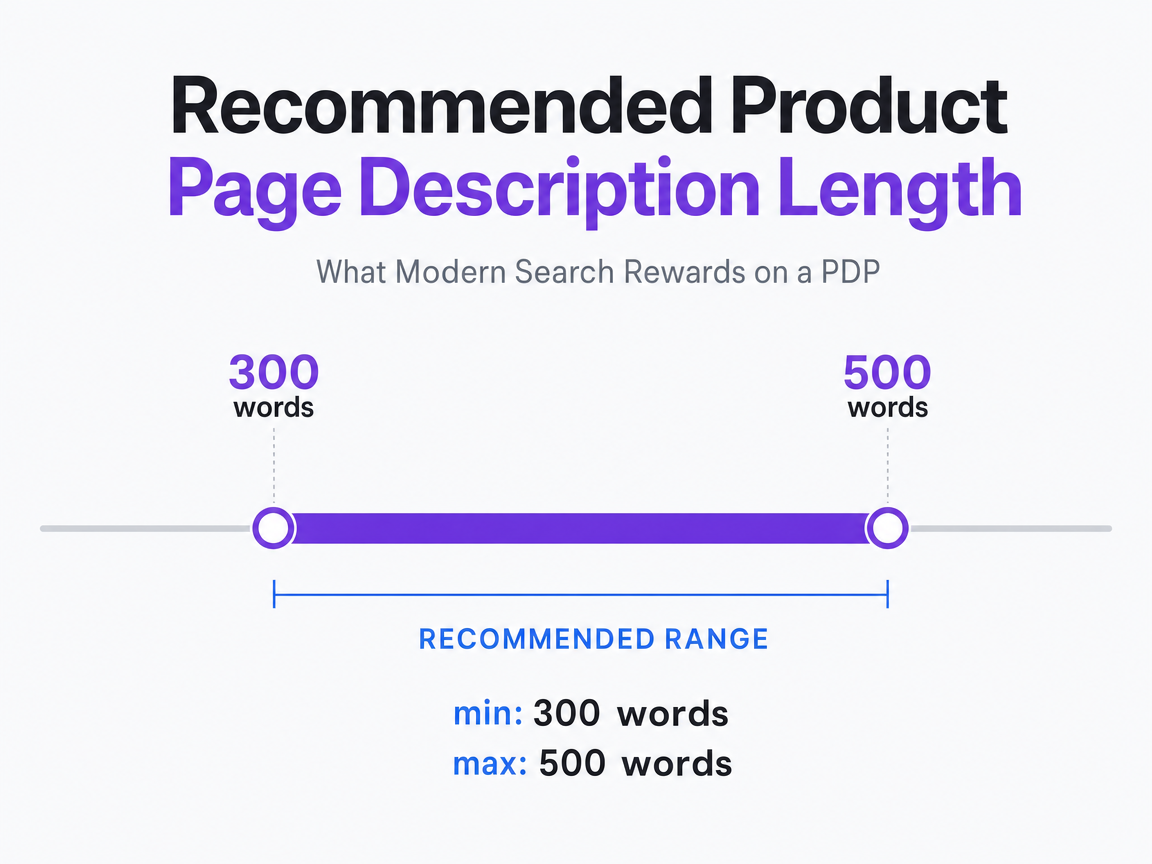
Industry guidance often suggests product descriptions should be between 300 and 500 words, incorporating primary and long-tail keywords naturally, and structured with headings and bullet points for scannability 5. Charle Agency's 2026 guidance similarly recommends this range for most descriptions, emphasizing clear hierarchy and scannable layouts 15. The underlying reason is that Google favors pages with sufficient depth to resolve user queries, and brief descriptions can miss opportunities for higher rankings 5.
This range is a benchmark, not a rigid rule. Chain Reaction, for instance, advocates for concise, benefit-led openings with direct sentences, prioritizing clarity over length 7. Both viewpoints are valid because they address different aspects. The 300–500 word range typically provides enough space to cover buying-decision content for considered purchases (e.g., apparel with sizing, electronics with compatibility, home goods with material details). The short-copy approach focuses on the immediate user experience on the first screen, which needs to be impactful regardless of the total length.
A structural reconciliation involves opening a description with 40 to 60 words that highlight the primary benefit and core specifications. This can then expand into a longer body below the fold to satisfy depth signals and long-tail queries. Commodity SKUs with minimal unique information, such as replacement parts, should not be artificially extended to meet a word count. Depth should be determined by the complexity of the buying decision, not by a policy.
 Recommended Product Page Description Length
A Shopify community expert suggests product pages should have 300-500+ words, noting that 'Google prefers pages with more depth' but emphasizing the need for structured content like headings and bullet points for readability.
Test SEO-Optimized Product Descriptions Live Instantly
Publish and measure real product description impact with no commitment during your 7-day trial.
The Description as a Coordinated Asset
Copy That Guides Buying Decisions
Effective product descriptions function as decision aids, not just promotional brochures. Research on Amazon PDPs indicates that copy should be designed to support the buyer's decision and must be factually consistent with images and specifications on the page 6. A description that contradicts visual elements regarding material, dimensions, or included accessories risks losing a sale, even if it ranks well.
Practically, this means organizing the description around questions a shopper is actively trying to answer: What is this product? Is it suitable for me? What does it replace or work with? What are the purchase conditions? Crimson Agility's advice on integrating primary keywords—product name, brand, and key features—naturally aligns with this structure, as these are the terms shoppers use when seeking information 3.
A useful audit technique is to review a live PDP's description without its images. If a reasonable buyer cannot understand the product, its target audience, or its primary attributes from the text alone, the description is failing both the shopper and AI retrievers. The solution isn't necessarily more prose, but rather answering decision-making questions in a logical sequence.
Schema, Metadata, and Imagery from a Single Source of Truth
The product description is one component of a larger asset set. The description, title tag, meta snippet, alt text, specs table, and JSON-LD Product markup all describe the same item. SEO benefits are maximized when these elements are consistent. Charle Agency's data shows that long-tail product keywords convert at 2.5 times the rate of broader terms, and sites using proper e-commerce schema markup see up to 30% higher click-through rates 15. These gains are cumulative. Long-tail terms reside in the description and headings, while schema lives in the markup, both referencing the same product facts.
A common governance challenge for content teams is that these assets are often managed by different individuals using disparate tools. Copy might be in a CMS, schema in a template, alt text added by an image uploader, and specs from a PIM export. Inconsistencies are common. For example, if a description states "free returns within 60 days" but hasMerchantReturnPolicy still says 30, an AI overview must choose, and a shopper noticing the discrepancy may bounce 1.
The solution is a single source of truth model. One record per SKU should hold canonical values: name, primary use case, key attributes, price, availability, return policy, GTIN or MPN, and approved images with descriptive filenames (e.g., black\_bodycon\_midi\_dress.jpg instead of IMG\_4471.jpg) 2. All downstream assets are then rendered from this record. The description writer, schema template, and alt text generation all draw from the same attribute list 1. QA then verifies the rendered page against this canonical record, ensuring consistency and scalability without a linear increase in writers or errors.
Meta Descriptions: Tiny Ads, Not Ranking Signals
Meta descriptions do not directly impact search rankings. Their influence is on the click-through rate, which determines whether a high ranking translates into traffic 12. SiteGround suggests treating meta descriptions as miniature advertisements for the product, featuring a key benefit, a differentiator, and a specific detail unlikely to be found in competing snippets 13. The ideal length is typically 120 to 160 characters to prevent Google from rewriting the snippet, with many practitioners aiming for under 155 characters to allow for a call to action 8, 14.
An underutilized tactic is to adapt high-performing paid search ad copy for meta descriptions. Search Engine Journal recommends mining ad platforms for headlines and descriptions that already generate clicks for similar queries, then porting that language to organic snippets 11. Paid teams often A/B test thousands of variants, providing pre-validated copy for the same audience.
Google may still rewrite snippets if the query doesn't align with the meta description, and mobile SERPs truncate more aggressively 12. The operational rule is to write for the target query, ensure the core promise is within the first 120 characters, and view the meta description as the final conversion asset in a coordinated set, not as a direct SEO input.
A Production Model for Catalogs at Scale
Research, Draft, Schema, QA, Measure
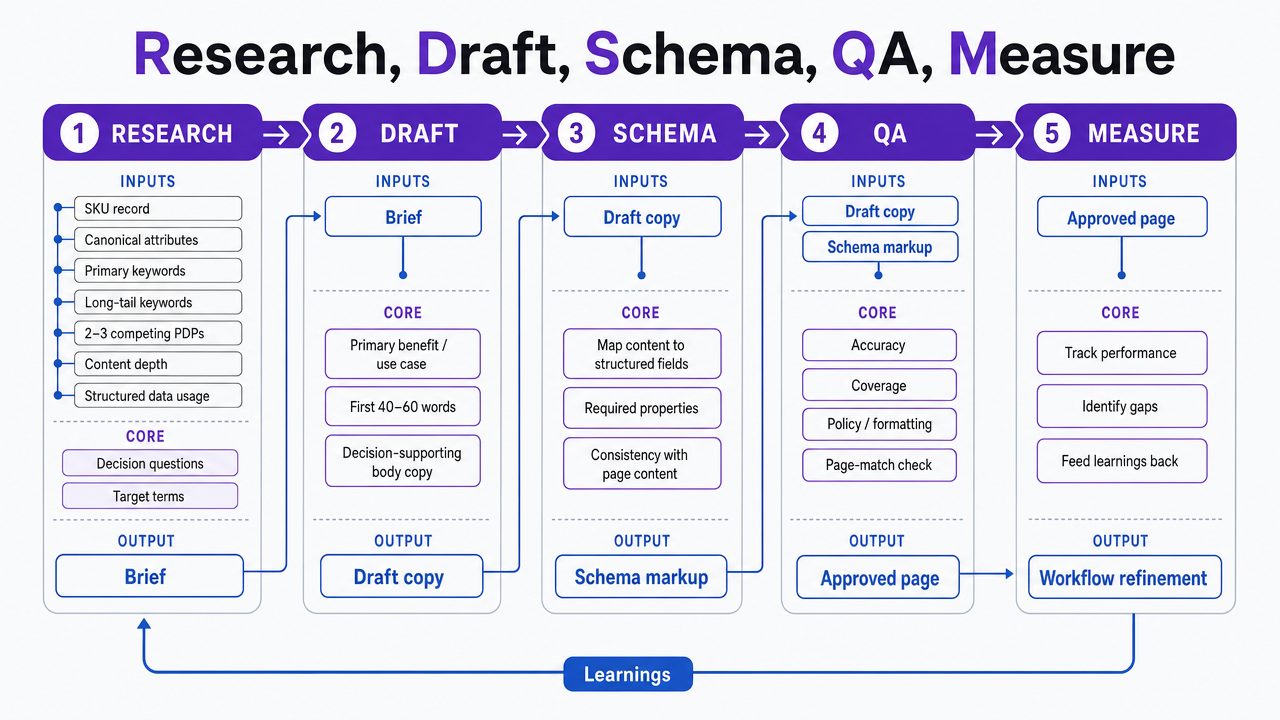
For in-house content teams, the primary bottleneck isn't writing speed but coordination costs. A five-stage workflow—research, draft, schema, QA, measure—can reduce handoffs and save time without increasing headcount.
- Research: This stage begins with the SKU record, not a blank page. The writer retrieves canonical attributes, target primary and long-tail keywords, and analyzes two or three competing PDPs that currently outrank the page. Competitor analysis of content depth and structured data usage is a standard input 3. The output is a brief outlining the decision questions the description must answer and the terms it needs to target.
- Drafting: Writing is guided by the brief, not a word count. The writer starts with the primary benefit or use case in the first 40 to 60 words 7, then expands into decision-supporting body copy within the 300 to 500-word range when the buying question warrants it 15. Specifications that are verbatim in the schema are omitted from the prose.
- Schema Binding: Schema is then bound from the same SKU record. Product, Offer, AggregateRating, and hasMerchantReturnPolicy properties are rendered from canonical values, eliminating manual re-entry 1. This automation is crucial for preventing data drift across the catalog.
- QA: Quality assurance involves a two-step check. First, the description is read without images to confirm it answers the decision questions from the brief 6. Second, the rendered schema is compared against the visible copy for consistency in return window, price, availability, and specs 1. Both checks are structural, not stylistic.
- Measure: This final stage closes the loop by feeding organic traffic, bounce rate, and conversion per PDP back into the next research cycle 14.
Production Math for Catalog Owners
The economics of a description program depend on three variables: Catalog size (C), refresh cycle in weeks (R), and descriptions per writer per week (D). These determine the required writer capacity: W = C / (R × D).
For example, a 4,000-SKU catalog with an annual refresh cycle (R = 52) and a writer producing 15 descriptions per week (D = 15) requires approximately 5.1 dedicated writers. Shortening the refresh cycle to 26 weeks for a semi-annual update would increase the need to about 10.3 writers. However, increasing D to 30 by binding schema to the SKU record and shifting QA from stylistic editing to structural diffs reduces the annual-refresh case to roughly 2.6 writers.
The most impactful lever is D, not headcount. Any time a writer spends retyping specs already in the PIM or waiting for schema updates directly reduces D. Teams that maintain a consistent catalog size (C), aim for a refresh cycle (R) that outperforms competitors, and invest in coordination layers to boost D can significantly increase throughput with the same payroll.
Managing Multi-Brand or Franchise Catalogs
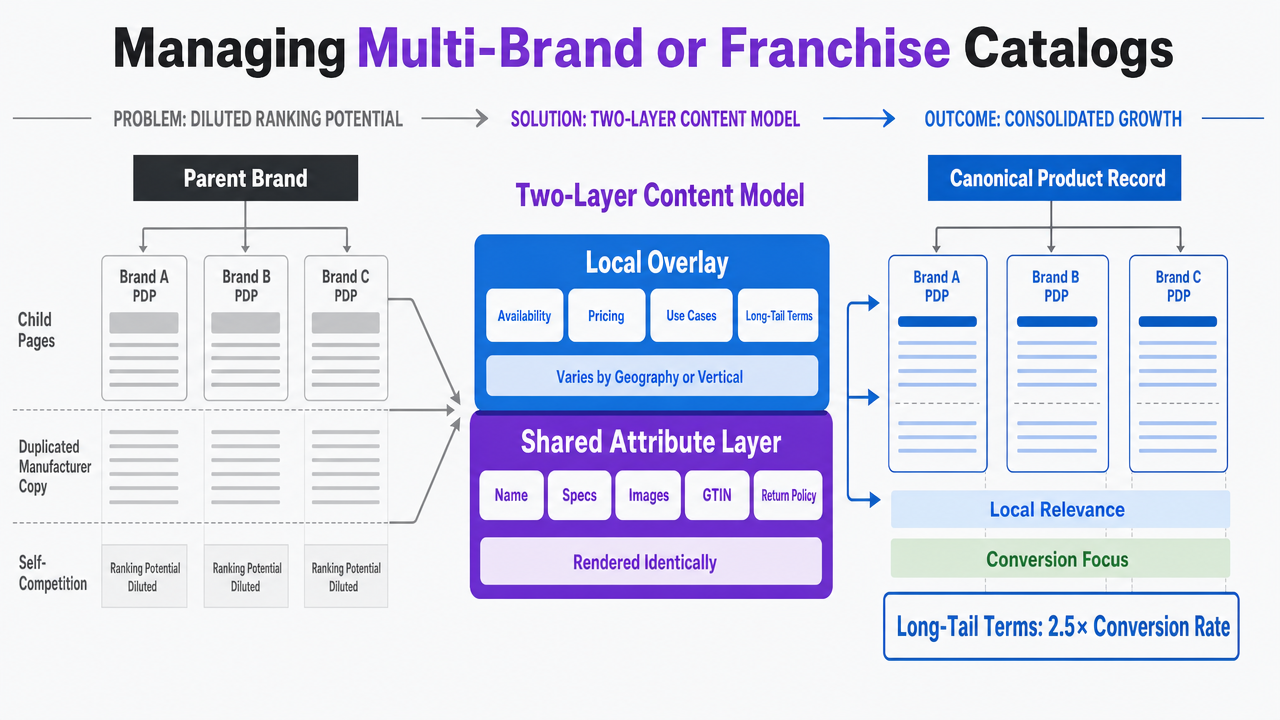
For portfolio operators—multi-brand retailers, franchise systems, or multi-location service networks with parallel PDPs—the challenge is often duplicated manufacturer copy across child pages. This self-competition dilutes rankings that the parent brand could otherwise consolidate 10.
The solution is a two-layer content model. A shared attribute layer holds the canonical product record—name, specs, images, GTIN, return policy—rendered identically across all locations or brand instances 1. A local layer then overlays fields that legitimately differ, such as availability, pricing, location-specific use cases, and long-tail terms that vary by geography or vertical. Long-tail terms are crucial for conversion, converting at 2.5 times the rate of broader terms according to Charle Agency's data 15, making the local layer essential for ranking gains in franchise or multi-brand catalogs. QA is performed once against the shared record and then per instance for the local overlay, rather than reviewing each page as a standalone asset.
Scale SEO-Optimized Product Descriptions—No Extra Headcount Required
See how enterprise teams and agencies automate high-quality, brand-consistent product descriptions for SEO—accelerating go-to-market velocity while maintaining full editorial oversight.
Measuring the Impact of Rewrites
A description program without a measurement layer becomes a subjective exercise. The goal of shipping rewrites in batches is to identify, at the SKU level, which changes influenced specific metrics, and to integrate this feedback into subsequent research cycles rather than just quarterly reports.
The minimum viable measurement stack includes three metrics tracked per product: organic traffic, bounce rate, and conversion rate 14. Organic traffic per PDP indicates whether the rewrite improved impressions and clicks through ranking or snippet changes. Bounce rate signals if the click led to a page that answered the query; if traffic increases but bounce also rises, the description is attracting clicks but failing to satisfy the buyer's follow-up questions 6. Conversion rate then links the description change directly to revenue.
Attribution requires discipline. Rewrites should be deployed in cohorts of comparable SKUs, with a control group of untouched pages in the same category. This helps prevent seasonality or category-level demand shifts from being misattributed to the copy. Charle Agency's guidance suggests using heatmaps, session recordings, and A/B tests for refinement once a cohort baseline is established 15. A/B testing is most effective on high-volume pages; low-volume SKUs should be measured in aggregate at the cohort level.
A monthly SKU-level scorecard provides a consistent reporting cadence. Pages that gained traffic but lost conversion are flagged for decision-question audits. Pages that improved both metrics become part of a "winner set" and inform future templates. Pages that showed no change prompt a diagnostic question: was the description the limiting factor, or was it price, imagery, or a category-level ranking ceiling?
Frequently Asked Questions
References
- 1.How to Optimize Product Pages in the Age of AI Search.
- 2.The ultimate guide to optimising product pages (PDPs) for SEO.
- 3.How to Do Product Page SEO.
- 4.How to Optimize Product Pages for SEO?.
- 5.How can I optimize my product pages for SEO?.
- 6.The Role of Information Quality in Amazon Online Purchase Intention: An S-O-R Approach.
- 7.How to Optimize Product Pages for Search & Conversions.
- 8.SEO Product Descriptions: 7 Tips To Optimize Your ....
- 9.How To Improve Your Ecommerce Product Page SEO (2024) - Shopify.
- 10.The Industry Leading Ecommerce SEO Guide (2025).
- 11.SEO For Ecommerce Product Pages: 20 Do's & Don'ts.
- 12.18 Ecommerce Product Page Best Practices (Plus 18 Of ....
- 13.SEO for ecommerce product pages: a beginner-friendly guide.
- 14.Practical Guide to Optimising Ecommerce Product Pages.
- 15.How to Optimize Product Descriptions for SEO - Shopify Agency.