
Key Takeaways
- Organic search drives 53.3% of website traffic and 44.6% of B2B revenue 6, making it a P&L conversation rather than a marketing line item.
- B2B buyers overwhelmingly start in the query bar, with 61% initiating research via search 5and 94% relying on Google during evaluation 11.
- Revenue forecasts should combine ranged CTR curves, from the Aslib 9.28% at position one 7up to 28.5% on cleaner queries 9, with the client's actual conversion and deal-value data.
- Margin gains come from approval-gated AI execution that shifts senior strategists from production to review, cutting production hours per client from 12-18 to 3-5 and expanding book size.
Organic Search Has Become the P&L Conversation
Agency leaders no longer sell rankings; they sell revenue share. Organic search delivers 53.3% of all website traffic and 44.6% of all B2B revenue, more than double every other digital channel combined, according to a 2025 analysis of channel performance across major publishers 6. This broad sample data positions organic search as a critical P&L item, not just a marketing expense.
SEO for your website now competes for budget alongside sales pipeline and paid media ROI. With almost half of B2B revenue originating from organic entry points, the focus shifts from visibility to attribution, forecast accuracy, and cost-to-serve. Agencies that reframe SEO as a strategic revenue driver, rather than a mere marketing line item, gain a stronger position during budget allocations.
This repositioning demands a change in agency deliverables. Instead of ranking reports, agencies must provide revenue-attributed forecasts, aligning with executives' growth targets and capital allocation decisions. Agencies that consistently deliver these outcome-based metrics are more likely to secure renewals.
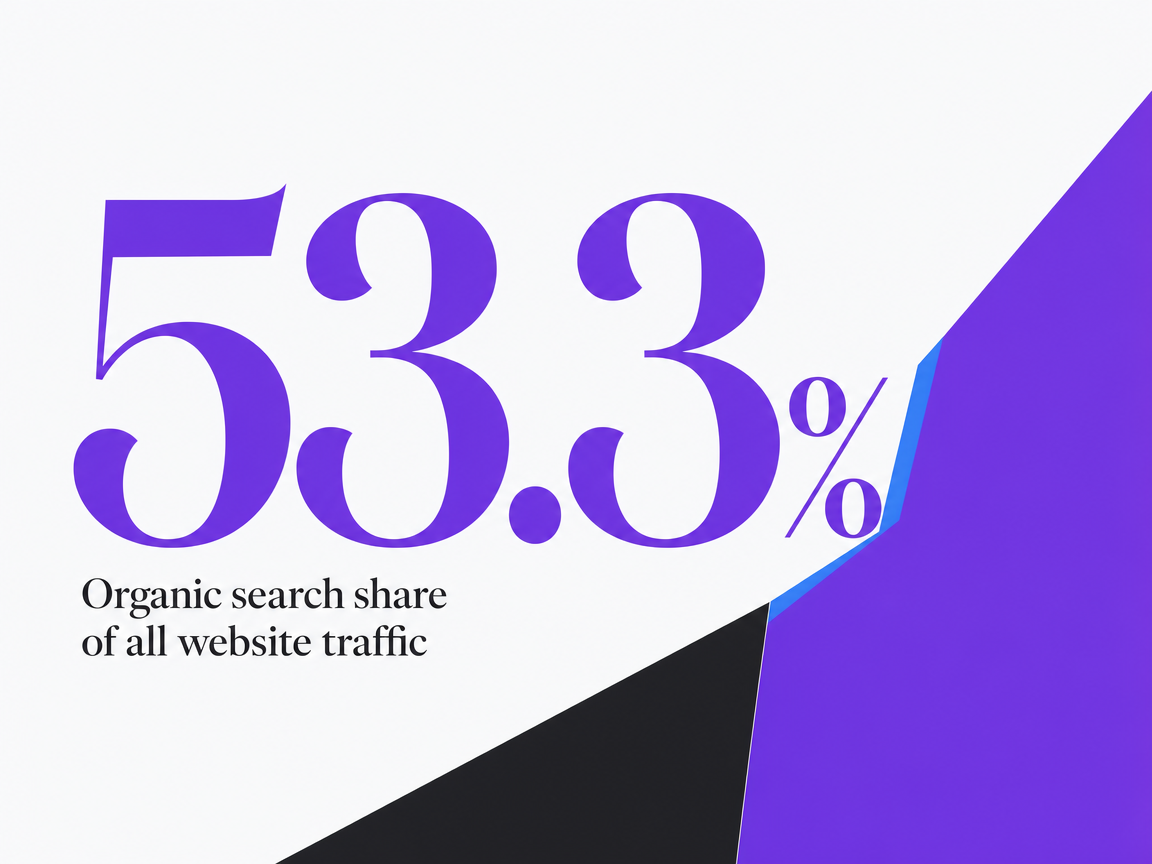 Organic search share of all website traffic
Organic search share of all website traffic
How Buyers Actually Reach the Website
The B2B Journey Starts in the Query Bar
The B2B buyer's journey increasingly begins digitally, with 67% occurring before any vendor conversation, as tracked by Forrester in 2024. Demand Gen Report further indicates that 61% of B2B decision-makers initiate this journey with a search engine 5. These figures, derived from self-reported behavior of B2B buyers across mid-market and enterprise categories, establish a baseline for account planning.
Google dominates this discovery phase, with 94% of surveyed B2B buyers using Google Search during their evaluation, according to Google and NRG's 2025 research 11. This concentration means that pages ranking for commercial-intent and mid-funnel queries effectively serve as the sales team's initial touchpoint, transforming editorial calendars, technical debt, and internal linking into pipeline infrastructure.
For SEO professionals, this means demonstrating to executives that underinvesting in the initial search phase compresses conversion rates downstream. Every step past the query bar is contingent on ranking, and a strong organic presence ensures buyers enter the funnel already engaged.
Consumer Consideration Behavior for Service Verticals
High-consideration service categories, such as legal, dental, home services, senior living, and behavioral health, exhibit distinct consumer behavior. PwC's 2023 global consumer survey found that 54% of consumers consider search engines their primary source of pre-purchase information 2. This indicates where research typically begins for these services.
Unlike e-commerce, service verticals involve more extensive comparison. Rithum's global consumer report shows 83% of shoppers visit two or more sites before purchasing 1. For significant, infrequent, and reputationally sensitive purchases like roofing or memory care, this number is likely higher, as buyers gather more evidence. Furthermore, PowerReviews reports that 63% of consumers use search engines to discover new products or services 4, making category and mid-funnel content crucial for first-time buyers in these sectors.
For SEOs managing service-vertical accounts, the goal is to ensure the client's site is among the few tabs a buyer opens and trusts enough to contact. Content depth, review integration, and clear service scope are vital for shortlisting. Ranking opens the tab; page content drives the conversion.
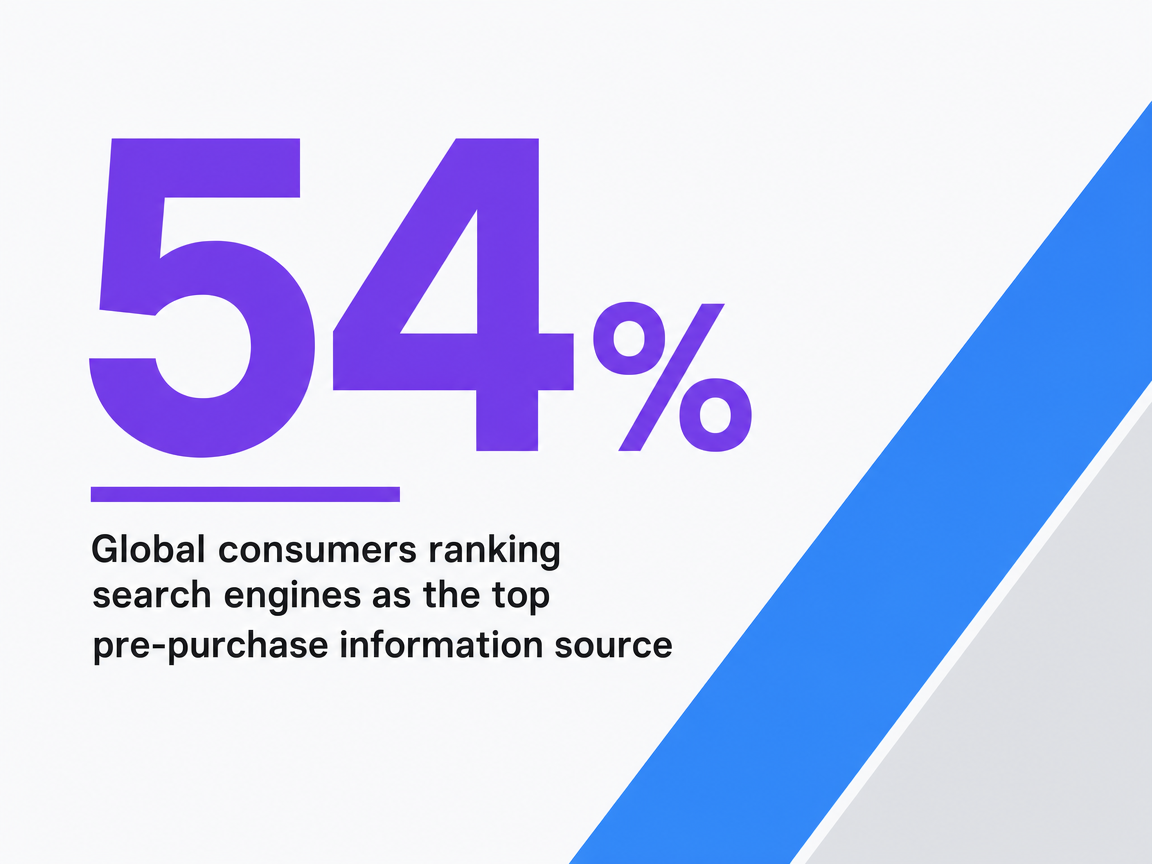 Global consumers ranking search engines as the top pre-purchase information source
Global consumers ranking search engines as the top pre-purchase information source
Test AI-driven SEO execution with real content
Experience live SEO content workflow and measure the impact on your site within a week.
Modeling Revenue From Ranking Movement
CTR by Position, and Why the Studies Disagree
The connection between ranking and revenue is mediated by click-through rate (CTR), though the exact magnitude is debated. A 2024 peer-reviewed analysis in the Aslib Journal of Information Management, using large-scale Google organic data, estimates position one CTR at 9.28%, position two at 5.82%, and position three at 3.11% 7. These figures account for modern SERP layouts, where rich features can depress CTRs compared to older benchmarks.
Conversely, a widely cited study reported by Search Engine Journal suggests position one CTR is closer to 28.5% 9. The discrepancy arises from differences in query mix, sample construction, and how each study handles SERPs with answer boxes, local packs, and knowledge panels. Both figures are valid but represent different search populations.
For client-facing revenue models, it is crucial to model a range rather than applying a single CTR curve. The Aslib figures are suitable for feature-heavy commercial queries, while higher estimates can serve as an upper bound for cleaner, intent-specific queries. A consistent pattern across both studies is the steep drop in CTR from position one to position three, highlighting the significant impact of even small ranking improvements on addressable clicks.
Translating Rank Movement Into Client Revenue
Revenue forecasts from ranking gains are derived using four key variables:
- Monthly search volume
- Modeled CTR at current and projected positions
- The site's conversion rate from organic session to qualified lead or transaction
- The client's average deal value or customer lifetime value
This calculation yields incremental sessions, conversions, and ultimately, attributable revenue.
For example, using the Aslib CTR curve, a keyword with 10,000 monthly searches moving from position five to position two could generate approximately 500 additional monthly organic sessions. With a 2% lead conversion rate and a $3,000 average deal value at a 25% close rate, this single keyword could produce around $7,500 in monthly incremental revenue once stabilized. Agencies should use the client's actual figures for accuracy.
Two caveats ensure defensibility: the CTR curve must reflect the actual SERP environment (applying a haircut for feature-heavy pages), and close rates and average deal values should come from the client's live CRM data, not industry averages. This compounding effect across multiple keywords can generate substantial cumulative revenue, a figure that resonates with CFOs and supports retainer renewals.
The Zero-Click and AI Overviews Headwind, Sized Honestly
The impact of SERP features like answer boxes and knowledge panels on organic CTR is a recognized challenge, as confirmed by peer-reviewed research 8. AI Overviews similarly answer queries directly on the results page, reducing clicks to websites. The mechanism is real, and understanding its magnitude is crucial for client credibility.
The 2025 organic traffic analysis, which highlights organic search's revenue contribution, also tracks the negative impact of zero-click behavior and AI-generated summaries 6. While some publishers experienced significant traffic losses, others gained by optimizing for these features. Organic search remains the largest traffic source overall, but performance distribution within the channel has become more uneven, making average performance an unreliable forecast for individual clients.
Clients with keyword portfolios heavily weighted towards informational queries (definitions, conversions, quick how-tos) face higher exposure to AI Overviews. Conversely, clients competing on commercial-intent, local-service, and comparison queries largely retain their click economics, as these searches still require users to evaluate specific providers. The mitigation strategy involves a keyword mix favoring commercial and evaluative intent, structured content optimized for AI summaries, and page-level conversion optimization.
Acknowledging both the continued dominance of organic traffic (over 53% in the studied sample 6) and the documented CTR compression from SERP features 8is essential for a credible client conversation. A balanced approach, rather than dismissing or overstating the headwind, aligns with actual analytics.
See How Enterprise SEOs Are Driving Revenue Through Scalable AI-Powered Workflows
Connect with our team to benchmark your current SEO processes against automated, approval-first platforms proven to cut content production time by 60% while maintaining strategic oversight across all client accounts.
The Real Bottleneck Is Delivery Capacity, Not Strategy
Where Senior Strategist Hours Actually Go
An audit of a senior SEO strategist's calendar often reveals that hours designated as "strategy" are predominantly spent on production tasks: writing briefs, QAing outlines, formatting schema, checking internal links, managing draft revisions, reconciling GSC exports, and rebuilding reports. The actual strategic work that drives rankings and secures renewals is often relegated to the margins.
Despite organic search delivering over half of website traffic and a significant portion of B2B revenue 6, clients are reluctant to pay senior strategist rates for tasks that could be handled by mid-level specialists. A typical mid-market retainer often sees:
- 8-12 hours per client per month on content briefs and coordination
- 4-6 hours on technical monitoring
- 3-5 hours on reporting
- 2-4 hours on internal linking
True strategic work—like keyword prioritization based on pipeline value or competitive gap analysis—rarely exceeds four hours monthly.
This imbalance means clients are paying senior rates for work that is approximately 70% production and 30% strategic thinking. This leads to margin compression, as production hours do not scale efficiently with retainer fees. The core challenge for agencies has shifted from strategic insight to efficient delivery.
Two Models for Serving a Forty-Client Book
When considering a full agency book of forty clients, the traditional staffing model assumes a senior SEO strategist can effectively manage 8-12 mid-market clients. At the higher end, this leaves less than three hours per client per week, largely consumed by production tasks. To serve forty clients, this model requires 4-5 senior strategists plus support staff, leading to high loaded costs and margin erosion as headcount increases.
The approval-gated AI execution model reallocates senior strategist time. Production tasks such as brief generation, draft assembly, schema markup, internal link mapping, and reporting rollups are handled by AI. The senior strategist then reviews, edits, approves, or rejects the AI-generated output. This allows a single strategist to maintain quality across 20-30 clients, freeing up hours for high-leverage activities like SERP analysis, competitive positioning, and pipeline-tied prioritization.
The following table illustrates the operational differences:
| Delivery variable | Traditional senior staffing | Approval-gated AI execution ||---|---|---|| Clients per senior strategist | 8-12 | 20-30 || Monthly production hours per client | 12-18 | 3-5 (review and approval) || Monthly strategic hours per client | 2-4 | 6-10 || Senior strategists required for 40 clients | 4-5 | 2 || Cost-to-serve variable | 40 clients × (loaded senior hourly × 15 hrs) | 40 clients × (loaded senior hourly × 4 hrs) + platform cost |
This model significantly reduces production hours while increasing strategic hours per client, effectively halving the senior strategist headcount needed for the same client volume. This margin recovery mechanism is a crucial lever for agencies facing pressure on retainer inflation.
Approval-Gated AI Execution as the Margin Lever
For agency leaders, the key distinction in evaluating AI is not autonomous versus manual, but rather the approval workflow. Autonomous automation, which publishes work without senior review, has been largely rejected by experienced Heads of SEO. Approval-gated execution, however, allows AI to draft, format, structure, and assemble content, then routes each artifact to a human strategist for approval before publication. This ensures that nothing reaches the client without senior judgment.
This design choice addresses quality control concerns. The strategist's role shifts from author to editor and decision-maker, a more efficient use of their time. The margin benefits stem from the hour reallocation: production hours per client drop from 12-18 to 3-5, while strategic hours increase to 6-10. This improves retainer economics without requiring price increases, funding more strategic work per client and allowing more clients per strategist.
Effective implementation requires structured approval queues where senior time is focused on decisions, with clear strategic reasoning, data, and expected KPI impact accompanying each recommendation. When executed correctly, a two-strategist team can manage forty accounts at a high quality level. Vectoron, for instance, offers a Command Center that coordinates content, SEO, backlinks, and reporting, routing all recommendations for human approval before deployment, thereby fitting this approval-gated model.
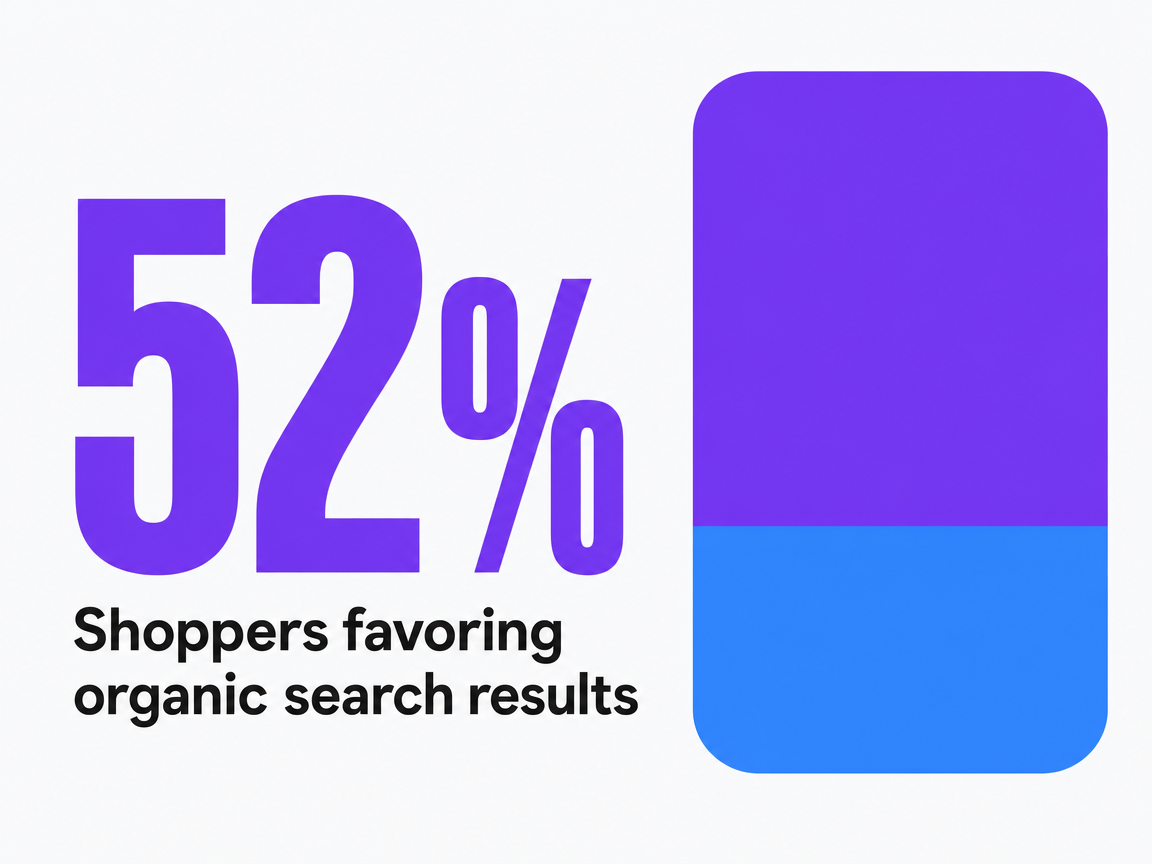 Shoppers favoring organic search results
Shoppers favoring organic search results
Frequently Asked Questions
References
- 1.Online Consumer Behavior Global Report.
- 2.June 2023 Global Consumer Insights Pulse Survey.
- 3.2024 Consumer Buying Behavior Report.
- 4.Survey: The Ever‑Growing Power of Reviews (2023 Edition).
- 5.B2B SEO Statistics: 100+ Actionable Insights for 2025 Success.
- 6.2025 Organic Traffic Crisis: Zero‑Click & AI Impact Report.
- 7.Aslib Journal of Information Management – Click-through rates for organic search results.
- 8.Exploring the Impact of SERP Features on Organic Click-through.
- 9.Over 25% of People Click the First Google Search Result.
- 10.Gen Z trends & search behaviour in India.
- 11.Google B2B Buyer Journey Whitepaper.