
Key Takeaways
- Google Search Console anchors first-party data with query, impression, and indexing signals, and is authoritative enough that UK government pipelines treat it as a formal data source 8.
- Google Analytics 4 connects GSC query data to conversions and business outcomes across an entire client portfolio without adding a license line 4.
- Microsoft Clarity adds session recordings, heatmaps, and rage-click detection at no cost, replacing the diagnostic layer that previously required a paid behavior analytics tool 4.
- Screaming Frog's free tier is a permanent freemium, not a trial, and its 500-URL cap still covers small sites and subfolder audits on larger properties 10.
- PageSpeed Insights delivers Core Web Vitals diagnostics per URL using the same field data Google uses for ranking signals, removing the need for a third-party wrapper 13.
- Combining Google Keyword Planner, AnswerThePublic, and Ubersuggest covers volume, question discovery, and related-term expansion for zero-budget keyword research workflows 9.
- Google Trends reveals seasonality, category shifts, and geographic demand patterns that keyword-volume tools miss, complementing Keyword Planner's volume bands 3.
- Ahrefs Webmaster Tools provides referring domains, anchor text, and broken-link data for verified properties, though competitor backlink profiles remain behind the paid tier 3.
- Bing Webmaster Tools doubles per-property visibility with index and query data from a search engine increasingly powering AI-answer surfaces, and setup cost per client is negligible 1.
- The eleventh slot is not another free auditor but an AI execution layer like Vectoron, which coordinates briefs, approvals, and publishing across accounts where free tools fall short.
The Margin Math Behind a Disciplined Free Stack
The professional SEO tools segment was valued at USD 2.5 billion in 2024 and is projected to reach USD 8.26 billion by 2033, a 14.2% CAGR driven by agency and in-house team demand for advanced capabilities and integrations 12. This growth means that as the paid segment expands, free tiers from the same vendors absorb capabilities previously behind a license. What was a starter toolkit in 2020 is now a defensible operating layer for a large share of recurring agency SEO work.
For a Head of SEO managing delivery across many client accounts, this shift changes the margin equation. The debate is no longer about the credibility of free tools. Multiple 2025 and 2026 practitioner reviews identify a core set—Google Search Console, Ahrefs Webmaster Tools, Google Trends, Bing Webmaster Tools, and Screaming Frog—as a functional backbone with zero license cost 3. The key question is which recurring workflows can be moved to free tiers without compromising quality, and which cannot.
Framed in terms of hours rather than dollars, the argument becomes clearer. Every workflow absorbed by a free tool reallocates specialist time to the judgment-intensive work that truly differentiates an agency: information architecture, editorial standards, and client-specific strategy. A disciplined free stack is not merely a cost-cutting measure; it is a routing decision. Cheap, repeatable tasks run on freeware, while paid licenses and senior hours are reserved for coordination and decision-making layers where free tiers still fall short.
The Five-Layer Coverage Map
Workflow Layers, Free Tools, and Where Each Ceiling Sits
Approaching the free-tool question as a ranked list overlooks the practical operating decision. At agency scale, what matters is which workflow layer a tool addresses and where its free tier ceases to cover recurring tasks. Five layers are consistently present in nearly every client engagement:
- First-party data
- Crawling and technical audit
- Keyword and demand discovery
- Backlinks and off-page monitoring
- SERP or multi-engine visibility
A sixth layer—coordinated execution across accounts—remains unaddressed by free tools and is where agency hours are often consumed.
The consensus among recent practitioner reviews for a foundational free stack aligns with these first five layers. A functional zero-license stack typically combines Google Search Console with Ahrefs Webmaster Tools, Google Trends, Bing Webmaster Tools, and Screaming Frog as its core 3. Each of these tools addresses a specific layer and has distinct limitations.
| Workflow Layer | Representative Free Tool | Free-Tier Ceiling ||---|---|---|| First-party data | Google Search Console | Query and impression data limited to verified properties; 16-month history 8 || Crawling and technical | Screaming Frog (free) | 500 URLs per crawl, no saved crawls, restricted configuration; freemium is permanent, not a trial 10 || Keyword and demand | Google Keyword Planner + AnswerThePublic + Ubersuggest | Difficulty-score granularity and daily query caps constrain deep research 9 || Backlinks and off-page | Ahrefs Webmaster Tools | Verified-site only; no competitor backlink profiles 3 || SERP and multi-engine | Bing Webmaster Tools | Bing-only index and query data 1 |
This table reveals a clear strategic pattern: free tiers reliably handle recurring diagnostic work on properties an agency already controls or has verified. However, they typically do not cover competitive intelligence, high-volume crawling across large sites, or cross-account coordination. These boundaries determine where a paid license or a different execution layer becomes necessary, guiding subsequent tool discussions.
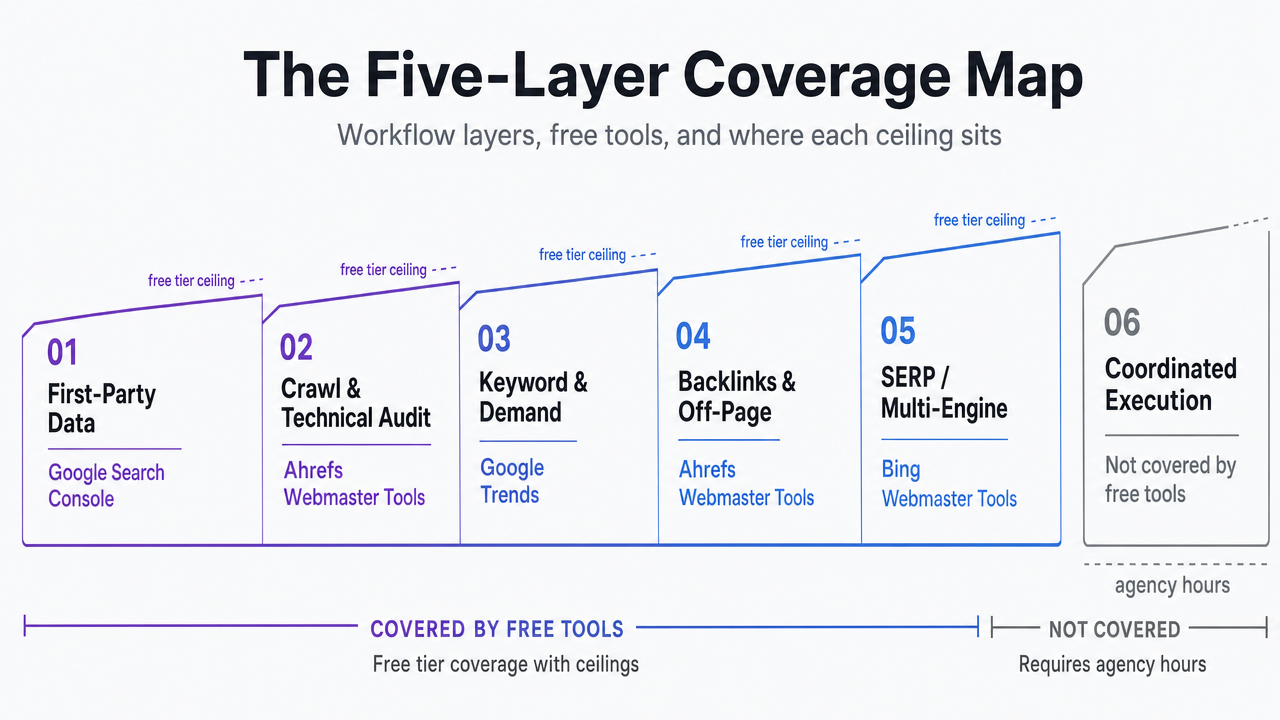 Visualize the five workflow layers, their representative free tools, and each free tier's ceiling, mirroring the comparison table in this section so readers can scan the operating model at a glance
Layer 1: First-Party Data
Google Search Console: The Query and Impression Backbone
Google Search Console is indispensable for first-party data because it provides a direct feed from the search engine itself, a capability no paid competitor can replicate. The UK government's Data Community technical documentation formally recognizes GSC as a data source, using it to capture searches that lead to a domain appearing in Google's results 8. When a public-sector reporting pipeline treats a free tool as an authoritative source, its place in an agency stack is affirmed.
GSC handles a wide range of recurring workflows, including query-level impressions, click-through rate by page, indexing status, Core Web Vitals summaries, and manual actions, all within a single property. Practitioner consensus from 2025 and 2026 stacks identifies it as an essential tool for first-party keyword and search performance data 4, with no meaningful free-tier alternative.
Its limitations emerge at scale: query and impression data are restricted to verified properties, exports are capped at approximately 1,000 rows per view in the standard interface, and history is limited to 16 months. Agencies conducting portfolio-level trend analysis often push this data into BigQuery or a reporting warehouse via bulk export to overcome these constraints. GSC does not provide competitor query data or attribute conversions; these workflows are handled by other tools in this layer.
Google Analytics 4: Conversion Attribution Without a License Line
GA4 serves as the conversion layer, connecting GSC's query data to business outcomes. Practitioner reviews for a robust 2026 agency stack position GA4 alongside GSC as a foundational, completely free component for tracking conversions and business results 4. For an agency managing numerous accounts, this means analytics coverage across the entire portfolio comes at no cost.
GA4 manages event-based conversion attribution, audience construction, and channel-level performance. When paired with GSC through the Search Console link, an SEO director can link landing-page performance to specific events—such as form submissions, calls, or transactions—without incurring middleware fees.
Known limitations include a default data retention of 14 months on the free tier, data sampling in high-volume explorations, and the standard interface not exposing all raw events. Agencies requiring clean cross-account reporting often route GA4 data into BigQuery, where the free export eliminates sampling constraints. GA4 does not, however, explain user behavior on a given page; this gap is addressed by the third tool in this layer.
Microsoft Clarity: Behavior Analytics the Free Tier Actually Includes
Clarity is a newer addition to the first-party layer and may be absent from agency stacks standardized before 2024. A 2026 agency review that identifies GSC and GA4 as essential components also places Microsoft Clarity in the same tier—free and now standard for behavior analytics across client accounts 4.
Clarity handles session recording, heatmaps, and detection of rage-clicks or dead-clicks. While GSC explains what users searched and GA4 explains what they converted on, Clarity reveals what happened in between, providing the diagnostic layer previously requiring a Hotjar or FullStory license.
A practical constraint is that Clarity is a Microsoft product, which can sometimes slow deployment due to data governance reviews at enterprise clients. Sample volume is generous but not unlimited on very large properties, and integration with GA4 events is functional but not as deep as a paid behavior suite. For most agency accounts, these limits do not impact recurring work, and the license-line savings accumulate across the portfolio.
Test scalable SEO workflows on live projects
Deploy and measure real SEO content during your trial, with full visibility into process and output quality.
Layer 2: Crawling and Technical Audits
Screaming Frog Free: The 500-URL Ceiling and Why It Still Earns Its Slot
The Screaming Frog SEO Spider FAQ explicitly details the free tier's inclusions and exclusions. Without a license, the crawler is limited to 500 URLs per crawl, crawls cannot be saved, and configuration and advanced features are restricted. However, the team emphasizes this as a permanent freemium commitment, not a temporary trial 10. This distinction is crucial: a durable free tier can be integrated into repeatable agency workflows, whereas a trial cannot.
For small client sites, service-business landing pages, and single-section audits on larger properties, 500 URLs are sufficient to identify common diagnostic issues:
- broken links
- redirect chains
- missing meta descriptions
- duplicate titles
- canonical conflicts
- orphan pages within a defined subfolder
Practitioner testing in 2025 continued to list the free Spider among tools that provide genuine crawling value rather than gated previews 7. This is why it maintains a position in the foundational $0 stack alongside GSC, Ahrefs Webmaster Tools, Google Trends, and Bing Webmaster Tools 3.
The limitation becomes apparent with mid-sized e-commerce catalogs, multi-location sites with hundreds of pages, or publisher archives. When a crawl needs to persist across sessions or exceed 500 URLs in a single pass, a paid license often becomes more cost-effective than the specialist hours spent on workarounds.
PageSpeed Insights: Core Web Vitals Without a Third-Party Wrapper
PageSpeed Insights is the second tool that secures a permanent place in the crawling and technical layer, and it is entirely free to use 13. It specializes in diagnosing Core Web Vitals—Largest Contentful Paint, Interaction to Next Paint, Cumulative Layout Shift—on a per-URL basis. This data is sourced from the same field data Google uses for ranking signals, complemented by lab metrics from Lighthouse.
For an agency, its operational value lies in eliminating the need for a third-party wrapper for Core Web Vitals reporting on individual page audits. When combined with the Core Web Vitals summary in Search Console, it connects site-wide trend data with specific URL-level fixes for engineering handoff.
Its limitation is scope: PSI processes one URL at a time and does not offer batch processing. Agencies auditing many templates or monitoring vitals across numerous client properties typically automate this process using the CrUX API or PageSpeed Insights API instead of the interface. PSI does not prioritize fixes by revenue impact; that judgment remains with the strategist.
Layer 3: Keyword and Demand Discovery
Google Keyword Planner + AnswerThePublic + Ubersuggest: The Zero-Budget Combination
No single free keyword tool can cover the entire research workflow. A 2026 comparative scoring of seven keyword research tools, evaluating data depth, long-tail coverage, and workflow value, specifically recommends combining Google Keyword Planner, AnswerThePublic, and Ubersuggest for zero-budget operators 9. Each tool addresses a distinct part of the research process, and their combination makes this layer viable for agency work.
- Keyword Planner provides volume and commercial intent signals, being the only free source directly pulling from Google's ad demand data, making it crucial for keyword sizing in search-driven revenue models.
- AnswerThePublic focuses on question and modifier discovery, identifying phrasings that indicate informational intent and aid cluster planning.
- Ubersuggest covers the middle ground, offering competitor URL insights, related-keyword expansion, and a functional difficulty proxy in its free tier.
The limitations are notable. Keyword Planner provides volume ranges rather than exact numbers for non-spending accounts. Ubersuggest imposes daily free query caps, and its difficulty scoring lacks the granularity of paid alternatives 9. AnswerThePublic throttles free searches per day per IP. For an agency, this means the combination supports cluster planning and content briefing across a portfolio, but in-depth competitive gap analysis still requires a paid seat or a shared license.
Google Trends: The Seasonality and Category-Shift Signal
Google Trends answers a question the keyword-volume tools cannot: whether demand for a topic is rising, seasonal, or declining. This makes it a core component of the foundational $0 stack 3, alongside Search Console and Ahrefs Webmaster Tools, as a durable element of the agency toolkit.
Trends handles recurring workflows such as seasonality mapping for editorial calendars, detecting category shifts for emerging queries, and comparing geographic demand across client footprints. Quarterly analysis using Trends can identify demand curves that annual keyword pulls often miss entirely.
Its limitation is the data itself: Trends reports relative interest, not absolute volume, and small-market queries may yield sparse or suppressed data. When used with Keyword Planner's volume bands, the two tools together provide a reliable demand picture. Used alone, Trends offers only directional insights.
Layer 4: Backlinks and Off-Page Monitoring
Ahrefs Webmaster Tools: Verified-Site Backlink Data at No Cost
Ahrefs Webmaster Tools is the cornerstone of the off-page layer in the foundational $0 stack, alongside Search Console, Google Trends, Bing Webmaster Tools, and Screaming Frog 3. It provides referring-domain inventory, anchor-text distribution, broken-backlink detection, and a functional segment of Ahrefs' index for any verified domain. Practitioner reviews in 2025 evaluated the free tier against paid alternatives and confirmed it as genuine freeware that delivers impact, not merely a gated preview 6.
For an agency, its recurring value lies in auditing and monitoring verified client properties. New referring domains, lost links, and spikes in toxic patterns are identified without requiring a Site Explorer subscription, eliminating the license cost for the diagnostic aspect of link work across the portfolio.
The limitation is inherent to this layer: free access is restricted to verified properties. Competitor backlink profiles, in-depth gap analysis against rival domains, and unrestricted Site Explorer queries remain behind the paid tier. Agencies pursuing new business or setting link-acquisition targets against competitors will encounter this barrier early, making a shared paid seat a more economical solution when managing multiple prospects simultaneously.
See How Leading Agencies Orchestrate SEO at Scale—Without Expanding Their Teams
Connect with experts to explore AI-powered workflows that centralize tool management, automate content approvals, and deliver measurable SEO results across multiple client campaigns.
Layer 5: SERP and Multi-Engine Visibility
Bing Webmaster Tools: The Multi-Client Argument
Bing Webmaster Tools is often overlooked in agency stacks focused solely on Google workflows, an omission that can be costly at a portfolio scale. A 2026 practitioner review of free stacks specifically highlights Bing Webmaster Tools as
"best for: agencies managing multiple clients" 1
Another agency-focused roundup describes it as a free tool
"well worth" the minimal setup time for each client property 13
The convergence of two independent 2026 sources on this recommendation signals its importance.
Bing Webmaster Tools provides visibility into the Bing index, offering query and impression data from Bing, indexing status, backlink discovery within the Bing graph, and crawl error reporting for a search engine that also powers a growing share of AI-answer surfaces. It is part of the foundational $0 stack alongside Search Console, Ahrefs Webmaster Tools, Google Trends, and Screaming Frog 3, and its setup cost per client is negligible once an agency standardizes verification.
Its limitation is scope: Bing WMT reports only on Bing's index and query set and does not address Google-specific ranking issues. For a Head of SEO managing many accounts, the operational benefit is that a second free data source per property effectively doubles visibility without adding a license fee.
The 11th Slot: AI Execution Across Accounts
What Free Tools Do Not Solve at Portfolio Scale
This section targets Heads of SEO managing many client accounts, not single-site SEO leads. The economics and bottlenecks shift significantly at this scale.
The first ten tools in this stack effectively cover diagnosis, research, and monitoring 3. However, they do not address the recurring execution loop that consumes agency margin: translating findings into briefs, routing briefs to writers and developers, tracking approvals, publishing content, and closing the loop back to GSC and GA4 for impact measurement. Free tools generate inputs but do not coordinate output work across many properties simultaneously.
This gap explains why free-tier expansion makes diagnosis cheaper but does not accelerate delivery. A senior strategist can quickly pull a Screaming Frog crawl and a GSC query export; however, specialist hours are still spent on briefing, review cycles, and status meetings across accounts.
Vectoron as an AI Execution Layer for Multi-Client Delivery
The 11th slot in this stack is not another free auditor or keyword tool. It is an execution layer that sits atop the first ten tools, transforming their outputs into approved, published work across a client portfolio. Vectoron fills this layer as an AI marketing execution platform, built around specialist strategists for content, SEO, PPC, backlinks, social, and call intelligence, all coordinated through a single approval workflow.
The operational premise is precise: data from tools like GSC, GA4, and Ahrefs Webmaster Tools feeds ranked recommendations into a Command Center. Here, a human strategist approves or rejects each item before any action is taken. Nothing is published without sign-off, and every recommendation includes its underlying reasoning. This model addresses the coordination costs untouched by free tools, compressing briefing cycles, handoffs, and status meetings into a governed queue.
Vectoron is a paid platform, not a free tool. It earns its place in this list because the limitations of the first ten free tools converge on the same bottleneck it targets: coordinated execution across accounts is where agency hours are still heavily invested, and no free tier closes this gap.
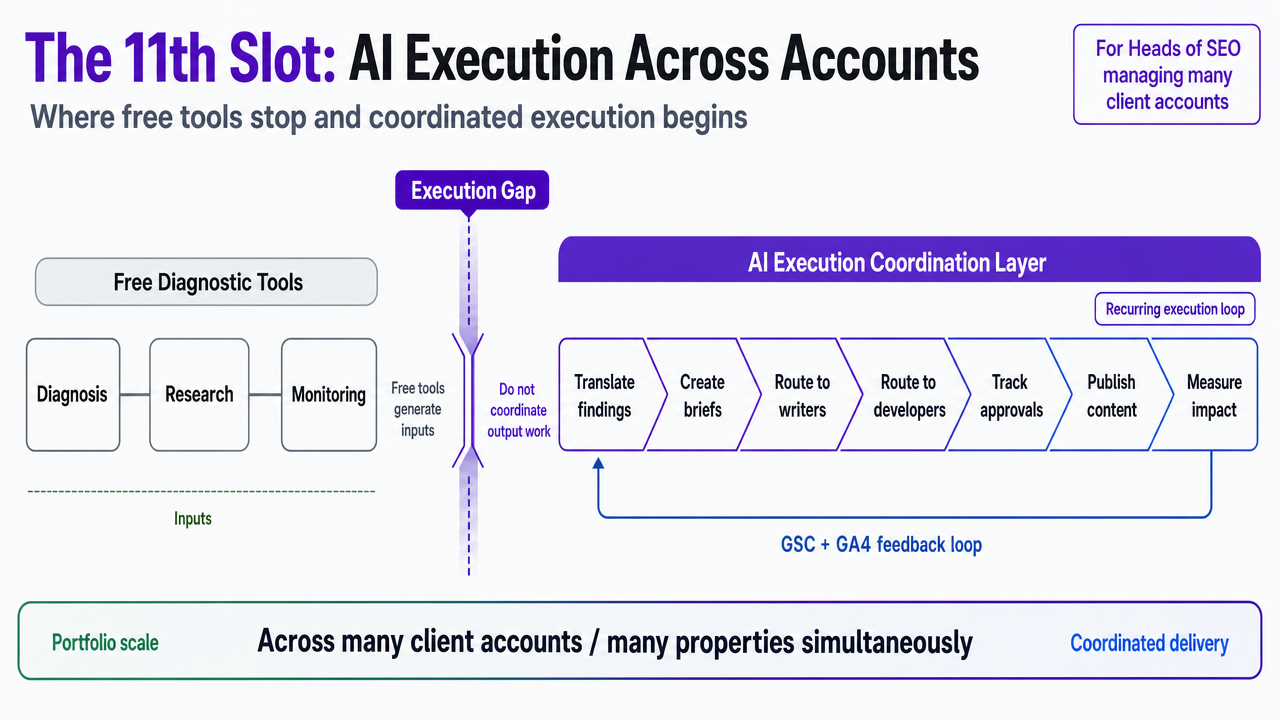 Show the operating flow from the ten free diagnostic tools into the AI execution coordination layer, illustrating where free tools stop and where coordinated execution begins across a client portfolio
If You Manage 50+ Client Accounts: Operationalizing the Stack
This section is for portfolio operators managing many accounts, not single-site SEO leads. The mechanics of operationalizing a free stack change significantly when the same workflow must be repeated across dozens of properties weekly.
- The first step is standardizing the core tools. Every client property should be verified in Google Search Console, Bing Webmaster Tools, and Ahrefs Webmaster Tools during onboarding, with GA4 and Microsoft Clarity installed before the initial audit 3, 4. This five-tool baseline transforms first-party data, off-page monitoring, and behavior analytics into a templated setup rather than a per-account decision. Screaming Frog's free tier handles subfolder and template-level audits within this repeatable pattern, with its 500-URL cap serving as a routing rule: anything exceeding it either escalates to a license or is scoped to a defined section 10.
- The second step is identifying where free tiers cease to be economical. Competitive backlink analysis, detailed difficulty scoring, and site-wide crawls on large properties are recurring points where specialist hours begin to outweigh license costs. A shared paid seat, used by senior strategists and managed via a request queue, is often more cost-effective than relying on free-tier workarounds.
- The third step, which no free tool addresses, is coordinating briefs, approvals, and publishing across the portfolio. This is the layer where an AI execution platform complements the free stack.
Frequently Asked Questions
References
- 1.24 best SEO tools I'm using in 2026 (free + paid) - Marketer Milk.
- 2.28 Free SEO Tools to Boost Your Search Rankings in 2025.
- 3.Best Free SEO Tools 2026: A $0 Stack That Actually Works.
- 4.10 Best SEO Tools for Agencies (My 2026 Stack).
- 5.The Top 5 Free SEO Tools in 2025 // Common Ground.
- 6.Best SEO Tools in 2025 (Free & Paid): Full Comparison.
- 7.19 Free SEO Tools That Actually Work in 2025 [Expert-Tested].
- 8.Google Search Console - Data Community Technical Documentation.
- 9.Best Keyword Research Tools 2026: 7 Compared & Scored.
- 10.SEO Spider FAQ.
- 11.SEO Software Market Size Worth USD 265.91 Bn by 2034 ....
- 12.Search Engine Optimization SEO Tools Professional ....
- 13.The Best Free & Paid SEO Software Tools For Agencies in ....