
Key Takeaways
- GEO extends SEO into AI answer surfaces by optimizing retrieval and citation within systems like AI Overviews, ChatGPT search, and Perplexity, rather than replacing classic ranking work 10.
- Agencies serving regulated verticals face heightened exposure because generative summaries strip qualifying language, and FTC rules on health claims and reviews now reach AI-cited content 2, 7.
- Delivery economics shift toward evidence sourcing, entity work, review cycles, and answer-inclusion monitoring, while AI-assisted drafting compresses hours, requiring retainer restructuring rather than a second pipeline.
- Reporting should separate activity, correlation, and outcome against a fixed query panel, since presenting probabilistic visibility as guaranteed carries real enforcement risk after the FTC's January 2025 vendor order 3.
The Definition Agencies Actually Need
Generative Engine Optimization (GEO) is the practice of improving how a client's content is retrieved, represented, and cited within AI-generated answers from systems like Google AI Overviews, ChatGPT search, Perplexity, and Copilot. The term originated from a 2023 Princeton research paper that defined GEO as a black-box optimization problem distinct from traditional search engine ranking 10. This distinction is crucial because it highlights that GEO is not merely an extension of classic SEO but addresses a different mechanism of content visibility.
For SEO managers, GEO is a measurement and packaging layer built upon retrievable, evidence-backed content that already drives organic clicks. It is not a separate discipline requiring its own infrastructure or team. Operationally, GEO introduces three key shifts:
- Content must now compete for inclusion in both ranked links and synthesized AI answers with inline citations.
- Visibility becomes fragmented; a page can be retrieved without being cited, cited without being clicked, or clicked without converting.
- The evidentiary standard rises, as retrieval-augmented systems prioritize attributable sources 6.
These shifts necessitate adjustments in execution, such as schema optimization, entity cleanup, review governance, and citation-grade writing. The strategic challenge for agencies is not whether to "do GEO," but how to integrate it into existing delivery models without significantly increasing production costs per client.
Where GEO Came From and What It Formally Measures
The 2023 Princeton paper introduced GEO as a black-box problem, meaning creators cannot directly observe the AI model's internal workings, audit its retrieval index, or precisely predict citation behavior. However, they can manipulate content features—such as citation density, direct quotations, statistical specificity, and source authority—and measure the impact on inclusion rates across a benchmark of generative responses 10.
This research also introduced GEO-bench, a synthetic evaluation set, demonstrating visibility gains of up to 40% in generative-engine responses when content was optimized. It's important to note that this figure was achieved under controlled benchmark conditions and does not directly translate to real-world performance on platforms like Google AI Overviews or ChatGPT search. Agencies should avoid presenting this lab result as a commercial guarantee for client revenue or lead generation.
The academic contribution lies in framing AI answers as a two-stage system: a retrieval step that identifies candidate documents and a generation step that composes an answer grounded in those documents 5, 6. This decomposition allows for measurable GEO efforts. A page can succeed or fail at retrieval, and then again at citation, with each stage influenced by different content signals.
Therefore, GEO formally measures the inclusion probability across these stages under a defined query distribution, focusing on inclusion rather than traditional rank or traffic. Agency reporting to clients should align with this construct or directly link to downstream business metrics, avoiding misinterpretation of benchmark numbers.
What Actually Changes in Client Strategy (and What Doesn't)
Many established SEO practices remain relevant. Crawlability, indexation, entity clarity, topical depth, internal linking, and E-E-A-T signals continue to influence both classic ranking and the retrieval process for generated answers 5. Google itself views AI features as an extension of its existing index, not a separate optimization challenge. Agencies that overhauled their strategies in 2024 often found themselves reinforcing fundamental SEO principles.
However, three areas undergo significant change. First, evidence density becomes a critical asset. Retrieval-augmented systems favor attributable sources, meaning specific numbers, named studies, direct quotations, and dated claims are more likely to be cited than general paraphrased content 6. Content designed to be quoted will be quoted.
Second, entity representation gains importance. AI models synthesize answers about a client from various sources, including their website, structured data, third-party mentions, and review platforms. Inconsistent NAP data or a weak knowledge-graph footprint can lead to inaccurate or incomplete AI-generated information about a business, beyond just impacting local pack rankings.
Third, reporting evolves. A client's ranking report no longer fully captures their visibility, as a portion of user intent is now resolved within AI answers that users may not click through. Agencies that continue with only rank-and-traffic dashboards risk underrepresenting their work.
Crucially, the content operating model does not require a separate pipeline. The same brief, subject-matter review, and publishing workflow can produce citation-grade assets by elevating standards for evidence and specificity within existing processes, rather than creating parallel systems.
Test SEO geo strategies on live client sites
Validate geo-targeted SEO improvements with real-time publishing and measurable client impact during your trial period.
The Three Measurement Layers Agencies Keep Conflating
Retrieval Visibility
Retrieval visibility is the initial stage where a client's page enters the candidate set for a generative system. This is analogous to classic indexation, but the retriever uses its own scoring against a query embedding, not just keyword matching. A page might rank well organically but be missed by retrieval, or rank poorly yet be pulled due to its high topical relevance 5.
Operational signals for improving retrieval visibility include clean crawl paths, canonical hygiene, entity-consistent copy, and specific, dated content. Since agencies cannot directly access the retrieval index, measurement is indirect. This involves sampling target queries across AI Overviews, Perplexity, and ChatGPT search, logging client URLs that appear as source links (regardless of whether they are quoted), and tracking this appearance rate as a leading indicator.
Answer Contribution
Answer contribution is a more stringent measure: did the AI model actually use the retrieved page to compose its answer? The TREC 2024 RAG work distinguishes between a URL appearing in the source list and its content being used in the synthesized answer 6. A URL can be cited without its facts being incorporated into the generated text, which might instead draw from a competitor's content.
Measuring contribution requires analyzing the generated answer for quoted phrases, paraphrased statistics, and named entities, then matching them back to client URLs. Pages designed for quotation—featuring specific numbers, dated claims, and concise, attributable sentences—are more likely to contribute. This layer is where evidence density is most impactful, and it's often absent from current agency dashboards.
Downstream Conversion
The third layer, downstream conversion, represents the business outcomes clients value, such as qualified traffic, form fills, and booked calls. While retrieval and citation are leading indicators, direct attribution from generative surfaces is often challenging due to inconsistent referrer data. ChatGPT and Perplexity may pass some referrer strings, but AI Overviews often do not differentiate clicks from unassisted organic traffic in standard analytics.
Practical instrumentation includes using tagged UTM patterns on answer-adjacent surfaces, server-side capture of referrer domains associated with generative engines, and correlating rising answer-contribution rates for a topic cluster with downstream call or booking volumes. This is a triangulation model, not deterministic attribution, and agency reporting should clearly communicate this. Clients should receive reports showing retrieval sample rates, answer contribution rates, and downstream conversion movement, with a nuanced understanding of causality.
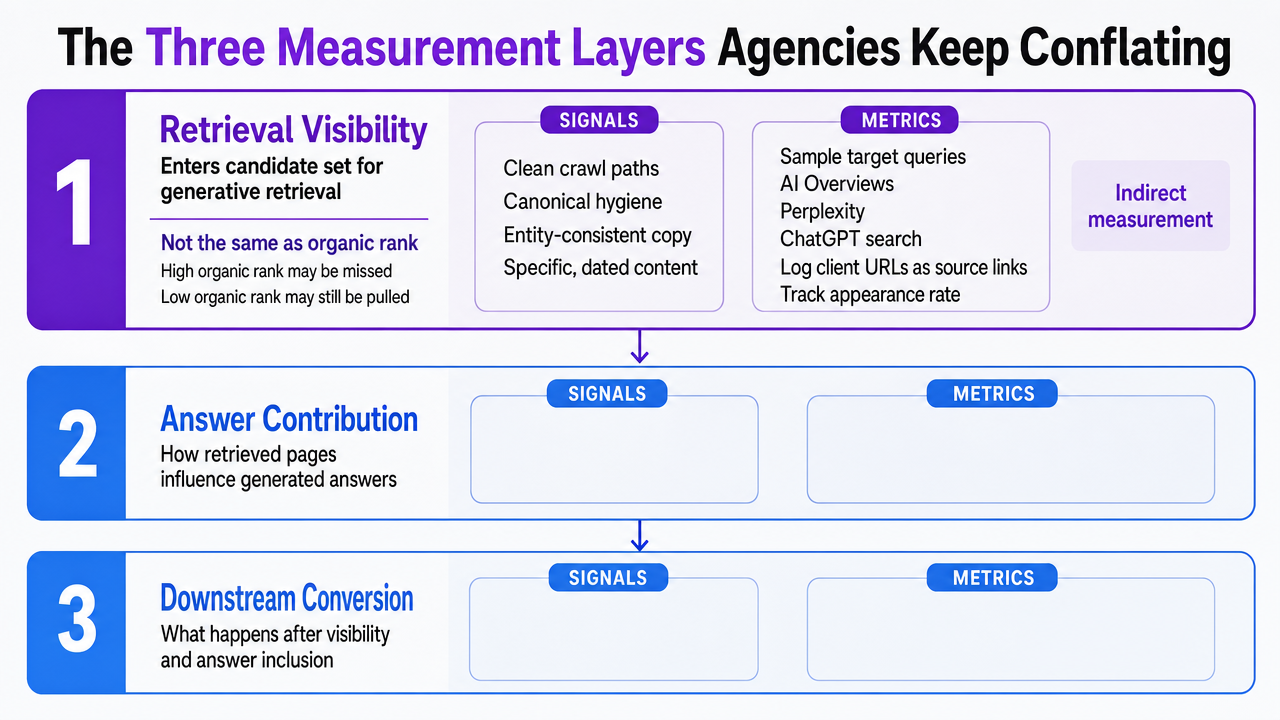 Visualize the three-layer measurement framework (Retrieval Visibility, Answer Contribution, Downstream Conversion) that structures the entire section, showing how each layer relates to signals and metrics
Regulated Verticals: Where AI Summaries Amplify Legal Exposure
For clients in regulated industries like law, healthcare, or senior living, AI summaries introduce new compliance risks. A generative answer is a synthesis, often stripping away the careful qualifying language present in a compliant source page. For example, a page stating "results depend on individual circumstances" might be summarized into a flat claim about outcomes, with the client cited as the source, potentially creating a non-compliant statement.
The FTC's Health Products Compliance Guidance mandates competent and reliable scientific evidence for health-related claims, including implied ones 2. Behavioral-health content optimized for retrieval—with dated statistics, specific outcome numbers, and named modalities—is precisely what generative systems prefer to quote. This preference, beneficial for retrieval, becomes a hazard at the answer layer because AI summaries rarely carry forward the necessary substantiation footnotes.
Review governance also falls into this category. The FTC's Consumer Reviews and Testimonials Rule, effective October 21, 2024, prohibits deceptive reviews and testimonials, extending to AI-generated presentations if the underlying endorsement is not genuine 7. Local prominence signals, such as "best personal injury attorney" or "top-rated memory care," feed generative answers about a client, meaning a manufactured review corpus can become a manufactured AI-cited authority claim 1.
Agencies also face vendor-side risk. A January 2025 FTC order fined an online marketer $1 million for deceptive claims about its AI product's compliance capabilities 3. This signals that agencies promising guaranteed AI citations, compliance, or lead volume through GEO programs face similar enforcement risks. Engagements in regulated verticals should focus on activities and observed correlations, not outcomes that the retrieval and generation layers do not allow anyone to fully control.
The Governance Layer: NIST AI RMF Inside an Agency Review Workflow
Agencies integrating GEO into their content pipelines need a robust answer when clients' legal teams inquire about AI-assisted content review. The NIST AI Risk Management Framework (AI RMF) provides this structure without requiring a new department. It organizes risk management into four functions—govern, map, measure, and manage—and emphasizes trustworthiness characteristics like validity, reliability, transparency, and explainability 4. Its Generative AI Profile specifically addresses risks such as confabulation and information integrity in generative systems.
Within an agency workflow, "govern" establishes standing policies: which models can be used for which client verticals, what data can be processed, and what client disclosures are required. "Map" involves per-engagement risk classification, distinguishing between, for example, a home services client and a behavioral-health client, to tailor risk assessment before content generation.
"Measure" creates an evidence trail for reviews. Every AI-touched asset should record the model used, prompt lineage, human editor, checked source citations, and substantiation status for any regulated claims. "Manage" defines the escalation and rollback path if a piece is flagged post-publication due to an AI answer summarizing it into a non-compliant claim.
While voluntary and not prescribing specific GEO tactics 4, the AI RMF offers agencies a procedural advantage: a documented review workflow that legal teams can inspect and that scales with headcount, avoiding per-account reinvention.
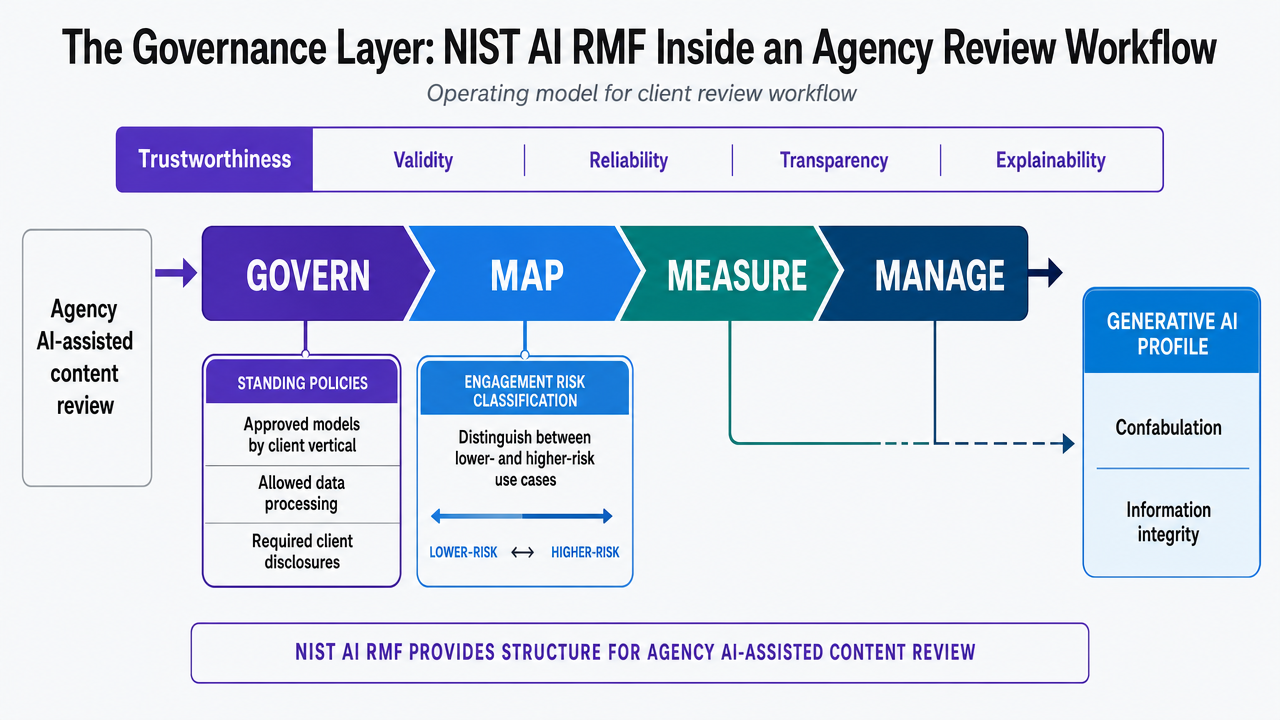 Visualize the four NIST AI RMF functions (Govern, Map, Measure, Manage) as applied inside an agency content review workflow, directly mirroring the section's operating model
See How Leading Agencies Operationalize Location-Based SEO at Scale
Connect with experts to benchmark your current geo-SEO workflow, explore automation opportunities, and identify data-backed efficiencies for multi-location or regional SEO management.
Operator Economics: What Changes Per Client Per Month
The economic impact of GEO for agencies centers on where it adds or compresses work, and its effect on retainer margins. Client demand is increasing; the Stanford HAI's 2025 AI Index reported that organizations using generative AI in at least one business function jumped from 33% in 2023 to 71% in 2024 8. Clients are requesting GEO solutions, often without a clear definition, placing pressure on delivery teams already scoped for traditional SEO.
Analyzing line items per client per month reveals three categories of change:
| Delivery Activity | Traditional SEO | GEO-Extended | Direction |
|---|---|---|---|
| Keyword and topic research | X hours | 0.8X to 1.0X hours | Flat to slight compression |
| Drafting | X hours | 0.4X to 0.6X hours | Compression under AI-assisted execution |
| Evidence sourcing and citation | X hours | 1.5X to 2.0X hours | Growth |
| Entity and schema work | X hours | 1.2X to 1.5X hours | Growth |
| Review cycles (editorial and compliance) | X hours | 1.5X to 2.0X hours in regulated verticals | Growth |
| Answer-inclusion monitoring | 0 hours | New standing line item | Net new |
| Rank and traffic reporting | X hours | 0.8X to 1.0X hours | Flat |
This pattern is directional. Drafting hours compress most for informational content but less for regulated-vertical thought leadership, which still requires significant subject-matter rewriting even with AI assistance. Evidence sourcing increases because citation-grade pages demand named studies, dated statistics, and direct quotations preferred by the retrieval layer 6. Review cycles grow disproportionately for regulated industries like law firms, behavioral-health groups, DSOs, and senior-living operators, where a documented substantiation trail is mandatory.
The net-new line item, answer-inclusion monitoring, challenges traditional per-hour agency pricing. It's a standing cost without a direct analog in rank-and-traffic retainers and doesn't scale linearly with account size. A monitoring program for a regional dental group might cost similarly to one for a national law firm with the same topic count. Agencies either absorb this cost into existing retainers or must justify a new fee for a leading indicator rather than a booked outcome.
Economically, GEO doesn't double delivery costs but reallocates them towards evidence, review, and monitoring, while AI-assisted execution reduces drafting hours. Agencies that don't restructure their service mix may be running GEO at a loss within current contracts.
If You Manage a Client Book: Operationalizing Without a Second Pipeline
A common pitfall is creating a separate GEO team alongside the SEO team, leading to duplicated intake forms, briefs, review queues, and dashboards for the same content assets. This results in agencies paying twice to produce a single page and struggling to clarify metric ownership to clients.
The effective alternative is a single production line that integrates GEO requirements into existing stage gates. The intake form should include a vertical-risk classification to route regulated accounts (e.g., law firms, behavioral health, DSOs, senior living) into a more rigorous substantiation track. The content brief should add three fixed fields:
- Specific queries for retrieval
- Required citable evidence units (named studies, dated statistics, direct quotations, licensed data)
- Entity anchors to reinforce
Drafting remains with the same personnel, but the editor's checklist now includes ensuring each factual sentence is concise and specific enough for verbatim quotation by an AI generation step 6.
Review cycles gain one additional pass: a substantiation check to confirm that every regulated claim has a verifiable source for potential inspection by client counsel. Publishing processes remain unchanged. Monitoring becomes the new standing work, involving a rotating sample of target queries across AI Overviews, ChatGPT search, and Perplexity, logged monthly and correlated quarterly with booked outcomes.
The goal is compression, not addition: one brief, one editor, one publish, and one governance trail, instrumented to report across three measurement layers instead of just one.
Reporting Without Overpromising
The reporting challenge for GEO is structural. Generative systems are probabilistic, their retrieval indexes are opaque, and their citation behavior can change without notice between model versions. An agency dashboard that presents GEO results as controllable outputs misrepresents the underlying system. Furthermore, following the FTC's January 2025 $1 million order against a vendor for overstating AI product capabilities, such misrepresentation carries significant regulatory risk 3.
A defensible reporting framework separates activity, correlation, and outcome. "Activity" details agency actions: pages published, evidence units added, entity fixes implemented, and review samples logged. "Correlation" tracks related movements: retrieval sample rates, answer contribution rates, and branded mention volume in generated answers. "Outcome" covers client-booked results: qualified calls, consultations, matters, or admissions. Each column stands independently, with the causal link between them presented cautiously, using language acceptable to client counsel.
To maintain this framework, agencies should report contribution rates against a fixed query panel that changes only quarterly, ensuring month-over-month movement reflects program impact rather than denominator shifts. Additionally, every deliverable must explicitly state that generative visibility is a leading indicator correlated with—not a guarantee of—downstream conversion.
Frequently Asked Questions
References
- 1.Endorsements, Influencers, and Reviews.
- 2.Health Products Compliance Guidance.
- 3.FTC Order Requires Online Marketer to Pay $1 Million for Deceptive Claims Its AI Product Could Make Websites Compliant.
- 4.Artificial Intelligence Risk Management Framework (AI RMF 1.0).
- 5.Overview of the TREC 2025 Retrieval Augmented Generation (RAG) Track.
- 6.Laboratory for Analytic Sciences in TREC 2024 Retrieval Augmented Generation.
- 7.The Consumer Reviews and Testimonials Rule: Questions and Answers.
- 8.AI Index 2025: State of AI in 10 Charts.
- 9.The 2025 AI Index Report.
- 10.GEO: Generative Engine Optimization.