
Key Takeaways
- Search Console proves exposure and engagement in Google's index, but connecting those signals to booked consults or signed retainers requires analytics conversion data and CRM-stage movement joined to the same window.
- Reporting should run goal, KPI, GSC evidence, conversion proof, then limitations disclosure—opening inside the Performance report inverts the chain and produces narratives about Google rather than the client's business.
- Pair every CTR delta with the position delta before claiming a content win, since controlled research shows click behavior tracks result position, not relevance alone 4.
- Codify measurable goals, matched metrics, ongoing analysis, and explicit attribution at onboarding 2so junior staff can execute defensible reports and portfolio capacity stops depending on individual strategists.
Why Search Console Keeps Losing Renewal Meetings
A renewal meeting rarely turns on a chart of impressions. It turns on whether the client's general counsel, operations director, or practice administrator believes the agency can connect what happened in search to what happened in the pipeline. Google Search Console is where many agency reports begin and, too often, where the argument ends. Impressions climbed. Average position improved. Clicks grew quarter over quarter. The client nods, then asks how many new consults were booked, and the room goes quiet.
That silence is a measurement problem, not a results problem. The U.S. General Services Administration's analytics guidance is explicit: organizations should define what the site is trying to accomplish, then translate that into objectives, calls to action, KPIs, and targets before pulling metrics 1. Search Console sits downstream of that chain, not at the top of it. When an agency leads with GSC output, the report describes activity in Google's index rather than progress toward the client's business goal.
The Government Accountability Office's review of advertising measurement reaches a similar conclusion from a different direction. GAO identifies four practices behind defensible performance claims: measurable goals, metrics suited to the objective, ongoing analysis, and an explicit understanding of how outcomes can be attributed 2. Impressions and clicks map to awareness and engagement. Signed retainers do not. The remainder of this article builds the chain that connects the two, and marks the places where GSC alone cannot carry the weight.
The Evidence Layer vs. the Value Layer
What Search Console Can Actually Prove
Search Console documents what happened in Google's index for a given property: how often URLs surfaced for queries, which queries drew clicks, the average position of those appearances, and how device, country, and search appearance segments shifted over time. That is a legitimate evidence base for one specific claim—organic visibility and demand changed in a measurable direction. NIST's information-retrieval framework helps sharpen the point: precision is the share of retrieved results that are relevant, and recall is the share of relevant results retrieved 5. GSC does not calculate either, but its query and page data let an analyst approximate whether a site is appearing more often for the query set that matches client intent, which is the practical proxy agencies use.
Within that scope, GSC can defensibly prove four things:
- That a target page is indexed and eligible to appear.
- That it is appearing for a defined query cluster.
- That the volume of appearances and clicks moved in a specific direction over a defined window.
- That technical signals such as coverage errors or Core Web Vitals changed.
Those are evidence-layer claims. They describe search exposure, not pipeline value, and should be labeled that way in any report that lands in front of a general counsel or practice administrator.
What Search Console Cannot Prove Without a Second Source
GSC cannot show whether a click became an intake form submission, a booked consult, a signed retainer, or recovered revenue. It cannot establish that an SEO engagement caused the change it displays, because it holds no data on concurrent redesigns, paid campaigns, referral partners, offline advertising, or algorithm updates running in the same window. It also truncates and anonymizes queries for privacy, which means the visible query set is a sample, not a census.
The GAO's review of military recruiting measurement names this problem directly: some services could tie engagements, leads, and signed contracts to specific marketing efforts, while others faced attribution gaps that left activity metrics disconnected from outcomes 3. The same gap sits inside every agency reporting cycle. Impressions moved. Position improved. Whether any of that produced qualified calls, booked appointments, or signed work requires a second source—analytics conversion data, CRM stage movement, or call-tracking records—joined to the GSC trend and interpreted against a defined baseline.
The operational rule for junior staff is simple: if a claim describes exposure or engagement in search, GSC can carry it. If a claim describes a business outcome, GSC is one input among several, and the report must name the other sources and the window they cover.
A Goal-to-Outcome Reporting Architecture
Start With the Goal, Not the Dashboard
Agencies that open a reporting cycle inside Search Console have already lost the thread. The GSA's analytics guidance orders the work in the opposite direction: identify what the site is trying to accomplish, define objectives that support it, specify the calls to action that move visitors toward those objectives, then choose KPIs and targets that measure progress 1. Metrics come last, not first.
For a personal injury firm, the goal is signed representation agreements. The objective is qualified consultations booked from organic search. The call to action is the intake form or tracked phone number on a practice-area page. The KPI is qualified consultations per month, with a target set against the client's historical baseline. Only at that point does GSC enter the chain, as evidence that the practice-area page is being surfaced and clicked for the query cluster that matches intake intent.
Reversed, the architecture collapses. A junior analyst who opens the Performance report first will build a narrative around whatever moved, then look for a goal that fits. The resulting report describes Google's index. It does not describe the client's business. The chain that holds together under scrutiny runs goal, KPI, GSC evidence, conversion proof, and limitations disclosure, in that order.
The Four Practices Behind Defensible Measurement
The GAO's audit of DOD advertising names four practices that separate defensible measurement from activity reporting: define measurable goals tied to a target audience, select metrics appropriate to the objective, conduct ongoing analysis using industry-standard measures, and develop an explicit understanding of how outcomes can be attributed 2. Each practice marks a specific boundary around what GSC can carry and what it cannot.
Measurable goals come from the client, not the dashboard. A target of 40 qualified intake calls per month for a regional dental group is measurable; a target of "more organic traffic" is not. GSC contributes nothing to goal-setting and should not be mined for one.
Appropriate metrics mean matching the metric to the question. Impressions and average position speak to visibility. Clicks speak to engagement. Neither speaks to whether a booked appointment occurred. The reporting table in a client deck should make the split visible: impressions, clicks, CTR, average position, and query data belong in the activity column; booked consults, signed retainers, and recovered revenue belong in the outcome column, sourced from analytics conversion events and the client's CRM.
Ongoing analysis means a cadence that catches drift between reports, not a quarterly screenshot. Weekly review of query shifts, coverage errors, and conversion-stage movement surfaces problems while they are still correctable.
Attribution understanding is the practice most agencies skip. GAO notes that some military services could attribute engagements, leads, and contracts to specific marketing efforts while others faced attribution gaps that left activity disconnected from outcomes 2. The same gap sits inside most agency reporting. Naming the attribution model, the window, and its limits in the report itself is the practice that holds up under cross-examination.
Mapping GSC Metrics to KPIs Clients Actually Care About
Every GSC metric should earn its place in a client report by connecting to a KPI the client already tracks. Impressions map to demand-side visibility for a defined query cluster, which supports a KPI such as share of visibility within a practice area or service line. Clicks map to qualified session volume on the pages tied to intake, which supports a KPI such as organic sessions reaching a service-area page. Average position across a tracked query set supports a visibility-trend KPI, with the caveat that position is a weighted average across devices, locations, and query variants rather than a single rank.
Query data is the metric with the highest translation value and the heaviest handling cost. A query cluster that matches intake intent—"workers comp attorney [city]," "emergency dentist near me," "memory care [county]"—maps to a KPI the client's operations lead already watches: inquiries from in-market prospects. GSA's framework is explicit that KPIs should express progress toward the business objective, with targets grounded in a client-specific baseline rather than a generic benchmark 1.
Pages, countries, devices, and search appearance segments earn space only when they alter the interpretation of the KPI. A mobile-only CTR drop on a practice-area page is reportable because it changes what the client should do next. A device split that moves within noise is not.
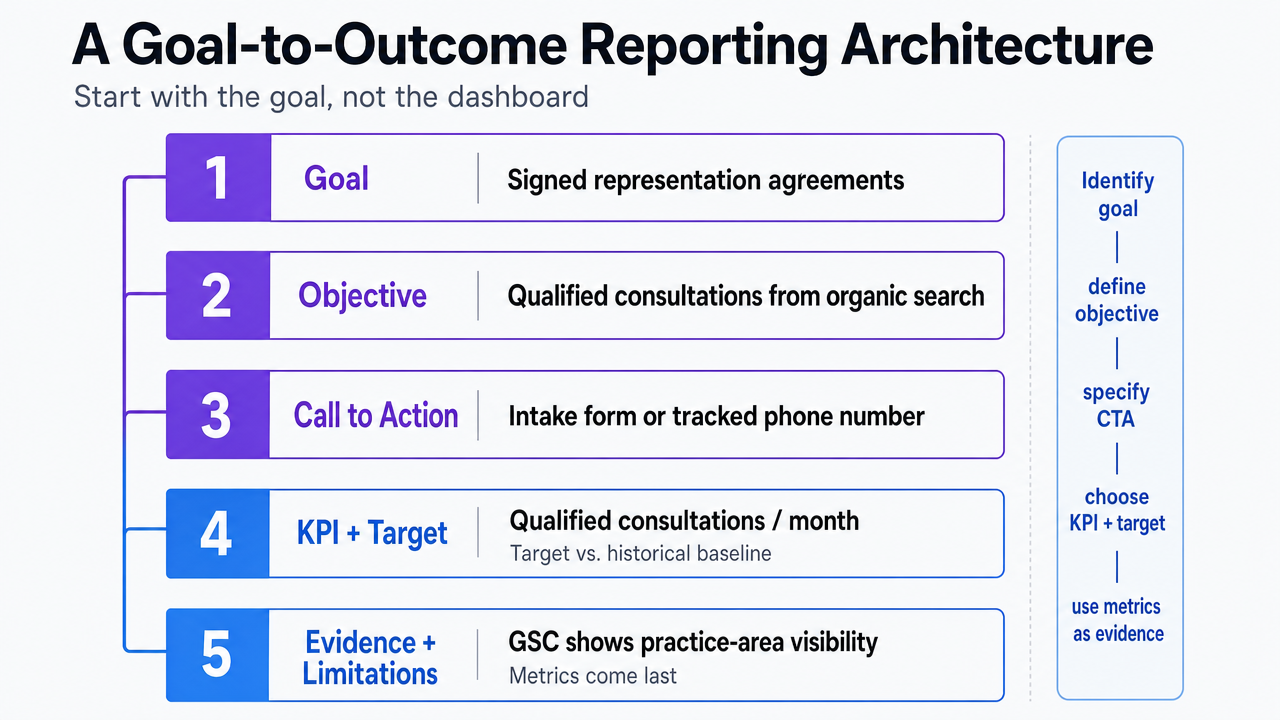 Visualize the five-link reporting chain the section argues for, so readers can see the ordered flow from business goal to limitations disclosure
Prove SEO Value With Real Client Data
Access actionable Google Console insights and publish client-facing reports using live campaign data during your trial.
Reading Clicks Without Fooling the Client
Position Bias and the CTR-as-Relevance Trap
A rising click-through rate feels like a content win. Often it is a ranking shift wearing a content costume. The distinction matters because the recommendation that follows a CTR gain—double down on the title tag pattern, expand the meta description style, replicate the content template—depends on whether the lift came from the page or from the position.
The Joachims et al. controlled information-retrieval study examined this directly. When researchers manipulated the order of search results shown to users, the average relevance rank of the results users clicked shifted with the manipulation. Click behavior tracked position, not just relevance 4. The study was a controlled experiment on a university-scale search system, not a measurement of commercial Google rankings, and its conclusion was narrow: clicks carry useful signal but are shaped by where a result sits on the page. That caveat is the one most SEO reporting omits.
The operational consequence for a client report is specific. A CTR increase on a practice-area page from 3.1 percent to 4.7 percent, paired with an average position move from 6.2 to 3.8, cannot be presented as evidence that a title rewrite worked. The position change alone predicts most of the CTR movement. The defensible version of the claim pairs the CTR delta with the position delta in the same row, labels the position change as the likely driver, and reserves content-win language for cases where CTR rose while position held flat across the measurement window.
Precision, Recall, and 'Appearing for the Right Query'
Impression volume answers a shallow question: did the site show up more often. The deeper question is whether it showed up for queries that match what the client's intake team can actually convert. NIST's information-retrieval framework separates these as precision—the share of retrieved results that are relevant—and recall—the share of relevant results retrieved 5. Search Console measures neither directly, but the distinction gives agency analysts a cleaner way to read the Queries report.
A memory care operator whose impression count doubled on queries like "what is memory care" and "memory care vs assisted living" gained recall across an informational cluster. The intake team will not see those gains in booked tours. The same operator gaining impressions on "memory care [county]" and "dementia care facility near me" gained precision against the query set the admissions director already tracks, and the trend will show up downstream.
The reporting move is to cluster queries by intent before reporting the impression trend, then show the activity change against each cluster separately. One table, two or three clusters, labeled by what the client's operations lead calls them. That turns an impression number into a sentence a practice administrator can act on.
Connecting Impressions to Signed Business
The Attribution Gap Between Click and Contract
A click on a workers' comp attorney page in Milwaukee and a signed representation agreement two weeks later are separated by an intake call, a conflict check, a consultation, and a decision the firm's intake coordinator records in the case management system. Search Console sees the first event. Nothing after it. The gap in between is where most agency reporting breaks down, and where clients learn to distrust the deck.
GAO's review of military recruiting measurement describes the same gap in a higher-stakes setting. Some services could trace engagements, leads, and signed contracts back to specific marketing efforts; others could not, and their activity metrics drifted free of the outcomes they were meant to predict 3. The report also notes that goals without specific targets, time frames, and responsible parties make it difficult to assess progress or communicate intended outcomes 7. For an agency, the operational translation is a joined dataset: GSC clicks on tracked pages, analytics conversion events fired by intake forms and tracked phone numbers, and CRM-stage movement from new inquiry to qualified lead to signed engagement, aligned on a shared time window and a defined baseline the client approved before the measurement period began.
Last-Click Reporting and What It Hides
Last-click attribution gives credit to the final interaction before a conversion, which is why so many agency reports lean on it. It is simple to compute, easy to audit, and consistent across accounts. GAO notes that organizations rely on last-click attribution even though earlier marketing efforts can contribute to the eventual outcome 7. For organic search, that bias cuts two ways.
An informational blog post that pulled a prospect in six weeks before they returned via a branded search and booked a consult receives no credit under last click. The branded session gets it. The reverse also happens: a service-area page that captures a final-touch booking receives full credit for a decision shaped by a paid campaign, a referral, or a Google Business Profile visit earlier in the week. A defensible report names the attribution model used, the window it covers, and the known blind spots in the same page as the conversion totals, so the client's operations lead reads the numbers with the correct frame.
If You Manage a Portfolio: Reporting Economics Across the Book
A single-client reporting conversation and a 30-account book are different operating problems. The agency head reading this is deciding whether a strategist can carry 12 accounts or 20, whether junior analysts can execute reports without senior review, and whether the model survives the next hiring freeze. The answer sits in how the reporting work is structured, not in how fast anyone can pull a GSC export.
Ad-hoc reporting rebuilds the narrative each cycle. A strategist opens Search Console, scans for what moved, hunts for a plausible story, pulls analytics conversions, and reconciles the result with whatever the client asked about last quarter. The work is bespoke, and it compounds. A standardized goal-to-outcome framework inverts the cost: the goal, KPI set, query clusters, conversion events, and limitations language are defined once at onboarding, then populated each cycle against the same baseline.
The economics across a book, expressed in variables rather than invented dollar figures:
| Variable | Ad-hoc GSC reporting | Standardized goal-to-outcome framework |
|---|---|---|
| Strategist hours per account per cycle | H_adhoc (narrative rebuilt each cycle) | H_std (template populated, exceptions reviewed) |
| Accounts per strategist (capacity) | Capacity_cycle / H_adhoc | Capacity_cycle / H_std |
| Senior review required | Per report | Exceptions and claim language only |
| Substantiation risk per claim | Variable by analyst | Bounded by template |
The framework that scales is the one GAO describes for defensible measurement: measurable goals, metrics suited to the objective, ongoing analysis, and explicit attribution 2. Codify those four at the account level once, and portfolio capacity stops depending on which strategist happens to pull the report.
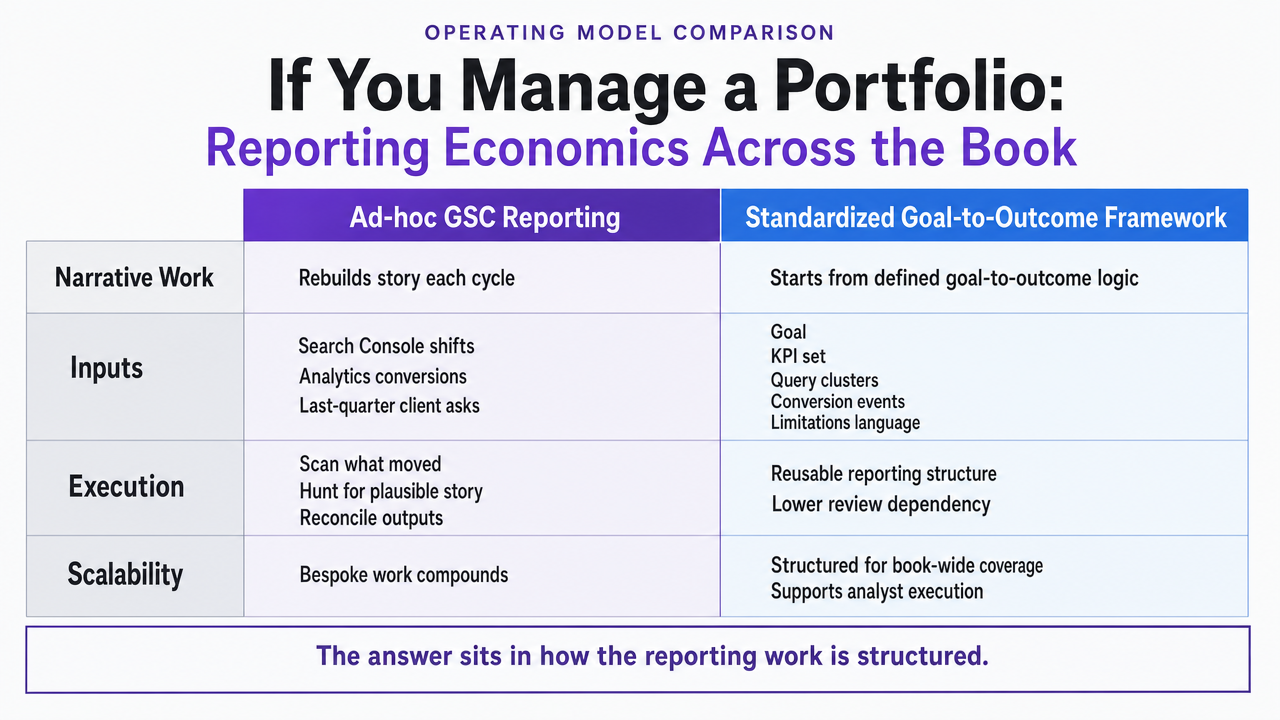 Render the article's comparison table as a scannable side-by-side framework comparing ad-hoc GSC reporting against the standardized goal-to-outcome framework across four operational variables
Show Client ROI With Reliable Google Search Console Insights—at Scale
Connect with our team to discover streamlined workflows for surfacing, interpreting, and presenting Google Console data that clearly quantifies SEO impact across all your client accounts.
Client-Facing Claims and the Substantiation Standard
Internal reports and public case studies carry different evidence obligations. A quarterly deck shared with a client's marketing lead is a working document; a case study published on the agency's site, a pitch deck sent to a prospect, or a comparative claim about results against competitors is an advertisement. The FTC treats objective performance claims as requiring a reasonable basis before dissemination, and that standard applies to agencies, not only to the advertiser whose results are being described 9. The commission's guidance for internet marketing is explicit that agencies cannot rely on an advertiser's assurance and must review the evidence behind the claims they help publish 10.
The operational translation is a short list of claim types that need documented backup before they leave the agency. A statement that organic traffic grew 212 percent needs the measurement window, the property, the baseline, and the analytics source named in the same artifact. A claim that an SEO engagement produced a specific number of signed cases needs the CRM query, the attribution model, and the exclusion rules written down. Comparative claims—faster, better, more leads than the prior vendor—need the test or data they reference, held at the level the claim itself implies 8.
The quiet risk is causality language. A case study that reports a before-and-after lift accurately can still overstate what caused it if it omits concurrent redesigns, paid campaigns, referral changes, or algorithm updates in the same window 9. The defensible version names the SEO work performed, reports the measured change, and lists the other variables active during the period. That paragraph is cheaper to write once at the case-study stage than to defend later when a prospect's counsel asks how the number was produced.
A Reporting Template Junior Staff Can Execute
A junior analyst should be able to produce a defensible client report in under 90 minutes without a strategist rewriting the narrative. The template below codifies the chain this article has built, so the thinking happens once at onboarding and the execution happens the same way every cycle.
Each client file carries five fixed blocks, populated in order:
- Goal and KPI header. One sentence naming the client business goal, the KPI that measures progress, the target, and the baseline window the client approved 1.
- Search Console evidence. Impressions, clicks, average position, and query-cluster movement for the tracked pages and query sets defined at onboarding. Clusters labeled with the client's own operations language.
- Conversion proof. Analytics conversion events and CRM-stage movement joined to the same pages and window. Signed outcomes reported where the CRM captures them.
- Attribution and limitations. The attribution model used, the window, concurrent variables active during the period, and known data gaps 7.
- Next-cycle actions. Two or three specific recommendations tied to the KPI, not to GSC curiosities.
Senior review shrinks to exceptions and claim language. Capacity scales with the template, not the strategist.
Frequently Asked Questions
References
- 1.An introduction to analytics.
- 2.GAO-16-396 Accessible Version, DOD ADVERTISING: Better Coordination, Performance Measurement, and Oversight Needed to Help Meet Recruitment Goals.
- 3.Military Recruiting: Actions Needed to Address Digital Marketing Challenges.
- 4.Evaluating the Accuracy of Implicit Feedback from Clicks and Browsing Behavior.
- 5.Building Better Search Engines by Measuring Search Quality.
- 6.GAO-16-396, DOD ADVERTISING: Better Coordination, Performance Measurement, and Oversight Needed to Help Meet Recruitment Goals.
- 7.Military Recruiting: Actions Needed to Address Digital Marketing Challenges.
- 8.Advertising FAQ's: A Guide for Small Business.
- 9.FTC Policy Statement Regarding Advertising Substantiation.
- 10.Advertising and Marketing on the Internet: Rules of the Road.