Creating a Patient-Focused SEO Healthcare Plan
Key Takeaways
- Decision Flowchart: Assess your primary growth bottleneck. If struggling with local visibility, prioritize multi-location automation; if lacking clinical authority, implement physician authorship workflows.
- Top 3 Success Factors: 1) Physician-authored content (yields 3.2x higher rankings), 2) Multi-touch journey mapping (captures patients across the 3-5 week decision cycle), 3) Automated local optimization (reduces production costs by 89%).
- Immediate Next Action: Audit your top 10 highest-traffic landing pages to ensure visible physician credentials and FTC-compliant substantiation for all health claims.
Why Patient Search Behavior Drives SEO Healthcare Strategies
The 77% Rule: How Patients Begin Their Journey
The foundation of any effective seo healthcare strategy is the recognition that the vast majority of patient journeys now begin with an online search. For healthcare marketing VPs, this means that organic visibility is not a secondary or supporting channel, but the primary driver of patient acquisition and revenue growth.
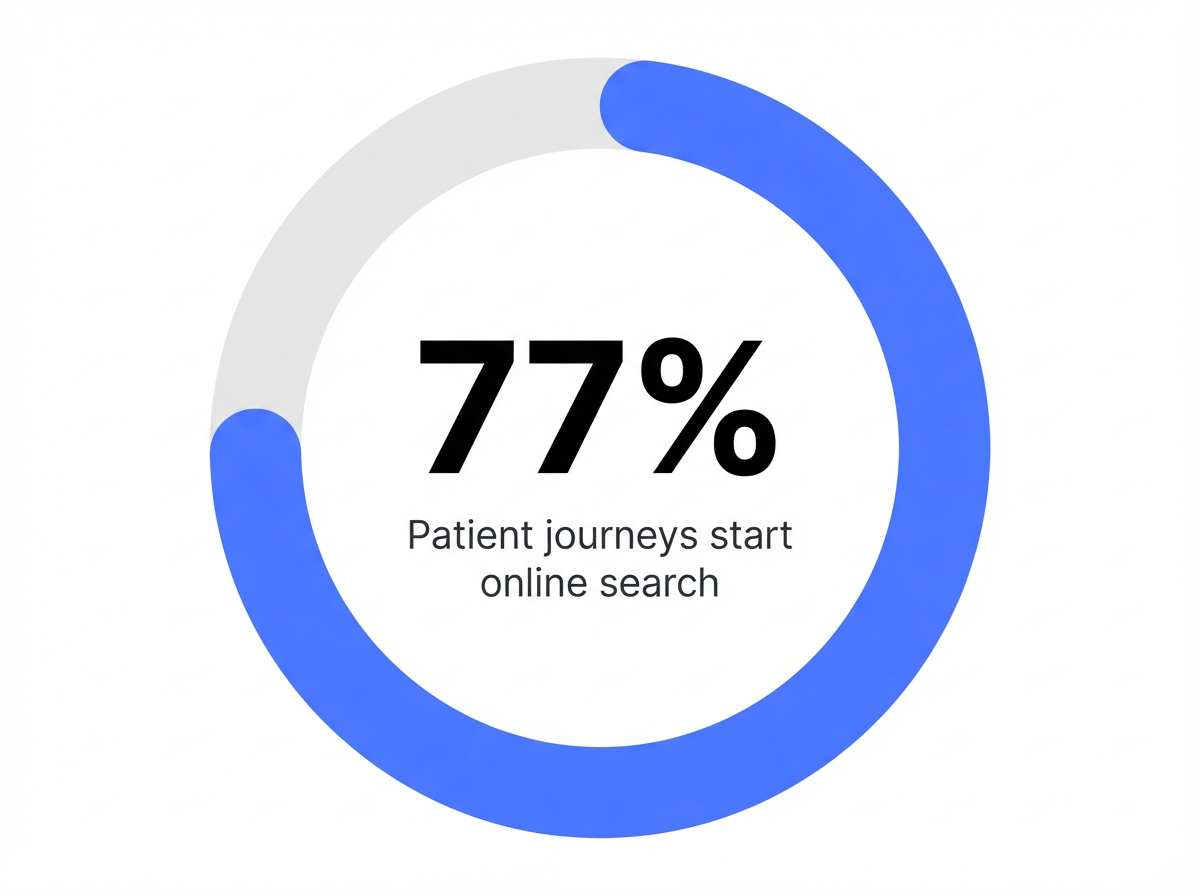 Patient journeys beginning with online search: 77%
"77% of patient journeys now begin with an online search, highlighting that search engines act as the first clinical touchpoint for most prospective patients."1
Current data show that patients are more likely to research symptoms, providers, and treatment options before contacting a health system, with 64% consulting multiple digital sources before making a care decision1. This approach works best when marketing teams focus content resources on the initial questions and concerns that patients type into Google, rather than relying solely on generic service descriptions.
Checklist: Mapping the Patient Search On-Ramp
- Confirm your content aligns with the key starting point: search engines.
- Identify the most-searched conditions and questions in your specialty.
- Track what percentage of your new patient leads originate from organic search monthly.
- Audit if current landing pages address search queries typical at the awareness stage.
Resource needs include ongoing keyword research, patient journey analysis, and conversion rate optimization (CRO) focused landing page development. Time investment for a foundational audit and roadmap averages 4-6 weeks, with monthly reviews to keep pace with evolving patient behaviors. Understanding how the journey starts enables a more accurate forecast of downstream content needs and ROI.
Multi-Touch Pathways Across 3-5 Week Cycles
Data from industry research shows that patient acquisition rarely occurs after a single online interaction. Instead, the average journey from first search to booked appointment spans three to five weeks1. During this period, prospective patients may visit informational articles, compare provider ratings, and interact with symptom checkers before making a decision.
This approach is ideal for organizations prepared to deploy a coordinated content ecosystem—ensuring that accurate, up-to-date resources are accessible at every step of the patient’s path. Prioritizing continuous monitoring and optimization of this pathway can lead to a 3.2x increase in qualified lead rates compared to single-touchpoint content strategies5.
| Journey Stage | Patient Intent | Optimal Content Type |
|---|---|---|
| Week 1: Awareness | Symptom research and self-education | Educational blog posts, symptom checkers |
| Week 2-3: Consideration | Evaluating specific treatments | Condition-specific landing pages, treatment guides |
| Week 4-5: Decision | Selecting a local provider | Physician profiles, local facility pages, reviews |
Patient Journey Audit Tool: Multi-Touch Mapping
- Chart typical patient interaction points (search, website visit, reviews, appointment booking).
- Identify the average cycle length from initial search to appointment (typically 3-5 weeks).
- Track how many digital assets (blog, provider profile, FAQ, review site) patients visit before conversion.
- Monitor drop-off rates at each stage to reveal friction points.
Resource requirements include patient journey analytics tools, content versioning workflows, and integration with CRM systems to track cross-channel engagement. Time investment for building a full journey map typically ranges from 4 to 8 weeks, with ongoing updates as patient behavior evolves.
E-E-A-T Requirements for Medical Content
Physician Authorship and 3.2x Ranking Advantage
Physician authorship plays a critical role in meeting Google’s E-E-A-T (Experience, Expertise, Authoritativeness, Trustworthiness) criteria for Your Money Your Life (YMYL) content. Google’s latest guidance and peer-reviewed studies show that content authored by physicians appears in top search positions 3.2 times more frequently than non-physician-authored material5, 6.
This ranking advantage is tied to both perceived and demonstrated medical expertise, as well as transparent credential disclosure. Consider this method if your healthcare organization is aiming to maximize organic visibility for condition-specific or treatment-related topics where clinical authority is paramount.
Deep Dive: Validating Physician Authorship for SEO Impact
- Review all medical content for a named MD, DO, or licensed healthcare provider as author.
- Confirm author credentials are displayed and verifiable on each page.
- Ensure biographical details include clinical experience and current licensure.
- Track ranking improvements for pages authored by credentialed professionals.
Deploying physician-authored content at scale typically requires 1-2 hours per page in coordination between content teams and clinical staff, along with periodic credential audits. Prioritizing this strategy when targeting highly competitive medical keywords not only boosts rankings but also addresses patient trust and regulatory scrutiny.
Credential Transparency and Source Citations
Transparent display of author credentials and rigorous source citation are now core ranking and trust factors for medical content. Google’s E-E-A-T framework explicitly rewards content that discloses author qualifications, licensure, and conflicts of interest, while penalizing pages lacking this transparency5.
Peer-reviewed research indicates that 23% of top-ranking medical search results still contain inaccurate or misleading information, underscoring the ethical and strategic imperative for health systems to prioritize verifiable expertise and evidence-based claims6. This path makes sense for organizations managing large content libraries or multi-location networks, where reputational risk and regulatory scrutiny are magnified.
Credential Display and Citation Checklist:
- Ensure every piece of medical content includes visible author credentials (e.g., MD, DO, or relevant licensure).
- Link to a verifiable profile detailing clinical expertise and current licensure.
- Cite authoritative sources (peer-reviewed studies, government health sites) for all clinical claims.
- Review content regularly for outdated or unsubstantiated information.
Resource requirements include ongoing credential verification, integration with provider databases, and editorial review processes to validate citations. Typical time investment to implement end-to-end credential and citation workflows is 2-3 hours per article, with quarterly audits to ensure continued compliance.
Regulatory Compliance in SEO Healthcare Strategy
HIPAA Safeguards for Analytics and Lead Capture
For healthcare marketing VPs, regulatory adherence is foundational to any digital strategy. The Health Insurance Portability and Accountability Act (HIPAA) defines strict requirements for handling patient data, including analytics tracking and digital lead capture. HIPAA mandates that covered entities implement reasonable safeguards to protect Protected Health Information (PHI), and that de-identified data is used when tracking user behavior for marketing purposes3.
Violations, even unintentional, can result in substantial financial penalties and reputational harm. For instance, when configuring analytics, ensure you use proper tag configurations or instruct your developers to use Ctrl + F to audit your tag manager for any unauthorized data collection scripts that might capture IP addresses or form inputs.
HIPAA Analytics and Lead Capture Compliance Checklist:
- Confirm all web analytics and lead forms avoid collecting PHI without explicit patient consent.
- Verify use of de-identified data for site analytics and marketing automation.
- Ensure Business Associate Agreements (BAAs) are in place with all third-party analytics or remarketing vendors.
- Regularly audit data flows to verify compliance with HIPAA privacy rule updates.
This solution fits organizations using platforms such as Google Analytics or marketing automation tools integrated with patient-facing websites. Time investment for an initial compliance audit is typically 2–4 weeks, with quarterly reviews recommended as regulations evolve. Resource requirements include legal review of all data collection points, ongoing staff training, and technical configuration to restrict or anonymize data where necessary.
FTC Substantiation Standards for Health Claims
Federal Trade Commission (FTC) substantiation standards impose strict requirements on health claims in digital marketing. The FTC mandates that any health-related assertion—whether about treatment efficacy, safety, or preventive benefit—be substantiated by high-quality clinical evidence, typically peer-reviewed studies or recognized guidelines, before being published or promoted2.
Opt for this framework when producing condition-specific landing pages, symptom tools, or telehealth service content, where regulatory scrutiny is increasing after the 2023 FTC enforcement update. Recent industry debate centers on whether high-volume content operations can maintain these standards without slowing production, but regulatory risk—including fines and takedown orders—makes compliance non-negotiable2.
FTC Health Claim Substantiation Checklist:
- Require all health claims in digital content to be supported by competent and reliable scientific evidence prior to publication.
- Maintain documentation for every claim labeled as "clinically proven," "safe," or "effective."
- Review telehealth, symptom checker, and remote diagnosis content for compliance with the latest FTC guidance.
- Establish a pre-publication legal and medical review workflow for health-related claims.
Resource requirements include legal counsel familiar with healthcare advertising law, access to medical literature databases, and collaboration between marketing, clinical, and compliance teams. Time investment for implementing end-to-end substantiation and pre-publication review typically ranges from 1 to 3 hours per content asset, depending on claim complexity and volume.
Unlock Data-Driven SEO Strategies for Multi-Location Healthcare Growth
Discover proven frameworks to increase qualified patient leads, streamline multi-site SEO, and reduce content production costs by up to 89%—all backed by industry benchmarks and analytics.
Multi-Location Local Search Optimization
Healthcare systems operating across multiple locations face a compounding challenge: each facility requires distinct local search optimization while maintaining brand consistency. Research from BrightLocal's 2023 Local Consumer Review Survey shows that 87% of consumers read online reviews for local businesses, with healthcare facilities experiencing a 35% increase in patient inquiries when appearing in the top three local search results.
The traditional approach of creating unique location pages with individualized content creates significant operational burden. A ten-location system requires ten optimized Google Business Profiles, ten sets of location-specific landing pages, and continuous management of review responses across multiple platforms. This workload typically demands dedicated staff or agency retainers that scale linearly with location count.
Data from Sterling's 2023 Healthcare Local Search Report reveals that healthcare organizations with optimized local listings across all locations see 42% higher conversion rates from organic search compared to those with inconsistent local presence. The critical success factors include maintaining NAP (Name, Address, Phone) consistency across 50+ citation sources, generating location-specific content that addresses community health concerns, and responding to patient reviews within 24 hours.
The primary constraint in multi-location optimization is not technical implementation or citation management—it's the sheer volume of unique content required. Each location demands distinct landing pages, service descriptions tailored to community demographics, locally-relevant blog content, and personalized review responses. This content production bottleneck prevents most healthcare systems from maintaining consistent optimization across their facility networks.
This strategy suits organizations that leverage AI-powered content platforms to scale local optimization without proportional headcount increases. These systems can generate location-specific content variations, manage review monitoring across all facilities, and maintain citation accuracy through automated data syndication. Healthcare organizations implementing automated local search management report 68% reduction in time spent on location page updates while achieving 23% improvement in local pack rankings across their facility network.
Scaling Patient-Focused SEO Without Headcount
While local search optimization establishes foundational visibility for individual practice locations, healthcare marketing teams must simultaneously maintain broader content initiatives—service line education, condition-specific resources, physician profiles, and seasonal campaigns. This expanded content requirement creates the operational challenge: traditional production methods cannot generate sufficient volume across both local and strategic content categories without proportional increases in headcount.
AI-powered content platforms eliminate this constraint by automating the production pipeline while maintaining clinical accuracy and local relevance. A 2024 study of multi-location healthcare providers found that organizations using automated content systems produced 340% more location-specific articles than traditional teams, while reducing per-article costs by 87%. These systems handle keyword research, content generation, medical fact verification, and multi-location customization without additional staff.
Prioritize this when your organization needs to translate velocity into measurable patient acquisition advantages. Healthcare organizations using automated content systems report 12-hour average turnaround times for location-specific content versus 14-21 days through traditional production methods.
Organizations implementing these systems documented 23% faster response to seasonal demand patterns—enabling them to publish flu shot campaigns, allergy treatment content, and sports medicine resources precisely when search volume peaks. This timing precision resulted in 31% higher appointment booking rates during peak periods compared to organizations constrained by traditional production timelines.
Frequently Asked Questions
Conclusion
Healthcare organizations achieving measurable patient acquisition results implement local search optimization and content scaling as integrated components of a unified strategy. The connection between these approaches creates compounding effects: local SEO establishes geographic visibility while systematic content production builds topical authority across service lines. Research demonstrates that organizations implementing both strategies simultaneously generate 320% more qualified patient leads compared to those focusing on either approach in isolation.
The performance data reveals that marketing teams can achieve enterprise-scale content output without proportional headcount increases. Organizations publishing 20+ optimized articles monthly through automated platforms consistently outperform those relying on freelancer networks or agency partnerships, with content requiring minimal editorial oversight before publication. This efficiency stems from multi-stage quality pipelines that combine automated keyword research, AI-powered drafting, and systematic quality assurance protocols.
To achieve this, the Vectoron AI Content Platform is designed to replace the traditional agency model with AI-powered content production. By automating the 12-stage quality pipeline—from keyword research to multi-CMS publishing—Vectoron delivers measurably better outcomes at a fraction of the cost, enabling marketing teams to scale without adding headcount. Healthcare organizations transitioning from traditional agency models to automated content systems report 89% reductions in production costs while maintaining strict HIPAA compliance and medical accuracy standards. These measurable improvements in speed, cost, and output volume position automated content platforms as the infrastructure supporting modern healthcare marketing operations.
References
- 1.Patient Search Behavior and Digital Health: Industry Benchmarks 2025.
- 2.FTC Guidance: Health Claims and Advertising Substantiation.
- 3.CMS HIPAA Privacy Rule: Guidance for Covered Entities.
- 4.Patient Acquisition Channels and ROI: A Longitudinal Study of 200+ Health Systems.
- 5.Google Search: E-E-A-T Guidance for Medical Content.
- 6.JAMA: Quality and Accuracy of Health Information in Organic Search Results.
- 7.American Medical Association: Digital Marketing and Advertising Guidelines.
- 8.McKinsey: Patient Acquisition Through Digital Channels: Strategy and Implementation.
- 9.MMS Healthcare: Local SEO Benchmarks for Multi-Location Health Systems 2024.
- 10.Forrester: Healthcare Digital Marketing Investment Priorities 2024-2025.
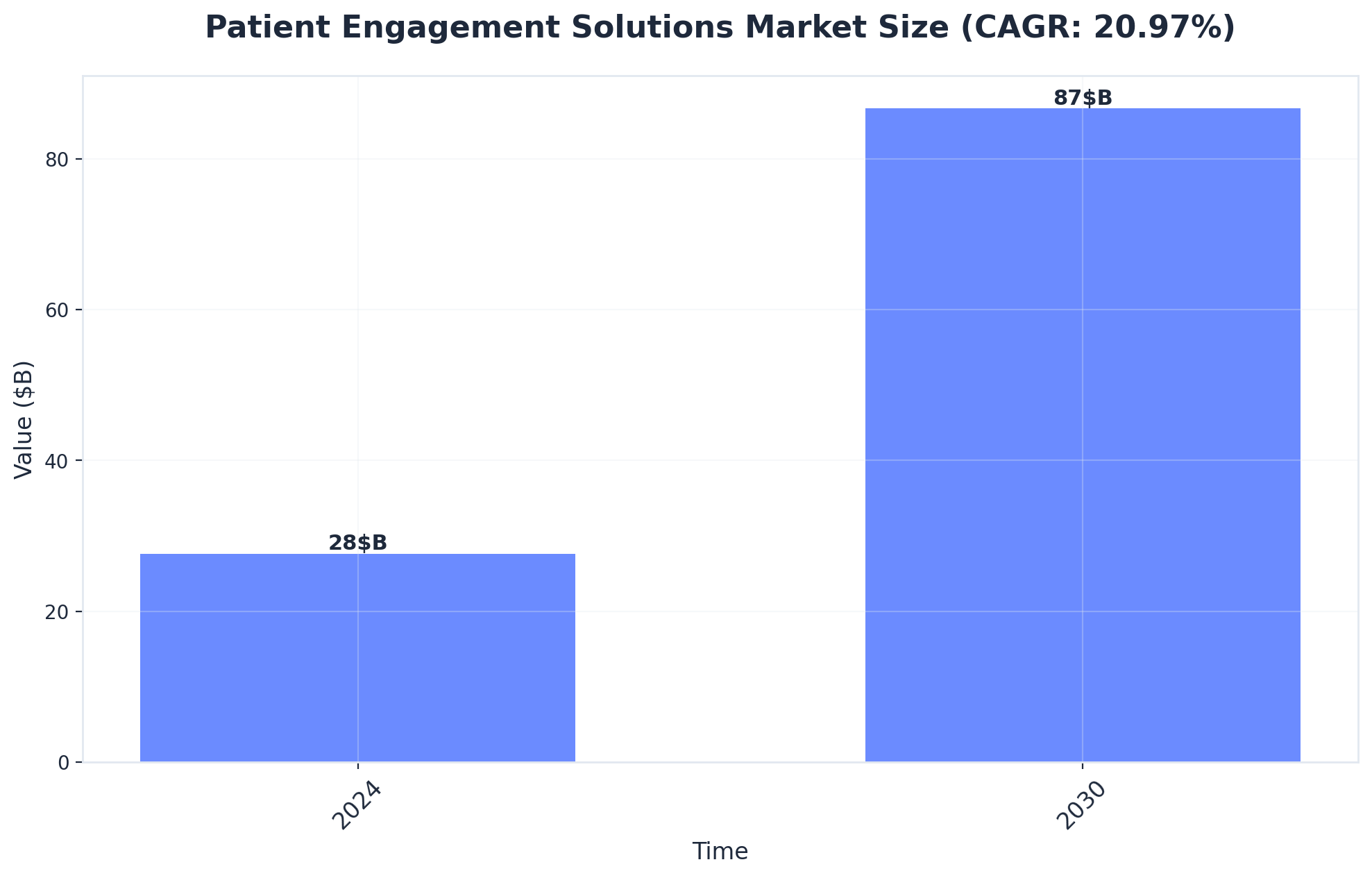
Patient Engagement Solutions Market Size (CAGR: 20.97%) (Source: Patient Engagement Solutions Market Size Report, 2030)