
Key Takeaways
- Organic pipeline leaks at five specific handoffs between impression and booked revenue: discoverability, content quality, conversion paths, measurement, and compliance, and none of them get solved by adding another vendor.
- HIPAA tracking rules, FTC substantiation standards, and WCAG 2.1 AA deadlines belong in one governance layer, with large HHS-funded recipients required to comply by May 11, 2026 1, 3, 8.
- The coordination tax on fragmented stacks is hidden inside salaried headcount; consolidation wins once vendor count times weekly hours times blended internal cost exceeds the price of a unified workflow 5.
- Focus next on one definition of a conversion applied from recommendation through measurement, compliance built in as a design input, and a named human approval gate on every material change.
Where Organic Pipeline Actually Leaks
Organic pipeline rarely stalls because a marketing team picked the wrong keywords. It stalls because the path from a search impression to a booked appointment runs through five or six systems, each owned by a different vendor or tool, and value quietly drains at every handoff. The rankings report looks fine. The revenue report does not.
Most in-house marketing leaders at multi-location service businesses already know this. They have a technical SEO retainer, a content agency, a paid media shop, a link-building contractor, a social vendor, and a call-tracking platform that all report on different timelines with different definitions of a conversion. The result is a stack that produces activity but not a defensible pipeline number.
The reframe worth making is simple. SEO help for scalable growth is not a shortage of tactics. It is a shortage of governance. Discoverability, content quality, conversion paths, compliance posture, and revenue measurement have to operate as one loop, with one source of truth, or the leaks stay hidden inside vendor dashboards that never touch each other.
This piece maps the loop as a diagnostic. It identifies the five points where value most often escapes between impression and booked revenue, treats HIPAA, FTC substantiation, and WCAG 2.1 as a single governance layer rather than three separate compliance projects1, 3, 8, and quantifies the coordination tax that fragmented vendor stacks impose on multi-location operators. The goal is not more work. The goal is fewer handoffs, tighter measurement, and a pipeline number the CEO can trust in a Monday review.
The Five Value-Leak Points Between Impression and Booked Revenue
Discoverability: The Crawl-to-Click Gap
The first leak is invisible on most executive dashboards because it happens before a user ever sees the brand. Pages are crawled but not indexed. Indexed pages rank on queries that do not match commercial intent. Location pages compete with each other. Schema drifts from visible content. The site earns impressions in Search Console that never translate into clicks because the title, meta description, and rich result signals do not match what the searcher is trying to do next.
For multi-location service businesses, the crawl-to-click gap almost always traces to three specific failure modes:
- duplicate or thin location pages that dilute topical authority,
- structured data that references entities not present on the page, and
- internal linking that treats every location as an island rather than a node in a service graph.
None of these show up in a rankings report. They show up as impressions without clicks and clicks without inquiries.
Closing this gap is a governance question, not a tooling question. One person, or one workflow, has to own the relationship between what a page says, what its schema declares, what its internal links promise, and what the SERP treatment previews. When that ownership sits across a technical SEO vendor, a content agency, and a web developer, the crawl-to-click gap stays open by default because no single party sees the full stack at once.
Content Quality: The Read-to-Trust Gap
The second leak sits between the click and the moment a reader decides the page is credible enough to act on. Content that ranks is not automatically content that converts, and in regulated verticals the gap is wider than most teams measure.
A 2025 systematic review of systematic reviews on patient-facing written materials examined 24 reviews, 438 studies, and 29,424 individual materials produced between 2001 and 2022. Across three decades, most materials exceeded the recommended sixth- to eighth-grade reading level, and readability showed no material improvement over the review period6. The scope matters: this is patient-information content specifically, not general marketing copy, but it is exactly the category healthcare, behavioral health, dental, and senior-living operators are producing at scale to compete on informational queries.
The operational read is that most organizations are publishing content their target audience cannot comfortably parse, then wondering why time-on-page is high and inquiry rate is low. Readability is not the whole picture, but it is the cheapest lever most teams ignore. Users seeking health information also cross-reference multiple sources before making a decision, which raises the bar on topical depth, author expertise signals, and internal consistency across a site7. A page that reads at a graduate level, cites nothing, and lives on a domain with no visible author or credential architecture loses on trust before it loses on rankings.
Closing the read-to-trust gap requires two things that fragmented vendor stacks rarely produce together: an editorial standard that specifies reading level, evidence handling, and author attribution as production requirements, and a QA loop that checks every published page against that standard before it ships. When content production sits with one vendor, editorial review sits with another, and subject-matter validation sits with an internal clinician or attorney who sees drafts on an ad-hoc basis, quality control becomes a lottery. The pages that convert are the ones where the reviewer happened to have time that week.
Conversion Paths: The Click-to-Inquiry Gap
The third leak is the one most in-house teams have already tried to fix and most have only partially closed. A qualified visitor arrives on a page that ranks, reads content that earns trust, and then encounters a conversion path that was designed for a different era of buyer behavior.
The pattern repeats across verticals:
- Form fields ask for information the visitor is not ready to provide on a first visit.
- Phone numbers appear in the header but call routing sends after-hours inquiries to voicemail.
- Booking widgets require account creation before a slot is visible.
- Chat opens with a generic prompt instead of a query-specific one.
- Location pages list a fax number but not a text-message option.
Each of these is a small design choice, and each one compounds against the last.
For service businesses where the primary conversion is a phone call or a booked appointment, the click-to-inquiry gap is also a measurement gap. Calls that route through a switchboard rarely tie back to the landing page that generated them. Form submissions that trigger an email but not a CRM record leave the marketing team dependent on sales for attribution, which arrives late and incomplete.
Closing this gap requires treating the conversion path as one continuous asset from headline to routed inquiry, with a single team accountable for the whole span. Split that accountability across a web vendor, a CRM administrator, and a call-tracking provider, and the leak stays open because no one is measuring the full path end to end.
Measurement: The Inquiry-to-Revenue Gap
The fourth leak is the one that determines whether the CEO believes the marketing report. An inquiry is not revenue. A booked appointment is not revenue. A signed matter, an admitted patient, a completed treatment plan, a closed installation is revenue. Most SEO reporting stops three or four steps short of that line.
The measurement gap has two sources. The first is definitional: key events in GA4, conversions in the ad platforms, and opportunities in the CRM are rarely aligned on what counts, when it counts, and against which channel it counts. The second is regulatory. Healthcare and behavioral-health operators cannot simply pipe every form field and call recording into a marketing warehouse. HHS guidance on tracking technologies makes clear that HIPAA applies when information collected or disclosed through tracking scripts includes protected health information, and that covered entities must ensure appropriate permissions and business-associate agreements where required8. That constraint shapes what can be measured, where it can be stored, and which vendors can touch it.
The operational answer is not to measure less. It is to design the measurement layer with the compliance layer from the start, so that qualified inquiries, booked appointments, and revenue outcomes can flow back to the originating query, landing page, and channel without moving PHI into systems that should not hold it. That design decision cannot be delegated to a call-tracking vendor or an analytics contractor working in isolation. It has to be made once, at the governance level, and enforced across every tool the marketing team uses.
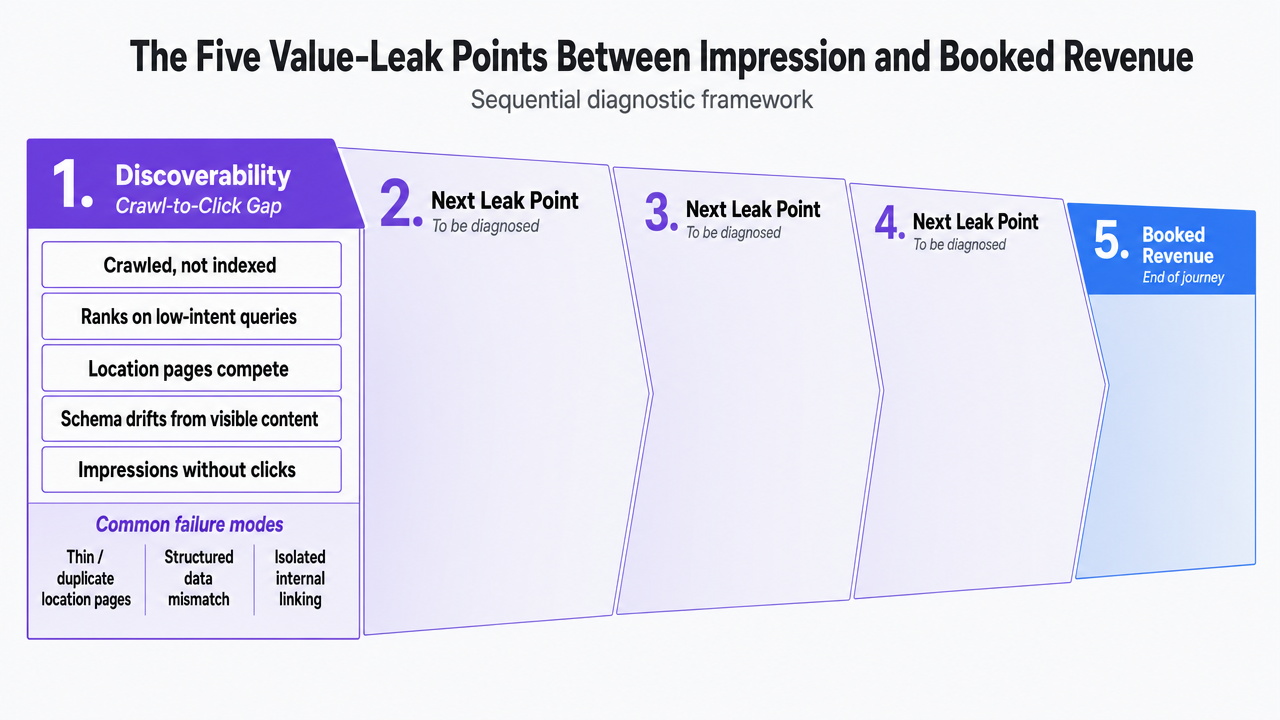 Visualize the five sequential value-leak points described in this section as a linear process infographic, reinforcing the article's core diagnostic framework
Test scalable SEO execution in your workflow
Experience hands-on pipeline growth with live content published directly to your channels during the trial.
Compliance as Discoverability: One Governance Layer for HIPAA, FTC, and WCAG
Compliance work is usually filed under legal risk. For SEO programs in regulated verticals, it is also a discoverability layer. Pages that cannot be parsed by assistive technology lose users and rank signals. Claims that cannot be substantiated get pulled, rewritten, or quietly demoted by editorial review long after they have accumulated links. Tracking configurations that violate HIPAA get torn out mid-quarter, taking conversion history with them. Each of these events resets a program that was otherwise working.
The three governing regimes rarely sit with the same owner, and that is where most operators lose ground. Accessibility usually lives with a web vendor. Advertising substantiation lives with legal or an external counsel. HIPAA tracking sits between a privacy officer and whichever analytics contractor last touched the tag manager. When a new landing page ships, no single reviewer sees the full stack.
The accessibility timeline is now specific enough to plan against. Under the HHS Section 504 rule, WCAG 2.1 Level AA is the technical standard for recipients of federal financial assistance, with large recipients of 15 or more employees required to comply by May 11, 2026 and small recipients by May 10, 20271. HHS itself operates against a WCAG 2.0 Level AA floor for its own information and communication technology, which sets a useful procurement benchmark when evaluating vendors and templates2. For healthcare, dental, behavioral health, and senior-living operators receiving federal funds, those dates are technical roadmap items, not aspirational goals.
Advertising substantiation is the second layer, and it applies to organic content the moment that content functions as advertising. The FTC treats health-related claims as requiring competent and reliable scientific evidence, with the required substantiation calibrated to the specific express or implied claim, its context, and any qualifications3, 9. That standard reaches SEO landing pages, service descriptions, outcome language, testimonials, headlines, and metadata. A page that ranks on a commercial-intent query and implies a treatment outcome without evidence carries the same exposure as a paid ad making the same claim.
The third layer is HIPAA's treatment of marketing communications. HHS defines marketing as a communication about a product or service that encourages recipients to purchase or use it, and authorization is generally required when such communications involve protected health information4. That definition reaches remarketing audiences built from site behavior, patient stories used as social proof, and form flows that route PHI to marketing systems without appropriate agreements in place.
Reviews and endorsements sit adjacent to all three. FTC guidance requires that material relationships between an endorser and a brand be disclosed clearly and conspicuously, which reaches incentivized reviews, employee testimonials, and influencer arrangements that increasingly feed local-pack visibility10. The NIST Privacy Framework offers the governance lens that ties these obligations to vendor selection, tracking design, and AI system oversight as one enterprise-risk conversation rather than four disconnected ones5. Run under one owner, compliance becomes a design constraint that improves the site. Run under four, it becomes an intermittent tax on velocity.
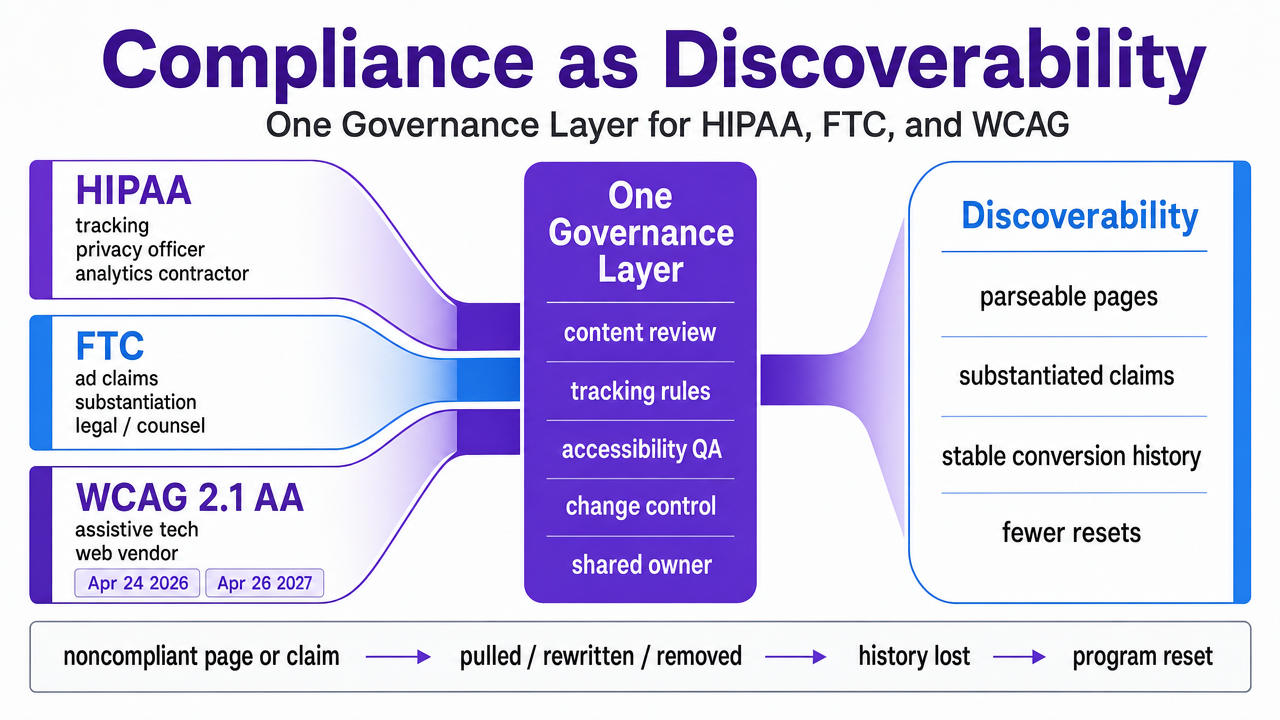 Show the three compliance regimes converging into one governance layer, with the specific WCAG 2.1 AA compliance deadlines cited in the section
The Coordination Tax on Fragmented Vendor Stacks
If You Manage Multiple Locations, Read This Section
The economics of SEO change once a business crosses roughly a dozen locations. This section is written for that reader: the VP of Marketing at a multi-location dental group, behavioral health network, home services franchise, senior living portfolio, or regional law firm running paid, organic, and local visibility across every rooftop.
At one location, vendor sprawl is annoying. At forty locations, it becomes the primary constraint on growth. Each vendor adds a status meeting, a reporting cadence, a data request, a legal review, and a person on the internal team who has to translate that vendor's dashboard into something the CEO can act on. The work of running the vendors starts to consume the budget that was supposed to fund the work itself.
The pattern shows up in three specific places:
- Local landing pages get updated by the SEO vendor but reviewed for claim accuracy by no one.
- Call-tracking numbers get provisioned by the media vendor but never reconciled against the CRM by the analytics contractor.
- Review-generation campaigns run through a reputation platform that neither the SEO team nor legal sees before incentives get offered.
Every one of these is a coordination failure, not an execution failure, and none of them get solved by hiring another vendor.
Consolidation Math: Six Vendors vs. One Governed Workflow
The coordination tax is measurable, but only if it is measured with the right variables. Retainer spend is the visible cost. Internal coordination hours are the hidden one, and at scale they dominate the equation. The NIST Privacy Framework frames vendor oversight, tracking design, and AI system governance as one enterprise-risk conversation rather than a series of isolated contracts, which is the right lens for pricing what fragmentation actually costs5.
The table below uses variables rather than invented dollar figures so an operator can substitute internal numbers.
N : the number of locations
V : the number of vendor relationships across the six common channels (technical SEO, content, PPC, backlinks, social, and call tracking)
R : the average monthly retainer per vendor
H : the weekly internal coordination hours per vendor relationship
C : the blended internal marketing hourly cost
| Variable | Fragmented Stack | Consolidated Workflow |
|---|---|---|
| Vendor relationships (V) | 6 channels × 1–3 vendors each | 1 governed workflow |
| Monthly retainer exposure | V × R (varies by channel and location count N) | Single platform fee, scales with N |
| Weekly coordination hours | V × H (typically 2–5 per vendor) | One approval cadence |
| Annual internal coordination cost | V × H × 52 × C | One review loop × 52 × C |
| Reporting sources of truth | V dashboards, misaligned definitions | One definition of a conversion |
| Compliance review touchpoints | V separate handoffs to legal or privacy | One governance layer |
The math tilts once V × H × 52 × C exceeds the marginal cost of consolidation. For a portfolio operator running six channels across twenty locations with even two hours per vendor per week at a blended $85 hourly cost, the internal coordination line alone runs into the tens of thousands annually before any retainer is paid. That number rarely appears in a marketing budget because it is buried inside salaried headcount, which is precisely why it keeps growing.
Consolidation is not a discount on retainers. It is a reduction in V and H, and a collapse of six reporting definitions into one. The retainer line may or may not shrink. The coordination line almost always does, and the compliance posture improves because one governance layer replaces six ad-hoc reviews.
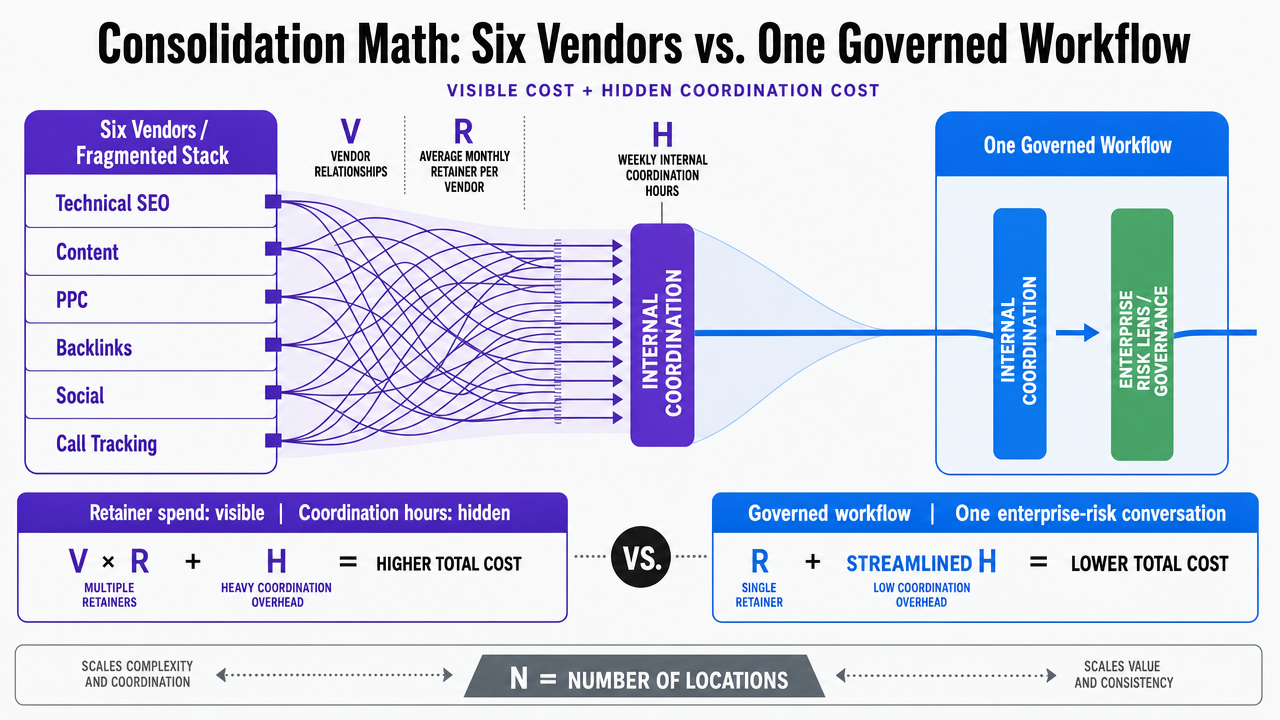 Translate the side-by-side comparison table in this section into a scannable visual contrast between fragmented vendor stack and consolidated workflow
See How AI-Driven SEO Execution Delivers Measurable Pipeline Growth
Request a data-backed walkthrough of unified SEO workflows that eliminate manual coordination and demonstrate statistically significant gains in qualified organic pipeline—without increasing team size or vendor complexity.
AI Overviews and AI Mode: Same Fundamentals, Sharper Stakes
AI Overviews and AI Mode did not rewrite the rulebook. They raised the price of ignoring it. The pages that get cited inside a generative answer are the ones that were already indexable, internally well-linked, structured to match visible content, and written with enough clarity that a summarization layer can extract a defensible answer without hallucinating around gaps. The fundamentals did not change. The tolerance for sloppy execution shrank.
Two shifts matter for in-house teams. The first is measurement. When an answer resolves inside the SERP, impressions can hold steady while clicks compress on informational queries, which distorts any reporting model that treats sessions as the primary success metric. Programs that already measured qualified inquiries, booked appointments, and downstream revenue absorb the shift without a panic cycle. Programs that reported on traffic volume as the headline number lose their narrative overnight.
The second shift is content quality. Generative surfaces reward the same signals human readers reward: clear author attribution, evidence handling that a reviewer can verify, and topical depth that survives cross-referencing. In regulated verticals, that reward compounds because unsupported claims are the exact material a well-tuned generator will decline to surface. FTC substantiation standards, HIPAA-aware measurement, and readable page architecture stop being separate projects. They become the same investment, and the sites that made it early get quoted while the rest get summarized around.
An Operating Model That Replaces Handoffs With Approvals
The pattern across every leak in this diagnostic is the same. Value escapes at handoffs. Between the SEO vendor and the content agency. Between the content agency and the internal reviewer. Between the reviewer and the web team. Between the web team and the call-tracking provider. Between the call-tracking provider and the CRM. Each handoff is a governance gap dressed as a workflow step, and the pipeline number pays for every one of them.
An operating model that scales organic pipeline replaces those handoffs with approvals inside one loop. Strategy produces a ranked recommendation. The recommendation carries its reasoning, its compliance context, and its measurement definition attached. A human reviewer approves, revises, or rejects. Execution happens against the approved specification. Measurement flows back to the same loop under the same definitions the recommendation was scored against. The reviewer stays in the decision seat. The coordination overhead collapses.
Three properties make the model work:
- One definition of a conversion, applied from recommendation through measurement, so the CEO report and the vendor dashboard cannot disagree.
- Compliance as a design input rather than a post-hoc review, with HIPAA tracking constraints, FTC substantiation standards, and WCAG 2.1 AA requirements built into the specification before work ships.
- An approval gate on every material change, so nothing reaches a live page or a tracking configuration without a named human signing off.
The category that fits this shape is the AI-powered marketing execution platform, where specialist strategists produce ranked recommendations across content, SEO, PPC, backlinks, social, and call intelligence, and a single approval workflow governs what ships. Vectoron operates in that category. The point for the reader is not the tool. The point is that the pipeline number stops leaking when the loop stops handing off.
Frequently Asked Questions
References
- 1.New Requirements for Accessibility of Web Content, Mobile Apps, and Kiosks.
- 2.HHS Digital Accessibility Statement.
- 3.Health Products Compliance Guidance.
- 4.Marketing.
- 5.Frequently Asked Questions - NIST.
- 6.Readability of written information for patients across 30 years: A systematic review of systematic reviews.
- 7.Online Health Information Seeking Behavior.
- 8.Use of Online Tracking Technologies by HIPAA Covered Entities and Business Associates.
- 9.Health Claims.
- 10.Endorsements, Influencers, and Reviews.