
Key Takeaways
- Pipeline predictability is a throughput problem across six handoff stages, not a creative one — small variance in briefs, QA, and compliance review compounds into missed SLAs across concurrent accounts.
- Demand mapping should rank query clusters by expected contribution to booked revenue and CRM object created, not search volume, and should disqualify queries that cannot be substantiated under FTC standards 3.
- The standardized brief is the highest-leverage artifact: fixed fields, a proof inventory tied to substantiation 3, and a conversion block specification eliminate downstream rework before QA ever runs.
- Concentrate specialist judgment at a single approval gate running a fixed QA checklist against the brief contract — intent, substantiation, schema, internal links, accessibility 6, and conversion instrumentation.
- Measurement must adapt to a zero-click, AI-mediated journey where 94% of B2B buyers now use AI during purchasing 1, elevating branded demand, assisted conversions, and qualified calls over last-click organic.
- A five-layer KPI stack — demand signals, engaged sessions by cluster, instrumented conversions, CRM-matched revenue, and assisted paths — ties organic effort to booked revenue under governed privacy posture 2, 5.
- Treat compliance as fixed brief inputs across FTC substantiation 3, the 2024 reviews rule 7, 8, HIPAA tracking and marketing 9, 10, CAN-SPAM 4, TCPA 5, and ADA 6.
- Portfolio accounts require parent-child briefs that fix brand-level proof and schema while allowing legitimate location variance, with batch approvals by region and centrally enforced review workflows 7, 8.
Why pipeline predictability is a production problem, not a content problem
Heads of SEO at growth-stage agencies rarely lose client pipeline because the content ideas were wrong. They lose it because briefs sat for nine days, QA caught the same schema error for the fourth time, and a legal review on a behavioral-health landing page pushed publication past the campaign window. The output gap between agencies is almost never a creative gap. It is a throughput and variance gap across the stages that turn commercial search demand into booked revenue.
Treating SEO as an editorial calendar hides this. A calendar lists titles and dates. It does not describe how a demand map becomes a brief, how a brief becomes a draft, how a draft clears substantiation review for an advertising claim 3, how a page gets approved under a client's internal legal protocol, or how a conversion ties back to a CRM-matched opportunity. Each of those handoffs carries a cost and a failure rate. Multiplied across 40 concurrent accounts, small variance compounds into missed SLAs and churn.
Pipeline predictability shows up when the delivery system is designed as six repeatable stages with defined inputs, defined outputs, and specialist judgment concentrated at a single approval gate rather than scattered across every task. The rest of this guide treats that assembly line as the unit of analysis — not the keyword list, not the pillar page, and not the backlink target.
The six-stage delivery model that governs predictable output
Demand mapping: commercial intent before keyword volume
Demand mapping starts with the client's revenue model, not with a seed list exported from a keyword tool. A personal injury firm with a $9,000 average matter value and a legal intake team of three does not have the same demand surface as a 42-location dental support organization selling $89 new-patient exams. The research stage should produce a one-page intent map that classifies every target query by matter type or service line, buying stage, geographic qualifier, and the specific CRM object a conversion would create — a signed retainer, a booked consult, an estimate request, a tour.
Volume is a secondary filter. A query returning 70 monthly searches for "revision rhinoplasty [metro]" can outweigh 4,400 searches for "what is rhinoplasty" because the first query maps to a scheduled surgical consult and the second maps to an educational session that may never convert. The intent map should rank clusters by expected contribution to booked revenue, not by traffic potential.
Three outputs leave this stage:
- a prioritized cluster list tied to service lines,
- a SERP-feature inventory per cluster that flags local packs, AI overviews, and review-driven results, and
- a disqualification list of queries the agency will not pursue because they will not substantiate under FTC advertising standards 3 or because they attract unqualified traffic that depresses conversion rate across the account.
The standardized brief as the agency's highest-leverage artifact
The brief is where variance either enters the pipeline or gets eliminated. A standardized brief template, enforced across every account, is the single artifact that most reduces downstream rework. It should carry fixed fields:
- target cluster and intent class,
- primary and secondary queries,
- SERP-feature targets,
- required schema types,
- internal link targets,
- conversion object,
- substantiation requirements for any claim the page will make,
- accessibility checkpoints the writer and designer must hit 6, and
- a named approver.
Two sections deserve more space than agencies usually give them. The first is the proof inventory — a bulleted list of the evidence the page will cite, the client-approved case studies it will reference, and the specific language that cannot be used without written substantiation under FTC guidance 3. The second is the conversion block specification: the form fields, the call-tracking number treatment, the consent language, and the thank-you page event that the measurement stack will listen for.
When briefs are built this way, writers stop guessing, QA checks against a shared contract rather than taste, and the approval gate reviews a predictable artifact instead of a surprise. Agencies that treat the brief as a two-paragraph outline keep paying for the shortcut in revision cycles. The brief is where a Head of SEO buys back QA hours before they are ever spent.
Production, QA, and the single approval gate
Production should be the cheapest stage in the pipeline. Once the brief is complete and the proof inventory is locked, drafting a page, generating supporting assets, and assembling schema is largely mechanical work. The leverage question for a Head of SEO is not whether AI-assisted drafting is used — most agencies now use it in some form — but where human judgment is concentrated and whether the QA checklist runs against the brief contract instead of a subjective rubric.
A functional QA checklist runs in a fixed order:
- intent match against the brief,
- substantiation check on every claim,
- schema validation,
- internal link targets present,
- accessibility pass covering form labels, heading order, keyboard navigation, and text alternatives 6, and
- conversion-block instrumentation verified against the measurement spec.
First-review pass rate is the number to track. When it rises, approval latency falls, and the gate stops being a bottleneck.
The approval gate itself should be one gate, not three. Specialist judgment belongs here — reviewing the finished artifact against the brief, the client's standards, and any sector-specific advertising constraints — rather than being spent re-briefing writers, chasing missing citations, or hand-correcting schema. When judgment is concentrated at the gate, upstream work can be executed by whichever combination of human and AI-assisted labor an account's margin supports, and the downstream publication and measurement steps become a scripted release rather than a negotiation.
The operational contrast is sharpest when the traditional per-account specialist model is compared with a governed, AI-assisted model that preserves a single human approval gate. Across briefs produced per specialist per week, pages published per account per month, approval cycle time, first-review QA pass rate, and reporting cadence, the governed model shifts throughput variables upward and holds variance in check at the gate — not by removing specialists, but by narrowing where their judgment is spent.
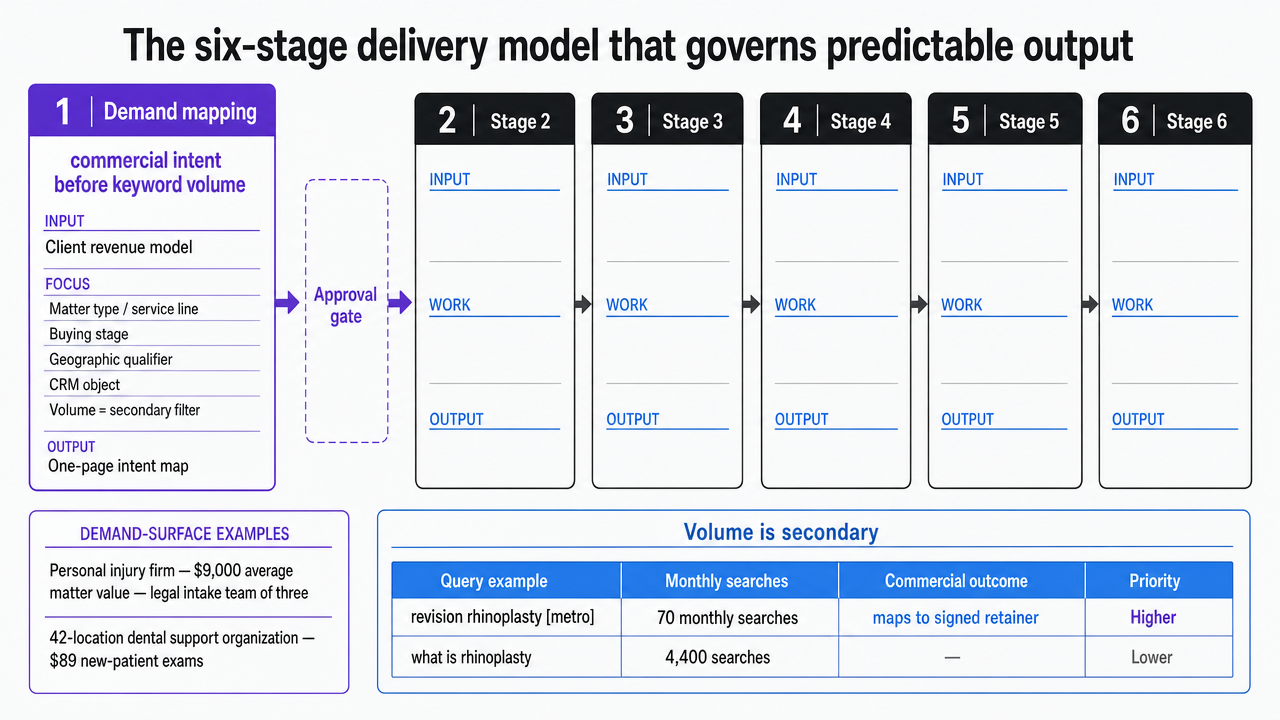 Visualize the six sequential pipeline stages described in the section, showing inputs, outputs, and the single approval gate
Measurement built for a zero-click, AI-mediated buying journey
The reporting problem for a Head of SEO is no longer whether a page ranks. It is whether the demand that organic effort generated can be identified at all. Buyers now research across answer engines, chat interfaces, podcast transcripts, and vendor comparison surfaces that return a decision before a click ever reaches the client's site. A ranking screenshot describes a shrinking fraction of the journey.
The scale of that shift is best grounded in a single data point: Forrester's 2025 Buyers' Journey Survey found that 94% of B2B buyers used AI during their purchasing process, with generative AI and conversational search rated more meaningful than vendor websites, product experts, or sales for many of those buyers 1. The figure is a B2B buyer survey, not a universal measurement of all web traffic, and it does not establish that AI discovery has replaced conventional search. It does establish that measurement built on clicks and keyword positions is now reporting on a minority of the research surface for commercial queries.
For an agency's reporting stack, three practical adjustments follow:
- Branded search volume and direct traffic become leading indicators of upstream organic and AI-mediated exposure, not vanity metrics to footnote.
- Assisted-conversion paths in analytics and self-reported attribution fields on lead forms — a simple "how did you hear about us" field with structured options — carry more weight than last-click organic sessions, because the first touch increasingly happens somewhere the pixel cannot see.
- Qualified calls and booked appointments routed through call intelligence become primary conversion events for service verticals, since many buyers skip the form entirely after an AI summary.
The reporting cadence should surface these together. A monthly client view that pairs organic sessions with branded demand trend, assisted conversions, qualified calls, and CRM-matched opportunities tells a Head of SEO which clusters are producing revenue the attribution model would otherwise miss. That view is also what defends the retainer when ranking volatility arrives.
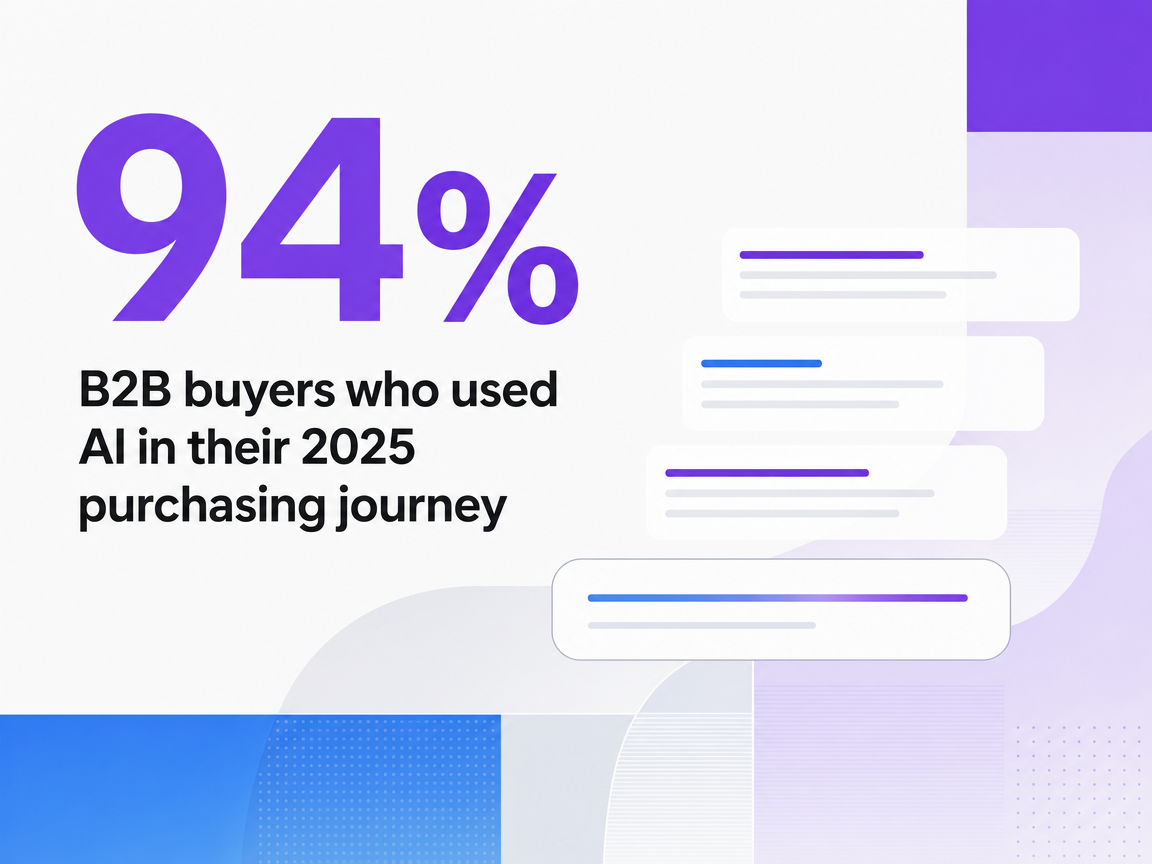 B2B buyers who used AI in their 2025 purchasing journey
B2B buyers who used AI in their 2025 purchasing journey
Test scalable SEO workflows with real campaigns
Experience a full-cycle SEO pipeline and publish live content before committing to a long-term solution.
The KPI stack that ties organic effort to booked revenue
A reporting stack built for predictable pipeline carries five layers, each answering a different question a Head of SEO is asked in a client QBR. The point is to connect upstream organic effort to a CRM-matched outcome without pretending the attribution model sees every touch.
- The first layer is demand signals: branded search volume in Google Search Console, direct traffic trend, and impression share on non-branded commercial clusters. These describe whether the market is encountering the client more often, including through AI summaries and comparison surfaces where no click occurs.
- The second layer is engaged organic sessions segmented by cluster and by conversion object — not aggregate organic traffic, which averages out the clusters that actually produce retainers or booked consults.
- The third layer is conversion events instrumented against the brief contract: form submissions with the self-reported attribution field captured, qualified calls routed through call intelligence with recording consent handled under FCC guidance 5, scheduled appointments, and chat-to-lead handoffs.
- The fourth layer is CRM-matched opportunities and closed revenue, pulled back into the reporting view by lead ID so that the agency can report on booked matters, signed treatment plans, or awarded jobs — not form fills.
- The fifth layer is assisted-conversion paths and self-reported source data, used to credit organic and AI-mediated exposure that last-click would otherwise assign to direct or branded.
Audience data that moves between these layers — remarketing lists, CRM syncs, enriched lead records — should be governed under a documented privacy posture. NIST's Privacy Framework offers a voluntary structure for identifying and managing that risk across the stack without duplicating sector-specific obligations 2. A reporting view built this way lets a Head of SEO show, on one page, which clusters produced revenue, which produced qualified calls that never completed a form, and which generated branded demand downstream.
Governance: compliance as a pipeline-reliability feature
Substantiation, reviews, and advertising claims across the book
Compliance review is where most agency pipelines stall silently. A page sits in approval not because the writing is wrong, but because a results claim lacks substantiation, a testimonial was pulled from a client's intake notes without consent, or a solicited review was offered in exchange for a five-star rating. Treating these as legal edge cases is what makes them unpredictable. Treating them as fixed inputs to the brief is what makes them cheap.
Three rules carry most of the operational weight:
- Every performance or outcome claim on a client page — case counts, settlement figures, treatment success rates, response times, savings percentages — must have substantiation on file before the brief leaves the research stage, under the FTC's standard that online advertising claims be truthful, nondeceptive, and substantiated, with endorsements reflecting the endorser's honest experience and material connections disclosed 3. The proof inventory in the brief is where that evidence gets attached; if the file is empty, the claim does not ship.
- Review workflows need a bright-line separation between soliciting authentic feedback and shaping its content. The FTC's 2024 final rule prohibits fake reviews, including AI-generated reviews that misrepresent a reviewer or experience, and bars incentives conditioned on a particular sentiment 7. The implementation FAQ clarifies that neutral incentives remain permissible when they are not tied to positive wording, and that suppressing unfavorable reviews is itself a violation 8. Agencies running reputation workflows across dozens of local accounts should encode this into the request templates, the incentive language, and the moderation rules — not the quarterly training deck.
Healthcare and behavioral health: HIPAA for tracking and marketing
Scope shifts here. The following applies specifically to agencies running SEO for covered entities and their business associates — hospital systems, behavioral-health networks, dental groups operating as covered entities, and the vendors that touch their data. The standard analytics and remarketing stack an agency deploys for a home-services client cannot be deployed unchanged on a behavioral-health intake page.
HHS has been explicit that regulated entities must configure tracking technologies — pixels, cookies, session replay, call tracking, chat tools — so that protected health information is used and disclosed only in compliance with the Privacy Rule and secured under the Security Rule, and that tracking vendors receiving PHI may require a business associate agreement 9. Authenticated patient portals carry the highest exposure, but unauthenticated pages are not automatically safe; the analysis turns on what data the technology actually transmits and the context of the user interaction.
Marketing communications carry a parallel constraint. HHS defines marketing as a communication about a product or service that encourages recipients to purchase or use it, and with limited exceptions requires written authorization before PHI is used or disclosed for marketing — a direct constraint on remarketing audiences built from patient lists, testimonial collection from identifiable patients, and email nurture that uses treatment history 10. The brief for any HIPAA-regulated page should name the covered entity, flag the tracking configuration required, and specify whether an authorization is on file for every data element the conversion workflow will use.
Nurture, call intelligence, and privacy governance
Lead follow-up is where SEO work turns into revenue, and where a well-run pipeline most often creates its own liability. Commercial email sent to nurture organic leads falls under CAN-SPAM, which requires accurate headers, non-deceptive subject lines, a physical postal address, a functioning opt-out, and opt-out honoring within 10 business days — applicable to business-to-business messages as well as consumer email 4. SMS nurture and automated call follow-up add a separate consent layer: the FCC treats prerecorded telemarketing calls as generally requiring prior written consent, and autodialed or prerecorded calls and texts to wireless numbers as generally requiring consent, with AI-generated voices treated as artificial voices under the TCPA 5. Public-facing conversion pages also carry an ADA baseline — labeled form fields, keyboard access, clear instructions — that functions as both a legal floor and a conversion lift 6.
A compliance-coverage matrix is the artifact most agencies lack and most need. Mapped against the pipeline stages described earlier, each stage pairs to a governing authority:
- research and brief sit under FTC advertising substantiation 3;
- production and QA touch ADA accessibility 6 and, for healthcare, HIPAA online tracking 9;
- publication and reputation workflows fall under the FTC reviews rule 7, 8 and HIPAA marketing where applicable 10;
- measurement and audience construction sit under NIST's Privacy Framework as a voluntary governance umbrella 2;
- nurture spans CAN-SPAM 4 and FCC consent rules 5.
Posted once, maintained centrally, referenced in every brief.
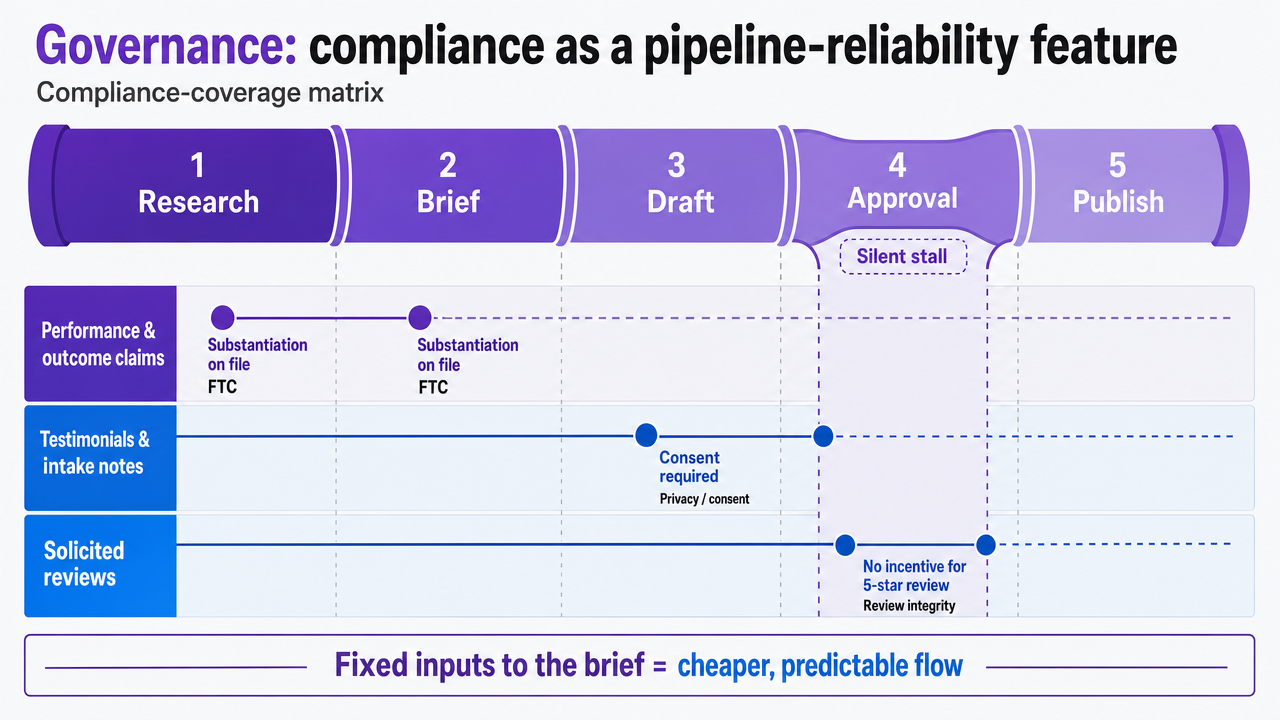 Visualize the compliance-coverage matrix explicitly described in the section, mapping each pipeline stage to its governing authority
See How Leading Agencies Build Predictable SEO Pipelines at Scale
Connect for a walkthrough of AI-powered workflows that streamline multi-client SEO delivery, minimize manual oversight, and surface KPI-driven recommendations—purpose-built for agencies managing complex pipelines.
If you run multi-location, DSO, or portfolio accounts
Scope shift: the preceding sections assumed a single-brand account. The economics change when one client is a 42-office DSO, a 180-branch home-services franchise, a behavioral-health network with 23 outpatient sites, or a senior-living operator with 60 communities across 14 states. The pipeline stages do not change. The multiplication does.
Three constraints dominate portfolio delivery:
- Location-level pages must be generated and maintained in parallel without collapsing into near-duplicates — each location needs its own service lines, intake routing, hours, provider rosters, and locally substantiated proof points, since generic claims copied across sites fail the substantiation standard the FTC applies to online advertising 3.
- Review workflows run against the 2024 FTC rule at every location, with incentive language and moderation rules enforced centrally rather than left to office managers 7, 8.
- Measurement must roll up by location, region, and brand simultaneously, with call intelligence routing qualified calls to the correct intake queue under consent terms that survive TCPA scrutiny when auto-dialed follow-up or SMS is involved 5.
The operating consequence is that the brief template becomes a parent-child artifact: one brand-level brief fixing the proof inventory, schema, and conversion specification, and a thin location-level brief carrying only what legitimately varies. The approval gate stays single, but the approver reviews batches by region rather than page by page. This is where governed, AI-assisted execution pays back the hardest — generating 180 locally-correct page variants in a week is a throughput problem no per-account specialist model solves without doubling headcount.
The operating cadence that keeps 40 accounts on track Monday morning
A delivery system that works on paper still fails without a weekly rhythm that enforces it. The cadence that holds up across 40 or more accounts is unglamorous: a Monday portfolio stand-up that reviews only two numbers per account — briefs in queue and pages past SLA — a Tuesday-through-Thursday production window where the approval gate meets twice daily to clear reviewed artifacts in batches, and a Friday reporting cut that locks the KPI stack for every client QBR scheduled the following week.
Three operating disciplines separate agencies that hold this cadence from those that drift:
- SLAs are measured against the brief completion date, not the kickoff call, because every day a brief sits incomplete is a day the production stage cannot start.
- The approval gate publishes a first-review pass rate by account each week; accounts trending below the portfolio median get a brief-template audit before more pages enter production.
- The compliance matrix referenced in every brief is version-controlled centrally, so a change in FTC reviews-rule interpretation 8 or HIPAA tracking configuration 9 propagates to every active brief within one release cycle rather than account by account.
Agencies rebuilding their delivery stack around this cadence — standardized briefs, a single approval gate, governed AI-assisted execution, and a KPI view that reports booked revenue rather than rankings — are the ones compressing the cost of each handoff without losing specialist oversight. Platforms such as Vectoron are built for exactly that operating model.
Frequently Asked Questions
References
- 1.B2B Buyers Make Zero-Click Number One.
- 2.Privacy Framework 1.1 - NIST.
- 3.Advertising FAQ's: A Guide for Small Business.
- 4.CAN-SPAM Act: A Compliance Guide for Business.
- 5.Stop Unwanted Robocalls and Texts.
- 6.Guidance on Web Accessibility and the ADA.
- 7.Federal Trade Commission Announces Final Rule Banning Fake Reviews and Testimonials.
- 8.The Consumer Reviews and Testimonials Rule: Questions and Answers.
- 9.Use of Online Tracking Technologies by HIPAA Covered Entities and Business Associates.
- 10.Marketing.