
Key Takeaways
- SEO budgets grow with headcount because teams add AI tools without redesigning workflows; the real constraint for a lean operation is weekly approval bandwidth, not writer or analyst count.
- Keep positioning, prioritization, and sign-off on regulated or reputational content in-house, while routing keyword expansion, drafts, metadata, monitoring, and reporting through approval-gated AI workflows 2.
- Expect capacity gains, not revenue transformation: writing studies show 40% faster output and 18% higher quality 10, translating to roughly 2–3x draft throughput per approver.
- Translate the five NIST generative AI risk categories—accuracy, privacy, security, bias, and intellectual property—into named human owners with logged pre-publish checklists 6.
- Treat HIPAA pixel exposure 8, WCAG 2.1 Level AA accessibility 5, and FTC review provenance 7as production constraints enforced at the approval gate, not legal cleanup after publish.
- Frame executive expectations in capacity metrics rather than revenue forecasts, since 71% of marketing AI users report gains but most fall below 5% 4, making clean baselines essential.
- Multi-location operators capture the largest gains by consolidating fragmented vendor stacks into one approval queue, cutting new-location cycle time from 3–6 weeks to 5–10 business days.
- Run the transition in three 30-day blocks: instrument the baseline, pilot one content type in parallel, then consolidate and retire overlapping retainers against a throughput-per-approver exit metric.
The Headcount Trap in Modern SEO Operations
Most in-house marketing VPs inherit the same SEO cost structure: one or two internal specialists, a retainer with an agency, a freelance writer bench, a technical SEO consultant for quarterly audits, and a reporting analyst who stitches it all together. Every new initiative—a location expansion, a service line launch, a Google algorithm update—gets priced in additional hours, additional headcount, or another vendor line item. The function scales linearly with people, which is why SEO budgets tend to grow faster than SEO outcomes.
The headcount reflex persists even as the underlying work has changed. Keyword research, draft production, metadata generation, internal link mapping, rank monitoring, and weekly reporting are now bounded, repetitive tasks that generative models handle at a measurable productivity premium on professional writing work 1. Enterprise adoption reflects that shift: 78% of organizations surveyed by McKinsey report using AI in at least one business function, with marketing and sales among the most common 9.
Adoption is not the same as redesign. Teams that bolt AI tools onto a traditional staffing model add software cost without reducing coordination cost. The real constraint for a lean SEO operation is not the number of writers or analysts available—it is the number of decisions the VP can review, approve, and ship each week. That constraint is a workflow problem, and the sections that follow treat it as one.
Redrawing the Line Between Human Judgment and Repetitive Work
What a Marketing VP Should Keep In-House
The work that stays with the marketing VP and the senior in-house team is the work that carries legal, strategic, or reputational consequence if it ships wrong. Positioning decisions sit at the top of that list: which service lines get content investment this quarter, which geographies rank as priority markets, which competitors deserve a direct comparison page, and which keyword clusters are off-limits because they attract the wrong buyer. No model can make those calls because they depend on pipeline data, sales feedback, and executive priorities the model does not own.
Approval authority is the second category. Every page that touches a regulated claim, a client testimonial, a pricing representation, or a medical, legal, or financial topic needs a named human reviewer with sign-off authority before it goes live. Worker research from Stanford HAI found that practitioners consistently prefer to retain agency and oversight over AI tools rather than cede final judgment 2, which aligns with how most mature SEO programs already handle sensitive content.
The third category is prioritization. Deciding what gets built next week—a new location page, a competitor comparison, a technical fix, a link outreach campaign—requires reading signals from calls, bookings, and pipeline that the VP's team sees first. That ranking function stays in-house.
What Belongs in an Approval-Gated AI Workflow
Everything downstream of a human decision is a candidate for automation under approval gates. Keyword expansion from a seed list, SERP analysis across a competitor set, outline generation against a brief, first-draft production, metadata and schema generation, internal link suggestions, image alt text, rank tracking, log-file parsing, and weekly reporting are all bounded, repetitive tasks that generative models complete at a measurable productivity premium on professional writing work 1. These tasks share three traits: the inputs are structured, the output format is predictable, and a human can verify quality in a fraction of the time it took to produce.
Monitoring work fits the same pattern. Crawl error alerts, Core Web Vitals regressions, lost featured snippets, new backlinks, review velocity changes, and GBP suspensions can run as continuous background processes with escalation rules, rather than consuming an analyst's calendar every Monday morning.
The gating principle is simple: AI drafts, researches, monitors, and formats; a named human approves before anything publishes, ships to a client-facing surface, or triggers an outbound action. That design matches what workers themselves say they want from AI assistance—automation of repetitive load with retained oversight on the outputs that carry consequence 2. It also keeps the VP's review queue focused on decisions that actually require judgment, not on reformatting a meta description.
The Capacity Math Behind AI-Assisted SEO Production
Productivity research gives the marketing VP a defensible number to plan against, but only if the scope of the research matches the scope of the work being redesigned. Two randomized experiments on professional writing tasks offer the clearest signal. The MIT study by Noy and Zhang assigned 444 college-educated professionals—marketers, consultants, managers, grant writers—to bounded writing exercises with and without ChatGPT access. Task time fell by 0.8 standard deviations and output quality rose by 0.4 standard deviations, with the largest gains going to lower-ability writers 1. A separate preregistered experiment published in Science, covering 453 professionals on similar tasks, found participants with model access completed work 40% faster and produced output rated 18% higher in average quality 10.
Both studies measured short-form writing, not end-to-end SEO programs. Neither establishes that organic traffic, rankings, or qualified leads move by the same margin. What they do establish is a reliable production delta on the specific artifacts that fill an SEO team's calendar: outlines, drafts, metadata, FAQ copy, summaries, and rewrites.
Applied to a lean operation, the math works out as capacity, not headcount reduction. A content specialist who previously shipped four long-form drafts a month at full attention can review and approve ten to twelve AI-assisted drafts in the same window, assuming the approval checkpoint is tight and the brief quality is high. A technical SEO lead who spent two days monthly on crawl reports and log analysis can compress that to a few hours of exception review. The freed hours do not disappear into slack; they get redirected to the work the models cannot do—positioning calls, pipeline analysis, competitive teardowns, and the compliance review covered in later sections.
The ceiling on this model is approval bandwidth. If the VP's team can approve fifty artifacts a week, that is the production rate, regardless of how fast drafts arrive in the queue.
Test SEO execution workflows with live publishing
Experience hands-on, approval-based SEO content production using your own brand and channels during the trial.
Designing Approval Gates Around the NIST Risk Categories
The National Institute of Standards and Technology published its Generative AI Profile in July 2024 as a companion to the broader AI Risk Management Framework, identifying categories of risk that generative systems either introduce or amplify 6. The profile is voluntary and sector-neutral, which means the marketing VP has to translate its risk categories into specific SEO artifacts and specific humans who sign off. Done well, that translation becomes the approval architecture that lets a lean team ship volume without losing control.
Five risk categories from the profile map cleanly onto SEO production.
- Accuracy covers factual claims on service pages, pricing representations, clinical or legal statements, and schema markup that encodes business facts for search engines.
- Privacy covers analytics configuration, intake form data, call-tracking integrations, and any pixel that fires on a page touching protected information.
- Security covers access to the CMS, publishing credentials, and the API keys that connect drafting tools to production environments.
- Harmful bias covers how location pages describe neighborhoods, how review responses characterize complainants, and how comparison pages describe competitors.
- Intellectual property covers source attribution in drafts, image licensing, and the risk of regurgitated training data appearing in published copy.
Each category needs a named owner, not a committee. Accuracy belongs to the subject-matter lead for the practice area or service line. Privacy belongs to the compliance officer or the operations lead who owns the martech stack. Security belongs to whoever controls CMS roles. Bias and IP typically consolidate under the senior editor or content lead, because both show up in the same read-through.
The gate itself is a checklist, not a meeting. Before any AI-drafted artifact publishes, the responsible owner confirms the specific items that correspond to their risk category—citations verified, no PHI in analytics parameters, no uncredited third-party copy, no comparative language that misrepresents a competitor. The checklist is logged with a timestamp and the approver's name, which creates the audit trail the NIST framework calls for and the one a plaintiff's attorney or regulator will later ask to see 6. That log is also what lets the VP measure approval bandwidth as a real production constraint rather than an abstraction.
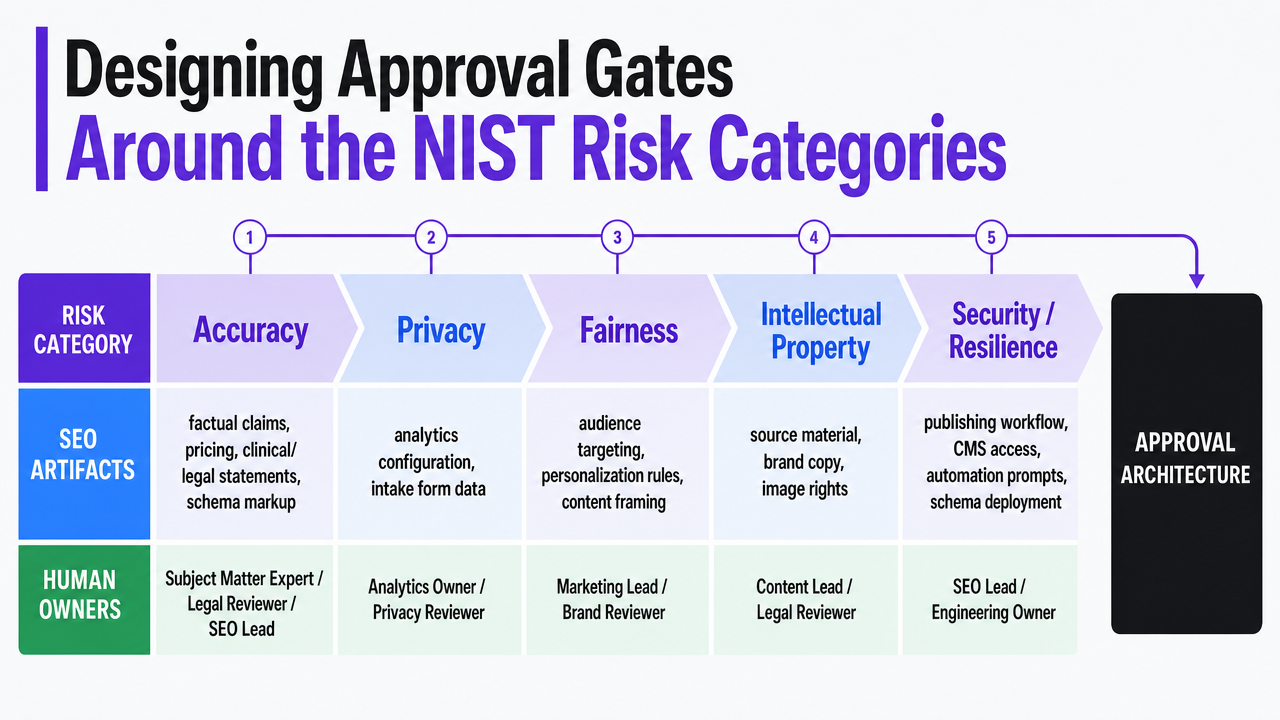 Visualize how the five NIST generative AI risk categories map to specific SEO artifacts and named human owners, directly supporting the section's governance framework
Compliance as a Production Constraint, Not a Legal Afterthought
HIPAA Exposure on Analytics, Attribution, and Intake Pages
For marketing VPs at healthcare, behavioral health, dental, and senior-care organizations, the SEO stack is also a HIPAA surface. The HHS Office for Civil Rights issued updated guidance in March 2024 clarifying that covered entities and business associates must configure tracking technologies—pixels, cookies, session replay tools, analytics tags, call-tracking integrations—to use and disclose protected health information in compliance with the Privacy Rule, and to protect electronic PHI under the Security Rule 8.
The operational consequence is specific. A conversion pixel firing on an appointment confirmation page may transmit URL parameters, IP address, and device identifiers that, combined with page context, constitute PHI. A chat widget on a service-line page that logs the visitor's symptoms before a scheduler responds does the same. These are not edge cases; they are the default configuration of most martech stacks.
Approval authority here belongs to whoever owns the compliance function, not the SEO lead. Before any new tag, pixel, form embed, or AI-generated schema touches a page tied to treatment, diagnosis, or payment, the compliance owner signs off on what data flows where. The AI workflow can draft, propose, and queue the implementation; it cannot push the tag live without that signature.
ADA and WCAG Obligations on Conversion-Facing Pages
SEO pages are conversion interfaces, which puts them inside the scope of the Americans with Disabilities Act for most public-facing service businesses. DOJ guidance identifies accessible headings, alt text, captions, forms, keyboard navigation, color contrast, and zoom capability as the website features that courts and regulators examine 3. The 2024 DOJ Title II rule set WCAG 2.1 Level AA as the technical standard for state and local governments, with phased deadlines, and that standard increasingly functions as the practical benchmark private operators are measured against in Title III litigation 5.
For a lean team shipping AI-assisted location pages and service pages at volume, two failure modes dominate:
- Auto-generated alt text that describes decorative images instead of informative ones.
- Heading structures that satisfy an SEO outline but break screen-reader navigation.
Both are catchable at the approval gate.
The practical control is a pre-publish accessibility check embedded in the same review that handles accuracy. Headings in order, alt text that conveys function, form fields labeled, contrast ratios verified. The AI drafts them; the editor confirms them against WCAG 2.1 Level AA before the page goes live.
FTC Rules for Reviews, Testimonials, and Local Landing Pages
Local SEO depends on reviews, testimonials, and location-specific proof points, which puts the program directly inside FTC jurisdiction. The Commission's updated Endorsement Guides and the Consumer Review Fairness Act require that reviews and endorsements be truthful and not misleading, and that businesses featuring reviews maintain processes to confirm the content reflects feedback from genuine customers 7.
Three automation patterns create exposure:
- Review-solicitation workflows that gate requests based on predicted sentiment, filtering negative feedback out of the public pool.
- AI-generated testimonial copy that composites real customer language into statements no single customer actually made.
- Local landing pages that recycle testimonials across cities without disclosing that the quoted customer was served at a different location.
The compliance control is a provenance log for every review, testimonial, and endorsement that appears on a page the AI workflow produces. Source customer, date, verification method, material-connection disclosure if one applies, and the location the experience actually occurred in. The senior editor who approves the page confirms the log is complete before publish. Without that provenance, the page does not ship, regardless of how well it ranks in draft review.
Calibrating Expectations Against Enterprise AI Adoption Data
Adoption curves are easy to misread. The share of organizations using AI in at least one business function climbed from 55% in 2023 to 72% in early 2024 and 78% by 2025, with marketing and sales consistently among the heaviest-use functions 9. For a VP building a board narrative, those figures confirm that AI-assisted SEO is no longer a differentiating bet; it is the operating baseline against which lean programs are measured.
Value capture is a separate question. Stanford's 2025 AI Index found that among AI users in marketing and sales, 71% reported revenue gains, but the gains were most commonly below 5% 4. That distribution matters more than the headline. It says the typical outcome from AI deployment in this function is incremental, not transformational, and that outlier returns are the exception rather than the planning case.
Three implications follow for a lean SEO operation:
- The ROI narrative to executives should be framed in capacity terms—throughput per approver, cycle time per artifact, cost per shipped page—rather than in projected revenue lift, because the revenue data does not support aggressive forecasts.
- Measurement discipline has to be built in from the first week, since a sub-5% lift is invisible without clean baselines.
- The competitive advantage is no longer having AI in the stack; it is having an approval architecture that lets the team ship more approved work per week than peers who adopted the tools without redesigning the workflow around them.
Streamline Your SEO Strategy—No Additional Headcount Required
Learn how enterprise marketing teams can scale organic pipeline and improve SEO execution using AI-driven workflows that maintain full oversight—without increasing team size or vendor complexity.
If You Manage Multiple Locations: Consolidating the SEO Stack
Multi-location operators—DSOs, legal practice networks, behavioral health groups, home-services franchises, senior-living portfolios—carry a different problem than single-site operators. The SEO work does not multiply linearly with locations; it multiplies with the number of coordination points between locations, vendors, and compliance owners. A thirty-location dental group typically runs some combination of an in-house marketing lead, a national SEO agency, a local-SEO vendor for GBP management, a review-generation platform, a reputation-management contractor, a technical SEO consultant, and a reporting analyst who reconciles the dashboards. Each vendor owns a slice of the surface area, and no one owns the approval queue.
The consolidation case is operational before it is financial. When a new location opens, a lean team with a consolidated stack ships the location page, schema, GBP optimization, review-request workflow, and intake form in the same approval cycle. A fragmented stack routes those artifacts through four or five briefing loops, each with its own turnaround time and its own compliance blind spots.
The variables that matter for a portfolio operator comparing models are below. Dollar figures depend on vendor contracts and are not supplied here, so the table uses operational variables the VP can measure directly.
| Variable | Traditional in-house + agency + freelance stack | Consolidated AI-assisted model with approval gates |
|---|---|---|
| Internal FTE count | 2–4 marketing roles plus analyst | 1–2 marketing roles plus approver bench |
| External retainer slots | 3–6 (SEO, local, reviews, technical, reporting) | 0–1 (specialist consultation only) |
| Approval touchpoints per new location | 4–6 handoffs across vendors | 1 unified queue with named owners |
| Cycle time, new location page live | 3–6 weeks | 5–10 business days |
| Compliance owner clarity | Diffused across vendors | Named per NIST risk category 6 |
Enterprise adoption data supports the direction. McKinsey's 2025 survey found marketing and sales among the functions reporting the heaviest AI use, with workflow redesign—not tool procurement—driving the organizations that captured measurable value 9. For a portfolio operator, the redesign is the consolidation itself: fewer vendors, one approval queue, and a measurable throughput number per location per month.
A 90-Day Transition Plan for an Existing In-House Team
The transition runs in three thirty-day blocks, each with a defined exit condition before the next begins. The point is not to deploy tools faster; it is to move the approval queue, the compliance ownership, and the production pipeline onto the new model without dropping shipped volume along the way.
- Days 1–30: Instrument the baseline. Document current throughput—pages shipped per month, cycle time per artifact, approval touchpoints per publish, and the compliance owner for each content type. Map the five NIST risk categories to named humans 6. Audit the existing vendor stack for overlap. Without a clean baseline, the sub-5% revenue lift typical of marketing AI deployments is invisible 4.
- Days 31–60: Run a parallel pilot. Select one content type—location pages, service pages, or FAQ clusters—and route it through the AI-assisted workflow while legacy production continues. Measure draft-to-approval time and rejection rate at the gate. Worker research shows adoption succeeds when practitioners keep oversight on consequential outputs, so build the approval checklist with the editors who will use it 2.
- Days 61–90: Consolidate and retire. Shift the remaining content types onto the model, cancel the retainers the new workflow replaces, and lock the approval cadence to the team's real review bandwidth. The exit metric is throughput per approver per week, measured against the day-one baseline.
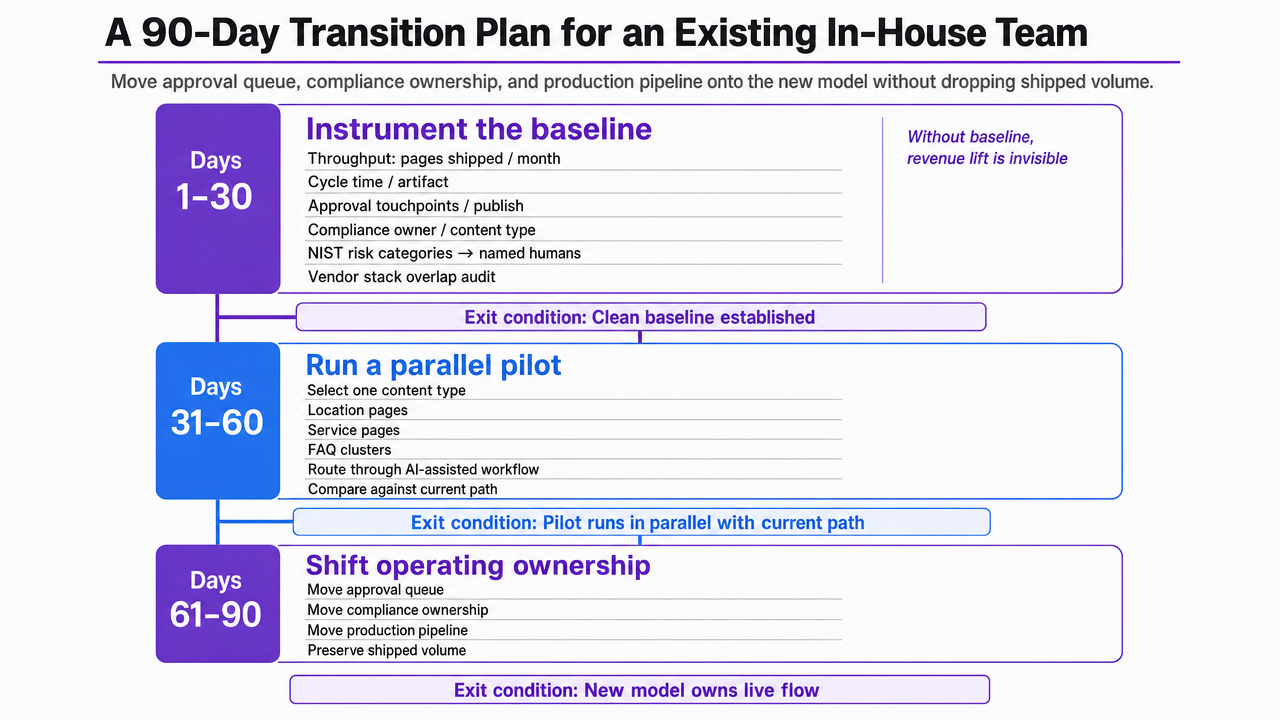 Visualize the three sequential 30-day blocks of the transition plan with their exit conditions, directly supporting the section's phased operating plan
Frequently Asked Questions
References
- 1.Experimental Evidence on the Productivity Effects of Generative Artificial Intelligence.
- 2.What Workers Really Want from Artificial Intelligence.
- 3.Guidance on Web Accessibility and the ADA.
- 4.Economy | The 2025 AI Index Report | Stanford HAI.
- 5.Fact Sheet: New Rule on the Accessibility of Web Content and Mobile Apps Provided by State and Local Government Entities.
- 6.Artificial Intelligence Risk Management Framework: Generative Artificial Intelligence Profile.
- 7.Endorsements, Influencers, and Reviews - Federal Trade Commission.
- 8.Use of Online Tracking Technologies by HIPAA Covered Entities and Business Associates.
- 9.The state of AI: How organizations are rewiring to capture value.
- 10.Experimental evidence on the productivity effects of generative artificial intelligence.