
Key Takeaways
- Map every tracked query to one of four intent states tied to a specific booked action, so rankings translate into consults, appointments, or signed contracts rather than orphan traffic.
- Score keywords on commercial intent and conversion density alongside volume, since lower-volume local queries with buying language routinely out-earn high-volume informational terms 4.
- Build QBR forecasts from current rank, Search Console CTR, and landing-page conversion rate to turn ranking recaps into defensible revenue conversations.
- Design pages for AI-era visibility by placing a quotable direct answer up top, named credentialed sources, and a qualified action above the fold.
- Operationalize review generation as a governed program after the FTC Reviews Rule, with verified-customer requests, sentiment-neutral incentives, and documented escalation paths 7.
- Standardize review response with pre-approved reply language, no public confirmation of patient or client status, and disclosed insider relationships 8.
- Separate PHI-bearing interactions into server-side infrastructure governed by a BAA, and treat condition-specific remarketing audiences as a HIPAA marketing risk 1, 3.
- Keep educational content neutral and cited while restricting service pages from implying outcomes the provider cannot substantiate under FTC evidence standards 2.
- Invert service page design so the primary action sits in the first viewport and long-form content lives below the fold where it supports rankings without burying conversion.
- Run a single local operations checklist across the book of business to cut specialist hours per account and raise the floor on the weakest performers.
- For multi-location portfolios, evaluate delivery models on accounts-per-specialist and approval-cycle time, since those two numbers decide margin and compliance speed.
- Treat AI execution platforms as a first-class delivery option when they combine approval-first execution, live business-signal input, and portfolio-wide throughput 7, 1.
Why Client Revenue, Not Rankings, Is the New Scorecard
Agency SEO leads running portfolios in law, dental, behavioral health, senior living, and home services face a scoring problem. Rank reports and session counts still fill client decks, but the metrics clients actually renew on are booked consults, qualified calls, retained matters, and signed contracts. The gap between those two scorecards is where margin and retention get decided.
Three shifts explain why the old scorecard no longer survives a QBR. AI-generated answers in the result page are absorbing informational clicks, so visibility has to be measured by qualified actions rather than visits alone. Privacy constraints, including HIPAA guidance on tracking technologies, limit how intake and conversion data can flow into analytics and ad platforms 1. And the FTC's Consumer Reviews and Testimonials Rule, effective October 21, 2024, has turned reputation work into a governed operational process with civil-penalty exposure 7.
The twelve ideas that follow are organized around that reality. Each one ties to a client-reported revenue signal, names the specialist-hour tradeoff, and treats SEO as a measurement and operations problem rather than a publishing problem.
Map Query Intent to a Booked Action, Not a Pageview
The first operational shift that moves client revenue is retiring the pageview as the terminal metric. A query like "estate planning attorney near me" and a query like "what is a revocable trust" sit in the same keyword report but produce entirely different balance-sheet outcomes. Treating them as equivalent inflates traffic numbers and starves the pipeline the client actually pays for.
A workable mapping assigns every tracked query to one of four intent states and ties each state to a specific booked action:
- Informational queries route to educational content measured by assisted conversions and return visits;
- Comparison queries route to service or location pages measured by consult requests;
- Transactional queries route to booking flows measured by qualified calls or scheduled appointments;
- Branded queries route to conversion-optimized landing pages measured by closed matters, retained patients, or signed contracts.
Agency delivery teams that build this map once per client and enforce it in the content calendar stop producing orphan blog posts that rank but never convert. The specialist-hour tradeoff is real. Mapping takes four to six hours per account upfront. It eliminates the recurring argument over why a #3 ranking produced zero booked revenue.
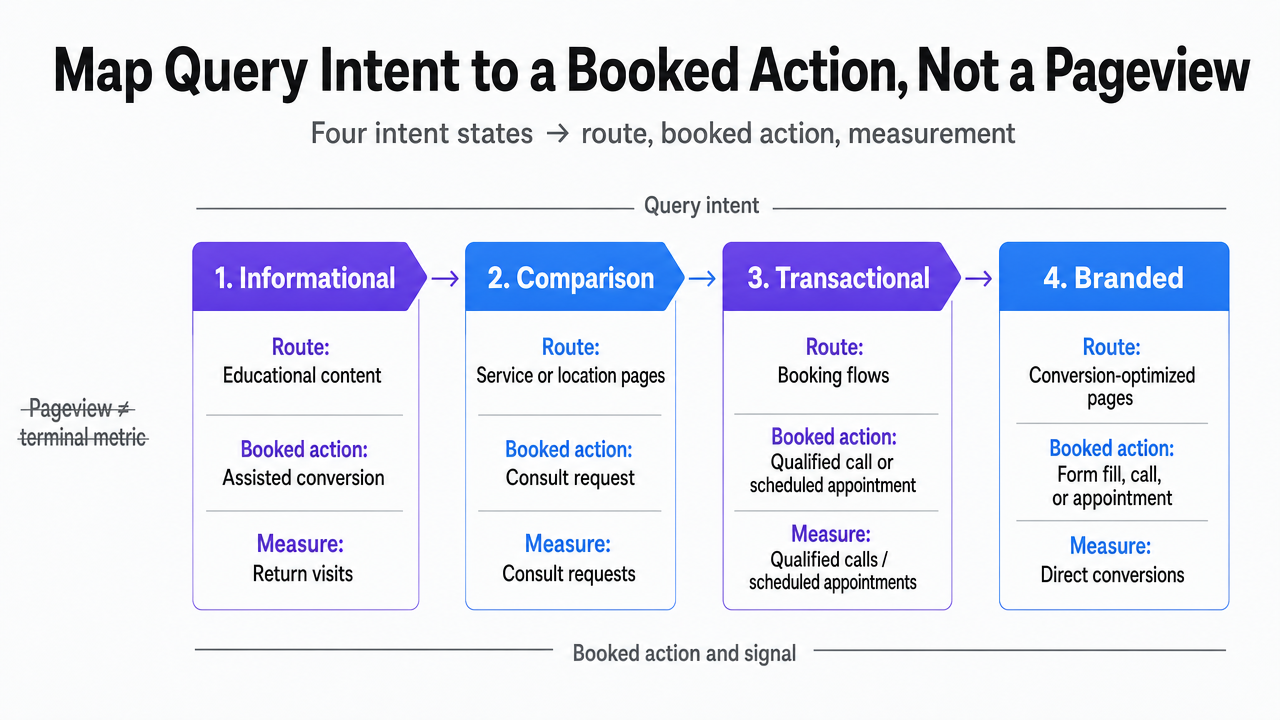 Visualize the four intent-state framework explicitly described in this section, mapping each query type to a specific booked action and measurement signal
Prioritize High-Intent, Lower-Volume Keywords Over Vanity Terms
Keyword prioritization is where most agency portfolios leak revenue quietly. A 40,000-search-per-month head term looks like the strategic win in a client deck, but the click economics rarely match the promise. Research on individual-level click behavior at a leading Korean search engine found that click activity after a keyword search is low overall and heavily concentrated on the organic list, and that less-popular keywords are associated with more clicks per search and a larger fraction of sponsored clicks 4. The scope matters: this is a non-Google dataset analyzing individual click streams, not a universal CTR curve. The directional signal still holds for how agency leads should rank keyword targets.
The practical reframe is to score every candidate query on three variables instead of one. Monthly volume is only the denominator. Commercial intent (does the query describe a service, a geography, a comparison, or a buying trigger) and conversion density (what fraction of clicks that landing pages produce qualified actions) complete the ratio. A query drawing 320 searches a month for "family law attorney [city] free consultation" will out-earn a 12,000-search informational term on the same page template, every quarter.
Delivery teams that rebuild keyword scoring around this ratio stop pitching clients on traffic growth and start pitching on booked-action growth. The specialist-hour saving is real: fewer thin blog posts chasing broad terms, more effort concentrated on the 40 to 80 queries per account that produce the client's revenue.
Forecast Revenue From Realistic Rank Gains in Client QBRs
Most agency QBRs still present rank movement as a standalone win. The slide shows a keyword climbing from position 7 to position 4, and the client nods politely. The missing translation is what that movement is worth in booked actions, and whether the next climb is realistic given the current SERP.
Peer-reviewed research on online hotel search found that a one-position increase in rank produced a 10.07% average lift in clickthroughs, and that first-ranked listings received 2.39 times more clicks than second-ranked and 3.42 times more than third-ranked listings in the reported context 5. The scope is specific: hotel-search queries, brand-familiar inventory, a particular SERP layout. Agency leads should not import that curve as a universal law. The usable principle is the shape of the relationship, not the exact multipliers.
A defensible QBR forecast combines three inputs per target query:
- Current rank and realistic 90-day rank gain from the existing optimization backlog,
- Search Console impression and CTR data for that query on the client's actual pages, and
- The historical conversion rate from that landing page to a qualified action.
The output is a range, not a point estimate. A query at position 6 with 1,200 monthly impressions, a current 3.1% CTR, and a 4.8% consult-request rate produces a defensible forecast for rank 4 that the client can compare against pipeline targets.
This reframes the QBR from a ranking recap into a revenue conversation. It also exposes which optimization work is worth the specialist hours and which keywords should be deprioritized because the available rank gain produces negligible booked revenue.
Build Pages for AI-Era Visibility, Not Click Counts
Google's AI overviews and third-party answer engines are absorbing the informational click. A page that once earned 4,000 monthly visits for a definitional query may now surface as a cited source inside a generated answer, with a fraction of the visits but a different kind of exposure. Agency SEO leads who still report that page as a traffic loss are measuring the wrong surface.
Research on online health-information seeking published in 2025 found that health-related websites had the highest self-reported adherence rate at 65%, followed by search engines at 63.2%, with respondents rating online health information above the neutral point for accuracy, helpfulness, trustworthiness, usefulness, and ease of understanding 9. The scope is specific: self-reported behavior from survey respondents across search engines, health sites, apps, forums, social media, and large-language-model tools, not clinical validation of outcomes. The usable signal for agency delivery is that source type influences downstream action, and content designed for comprehension and trust continues to produce behavior even when the click path shortens.
Page design for this environment emphasizes four things specialists can enforce in a template:
- A direct answer in the first 60 words that an answer engine can quote cleanly,
- Structured subheadings that match the question's natural follow-ups,
- Named sources and credentialed authorship visible on the page, and
- A qualified action positioned above the fold rather than buried past the content body.
Reporting shifts in parallel. Impressions, citation appearances in AI surfaces, assisted-conversion paths, and direct-navigation lift to the service page carry the measurement weight that raw sessions used to.
Test Revenue-Driven SEO Ideas on Live Sites
Validate new SEO strategies directly on client projects and measure real impact before committing long-term.
Treat Reviews as a Governed Operational System After the FTC Rule
Review generation stopped being a volume play on October 21, 2024. That is when the FTC's Consumer Reviews and Testimonials Rule took effect, giving the agency authority to seek civil penalties against knowing violators and sharpening the definition of what counts as deceptive conduct in reputation marketing 7, 11. For agency SEO leads running local-visibility programs across dental groups, law firms, and senior-living portfolios, this reclassifies review work from a growth tactic into a governed operational system.
Four categories of conduct are explicitly prohibited:
- Fake reviews, including AI-generated reviews that misrepresent a real customer experience, cannot be created, bought, sold, or disseminated.
- Insider testimonials from officers, employees, or their immediate relatives require clear and conspicuous disclosure of the relationship.
- Sentiment-conditioned incentives are prohibited, meaning a client cannot offer a gift card only when the star rating is four or five.
- Suppression of honest negative reviews, whether through threats, intimidation, or selective publication, is treated as a separate violation 6, 11.
The operational translation is a documented program every client account runs identically. Review requests go to verified customers only, pulled from booking or billing systems rather than scraped lists. Incentive language, if offered, is sentiment-neutral and the material connection is disclosed on the page where the review appears. Suspected manipulation routes through a written escalation path with timestamps. The specialist-hour cost is one-time setup of roughly six to ten hours per account for policy, templates, and workflow; recurring effort drops because volume targets stop driving the work.
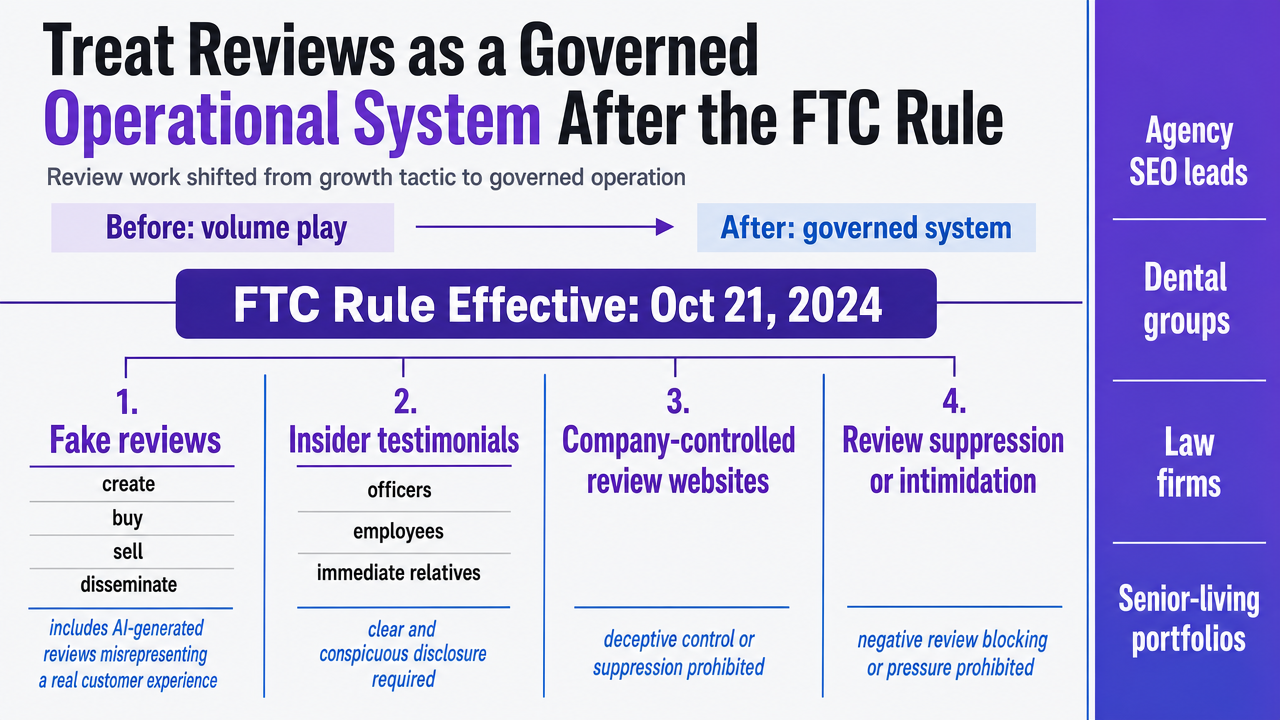 Visualize the four FTC-prohibited conduct categories named in this section, giving agency readers a scannable governance reference tied directly to the cited rule
Response Governance and Disclosure Controls for Local Reputation
The flip side of review generation is review response, and this is where agency programs still rely on improvisation. A client's front-desk manager fires off a defensive reply to a one-star complaint, a paralegal confirms case details in a public thread, and a dental office owner thanks a reviewer by first and last name without checking whether that person consented to be identified as a patient. Each of those responses creates a different kind of exposure.
FTC guidance is explicit that businesses should maintain processes ensuring featured reviews reflect genuine customer feedback, and that moderation is legitimate when it removes policy violations, privacy breaches, or spam but not when it suppresses honest negative opinions 8. The operational translation for agency reputation programs is a response policy every account runs from the same template:
- Approved reply language for common complaint categories,
- A rule against confirming or denying a reviewer's status as a patient or client in public,
- A disclosure line any time an employee or family member posts, and
- A documented path for flagging suspected fake reviews to the platform rather than quietly removing them 10.
Response SLAs sit inside that policy, not outside it. Specialist hours drop because the judgment calls are decided once, at the policy layer, rather than relitigated per reply.
Rebuild Conversion Instrumentation for Privacy and HIPAA Constraints
Conversion tracking in healthcare and behavioral-health accounts is where most agency SEO programs quietly fall out of compliance. The default stack, a Google Tag Manager container firing a conversion pixel on form submit or call connect, routinely captures information that qualifies as protected health information the moment it is tied to an identifiable visitor on a page about a specific condition, provider, or appointment type. HHS has stated that HIPAA obligations apply when tracking technologies on covered-entity websites or apps collect or disclose protected health information, which requires appropriate safeguards and, where applicable, business associate agreements with the vendors receiving that data 1.
The rebuild that keeps conversion measurement alive without creating exposure separates two data layers. Ordinary content analytics, meaning page views on non-PHI pages, scroll depth, and aggregate session counts, continues to flow into standard analytics tools. PHI-bearing interactions, meaning intake form fields, appointment-type selections, condition-specific chat transcripts, and call recordings tied to a specific service page, route through server-side infrastructure governed by a BAA, with identifiers hashed or stripped before any downstream syndication. Remarketing audiences built from condition-specific page visits are the trap most agencies miss. Those audiences can themselves constitute marketing uses of PHI that require patient authorization under the HIPAA Privacy Rule's marketing definition 3.
The operational artifact every account should carry is a one-page data-flow diagram: which events fire, which vendor receives them, which contract governs the vendor, and which events are blocked on condition-specific URLs. Specialists spend six to twelve hours building it once per client and reference it in every tracking change thereafter.
Separate Educational Content from Treatment Claims in Regulated Verticals
Healthcare, behavioral health, and dental clients bring a content risk most agency SEO leads underestimate until a condition page gets flagged. The FTC has stated that objective health claims require competent and reliable scientific evidence, and that individual consumer experiences are not a substitute for that evidence 2. A page that promises symptom resolution, success rates, or clinical outcomes without substantiation sits in a different legal category than a page that explains a condition and routes the reader to a qualified provider.
The operational line delivery teams should draw is simple. Educational pages describe conditions, procedures, and decision factors in neutral language, cite medical sources, and name the credentialed reviewer. Service pages describe what the provider does, who is eligible, and how to book, without implying outcomes the provider cannot substantiate. Testimonial content, when used, cannot carry the weight of an effectiveness claim the underlying evidence does not support 2. A one-page claim register per client, reviewed quarterly, keeps writers from drifting into language that creates FTC exposure while chasing a competitive keyword.
Design Service Pages Around the Qualified Action, Not the H1
Most service pages still read like brochures. A keyword-stuffed H1, three paragraphs of corporate description, a trust-badge row, and a contact form parked at the bottom of a 1,400-word scroll. The page ranks, the client sees traffic, and the booked-action rate sits below 2%. The design is optimized for the ranking signal, not the revenue event.
A service page built around the qualified action inverts that order. The primary action, which is a call button, a scheduler widget, or a short intake form, sits in the first viewport on both desktop and mobile. The next block answers the three questions that gate the decision: who is eligible, what the first appointment or consultation includes, and how fast the provider can see them. Credentialing, named reviewers, and address or service-area detail follow. Long-form content lives below the fold for the readers who need it and for the ranking signal, not above it where it buries the conversion.
The specialist-hour tradeoff favors this design. Agency teams spend two to four hours per page restructuring the template once, then measure booked-action rate rather than scroll depth in every subsequent iteration.
See How Top Agencies Operationalize Revenue-Driven SEO at Scale
Connect with experts to explore workflows and platform strategies proven to streamline multi-client SEO delivery—without expanding your headcount or compromising on client results.
Standardize Local Visibility Ops Across the Book of Business
Local SEO work in agency portfolios tends to accumulate as sediment. One client's Google Business Profile gets refreshed monthly by a specialist who likes the account, another's hasn't been touched since onboarding, and a third runs a service-area template nobody remembers approving. The result is uneven performance that correlates less with market difficulty than with which specialist happened to care that quarter.
Standardization pulls that variance out. A single operating checklist runs across every account:
- Profile category and service list audited quarterly,
- Hours and holiday schedules synced from the client's booking system,
- Geo-tagged photos refreshed on a 60-day cadence,
- Q&A monitored weekly with pre-approved reply language, and
- Local citation parity verified against the client's authoritative NAP record.
Posts and offers follow a shared editorial calendar rather than per-account improvisation.
The specialist-hour math favors standardization heavily. Running 30 accounts off one checklist cuts local-ops time from roughly four hours per account per month to under 90 minutes, while raising the floor on the weakest accounts. The ceiling on the best accounts barely moves. Clients notice because the weakest performers in the portfolio are usually the ones generating renewal risk.
If You Manage Multiple Locations: Portfolio Economics for Delivery Models
This section shifts scope. The ideas above apply to any agency book, but the economics change sharply for leads running multi-location brands, DSOs, regional law firms, home-services franchises, or senior-living operators where the same SEO program ships across 20, 50, or 200 locations. Portfolio operators carry a different constraint: specialist-hours-per-location, not specialist-hours-per-account, is the number that decides margin and renewal.
Three delivery models compete for that work. Each one trades specialist cost against approval-cycle time and throughput. The table below holds the variables agency leads can plug into their own blended rate, rather than invented dollar figures.
| Variable (per location, per month) | In-House Specialist Pod | Outsourced Freelance Stack | AI-Assisted Platform with Human Approval |
|---|---|---|---|
| Keyword research & mapping | 2.0–3.0 hrs | 1.5–2.5 hrs | 0.3–0.6 hrs (review only) |
| On-page production & updates | 3.5–5.0 hrs | 3.0–4.5 hrs | 0.5–1.0 hrs (approval only) |
| Local & review operations | 3.5–4.0 hrs | 2.5–3.5 hrs | 1.0–1.5 hrs |
| Reporting & QBR prep | 1.5–2.0 hrs | 1.5–2.5 hrs | 0.3–0.5 hrs |
| Accounts per senior specialist | 8–12 | 15–20 | 40–60 |
| Approval-cycle time per change | 1–3 days | 3–7 days | Same day to 24 hrs |
Two numbers matter more than the rest. Accounts-per-specialist decides blended cost per location, and approval-cycle time decides how fast portfolio-wide changes, like an FTC-compliant review template refresh 7or a HIPAA-aware tracking rebuild 1, actually reach every location. A model that looks cheap per hour but routes 60 locations through a 5-day approval queue will miss the quarter.
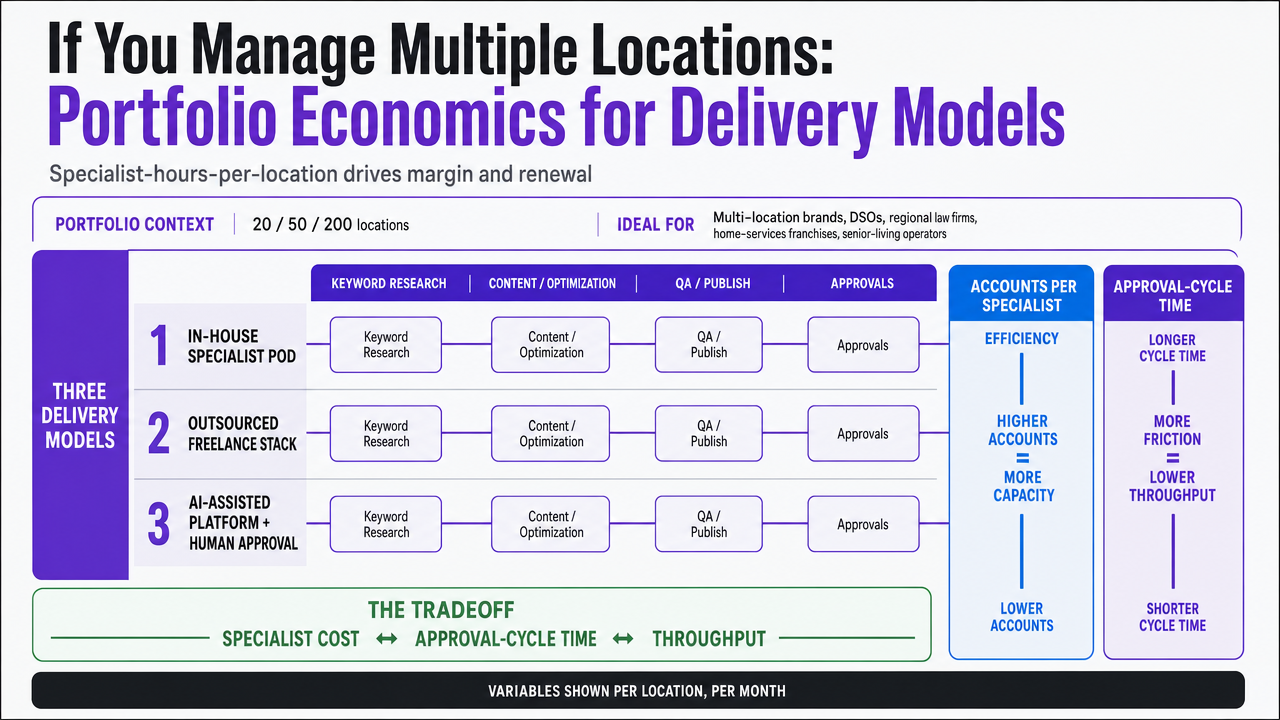 Visualize the three-model comparison table already present in the section, highlighting the two decisive variables (accounts-per-specialist and approval-cycle time) called out in the prose
Make AI Execution Platforms a First-Class Delivery Option
Agency SEO leads have historically evaluated AI tooling as a writing accelerator parked next to the specialist, not as a delivery model that competes with the specialist. That framing is now out of date. A category of AI marketing execution platforms has emerged that handles keyword mapping, on-page production, local operations, and reporting as coordinated workflows, with every output routed through human approval before anything ships. Treated as a first-class delivery option, these platforms belong in the same evaluation grid as in-house pods and freelance stacks.
Three criteria separate serious platforms from wrappers:
- Approval-first execution: no page edit, review response, or tracking change leaves the system without a named human sign-off, which keeps FTC review-rule exposure 7and HIPAA tracking exposure 1inside a documented chain of custody.
- Live business-signal input: qualified calls, booked consults, and cost-per-lead feed the ranking of what to work on next, so specialist judgment arbitrates priorities rather than generating them from scratch.
- Portfolio throughput: the platform ships identical standards across 40 or more accounts without a per-account improvisation tax.
Vectoron is one option in this category; the evaluation grid matters more than the vendor name.
Instrument Retention: Measure Which Rankings Produce Repeat Revenue
The last idea closes the loop most agency SEO programs never actually close. Rankings and booked actions are tracked in detail; whether those bookings turned into retained matters, completed treatment plans, renewed service contracts, or multi-year resident stays is tracked in the client's CRM, if at all, and almost never flows back to the keyword that produced the lead.
That missing feedback is where portfolios lose their best decisions. A query producing 40 consult requests a month looks like a top performer in the SEO report. If 32 of those consults cancel before intake and the eight that convert churn inside 90 days, the specialist hours spent defending its rank are a loss. A lower-volume query producing six consults that all retain and refer is the actual revenue engine.
Agency leads should require a quarterly retention cohort pull from each client: lead source, landing page, originating query where available, and the client-side revenue outcome at 30, 90, and 180 days. That report, not the rank tracker, decides where the next quarter's optimization hours go.
Frequently Asked Questions
References
- 1.Use of Online Tracking Technologies by HIPAA Covered Entities and Business Associates.
- 2.Health Products Compliance Guidance.
- 3.Marketing | HHS.gov.
- 4.Consumer Click Behavior at a Search Engine.
- 5.Examining the Impact of Ranking on Consumer Behavior and Search Engine Revenue.
- 6.The Consumer Reviews and Testimonials Rule: Questions and Answers.
- 7.Federal Trade Commission Announces Final Rule Banning Fake Reviews and Testimonials.
- 8.Endorsements, Influencers, and Reviews.
- 9.Online Health Information–Seeking in the Era of Large Language Models.
- 10.Online Advertising and Marketing.
- 11.Use of Consumer Reviews and Testimonials: Final Rule.