
Key Takeaways
- Treating a keyword cluster as a production unit with precision and recall targets, ranked intent, and link obligations removes the per-page rework that caps agency throughput.
- Intent should be mined as a ranked hierarchy per page, not stamped with a four-bucket label, so each supporting page owns one job and routes drift elsewhere 7, 8.
- Google's scaled content abuse policy judges output, not production method, so briefs must specify user need, evidence, and a named reviewer before drafting begins 3, 4.
- Focus next on governance: pick a cluster model deliberately per client, enforce hub-to-supporting link contracts, and run quarterly and annual review passes to catch intent drift 2, 8.
The production unit most agencies still treat as a spreadsheet
Walk into most agency SEO workflows and the keyword cluster shows up as a tab in a sheet: a seed term, forty variants, a volume column, a difficulty column, and a strategist's note about which page it maps to. That artifact is a research byproduct. It is not a production unit, and that distinction is what caps output at roughly one strategist per client account.
A production unit has measurable inputs, a quality floor, and a handoff contract. A spreadsheet of related queries has none of those things. The strategist still rewrites intent assumptions page by page, re-litigates the hub-and-supporting link structure in every brief, and re-checks for cannibalization after publication rather than before. Scale breaks under that model because the per-cluster cost is dominated by rework, not research.
Google's own guidance pushes in the opposite direction. The Search Starter Guide treats logical content organization as foundational, with pages that relate to one another through consistent structure and crawlable links 1, 2. That is an architecture instruction, not a keyword-list instruction. The agencies shipping clusters at volume have already made the shift: they treat each cluster as a retrieval problem with precision and recall targets, a ranked intent hierarchy, a documented link obligation, and a quality floor anchored to Google's people-first and scaled-content-abuse policies 3, 4. The rest of this piece covers how that production unit is built, measured, and governed.
Clusters as retrieval problems, not taxonomies
Precision and recall as cluster QA language
The vocabulary most agencies use to evaluate a cluster is impressionistic. A strategist opens the sheet, scans the SERP overlap column, eyeballs the semantic drift, and signs off. That workflow does not survive portfolio scale because it has no failure categories. Precision and recall do.
NIST's TREC evaluation material defines recall as the ability to present all relevant items and precision as the ability to present only relevant items, and it names the trade-off directly: pushing recall higher tends to pull in nonrelevant items, dragging precision down 5. Those two definitions, borrowed from information retrieval, give cluster QA a diagnostic grammar.
In cluster terms, a recall failure is a missed subtopic. The cluster for "commercial roof repair" that omits "TPO membrane patching" or "emergency tarp service" has left relevant query space on the table, and a competitor will fill it. A precision failure is the opposite: queries pulled into the cluster that do not belong, which produces thin pages, cannibalization between the hub and a supporting page, or a brief that confuses the writer about who the reader actually is.
Strategists running QA under this frame ask two questions per cluster. Does the current set cover the query universe a buyer or researcher would plausibly traverse, and does every grouped term route to the same user and the same destination page? Clusters that fail the first question need expansion. Clusters that fail the second need splitting, consolidation, or a sharper intent definition.
Framing QA this way also sets up the trade-off conversation honestly. A cluster tuned for maximum recall will accumulate borderline terms that dilute page focus. A cluster tuned for maximum precision will leave coverage gaps. The strategist's job is to pick the band deliberately per client, not drift there by accident.
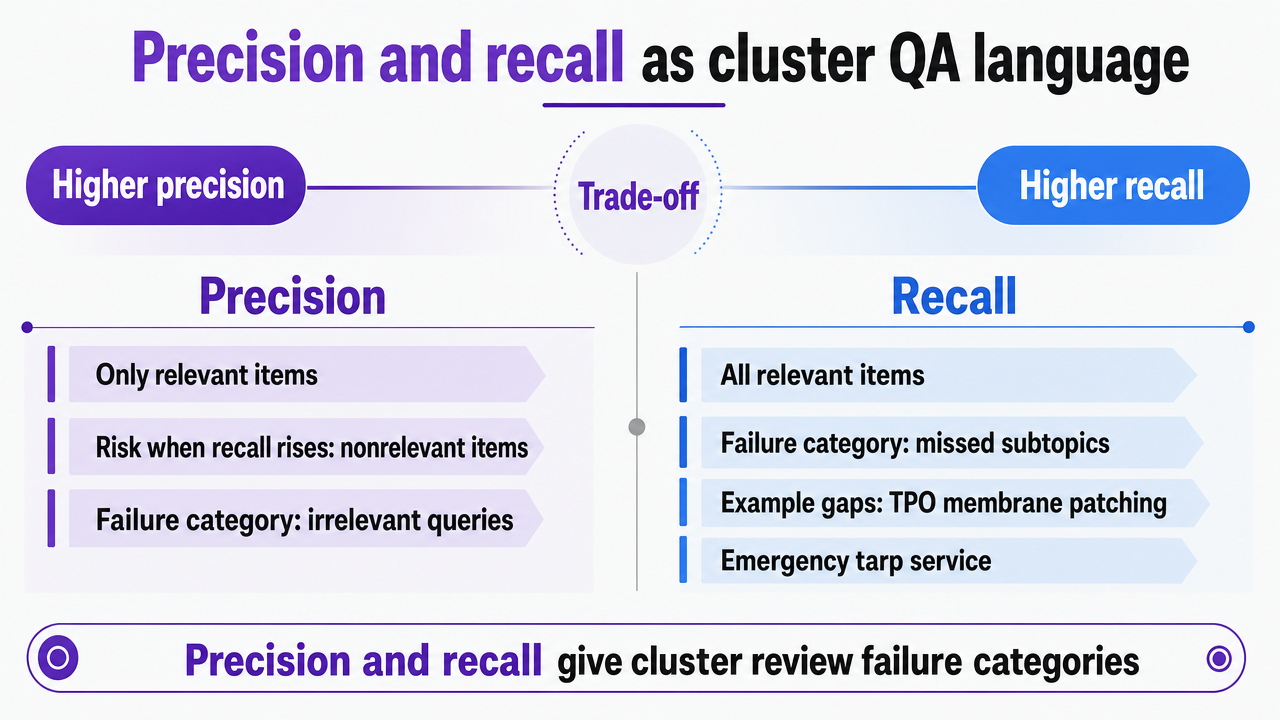 Visualize the precision vs recall trade-off as a diagnostic framework for cluster QA, directly supporting the section's argument that these two concepts give cluster review a failure-category grammar
What the citation-cluster evidence actually says
The empirical case for clustering is narrower than most SEO writing admits. The strongest recent evaluation comes from a 2023 Springer study of citation-based clusters applied to systematic reviews. It found that clusters can complement query-based retrieval by surfacing additional relevant documents, but performance is highly variable, and clusters deliver their clearest benefit to users whose preference for recall over precision falls between a 2-to-8 ratio 6.
Scope matters here. That study measured academic retrieval in a simulated search environment. It describes user preference profiles, not SEO ranking outcomes, and the documents being clustered were research papers linked by citations, not commercial queries linked by SERP overlap. Nothing in the paper claims that clustering lifts organic rankings or that a 2-to-8 ratio applies to Google's algorithm.
What the evidence does support is a design principle agency SEO leads can act on. Cluster-based structures help when the user is in discovery mode and willing to tolerate some noise to find adjacent material. They help less when the user has a sharp, single-intent query and expects the top result to resolve it. Mapping that back to a portfolio: top-of-funnel informational clusters benefit most from recall-leaning design, while bottom-of-funnel commercial clusters need tighter precision because a wrong page wastes a click that cost real money.
The second takeaway from the study is the variability itself. Clusters that look structurally identical can perform very differently depending on the underlying document relationships. That argues for validating every cluster against SERP overlap, intent agreement, and business relevance rather than trusting that semantic similarity alone is enough 6.
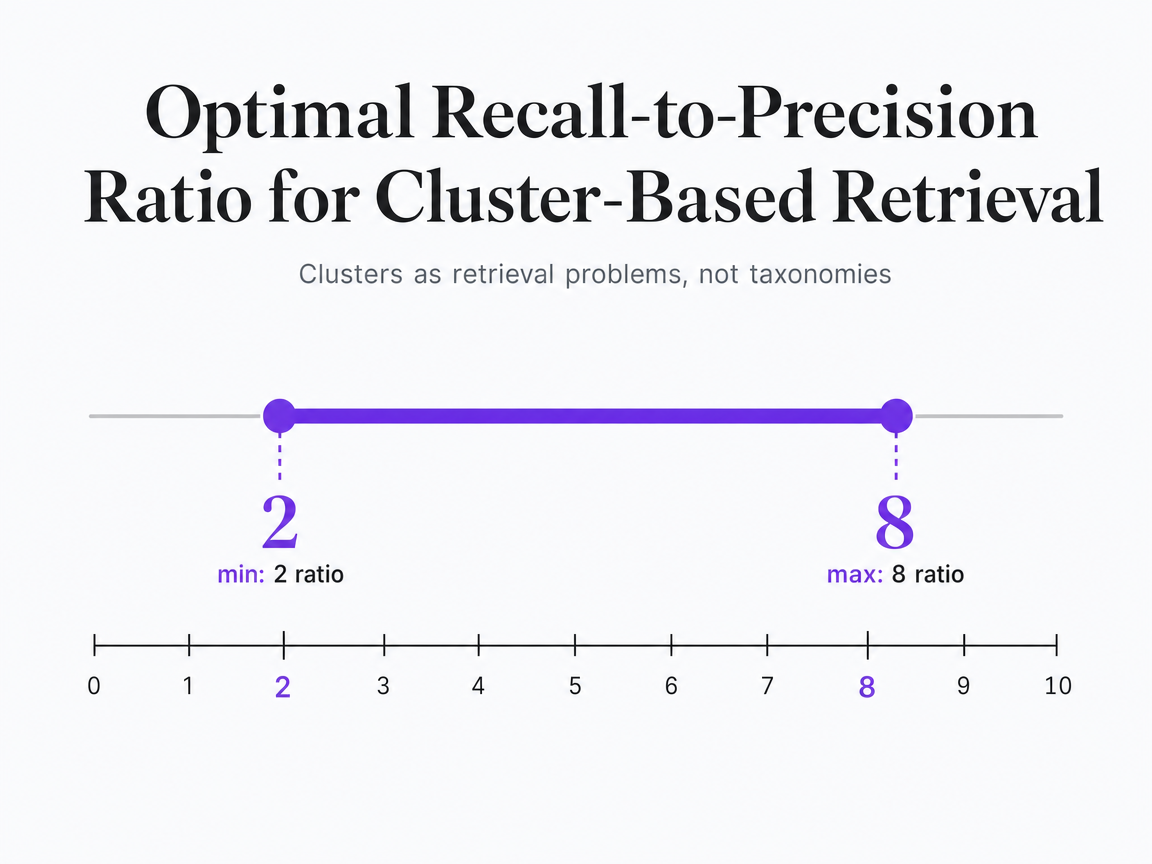 Optimal Recall-to-Precision Ratio for Cluster-Based Retrieval
A 2023 study found that citation-based clusters are most effective for users who prioritize finding all relevant documents (recall) over ensuring all found documents are relevant (precision), specifically within a 2-to-8 ratio preference.
Intent as a ranked hierarchy, not a four-bucket label
Classification versus intent mining
The four-bucket intent label—informational, navigational, commercial, transactional—is a classification output. It is useful for sorting a sheet. It is not useful for writing a brief that resolves what the page should actually do.
The query-understanding literature splits intent work into two separate activities. Classification maps a query into a predefined category. Intent mining does something harder: it discovers the subtopics and user needs embedded in a query, which may include locality, time sensitivity, topical category, and search vertical 7. Those are different operations with different outputs. A classifier returns a label. A miner returns a structure.
Agencies that only classify end up with clusters where every supporting page carries the same intent tag and the briefs read nearly identically. The writer has no instruction about which subtopic to lead with, which objections to address, or what the reader is likely to do next. That is why pages inside a classified-only cluster drift toward the same middle and begin to cannibalize each other.
Intent mining produces the material a brief actually needs: the specific user need the page resolves, the adjacent needs the page should acknowledge but not try to satisfy, and the handoff to the next page in the cluster. The classification label still appears on the sheet. It stops being the only thing on the sheet.
Ranking intents inside a single cluster
A commercial query like "workers comp attorney" does not have one intent. It has several, held simultaneously by different searchers and sometimes by the same searcher across a session. The Jiang et al. intent-mining work frames this directly: queries carry a hierarchy of possible intents, and the practical task is ordering them by relevance, diversity, and intent drift 8.
Applied to a cluster, that means every page gets a primary intent, a short list of secondary intents it must acknowledge, and an explicit note on which intents belong to a different page in the same cluster. The hub for "workers comp attorney" might rank an informational primary intent (how the claim process works), a commercial secondary intent (why representation matters at specific decision points), and route the transactional intent (book a consultation) to a conversion-focused supporting page. A separate supporting page handles the local intent for a specific jurisdiction.
Ranking intents also forces a decision about intent drift. Some queries pull toward adjacent topics—disability benefits, third-party liability, employer retaliation—that look semantically related but belong to different reader goals. The ranked hierarchy marks those as drift zones, which keeps them out of the hub and out of the wrong supporting page. That is the mechanism that prevents the cluster from quietly becoming a different cluster over six months of edits.
The operational payoff is brief quality. A writer handed a ranked intent hierarchy produces a page that resolves one job well and signals the next job clearly. A writer handed a label produces a page that tries to resolve everything and resolves nothing.
Test AI-driven cluster content production risk-free
Experience hands-on, full-scale keyword cluster publishing for your clients’ sites during the 7-day trial.
The scaled-content-abuse line every cluster page must clear
Cluster production at agency scale runs straight into Google's spam policy, and the policy is unambiguous. Scaled content abuse is defined as generating many pages primarily to manipulate search rankings rather than help users, and the policy explicitly applies regardless of whether the pages were written manually, assembled from templates, or produced with generative AI 3. Production method is not the line. User value is the line.
That reframing matters because most agency conversations about AI in clusters get stuck on the wrong question. The question is not whether a page was drafted by a model. The question is whether the page resolves a distinct user need, carries original analysis or first-hand knowledge where the topic requires it, and would exist even if search traffic were not the goal 4. A cluster of forty supporting pages that each answer a different query with a different structure and a reviewer-verified point of view is not scaled content abuse. A cluster of forty pages that paraphrase the same source material under forty long-tail headers is, no matter who or what produced them.
The operational implication for a Head of SEO is that the quality floor has to be encoded into the cluster brief, not inspected at the end. Every page in the cluster needs:
- a named user need
- a defined evidence requirement
- a human reviewer with topical authority
- a success metric tied to that reader's goal rather than to a ranking position
Google's people-first guidance frames the self-audit directly: a reader should leave the page with enough information to achieve what brought them there 4.
Clusters that pass this test share three structural traits. Each page answers a question the hub cannot answer in a paragraph. Each page cites or demonstrates something the writer actually knows. And the set, taken together, reads like a resource library a specialist would build, not a surface area engineered for query coverage. Agencies that embed these traits in the brief template push the compliance decision upstream, where it costs minutes, instead of leaving it for a post-publish audit that costs rewrites.
Architecture that holds up under audit
Hub and supporting pages as link obligations
The hub-and-supporting structure is often described as a design preference. It is better understood as a link obligation. Google's link documentation is explicit: a page that matters should be reachable through an HTML anchor with an href from at least one other page on the site 2. Inside a cluster, that requirement becomes a contract. Every supporting page carries an inbound link from the hub, and the hub earns its status by actually routing readers to the pages that resolve the subtopics it introduces.
Agencies that skip the contract produce clusters that look complete on the sheet and read as orphans in the crawl. The hub mentions the subtopic in a paragraph, never links to the dedicated page, and the supporting page sits two clicks deep behind the sitemap. Discovery suffers, and so does the signal that these pages belong to the same resource.
The operational fix is a brief-level rule. Each supporting page lists the hub link it must receive and the anchor phrasing that reflects the subtopic, not a generic "learn more." The hub brief lists every supporting page it must link out to, in the body, where the context makes the link useful 1, 2. Audit becomes a diff between the brief and the published HTML, not a judgment call.
URL folders aid auditability, not authority
URL structure is where strategists most often confuse operational clarity with ranking lift. Google's URL guidance is narrow: construct URLs logically, keep them intelligible to people, and avoid unnecessary parameters 10. The guidance says nothing about keyword-rich folders improving rankings, and treating folder depth as a topical-authority signal misreads what the documentation actually claims.
What consistent folders do deliver is auditability. A cluster that lives under /workers-comp/ with predictable child slugs is easier to inventory, migrate during a redesign, and evaluate in Search Console segment reports. Strategists can pull a folder-level view, spot pages missing hub links, and catch intent drift before it compounds across a quarter of edits.
The practical rule for agency teams: pick a folder convention per cluster, document it in the client's content standards, and enforce it at publish. Expect faster audits and cleaner reporting. Do not expect the folder itself to rank anything 10.
If the portfolio includes multi-location clients
Doorway-page risk inside location clusters
A shift in scope matters here. The rest of this piece applies to any cluster. This section applies to agency teams running portfolios where a single client operates across ten, fifty, or two hundred locations, which is where cluster production most often collides with Google's doorway-page criteria.
The failure pattern is familiar. A multi-location client wants a page per city, the strategist clones a template, swaps the city name and a stock hero image, and the cluster grows to ninety near-duplicate pages that funnel every visitor to the same booking form. Google's spam policy addresses this directly: pages created primarily to rank for location variations and shuffle users toward one destination fit the scaled content abuse pattern, regardless of whether they were templated by hand or assembled by a script 3.
The fix is not fewer location pages. It is location pages that resolve a locally specific user need. Each page needs content a reader in that market would recognize as made for them: the actual service team, the local regulatory context, the response-time commitment, the facilities, the reviews from that market. LocalBusiness structured data supports that signal when the markup reflects accurate hours, departments, and reviews rather than copied boilerplate 9. Pages built this way are location clusters. Pages built the other way are doorways with better URLs.
Strategist hours per cluster across three governance models
Portfolio economics in a multi-location agency come down to a single ratio: strategist hours per published cluster, held against a quality floor that Google's people-first and scaled-content-abuse guidance defines rather than the agency 3, 4. The hours shift substantially depending on how the cluster is governed, and the shift is where margin lives.
Three governance models account for most of the field.
- In a manual keyword-list model, the strategist owns H_research (seed term expansion, SERP overlap, intent classification), H_brief (one brief per supporting page, written longhand), and H_review (a post-draft pass per page). Pages_per_cluster scales linearly against all three, so a twenty-page cluster costs roughly twenty times the per-page strategist load, with no leverage past the research phase.
- A semi-automated model with human intent ranking cuts H_research through tooling for term expansion and SERP overlap, but keeps the strategist on intent mining and brief authorship. H_brief drops because intent hierarchies are templated per cluster rather than per page. H_review stays comparable, since the quality floor has not moved. The economics improve, but strategist capacity still gates throughput.
- An approval-gated AI execution model shifts the strategist's role upstream. H_research and H_brief compress into a single ranked-intent and evidence specification per cluster. Draft production runs against that specification. H_review rises per page because the reviewer is now the quality floor rather than the author, but total hours per cluster fall because the strategist is no longer rewriting what the brief should have specified. Pages_per_cluster becomes a function of reviewer throughput, not strategist authoring speed.
Two caveats keep this honest. First, the quality floor does not move across models; a page that would fail the people-first self-audit fails it the same way regardless of who or what produced the first draft 4. Second, the scaled-content-abuse line applies to the output, not the method, so a model that compresses H_brief without preserving per-page user need, evidence, and reviewer accountability trades hours for policy risk 3. Agencies that model their portfolio in these variables, instead of in abstract capacity, pick the governance model deliberately per client rather than defaulting to whichever one the team already knows.
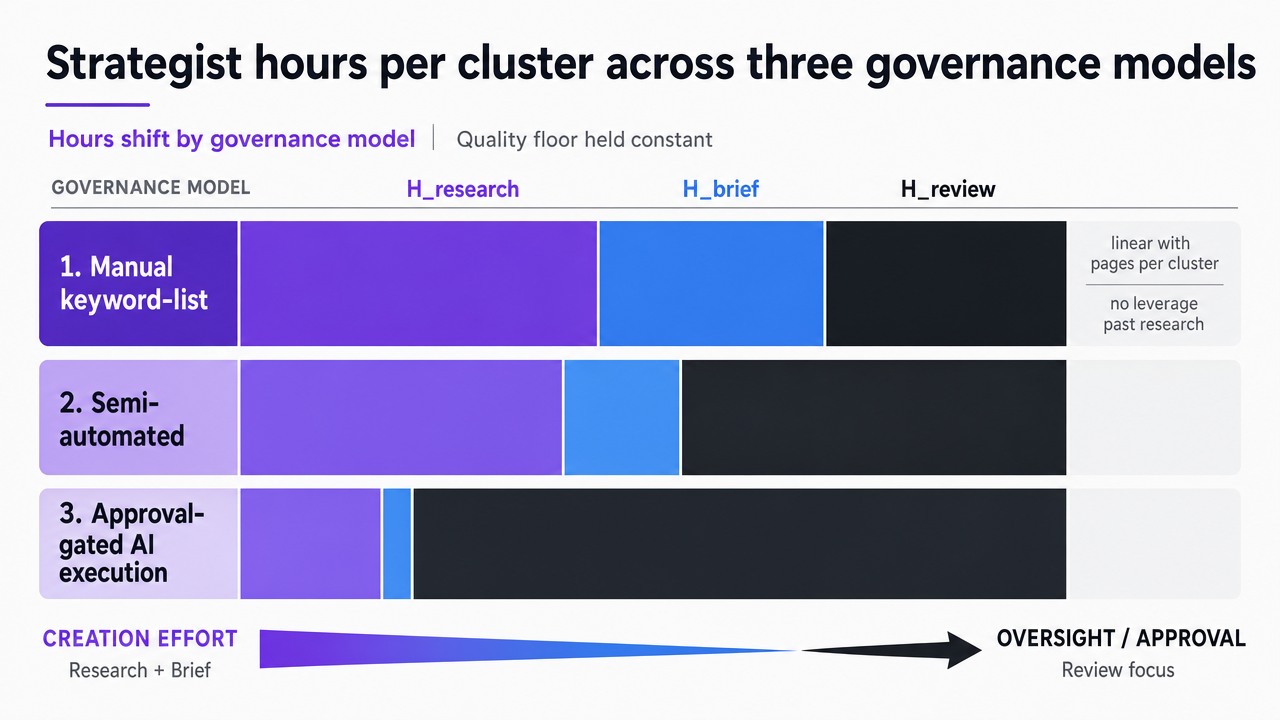 Visualize the three governance models described in the section (manual keyword-list, semi-automated with human intent ranking, approval-gated AI execution) as a comparison framework showing where strategist hours shift across H_research, H_brief, and H_review
See How Leading Agencies Operationalize Keyword Clustering at Scale
Connect with experts to review real workflows and metrics for deploying keyword clusters across dozens of clients—without expanding your SEO team or losing strategic oversight.
AI-assisted execution without crossing the policy line
The policy question agency teams actually face is narrower than the industry debate suggests. Google's spam guidance applies to output, not production method, and the people-first framework asks whether a reader leaves the page able to do what brought them there 3, 4. Those two tests do not change when a model drafts the first version. They change what the strategist is responsible for.
Under an AI-assisted workflow that holds the line, the model does not decide what the page is for. The strategist specifies the primary user need, the ranked secondary intents, the evidence the page must carry, and the subtopics that belong to a different page in the cluster. Draft production fills that specification. A named reviewer with topical authority then verifies the page against the specification and against the people-first self-audit, not against a word count.
Three failure patterns put a cluster on the wrong side of the line:
- Drafting against a keyword list rather than a ranked intent brief produces pages that paraphrase the same source material under different headers 3.
- Skipping the reviewer step pushes compliance decisions downstream, where they surface as rewrites or deindexing.
- Treating volume as the output metric replaces user need with query coverage, which is the exact pattern the policy names 3.
Agencies that encode the specification, the reviewer, and a user-goal success metric into every brief keep AI execution inside the policy. The method stays invisible to the reader because the quality floor did not move.
A review cadence that keeps clusters honest
Clusters decay. Intent shifts, SERPs reshuffle, supporting pages drift toward topics the hub no longer introduces, and the ranked intent hierarchy that made sense in Q1 reads as outdated by Q3. The Jiang et al. intent-mining work makes this explicit: query intents move over time, which means a cluster is a periodic review object, not a one-time categorization 8.
A workable cadence runs on two clocks. A quarterly pass per cluster re-checks SERP overlap, confirms that each supporting page still matches its primary intent, and flags drift zones that have grown into their own subtopic. An annual pass re-runs the full intent hierarchy against current query data, which is where splits, merges, and retirements get decided.
The review artifact matters as much as the cadence. Each pass produces a short diff: which pages still clear the people-first self-audit, which supporting pages have lost their hub link, which URLs under the folder convention have gone stale 1, 4. Strategists who log the diff instead of rewriting on instinct keep the cluster inventory auditable and keep rework out of the next production cycle.
Frequently Asked Questions
References
- 1.SEO Starter Guide: The Basics.
- 2.SEO Link Best Practices for Google.
- 3.Spam Policies for Google Web Search.
- 4.Creating Helpful, Reliable, People-First Content.
- 5.measures.dvi.
- 6.Academic information retrieval using citation clusters: in-depth evaluation based on systematic reviews.
- 7.Query Intent Understanding.
- 8.Mining and ranking users’ intents behind queries.
- 9.Local Business (LocalBusiness) Structured Data.
- 10.URL Structure Best Practices for Google Search.