
Key Takeaways
- The informational query 'how does bruxism damage teeth' should feed a DSO condition pillar article, letting commercial pages inherit authority without forcing an inappropriate call to action.
- 'What is sundowning in dementia' belongs in a memory care education hub, since families are 60 to 180 days from a move-in decision and conversion pages misread that stage.
- Long-tail task queries like 'how to shut off water main before vacation' work best as FAQ assets inside a seasonal plumbing cluster rather than standalone phrases 4, 8.
- 'Best Invisalign provider vs ClearCorrect' is commercial investigation, not informational 9, and should route to a comparison page with treatment duration, materials, and cost ranges.
- 'Top personal injury law firms Houston' needs a trust-anchored firm page covering verdicts, bar admissions, and jurisdiction, since legal SERPs often lack those signals 2.
- '[Brand] patient portal login' is navigational and must sit on an indexed brand utility page, since navigational queries skew heavily to brand terms 10.
- '[DSO brand] locations near me' should land on a directory hub with map-first layout, sortable hours, schema, and booking CTAs pinned to each card.
- 'Book same day HVAC repair' is transactional and demands a service landing page where dispatch availability and trust signals outrank editorial copy above the fold.
- 'Schedule free consultation car accident lawyer' needs a short intake form, click-to-call, and a referral path for out-of-jurisdiction leads rather than a dead end 2.
- 'Dentist near me open Saturday' routes to a location landing page with Saturday hours in the title, opening-hours schema, and a booking widget.
- 'Personal injury lawyer near me' and 'dentist near me' share syntax but require different briefs: credibility-first for PI, logistics-first for dental 2.
- 'Early signs of lymphoma' requires a clinician-reviewed, review-gated article with author schema, since most health searches begin on general engines 1, 6.
Why Agency Keyword Lists Keep Breaking at Scale
The challenge for agencies isn't a lack of understanding of search intent among strategists. It's the inconsistency that arises when multiple strategists, working across numerous client accounts, categorize the same query differently. This divergence in interpretation directly impacts the content calendar, leading to inefficiencies.
For instance, a senior analyst might classify "best personal injury lawyer Houston" as commercial investigation, directing it to a comparison page. A junior analyst might tag the same query as transactional, briefing a conversion landing page. Meanwhile, a Digital Strategy Officer (DSO) account manager, using a different template, might label it as local. Each defensible interpretation results in distinct content assets, briefs, and often, multiple rounds of revisions when clients provide feedback.
When this lack of alignment is multiplied across many client accounts, the keyword list ceases to be a functional planning document. Instead, it becomes a backlog of unresolved intent classifications, consuming valuable strategist hours before any content is even drafted.
The solution isn't to conduct more keyword research. It's to implement a standardized intent-to-page-type mapping that every strategist applies uniformly. This mapping should be grounded in query-log research rather than subjective habits 3, 9, and maintained as a governance artifact across all agency accounts. The 13 examples provided below illustrate how to make this mapping reproducible.
The Intent Taxonomy Agencies Should Standardize On
Query-log research offers a robust starting point for agencies, but not a rigid allocation model. Early studies, like Jansen et al.'s classification of over 1.5 million queries, indicated approximately 80% informational, 10% navigational, and 10% transactional 3, 7. A subsequent k-means clustering study of 130,000 queries found roughly 75% informational and 12% each for navigational and transactional 5. Both studies predate current AI-driven search results and were based on general web traffic, not specific service-vertical client data. Therefore, these proportions should be viewed as directional evidence that informational demand is dominant, rather than strict budget allocations for legal, DSO, or home-services accounts.
What agencies truly need to standardize is the set of labels strategists use, not the ratio of query types. A practical taxonomy for multi-client delivery should include five classes: informational, commercial investigation, navigational, transactional, and local. While the original three-part model 9 covers most queries, it often categorizes commercial comparison queries as informational and overlooks the crucial geographic signal that drives many service-business conversions. By adding commercial investigation and local as distinct categories, the taxonomy better reflects how intent varies by topic 10, thereby preventing recurring debates over whether queries like "best Invisalign Dallas" are informational, transactional, or something in between.
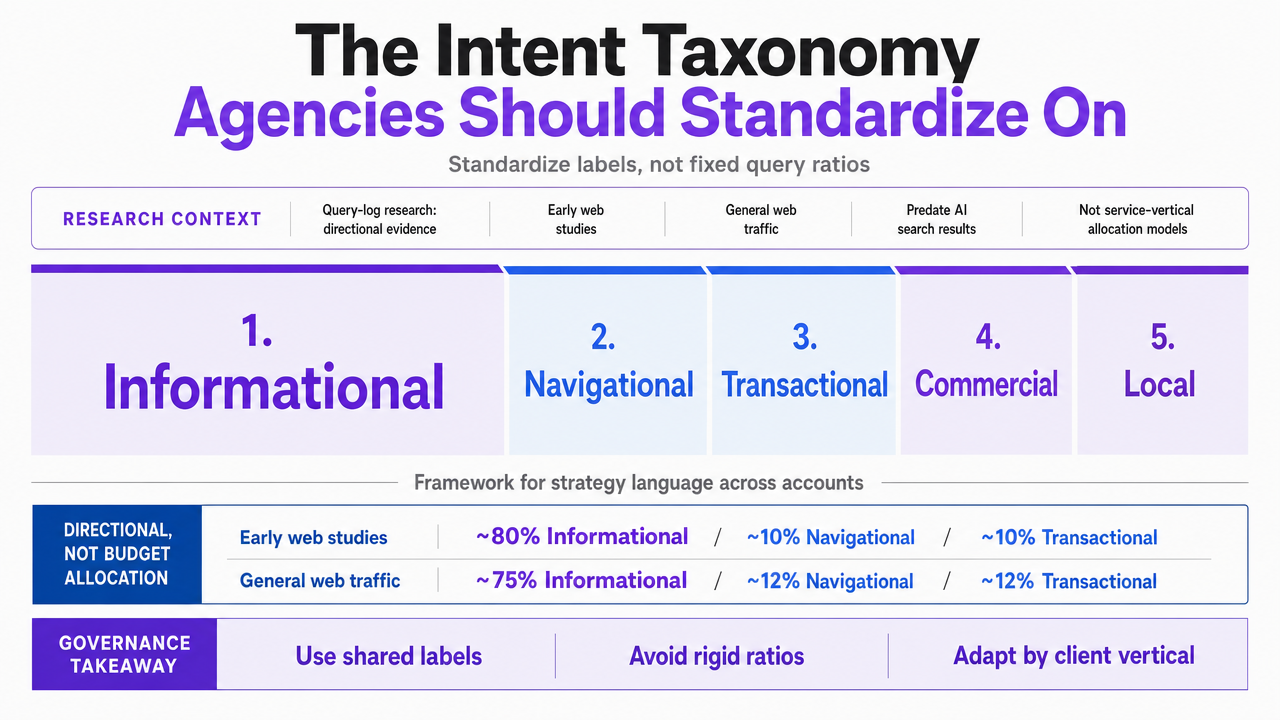 Visualize the five-class intent taxonomy the article argues agencies should standardize on, making the framework scannable for Heads of SEO
Test Advanced Keyword Strategies in Real Campaigns
Validate search intent targeting and publish live SEO content with full platform capabilities during your trial.
Four Fields Every Keyword Example Needs on a Brief
A keyword on its own provides limited context. However, when augmented with four structured fields, it communicates a consistent message to every strategist working on an account.
These four essential fields are:
query : the exact phrase, preserved verbatim from the source list
dominant intent : one of the five standardized classes, avoiding hybrid labels
target page type : e.g., pillar article, comparison page, service landing page, location page, brand utility page
vertical modifier note : explaining how the intent classification shifts for specific verticals like law, DSO, HVAC, memory care, or behavioral health
The vertical modifier field is particularly important because the same phrase can carry different weight across various accounts. Business-related queries may lean navigational in some topics and commercial in others 10. A brief that omits this modifier forces subsequent strategists to re-evaluate the intent. By filling these four fields once, such recurring arguments are eliminated.
13 Keyword Examples Mapped to Intent and Page Type
Informational: 'how does bruxism damage teeth' (DSO content pillar)
Query: how does bruxism damage teeth. Dominant intent: informational. Target page type: pillar article anchored to a condition hub, with internal links to night guard and TMJ service pages.
The searcher is seeking an explanation of a mechanism, not an immediate appointment. For a DSO account, this query should be routed to a 1,500- to 2,500-word pillar article detailing enamel wear, fracture risks, and referral triggers. Commercial pages can then inherit authority from this informational content. Informational demand is prevalent in general query logs 7, and condition explainers effectively capture this demand without forcing an inappropriate call to action.
Vertical modifier note: single-location practices typically do not require such a pillar. For multi-location DSOs, the same asset can be syndicated across location pages with minor localization.
Informational: 'what is sundowning in dementia' (memory care education hub)
Query: what is sundowning in dementia. Dominant intent: informational. Target page type: education hub article within a caregiver resource section, not a tour-request landing page.
Families researching sundowning are typically 60 to 180 days away from making a move-in decision. Directing this query to a conversion page misinterprets their current stage and can reduce dwell time. The brief should request content covering definitions, trigger patterns, and evening-routine guidance, with a soft transition to a memory care programming page.
Vertical modifier note: for independent living operators, this query is not relevant and should not be targeted. For memory care and assisted living facilities with memory programming, it serves as a top-of-funnel anchor, supporting brand consideration throughout the research phase.
Informational long-tail: 'how to shut off water main before vacation' (HVAC/plumbing FAQ asset)
Query: how to shut off water main before vacation. Dominant intent: informational, long-tail task. Target page type: FAQ-style asset in a homeowner resource library.
Long-tail task queries indicate a specific need and require precise answers. A Stanford study found that direct answers effectively addressed query intent in 58% of unique long-tail queries 4. Furthermore, session-level analysis of over 1.5 million queries revealed that reformulation and assistance account for approximately 45% of query reformulations 8, meaning searchers often adjust their queries and delve deeper. Strategists should brief this query as part of a seasonal-plumbing cluster, including topics like shut-off valves, frozen-pipe prevention, and vacation checklists, rather than treating it as a standalone phrase.
Vertical modifier note: for HVAC operators that also offer plumbing services, this cluster can feed leak-detection service pages. For pure HVAC accounts, the priority of this cluster should be lower.
Commercial investigation: 'best Invisalign provider vs ClearCorrect' (DSO comparison page)
Query: best Invisalign provider vs ClearCorrect. Dominant intent: commercial investigation. Target page type: comparison page under an orthodontics hub, presenting an evidence-based evaluation rather than a sales pitch.
This query type is often misclassified as informational within the traditional three-part taxonomy 9. Such misclassification leads searchers to generic explainers, potentially losing them to a competitor's comparison page. The brief should request a side-by-side comparison covering treatment duration, aligner materials, refinement policies, and total case cost ranges, along with the practice's clinical rationale for its preferred system.
Vertical modifier note: solo orthodontic practices may not be able to provide a defensible comparison and should instead route this demand to a consultation page. DSOs with multiple certified providers, however, should embrace this comparison format as it aligns with the searcher's decision-making process.
Commercial investigation: 'top personal injury law firms Houston' (law firm comparison/trust page)
Query: top personal injury law firms Houston. Dominant intent: commercial investigation with a significant local component. Target page type: trust-anchored firm page emphasizing case results, verdicts, and attorney credentials, rather than a generic practice-area page.
The searcher is actively compiling a shortlist. Search Engine Results Pages (SERPs) for this phrase typically include directories, local news, and firm pages, necessitating that the firm's own content actively makes a case for its position. The brief should specify details like settlement ranges by case type, attorney bar admissions, and jurisdiction coverage. Audits of legal search results have highlighted persistent issues with low-quality information and missing jurisdiction signals for legal-help queries 2. Firms that directly address jurisdiction are more likely to meet searcher needs where competitors fall short.
Vertical modifier note: for mass-tort or class-action firms, this phrase has a different conversion mechanism and should route to a case-eligibility screener.
Navigational: '[brand] patient portal login' (brand utility page)
Query: [brand] patient portal login. Dominant intent: navigational. Target page type: brand utility page, indexed and accessible from the global header, with the login link prominently placed above the fold.
Navigational queries, while a smaller portion of overall query volume, represent a significant share of returning-user sessions and are heavily skewed towards business and brand terms 10. Losing this query to a third-party aggregator or an outdated help article is a common self-inflicted traffic loss identified in healthcare and dental SEO audits.
Vertical modifier note: for multi-location DSOs and health systems, the brief must specify whether the portal is unified or location-specific. An incorrect structure can force patients through multiple logins, increasing support ticket volume.
Navigational-commercial: '[DSO brand] locations near me' (location directory hub)
Query: [DSO brand] locations near me. Dominant intent: navigational with commercial follow-through. Target page type: location directory hub listing every practice with city, hours, and a direct booking link, with individual location pages one click away.
The searcher is already familiar with the brand and is looking for the nearest open office. The directory's structure is more critical than the copy. The brief should specify a map-first layout, sortable hours, and schema markup for each location, with the booking call-to-action (CTA) pinned to each card.
Vertical modifier note: for home-services franchises, the same structure applies, but service-area polygons replace fixed addresses. For senior living operators, add care-level filters to the directory, allowing searchers to filter by independent living, assisted living, and memory care before navigating to a community page.
Transactional: 'book same day HVAC repair' (service landing page)
Query: book same day HVAC repair. Dominant intent: transactional. Target page type: service landing page with phone number, booking widget, and same-day availability status prominently displayed above the fold.
This represents one of the clearest conversion queries within the home-services keyword set. The brief should prioritize dispatch availability and surface trust elements (licensing, response time guarantees, service area) in a sidebar, minimizing editorial copy. Secondary content can be placed below the fold for crawlers, but not at the expense of the searcher's immediate needs.
Vertical modifier note: for commercial HVAC accounts, 'same day' is often unrealistic. The query should be rephrased to 'emergency commercial HVAC service' with a four-hour response commitment. For residential services, same-day availability is a key conversion driver and must be supported by dispatch workflows, not just marketing copy.
Transactional: 'schedule free consultation car accident lawyer' (intake-driven landing page)
Query: schedule free consultation car accident lawyer. Dominant intent: transactional. Target page type: intake-driven landing page featuring a concise qualification form, click-to-call functionality, and a visible response-time commitment.
This query contains three strong conversion signals: "schedule," "free," and the specific service. The brief should request a form with a maximum of five fields (name, phone, state, date of incident, brief description), a jurisdiction-check step, and a bilingual option if market data supports it. Research on legal-help queries indicates that jurisdiction and legal-aid pathways significantly influence what constitutes satisfied intent 2. Therefore, the page must handle out-of-jurisdiction leads with a referral, rather than a dead end.
Vertical modifier note: for firms with intake call centers, this query should be routed to a dedicated tracking number per campaign to ensure accurate attribution.
Local: 'dentist near me open Saturday' (local landing page)
Query: dentist near me open Saturday. Dominant intent: local with a transactional overlay. Target page type: location landing page with Saturday hours in the title, structured data for opening hours, and a booking widget.
Local queries integrate geography, availability, and brand considerations. Topic-level analysis of query logs demonstrates that intent varies significantly by topic, and modifier phrases do not carry a universal meaning across verticals 10. A standardized intent-to-page-type routing diagram ensures strategists are aligned:
- informational queries lead to pillar articles
- commercial to comparison pages
- navigational to brand utility or location pages
- transactional to service landing pages
- local to location landing pages, with vertical modifiers applied for specific sectors like law, DSO, HVAC, and memory care
Vertical modifier note: for home services, replace 'Saturday hours' with 'weekend emergency availability.' For memory care, the local query mechanism shifts towards tour scheduling rather than direct booking.
Local YMYL: 'personal injury lawyer near me' vs 'dentist near me' (same syntax, different conversion mechanics)
These two queries share identical syntax but possess fundamentally different economic dynamics.
'Personal injury lawyer near me' represents a one-time, high-value, consultative conversion. The searcher may be in physical pain, dealing with insurers, and evaluating multiple firms over several days. The landing page must establish credibility (case results, bar status, jurisdiction) before requesting contact information. Legal search audits confirm that generic results often fail to address jurisdiction and legal-aid pathways 2, meaning the page must explicitly provide this information.
'Dentist near me' is a recurring, moderate-value, convenience-driven conversion. The searcher primarily seeks an available appointment within a reasonable driving distance. The landing page needs to prioritize logistics (hours, accepted insurance, booking options) over extensive credentials. Trust is often assumed; convenience is the primary conversion lever.
Despite identical syntax, these queries require distinct briefs and conversion workflows. Applying the same template to both will result in underperforming assets in both verticals.
Vertical modifier note: for DSO accounts, high intake friction deters bookings. For Personal Injury (PI) accounts, intake friction serves as a necessary filter.
Vertical YMYL informational: 'early signs of lymphoma' (behavioral/clinical review-gated article)
Query: early signs of lymphoma. Dominant intent: informational, high-stakes Your Money Your Life (YMYL). Target page type: review-gated article within a condition library, authored or reviewed by a credentialed clinician with visible author schema.
Symptom-appraisal research indicates that most searches in this category are symptom-based, with searchers moving between symptom, condition, and treatment perspectives as they learn 1. A separate review found that 83% of health-information consumers begin with general search engines rather than specialized medical sites 6. This highlights the importance of a well-structured article from a credible provider to capture demand that might otherwise go to less authoritative sources.
The brief should request a symptom checklist, differential considerations, thresholds for seeking care, and a clinician review note including name, credentials, and review date. Rigorous editorial review is non-negotiable for this query class.
Vertical modifier note: for behavioral health operators, an equivalent query is 'signs of eating disorder in teen,' which carries the same editorial burden plus mandatory crisis-resource links. Non-clinical accounts should not target this query class.
Workflow example: how an intent cluster feeds an approval queue
The final example focuses on the workflow that transforms the preceding twelve examples into deployable assets without manual re-briefing.
An intent cluster enters the queue as a bundle, comprising the primary query, its reformulations (which account for approximately 45% of session-level query behavior 8), the standardized intent class, the target page type, and the vertical modifier note. A strategist reviews this bundle, approves or edits the intent classification, and then routes it to the production brief. The brief automatically inherits these four fields, eliminating the need to rewrite them for each query.
This streamlined routing significantly boosts agency throughput. A manual process requires re-interpreting intent at every stage: strategist, writer, editor, and account manager. In contrast, a clustered-and-mapped process interprets intent once, at the approval stage, and every subsequent role inherits that decision.
For a Head of SEO, the key takeaway is that the keyword list itself is not the ultimate deliverable. The approval-gated routing between the keyword list and the content calendar is the true deliverable. AI marketing execution platforms with approval-gated workflows, such as Vectoron, formalize this routing, moving beyond reliance on tribal knowledge among strategists.
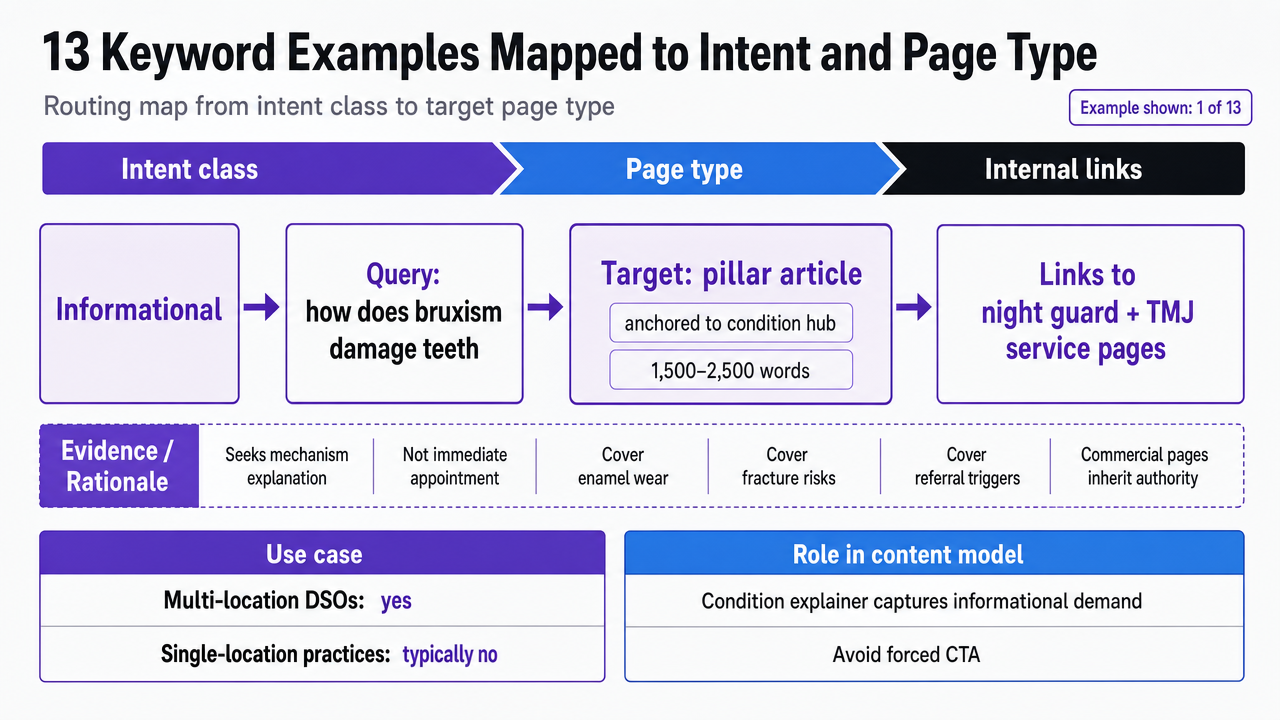 Summarize the 13 keyword examples as a compact routing map from intent class to target page type, reinforcing the article's core deliverable
See How Leading Agencies Operationalize Search Intent with Real Keyword Frameworks
Connect for a walkthrough of enterprise-grade workflows and approval-first automation that help agencies scale keyword research, mapping, and content by intent—without additional headcount or workflow bottlenecks.
If You Manage Multiple Client Accounts: Hours Reclaimed by Intent-Mapped Templates
This section is specifically for Heads of SEO managing 20 or more client accounts, as the economic benefits compound significantly at portfolio scale, rather than for single-account practitioners.
In a manual strategist model, each client's keyword list is interpreted from scratch. A strategist conducts research, assigns intent, drafts routing notes, and defends these decisions during brief reviews. Across a portfolio of 20 clients, these hours accumulate into a fixed monthly burden that scales linearly with headcount.
Conversely, with an intent-mapped template model, the taxonomy, four-field schema, and page-type routing are established once and applied across all accounts. Strategists then focus their time on vertical modifier calls and addressing edge cases, rather than repeatedly re-deriving the foundational framework. The variables in the table below are illustrative, not benchmarks, as keyword-planning hours vary based on vertical complexity and account maturity.
| Activity (per client, per month) | Manual strategist model | Intent-mapped template model ||---|---|---|| Intent classification | H₁ | H₁ × 0.3 || Page-type routing decisions | H₂ | H₂ × 0.2 || Brief re-litigation in review | H₃ | ~0 || Vertical modifier calls | H₄ | H₄ || Per-client total | H₁+H₂+H₃+H₄ | (H₁×0.3)+(H₂×0.2)+H₄ || 20-client book | 20×(H₁+H₂+H₃+H₄) | 20×((H₁×0.3)+(H₂×0.2)+H₄) |
The hours saved are not eliminated; instead, they are reallocated upstream to vertical modifier work and governance. This is where a strategist's judgment truly differentiates agency output and adds unique value.
Governance Rules That Keep Strategists Calling Intent the Same Way
Three primary rules ensure consistency in intent classification among strategists.
- Rule one: one label per query, selected from the five-class taxonomy. This means no hybrid tags like "informational-commercial" or any strategist-specific shorthand. If a query genuinely falls between classes, the designated governance owner must select the dominant intent and document the decision. This ensures subsequent analysts inherit the decision rather than re-evaluating it.
- Rule two: vertical modifier notes are mandatory. The significance of a phrase varies across different verticals such as law, DSO, HVAC, and memory care, because intent itself varies substantially by topic 10. A brief lacking a modifier note will default to a generic interpretation, leading to the creation of an inappropriate asset.
- Rule three: treat query clusters as the planning unit, not individual phrases. Session-level data reveals that approximately 45% of query behavior involves reformulation 8. Therefore, a keyword list composed solely of fixed strings misrepresents actual searcher behavior. Clusters should be routed to a single brief, whereas individual phrases often lead to rework.
The governance owner should be a named Head of SEO or a senior strategist, not a committee. A single authority, a unified taxonomy, and a consistent page-type routing map maintained across the client portfolio will resolve most disagreements.
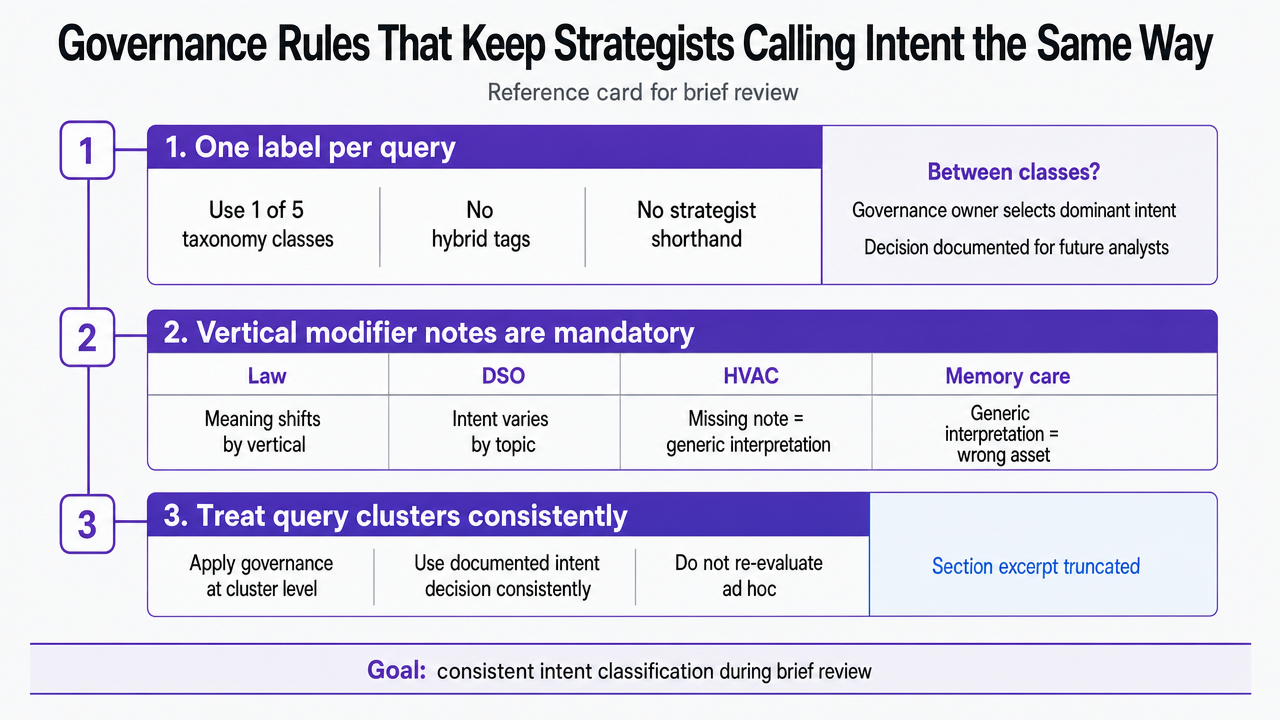 Codify the three governance rules into a single reference card so Heads of SEO can apply them during brief review
Frequently Asked Questions
References
- 1.Web Use for Symptom Appraisal of Physical Health Conditions: A Systematic Review.
- 2.Research on Legal Help Online.
- 3.Determining the user intent of web search engine queries.
- 4.Direct Answers for Search Queries in the Long Tail.
- 5.Classifying the user intent of web queries using k-means clustering.
- 6.Online Health Information Seeking Behavior.
- 7.Determining the informational, navigational, and transactional intent of Web queries.
- 8.Predicting Query Reformulation During Web Searching.
- 9.Determining the informational, navigational, and transactional intent of Web queries.
- 10.Classifying Web Queries by Topic and User Intent.
- 11.You are how (and where) you search? Comparative analysis of web search behaviors in Switzerland and Germany.