
Key Takeaways
- Average position is a blended approximation shaped by device, personalization, and now AI Overviews, making it unreliable as a headline KPI for client reporting 1, 3.
- A four-layer monitoring architecture—query coverage, page diagnosis, technical integrity, and conversion signal—replaces keyword-first dashboards with first-party Search Console data organized around URLs, not terms 1, 4.
- Before escalating a reported ranking drop, confirm whether the change is a reporting composition shift, an index coverage failure, or a policy and quality exposure 3, 10, 5.
- For multi-location portfolios, treat the regional URL cluster as the diagnostic unit and alert when declared hreflang canonicals diverge from the canonical actually indexed 11, 1.
Why Average Position Stopped Being the Headline Metric
Average position, once a key performance indicator, now behaves more like a mood ring. Google's Search Console documentation describes it as an impression-based approximation influenced by result type, device, location, personalization, and canonicalization. This means the number a client sees reflects a weighted average of appearances across contexts an agency cannot fully reconstruct 1. Consequently, two clients with identical "average position 4.2" can have vastly different impression volumes, click behavior, and pipeline impact.
The reporting landscape has also shifted. AI Overviews and AI Mode are now integrated into the Web search type within Search Console, meaning impressions and clicks increasingly reflect appearances within generative answers rather than traditional ten blue links 2. Google's documentation changelog confirms that AI Overviews are counted and logged in the Performance report, and AI Mode data contributes to overall Search Console totals 3. In this environment, a "position" is a blended artifact, not a static SERP coordinate.
A second structural issue lies with keyword-first reporting. Google's ranking systems operate at the page level, evaluating signals against URLs rather than isolated terms 4. A page competing for a cluster of thirty related queries will fluctuate across positions as the SERP recomposes for each intent. Focusing on any single query as the headline metric creates artificial volatility unrelated to the site's actual health.
Agency portfolios cannot be managed effectively with such a noisy metric. The following sections propose a four-layer monitoring architecture—query coverage, page diagnosis, technical integrity, and conversion signal—anchored in first-party data and designed to facilitate informed decisions rather than just provide screenshots.
A Four-Layer Monitoring Architecture for Agency Portfolios
Layer One: Query Coverage Across Web Search and AI Features
Query coverage is the foundational layer, defining the scope of what the agency measures. Search Console's Performance report categorizes traffic by queries, pages, and countries, providing impression and click trends for each 1. This first-party query inventory, not a third-party keyword list, is the appropriate starting point. While a rank tracker reports positions for specified queries, Search Console reveals the queries Google actually matched to the site, offering a more accurate reflection of real demand.
The measurement surface has expanded to include AI features. Google confirms that sites appearing in AI features are included in overall search traffic within Search Console and are reported under the Web search type 2. The documentation changelog further notes that AI Overviews are logged in the Performance report and AI Mode data contributes to overall Search Console totals 3. Consequently, impressions and clicks in the Web search type now combine classic ten-blue-link appearances with generative answer appearances. Agencies reporting "organic clicks" without acknowledging this compositional change are describing a different landscape than they were previously.
What this layer does not isolate is as important as what it includes. The Performance report does not break out per-citation prominence within an AI Overview, nor does it strip personalization or device-level variations, nor does it expose every query a site could rank for 1. Therefore, query coverage monitoring should track impression volume and CTR by query cluster and page, identify new query entrants weekly, and watch for CTR compression on head terms—a pattern consistent with queries being answered within generative surfaces before a click. The analyst managing this layer should focus on query deltas, not position changes.
Layer Two: Page-Level Diagnosis, Not Keyword-Level Chasing
Page-level diagnosis addresses a common failing in agency keyword programs. Google states that its ranking systems operate at the page level, evaluating billions of pages against numerous factors and signals 4. This means a single URL competes for a cluster of queries simultaneously, and movement within that cluster is often redistribution rather than loss. A page that loses position on one head term but gains impressions across twenty mid-tail variants is not degrading; it is maturing into a broader match surface. A keyword-first dashboard cannot discern this, but a page-first dashboard can.
The diagnostic unit should be the URL, with queries nested beneath it. For each priority URL, the monitoring record should include impressions, clicks, CTR, and average position for the top query cluster, the canonical status reported by URL Inspection, and the last indexing date observed in Search Console 1. If a URL's total impressions fall while its query count remains stable, intent coverage is likely intact, and the issue is probably SERP composition. If impression count collapses alongside query count, the page itself has lost match eligibility, prompting investigation into content relevance, canonical conflicts, or index status.
This layer also incorporates the question of editorial quality. Google's helpful-content guidance advises reviewers to evaluate experience, expertise, originality, completeness, and whether users receive sufficient information 6. These criteria do not translate to a keyword score, which is precisely why they belong at the page layer. A strategist reviewing a URL's performance should read the page as a user would, rather than auditing keyword density. The output of this layer is a concise list of URLs requiring rewriting, consolidation, or retirement—a decision queue, not merely a trend report.
Layer Three: Technical Integrity as a Visibility Signal
Technical integrity functions as a failure detector within the monitoring stack, not primarily as a growth lever. Google's Core Web Vitals documentation recommends LCP within 2.5 seconds, INP below 200 milliseconds, and CLS below 0.1 for a good user experience, but explicitly states that good Core Web Vitals results do not guarantee top rankings 7. Google's page experience guidance reiterates that there is no single page-experience signal, and strong report scores alone do not ensure top rankings 8. Agencies that base client reporting on a green CWV dashboard are measuring something real but misrepresenting its impact on rankings.
The appropriate use of this layer is threshold-based alerting. A URL moving from "good" to "needs improvement" or "poor" on any of the three metrics serves as an input for diagnosis, not a final verdict. When a cluster of priority URLs degrades simultaneously—often after a template change, tag manager update, or third-party script addition—the technical layer flags the pattern before the query layer registers it as a CTR or impression decline. This lead time provides operational value. Treating CWV as a rank predictor inverts the relationship Google documents.
Index integrity resides in the same layer and holds equal importance. URL Inspection reveals current index status and allows for live testing or recrawling requests 1. Sitemaps indicate preferred and important URLs but do not compel Google to crawl, index, or rank them, and canonical URLs are generally what appear in results 9. Monitoring should verify the actual indexation of priority URLs against the sitemap, rather than assuming it. A separate robots.txt watch is also crucial: Google states that a disallowed page may still have its URL indexed without a snippet, and that robots.txt should not be used to prevent indexing—noindex or access controls are the appropriate mechanisms 10. This distinction is a frequent source of false ranking drops in agency escalations, and this layer is where such issues are identified.
Layer Four: Conversion Signal and Pipeline Attribution
The fourth layer completes the cycle by linking query and page performance to the business outcomes clients value. Search Console's query, page, and country breakdowns can be integrated with conversion data at the URL level, transforming impression and click trends into revenue-relevant signals rather than mere vanity metrics 1. A URL ranking third for a term that generates no qualified leads is less valuable than one ranking eighth for a term that consistently produces bookings. Position-only reporting cannot make this distinction; conversion-joined reporting can.
The primary output of this layer is a per-URL conversion-weighted view: impressions, clicks, and CTR for the priority query cluster, combined with form fills, calls, bookings, or other client-defined downstream events. This is also where pipeline-relevant anomalies surface before they appear in position data. A sudden drop in conversions on a stable URL with stable impressions usually indicates a form malfunction, a tracking regression, or a landing-page change—not a ranking issue. Detecting this in the conversion layer prevents strategists from spending time optimizing a page that was never ranking-impaired.
For agency portfolios, this layer also governs client-facing reporting. The headline metric shifts from average position to qualified conversions attributable to organic query coverage, with the other three layers providing diagnostic context when the numbers change. Google's own advice against treating any single technical or ranking signal as decisive applies equally to average position 8. This reporting hierarchy inverts the typical agency dashboard: outcomes first, page diagnosis second, technical integrity third, and query coverage as the underlying data substrate.
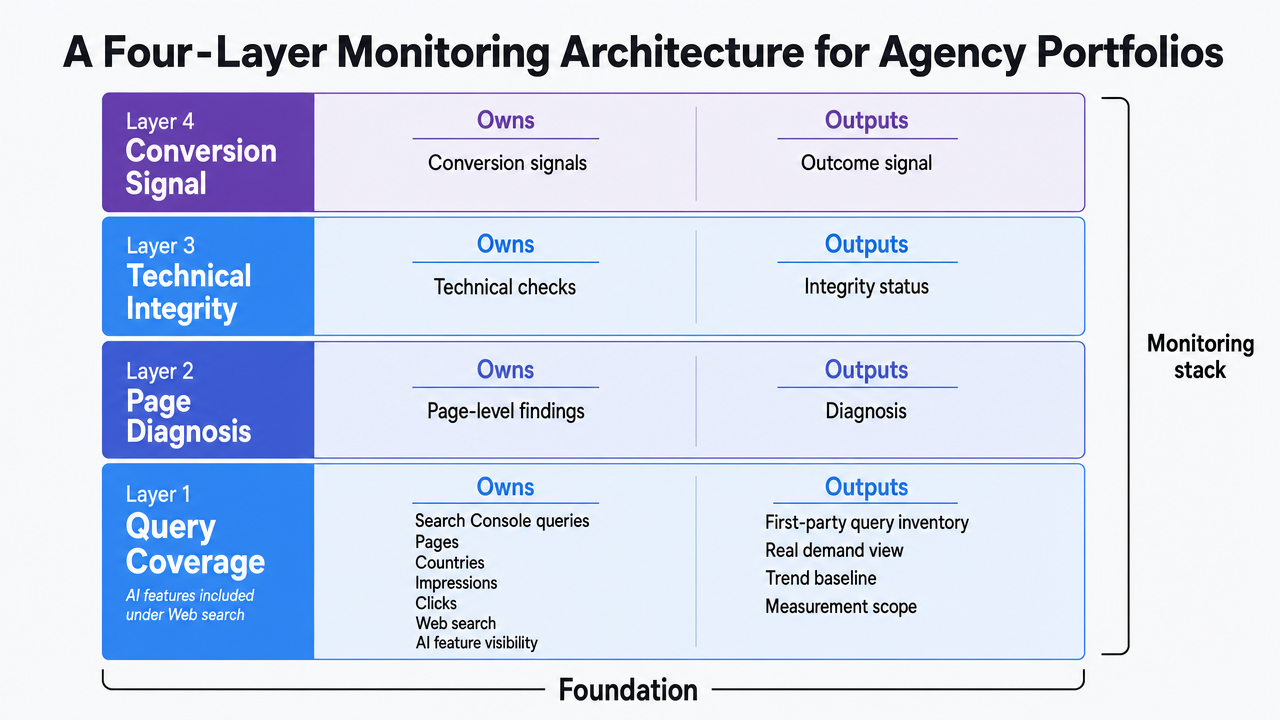 Visualize the four-layer monitoring architecture described in the section — query coverage, page diagnosis, technical integrity, and conversion signal — as a stacked framework showing what each layer owns and outputs
Monitor Every Ranking Change Across All Keywords
Track and act on real-time keyword movements with live publishing during your free trial.
Portfolio Cadence: What Each Layer Owes the Review Queue
A monitoring architecture without a scheduled review process is merely a logging system, not an operational model. For a Head of SEO managing 20 to 150 client sites, the key question is not which tool to acquire, but which layer is reviewed, by whom, and at what frequency before a signal escalates into a client issue. Each of the four layers has a distinct half-life and a dedicated owner.
Query coverage operates on a weekly rhythm. The Search Console Performance report, with its traffic breakdowns by queries, pages, and countries, and trends for impressions and clicks, provides the native cadence for identifying new query entrants, CTR compression on head terms, and shifts in Web search type composition 1. An analyst oversees this layer across the portfolio, scanning for week-over-week deltas and flagging URLs where impression trends and query counts diverge. Daily checks in this area tend to generate noise rather than actionable decisions.
Page diagnosis follows a biweekly to monthly cadence, depending on the account tier, because ranking systems operate at the page level, and page-level signals stabilize over weeks rather than days 4. A strategist manages this layer, working from the analyst's flagged URL list instead of scanning the entire inventory. The deliverable is a decision queue—rewrite, consolidate, retire, or leave alone—not a report.
Technical integrity involves continuous alerting with a weekly review. Core Web Vitals degradation, index coverage changes, and sitemap-versus-indexed deltas are surfaced through URL Inspection and the index coverage report 1. The analyst triages alerts, and the strategist escalates patterns. The threshold for moving a URL from monitoring to the review queue is a band change on any CWV metric or a canonical status flip, not a position shift.
Conversion signal is reviewed monthly, linked to the client's downstream event—form, call, booking. The Head of SEO owns this layer because it governs client-facing reporting and renewal discussions. Position data is only introduced into the review when the conversion number changes and the other three layers have already indicated the reason. This inversion—outcomes as the headline, query coverage as the substrate—enables a small team to manage a large portfolio without needing additional specialists for every new account.
Diagnosing a Reported 'Ranking Drop' Before Escalating
Is It a Reporting Change or a Real Movement?
The initial question for any ranking-drop ticket is whether the number itself changed or its definition did. Google's documentation changelog clarifies that AI Overviews are counted and logged in the Search Console Performance report, and AI Mode data contributes to overall Search Console totals 3. A client comparing this quarter's "organic clicks" to last year's is comparing a blended total that now includes generative-answer appearances against a total that largely did not. The delta may appear as a drop, but the underlying behavior could be unchanged or even improved.
This check takes minutes. Pull the Performance report for the affected URL cluster, segment by Web search type, and compare impressions and clicks across the window before and after the reporting change 1. If impressions are flat and CTR has compressed on head terms, the signal is consistent with queries being resolved within AI features rather than a position loss. If both impressions and clicks have fallen in parallel across a stable query set, the movement is real, and the ticket advances to the next layer. This reporting-change triage prevents strategists from investigating a SERP that did not actually move.
Index Coverage: Sitemaps, robots.txt, and the Noindex Confusion
If the movement is real, index coverage is the next area to examine, as its failure modes are binary and quickly confirmed. URL Inspection reports current index status and allows live testing or recrawl requests, serving as the primary diagnostic tool 1. A URL that was ranking last week but now returns "URL is not on Google" or shows a canonical different from the submitted one has not lost rankings competitively; it has been removed from the eligible set.
Sitemaps are a contributing factor. Google recommends including URLs that should appear in Search, using fully qualified absolute URLs, and generally showing canonical URLs in results. However, a sitemap signals preferred and important URLs rather than forcing crawling, indexing, or ranking 9. A sitemap that silently dropped a URL after a CMS migration or template change can create the illusion of a ranking collapse when the actual issue is discoverability.
The second variable is the common confusion between robots.txt and noindex, which generates a disproportionate number of agency escalations. Google states that robots.txt controls which resources crawlers may request, but a disallowed page may still have its URL indexed without a snippet, and robots.txt should not be used to prevent indexing—noindex directives or access controls are the appropriate mechanisms 10. A page newly blocked in robots.txt will often lose its snippet and CTR before its URL is removed from the index, which appears exactly like a ranking drop in a position tracker. Resolving this misconfiguration restores visibility without any content work.
Policy and Quality Exposure in Scaled Production
If reporting and index checks are clear, the investigation proceeds to policy and quality exposure—a layer particularly relevant for agencies producing content and links at scale. Google defines spam as techniques intended to deceive users or manipulate Search systems, including attempts to manipulate generative-AI responses, and states that sites violating these policies may rank lower or disappear from results 5. Scaled content abuse and link manipulation are explicitly named categories. An account that recently increased production velocity, syndicated templated content across locations, or accelerated link acquisition should be audited against these categories before further diagnosis.
The quality gate runs parallel to the policy check. Google's people-first guidance instructs reviewers to evaluate experience, expertise, originality, completeness, and whether users leave with sufficient information, framing this as an ongoing requirement rather than a one-time optimization 6. These criteria do not translate to a keyword score, which is why they necessitate human review of the affected URLs. A strategist reading the page as a user—not as an auditor counting entities—is the correct approach.
Policy and quality findings lead to a different decision queue than earlier layers: rewrite, consolidate, remove, or disclose. Treating a potential policy exposure as a ranking problem to be re-optimized wastes resources and risks exacerbating the issue across the portfolio.
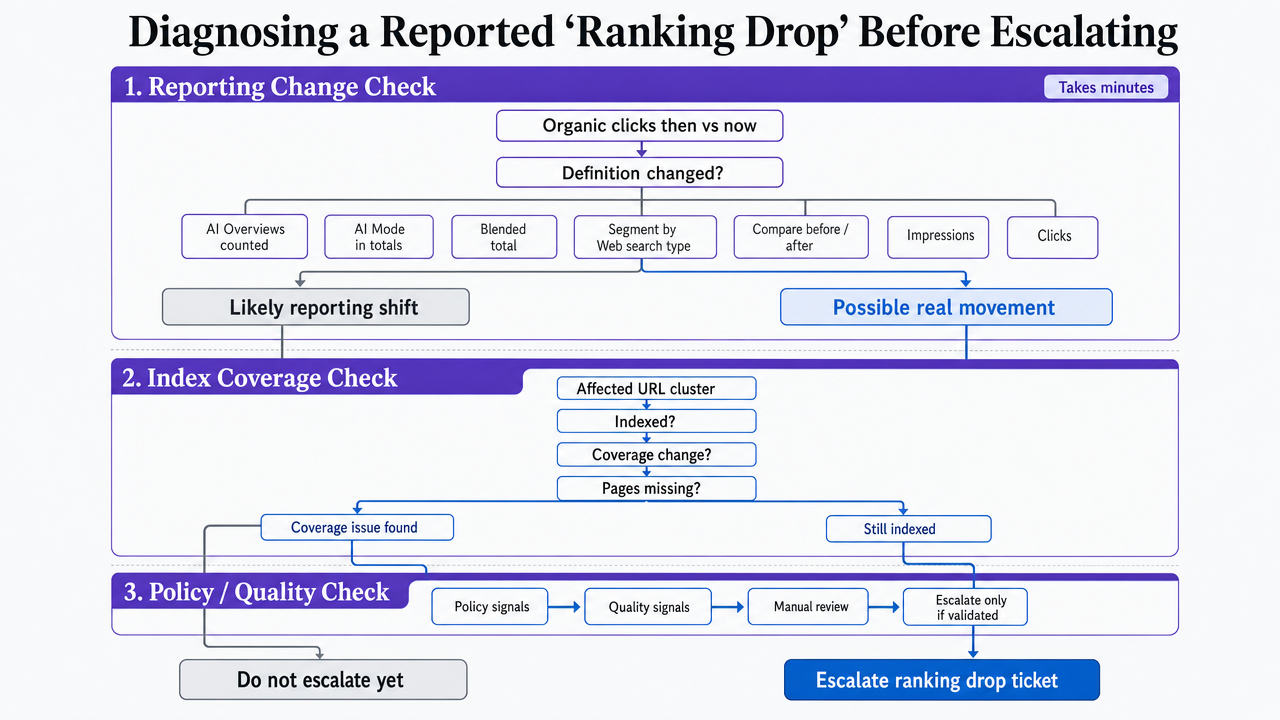 Visualize the sequential diagnostic workflow described in the section's three subsections — reporting change check, index coverage check, policy/quality check — as a decision flow a strategist follows before escalating a ranking drop ticket
See Every Keyword Opportunity—Monitor Search Performance at Scale
Request a demo to discover how enterprise teams use AI-driven keyword monitoring to identify ranking gaps, track competitive shifts, and automate reporting—without expanding headcount or sacrificing data accuracy.
If the Portfolio Includes Multi-Location Clients
For agencies managing local service accounts—such as dental groups, law firm networks, home services franchises, or senior living operators—the monitoring challenge differs significantly from a single-site playbook. A national average position for "emergency plumber" is irrelevant when the actual query is answered in forty metros, each with its own SERP composition and competitive landscape.
Google recommends separate URLs for language and regional versions and the use of hreflang annotations to help Search serve the correct regional URL, along with canonical and hreflang coordination for similar regional content 11. For multi-location clients, this guidance translates into a monitoring unit agencies rarely build: the hreflang cluster or regional URL group, treated as a single diagnostic object rather than fifty disconnected pages. When one location's URL loses canonical status to a sibling, impressions migrate across the cluster in ways that appear as a ranking drop at the local level but as noise at the portfolio level.
The Search Console Performance report breaks traffic down by country, serving as the first-party anchor for regional segmentation, and URL Inspection confirms the indexed canonical for each location page 1. The practical monitoring record for a multi-location account includes impressions, clicks, and CTR per location URL, the declared hreflang relationships, and the canonical actually indexed. Divergence between the declared and indexed canonical is the alert condition. A single national position number obscures the very failures this client type pays an agency to identify, and the layered architecture is effective only when the regional URL cluster is the unit of review.
Where Coordinated Execution Fits the Monitoring Stack
A monitoring architecture is only as effective as the execution loop it feeds. The four-layer model generates a decision queue—URLs to rewrite, templates to fix, regional canonicals to reconcile, policy exposures to resolve 4, 5. The common challenge for most agencies is not detection, but the seamless transition from signal to approved, shipped work across a portfolio, without getting bogged down in briefing cycles or losing the strategic rationale behind each change.
This is where Vectoron excels: providing specialist AI strategists who interpret the same first-party Search Console signals, prioritize the queue, and route every change through human approval before execution 1. The monitoring stack determines what matters. A coordinated execution layer determines whether a Head of SEO can manage 150 accounts with the same team that manages 20.
Frequently Asked Questions
References
- 1.How To Use Search Console.
- 2.AI Features and Your Website | Google Search Central.
- 3.Latest Google Search Documentation Updates | Google Search Central | What's new | Google for Developers.
- 4.A Guide to Google Search Ranking Systems.
- 5.Spam Policies.
- 6.Ask ``who, How, And Why''....
- 7.Understanding Core Web Vitals and Google search results.
- 8.Understanding page experience in Google Search results.
- 9.Build and Submit a Sitemap | Google Search Central.
- 10.How Google Interprets the robots.txt Specification.
- 11.Managing Multi-Regional and Multilingual Sites.