
Key Takeaways
- Service-line keyword lists cover solution awareness but miss the mid-journey queries where nearly 90% of B2B purchases now stall on price sensitivity and value-and-risk concerns 1.
- Coverage should map to the six buying jobs Forrester identifies — problem identification, solution exploration, requirements building, supplier selection, validation, and consensus creation — not just head terms 8.
- Requirements, shortlisting, risk and price-sensitivity, and expertise-proof queries decide regulated-vertical deals, yet rarely appear on volume-sorted exports agencies still deliver to clients.
- Scaling across 30-plus accounts means separating senior judgment work from execution, automating clustering and brief scaffolds behind approval gates, and reporting buying-job coverage tied to CRM pipeline data.
Why service-line keyword lists no longer produce pipeline
The keyword lists most agencies still deliver look roughly the same as they did a decade ago: service-line terms, geo modifiers, a spread of long-tails ranked by volume, and a color-coded difficulty score. What has changed is what buyers do between the first search and the sales call. Forrester's 2023 Global Buyers' Journey Survey, which polled global business buyers involved in recent purchases, found that nearly 90% of global business buyers reported their purchase process stalled in 2023, largely driven by price sensitivity and value-and-risk concerns rather than difficulty finding a vendor 1. Deals are not dying at the discovery stage. They are dying in the middle, where buyers hunt for evidence that a provider is worth the cost and safe to choose.
Service-line keyword lists barely touch that territory. "Personal injury attorney," "DSO management services," "in-home senior care" and their variants map to solution awareness. They do not map to the questions a general counsel, practice owner, or family decision-maker actually types when a deal is in doubt: pricing benchmarks, switching risks, implementation timelines, comparisons to a specific competitor, or evidence that a firm has handled a case like theirs before.
For a Head of SEO running delivery across a client roster, this is where retainer justification quietly erodes. Rankings improve. Traffic reports look healthy. Yet the queries that decide whether a buyer moves forward remain uncovered, and clients notice when pipeline stays flat.
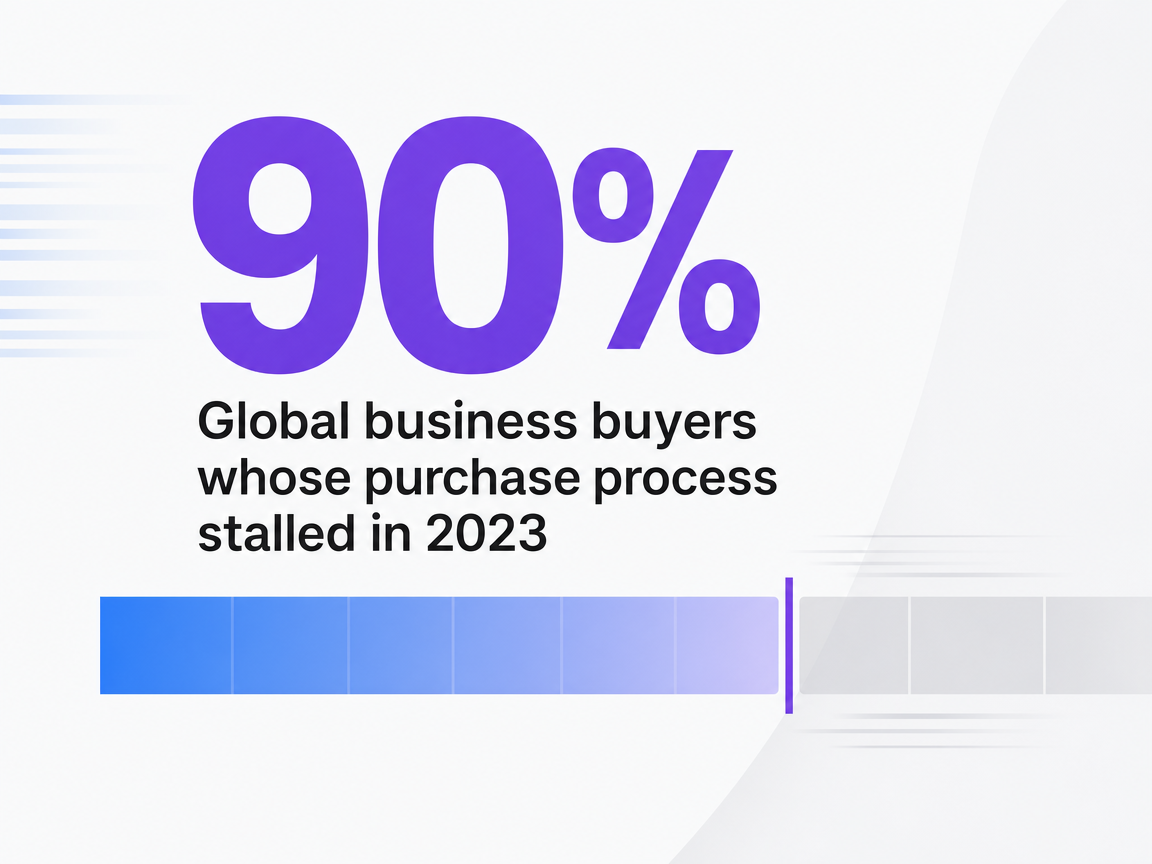 Global business buyers whose purchase process stalled in 2023
Global business buyers whose purchase process stalled in 2023
Keyword coverage is the sales conversation now
Sales reps used to answer the buyer's mid-journey questions. Now search results do. McKinsey's analysis of B2B growth, drawing on its multi-year B2B Pulse survey of buyers across industries and regions, found that roughly two-thirds of B2B buyers prefer digital or remote human interactions across the buying journey rather than in-person conversations with sellers 3. That preference holds even in complex, high-consideration purchases, which is precisely where legal, DSO, behavioral health, senior living, and home services deals sit.
The practical consequence for a Head of SEO is direct: for the two-thirds of a client's prospects who never want a rep on the phone until late, whatever ranks for their questions is the pitch. Not the sales deck. Not the case study library the BD team emails after a discovery call. The organic result, the AI Overview summary, the review-site listing, and the comparison article a prospect reads at 10 p.m.
That reframes the job of a keyword program. It is no longer sufficient to capture demand at the top and hand qualified traffic to sales. The program has to hold the buyer through requirements building, shortlisting, objection handling, and internal consensus — stages that used to belong to a rep and now belong to whatever content the buyer surfaces on their own.
Agencies that still measure keyword strategy by rankings and sessions are grading themselves on the opening line of a conversation their client is no longer part of. Coverage of the whole conversation is the deliverable.
The six buying jobs a keyword program has to cover
Mapping queries to problem identification, solution exploration, and requirements building
Forrester's 2024 State of Business Buying survey, which drew on more than 18,000 global respondents involved in recent purchases, describes the modern buyer journey as a set of recurring jobs buyers work through — largely self-service, largely non-linear — rather than a tidy funnel handed from marketing to sales 8. Six jobs recur across the data: problem identification, solution exploration, requirements building, supplier selection, validation, and consensus creation. Each generates a distinct query pattern. A keyword program that only covers the first two is running at roughly a third of its coverage potential.
Problem identification queries are diagnostic. A DSO operations lead searches "why is hygienist turnover killing production," not "dental staffing services." A general counsel at a mid-market company types "what triggers a DOJ second request" long before typing "antitrust counsel." These queries reward explanatory content — symptom framing, root-cause breakdowns, benchmarks — and rarely surface in a volume-ranked keyword export because the exact phrasing is low-frequency and highly varied.
Solution exploration queries compare categories against each other: in-house versus outsourced revenue cycle management, fractional CMO versus agency retainer, memory care versus assisted living with dementia support. Buyers are testing whether they even want the category the client sells. Content has to hold both sides honestly or the buyer bounces to a source that does.
Requirements building is where most agencies lose the thread. Buyers here draft internal criteria: "HIPAA compliant EHR requirements," "multi-site dental scheduling software features," "trust and estate attorney credentials." These are the queries that shape the RFP the client will eventually receive. Whoever ranks here writes the specification.
Supplier selection, validation, and consensus queries agencies systematically underweight
The back half of the buying-job set is where deals actually close, and it is also where most keyword programs go quiet.
Supplier selection queries name competitors, categories, and geographies together: "[competitor] alternatives," "top personal injury firms in Cook County," "best senior living operators in the Southeast." Forrester's 2023 Professional Services Buyer Insights report, which surveyed global buyers of professional services on their discovery and evaluation behaviors, documents that these buyers increasingly expect self-serve digital research — comparisons, case studies, credentialing evidence — before they will accept a sales conversation 10. If a client is invisible on shortlisting queries, they are not on the shortlist.
Validation queries look like due-diligence questions after a buyer has a preferred vendor: "[firm name] reviews," "[firm name] malpractice history," "[software] SOC 2 report," "[operator] state survey results." Buyers run these to disprove their own preference before committing. Ranking here — with owned content, review platform presence, and legitimate third-party coverage — is the difference between a signed engagement letter and a silent drop-off.
Consensus queries are what a champion types when selling internally. "How to justify legal spend to CFO," "ROI of outsourced marketing for multi-location dental," "board memo template for senior living capex." These are enablement queries, and they reward content that hands the champion a working artifact — a calculator, a comparison table, a one-page memo.
Ignore these three jobs and a keyword program can rank for the category, drive traffic, and still watch the client's pipeline flatten. Cover them and the same rankings start moving deals.
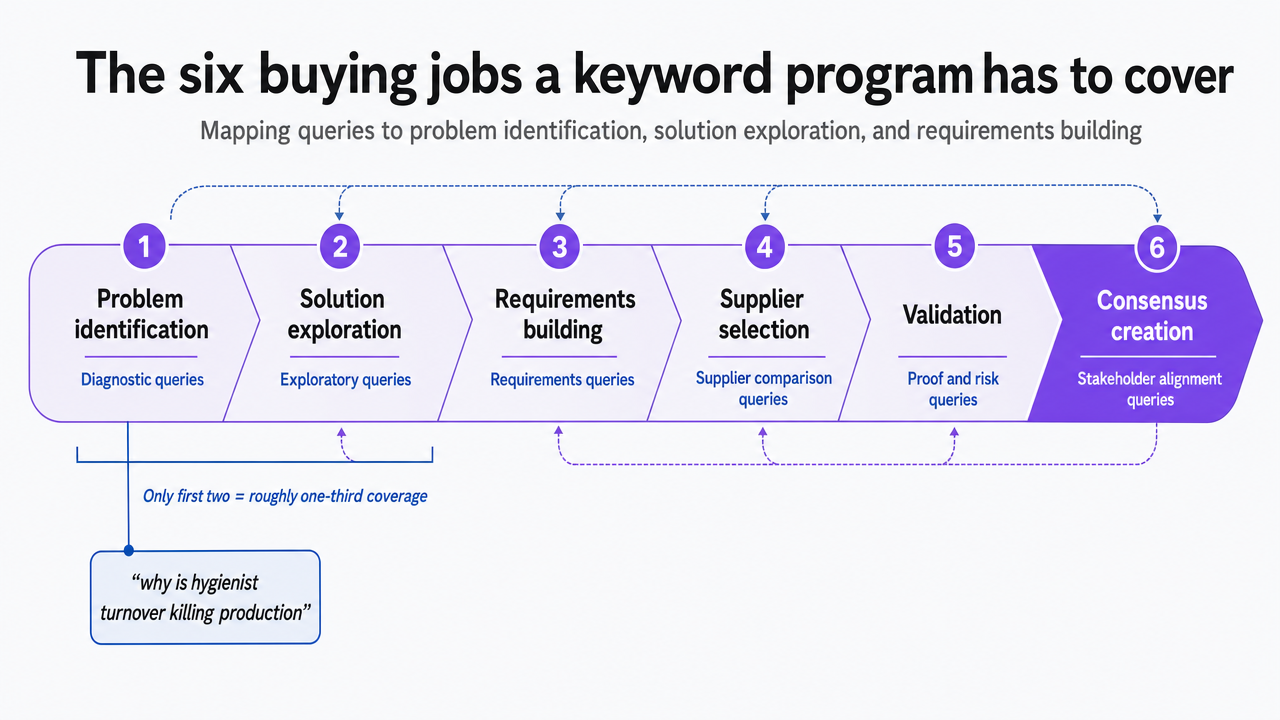 Process infographic mapping the six buying jobs to query types, directly visualizing the section's framework from Forrester's 2024 State of Business Buying
Test data-driven SEO keyword execution now
Trial real-time keyword strategies that impact client pipeline without commitment or risk.
The keyword categories that decide mid-funnel deals
Requirements-building and vendor-shortlisting queries
Requirements-building queries are the ones a buyer types after they have decided the category is real but before they have decided what the ideal vendor looks like. They read like specifications in draft form: "minimum case volume for a personal injury referral partner," "EHR interoperability requirements for a multi-site behavioral health practice," "CON requirements for a memory care expansion," "insurance and licensing checklist for a residential HVAC contractor." Whoever ranks for these queries gets to seed the criteria the buyer will apply to every subsequent shortlist.
Shortlisting queries then attach names to those criteria. They pair a competitor, category, or geography with a comparison word: "Clio versus MyCase for mid-market firms," "top DSO platforms for pediatric practices," "best senior living operators in the Carolinas." Forrester's 2023 Professional Services Buyer Insights survey of global buyers of professional services documents that these buyers now expect self-serve comparisons, credentialing evidence, and case documentation before they will take a sales meeting 10.
An agency delivering pipeline-relevant SEO builds a requirements page and a shortlist page for every priority service line, per vertical, per geography. Volume is beside the point. If three prospects a quarter run those queries and one converts, the client bought a placement in the RFP, not a click.
Risk, objection, and price-sensitivity queries
Risk and price queries are the ones agencies quietly avoid because clients dislike seeing them on a keyword sheet. They are also the ones tied most directly to whether deals close. "How much does an outsourced revenue cycle contract cost per month," "what happens if we cancel a marketing retainer early," "average settlement for a slip and fall case in Florida," "malpractice risk of switching EHR mid-year," "hidden fees in assisted living contracts."
Buyers run these queries specifically to disqualify options. The Forrester finding that most mid-journey deals stalled on price sensitivity and value-and-risk concerns rather than vendor discovery, cited earlier in this piece, points directly at this cluster. If a client's site is silent on cost drivers, cancellation terms, downside scenarios, or the specific fears a buying committee carries into an internal meeting, the buyer resolves those fears somewhere else — usually a competitor's blog, a Reddit thread, or a review site with an opinion of its own.
The practical move is to publish honest, structured answers: cost ranges with the variables that move them, cancellation and offboarding terms in plain language, common failure modes with mitigation, and side-by-side comparisons of the two or three approaches a buyer is weighing. Ranking for a $50,000 objection is worth more than ranking for a 5,000-volume category term.
Expertise proof and industry specialization queries in law, DSO, behavioral health, and senior living
High-stakes verticals share a specific search pattern: the buyer wants proof that a provider has handled a case, patient, resident, or operational scenario very close to their own. Generic authority signals do not clear the bar. Forrester's 2023 Professional Services Buyer Insights survey found that buyers in these categories explicitly seek expertise proof, case studies, and industry specialization evidence during evaluation, and treat its absence as a disqualifier 10.
What that looks like at the query level varies by vertical. In law, buyers search for "mass tort firm with talc verdict experience," "appellate attorney with Sixth Circuit reversals," or "trust and estate counsel for family-owned manufacturers." In DSOs, the queries fold operational specifics into the search: "DSO with orthodontic scaling playbook," "pediatric-first practice acquisition partner." Behavioral health buyers look for accreditation combinations, payer mix, and modality: "CARF-accredited PHP with Medicaid contracts in Ohio." Senior living operators search for regulatory-specific experience: "operator with clean state survey history in Texas assisted living."
These are not head terms and they will never appear on a volume-sorted keyword export. They also convert at rates the head terms cannot approach. Building coverage means treating every case, credential, verdict, accreditation, and regulatory experience the client actually holds as a discrete landing target — not a bullet in an About page.
AI assistants as a keyword surface, not a threat
ChatGPT, Perplexity, Claude, and Google's AI Overviews are already inside the buying journeys agencies are supposed to be covering. A DSO ops lead pastes three job descriptions into an assistant and asks which staffing model fits. A GC uploads an RFP and asks which firms tend to handle Sixth Circuit appeals. A family caregiver asks Perplexity for the difference between memory care and skilled nursing in Texas. Each of those exchanges is a query — just one the agency's rank tracker never sees.
The instinct in some agency shops is to treat this as an existential problem for SEO. It reads better as a coverage problem the discipline already knows how to solve. Assistants pull their answers from indexed sources: canonical pages, review sites, structured comparisons, professional directories, and the same requirements, shortlist, and validation content that ranks in traditional results. A keyword program built around the six buying jobs — problem identification through consensus creation, per Forrester's 2024 State of Business Buying survey of more than 18,000 global respondents 8— feeds those systems directly. A program built around service-line head terms does not.
The practical implication for a Head of SEO: audit which assistants cite which client pages, log the questions the assistants answer with a competitor's content, and route those gaps back into the requirements, objection, and expertise-proof categories already in the program. Assistants are not a new channel to build a strategy for. They are a new surface where the same buying-jobs coverage either shows up or does not.
See How Leading Agencies Automate Scalable Keyword Strategies Without Sacrificing Oversight
Request a walkthrough of AI-driven workflows that align keyword targeting to pipeline metrics—enabling your team to execute at scale, maintain quality, and report measurable impact across all client accounts.
If you run SEO delivery across a client portfolio: the operating model that scales
Separating strategist judgment from execution work
A scope note before this section develops: the argument shifts here from what a keyword program should cover to how a Head of SEO delivers that coverage across 15, 30, or 60 accounts without cloning senior strategists the agency cannot hire.
Most senior strategist hours on a client account fall into two categories that look similar on a timesheet and behave nothing alike. Judgment work is the part that requires a person who has run programs before: interpreting a buyer-jobs audit, deciding which requirements queries actually deserve a landing page this quarter, calling the tradeoff between an expertise-proof page for a niche practice area and a broader shortlist page, reading the client's pipeline data against the keyword map, and defending the whole thing in a QBR. Execution work is everything downstream: pulling SERP data, drafting brief skeletons, clustering variants, tagging queries against the six buying jobs, updating tracking sheets, and formatting deliverables.
On a traditional retainer, both categories sit on the same senior calendar. That is why a strong Head of SEO caps out somewhere around eight to twelve accounts before quality slips. The judgment work has a natural ceiling in hours per week. The execution work has no ceiling at all — it expands to fill whatever time is left, and it is almost never what a client is paying senior rates to receive.
Senior strategist capacity under two operating models
The economics get clearer once the two categories are separated on paper. The table below uses labeled variables rather than invented dollar figures — blended senior rate R, hours H, judgment split J — so the argument holds regardless of an agency's specific cost structure. McKinsey's 2024 B2B Pulse infographic on how top performers go to market reinforces the broader point: digital-first, data-driven execution models are what separate winning go-to-market operators from the rest of the field 9.
| Variable | Traditional keyword-brief model | Approval-gated AI-assisted model |
|---|---|---|
| Hours per account per month (keyword research + brief production) | ~12–16 H | ~4–6 H |
| Share of those hours that is judgment vs. execution | ~30% judgment / ~70% execution | ~80% judgment / ~20% execution |
| Senior judgment hours consumed per account per month | ~4 H | ~4 H |
| Senior execution hours consumed per account per month | ~10 H | ~1 H |
| Accounts per senior strategist ceiling (at ~140 productive H/month) | ~10 accounts | ~28–32 accounts |
| Cost exposure per account | ~14 H × R | ~5 H × R |
The judgment column barely moves. That is the point. A senior strategist still spends roughly the same four hours per account on the decisions only they can make. What changes is the execution overhead sitting on top of those hours. Cut the execution load and the same senior head runs 3x the portfolio without shortening a single QBR or thinning a single strategic call.
Approval gates: where senior review stays non-negotiable
Moving execution to AI-assisted workflows only works if the approval gates are drawn in the right places. Four decisions cannot be delegated without eroding the delivery quality the model is supposed to protect.
- The buying-jobs map itself. Which of the six jobs the program prioritizes this quarter, per client, per vertical, is a senior call informed by pipeline data — not a template.
- The requirements and shortlist pages that will seed a client's RFPs. Anything that shapes how a buyer specifies the category deserves human sign-off on angle, competitor framing, and evidence claims.
- Risk, objection, and price-sensitivity content. Publishing honest cost ranges or cancellation terms without senior review exposes the client to positioning mistakes that outlive the campaign.
- Expertise-proof content in regulated verticals — verdicts, accreditations, state survey results, clinical outcomes — where a factual error is a legal or licensure problem, not an SEO one.
Everything else — clustering, tagging, SERP pulls, brief scaffolds, internal link suggestions, tracking updates — can move through automation with spot-check review. The rule of thumb: automate what a strategist would delegate to a junior analyst. Keep the strategist on what a client is actually paying them to decide.
Reporting keyword strategy as pipeline coverage, not rankings
The reporting layer is where a pipeline-led keyword program either earns its retainer or quietly reverts to a rankings dashboard. If a QBR opens with average position, share of voice, and organic sessions, the client's finance team will keep asking why SEO spend is not showing up in the pipeline column of the CRM. The metrics have to change with the strategy.
A pipeline-coverage report reads differently. It opens with buying-job coverage: how many of the six jobs — problem identification, solution exploration, requirements building, supplier selection, validation, consensus creation — the client owns first-page ranking or AI Overview inclusion for, per priority service line and geography. Forrester's 2024 State of Business Buying survey of more than 18,000 global respondents supplies the framework, and it maps cleanly onto a coverage percentage the client can track quarter over quarter 8.
The second layer is query-to-pipeline attribution. Which requirements, shortlist, objection, and expertise-proof queries brought a session that turned into a qualified call, a booked meeting, or an RFP invitation. This is where CRM data, call intelligence, and form-fill routing have to be wired into the report — not as a separate analytics deliverable, but as the primary column next to each query cluster.
The third layer is gap movement. Which underweighted categories closed this quarter, which competitors lost validation-query real estate, which AI assistants started citing the client's content. Rankings still appear on the report. They just stop being the headline.
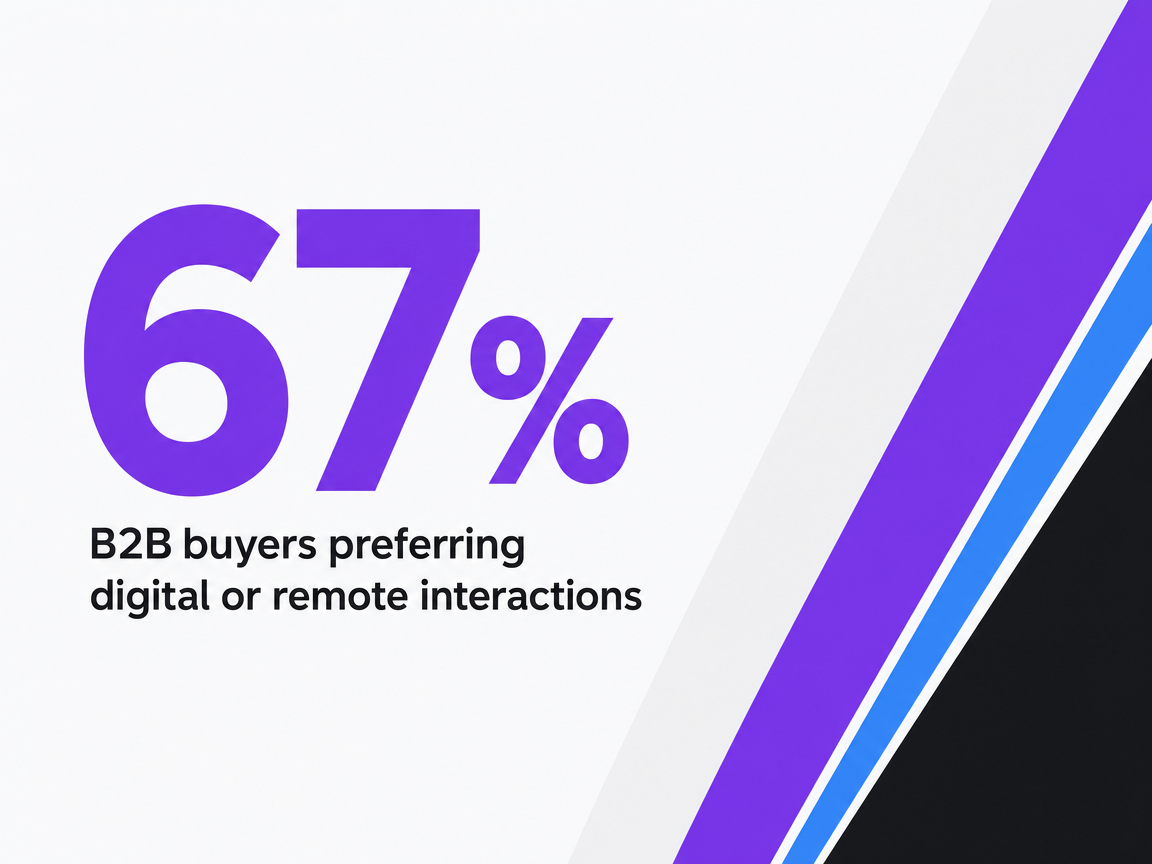 B2B buyers preferring digital or remote interactions
B2B buyers preferring digital or remote interactions
Frequently Asked Questions
References
- 1.Forrester's 2023 Global Buyers' Journey Survey.
- 2.The State of Business Buying And The B2B Buyers Journey.
- 3.The New B2B Growth Equation.
- 4.Google Trends: Opportunities and limitations in health and health policy research.
- 5.Comparing Web search engine performance in searching consumer health information: evaluation and recommendations.
- 6.Assessing domains of uncertainty in critical Web-based healthcare information.
- 7.When and in what circumstances is patient-targeted googling acceptable for health and social care professionals? A narrative review and thematic analysis.
- 8.The State Of Business Buying, 2024.
- 9.5 Fundamental Truths: How B2B Winners Go to Market.
- 10.2023 Buyer Insights: Professional Services Industry.