
Key Takeaways
- Head terms anchor a content hub as a pillar page, distributing authority across supporting content and requiring low velocity but high structural completeness across subtopics.
- Long-tail informational keywords power aggregate traffic through narrow, question-answering pages shipped at high velocity, compounding topical authority when linked back to a pillar.
- Commercial investigation keywords demand comparison or evaluation pages with declared criteria, direct-experience signals, and a defensible point of view rather than neutral summaries.
- Transactional keywords require service or product pages that lead with the offer and conversion element, since the searcher wants to complete an action, not read explanation.
- Visit-in-Person keywords, added in Google's rater guidelines 8, route to local landing pages with NAP data, maps, and original location detail that national templates cannot fake.
Why Keyword Type Determines Page Type
Search demand is not evenly distributed across intent. A widely cited Penn State analysis of query logs found that roughly 80 percent of web searches are informational, about 10 percent are navigational, and about 10 percent are transactional 3. That single distribution, drawn from large-scale query classification research, does more to shape a content calendar than any keyword tool output. Four out of five searches are people looking to learn something, which means four out of five production slots should be earning attention with explanatory pages, not conversion pages.
The practical consequence is that keyword type is a routing decision, not a labeling exercise. An informational query rewards a guide, explainer, or hub page that can be referenced across multiple visits. A navigational query rewards a branded landing page or a well-structured homepage. A transactional query rewards a service page, product page, or checkout-adjacent asset built to complete an action. Google's own quality evaluation framework judges results on how fully they satisfy the intent behind the query, not on how many times the query terms appear on the page 7.
For a content manager sizing weekly output, this reframes the brief. Before assigning volume or word count, the type of keyword decides which template a writer works from, which SERP features to target, and which conversion event to instrument. The five categories that follow are organized around that routing decision, so each entry in an editorial calendar can be mapped to a specific page format with a defensible reason.
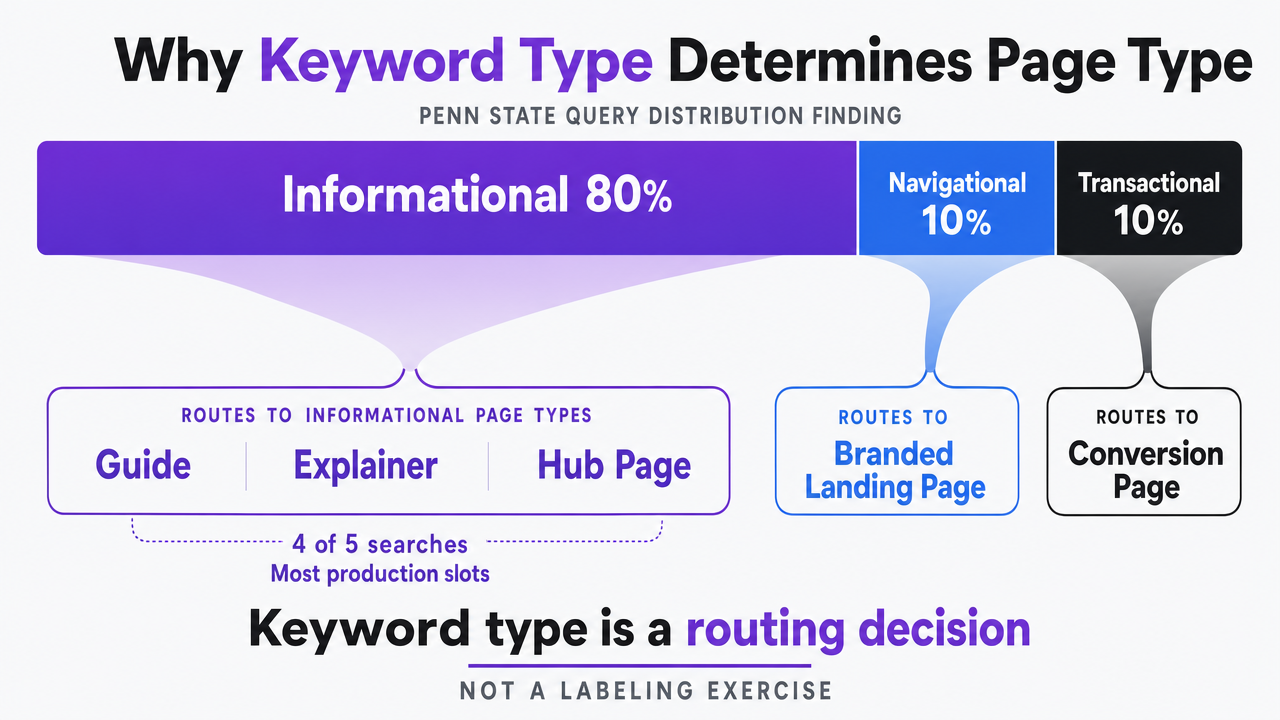 Visualize the Penn State query distribution finding cited in the section prose (80% informational, 10% navigational, 10% transactional), which is the single most concrete data point in the article and directly supports the section's argument that keyword type determines routing
The Intent Framework Behind the Five Types
The five categories in this article rest on two overlapping taxonomies. The older one comes from Andrei Broder's 2002 paper, which classified web queries into three intent classes: informational (learning something), navigational (finding a specific site), and transactional (completing an action such as buying, downloading, or booking) 1. Jansen and colleagues later operationalized those definitions for query log analysis, describing informational queries as content-seeking, navigational queries as single-destination, and transactional queries as a prelude to an online action 2. Stanford's information retrieval textbook uses the same three-part split and adds an important behavioral note: informational queries often require the searcher to consult multiple pages before the need is satisfied 4. That single observation is why cluster and hub content models exist.
Google's rater documentation extends the classic three into four. The General Guidelines describe Know, Do, Website, and Visit-in-Person intents 8. Know maps roughly to informational. Do maps to transactional. Website maps to navigational. Visit-in-Person is the addition: queries where the searcher intends to go somewhere physical, such as a clinic, restaurant, or dealership. The November 2023 update to the rater guidelines confirmed that Google actively refines these categories rather than treating them as fixed 9, which is why an intent-first keyword strategy holds up better than one built around exact-match terms.
The five keyword types covered in the remaining sections combine both frameworks. Head terms and long-tail informational queries sit inside Know. Commercial investigation queries sit at the boundary between Know and Do, where a searcher is comparing options before acting. Transactional keywords occupy Do. Visit-in-Person keywords form the fifth category, drawn directly from the expanded rater taxonomy. Navigational queries are addressed briefly where they overlap with branded head terms but do not warrant their own production track for most content teams, since branded traffic is earned through the other four categories over time.
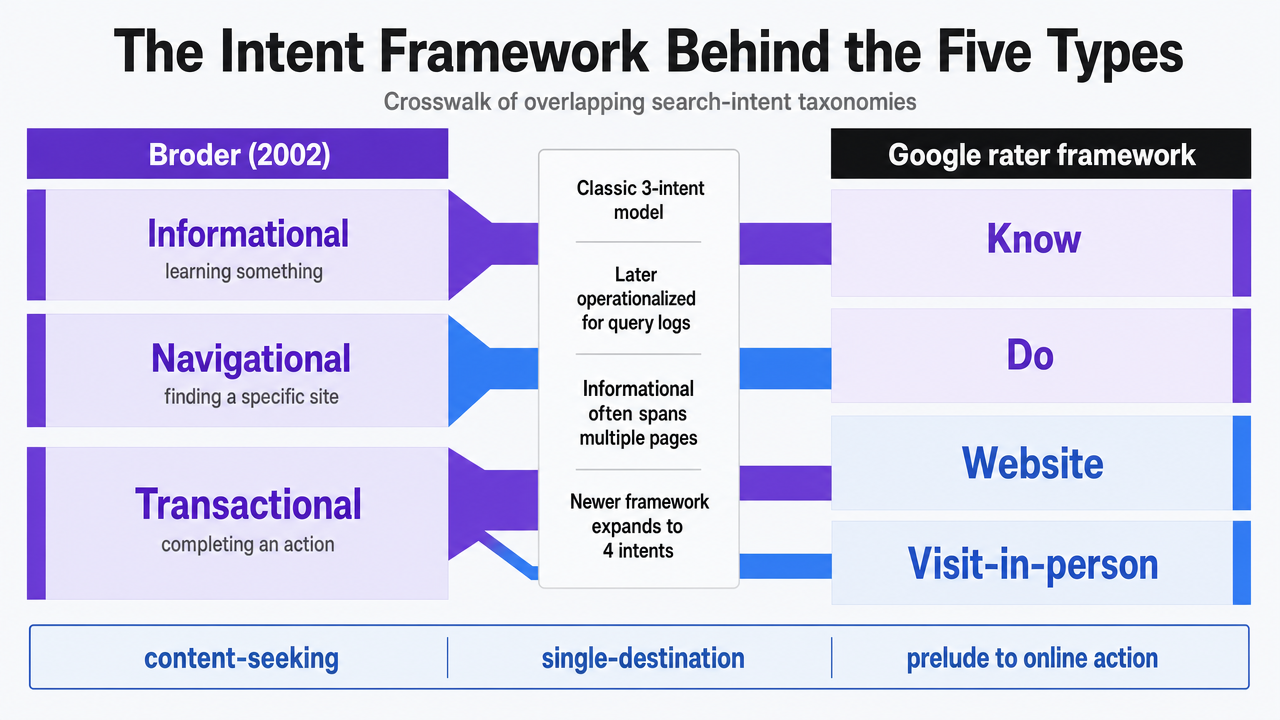 Visualize the crosswalk between Broder's classic three-intent taxonomy and Google's expanded four-intent rater framework, which the section explicitly compares in prose. This maps the two overlapping frameworks that anchor the entire article
Head Terms: Broad Themes That Anchor a Content Hub
Head terms are the one- or two-word queries that describe an entire topic: content marketing, personal injury law, dental implants, senior living. Search volume is high, competition is brutal, and click-through is diluted across ads, featured snippets, People Also Ask, and a crowded organic block. A content team that chases a head term as a single blog post almost always loses. A content team that treats a head term as the anchor of a hub can win the topic over 12 to 18 months of steady production.
The reason is embedded in how searchers behave. Stanford's information retrieval chapter notes that informational queries frequently require the reader to consult multiple pages before their need is met 4. A head term signals a broad information need, not a specific question, so the searcher is scanning for a resource that will orient them and point to the next click. That resource is a pillar page: a long, structured guide that defines the topic, previews its subcategories, and links out to deeper pages on each one.
Head-term briefs look different from long-tail briefs. The deliverable is 2,500 to 4,000 words, organized around subtopic H2s that each map to a planned or existing supporting page. Internal links carry more weight than external backlinks at this stage, because the pillar's job is to distribute authority across the cluster. Google's SEO Starter Guide frames the standard plainly: content should be unique, up to date, and helpful 5, which for a head-term page means the guide has to be more complete than the top three competing results, not merely competitive with them.
Production velocity is low here by design. One pillar per quarter, refreshed twice a year, is a reasonable cadence for a single vertical. The pillar earns its keep by anchoring dozens of long-tail pages that would otherwise float without topical context.
Test real keyword strategies with live publishing access
Experiment with actionable SEO keyword examples and measure content impact—all within your actual workflow.
Long-Tail Informational Keywords: The Volume Engine
Long-tail informational keywords are the specific, multi-word questions that sit under a head term. Where dental implants is a hub anchor, how long do dental implants last after gum recession is a supporting page. Search volume per query is modest. Aggregate volume across a well-planned cluster is where most organic traffic actually comes from, because these queries convert into pages that rank quickly, satisfy a narrow intent, and accumulate over time.
Jansen's operational definitions frame informational queries as content-seeking: the searcher wants an answer, not a destination or a purchase 2. That intent translates directly into brief structure. A long-tail informational page opens by answering the question in the first paragraph, expands with the necessary context, and closes without a hard conversion push. Google's helpful content guidance is explicit that pages should be created primarily for people, not to manipulate rankings 6, which for a content manager means the brief should be judged on whether the question is fully answered, not on keyword density.
Discovery is where most teams stall. Google Trends is a free ideation surface that Google itself documents for this purpose. Its Explore tool can compare up to five terms at a time, show regional interest, and surface related topics and rising queries 10. A practical workflow uses each capability for a specific ideation step:
- The five-term comparison ranks candidate subtopics against each other for relative demand.
- Regional interest identifies where a topic is heating up in a specific state or metro.
- Related topics expand a seed term into adjacent question territory.
- Rising queries flag emerging long-tail phrases before they saturate.
A weekly 30-minute Trends session, run against the pillar's subtopic list, typically yields 8 to 12 briefable long-tail titles.
Production velocity is high by design. A single writer or content system can ship three to five long-tail pages per week against a mature cluster, because each brief is narrower, the target word count is 900 to 1,500 words, and the SERP feature to target is usually the People Also Ask block or a featured snippet. Google's rater documentation reinforces the standard: usefulness is judged by how fully the result satisfies the intent behind the query 7. For a long-tail page, that satisfaction test is concrete:
- Does the first 100 words answer the question?
- Does the rest of the page anticipate the follow-up questions the searcher will have?
- Does the page link back to the pillar and sideways to sibling pages in the cluster?
The compounding effect matters more than any single page's traffic. A cluster of 40 long-tail pages linked to one pillar builds topical authority that lifts the entire hub, which is why the head term and long-tail categories are best planned together rather than as separate tracks.
Commercial Investigation Keywords: Comparison and Evaluation Pages
Commercial investigation keywords are the queries a searcher runs after they know they have a problem but before they are ready to buy. Phrases like best CRM for small law firms, Invisalign vs veneers cost, or SEO agency alternatives sit between Know and Do in Google's expanded rater framework 8. The searcher is still gathering information, but the information they want is comparative: which option, which provider, which price tier, which trade-off. That shift in intent changes the page format.
The right deliverable is a comparison or evaluation page, not a general guide. Common formats include head-to-head comparisons of two named options, ranked lists of alternatives with selection criteria stated up front, and buyer's guides that walk through the decision variables before recommending a shortlist. Each format shares a structural requirement: the page has to declare its evaluation criteria in the first screen. Searchers at this stage are scanning for a framework they can defend internally, and Google's rater documentation judges usefulness by how fully the result satisfies the intent behind the query 7. A comparison page that hides its methodology fails that test regardless of word count.
Briefs for commercial investigation pages carry three non-negotiable elements:
- A criteria table or ranked matrix that lets the reader compare options at a glance.
- Direct-experience signals, such as screenshots, pricing pulled from public sources, or feature specifics, because Google's helpful content guidance rewards demonstrable first-hand knowledge over paraphrased marketing copy 6.
- A stated point of view on which option fits which buyer profile. Neutrality is not the goal; defensible reasoning is.
Production velocity sits between the pillar and the long-tail cadence. One well-researched comparison page per week per vertical is a realistic target, since the research load is heavier than a long-tail explainer but the page compounds faster than a hub piece once it ranks.
Transactional Keywords: Service and Product Pages
Transactional queries are the ones a searcher runs when the decision is essentially made. Book dental implant consultation, hire personal injury lawyer, content marketing platform pricing, download SEO audit template. Broder's original taxonomy classifies these as transactional because the intent is to complete an action, whether that action is a purchase, a download, a signup, or a booking 1. Stanford's information retrieval chapter sharpens the point: a transactional query is a prelude to an online action, which means the page that ranks needs to make that action possible in the first screen 4.
Service and product pages are the deliverable. The brief structure is inverted from an informational page. Instead of leading with explanation, a transactional page leads with the offer, the price signal, and the conversion element, then supports those with proof: credentials, guarantees, timelines, and objection-handling. Word count is usually 600 to 1,200 words, because additional prose past that point tends to push the conversion element below the fold without adding decision value. Jansen's operational definition holds up here as a brief test: if the page does not let the searcher complete or initiate the action they came for, it has not satisfied the query 2.
Production velocity for transactional pages is the lowest of the five categories, but the leverage is the highest. A single service page that ranks for its transactional query typically outperforms twenty informational pages on revenue contribution. One or two new or refreshed service pages per quarter, with tight attention to schema markup, page speed, and conversion instrumentation, is a defensible cadence for most content teams.
See How Enterprise Teams Operationalize Keyword Strategies With AI
Connect with our specialists to review actionable workflows for scaling keyword research, clustering, and content approvals—built for agencies and brands managing high-volume SEO programs.
Visit-in-Person Keywords: The Category Most Listicles Miss
The fifth category rarely shows up in keyword-type listicles because it did not exist in Broder's original taxonomy. Google's General Guidelines added it explicitly: Visit-in-Person queries are searches where the user intends to go somewhere physical 8. Dentist near me, personal injury lawyer Grand Rapids, urgent care open now, senior living Traverse City. The searcher is not looking for a guide, a comparison, or a national service page. They want a location, hours, directions, and a way to book or call.
For content teams serving multi-location operators, franchises, or single-site service businesses, this category is the highest-leverage of the five. A local landing page that ranks for its city-plus-service query typically drives more qualified calls than an entire cluster of informational content, because the searcher has already moved past evaluation. Jansen's operational framing applies with a physical twist: the query is a prelude to an offline action, so the page has to make that action possible without friction 2.
The brief for a local landing page departs from the other four formats. Word count runs 500 to 900 words, but the structural elements matter more than the prose. Each page needs:
- The location's full NAP data
- Embedded map
- Service-area language
- Staff or provider names where relevant
- Photos of the actual site rather than stock imagery
Google's helpful content guidance rewards first-hand, demonstrable knowledge 6, and for a local page that translates directly into original photography, real reviews, and location-specific detail that a national template cannot fake.
Production velocity depends on footprint. A single-location business ships one page and refreshes it quarterly. A 40-location operator ships 40 templated pages with unique local content in each, which is where most in-house teams stall without an execution model built for volume.
Matching Execution Models to Keyword Type
Five keyword categories mean five different brief structures, five different velocity targets, and five different quality bars. That variance is what breaks single-model content operations. A freelance writer optimized for long-tail explainers rarely produces a defensible comparison page. An agency retainer priced for pillar production burns budget on local landing pages that should be templated. An in-house team of two cannot ship 40 location pages and a quarterly pillar and weekly long-tail cadence without something slipping.
The four common execution models each have a natural fit:
- Freelance networks work well for long-tail informational pages, where briefs are narrow and volume matters more than institutional knowledge.
- Traditional agencies fit pillar and comparison work, where research depth and editorial oversight justify the retainer.
- In-house teams own transactional service pages, because conversion copy is inseparable from product knowledge, positioning, and legal review.
- Local landing pages sit awkwardly across all three: too templated for an agency to price fairly, too voluminous for in-house teams, too location-specific for a freelance pool to research at scale.
AI-augmented execution changes the math on the categories that stall under human-only models. A platform that produces briefs, drafts, and location-specific variants against an approved template can ship 40 local pages in the time an in-house team ships three, without offloading judgment. Google's rater documentation still governs the quality bar: usefulness is judged by how fully the result satisfies the intent behind the query 7, and helpful content guidance rewards first-hand, demonstrable knowledge over generic output 6. Those standards apply equally to human and machine production, which is why the practical question is not whether to use AI but where in the approval workflow human sign-off sits.
A defensible allocation for a mid-sized content team looks like this: agency or senior in-house talent on one pillar per quarter and one comparison per month, freelance or AI-augmented production on three to five long-tail pages per week, in-house ownership of one or two transactional pages per quarter, and templated AI-augmented production for local pages at whatever footprint the business operates. The keyword type dictates the model, not the other way around.
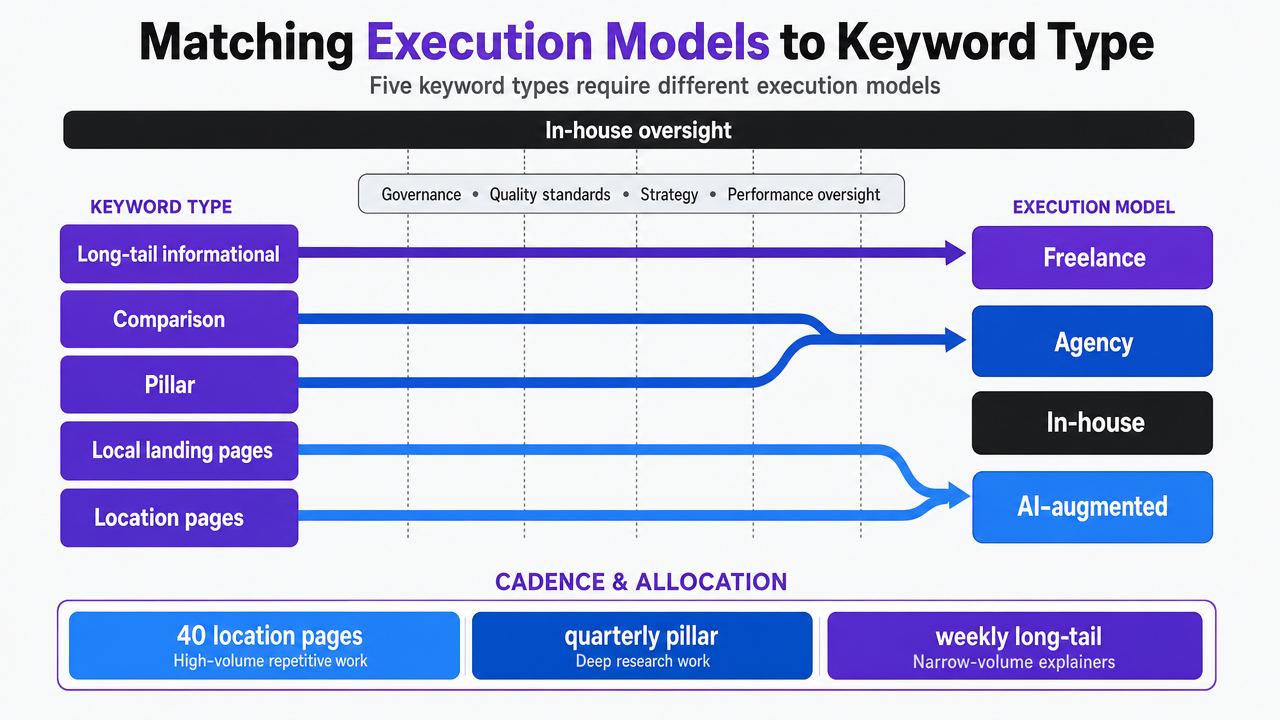 Visualize the section's explicit routing model between the five keyword types and four execution models (freelance, agency, in-house, AI-augmented), including the recommended cadence allocation stated in the closing paragraph
Building the Editorial Calendar From the Five Types
A defensible editorial calendar treats each of the five keyword categories as a separate track with its own cadence, brief template, and quality gate.
- Head terms drive one pillar per quarter per vertical.
- Long-tail informational queries fill the weekly production line at three to five pages.
- Commercial investigation work runs at roughly one comparison page per month.
- Transactional service pages get one or two refreshes per quarter, with conversion instrumentation as the acceptance test.
- Local landing pages scale with footprint, from one per single-site business to dozens for multi-location operators.
Sequencing matters as much as volume. A new topic cluster starts with the pillar, then seeds 8 to 12 long-tail titles pulled from a Google Trends session against the pillar's subtopic list 10. Comparison pages come next, once the cluster has enough topical authority to rank for evaluation queries. Transactional pages are refreshed against the cluster once informational traffic starts feeding them. Local pages run on their own track, tied to physical expansion rather than topic cadence.
The calendar's job is to route each brief to the execution model that fits its intent, not to force every page through the same template. Intent decides format, format decides brief, brief decides who ships it. Vectoron was built for that routing decision.
Frequently Asked Questions
References
- 1.A taxonomy of web search.
- 2.Determining the informational, navigational, and transactional intent of Web queries.
- 3.IST researchers classify Web searches.
- 4.User query needs - Stanford NLP Group.
- 5.Search Engine Optimization (SEO) Starter Guide.
- 6.Creating Helpful, Reliable, People-First Content.
- 7.Search Quality Rater Guidelines: An Overview - Google Search.
- 8.General Guidelines.
- 9.Search Quality Raters Guidelines update.
- 10.Get started with Google Trends | Google Search Central.