
Key Takeaways
- Treat keywords as a portfolio, not a list: every cluster needs a named owner, a defined conversion path, and a pipeline-contribution KPI before it earns budget.
- Volume-first sorting leaks revenue by overweighting informational queries; rank terms by intent first, then filter by volume, since more than 80% of web queries are informational 10.
- Map BOFU queries to pages built to close — pricing, comparison, and demo terms belong on pricing, head-to-head, and trial pages, not blog posts 5.
- Focus next on governance and measurement: an approval workflow, quarterly cluster reviews, and a CRM-sourced pipeline view keep organic accountable to sales-accepted opportunities rather than sessions.
The pipeline test every keyword list should pass
Most keyword strategies fail one question: which of these terms, if we ranked for them, would produce a qualified opportunity a sales team would actually accept? A ranked list ordered by search volume rarely survives that filter. A list ordered by intent, cluster ownership, and named conversion path usually does.
The benchmark worth anchoring to is directional, not aspirational. Organic search drove a median 27% of sourced pipeline among B2B SaaS companies in 2024, according to a secondary benchmark aggregating vendor and HubSpot data 8. That figure sets a realistic ceiling for how much of a revenue number organic can carry when the strategy is built around pipeline contribution rather than session growth. It is not a promise. It is a scope marker: half of comparable companies fall below it, and the benchmark itself is drawn from a marketing firm's aggregation rather than primary research.
The implication for an in-house VP is straightforward. A keyword strategy that cannot connect each cluster to a specific conversion path, a named owner, and a pipeline-contribution KPI is producing traffic reports, not revenue. Google's own guidance points in the same direction: use the words searchers actually use, place them where both users and search engines can find them, and subordinate keyword targeting to whether the page helps the reader finish what they came to do 2, 3.
Everything that follows treats a good SEO keywords strategy as a portfolio decision. Intent classification decides what belongs in the portfolio. Funnel mapping decides where each cluster sits. Governance and measurement decide whether the portfolio earns its budget or drifts into a cost center.
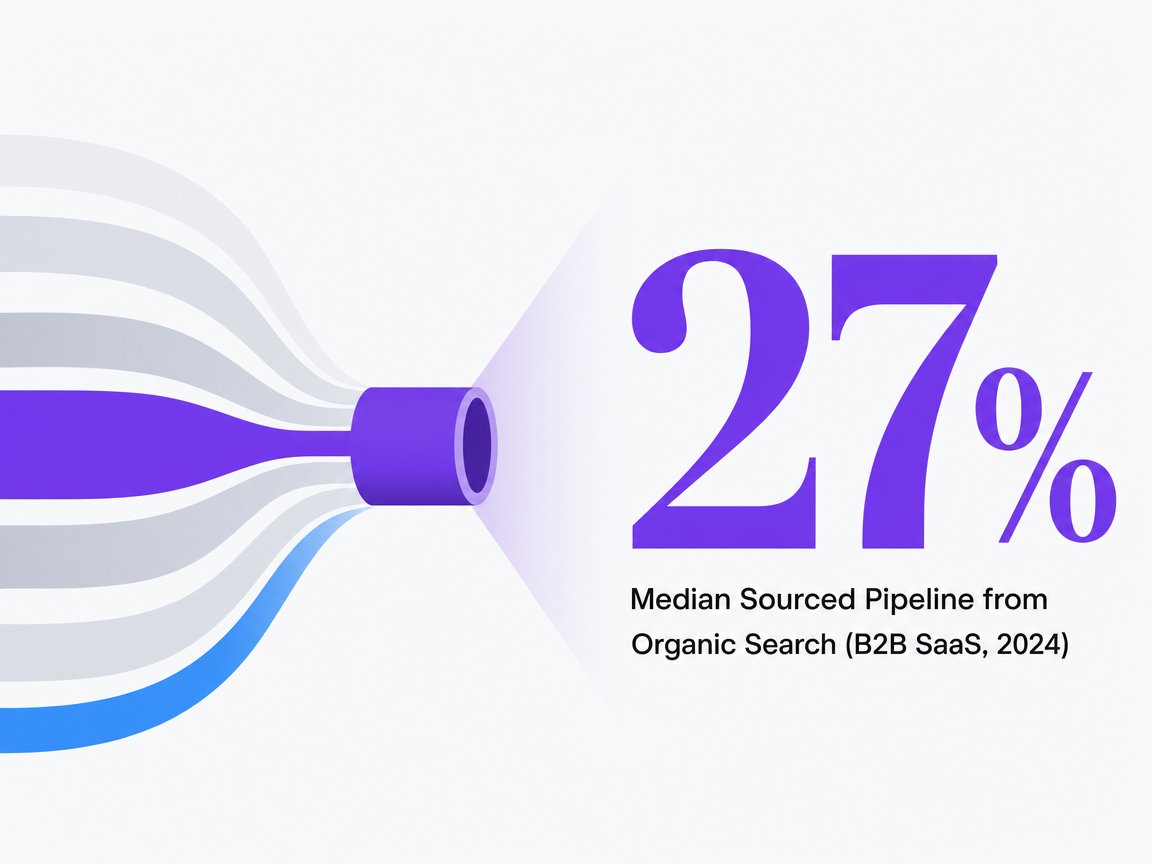 Median Sourced Pipeline from Organic Search (B2B SaaS, 2024)
Median Sourced Pipeline from Organic Search (B2B SaaS, 2024)
Why volume-first keyword strategies leak revenue
Sorting a keyword list by monthly search volume is the fastest way to build a plan that ranks and still misses the number. High-volume terms skew toward the top of the funnel, where the reader is defining a problem, comparing categories, or gathering vocabulary. Ranking there produces sessions. It rarely produces a qualified opportunity in the next quarter.
The mechanics are simple. A volume-first list overweights broad informational queries because that is where the traffic lives. It underweights the narrower, harder-to-produce terms that signal purchase intent: comparison queries, pricing questions, implementation concerns, and vendor-specific language used by evaluators. HubSpot's practitioner framing makes the same point: B2B keyword research is the process of identifying buyer search terms and ranking them by intent, not by volume 6. Salesforce's guide reaches a similar conclusion when it recommends pairing bottom-of-funnel terms such as "price," "demo," and "[brand] versus [competitor]" with pricing, trial, and product pages 5.
Revenue leaks in two predictable places:
- First, budget flows to content designed for search visibility rather than reader outcomes, which Google's helpful-content guidance explicitly discourages 3.
- Second, the pages that do earn traffic have no conversion path attached, so sessions convert to newsletter subscribers or bounce, not to sales-accepted opportunities.
The correction is not to abandon volume as a signal. It is to treat volume as a filter applied after intent, funnel stage, and conversion path have been decided. That reordering is what separates a keyword list from a pipeline portfolio.
Intent classification: the layer most keyword lists skip
The three-bucket model and its ceiling
The working taxonomy that has held up for two decades sorts queries into three buckets:
- Informational (learn something)
- Navigational (find a specific site)
- Transactional (do something, usually buy)
It is imperfect, but it is the backbone practitioners still use because it survives contact with real search logs.
The distribution matters more than the labels. Query classification research found that more than 80% of web queries are informational in nature, with roughly 10% each navigational and transactional 10. That ratio is drawn from broad web-search behavior rather than B2B software buyers specifically, so a VP should treat it as a directional constraint, not a precise forecast for a niche category.
The constraint is the point. If four out of five queries in the wild are informational, then the pool of high-intent, ready-to-buy searches inside any given category is inherently thin. A keyword strategy that assumes bottom-of-funnel volume will carry the pipeline number is fighting the underlying distribution of how people search. The math forces a choice: either build enough informational coverage to feed a nurture path that converts later, or concentrate resources on the small transactional pool and accept that its absolute volume will be modest.
Most keyword strategies drift into a third option by accident — producing informational content with no nurture path and no transactional pages worth ranking for. The three-bucket model, used honestly, prevents that drift by making the ceiling visible before the calendar gets filled.
Where informational, navigational, and transactional buckets break down
The three-bucket model is a starting point, not a finish line. Academic work on query intent has long acknowledged the definitional problem: search intent is what the user implicitly hoped to find using the submitted query, and that hope is often ambiguous even to the searcher 9. A query like "marketing attribution" could be a VP checking a definition, an analyst comparing methodologies, or a buyer late in an evaluation reading vendor language. Same string, three different pipeline implications.
Two failure modes follow from this ambiguity:
- The first is mislabeling: a term gets filed as informational because the SERP is dominated by blog posts, when in fact the searcher is comparing vendors and would click a product page if one ranked.
- The second is over-labeling: a term gets marked BOFU because it contains the word "software" or "pricing," when the actual searchers are researchers, students, or competitors.
Broader intent frameworks help correct both errors. One classification approach separates intents by content, task, social, and aggregation goals, capturing that a single query can carry more than one dimension of purpose 11. Practically, that means intent labels should be applied by looking at the SERP, the pages that currently rank, the click behavior on those pages, and the language of the query itself — not by pattern-matching on trigger words. Intent classification is a judgment call informed by evidence, and treating it as a spreadsheet dropdown is where most portfolios lose accuracy.
Buying-committee intent variants that most lists miss
The intent variants that decide pipeline outcomes usually sit outside the standard buckets. A modern B2B purchase involves a buying committee — economic buyer, technical evaluator, end user, procurement, sometimes legal — and each role searches differently for the same underlying decision. A generic keyword list flattens all of them into "category + software" and misses the queries that actually surface an active evaluation.
The variants worth naming:
- Comparison queries ("[category] vs [category]," "[vendor] alternatives")
- Validation queries ("[vendor] reviews," "[vendor] pricing," "[vendor] implementation time")
- Risk queries ("[category] security," "[vendor] SOC 2," "[category] data residency")
- Integration queries ("[vendor] + [existing stack tool]")
Each maps to a role on the committee and a specific objection that has to clear before a deal advances. The Starr Conspiracy's operating model goes further and describes targeting buying-committee search patterns as the shift that separates traffic from pipeline, though as a marketing-firm publication its framing is directional 7.
The operational takeaway is to build the portfolio with named committee roles attached to each cluster. If a cluster cannot be tied to a role, an objection, and a page that resolves it, the cluster is producing sessions for someone else's funnel.
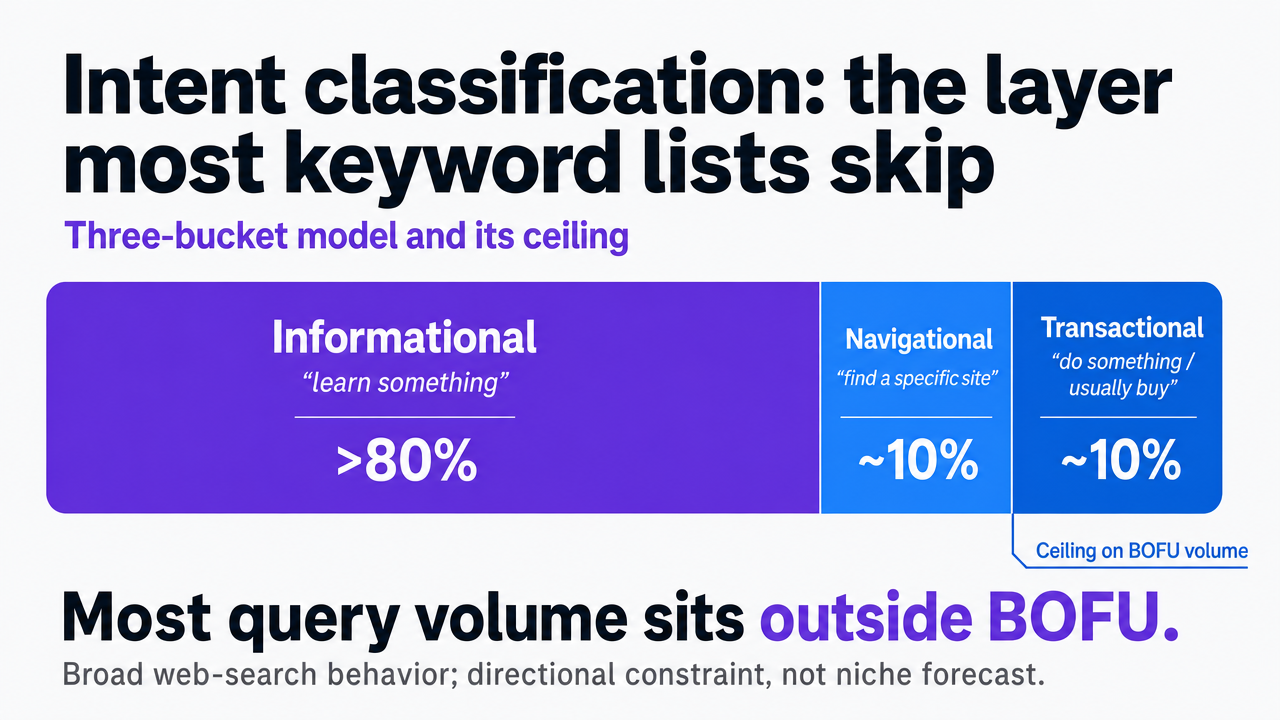 Visualize the three-bucket query intent distribution (>80% informational, ~10% navigational, ~10% transactional) that the section cites and uses to explain the ceiling on BOFU volume
Test AI-driven SEO keywords for real pipeline impact
Validate your SEO keyword strategy by publishing live content and tracking pipeline results in your market.
Building the keyword portfolio, not the keyword list
Clusters, owners, and named conversion paths
A keyword list is a spreadsheet. A portfolio is a set of clusters, each with a named owner, a defined conversion path, and a pipeline-contribution KPI. The difference is who gets called when a cluster underperforms.
A cluster is a group of semantically related queries that share a searcher goal and a target page or small page set. "Marketing attribution software," "attribution platform comparison," and "multi-touch attribution vendors" belong in one cluster because they resolve to the same evaluation decision. "How does marketing attribution work" belongs in a different cluster, further up the funnel, resolving to a different reader outcome. Google's guidance is blunt on why the grouping matters: pages should help the reader finish what they came to do, and that requires knowing what the reader came to do 3.
Each cluster needs three attachments before it enters the portfolio:
- An owner — usually a content lead, product marketer, or demand gen manager who is accountable for the cluster's page quality and conversion rate.
- A conversion path: the specific next step the page invites, whether that is a demo request, a self-serve trial, a gated benchmark download, or a nurture sequence for readers not yet in-market.
- A KPI expressed in pipeline terms — sales-accepted opportunities sourced or influenced by the cluster over a defined window, not sessions or keyword rankings.
Clusters without those three attachments are decoration. They may rank, but no one on the team can say what they contribute or defend them in a budget review.
Mapping BOFU keywords to the pages that close
Bottom-of-funnel keywords fail more often from bad page mapping than from weak content. The query signals an evaluation moment; the page has to resolve it in one visit.
Salesforce's practitioner guidance names the pairings directly: match "price," "demo," and "[brand] versus [competitor]" queries with pricing pages, free trial pages, and product landing pages 5. The mapping is not exotic, but three failures show up repeatedly in audits:
- Pricing queries route to a blog post explaining pricing models instead of a pricing page.
- Comparison queries route to a category overview instead of a head-to-head page with a decision table.
- Demo queries route to a product tour that requires three more clicks to reach a form.
The fix is to inventory every BOFU cluster against the page it currently resolves to, then score that page on three questions:
- Does it answer the query in the first screen?
- Does it include the objection the searcher is likely carrying — security, integration, implementation time, contract terms?
- Does it offer a conversion action appropriate to the intent, rather than a generic newsletter signup?
Pages that fail any of the three are the highest-leverage fixes in the portfolio. Ranking improvements on unmapped BOFU pages produce sessions that convert at informational-page rates, which is the pattern that turns organic into a cost center.
Governance: approval workflow and the single pipeline view
Portfolios drift without governance. Clusters get added because a query looked interesting, pages get published without a conversion path, and by quarter three the roster no longer matches the pipeline model it was built to serve.
Three governance mechanisms hold the portfolio together:
- The first is an approval workflow for cluster additions and page publishes: no cluster enters the portfolio without an owner, a target page, and a KPI, and no page ships without sign-off from the cluster owner and whoever owns the conversion path on the revenue side.
- The second is a quarterly cluster review that removes or reassigns underperformers based on pipeline contribution, not traffic.
- The third is a single pipeline view — one dashboard, not five — that shows sourced and influenced opportunities by cluster, with the source-of-truth pulled from the CRM rather than the analytics platform.
The Starr Conspiracy's operating model describes the same shift in different words: pipeline-focused SEO requires buying-committee keyword research, intent classification, and multi-touch attribution wired into revenue reporting rather than analytics dashboards, though as a marketing-firm publication the framing is directional 7.
Governance is where most in-house teams lose the plot. The strategy document is sound, the initial portfolio is well-constructed, and then six months of ad hoc additions dilute both. A standing approval workflow and a single pipeline view are what keep the portfolio accountable to the number it was built to move.
Measurement discipline: what organic can and cannot claim
Attribution debates burn more calories in marketing meetings than almost any other topic, and pipeline-focused SEO does not resolve them. It just imposes discipline on what organic is allowed to claim.
Three claims are defensible:
- Organic can claim sourced pipeline when a first-touch attribution model shows the opportunity originated from an organic session on a portfolio page.
- Organic can claim influenced pipeline when a multi-touch model shows at least one organic touch inside the qualified window, provided the window is defined in advance and applied consistently.
- Organic can claim assisted conversions when a specific cluster page appears in the path of an opportunity that closed within a stated timeframe.
Three claims are not defensible and quietly inflate most SEO reports:
- Organic cannot claim credit for opportunities where the only organic touch was a branded query — those are downstream of another channel doing the demand generation.
- Organic cannot claim ranking positions or session growth as pipeline outcomes, because neither correlates reliably with sales-accepted opportunities inside a mid-market B2B model.
- Organic cannot claim contribution to deals that closed outside the attribution window without saying so explicitly in the report.
The discipline shows up in one place: a single pipeline view sourced from the CRM rather than the analytics platform, with cluster-level tags on opportunities and a stated attribution model on every dashboard tile. Google's helpful-content framing supports the same restraint from the content side, asking whether readers actually finished what they came to do 3. Pipeline measurement asks the same question in revenue terms, and the answer determines which clusters get renewed budget in the next quarter.
See How Enterprise Teams Operationalize SEO Keyword Strategy for Pipeline Impact
Request a walkthrough of live workflows that connect keyword selection to measurable pipeline outcomes—no extra headcount, no agency overhead. Learn how leading brands synchronize content, SEO, and analytics in a unified approval process.
Execution: closing the loop between content, SEO, and revenue
Strategy documents do not source pipeline. Execution loops do. The gap between a well-constructed portfolio and a pipeline number is filled by the operational rhythm that connects intent research, page production, technical publishing, conversion testing, and revenue reporting into one workflow with sign-off at each handoff.
The loop has four stops:
- Intent research produces the cluster, the committee role it serves, and the objection the target page must resolve.
- Content production builds the page against those inputs, with the conversion path defined before the first draft.
- Technical publishing handles the on-page fundamentals Google names directly — using searcher language in prominent locations and structuring the page so both readers and search engines can follow it 2.
- Revenue reporting closes the loop by tagging opportunities to the cluster in the CRM, not by celebrating a ranking screenshot in a Slack channel.
The directional ceiling for a loop that actually closes is worth naming honestly. A vendor-reported case study describes a Series B PLG SaaS company growing its organic pipeline 4x in six months after implementing pipeline-first SEO execution, including technical fixes, intent-mapped content, CTA testing, and attribution tracking 12. It is a marketing case study, not independent evidence, and outcomes at that scale are not the median. What the case documents is the shape of the loop: intent, content, technical, conversion, and attribution treated as one system rather than five handoffs.
Production quality inside the loop matters regardless of how the pages get built. Google's stance on AI-generated content is that method of production is secondary to whether the content is original, useful, and demonstrates expertise, experience, authoritativeness, and trustworthiness 4. That standard applies whether a page is drafted by a senior writer, a subject-matter expert, or an AI-assisted workflow with human review. The loop's job is to enforce that standard at every step, so briefing cycles, status meetings, and vendor coordination stop consuming the calendar that should be spent on judgment calls. Platforms like Vectoron are built to run that loop with specialist strategists coordinating content, SEO, and measurement under an approval workflow, so the VP keeps the decisions and loses the overhead.
If you manage multiple locations: cluster reuse across a portfolio
A note for a different reader: the operator running marketing across a multi-location footprint — DSOs, home services rollups, senior living portfolios, regional law or behavioral health groups. The keyword portfolio logic still applies, but the economics change when the same intent cluster has to serve twenty or two hundred locations.
The reuse pattern is straightforward. Build each intent cluster once at the brand level — the objection, the target page structure, the conversion path — then localize the surface layer: city, service area, staff, licensing, and the specific phrasing local searchers use for the same underlying query 2. Comparison, validation, and risk clusters travel well because the buying committee's questions do not change by ZIP code. Purely local transactional clusters — "[service] near me," "[service] [city]" — need their own governance because they compete against the brand's own locations if left unmanaged.
The measurement discipline gets stricter, not looser. A single pipeline view has to tag qualified opportunities to both the cluster and the location, so a portfolio operator can see which clusters carry pipeline across the footprint and which only work in specific markets. Cluster reuse without location-level attribution produces averages that hide the two or three markets subsidizing the rest.
 Organic Pipeline Growth in 6 Months (SaaS Case Study)
Organic Pipeline Growth in 6 Months (SaaS Case Study)
Frequently Asked Questions
References
- 1.Search Engine Optimization (SEO) Starter Guide.
- 2.Google Search Essentials (formerly Webmaster Guidelines).
- 3.Creating Helpful, Reliable, People-First Content.
- 4.Google Search's guidance about AI-generated content.
- 5.SEO Lead Generation: Strategies for Organic & AI Search.
- 6.How to create a B2B SEO strategy in 9 steps [+ 2026 data].
- 7.B2B SEO: Traffic to Pipeline Engine - The Starr Conspiracy.
- 8.B2B SEO + Content Engine Benchmarks 2024.
- 9.Collection and Analysis of Ground Truth Data for Query Intent.
- 10.Determining the User Intent of Web Search Engine Queries.
- 11.Can We Predict User Intents from Queries?.
- 12.B2B SEO Case Study: 4x Pipeline Growth.
- 13.Budgets & Spending.